
译林牛津 Unit 2 -How do you come to school (Story time)
Watch and answer How does Su Hai come to school?
Why?
Watch and answer
1.How does Su Hai come to school? A. On foot. B. By bus.
2.Why does Su Hai come to school by bus? It’s far from school.
Listen and guess
What transportation is it?
a plane
a train
a ship
a taxi
How do you come to school? I come to school on foot.
Listen and respond
听老师描述,如果你的想法和老师的相同, 请起立并大声说:Me too!
I live near school. I come to school on foot. Where do you live?
I live in Sunshine Town. I come to school by metro. What about you, Liu Tao? I live on Park Street. I come to school by taxi. My father is a taxi driver.
自我评价
(圈出你得到的 哦)
2. I can try to retell the story. 我能尝试复述课文。
1.能复述文中四个人情况: 2.能复述两到三个人情况: 3.能复述一个人情况:
A little reporter
目的地上海 Shang Hai.
上班
目的地香港 (Hong Kong)
Read the story
4人小组,选择一种喜 欢的方式读一读课文。
Read together 齐读 Correctly! Fluently! Emotionally! Read in! roles 朗读正确、流利、有感情是你们的目标哦 分角色朗读
…
Retell the story
参照板书,一起来 描 述课文内容吧!
Read and find
Read page17,find Yang Ling,Mike and Liu Tao‘s home.(浏览课文并找出他们的家,ABC分别代表谁的家。)
Task 3:A:How do you come to school? B:I come to school...
School
Low-carbon travel.
Better life.
自我评价
(圈出你得到的 哦)
3. I can talk about where I live and how do I come to some places. 我能谈论住在哪里,怎么 去某处。
1.能和别人正确、流利谈论: 2.能正确地和别人交流: 3.有一些小错或不太流利:
目的地不一定用school哦!
A: How do you come/get/go to…?
B:I come/get/go to … by …(on foot)
电影院
回家 目的地温州 Wen Zhou
Can you come to school by bike? No,I can’t. Why? Because I’m too young. In China,the students over 12 years old can ride a bike.
Homework
Read the story fluently, try to retell the whole story. 熟练朗读课文,复述整个故事。 Write down the dialogue you made in class. 把课上编的对话写下来。 Collect the names of public transport. 收集更多的公共交通方式的名称。(选做)
by bus by car
by taxi
Try to guess
试着猜一猜!
How do they come to school?
Listen and match How do they come to school?
Listen and match
How does Su Hai come to school? She comes to school by bus.
A: How do you come to school? B: I come to? A: I come to school_______.
by plane
on foot
by train
by metro
TAXI
by bike
Make a dialogue
Su Hai lives…
She comes to Talk in two(同桌讨论): Each one can say one sentence school… or say it together.(一人说一句或一起说) Yang Ling … She … Mike … Liu Tao …
Retell the story
Mike: I live in Sunshine Town. I come to school by metro.
What about you, Liu Tao? Liu Tao: I live on Park Street. I come to school by taxi. My father is a taxi driver.
I live on Moon Street, near City Library.
Where does Su Hai live ?
far from
远离
on Moon Street
near
在。。。附近
Read and answer
Where do you live, Yang Ling? How do you come to school?
Yang Ling: Where do you live now?
Su Hai: I live on Moon Street, near City Library. Yang Ling: How do you come to school? Su Hai: Su Yang and I come to school by bus.
by (school) bus
How do you come to school? Beijing isI a bignear city.school. Tongli is a live town ,not a city.
by taxi
I come to school on foot.
by metro
Listen and repeat.
Mike: Where do you live, Yang Ling? How do you come to school? Yang Ling: I live near school. I come to school on foot. Where do you live?
Sunshine Town
Listen and repeat.
Yang Ling: Do you like your new home, Su Hai? Su Hai: Yes! It’s very big. I like it very much, but it’s far from school.
(在中国,年满12周岁的学生可以骑自行车。)
Interview (采访) your friends ,make a survey about how do your classmates come to school? draw in the chart
Name Bob
How do you come to school? by bus
She lives on Moon Street, near City Library. Su Hai lives far from school. She comes to school by bus. Yang Ling comes to school on foot. She lives near school. Mike comes to school by metro. Liu Tao comes to school by taxi.
(完整word版)unit2Howdoyoucometoschool练习题
江苏译林(牛津)版英语五年级下册练习题Unit 2 How do you come to school?一、英汉互译离……远乘公共汽车步行出租车司机在街上through the treeswant toshow…to…go to schoolget there二、给所给词的适当形式填空1.Where (do) Mike live? He (live) near school.2. How (do) your brother come to school?He (come) to school by bus.3.There aren't (some) flowers in front of (在……前面) the house.4.We go to the zoo by metro. It takes (we) 30 minutes to get there。
5. The wheels on the bus (go) round and round.6. I have a dream, I want (fly) into the space(太空) someday(某天).7.My father (go) to work by metro.8.Don’t be (worry) about his English. He can (learn) it well.三、单项选择1。
——-— is your home from the library?-—-- About five miles.A。
How old B. How far C。
How long D. How often2.Mike goes to work and his wife goes to work .A。
by car, on bike B. by a car, on a bikeC。
by car, on her bike D. by his car, in her bike3.It always me a whole(整个的) day to do my homework on Sunday.A. getsB. has C。
译林英语五下教案Unit 2 How do you come to school 第四课时
译林英语五下教案Unit 2 How do you come to school 第四课时教学目标1.能够综合运用本单元所学交通工具及时间状语表述个人出行方式。
2.能够听懂、理解并掌握课文内容。
3.能够自主进行口语交际活动,表述自己的出行方式及原因。
教学重点1.综合运用本单元所学交通工具及时间状语表述个人出行方式。
2.听懂、理解并掌握课文内容。
教学难点能够自主进行口语交际活动,表述自己的出行方式及原因。
教学过程一、课前导入(5分钟)1.导入本单元的单词及交通工具。
2.引导学生回忆上节课所学内容。
二、新课教学(35分钟)1. 听力训练(10分钟)1.播放录音,让学生跟读并理解课文。
2.在录音结束后,进行听力训练。
教师可以出示图片供学生选择对应的交通工具,增加互动性。
2. 口语练习(10分钟)1.分组进行角色扮演,学生在不看书的情况下,进行交通方式的问答。
2.通过问答,让学生掌握正确的表述方式。
3. 课文理解(10分钟)1.结合图片及示意图,让学生理解课文内容。
2.帮助学生解决问题,并进行有效引导,以确保学生对课文内容的理解。
4. 小组活动(5分钟)1.将学生分为小组。
2.让学生通过小组讨论的方式,分享个人日常出行方式及原因。
三、课堂练习(10分钟)1.教师进行问答,检测学生对课上所学内容的掌握程度。
2.通过错题讲解及点拨,让学生纠正错误。
教学反思本节课采用了多种教学形式,结合听力、口语和阅读等多种技能进行了教学。
通过小组讨论的方式,让学生分享自己的出行方式和原因,有利于帮助学生互相学习和交流。
同时,合理安排时间,分别设立不同的环节进行教学,在快乐中学习,使学生对本单元的内容有了更加深入的理解。
译林版(三起)五年级下册英语教案:Unit2 How do you come to school
译林版(三起)五年级下册英语教案:Unit2 How do you come toschool教学目标•听、说、读、写本单元的交通工具及其乘坐方式。
•学习并掌握以下句型:–How do you come to school? I come to school by…–How does he/she come to school? He/She comes to school by…–Do you go to school on foot/by bike/by car/by bus/by subway?–Yes, I do./No, I don’t.•培养学生的口语表达能力和听力理解能力。
教学重点•学会使用句型“How do you come to school?”及其回答。
•学会用英语谈论日常出行习惯,了解交通工具的使用规则。
•学会运用英语进行简单的书面和口头表达。
教学难点•掌握常见交通工具的英文表达和乘坐方式的表达。
•把对各种交通工具乘坐方式的了解转化为英语交际能力。
•帮助学生快速掌握句型“How do you come to school?”的使用和回答。
教学过程1.创设情境老师介绍出行方式的新闻报道,引入本节课的学习内容,让学生对出行方式的重要性有一定的了解,并了解一些常见的乘坐方式,激发学生的学习兴趣。
2.学生自主探究教师在黑板上或幻灯片上出示各种交通工具的图片,引导学生思考和讨论,了解各类交通工具的名称以及其特点。
3.观看教学视频教师播放本单元的教学视频,让学生可以直观地感受到不同交通工具的使用方法。
4.听力训练•听录音,模仿发音和语调。
•听录音,回答问题。
•听录音,选择正确的答案。
5.句型讲解和操练•教师板书和解释句型“How do you come to school?”及其回答。
•分角色练习此句型,加深学生对此句型的理解,并提高学生的语言表达能力。
6.课文学习•听课文并按照内容回答问题。
基于学习活动观的小学英语教学实践——以译林版《英语》五(下)Unit_2_How_do_you_co
文郑醉榴︱︱︱以译林版︽英语︾五︵下︶Unit 2How do you come to school?复习课为例一、教学内容分析文本解读是落实活动观、实现学科育人的逻辑起点(王蔷,2018)。
深入解读语篇文本,能够帮助教师更好地把握核心教学内容,再通过英语学习活动观的有效实施,从而积极促进学科育人目标的达成。
译林版《英语》五年级下册Unit 2How do you come to school?的单元主题是谈论家庭地址和上学所用的交通工具,各单元板块分别从语篇、语法、语音、文化等方面围绕Who (人物),What (交通工具),Where (居住地点),How (合理选择交通工具),Why (选择交通工具的原因)等展开教学。
该教学案例是本单元的最后一个课时———复习课,对夯实学生的知识基础、培养和提升学生运用语言、解决问题的能力有着重要作用。
本案例中,教师在主题语境的引领下,基于英语学习活动观,深入解读文本,创设主题语境,对应学科能力提升的三个维度,整体设计教学目标和学习活动(见表1):本案例中的教学目标契合新课标要求,很好地体现了课程的育人功能和内涵价值,指向学生核心素养的发展,对应了学科能力的培养。
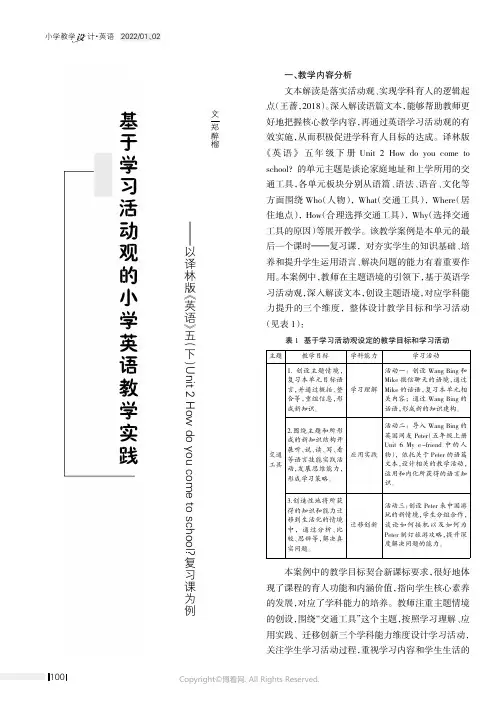
教师注重主题情境的创设,围绕“交通工具”这个主题,按照学习理解、应用实践、迁移创新三个学科能力维度设计学习活动,关注学生学习活动过程,重视学习内容和学生生活的表1基于学习活动观设定的教学目标和学习活动主题教学目标学科能力学习活动交通工具1.创设主题情境,复习本单元目标语言,并通过概括、整合等,重组信息,形成新知识。
学习理解活动一:创设Wang Bing 和Mike 微信聊天的语境,通过Mike 的话语,复习本单元相关内容;通过Wang Bing 的话语,形成新的知识建构。
2.围绕主题和所形成的新知识结构开展听、说、读、写、看等语言技能实践活动,发展思维能力,形成学习策略。
应用实践活动二:导入Wang Bing 的英国网友Peter (五年级上册Unit 6My e -friend 中的人物),依托关于Peter 的语篇文本,设计相关的教学活动,运用和内化所获得的语言知识。
译林英语五下教案Unit 2 How do you come to school 第一课时
译林英语五下教案Unit 2 How do you come to school 第一课时一、知识目标1.掌握本课的语音、词汇和语法知识点;2.能够用英语自然、流利地介绍自己上学的方式;3.能够就某个事物进行简单的调查,并用英语进行汇报;4.能够理解并回答有关交通工具的问题;5.培养学生的合作意识和口语表达能力。
二、教学重难点1.介绍自己上学的方式,如步行、骑车等;2.学习表示交通工具的单词,如bus、car、taxi、bike等;3.掌握词汇交际,如How do you come to school? I come to school by bike.等;4.提高学生口语表达能力和合作意识。
三、教学过程1. Class opening通过问好、点名等方式营造积极的学习氛围,创设英语学习的环境,让学生在轻松的情境中进入学习状态。
2. Warm-up引导学生用英语回答How do you come to school?的问题,同时检查学生掌握交通工具的能力。
教师问:How do you come to school?学生回答:I come to school by bus/car/bike/walk等方式。
教师指着图片问:What’s this?学生回答:It’s a bus/car/taxi/bike等。
3. Presentation引导学生学习掌握交通工具等单词,并熟练运用“by”表达交通工具方式的句型。
教师出示交通工具图片,先让学生自己猜测、描述,再出示,让学生朗读单词,最后以口语形式让学生学会使用这些单词。
4. Practice在课堂中安排小组活动,打造合作、交流的氛围,让学生在做中学,学以致用。
小组内的成员分别介绍自己上学的方式,其他组员需要用英语说出介绍者的上学方式。
如:A:How do you come to school?B:I come to school by bike.C:He/She comes to school by bike.D:She/He comes to school by bike.E:They come to school by bike.5. Production以学生为主体,自主完成用英语调查身边同学或周围人的上学方式,如问卷调查方式收集数据,汇总出结果。
五年级下册英语教案-Unit 2 How do you come to school? Story
五年级下册英语教案-Unit 2 How do you come to school?Story time 译林版一、教学目标1.掌握表示不同交通工具的单词及其用法;2.了解不同交通工具的特点及使用方法;3.能够在日常生活中正确使用所学的交通工具单词。
二、教学内容1.学习并掌握以下交通工具单词:walk, bike, car, bus, subway, train, plane;2.了解不同交通工具的特点及使用方法;3.通过故事、歌曲等方式帮助学生掌握所学词汇;4.练习运用所学词汇进行日常交流。
三、教学步骤1. 导入新课•T: Good morning/afternoon, boys and girls. Today we are going to learn about different transportation. Can you tell me how you usually come to school?Ss: …•T: Great! So we can come to school by walking, riding a bike, taking a car, a bus, a subway, a train, or even a plane! Let’s learn more about these transportation today.2. 学习新单词•T: Now, let’s learn these words together: walk, bike, car, bus, subway, train, plane.•T: Class, please repeat after me and practice each word.3. 观看视频•T: Now, let’s watch a short video and learn about the different transportation. (播放视频)•T: Do you see the different transportation in the video? Can you tell us what they are? (让学生回答)•T: Good job! Now, let’s practice these transportation words by playing a game.4. 活动一:拼图游戏•T: Class, please get into groups of 2 or 3. Each group will get a set of puzzle pieces with different transportation on them. Your task is to put the puzzle pieces together to make the correct transportation. (分发拼图,并让学生自由组合)•T: Good job! Class, can you tell us what transportation you made? (点名学生回答)5. 活动二:Story time•T: Now, let’s read a story about different transportation. (读故事)•T: How does the boy come to school in the story? (让学生回答)•T: How does the girl come to school in the story? (让学生回答)•T: Great! Now, let’s sing a song about different transportation.6. 活动三:本地文化体验•T: Class, we have learned about different transportation today. Let’s talk about how people in our city travel. Do you know what means of transportation our city has?•T: Let’s go out and experience the transportation in our city! (让学生在校内/校外寻找各种交通工具,了解本地文化)7. 总结•T: Today we learned about different transportation and how people come to school. Do you have a favorite transportation? Why do you like it? (让学生发言)•T: Great job today, everyone! Remember to use the transportation words we learned in your daily life. Class is dismissed.四、教学评估1.观察学生在活动中的表现;2.随堂测试:让学生回答关于交通工具的问题;3.课后布置作业:要求学生写一个短文,介绍自己以及家人通常使用的交通工具。
[译林版]5B Unit2 How do you come to school知识点及练习
5B Unit2 How do you come to school知识点及练习①书本知识梳理:一、单词far from 离……远moon月亮street 街,街道near在…附近city城市by…乘(汽车、火车等) bus公共汽车,大巴士on foot 步行metro地铁taxi 出租车,的士 bike 自行车plane 飞机ship轮船train火车ride 骑车show给…看二、短语come to school到学校来your new home你的新家far from 离……远by bus乘公共汽车near school在学校附近on foot步行by metro乘地铁by taxi乘出租车taxi driver出租车司机by car乘小轿车by bike骑自行车by plane乘飞机by ship乘轮船by train乘火车on the street在街上through the trees穿过树林taxi driver 出租车司机get there到达那里in the basket在篮子里think so认为如此too young太年轻了,太小了go to school去学校show…to…向……展示……want to+动词原形…想要…a new bike一辆新的自行车the wheels on the bus公共汽车的轮子sit in the basket 坐在篮子里go round and round转啊转三、句型1.Do you like your new home?你喜欢你的新家吗?解析:do是助动词,其第三人称单数形式是does,否定形式分别为:don’t 和doesn’t。
助动词开头的句子是一般疑问句,一般用“Yes,…do/does.”或“No,…don’t/doesn’t.”来回答。
2.Where do you live?你住在哪里?解析:where是特殊疑问词,用来引导特殊疑问句,其回答不能简单地回答yes或者no,而是要根据具体所问来回答,比如这里可以用“I live+表示方位的词语”来回答。
牛津 译林版 英语五年级下册 Unit 2 How do you come to school
Let’s practice 看图,填空。 A:_H__o_w__ do you come to school? B:I come to school _b__y_t_a__x_i _.
Let’s practice 看图,填空。
A: Good morning, kevin, _W__h_e__re____do you live? B: Good morning, Susan. I live on Changjiang Street.
Useful expressions: Sun Street Park Street far from home Moon Street
near school by taxi by ship by car
by bus by metro by bike on foot
Let’s do.
Make a report
21世纪教育网
Showtime.
1. 四人一组进行故事拓展表演练习,每人扮演一个角色。 2. 注意自己的语音语调,表情和动作。 3.一小组表演时,其他小组观看并评分。 朗读基本流利,表情动作基本到位。 朗读较为流利,表情动作比较到位。 基本能够脱稿,表情动作十分到位。
Let’s learn Grammar
Let’s practice. 看图,用come 或者go填空。 1. How do you ________ to cscohomole?
2. How do you ________ to school?
go
Answer the questions.
1. How does Yang Ling go to school? She goes to school on foot. 2. Where does Su Hai live? She lives on Moon Street, near City Library. 3. Where does Liu Tao live? He lives on Park Street.
五年级下册英语Unit 2 How do you come to school知识梳理译林版三起
Unit 2 How do you come to school?知识梳理+巩固练习(含答案)一、语音解析:字母组合tr在本单元中发/tr/,例如:例如:tr ain, tr avel, tr ee, tr ousers二、重点单词四会moon月亮street街;街道near在...附近city城市by乘(骑车、火车等)bus公共汽车,巴士metro地铁taxi出租车,的士bike自行车plane飞机train火车三会ship轮船ride骑车show给...看young年幼的basket篮子三、核心短语come to school来学校your new home你的新家far from school离学校远live on Moon Street住在月亮街near City Library在城市图书馆附近live near school住在学校附近on foot步行in Sunshine Town在阳光镇Park Street公园街 a taxi driver一名出租车司机through the trees穿过树林the wheels on the bus公共汽车上的轮子go round and round转了一圈又一圈have a new bike有一辆新自行车too young太年幼think so这样认为sit in the basket坐在篮子里go to many cities去许多城市show his bike to Sam给山姆看他的自行车work on a big ship在一艘大轮船上工作四、重点句型1. I like it very much, but it’s far from school.知识点:far from为副词短语,意为“离....远”用法:后接地点,其反义词为near,反义短语为close to例如:Helen lives near our school,but I live far from it.Our new house is close to the supermarket.2. --Where do you live now?--I live on Moon Street, near City Library.知识点:where引导的特殊疑问句用法:用来询问别人住在哪里,句型结构为“Where十do/does十主语+live?”,其答句为“主语十live(s)in/on/near/...十地点”。
牛津译林版五年级下册《单元 2 How do you come to school》同步练习卷(2)
牛津译林版五年级下册《Unit 2 How do you come to school》小学英语-有答案-同步练习卷(2)一、单词默写.1. 单词默写(1)飞机________(2)轮船________(3)火车________(4)骑车________(5)给……看________(6)年幼的________(7)篮子________(8)酷________(9)轮子________(10)运输________二、词组默写.词组默写(1)骑自行车________(2)太年轻________(3)坐在篮子里________(4)我不这样认为.________(5)穿过城镇________(6)远离学校________三、根据中文提示完成句子.你爸爸每天怎样去上班?________ your father go to________every day?你太重了.You________ heavy.他骑车去上学.He________to school.Bobby 有一架新的玩具飞机.Bobby________ a new toy________.大海上有许多轮船.There________ a lot of________ on the sea.四、用所给单词的正确形式填空.My parents________ (live) in Nanjing.There are many________ (bus) near the shop.My grandparents are________ (farm).Why can't Joe________ (play) with us today? Because he is ill.五、翻译句子.翻译句子Bobby likes riding the bike in the park.________翻译句子Bobby wants to show his bike to Sam.________翻译句子How does Sam go to school? He goes to school by bike.________翻译句子Bobby's dad does not think so.________翻译句子He always sits in the basket.________参考答案与试题解析牛津译林版五年级下册《Unit 2 How do you come to school》小学英语-有答案-同步练习卷(2)一、单词默写.1.【答案】plane,ship,train,ride,show,young,basket,cool,wheel,transport【考点】单词、词组【解析】略【解答】1. plane 2. ship 3. train 4. ride 5. show6. young 7. basket 8. cool 9. wheel 10. transport二、词组默写.【答案】ride bike,too young,sit in the basket,I don't think so.,through the town,far from school【考点】翻译能力【解析】略【解答】1. ride bike 2. too young 3. sit in the basket 4. I don't think so. 5. through the town 6. far from school三、根据中文提示完成句子.【答案】How does,work【考点】汉译英【解析】How does your father go to work everyday?【解答】本题考查汉语词汇的英语表达.怎样how,去上班go to work.将题干进行英汉对比可知空格处填"怎样"和"去上班"的英文表达.由题判断为疑问句,疑问词提前,go to work为实义动词,需要借助动词.主语为第三人称单数,故用助动词does.且句子首字母大写,故填:How does;work.故答案为:How does;work.【答案】are【考点】You are heavy.【解答】本题考查汉译英.You 为主语,heavy为表语,句子缺少谓语动词be动词.主语为第二人称be动词用are,且句子首字母大写,故"你太重了"译为You are heavy.故填:are.故答案为:are.【答案】rides a bike【考点】汉译英【解析】He rides a bike to school.【解答】本题考查汉语词汇的英语表达.由题可知,句子为一般现在时.他he,骑车ride a bike.对比题干发现所填的词为"骑车",主语为第三人称单数he谓语动词ride变为rides,故"他骑车去上学"译为He rides a bike to school.故答案为:rides a bike.【答案】has,plane【考点】汉译英【解析】Bobby 有一架新的玩具飞机.Bobby has a new toy plane.【解答】本题考查汉语词汇的英语表达.将题干进行英汉对比,可知空格处填"有""飞机"的英文表达.句子强调一般事实,时态为一般现在时,主语Bobby是第三人称单数,故谓语动词要变为单三形式has."有"译为has;"飞机"译为plane.故答案为:has;plane.【答案】are,ships【考点】汉译英【解析】There are a lot of ships on the sea.【解答】本题考查汉语词汇的英语表达.将题干进行英汉对比,可知第二空格处填"轮船"的英文表达.轮船的英文是ship,因前面有a lot of许多修饰,后面应跟复数名词,所以第二空格是ships,本句型为There be句型,结合汉语表达,可判断时态为一般现在时态,be动词后是复数名词,所以be应用are,故答案为:are, ships.四、用所给单词的正确形式填空.【答案】planes我特别喜欢玩具飞机.【解答】本题考查单词填空.like说明句子时态是一般现在时,toy plane意思为:玩具飞机,plane是可数名词.在句中不能单独使用,要么在其前加冠词a,要么将其变为复数形式,由句意可知:我特别喜欢玩具飞机,是一个抽象概念,不是指具体哪一个玩具飞机,所以将plane变为复数形式:planes.故答案为:planes.【答案】live【考点】单词、词组【解析】我父母亲居住在南京.【解答】本题考查单词填空.观察句子,没有任何特殊时态的标志词,所以句子时态是一般现在时.句子主语是My parents(我父母亲),是两个人,为复数,根据主谓一致原则,其后的动词用原形.故答案为:live.【答案】buses【考点】单词、词组【解析】在商店附近有许多公交车.【解答】考查单词填空.句意:在商店附近有许多公交车.本句句型为there be结构,表示"哪里有…",根据be动词are可知,句子中空格出的名词应为复数;根据名词单复数改写规则,bus为字母s结尾,改复数时要在bus后加es变成buses.故答案为:buses.【答案】farmers【考点】单词、词组【解析】我的爷爷奶奶是农民.【解答】考查单词填空.句意:我的爷爷奶奶是农民.空格处缺少表示"职业"的名词,已给单词为farm"农场,农田",根据单词派生规则,在farm后面加er变成"在农田里干活的人",及"农民";根据be动词are可知,farmer要加s变成farmers.故答案为:farmers.【答案】play为什么Joe今天不能和我们一起玩?因为他生病了.【解答】考查单词填空.句意:为什么Joe今天不能和我们一起玩?因为他生病了.句子为Why开头的特殊疑问句,句中情态动词can't提示其后的动词play要用动词原形.故答案为:play.五、翻译句子.【答案】波比喜欢在公园里骑自行车.【考点】英译汉【解析】略【解答】波比喜欢在公园里骑自行车.【答案】波比想要展示给山姆看他的自行车.【考点】英译汉【解析】略【解答】波比想要展示给山姆看他的自行车.【答案】山姆怎么去学校的?他骑自行车去的.【考点】英译汉【解析】略【解答】山姆怎么去学校的?他骑自行车去的.【答案】波比的爸爸不相信.不认为这样的.【考点】英译汉【解析】略【解答】波比的爸爸不相信.不认为这样的.【答案】他总是坐在篮子里.【考点】略【解答】他总是坐在篮子里.。