
2015-2016学年牛津译林版九年级上册英语课件Unit4 Grammar课件.ppt
Fill in the blanks. 1. He remained there for about a year before the NBA took notice of him.(P51) _______ After he graduated, he was forced to 2. _______ play in another basketball league.(P51) When he finally got the chance, he 3. ______ scored 20 points in his first game.(P50) While (he was) attending junior high, 4. _______ Spud tried out for the school team.(P50) when we should 5. Sometimes we forget _______ stop. (P37)
1. _______ the children have fun, parents can take dance lessons on the beach. (2013山东菏泽) A. When B. If C. While D. Once 2. _______ I got back, I found my mother cooking for me. (2013湖北黄石) A. When B. Before C. Since D. Although
Task B: Using since,till and until Look at the following sentences.
1. You’ve been happy since I first met you.(P48) 2. Spud remained in another basketball league for about a year till/until the NBA took notice of him.(P51) 3. Until his dream came true, Spud never gave up. (P55) 4. Do not wake me up until you finish your work.(P48)
ห้องสมุดไป่ตู้
before的意思是“在……之前”,表示主 句动作发生在从句动作之前。如: Close the windows before you leave the room, please. 在你离开房间前,请关上窗。
after意思是“在……之后”,表示主句的 动作发生在从句的动作之后。如: I went to school after I finished my breakfast. 我吃完早饭去上学。
Step1: Lead-in Look at the following sentences. 1. He remained there for about a year before the NBA took notice of him.(P51) 2. After he graduated, he was forced to play in another basketball league.(P51) 3. When he finally got the chance, he scored 20 points in his first game.(P50) 4. While (he was) attending junior high, Spud tried out for the school team.(P50)
While the boys were playing football, it rained. 当男孩子们踢足球时,下雨了。
注意: 在when和while引导的从句中,当 主句和从句的主语一致,并且从句中有be 动词时,可以省略主语和be动词,构成 when/while+ -ing结构。如:
When (she is) in trouble, she always asks for my help. 她遇到困难时总是向我求助。 While (I am) travelling, I like to buy some souvenirs. 旅游时我喜欢买纪念品。
while意思是“当……时”,强调主句动作 和从句动作是同时发生的。如: While my sister was sweeping the floor, I was washing the dishes. 我姐姐扫地时,我在洗碗。
注意:while引导的从句的谓语动词必须是 延续性的。
while还可以表示“在……期间”,表 示主句动作发生在从句动作进行的过程 中。如:
A David is writing in his diary about one of
his days. Help him combine his sentences using before, after, when or while. (P54)
1. I go to jogging every morning. Then I have breakfast. I go jogging every morning before I have _____________________________________ breakfast. ________________________________ 2. I practised playing basketball for hours. I felt tired out. After I practised playing basketball for _____________________________________ hours, I felt tired out. _________________________________
since, till和until常用来引导时间状语从句。 如: Mr Brown has been in Beijing since you left. 自从你离开,布朗先生就一直待在北京。 I worked till/until he came back. 我一直工作到他回来为止。
since意思是“自从……以来”。一般情况 下,从句谓语动词用一般过去时,而主句 的谓语动词用现在完成时。如: They have been friends since they were at primary school. 他们从小学起就一直是好朋友。
Fill in the blanks. 1. You’ve been happy _________ since I first met you.(P48) 2. Spud remained in another basketball till/ until the league for about a year __________ NBA took notice of him.(P51) Until 3. _________ his dream came true, Spud never gave up. (P55) until 4. Do not wake me up ________ you finish your work.(P48)
3. I met Peter. I was waiting at the bus stop. ___________________________________ I met Peter while (I was) waiting at the _______________________________ bus stop. 4. I was watching TV. I received a call from my uncle. While (I was) watching TV, I received a ___________________________________ call from my uncle. ________________________________ 5. I was ready to go to bed. My father came back from work. I was ready to go to bed when my father ___________________________________ came back from work. ________________________________
5. It moved up over my stomach and until it was standing near my neck _______ face. (牛津八年级下U4) since I was born. 6. I’ve lived here ________ (牛津八年级下U1) 7. They’ll say “excuse me” and be polite till enough to wait ________ you move. (牛津 八年级下U5)
• 你还记得吗? • 如何使用when, while,as引导 时间状语从句 取决于主句和从 句的谓语动词 while • 前长后长用____________ when, while, as • 前短后长用____________ when • 前长后短用____________ as • 前短后短用_____________
when you are 6. It can cheer you up _______ feeling sad. (P23) 7. Outside, people were running in all while pieces of glass and directions _______ bricks were falling down.(牛津八年级上U8) 8. Timmy was trapped in a dark place after the earthquake stopped.(牛津八 _______ 年级上U8) 9. He stayed with the boy and played with before the boy’s him for two hours ________ parents came.(牛津七年级下U7)
牛津译林英语 九年级上册Unit4grammar(共16张PPT)

5. As soon as he finishes school, he
_w_i_ll__ta_k_e__(take) part in the training. 6. He won’t go home until he _f_e_e_l_s_(feel) tired out.
basketball? --- ________ he retired in 2011.
A. Until
B. Not until
C. Before
Complete David’s diary
Group work
I’m so crazy about basketball that I spend much time
David—Yao Ming’s big fan
当主句和从句主语一致 时,可省略从句的主语 和be动词
David was watching basketball
games _w__h_il_e__ his classmates
were watching cartoons.
_WW__hh_ie_lne_/_(he
durative verb (延续性动词)
was)attending
junior high, David tried out for
the school basketball team.
non-durative verb (短暂性动词)
__W__h_e_n__his mother came back,
Hawks的比赛中得到了41分。 3. 每当他被需要的时候,他都会回到中国。
(whenever)
译林版英语九年级上册_Unit4_Grammar名师教案
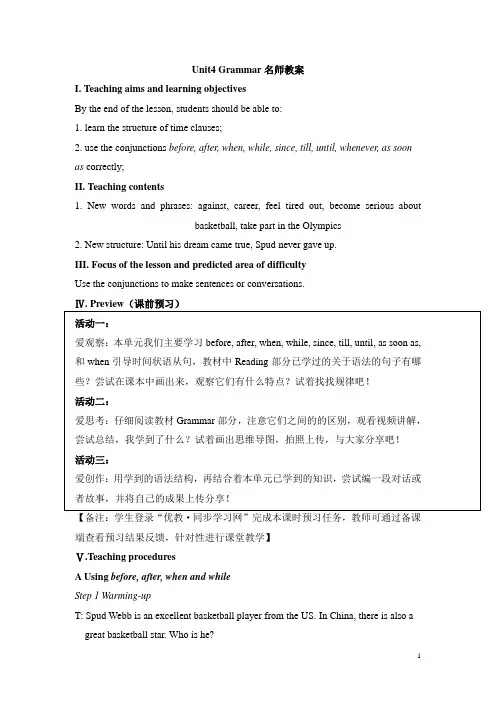
Unit4 Grammar名师教案I. Teaching aims and learning objectivesBy the end of the lesson, students should be able to:1. learn the structure of time clauses;2. use the conjunctions before, after, when, while, since, till, until, whenever, as soon as correctly;II. Teaching contents1. New words and phrases: against, career, feel tired out, become serious aboutbasketball, take part in the Olympics2. New structure: Until his dream came true, Spud never gave up.III. Focus of the lesson and predicted area of difficultyUse the conjunctions to make sentences or conversations.Ⅳ. Preview(课前预习)活动一:爱观察:本单元我们主要学习before, after, when, while, since, till, until, as soon as,和when引导时间状语从句,教材中Reading部分已学过的关于语法的句子有哪些?尝试在课本中画出来,观察它们有什么特点?试着找找规律吧!活动二:爱思考:仔细阅读教材Grammar部分,注意它们之间的的区别,观看视频讲解,尝试总结,我学到了什么?试着画出思维导图,拍照上传,与大家分享吧!活动三:爱创作:用学到的语法结构,再结合着本单元已学到的知识,尝试编一段对话或者故事,并将自己的成果上传分享!【备注:学生登录“优教·同步学习网”完成本课时预习任务,教师可通过备课端查看预习结果反馈,针对性进行课堂教学】Ⅴ.Teaching proceduresA Using before, after, when and whileStep 1 Warming-upT: Spud Webb is an excellent basketball player from the US. In China, there is also a great basketball star. Who is he?S: …T: Yes. David’s favourite basketball player! How much do you know about him?S: …Step 2 Presentation1. before, afterT: His parents are both basketball players. One is 2.08 m tall and the other is 1.88 m tall.Before Yao Ming was born, many people believed that he would be a basketball star.Did he become a basketball star later?S: …T: After he took some basketball training, he showed his talent in the game.2. When, whileT: When did he begin to take training?S: When he was 9, he began to take basketball training.T: Yes, he started training at 9.While/When he was attending junior high, he joined the Shanghai Youth Team. 【设计意图:以讨论David最喜欢的篮球明星姚明为线,导入新知识的学习。
译林版英语九年级上册unit4复习课件
mind作动词,意为“介意,在乎,反对”。 mind doing sth.意为“介意做某事”。
change one’s mind 改变主意 e.g. Nothing will make me change my mind. 什么都不能让我改变主意。
8.参加校队的选拔 try out for the school team
9.失去信心
lose heart
10.从那时开始 from then on
11.由于他的身高 because of his height
12.注意到他
take notice of him
13.得到机会
get the change
的复数形式 词
词或不可数名词
a good / great much,
many,
a good / great
many
deal of,
a large / great
amount of
作主语时,谓 作主语时,谓
语动词用复数 语动词用单数
形式
形式
a lot / lots of, plenty of, a large / great quantity of
Whoever telephones, tell them I’m out. 不管是谁打电话,都说我出去了。
whenever conj. 无论何时 类似的词有: whatever意为“无论什么”, whoever意为“无论谁”, wherever意为“无论在哪里”, however意为“无论怎样”。 它们等同于“no matter + wh⁃” 结构。
Unit4Growingup(Grammar)教材详解训练-牛津译林版九年级英语上册
Unit4 Growing upGrammar1.I felt tired out.我感觉筋疲力尽。
(1)tired out 筋疲力尽的常用于连系动词后作表语be tired out.他们又冷又饿,疲惫不堪。
They were cold,hungry and tired.【拓展】be tired of...厌倦/厌烦...·Are you tired of sitting too long你厌倦久坐了吗?2.It is the first time we have played basketball since Monday.这是自周一以来我们第一次打篮球(1)It is + the + 序数词+time + that 从句.表示这是...第...次...",其中从句通常用现在完成时,且that 在口语中常省略。
It is the first time that I have met her.这是我第一次遇见她。
【拓展】类似的句式还有:This/That is + the +序数词+time + that 从句这/那是...第...次...This is the second time that Mr Smith has visited China.这是史密斯先生第二次到中国旅游。
3.... but he did not bee serious about basketball till/until he was 12....但是直到12岁他才认真对待篮球。
(1)serious adj.严肃的;认真的seriously[副词]严肃地;认真地be/bee serious about sb./( doing) sth.认真对待某人/(做)某事Be serious for a moment; that is important.严肃点儿,这件事很重要。
Are you serious?你是认真的吗?He was very serious about studying.他学习很认真。
九年级英语上册Unit1 第4课时Grammar教学课件新版牛津版
B1Amy is writing about what her family does at the weekend. Help her complete the sentences with the correct conjunctions.
3. _E_it_h_e_r_/_N_o_t_o_n_l_y_ my mum _o_r_/b_u_t__(a_l_s_o_) my dad does the dishes after lunch. I also help with it.
4. In the afternoon, my grandpa and my dad _e_i_th__er_/_n_o_t_o_n_l_y_ play chess _o_r/_b_u_t_(_a_l_so_)_ chat with each other.
(also) ..., either ... or ... and neither ... nor ...
both ... and ...、not only ... but (also) ...、 either ... or ... 和neither ... nor ...都是常见 的并列连词,它们可以连接两个并列的主 语、谓语、宾语、表语、状语等。 both ... and ...意思是“......和......两者都; 既......又......”。
with my family in Beijing. 2. The classrooms are clean _a_n_d_ bright. 3. Sometimes I feel hungry between meals,
_s_o_ I eat an apple or a pear.
牛津译林版英语九上Unit4《GrowingUp》(Grammar1)说课稿
牛津译林版英语九上Unit 4《Growing Up》(Grammar1)说课稿一. 教材分析《Growing Up》是牛津译林版英语九年级上册Unit 4的一篇文章,主要讲述了一个名叫Jack的小男孩在成长过程中,从小学到中学,再到大学,最后成为一名作家的故事。
文章通过描述Jack在不同阶段的生活经历,让学生了解成长过程中的变化和挑战,并学会如何面对。
本节课的主要语法知识点是现在完成时态,通过学习Jack的成长经历,让学生掌握现在完成时态的构成、用法和辨析。
同时,文章中还涉及一些词汇和短语,如:primary school, secondary school, university等,为学生提供了丰富的语言材料。
二. 学情分析九年级的学生已经具备了一定的英语基础,对过去时态有了初步了解。
但是,对于现在完成时态的掌握还不够扎实,需要通过本节课的学习来进一步巩固。
同时,学生对于成长过程中的变化和挑战可能还缺乏深刻的认识,通过本文的学习,可以让学生有所启发和感悟。
三. 说教学目标1.知识目标:–掌握现在完成时态的构成、用法和辨析;–学会运用现在完成时态描述个人的成长经历。
2.能力目标:–提高学生的阅读理解能力,能读懂并理解文章内容;–培养学生的口语表达能力,能用英语谈论自己的成长过程。
3.情感目标:–让学生认识到成长过程中的变化和挑战,学会面对和克服困难;–培养学生的团队合作精神,学会与人分享和交流。
四. 说教学重难点•现在完成时态的构成、用法和辨析;•文章内容的理解和掌握。
•现在完成时态的运用,尤其是体现在日常交流中的运用;•对文章深层含义的理解,以及如何将文章内容与个人经历相结合。
五. 说教学方法与手段1.采用任务型教学法,让学生在完成任务的过程中,自然地学习和掌握现在完成时态;2.运用情境教学法,创设各种情境,让学生在实际情境中运用英语;3.利用多媒体教学手段,如图片、视频等,激发学生的学习兴趣,提高课堂效果。
译林版九年级英语上册Unit 4 Grammar示范公开课教学课件
past
was watching the gala
was watching fireworks
past
now
rang
was watching fireworks
Extension
3. Ron was watching the gala on TV when the bell rang.4. When Jennifer was watching fireworks, the bell rang.
Extension
“主将从现”
1. David will play basketball in the playground until it gets dark.2. David won’t go to bed until he finishes watching the NBA.
Read and circle
Ron wants to tell you more information about his friend, David.
Can roduce time clauses?
Extension
□
□
5. While Jennifer was watching fireworks, the bell rang.6. When Jennifer was watching fireworks, the bell rang.
□
□
Extension
Observe and learn
when/while
Read and combine
I go jogging every morning before I have breakfast.
After I practised playing basketball for hours, I felt tired out.
Unit4Grammar时间状语从句语法复习牛津译林版英语九年级上册
牛津译林版9A Unit 4 Grammar 时间状语从句语法复习(一)before,after,when和while引导的时间状语从句时间状语从句是指在复合句中充当时间状语的句子。
我们可以用before,after,when和while引导时间状语从句,这些连词既可放在句首,也可放在句中。
一、before引导的时间状语从句before意为“在……之前”,表示主句动作发生在从句动作之前。
▶She worked in Shanghai before she came here.她来这儿之前在上海工作。
▶Close the windows before you leave the room, please.在你离开房间前,请关上窗。
二、after引导的时间状语从句after意为“在……之后”,表示主句动作发生在从句动作之后。
▶After you think it over, please let me know your decision.你仔细考虑以后,请告诉我你的决定。
▶I went to school after I finished my breakfast.我吃完早饭后去上学。
▶Will you be free after two o’clock?2点钟之后你有空吗?三、when引导的时间状语从句when意为“当……时”,表示主句动作发生的特定时间。
从句中的谓语动词可以是延续性动词,也可以是非延续性动词。
▶When I got home,my mother was cooking diner.当我到家的时候,我的妈妈正在做饭。
▶I often think of my grandpa when I see the picture.当我看见这张照片时,我常常想起我的爷爷。
,四、while引导的时间状语从句while意为“在……期间”,表示主句动作发生在从句动作进行的过程中。
▶You can go swimming while I’m having lunch.我吃午饭时你可以去游泳。
Unit4Grammar课件牛津译林版九年级英语上册
1. I go jogging every morning. Then I have breakfast. __I_g_o__jo_g_g_i_n_g__e_v_e_ry__m_o__rn__in_g__b_e_f_o_re__I_h_a_v_e__b_r_e_a_k_fa_s_t_.__ 2. I practised playing basketball for hours. I felt tired out. A__ft_e_r_I__p_ra_c_t_i_se_d__p_l_a_y_in_g__b_a_s_k_e_tb_a_l_l_f_o_r_h_o_u__rs_,_I__fe_l_t_ti_r_e_d out. 3. I met Peter. I was waiting at the bus stop. _I_m__e_t_P_e_t_e_r_w__h_il_e_/w__h_e_n__(I__w_a_s_)_w__a_it_in_g__a_t_t_h_e_b_u__s_s_to_p_._ 4. I was watching TV. I received a call from my uncle. W__h_i_le__(_I_w_a_s_)_w__a_tc_h__in_g__T_V_,_I__r_ec_e_i_v_e_d_a__c_a_l_l _fr_o_m__m__y_u__ncle. 5. I was ready to go to bed. My father came back from work. I_w__a_s_r_e_a_d_y_t_o_g_o__to__b_e_d_w__h_e_n_m__y_f_a_t_h_e_r_c_a_m_e__b_a_c_k_f_r_o_m__work.
the room.
Unit4语法讲义时间状语从句牛津译林版九年级英语上册
9A Unit 4语法讲义(时间状语从句)一、状语从句的概念在主从复合句中作状语的句子被称为状语从句。
三、时间状语从句1、before 引导的时间状语从句before “在...之前” 连词+时间状从(主一过从一过)e.g. He remained there for about a year before the NBA took notice of him.介词+时间点/doing e.g. before 9 a.m.2、after 引导的时间状语从句after “在...之后” 连词+时间状从(主一过从一过)e.g. The sun came out after the storm stopped.介词+时间点/doing e.g. after lunch3、when 引导的时间状语从句when “当...的时候” 连词+时间状从(主短从长、主长从短、主短从短、主将从现)长:现在/过去进行时,即谓v.是be +doing 短:一般现在/过去时,即谓v.是原形、三单、过去式e.g. The earthquake started when I was doing some cleaning the other day.e.g. Daniel was watching TV when the earthquake started.e.g. When he finally got the chance, he scored 20 points in his first game.e.g. she returns.“什么时候” 4、while 引导的时间状语从句while “当...的时候” 连词+时间状从(主短从长、主长从长)e.g. While the boys were playing football, it rained.e.g. Daniel was watching TV while his mother was washing the dishes.“而” 表对比e.g.You like sports while I like reading.注意:在[含有(when/while引导的)时间状语从句的]主从复合句中,若主句和从句的主语一致,且从句的谓v.是be动词,则可省略从句的主语和bee.g. when (he was) attending junior high, Spud tried out for the school team.( )1.A true friend can see the pain in your eyes ______ everyone else believes the smile on your face.A.whileB.becauseC.beforeD.until( )2.It is summer now in China, ______ it is winter in Australia.A.beforeB.untilC.whileD.since5、since引导的时间状语从句since“自...以来”(1)现在完成时/一般现在时+since+一般过去时主句从句( )1.[易错题]It ________ four years since my family ________ to Xiamen.A.is; have moved B.has been; has moved C.is; moved D.was; moved( )2.[变式题]How time flies! Four years ________ since I ________ to our Middle School.A.have passed; came B.has past; came C.has passed; came D.have passed; have e3. It has been a couple of years since I came to our Middle School.(改为同义句)A couple of years ________ ________ since e I came to our Middle School.(2)since+过去时间点 e.g. since then(自那时以来), since 2008, since two years ago( ). ________ no one is against this plan, let’s carry out it.A. SinceB. UntilC. AlthoughD. So6、till/until和not...till/until引导的时间状语从句till/until “直到...为止”(顺译)连词+时间状从(主一过从一过)e.g. He remained there for about a year till/until the NBA took notice of him.延续性动词=before介词+时间点 e.g. till/until today★not...till/until...“直到...才”(倒译)连词+时间状从(主一过从一过、主将从现、主情从现、主祈从现)直到(从句)才(主句)e.g. I did n’t go to bed till/until I finished my homework.短暂性动词e.g. Smokers wo n’t realize the importance of health till/until they lose it.短暂性动词e.g. For your safety, you must n’t get close to the train till/until it stops.e.g. Do n’t wake me up till/until you finish building it.( )1. [变式题]Nothing can be done _______ he returns.A.asB.untilC.whileD.before( )2. [变式题]—May I borrow another two books, Madam?—Sorry. No more books can be borrowed until these two ______.A.returnB.are returnedC.will returnD.will be returned( )3.—I’m afraid the meeting has begun. —Don’t worry. It _______ until the bell _______.A.will begin; ringsB.doesn’t begin; will ringC.won’t begin; will ringD.won’t begin; ringsNot until+一般现在时( )1. —Sir, when can we have two days off ? —Not until your task _______ tomorrow.A.pletesB.is pletedC.will be pletedD.will plete( )2. —Excuse me, when shall we play tennis at the court? —Not until it _______ next week.A.repairsB.is repairedC.will be repairedD.repair[区分] How long提问till/until,when提问Not until...( )1.—When will the rain stop? —________ next Friday. The radio says it will last for a week.A.UntilB.BeforeC.AfterD.Not until( )2.—________ will the negotiation(谈判) between the two countries last(持续)?—________ they reach an agreement(协议), I am not sure.A.How long; Not until B.When; Not until C.How long; Until D.When; Until( )3.—Mr. Li, when will the plan that solves the problem be ________?—________ all the engineers e to have a further discussion.A.turned out; Until B.taken out; Until C.broken out; Not until D.carried out; Not until [拓展]not...until...的倒装句结构和强调句结构倒装句结构:Not until+从句+主句(部分倒装语序)部分倒装:把助动词、情态动词提前强调句结构:It is/was not until+从句+that+主句(陈述语序)基本结构:We didn’t get off the bus until it stopped.倒装句结构:Not until it stopped did we get off the bus.强调句结构:It was not until it stopped that we got off the bus.( )1.[提优]Not until he left the small village __________ the world is really big.A.he did realizeB.did he realizeC.he realizedD.realized he( )2.[提优]It was not until he left the small village that __________ the world is really big.A.he did realizeB.did he realizeC.he realizedD.realized he7、as soon as引导的时间状语从句as soon as possible= as soon as sb. can/could( ). —______________ I called you, you went downstairs _______________.A.As soon as; as soon as you canB. As soon as; as soon as possibleC. Whenever; as soon asD. Since; as quickly as possibleas soon as+一般现在时( ). —When shall I hand in my report? —As soon as it _______ tomorrow.A pletes B.is pleted C.will be pleted D.will plete8、whenever引导的时间状语从句whenever “每当;无论何时” 连词+时间状从(主一现从一现、主一过从一过、主将从现、主情从现)My parents were always there for me I needed them.。