
高中英语新人教版必修3新素养导学:Unit 1 Festivals and celebrations Section C Discovering ……
Do you know the crying boy at the gate? 你认识在门口哭的那个小男孩吗?
When he got home,he found there were some emails waiting for
him. 回家后,他发现有几封邮件在等他。
重点词汇
重点句式
重点语法
随堂练习
课堂篇学习理解
重点词汇
重点句式
重点语法
随堂练习
介词 (短语)
辨析
例句
“除了……外”经常用
在
I never saw him reading anything
no,all,nobody,anywher but the newspaper.我看他除了读
but e,everything 等词后 报纸,没读过别的东西。He did
课堂篇学习理解
重点词汇
重点句式
重点语法
随堂练习
【易混辨析】
介词 (短语)
辨析
例句
All went out besides
besides
“除了……还有”,包括后面所提到 的人或事物,相当于 in addition to。
me.除了我去了外,大 家也都去了。(我去
了)
“除……之外(其他都)”,不包括后 except 面提到的人或事物,表示同类之间
2.eve
B.the feeling that an event or place gives you
3.envelope C.happy and cheerful
4.merry
D.the night or day before an important day
5.firework E.a small container filled with powder that burns or
重点词汇
重点句式
重点语法
随堂练习
课堂篇学习理解
It was great fun walking along the streets,enjoying the relaxing atmosphere!
沿街而走享受令人放松的氛围是很有趣的! 【句式剖析】It is (no) fun doing/to do sth“做……非常有趣”,it是 形式主语,代替后面的动词-ing形式短语。 It is no fun walking alone in the park. 独自在公园里闲逛没乐趣。
重点词汇
重点句式
重点语法
随堂练习
课堂篇学习理解
1.go off爆炸;走火;离开 【课文原句】But,to be frank,the fireworks going off throughout the night were really annoying. 但是,说实话,整晚的烟花燃放声真的有些令人烦躁。 【词汇精讲】go off是动词短语,意为“爆炸;走火;离开”。 The bomb went off in a crowded street. 炸弹在拥挤的街道上爆炸了。 The gun went off by accident.那枪偶然走火了。
重点语法
随堂练习
动词-ing形式(1) 一、动词-ing形式作定语 1.位置 动词的-ing形式作定语时,其逻辑主语往往是所修饰的名词。单 个动词-ing形式作定语要位于名词之前,短语作定语要位于名词之 后。
He asked an embarrassing question. 他提了一个令人难堪的问题。
It is great fun to travel in space. 在太空中旅行很有趣。
重点词汇
重点句式
重点语法
随堂练习
课堂篇学习理解
【句式拓展】
no use doing sth 做什么事情没用 it is no good doing sth 做什么事情没好处
a waste of time doing sth 做什么事浪费时间
The thief ran away when the burglar alarm went off. 防盗警报器一响,窃贼就逃走了。
重点词汇
重点句式
重点语法
随堂练习
【词汇拓展】
go against 违背;与……不符 go without 勉强维持;凑合 go in for 爱好,参加;从事 go over 复习;仔细审查;走近 go ahead 进行 gothough 被通过;排练;经历
重点词汇
重点句式
重点语法
随堂练习
课堂篇学习理解
(2)与被修饰词为主动关系且表示正在进行的动作。 There were about 200 children studying in the art school. 有大约二百个孩子在这所艺术学校学习。
Who is the woman talking to our English teacher? 正在和我们英语老师谈话的那位女士是谁? 注意:动词-ing形式与被修饰词为主动关系且表示正在进行的动 作时,可变为定语从句。 The girl sitting next to me is my cousin. →The girl who is sitting next to me is my cousin. 坐在我旁边的姑娘是我表妹。
重点 It was great fun walking along the streets,enjoying the 句式 relaxing atmosphere!
重点 语法
动词-ing 形式作定语和表语
Ⅰ
Ⅱ
Ⅲ
课前篇自主预习
Ⅱ.释义匹配
1.atmosphere A.a thin paper cover in which you put and send a letter
课堂篇学习理解
2.用法 (1)说明被修饰词的性质、特征或用途。
Ladies and gentlemen,please go and wait in the meeting room. 女士们先生们,请去会议室等待。 注意:动词-ing形式说明被修饰词的性质、特征或用途时,相当于 for+doing形式。 a sleeping car=a car for sleeping卧铺车厢 a reading room=a room for reading阅览室
重点词汇
重点句式
重点语法
随堂练习
3.常用来作表语的动词-ing形式 interesting有趣的;interested感到有趣 exciting令人激动的;excited感到激动 delighting令人高兴的;delighted感到高兴 disappointing令人失望的;disappointed感到失望 encouraging令人鼓舞的;encouraged感到鼓舞 pleasing令人愉快的;pleased感到愉快 puzzling令人费解的;puzzled感到费解 satisfying令人满意的;satisfied感到满意 surprising令人惊讶的;surprised感到惊讶 worrying令人担心的;worried感到担心
重点句式
重点语法
Байду номын сангаас随堂练习
课堂篇学习理解
重点词汇
重点句式
重点语法
随堂练习
课堂篇学习理解
2.except for除……之外 【课文原句】Anyway,except for that,everything was fine. 总之,除了这个,一切都很好。 【词汇精讲】except for“除……以外”,其后所跟的词往往与前面 的不是同一类的,是指整体中除去的一个细节或某一方面。
4.envelope n.信封;塑料封套
5.Christmas carol
圣诞颂歌
6.merry
adj.愉快的;高兴的
7.pumpkin n.南瓜
8.pudding n.布丁;(餐末的)甜食
9.roast
adj.烤的;焙的 vi.&vt.烘烤;焙
10.pleased adj.高兴的;满意的
11.firework n.烟火;烟花;[pl.]烟花表演
good film.除了结尾,这部电影不 错。(相当于 except for) Apart from good service,the food in the restaurant is delicious.除了服务好
外,饭菜也很香。(相当于 besides)
重点词汇
重点句式
重点语法
随堂练习
课堂篇学习理解
重点词汇
重点句式
重点语法
随堂练习
课堂篇学习理解
二、动词-ing形式作表语 1.用来说明主语的具体内容。在这种情况下,主语和表语通常是 对等关系,可互换位置。
My job is teaching English.=Teaching English is my job. 我的工作是教英语。
Our greatest happiness is serving the people. 我们最大的幸福是为人民服务。 2.用来表示主语所具有的特征,有些词已变成了形容词。 The news is really disappointing.这个消息的确令人失望。 The lecture is exciting.演讲令人激动。
If you go against nature,you will be punished. 如果你违背自然,你就会受到惩罚。
Most students in our class go in for scientific activities. 我们班上大多数学生参加各项科学活动。
课堂篇学习理解
重点词汇
now?
2.They set up an operating (operate) table in a small temple. 3.There were about 200 children studying (study) in the art
新人教版必修第三册Unit1FESTIVALSANDCELEBRATIONS教案
Unit 1 Festivals and CelebrationsListening and speaking & Listening and talking【教材分析】本板块的活动主题是"谈论节日活动”(Talk about festival activities),主要是从贴近学生日常生活的角度来切入“节日”主题。
学生会听到发生在三个国家不同节日场景下的简短对话,对话中的人们正在参与或将要亲历不同的庆祝活动。
随着全球化的进程加速,国际交流日益频繁,无论是国人走出国门还是外国友人访问中国,都已成为司空见惯的事情。
因此,该板块所选取的三个典型节日场景都是属于跨文化交际语境,不仅每组对话中的人物来自不同的文化背景,对话者的身份和关系也不尽相同。
【教学目标】1 ・Master the new words related to holiday: lantern, carnival, costume, di'ess (sb) up. march, congratulation, congiatiilate, riddle, ceiemony, samba, make-up, after all.2.To understand the ongin of major world festivals and the activities held to celebrate them and the significance of these activities;3.Improve listening comprehension and oral expression of the topic by listening and talking about traditional festivals around the world;4.Improv亡students,understanding of the topic by watching pictures and videos about different traditional festivals around the world;5.Review the common assimilation phenomenon in English phonetics, distinguish the assimilated phonemes in the natural language flow, and consciously use the assimilation skill ill oral expression・【教学重难点】Importance:1 ・ Guide students to pay attention to the attitude of the speaker in the process of listening, and identify the relationsliip beh\r een the characters;2.Inspire students to use topic words to descnbe the festival activities based on tliek backgiound knowledge.Difficulties:Ill the process of listening to the coixect understanding of the speaker^ attitude, accurately identify the relationship between the characters ・【课前准备】1 ・ To understand the origin of traditional festivals in the world, the celebration activities (customs) of these festivals and the meaning of these activities;2.Talk about holiday celebrations;3.Preview: understand the new words according to the context.【教学过程】Step 1 Lead-inTeachers talk about the world's traditional festivals, such as the Lantern Festival in Cliina,adults' day in foreign countries, carnivals and so on.Step 2 Watching and talkingActivity 11.Teacher lets Ss look at some pictures about festival activities. During talking about these activities, teacher can add some background knowledge about festivals・Questions:①What festivals do the pictures show us?②In wliich countiy do you tliiiik people celebrate each festival?(3)How do people celebrate each festival?2.Ask sb to choose some words or phrases fiom the box to celebrate each festival.3.Teacher can show students how to use these word blocks and leani to describe holiday activities ingroups. For example:On the Comiiig-of^Age Day, young girls in Japan would wear traditional costumes・ One of the most important activities during the Lanteni Festival is to guess riddles. During the Rio Caniival, you can watch wonderfiil samba dances・4.Tlie teacher asks students to report the results of the group lecture・ Ask these questions:QjWhat do people do to celebrate the Chinese Lanteni festival?②Who will celebrate Coniing-of^Age Day? What do they do to celebrate it?③What do you expect to see if you go to the Rio Carnival?5.Leani some words and plii'ases in the box.Step 3 ListeningActivity 21.Teacher asks sb to read "Listen for relationships”, Ill pairs, discuss how to identify relationships between people based on their tone and content・ The teacher can provide the following questions to inspire students to discuss・〔];What does a tour guide usually say to a tour group? Wliat expressions are frequently used?②What questions does an iiiten4ewer usually ask during an interview?③What would a reporter say or do if he/she wants to inten*iew a tourist?④How do fiiends usually talk?2.Some group representatives are invited to communicate and speak in class・3.Teacher plays the listening tape for students to listen to and write the order of the conversations next to the names of the festivals・4.Play the tape again, students match each conversation with the relationship betwzn the speakers.5.Check the answers with class・Activities 3-41.Teacher asks students to look at the tasks and requkements of activity 3. Then read the main ideas of the three dialogues. (Guide the stxidents to guess and fill in the words according to the context. Let the students analyze the English syntactic stmctiire based on the meaning of the sentence and make reasonable inferences.)2.Teacher plays the tape for the second time. After listening to the tape, students discuss the answers in pail's・ Then the class communicates and checks the answers・3.Teachei' lets stxidents listen to the tape for the third time (Before the teacher plays the recording for the third time, the teacher should prepare the students to take notes and remind them to catch key words, especially phrasal verbs.).Step 4 SpeakingActivity 51.Lead the dialogue by asking questions・Let students understand how to discuss their favorite festivals and give tlieii* reasons ・E.g.,Conversation 1T: Which of the three festivals do you like best?SI: I tliiiik the Coniing・of-Age Day is the most interesting.T: Why is it your favourite?SI: Because I like to see women dressed up ill their colorfill traditional kimonos.Conversation 2T: Wliicli of the tlu'ee festivals attracts you most?S2: The Chinese Lantern Festival.T: I suppose you like yuanxig the sweet dumplings.S2: Not only that. I especially like guessing riddles and Pm good at it.2.Follow the example of the conversation in activity 5 and work in pairs to discuss your favorite holiday and explain why. After the discussion, the teacher asks some groups to show the dialogue.Step 5 ActingOne student plays the role of a journalist. The other tluee students play the roles of the characters in the listening dialogue. They are the Japanese gill attending the coming ceremony, the gill attending the Rio carnival, and the tourist visiting China. The following questions can be used ill the interview: is the puipose of tliis festival?②How do you usually celebrate this festival?③What do you like best about this festival?Step 6 Pronunciation1 ・ Help students recognize speech assimilation・(1)Teacher plays the recording of activity 1 and asks the students to pay attention to the pronmiciation changes of bold letters while listening.(2 ) Teacher organizes students to cany out activities in pairs: the teacher plays the recording, one person in the group reads after the words and phrases in activity 1, the other person compares the pronunciation of the recording with that of liis partner carefiilly, and points out the pronunciation problem of his/her partner if there is any difference・ Tlien switch roles, listen to the tape again and complete the same task.2. Let students imitate and read・(1)Teacher guides students to understand the requirements of activity 2. Before listening to the tape, the teachei' asks the question for students to think: “How does your pronunciation change while reading the sentences?^(2)Teacher plays the tape for the first time ・ The students read after the sentences ill activity ■ •(3)Teacher plays the tape for the second time, the students repeat the sentences again, and then discuss with their partners the differences between the pronunciation of the bold consonants in words and the prominciation in sentences, and describe the phonetic assimilation in the flow.(4)Teacher asks different students to read the six sentences of activity 2 and report the result of the discussion on phonetic assimilation・ Tlie teacher supplements and coixects the students' conclusion, explains it appropriately, and writes the assimilation pronunciation in these sentences on the blackboard or presents it to the students tluougli the comseware.Step 7 Listening and TalkingActivity 61.Leani the new words about the festivals・2.Look at the pictures and predict what festival Song Lin and Max are going to talk about・3.Listen and answer the questions.①What festival is Max talking about?②What did Max's mother cook?③What did Max do duiing the festival?@;What did Max and his family do during and after the dinner?⑤"Hiat was the best part of the Estival?4.Listen again and check the answers with class・Answers:〔[[Christmas expenences・②Roast turkey, mashed potatoes and Clmstmas pudding,・・・®He helped decorate the Clmstmas tree and put presents under it, then helped his mum prepare for the family dinner.(4}Durmg dinner they shared stories and told jokes, aftenvards they played games, opened theii' presents ・⑤The best part was opening their presents on Chi'istmas morning.5.Listen again and tick the phrases that Max or Song Lili uses・ Then check the answers with class.6.Have a com-ersation with the help of these questions:CL'Wiat is the recent festival you hav亡had?②How did you celebrate it?③How do you feel about the festival? Why?Step 8 Homework1)Read the passage again and understand the food culture from a cross-cultiual perspecth-e ・2)Remember the new words and leani the usages of them・【教学反思】1、通过本节内容学习,学生能否理解发生在三个国家不同节日场景下的简短对话, 对话中的人们正在参与或将要亲历不同的庆祝活动;2、通过本节内容学习,学生能否辨别对话中人物之间的关系;3、通过本节内容学习,学生能否拿握听力训练中的听力策略。
人教版2020版高中英语必修3课文逐句翻译
1.必修三Unit1 Festivals and celebrations节日和庆典Festivals and celebrations of all kinds have been held everywhere since ancient times. 自古以来,世界各地就有各种各样的节日和庆典。
Most ancient festivals would celebrate the end of cold weather, planting in spring and harvest in autumn. 最古老的节日总是庆祝严寒的结束、春季的种植和秋天的收割。
Sometimes celebrate would be held after hunters had caught animals. 有时,在猎人捕获猎物后,也举行庆祝活动。
At that time people would starve if food was difficult to find, especially during the cold winter months. 在那个时代,如果食物难以找到,特别是在寒冷的冬月,人们会挨饿。
Today’s festivals have many origins ,some religious, some seasonal, and some for special people or events. 现在的节日有很多由来,一些是宗教上的,一些是季节性的,一些是纪念特殊的人和事件的。
Festivals of the Dead亡灵节Some festivals are held to honour the dead or to satisfy the ancestors, who might return either to help or to do harm. 有些节日,是为了纪念死者,或使祖先得到满足,因为祖先们有可能回到世上(给人们)提供帮助,也有可能带来危害。
高中英语必修3课文逐句翻译(人教新课标)
1.必修三Unit1 Festivals and celebrations节日和庆典Festivals and celebrations of all kinds have been held everywhere since ancient times. 自古以来,世界各地就有各种各样的节日和庆典。
Most ancient festivals would celebrate the end of cold weather, planting in spring and harvest in autumn. 最古老的节日总是庆祝严寒的结束、春季的种植和秋天的收割。
Sometimes celebrate would be held after hunters had caught animals. 有时,在猎人捕获猎物后,也举行庆祝活动。
At that time people would starve if food was difficult to find, especially during the cold winter months. 在那个时代,如果食物难以找到,特别是在寒冷的冬月,人们会挨饿。
Today’s festivals have many origins ,some religious, some seasonal, and some for special people or events. 现在的节日有很多由来,一些是宗教上的,一些是季节性的,一些是纪念特殊的人和事件的。
Festivals of the Dead亡灵节Some festivals are held to honour the dead or to satisfy the ancestors, who might return either to help or to do harm. 有些节日,是为了纪念死者,或使祖先得到满足,因为祖先们有可能回到世上(给人们)提供帮助,也有可能带来危害。
新人教版必修三Unit1Festivalsandcelebrations课件

a festival of the dead(亡灵节)
Some Chinese traditional festivals
Festival of Lanterns Children’s Day
National Day
B
Easter Festival
B
Brainstorming
festivals of foreign countries
Thanksgiving Day
Easter
Christmas
Carnival
festivals
Father’s Day
Mother’s Day Valentine’s Day
all over the world.
Discussion :
1.Tell your friends your favorite festival and your reason .
2.Should we, Chinese students, celebrate western festivals like Christmas? Why or why not ?
6 Which of the following festivals is not celebrated in Japan? A Easter B. Oal D.
Mid-autumn Festival
7.What’s the main idea of the passage? Give one sentence to describe it.
Dragon Boat Festival
New Year’s Day
人教版(2023)必修 第三册 UNIT 1 FESTIVALS AND CELEBRATIONS
人教版(2023)必修第三册UNIT 1 FESTIVALS AND CELEBRATIONS 单元整体设计(表格式)教学基本信息教材书名:普通高中教科书·英语必修第三册出版社:人民教育出版社单元名称Book 3 Unit 1 Festivals And Celebrations学科英语学段高中年级高一第二学期单元主题与单元内容分析◆主题语境:人与社会◆主题群:历史、社会与文化◆子话题:不同民族文化习俗与传统节日本单元的主题是“节日与庆典”。
该单元从呈现不同节日和庆祝活动入手,引导学生思考人们为何要庆祝节日,通过回顾节日的产生、发展和变化,展示不同国家和民族各具特色的节日风俗、庆典仪式、欢聚活动以及特色食品等,启发学生思考和探究节日的丰富内涵。
不同民族有不同的节日,但是不同的节日却反映了人们共同的美好愿望和追求。
节日是一个国家或民族在漫长的历史过程中形成和发展的文化现象,大多富有趣味性和人文性,有着深刻的精神内涵。
学习不同国家和民族的节日,不仅能开阔学生的视野,增加文化积累,促进语言表达, 同时还能增强学生的文化认同感,充分认识文化差异,培养学生的跨文化交际意识和能力,增进国际理解。
本单元由诗歌、对话、视频、记叙文、说明文、网贴、海报、演示、卡片等多模态语篇(见表1)构成。
表1 单元语篇梳理教学板块语篇类型(技能) 语篇内容语篇主题页码Listening and Speaking 对话、采访(听说) 元宵节、倭国成人节、里约狂欢节Talk about festival activities 2,3Reading and Thinking 说明文(阅读) 世界各地多样的节日、起源、意义Discover the reasons for festivals and celebrations 4,5 Discovering Useful Structures 网贴(语法)、填空讨论哪个节日最好、西班牙西红柿节Describe festival activities 6Listening and Talking 对话(听说) 节日感受Talk about festival experiences 7Reading for Writing 记叙文(读写) 内蒙古那达慕节的经历Write about festival experience 8,9Assessing Your Progress Project 壮族山歌节、腊八粥Introduce festival and celebrations 11Video Time 视频(视听) 元宵节Introduce festival and celebrations 12 Using Structures 填空,翻译(语法) 各种节日活动Describe festival activities 62,63Reading and Writing 说明文(读写) 中国春节Introduce festival and celebrations 64,65单元整体教学框架及课时分配(What) ACTIVITIESListening and Speaking (P 2) 今Chinese Lantern Festival 今Rio Carnival 今Coming- of-Age Day(Videotime(P12)今ChineseLanternFestival) (Readingandwriting(P今The Chinese Spring Festival) ( Listeningand Talking(P7)*Talkaboutfestival experiences ) (I) (REASONS围绕个人节日经历展开交流,并在交谈中合理运用表达情感的句式。
必修三 Unit 1 Festivals and celebrations 单元重点词块与句型
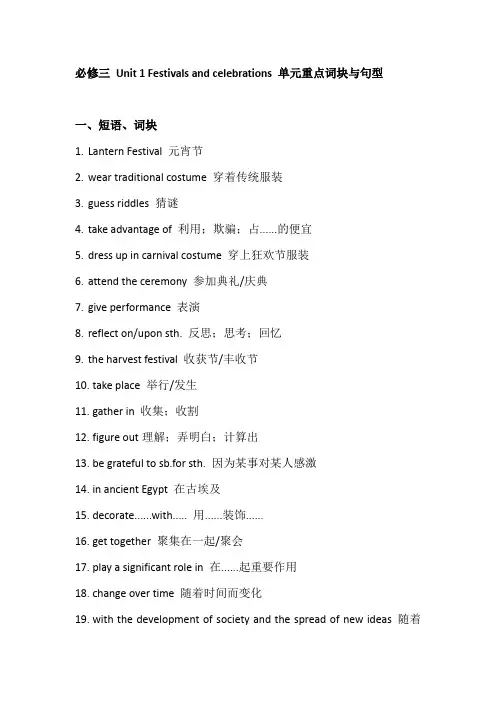
必修三Unit 1 Festivals and celebrations 单元重点词块与句型一、短语、词块ntern Festival 元宵节2.wear traditional costume 穿着传统服装3.guess riddles 猜谜4.take advantage of 利用;欺骗;占......的便宜5.dress up in carnival costume 穿上狂欢节服装6.attend the ceremony 参加典礼/庆典7.give performance 表演8.reflect on/upon sth. 反思;思考;回忆9.the harvest festival 收获节/丰收节10.take place 举行/发生11.gather in 收集;收割12.figure out理解;弄明白;计算出13.be grateful to sb.for sth. 因为某事对某人感激14.in ancient Egypt 在古埃及15.decorate......with..... 用......装饰......16.get together 聚集在一起/聚会17.play a significant role in 在......起重要作用18.change over time 随着时间而变化19.with the development of society and the spread of new ideas 随着社会的发展和新观念的传播20.fade away 消失/消退21.light firecrackers 燃放鞭炮22.drive away the evil spirits 驱邪/赶走邪恶的鬼魂23.in spite of 尽管;虽然;不顾24.the increase in spending 消费的增长25.have a lot in common 有许多共同之处26.a wide range of 大范围的;各种各样的27.range from...to... 包括从......到......之间28.the dinner on the Lunar New Year’s Eve 除夕年夜饭29.lucky money in red envelope 红包/压岁钱30.reach up to 多达/达到......st for three days 持续三天32.wash away 冲洗掉33.to be frank 坦白地说34.except for that 除此之外35.for the first time 第一次36.be pleased to do sth. 很高兴做某事37.go off 离开;爆炸;走火38.set off 出发;动身;启程;引起39.fall on 适逢(某日),正当(某日)40.practise archery 练习射箭41.the Olympic Games 奥林匹克运动会42.eat hot pot 吃火锅43.the Double Ninth Festival 重阳节44.show respect to/for. Sb. 尊敬某人45.folk song 民歌46.food recipes 食谱47.have influence on 对.....有影响48.pay a visit to sb./sp. 拜访某人/某地49.have a get-together 聚会二、重点句式1.However, no matter how different they may seem,all over the world, the spirit of sharing joy,gratitude,love,or peace is common in all festivals. (“no matter+疑问词”引导让步状语从句)然而,无论那些节日看起来多么不同,在全世界,分享快乐、感恩、爱或者和平的精神都存在于所有的节日中。
人教版高中英语必修三第一单元《festivals and celebrations》教学设计
Festivals and Celebrations--Topic Reading and Writing教学设计Before Class(晨读素材)话题分析节假日活动(Festivals, holidays and celebrations)Cultural festivals (Spring Festivals, New Year's Day, Christmas, etc. )Religious holidays(Christmas, Easter, Ramadan, etc. )Personal celebrations(birthday, anniversary, graduation, etc. )Describing your own experiences of these activities and stating your pre ferences, etc.Learning goals:1. Gain a large vocabulary to introduce festivals and describe personal experiencesof these activities.2. Improve reading and at the same time gather materials for writing.3. Practice writing properly and beautifully.话题词汇积累:一、阅读与写作词汇组合背(节假日活动)[阅读障碍词1]1.adventure n.冒险;奇遇2.balloon n.气球3.cancel vt.取消4.candle n.蜡烛5.cater vt.& vi.提供饮食及服务6.ceremony n.典礼;仪式;礼节7.champion n.冠军8.concert n.音乐会9.courage n.勇气;胆略10 questionnaire n.调查表,问卷11.promote v.促进,推动,促销,晋升12.procedure n.程序,手续,待遇13.coincidence n.巧合,巧事14.ball n.球,舞会15.ballet n.芭蕾舞16.bonus n.津贴,奖金,红利17 decorate vt.装饰,修饰→decoration n.装饰,装饰品18.celebration n.庆祝;庆祝会→celebrate vt.& vi.庆祝,祝贺19.amusement n.娱乐→amuse vt.以……自娱,逗……乐20.organise(美organize) vt.组织→organiser (organizer) n.组织者→organization n.组织,机构[阅读障碍词2]1.director n.导演2.feast n.盛宴,宴会;(宗教的)节日3.firework n.焰火 (pl.)烟火4.firecracker n.鞭炮5.flame n.火焰;光辉6.invitation n.邀请;请柬7.lantern n.灯笼;提灯8.mass n.群众;民众;大量adj.民众的;大规模的9.medal n.奖章10.perfect adj.完美的,极好的11.preparation n.准备12.programme n.节目;程序13.march n.游行,行进14.passenger n.乘客,旅客15.passer-by n.过客,过路人16.anniversary n.周年纪念日17.annual adj.每年的,年度的,一年一次的18.choir n.合唱团,教堂的唱诗班19.chorus n.合唱曲,歌咏队20.clap vi.拍手;鼓掌[写作常用词]1.award n.奖品;奖vt.授予;给予2.event n.事件;大事3.gather v.搜集;集合;聚集4.mark n.记号;标志v.标志;做记号于……5.skate vi.溜冰,滑冰6.prepare vt.准备;预备7.picnic n.& v.野餐8.club n.俱乐部9.camp n.(夏令)营vi.野营,宿营10.cinema n.电影院;电影11.exhibition n.展览;展览会12.experience n.经验;经历13.running n.跑步.14.match vt.使相配,使成对n.比赛,竞赛;火柴15.notice n.布告,通告;注意vt.注意,注意到16.ride (rode,ridden)v.骑(马、自行车);乘车n.乘车旅行17.cheer v.& n.欢呼,喝彩→cheerful adj.愉快的,高兴的18.compete vi.比赛;竞争→competitive adj.竞争的;比赛的19.national adj.国家的;民族的;全国性的→nationality n.国籍20.participate vi.参加;参与→participation n.参加补充:过年 celebrate the spring festival春联 spring festival couplets剪纸 paper-cuts年画 new year paintings红包 red packets (cash wrapped up in red paper, symbolize fortune and wealth in the coming year.)舞狮 lion dance (the lion is believed to be able to dispel evil and bring good luck.) 舞龙 dragon dance (to expect good weather and good harvests)灯谜 riddles written on lanterns灯会 exhibit of lanterns守岁 staying-up拜年 pay new year's call; give new year's greetings; pay new year's visit压岁钱 gift money; lucky money辞旧岁 bid farewell to the old year年糕 nian-gao; rice cake; new year cake团圆饭 family reunion dinner年夜饭 the dinner on new year's eve中西方节日名称中国传统节日:1、春节(农历一月一日)the Spring Festival;Chinese New Year's Day2、元宵节(农历一月十五日)the Lantern Festival3、清明节(公历4月5日左右)the Tomb Sweeping Day4、端午节(农历五月初五)the Dragon Boat Festival5、七夕节(农历七月初七)the Double Seventh Festival;Chinese Valentine's Day6、中秋节(农历八月十五)the Mid-autumn (Moon)Festival7、重阳节(农历九月九日)the Double Ninth Day8、腊八节(十二月初八) the Laba Rice Porridge Festival9、除夕(农历十二月三十日)New Year's Eve西方传统节日:1.New Year's Day (一月一日)新年2、Valentine's Day (二月十四日)情人节3、April Fool’s Day (四月一日)愚人节4、Easter Day (春分月圆后的第一个星期日)复活节5、Mother's Day (五月的第二个星期日)母亲节6、Father's Day (六月的第三个星期日)父亲节7、Halloween Day (十一月一日)万圣节8、Thanksgiving Day(十一月的第四个星期四)感恩节9、Christmas Day (十二月二十五日)圣诞节二、高级表达句式综合背1.(2016·天津高考书面表达)What impresses us most is your art skills,in which you showed outstanding talent.给我们印象最深的是你的艺术技巧,显示出了不同凡响的才能。
人教版必修3第一单元Unit1-Festivals-and-celebrations说课稿+文档
Book3(高中英语人教版必修3第一单元) Unit1 Festivals and celebrations《节日与庆典》我说课的内容是高一英语必修3Unit1阅读 Festivals and celebrations ,这是一节综合技能课,我说课内容包括以下几个部分:教材分析、学情分析、说教法、学法以及教学程序和教学反思。
一.教材与学情分析1.教材内容、地位和作用本单元以”节日”为话题。
本文的题目是Festivals and Celebrations.这一部分是本单元主题的重要体现形式。
本篇阅读主要介绍古今中外节日的种类、由来、以及人们的活动和习俗。
使学生不仅增进了对我国传统节日的理解,而且对外国的节日也有所了解和感悟,提高学生的文化素质,进而拓展社会文化背景、增加跨国文化知识。
2.学情分析由于本单元是安排在春节过后,寒假开学时的第一个单元,学生并对所学相关内容作了很好的铺垫,并有一定的生活积累,而且对“节日”这个话题既熟悉又比较感兴趣,因此可以激发学生的求知欲,更深层次的理解本课内容。
但由于学生基础薄弱,课文也涉及到西方文化,学生学习和理解有一定难度。
二.课程标准与教学目标新课程标准对这一课的要求是:通过介绍古今中外节日的种类、由来、以及人们的活动和习俗,使学生掌握阅读技巧,提高阅读能力。
根据《新课程标准》的要求和学生实际情况,确定了以下三维教学目标:知识与技能目标:熟悉中外节日,培养学生猜词能力,通过略读,找读、细读等方法,提高阅读能力和技巧。
过程与方法目标:通过对课文的阅读,教师引导,学生自主探究与合作学习,熟悉中外节日、掌握词汇,提高阅读能力。
情感、态度与价值观目标:在熟悉中外节日的基础上,提高学生的文化素质,进而拓展社会文化背景、增加跨国文化知识。
三. 教学重点和难点重点:1.熟悉中国和其他国家的节日。
(阅读)2.分析整理课文中的细节内容。
(详细阅读)难点:用所学知识谈论中国和其他国家的节日和庆祝方式。
英语:unit 1 Festivals and celebrations说课ppt(新人教版必修3)
Group reporting
3.Teaching procedures
Gap-filling
Fill in the blanks Of a passage according to the text
Present vocabulary
3.Teaching procedures
Following-up
vocabulary: religious origin starve ancestor dress up admire energetic arrival gather have fun with
Most ancient festivals would celebrate… At that time people would starve if food was difficult… Festivals can also be held… Some people might win awards…
Content
1.
2. 3. 4.
Understanding about the Teaching Materials
Teaching approaches and learning styles
Teaching procedures
Teaching effectiveness assessment
1. Understanding about the Teaching Materials
Teaching Material Analysis Learners Analysis Teaching aims and demands Teaching aids Teaching important& difficult points
人教版(2019)必修第三册 Unit1 Festivals and Celebrations课件
Unit 1 Festivals and Celebrations
Do you want to know more things about Chinese festivals?
《教师教学用书》P13 二、 背景知识
Cultural background
在辽阔的草原上,有一个特别的民族。他们 都是草原上威风凛凛的骑射手。他们特别喜欢 喝奶酒,奶茶,奶制品。而且,他们也特别热 情好客,他们就是马背上的民族,成吉思汗的后 代—蒙古族。
Do you want to know more things about Chinese festivals?
《教师教学用书》P13 二、 背景知识
Unit 1 Festivals and Celebrations
Do you want to know more things about Chinese festivals?
Words and Collocations (Student’s Worksheet 1)
Burin told me that Mongolians travel every year⑥_ff_rr_oo_mm__ne_eva_er_r_ayn_wd_h_fe_ar_re_(来从四面 八方赶来) ⑦__t_o_a_t_te_n_d__th_e__fe_s_ti_v_a_l _(参加这个节日), just as their ancestors had done for centuries. After ⑧_o_p_e_n_i_n_g__c_e_r_em__o_n_y__(开幕式) and some amazing performances, ⑨__t_h_e_w__r_e_st_l_in_g__c_o_m_p_e_t_it_i_o_n_b_e_g_a_n___ (摔跤比赛开始了). Mongolian wrestling is different from the wrestling in the Olympic Games. There are no rounds, and wrestlers are not separated by weight. The wrestlers loses if any part of his body above his knee touches the ground. After singing some songs, the competitors ⑩_d__a_n_c_ed__o_n_t_o_t_h_e_g_r_e_e_n__fi_e_ld__(在草地上翩翩起舞), waving their arms in the air as if they were eagles. I was quite moved by their show of strength and grace.