
高中英语选修7全册教案.pdf
Unit 1 Living well知识目标1.Get students to learn the useful words and expressions in this unit.eyesight,ambition,disabled,beneficial,in other words,clumsy,adapt,microscope,out of breath,absence,stupid,fellow,annoyed,all in all,industry,tank,make fun of,encouragement,adapt to 2.Help students to learn about disabilities and life of the disabled.能力目标1.Let students read the passage Marty's Story to develop their reading ability.2.Enable students to know that people with disabilities can also live well.情感目标1.By talking about disabilities and life of the disabled,make sure students can learn some positive stories of the disabled.2.Help them understand more about how challenging life can be for the disabled.3.Develop students' sense of cooperative learning.教学重点Get students inspired by positive stories of the people with disabilities. 教学难点1.Develop students' reading ability.2.Help students understand the difficulties the disabled have to overcome.学情分析1.教学方法1.Task-based teaching and learning.2.Cooperative learning.教学过程Step 1Warming up1.Warming up by discussingFirst ask students to talk about people with a mental or physical disability to see how much they know about disabilities. Then show some photos of people with disabilities. Students will be asked to discuss the following questions in small groups.Do you know any famous people who are disabled?What difficulties do they have to overcome in daily life?What have they achieved?2.Warming up by talkingFirst,ask students to look at the pictures and read what these people have achieved even though they each have a disability. Next,work with partners to talk about what disability they might have according to each description below the picture.Step 2Pre-readingAsk students to read the short paragraph in Pre-reading carefully and find out the purpose of the website “Family Village”.Step 3Reading1.SkimmingGive students 2 minutes;ask them to read the passage fast to fill in the blanks:Sum up the main idea of each paragraph:Paragraph 1:A(n)______ to Marty and his muscle disease.Paragraph 2:How the disease ______.Paragraph 3:Marty met a lot of ______ at school.Paragraph 4:How his life has become ______.Paragraph 5:The ______ of his disease.Suggested answers:Paragraph 1:An introduction to Marty and his muscle disease.Paragraph 2:How the disease developed/started.Paragraph 3:Marty met a lot of difficulties at school.Paragraph 4:How his life has become easier.Paragraph 5:The advantages of his disease.2.Scanning for detailed informationAsk students to read the passage carefully to locate the detailed information.(1)First ask students to read paragraph one and complete the chart below.DiseaseDifficultiesMottoSuggested answers:Disease A muscle disease that makes him very weak. Difficulti He can't run or climb stairs as quickly as other people.(2)Next read paragraphs two and three and choose the best answer.Why did the doctors cut out a piece of muscle from Marty's leg?A.Because they could cure the disease by cutting it out.B.Because they wanted to use it as a specimen(标本).C.Because they would transplant(移植) the new muscle.D.Because they wanted to find out the cause of the disease.Key:D(3)Read paragraph four and answer the following questions:①What is Marty's ambition?②What is Marty's achievement?③What is Marty's hobby?(4)Ask students to find Marty's advice in paragraph five.Step4:合作探究1.Ask students to work together to write a mini biography for Marty according to the text.My mini biographyNameStatusHealthInterests andHobbiesAmbitionMotto2.Discuss in pairs to get the main idea of the passage by filling in the blanks.Though he is a ______ person,Marty never feels ______ for himself and he ______ his life.Step 5总结提升1.Ask students to read the whole passage and choose the best answers.(1)Which of the following is false?A.Although there are a few students who look down upon him,Marty never gets annoyed.B.Marty leads a meaningful life and does not feel sorry for being disabled.C.Marty only spends time with his pets and never with his friends.D.Marty's disability has made him more independent.(2)From the passage we can infer that ______.A.Marty asks others to feel sorry for himB.Marty never loses heartC.Marty is afraid of being made fun ofD.Marty will not accept any encouragement because he has grown stronger psychologicallyStep 6Homework1.Retell Marty's Story according to the mini biography.2.Surf the Internet to learn more about the life of disabled people.教学反思:这篇文章是记叙文,对文章的整体理解不存在问题,不足之处是单词不熟。
人教版高中英语选修7 Unit 2 Robots教学设计
人教版高中英语选修7 Unit 2 Robots教学设计人教版高中英语选修7 Unit 2 Robots教学设计《英语》(人教版)选修7 Unit 2 Robots第一课时任务型教学设计一、教学内容分析教学内容《英语》(人教版)选修7 Unit 2 Robots 第一课时教学对象高二学生教学项目词语industrial military vacuum hel结构其他Listening Speaking教学目标语言知识熟悉有关机器人种类与功能的话题。
语言技能能运用词汇表述自己的想法与观点。
语言运用能运用语言就选择什么样的机器人发表自己的观点。
文化意识培养学生想象力和对未知世界的探索精神。
情感态度在英语学习中有较强的自信心,敢于用英语进行交流与表达。
学习策略借助联想学习相关词汇。
教学方法任务教学法、学生中心教学法、多媒体教学法教学媒体PPT幻灯媒体、黑板教学重点学习有关机器人的词汇,培养学生表达能力。
教学难点培养学生的表达及判断能力。
运用任务Task of Unit 2: The Future Robot Companyin America is holding a robot desigDesign your robot and write a design plan.Task of Period 1: Make a list of dds of robots anduand decide what kind of robots you want to design.二、课堂教学过程时间教学步骤教师活动学生活动教学目的第1-5分钟热身导入,启动教学播放有关奥特曼的动画片段:an you makea list of works wlude robots as characters? (and get prepared to tell the class about it briefly.)2. What is a robu?(A robot is a machine designed to do jobs that are usualld by humaRobots are programmed and controlled by a computer.)思考有关机器人的作品。
高中英语book7 unit 4 sharing 全单元教案新人教版选修7
Unit 4 Sharing I.单元教学目标Ⅱ.目标语言III. 教材分析与教材重组1. 教材分析本单元以Sharing为话题,旨在通过单元教学,使学生了解世界上很多地方依然很落后,从而懂得同情,学会分享。
结合针对短文话题的探讨激发学生的国际意识,通过各种渠道力所能及地为贫困地区的孩子做出自己贡献。
1. 1 WARMING UP 提供了三项任务。
通过完成这些任务让学生懂得什么是“帮助〞,并且反思自己是否乐于助人,以及怎样做才是“志愿者〞,由此为后面的短文学习做好铺垫。
1. 2 PRE-READING是READING的热身活动。
其中介绍了短文主人公Jo,还根据她在PNG拍的照片提出了5个问题,使学生在阅读之前就简单了解短文内容。
1. 3 READING是一篇Jo写给Rosemary的信。
其中介绍Jo在PNG(Papua New Guinea)的所见所闻,使学生感受到PNG的儿童生活艰难,从而珍惜自己的学习机会。
.1. 4 COMPREHENDING 是根据短文设计的阅读理解试题。
1. 5 LEARNING ABOUT LANGUAGE分词汇和语法两部分。
其中,第一部分是有关此篇短文中的重点单词和短语;第二部分是有关限定性定语从句的复习。
1. 6 USING LANGUAGE是对READING的延伸。
通过阅读,参与“Give an unusual gift〞的活动。
1. 7 LISTENING AND SPEAKING通过Jennifer Wells的采访介绍了Mary Murray作为MSF的一个volunteer的工作经历,而且针对这一话题展开Speaking。
1. 8 WRITING 根据LISTENING AND SPEAKING话题运用时间表达方式进行写作。
2. 教材重组2.1 从话题内容和训练目的上分析,WARMING UP与LISTENING AND SPEAKING相一致;从教材份量来说,可将WARMING UP与LISTENING AND SPEAKING的1、2、3、4项和Workbook中的LISTENING以及LISTENING TASK整合在一起,设计成一节任务型“听力课〞。
人教版高二英语选修7 Unit 1 Living well 全单元教案
Part 1: Teaching Design第一部分:教学设计Period 1: A sample lesson plan for reading(Marty’s story)AimsTo help students develop their reading abilityTo help students learn about living well.ProceduresI. Warming up by learning about disabilityWhat is disability?A disabled person is one who has a condition called a disability that interferes with his or her ability to perform one or more activities of everyday living. For example, locomotion (indoors and going outside), getting dressed, communicating with others.What are the types of disability?"Disability" can be broken down into a number of broad sub-categories, which can include the following:●Physical impairments affecting movement, such as muscular dystrophy, post-polio syndrome,spina bifida and cerebral palsy.●Sensory impairments, such as visual or hearing impairments.●Neurological impairments, such as epilepsy or dysautonomia.●Cognitive impairments such as Autism or Down Syndrome.●Psychiatric conditions such as depression and Schizophrenia.II. Pre-reading by visiting the Family Village websiteGet online to /index.htmlx.Welcome to the Family Village! We are a global community that integrates information, resources, and communication opportunities on the Internet for persons with cognitive and other disabilities, for their families, and for those that provide them services and support.Our community includes informational resources on specific diagnoses, communication connections, adaptive products and technology, adaptive recreational activities, education, worship, health issues, disability-related media and literature, and much, much more!So stop in, stroll around, and visit some of the Family Village's attractions. Simply click on a place to explore and discover a cornucopia of useful information! Let us know what you like (or dislike) and visit often, for our village is constantly changing.III. ReadingTurn to page 2. We shall take Marty’s story this time.First we shall listen and read aloud to the recording of the text. Try to read aloud the text as loudly and correctly as possible.Then we shall go over the text to read it to: cut/ the sentence into thought groups, blacken the predicates, darken the connectives and underline all the useful expressions.IV. Transferring informationVI. Closing down by talking about living well with disability●To use goal setting and problem solvi ng as the framework for developing healthy lifestyles●To practice healthy living when we have meaningful activities we want to do●To begin with why we want to be well●To develop tools and skills for healthy living, including healthy reactions and commun ication, managing depression, information seeking, physical activity, nutrition, and advocacy●To pursue meaningful goals despite limitations●To have a sense of belonging developsPeriod 2: A sample lesson plan for Learning about Language(Revise the Infinitive)AimsTo help students revise the InfinitiveTo help students discover and learn to use some useful words and expressionsTo help students discover and learn to use some useful structuresProceduresI. Warming up by learning about the InfinitiveInfinitiveAn infinitive is the simple present form of a verb used as either a noun, adjective, or adverb. The verb of the infinitive is normally preceded by the word to. When the infinitive follows some verbs as the direct object, the “to”may be dropped.An infinitive phrase is the infinitive plus any complements and any modifiers of the infinitive and complements.As a Noun: He helped to write the program.As an Adjective: Lydia was looking for a way to earn money.As an Adverb: He shouted to get our attention.To Dropped: He helped write the program.In the above examples, the infinitive is italicized and the infinitive phrase is underlined.II. Listening, reading and completingand German. She did not only function as a model because of her intellectual accomplishments or her devotion to serving others, but also because "... In Lei Feng, Chinese youths had to reach for Now you are to complete the two paragraphs on page 4 choosing the right words from the list. III. Learning and findingWhat is an Infinitive?The infinitive usually occurs with 'To' (for example To go, To come, To wear etc.), except after an auxiliary or modal verb.It is a verb form that shows no person, tense or aspect.EXAMPLES OF THE INFINITIVE:I had to goI must goI want to singTo err is humanYou don't know herYou may comeThe following verb forms are derived from the Infinitive:i/ Imperative (same as Infinitive but without 'To')ii/ Present Simple (same as Infinitive without 'To' but the third person singular takes 's')iii/ Present Participle or Gerund (add 'ing')Now read the text once again to find and copy on page 5 all sentences which contain examples of the Infinitive.IV. Making sentences with the Infinitive1. To have a muscle disease is very boring for any people.2. I do not want to make my body very weak.3. To climb stairs, you need some tips.4. I don’t want you to drop things while going along the street.5. To bump into a car is dangerous.6. To make life well worth living you have to learn to live with what you have.7. He is looking for ways not to get worse or get older.8. He stayed on to adapt to the life there.9. My motto is to live one day at a time.10.He likes to climb tree, play football and dream about becoming rich overnight.11.I hope to represent my country in the World Cup.12.Getting weaker and weaker, I have no strength even to get out of bed.13.To go into hospital for tests, I have to miss a lot of school.14.He learns to look at small things under a microscope.15.To get out of breath, you just have to run a short way.V. Closing down by reading a poem in EnglishDisabledHe sat in a wheeled chair, waiting for dark, And shivered in his ghastly suit of grey, Legless, sewn short at elbow. Through the parkV oices of boys rang saddening like a hymn,V oices of play and pleasure after day,Till gathering sleep had mothered them fromhim.About this time Town used to swing so gay When glow-lamps budded in the light blue trees,And girls glanced lovelier as the air grew dim,-In the old times, before he threw away his knees.Now he will never feel again how slimGirls' waists are, or how warm their subtle hands.All of them touch him like some queer disease.There was an artist silly for his face,For it was younger than his youth, last year. Now, he is old; his back will never brace;He's lost his colour very far from here, Poured it down shell-holes till the veins ran dry,And half his lifetime lapsed in the hot race And leap of purple spurted from his thigh. One time he liked a blood-smear down his leg, After the matches, carried shoulder-high.It was after football, when he'd drunk a peg, He thought he'd better join. - He wonders why. Someone had said he'd look a god in kilts, That's why; and maybe, too, to please his Meg,Aye, that was it, to please the giddy jiltsHe asked to join. He didn't have to beg; Smiling they wrote his lie: aged nineteen years.Germans he scarcely thought of; all their guilt, And Austria's, did not move him. And no fears Of Fear came yet. He drought of jewelled hills For daggers in plaid socks; of smart salutes; And care of arms; and leave; and pay arrears; Esprit de corps; and hints for young recruits. And soon, he was drafted out with drums and cheers.Some cheered him home, but not as crowds cheer Goal.Only a solemn man who brought him fruits Thanked him; and then enquired about his soul.Now, he will spend a few sick years in institutes,And do what things the rules consider wise, And take whatever pity they may dole. Tonight he noticed how the women's eyes Passed from him to the strong men that were whole. How cold and late it is! Why don't they come And put him into bed? Why don't they come? Wilfred OwenPeriod 3: A sample lesson plan for Using Language(A letter to architect)AimsTo help students read the passage A letter to architectTo help students to use the language by reading, listening, speaking and writingProceduresI. Warming up by listening and reading aloud learning about Mount KilimanjaroOverview ofMount KilimanjaroElevation (feet): 19563Elevation (meters): 5963Range: East Africa MountainsCountry: TanzaniaContinent: AfricaLatitude: -3.06667Longitude: 37.35Difficulty: Walk upBest months for climbing: December, January,February, March, June, July, AugustV olcanic status: ExtinctYear first climbed: 1889Convenient Center: Marangu via Moshi,TanzaniaNearest major airport: Nairobi, KenyaBarry Minto is being interviewed by a radio reporter about his climbing of the Mount Kilimanjaro.On page 7 there are several situations. Now read them and create dialogues with your partners.Now it is time to listen to the letter. Go to page 8, please.Now read the text A letter to an architect on page 8 to: cut/ the sentence into thought groups, blacken the predicates, darken the connectives and underline all the useful expressions.VI. Copying expressions from A letter to architect and making sentences of your own withDid your father help you?One day, Tim's mathematic teacher looked at his homework and saw that he had got all his sums right, The teacher was very pleased-and rather surprised, He called Tim to his desk and said to him, "You got all your homework right this time, Tim. What happened? Did your father help you?" Usually Tim's father did help him with his homework, but the evening before this, he had not been able to, because he had not been at home, so Tim answered, "No, sir. He was busy last night, so I had to do it all myself."你爸爸帮你做了吗?一天,蒂姆的数学老师看了他的作业,发现他全做对了。
高二英语选修7全册课件3-2

人 教 版 英 语
Unit 3 Under the sea
人 教 版 英 语
Unit 3 Under the sea
Ⅰ.单词 A)根据英文解释及首字母写出单词。 1.a________ a short story based on your personal
人 教 版 英 语
Unit 3 Under the sea
Ⅲ.语篇导读 请根据课文内容在下表中填入最恰当的词。注意:每 空一词。
Title
Old Tom the Killer Whale
人
教
The event
I__1__Old Tom helped the whalers__2__the huge whales.
教
yesterday.
版 英
A.watched
B.contributed
语
C.witnessed
D.made
Unit 3 Under the sea
答案:C 本题题意:“近年来我的家乡变化很
快。”“对呀,昨天来到这里时,我几乎认不出来
了。”witness表示“是发生……的地点(或时间、组织等);
见证”。注意,动词see也具有相同的用法。
bay. •The killer whale__6__the team to the hunt. •The killers ate the__7__and tongue of the whale.
The result
•Although Old Tom and the other killers were fierce hunters, they
ground, often because they are too heavy to carry
人教版教材选修七第一单元Living Well教案
人教版教材选修七第一单元Living Well-Using LanguageA Letter To An Architecture教学设计课题名称:Using language课型:阅读写作课授课年级:高二年级(下)主题语境:人与社会——关爱残障人士教材内容分析一、教材内容:本课为人教版教材选修七第一单元Living Well的第五课时Using Language 板块的第二项活动Reading,Speaking & Wring.本单元的话题是围绕“残疾”、“残疾人的生活”展开的,介绍残疾人积极进取的生活。
教材上这部分共有六个练习,练习1看图说话,讨论行动困难的人在电影院可能会遇到什么麻烦。
练习二要求学生阅读一封信件,内容为一位读者写给电影院建筑师的信,请求建筑师充分考虑残疾者的需求,然后让学生把心中的建议要点列举出来。
练习三回答问题。
练习四要求学生找出信中的礼貌用语。
练习五分组讨论社区是否方便残疾人进出以及改进的方法。
练习六要求学生仿照读过的信件给某建筑师写一封建议信。
二、阅读文本分析:WhatReading部分呈现的是一封较为正式的写给一位电影院建筑师就新影院的设计的建议信,内容主要包括:1. 写信目的——考虑残障人士的需求;.2. 包括电梯设计(Adequate access for wheelchairs),耳机配置(Earphones for people who have trouble hearing),座位高度(Raised seating),厕所位置(Toilets)以及停车场位置(Car parking)等五个方面的建议;3. 表示感谢和期待,并表明合理设计的原因——利于残障人士也利于电影院的双赢局面。
How1. 结构上。
Reading在结构上采取了总分总的布局,先说明写信目的,随后从一些细节上体现对残障人士可能遭遇的问题的考虑而提出可行性建议,最后总结表示希望建议得到认可并进一步提出双赢的预期效益。
高中英语选修7讲义:Unit+1+Living+with+technology+Section+Ⅰ
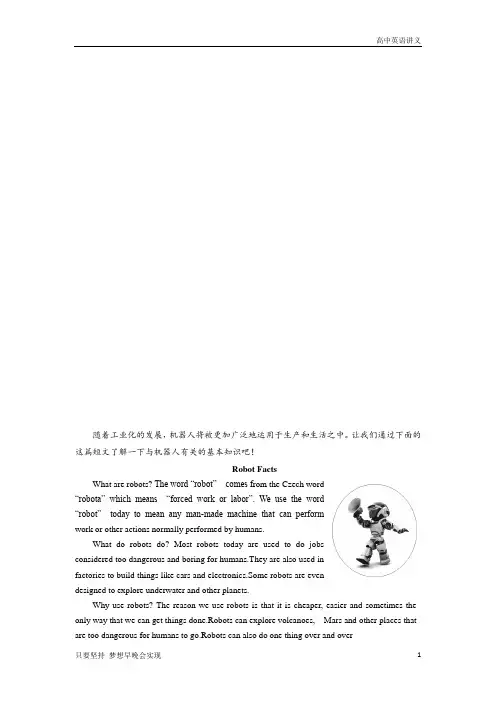
随着工业化的发展,机器人将被更加广泛地运用于生产和生活之中。
让我们通过下面的这篇短文了解一下与机器人有关的基本知识吧!Robot FactsWhat are robots? The word “robot” comes f rom the Czech word“robota” which means “forced work or labor”. We use the word“robot” today to mean any manmade machine that can performwork or other actions normally performed by humans.What do robots do? Most robots today are used to do jobsconsidered too dangerous and boring for humans.They are also used infactories to build things like cars and electronics.Some robots are evendesigned to explore underwater and other planets.Why use robots? The reason we use robots is that it is cheaper, easier and sometimes the only way that we can get things done.Robots can explore volcanoes, Mars and other places that are too dangerous for humans to go.Robots can also do one thing over and overagain without getting bored.Another reason to use robots is that they never get sick and they don’t need to take a day off.What are robots made of? Well, robots can be made from a variety of materials including metals and plastics and most robots usually have at least 3 main parts:(1)The controller, also known as the “brain”,which is run by a computer program;(2)Mechanical(机械的) parts such as motors and wheels that make the robot move;(3)Sensors(传感器)—to tell the robot about its surroundings.These parts working together control how the robot operates.Without the controller or “brain”,motors and sensors, robots would not be able to function.Robot limitations(局限性). Unlike those in the movies, robots are unable to think or make decisions; they are only tools to help us get things done.But who knows what robots may be able to do in the future. Mayb e you will design the “Super Robot” of tomorrow.Section ⅠWelcome to the unit & Reading—Warming Up[基础词汇]1.evolution n.演变,发展;进化2.drawback n. 缺点,缺陷;不利条件3.principle n. 原理,法则;道德原则,行为准则4.percentage n. 百分率,百分比5.component n. 组成部分,成分,部件6.portable adj. 便携式的,轻便的7.digital adj. 数字信息系统的,数码的,数字式的[拓展词汇]8.construct v t. 制造;修筑,建造→construction n. 建造,修筑9.accessible adj. 可使用的;可接触到的;可到达的;易理解的→access n. 享用权,通道10.distribute v t. 使分布,分散;分发,分配;分销→distribution n. 分发,分配11.eventually ad v. 最后,终于→eventual adj.最终的;可能的12.adaptation n. 适应;改编本,改写本→adapt v. 适应,改编→adaptable adj. 能适应的13.sceptical adj. 怀疑的→sceptically ad v.怀疑性地1.keep in touch with 与……保持联系2.contribute to 导致;有助于,对……贡献3.in the development of ... 在……的发展过程中4.in color 彩色的5.benefit from 从……获益6.wind up 上发条7.along with 和……一起,随着;除……以外8.keep pace with 与……齐步前进1.not until的强调句型John Logie Baird constructed the first colour TV in 1928, but it was not until 1938 that the first colour TV programme was broadcast.约翰·洛吉·贝尔德于1928年制造出第一台彩色电视机,但直到1938年第一个彩色电视节目才播出。
高中英语选修7 Unit5 Travelling Abroad教案
高中英语选修7 Unit5 Travelling Abroad一.教学内容人教版高中英语选修7 第五单元(Travelling Abroad)二. 教材分析本单元以Travelling abroad and studying abroad为话题,旨在通过单元教学,使学生获得旅游、旅居国外方面的通用知识,开阔眼界,以及旅游方面的英语表达。
使学生了解在国外旅行或学习时可能会遇到的一些问题,并学会怎样去解决问题和避免这些问题的发生。
学会表达个人观点,能用所学的有关travelling abroad的词汇描述在国外居住生活的情况。
本节课主要是通过“warming-up & pre-reading”部分的学习,使学生了解了在国外学习生活时可能面临的困难以及怎样解决这些困难。
Warming Up让学生说说想去哪个国家去旅游或学习并用已有的知识和经验讨论在国外学习或旅行会遇到什么问题。
Pre-reading是Reading 的热身活动,要求学生采用与同学讨论交流的方式谈论在国外学习的利与弊,为正文的阅读做好知识上和心理上的铺垫。
Reading是一篇介绍中国女孩谢蕾在伦敦学习和生活的情况,让学生通过实例对比在国内学习生活与在国外学习生活的不同,从而培养他们的国际视眼。
三、学情分析1.情感和认知方面:学生对国外的学习生活情况了解是很感兴趣的。
在以往的学习阅读中对国外的生活学习也有所了解,但不是很具体。
这篇关于中国女孩在伦敦学习和生活情况的介绍和他们的生活比较贴近,在在预读,学习,讨论时会觉得比较亲近熟悉。
2.语言技能方面:我校大部分学生英语语言能力比较若,在思维上相对有较强的独立性,通过老师的引导和提示,一般能够从的文字资料中获取主要信息和基本的内容,能根据阅读目的运用适当的阅读策略完成阅读任务。
但一些学生的分析信息和处理信息的能力还欠缺,尤其是归纳总结能力。
四、教学目标1. Knowledge aims: Duide the students to master the first part of the words and phrases related to the topic, including "lecture, qualification, recommend, comfort, substitute, acknowledge, as far as one is concerned, be occupied with, keep it up, fit in ... and etc.2. Ability aims: Enable the students to learn about the information of travelling abroad, working or studying abroad by using different reading skills. Enable the students to summarize the advantages and the disadvantages of living or studying in a foreign country.3. Emotional aims: Help the students learn about the differences and difficulties of living and studying in a foreign country and learn how to deal with the problems that they would face when studying in a foreign country.五、教学重点及难点1. Widen the vocabulary range. Develop the students’reading skills namely skimming and scanning and so on.2. Guide the students to summarize the benefits and difficulties of living in a foreign country.六. 教学方法1.演示法:通过相关的图片、PPT等网络多媒体辅助显示给学生看,便于学生对基础知识和背景知识的把握,并从旧知识中获得启迪,从而达到解决问题的目的。
【精品】外研版高中英语选修7全册教案
外研版高中英语选修7 全册教学设计教案目录Module 1 Basketball-Period 1Module 1 Basketball-Period 2Module 1 Basketball-Period 3Module 1 Basketball-Period 4Module 1 Basketball-Period 5Module 1 Basketball-Period 6Module 1 Basketball-Period 7Module 1 Basketball-Section 1 Background readingsModule 1 Basketball-Section 2 The Analysis of the Difficult SentencesModule 2 Highlights of mey senior Year-Period 1Module 2 Highlights of mey senior Year-Period 2Module 2 Highlights of mey senior Year-Period 3Module 2 Highlights of mey senior Year-Period 4Module 2 Highlights of mey senior Year-Period 5Module 2 Highlights of mey senior Year-Period 6-7Module 2 Highlights of mey senior Year-Section 1 Background ReadingsModule 2 Highlights of mey senior Year-Section 2 The Analysis of the Difficult SentencesModule 2 Highlights of mey senior Year-Section 3 Words and ExpressionsModule 3 Literature-Period 1Module 3 Literature-Period 2Module 3 Literature-Period 3Module 3 Literature-Period 4-5Module 3 Literature-Period 6-7Module 3 Literature-Section 1 Background readingsModule 3 Literature-Section 2 The Analysis of the Difficult SentencesModule 3 Literature-Section 3 Words and ExpressionsModule 3 Literature-TaskModule 4 Music Born in America-(Period 5-6)Module 4 Music Born in America-(Period 7-9)Module 4 Music Born in America-Period 1Module 4 Music Born in America-Period 2Module 4 Music Born in America-Period 3Module 4 Music Born in America-Period 4Module 4 Music Born in America-Section 1 Background ReadingsModule 4 Music Born in America-Section 2 The Analysis of the Difficult SentencesModule 4 Music Born in America-Section 3 Words and ExpressionsModule 5 Ethnic Culture-Grammar1Module 5 Ethnic Culture-Grammar2Module 5 Ethnic Culture-IntroductionModule 5 Ethnic Culture-Reading and Vocabulary(1)Module 5 Ethnic Culture-Reading and Vocabulary(2)Module 5 Ethnic Culture-Section 1 Background ReadingsModule 5 Ethnic Culture-Section 3 Words and ExpressionsModule 5 Ethnic CultureSection 2 The Analysis of the Difficult SentencesModule 6 The World’s Cultural Heritage-(Period 4-5)Module 6 The World’s Cultural Heritage-(Period 6-7)Module 6 The World’s Cultural Heritage-Period 1Module 6 The World’s Cultural Heritage-Period 2Module 6 The World’s Cultural Heritage-Period 3Module 6 The World’s Cultural Heritage-Section 1 Background ReadingsModule 6 The World’s Cultural Heritage-Section 2 The Analysis of the Difficult SentencesModule 6 The World’s Cultural Heritage-Section 3 Words and ExpressionsModule 1 BasketballPart One Teaching Design▇Goals· To read about the basketball players:Michael Jordan, Wilt Chamberlain;· To Learn to enjoy the titles■ProceduresStep 1: Warming up by learning IntroductionPlease think about the following questions:(1)Do you love team sports, such as football, basketball, volleyball?(2)Can you name some basketball players, at home or abroad? Do you know what positions they play?(3)What are the forwards doing---attacking or defending?(4)What is the referee doing?Let’s look at the picture on page 1 and what do the words mean?2.What is the NBA?Class, what basketball games do you love watching? Why?Step 2: Practice for words studyOur school basketball team is awesome. Last year we _________ over 3,000 points. At the start of the season, our two star __________, Yang Hua and Xiao Ping _________ of getting 30 points each in every game. They didn’t manage that, but they _________ about 25 each. The game I remember best is the one where I _______ the ball through the basket six times in the first 15 minutes. Our coach said that was a _______ for our team. When the game was over, everyone jumped out of their seats and _______ for me; they wanted me to sign their programmes. My pen _________ because I had to write fast.Step 3: Before you read1. Information about Michael Jordan and Wilt ChamberlainClass, are you familiar with Michael Jordan and Wilt Chamberlain? Here is a posterStep 4: While you read1. Fast reading for general ideas of the textShall we get the details of the two famous basketball players? As we have known, they are outstanding and are well thought of in the history of basketball. Read the two titles and they are meaningful. “Michael Jordan--- Head and Shoulder Above the Rest”. Look at yourself, and your head and shoulder are always above the rest of the other parts of your body. It means somebody is much better than others. “Wilt the Stilt --- the Tower of Power” Class, have you ever seen people walk on stilts in the Spring Festival? They are taller than people who don’t. As we know, Chamberlain was even 19 centimeters taller than Jordan. He was not only tall but also full of power and magic on the basketball court. Comprehension—understanding what you are reading—is important. To read in thought groups is an easy, yet effective, way of improving reading comprehension. (Divide the whole class into two groups) Group A read the first passage about Jordan and group B read the other. And then introduce the basketball player to each other by using the information of the text. (a form of finding topic sentence or generalidea of each paragraph)Now read the recording of the text. Pay attention to the details while listening and reading.2. Fill in the formDuring the 1990s, Michael Jordan was probably the ___________ athlete in the world. He was _________ the most valued player five times. Millions of fans admire his athletic ability, ___________and confidence. Off the basketball __________, MichaelChamberlain. He is the only NBA player who _________ over 50 points per game for an entire season. There is no _________ that he __________ the title “outstanding player of his generation”.Step 5: After you read1. Retell the text2. Introduce the two famous sportsmenModule 1 BasketballPeriod 2 Function -- Expressing Feelings and Emotions■Goal●To learn to describe feelings and emotions■ Procedures心理状态动词的-ing形式与-ed形式1)-ed形式多用来修饰人,描述人的声音、表情或感受;多和人连用,如:an excited girl,/I am tired./He was frightened to death when he heard the news. / He was frightened by the frightening noise. /You looked frightened.2)-ing形式则多用来修饰事物,描述事物的状态或性质。
新课标人教版选修七Book7_unit5_Language_points
单元主题
• 文化交流与理解:本单元以文化交流与理解为主题,通过探讨 不同文化背景下的交际方式和语言运用,帮助学生增强跨文化 意识和跨文化交际能力。
核心内容
文化差异与交际策略
介绍文化差异对交际的影响,以及针 对不同文化背景的交际策略,如非语 言交际、礼仪习俗等。
跨文化交际能力
强调跨文化交际能力的重要性,包括 如何适应不同文化环境、如何处理文 化冲突等。
宾语从句
由一个完整的句子作为宾语,例如:“I don’t know where he lives.”(我不知道他住在哪里。)
表语从句
由一个完整的句子作为表语,例如:“The problem is that we don’t have enough money.”(问题是我们 没有足够的钱。)
同位语从句
写作技能培养途径探讨
积累素材与灵感
通过阅读、观察、思考 等方式,积累各类写作 素材和灵感,丰富文章 内容。
模仿与创新
学习优秀范文的写作技 巧和表达方式,进行模 仿练习,逐渐形成个人 独特的写作风格。
反馈与修改
重视他人对自己作文的 反馈意见,认真修改和 完善作文,提高写作水 平。
优秀范文欣赏与借鉴
词汇3
详细解释词汇3的含义、用法及常见 搭配。
短语及习惯用法短语1
解释短语1的含义,给出 例句展示其用法。
短语2
解释短语2的含义,给出 例句展示其用法。
习惯用法1
解释习惯用法1的含义, 给出例句展示其用法。
词义辨析与例句展示
词义辨析1
对比分析词义相近的词汇 ,给出例句帮助理解。
词义辨析2
语音语调
注意语音语调的准确性,通过模仿和练习来提高发音和语调的自 然度。
2019-2020年高中英语人教版选修7教学案:Unit1SectionⅢGrammar—复习动词不定式(含答案)
2019-2020年高中英语人教版选修7教学案:Unit 1 Section ⅢGrammar—复习动词不定式(含答案)语法图解探究发现用所给词的适当形式填空1.Unfortunately, the doctors don't know how to_make (make) me better, but I am very outgoing and have learned to_adapt (adapt) to my disability.2.Then I started to_get (get) weaker and weaker, until I could only enjoy football from a bench at the stadium.3.Even after all that, no one could give my disease a name and it is difficult to_know (know) what the future holds.4.I am happy to_have_found (find) many things I can do, like writing and computer programming.5.My ambition is to_work (work) for a firm that develops computer software when I growup.6.Last year I invented a computer football game and a big company has decided to_buy (buy) it from me.7.To_look (look) after my pets properly takes a lot of time but I find it worthwhile.8. I have to work hard to_live (live) a normal life but it has been worth it.9.If I had a chance to_say (say) one thing to healthy children, it would be this: having a disability does not mean your life is not satisfying.10.Just accept them for who they are, and give them encouragement to_live (live) as rich and full a life as you do.[我的发现](1)以上句子皆用了动词不定式。