
高中英语_A Trip on “The True North”教学设计学情分析教材分析课后反思
济南中学教师课时教案教学设计学情分析:1.这节课的内容围绕两个女孩的加拿大之旅展开,年龄和同学们相仿,更容易引起学生的共鸣。
在讲述加拿大的概况---地理位置、主要城市、风土人情的时候加深了学生地理知识的了解,地理爱好者的学生更喜欢分享有关的地理知识,了解了加拿大的多元文化现象和多元文化国家的特点。
通过加拿大概况的小测试,激发学生已有的知识和经验,为进入本单元的学习做好准备。
2.高一的大部分学生已经初步能够通过阅读文章获取信息并解决相关问题,但是对阅读文章的准确理解及解决问题的能力还有待于进一步提高;3.学生的思维活跃,已经储备了一定的词汇和英语知识,在适当的引导下能够对相关话题独立的展开讨论,各抒己见,并整理出答案;4.学生之间的差距较大,英语水平参差不齐。
效果分析:通过课后反馈,总体讲学效果良好,课堂氛围轻松,师生互动频繁,跳读与细读到写作输出取得了较好的效果。
学生都了解了有关加拿大的基本概况及特色风景,拓展了视野及文化积累;通过阅读训练达到了训练阅读技能的目的,增强了独立思考问题的能力及团队合作意识。
初步了解了重点词汇的含义,积累了重点表达和句型,能运用所学转化到自己的写作中,为写作能力的提高打下了基础。
多媒体的运用也提升了学生的学习兴趣。
语言简洁、明确,学生快速明白指令。
学生们在获得语言知识的同时,提升了文化品格的培养。
总之,从各方面注重学生核心素养的提升。
这节课基本达到了既定的教学目标。
教材分析本单元的主要内容是了解加拿大的概况---地理位置、主要城市、风土人情等;了解多元文化现象和多元文化国家的特点。
1. Warming up 部分提供了一个关于加拿大概况的小测试,目的是激发学生已有的知识和经验,为进入本单元的学习做好准备。
2. Pre-reading 部分通过三个问题的设置提问学生有关旅行和加拿大的知识。
本单元的阅读部分是“在旅途中看加拿大”,然后提问如果你有机会去加拿大,你想到那看什么,以及你会用什么词汇描述加拿大来导入阅读部分。
3. Reading 部分是篇游记,记述了李黛予和刘倩去加拿大看他们的表兄妹的途中见闻。
乘火车横穿加拿大,他们的朋友Danny Lin 像他们介绍了加拿大的概况,包括面积、地貌、城市、人口和生态环境等。
一路上,他们看到了加拿大的自然风光,野生动物,并在途中停靠卡尔加里而联系到大西部赛马会(Calgary Stampede)。
加拿大地广人稀,多数人住在美加边境。
本文提到了桑德贝,五大湖,温哥华和多伦多,介绍了加拿大的淡水资源。
有些地方没有详述,给学生留下了思考的空间。
4. Comprehending 部分有三部分组成:回答问题、写出正确信息和讨论问题。
这些不仅检查学生对课文细节的把握,而且检查学生根据阅读课文内容所做的推理和判断。
提出的问题:如果你有机会去加拿大,你会选择去那个地方?这样给学生更多的想象和思考。
不仅提升学习能力,也有利于文化品格的养成。
5. Learning about language 部分重在提高学生的学习能力和知识能力,扩大了词汇量,以及前缀词汇的学习。
6. Using language 部分综合训练听说读写的能力,听说写有机结合。
这部分内容继续加拿大之行,从多伦多到蒙特利尔,本文提到了枫树,加拿大国家塔,尼亚加拉大瀑布等著名地方,加深了学生对加拿大的了解。
提升了学生的思维品质。
Class testⅠ. 语段填词1. This was a small _____ (测验)about the knowledge of seven ____ (大洲).2. The passenger was ________ (聊天)with his friend. He didn’t watch out for his ________ (行李)and a thief stole it.3. If you go ________ (向东走), you will see a ________ (港口). It was ________ (包围)on three sides by the hills.4. This town ________ ( 与……接壤)a wealthy city. In the past five years it has ________ (测量)800 ________ (英亩) waste lands to build an ________ (城市的)park.Ⅱ. 选词填空rather than, settle down, catch sight of, be surrounded by, go through, have a gift for, be bordered on, compare. . . with, manage to, take measures to1. We should help him ________ he should help us.2. We must ________ reduce crimes in the area.3. I must ________ and do my homework.4. The country has ________ too many wars.5. The little girl ________ music and promises to be a musician.6. If you ________ her work ________ his, you’ll find hers is much better.7. The house ________ high walls.8. Our garden ________ one side by a stream.9. Though we left home very late, we ________ catch the last bus.10. Finally he ________ the young man’s light overcoat in the distance.Ⅲ. 单句改错1. He knew a Canada and I often talked with him. ( )2. Asia is the largest of the continent of the world. ()3. We sat on the chairs chatted in his living room. ( )4. They stopped for a while to admire the scenerys. ( )5. The old man surrounded by a troop of children. ()Ⅳ. 课文语法填空My cousin and I travelled across Canada by train. We saw some great scenery and many wild 1. ________ (animal) from the train on the way through the Rocky Mountains. The city of Thunder Bay is 2. _______ port in the centre of Canada. In Toronto, we went up the tall CN Tower and saw the 3. ________ (mist) cloud from Niagara Falls. When we 4. ________ (arrive) in Montreal, we saw many signs and ads in French. Then we went to Old Montreal, 5. ________ (sit) in a typical cafe beside the St Lawrence River. Montreal is a city 6. ________wonderful restaurants and clubs. We spent the afternoon 7. ________ (do) some shopping in shops and visiting the artists in their workplaces. People there speak English 8. ________ the city has French culture and traditions. That night as the train was speeding along the St Lawrence River toward the Gulf of St Lawrence and down to the 9. ________ (distance) east coast, we dreamed of 10. ________ (France) restaurants and red maple leaves.课后反思本节阅读课导入部分的知识补充及跳读、细读等环节的任务设置及完成引导学生对加拿大的概况、风土人情及风景等有了更好的了解,达到了阅读的预期目标。
教学环节安排紧凑合理,过渡自然,引导学生循序渐进深入浅出的理解了课文内容。
教学形式较为多样,学生抢答,独立阅读,小组讨论的穿插使用极大的调动了学生的积极性和学习兴趣,有助于课堂效率的提高;阅读完成后的总结环节用唱歌的形式既活跃了课堂气氛,又增强了学生们的英语成就感。
最后又以写作的形式落实到笔头,对本节所获进行了有效的输出,也是本节课的亮点之一。
不足方面体现在:一本节课主要通过听、读的输入,来激活和扩展学生的阅读能力和口头输出。
注重课文的整体教学,教学过程中更多地帮助学生对课文进行整体理解,因此,语言点的渗透偏少,这个问题只能在下一课时解决。
二学生的调动力度要加强,最好能照应到不同层次的学生需求,本节课英语程度中等以上水平的学生较适合,而中下水平的学生仍然会在寻读和听力环节上会感到有点吃力。
三写作的时间不够多,还应精减环节,给予充分的写作时间,多展示几份作品,然后当堂总结改错,效果会更好。
四课堂测试没来得及进行,应当思考如何加入这一环节。
课标分析新修订的课程标准中普通高中英语学科的四项核心素养要求学生具备:语言能力、学习能力、思维品质和文化品格。
从过去重视语言知识和语言技能的双基目标转向了多元的综合目标,推动以学生发展为本的教育。
从过去关注学科知识和技能,转向了关注培养学生的综合语言运用能力,也就是要在发展学生语言能力的同时,培养学生的积极情感态度和价值观、良好的跨文化意识和有效的学习策略,这些都成为了英语教学的重要目标。
高中英语_A Trip On "The True North"教学设计学情分析教材分析课后反思

教学设计授课版本:人教版内容:必修三Unit 5 Canada ---“The True North”课型:阅读课题目:A Trip On “The True North”教学目标:由视频导入,通过本节课的学习,学生能够:1.了解加拿大人文风光;2.提高不同的阅读技巧;3.通过对喜爱句子的复述,简单介绍加拿大的城市特色;4.能运用所学英语知识,简单介绍去过的城市。
教学重点:1.限时完成阅读任务;通过阅读了解文章大意并掌握重点短语;2.指导学生创设情境,用课文知识表演对话;3.指导学生利用所学句子,介绍自己去过的城市。
教学难点:指导学生用所学句子,介绍自己去过的城市。
教学方法:任务型教学法、情景教学法、合作教学法教具:多媒体和黑板教学步骤:Lead in1.Do you know the national tree of Canada?2.What is the national animal of Canada?Self-studyI.Fast Reading1.What is the main idea of the passage?__________________________________________________________ 2. Put the following places into a correct order according to the text.___________________________________________II. Careful ReadingPara 1: Main ideaPara 2: The first stop --- Vancouver1. What is “The True North”?__________________________________________________________ 2. Fill in the blanks:Vancouver is Canada's _______ (warm) and most beautiful city, ________ (surround) by mountains and the Pacific Ocean. _________ (ski) in the Rocky Mountains and ______ (sail) in the harbor make it one of Canada's _______ (much) popular cities to live in. Its population is increasing ______ (rapid). The coast north of Vancouver has some of the oldest and most beautiful forests in the world. It is so wet there _____ the trees are extremely tall, some _______ (measure) over 90 meters.Para 3: The afternoon’s activity --- Rocky Mountains and Calgary1.What did the girls see earlier that day?__________________________________________________________2. True or False①They succeeded in seeing mountain goats when they crossed the Rocky Mountains.②After the Rocky Mountains, they arrived in the Calgary Stampede.③Cowboys who compete in the Stampede will have a gift and win much dollars in prizes.Para 4: Two days later: Thunder Bay1. What can we learn from “The girls were surprised at the fact that oceanships can sail up the Great Lakes.”?A. The girls never saw ocean ships before.B. Ocean ships here weren’t as big as those in other places.C. The Great Lakes were big enough for ocean ships.2. How much fresh water does Canada have?__________________________________________________________ Para 5: The last stop ---TorontoIII. RevisionCan you share some sentences describing Canada’s cities?Cooperate LearningShow timeSuppose Li Daiyu and Liu Qian happened to meet a reporter and a cameraman on the train.Work in groups and make a dialogue among them.Example:R: Hello, I’m a reporter from ….. Can I interview you something? T: Yes, of course.R: Is this the first time that you’ve traveled here?T: …R: Can you tell us which city gives you the deepest impression?T: …R: Why?T: …R: Thanks for your sharing. Hope you’ll have fun.T: ...Challenge YourselfCan you introduce something about Jinan according to the sentences in the text?Homework1. Remember the beautiful sentences.2. Write a short passage to introduce something about Jinan.学情分析本节课的授课对象为高中一年级学生,智力发展趋于成熟。
Module 3 Unit 5 A Trip on “the True North”教学设计

Module 3 Unit 5 A Trip on “t he True North”Ⅰ. The analysis of teaching material这篇文章以游记的形式,记述了李黛予和刘倩去加拿大看她们的表兄妹的途中见闻, 沿着从西向东的旅游路线向我们介绍了加拿大的地理位置、面积、地貌、主要城市、生态环境、风土人情以及该国的多元文化。
两位女孩在旅途中看到了自然美景及野生动物,文章还提到了加拿大的自然资源,介绍虽然不是详细,但涉及面较宽,使学生对加拿大的美丽、富饶、幅员辽阔、地广人稀等特征有了更深的了解。
学生可以通过学习课文,掌握新的词汇句型和游记的写法,提高学生的阅读能力。
Ⅱ. The analysis of students教学对象为高一学生,智力发展趋于成熟。
他们的认知能力有了进一步的发展,渐渐形成用英语获取信息、处理信息、分析问题和解决问题的能力,因此在教学中我特别注重提高学生用英语进行思维和表达的能力。
逐渐由大量输入信息转向试着自己输出信息,形成自己学习技能和策略,学会把语言和现实生活联系起来。
通过任务型课堂活动和学习,让学生自主参与课堂活动,形成主体。
勇于表现自己和阐述自己的观点。
把课堂知识拓展到课外,通过多渠道获取信息。
Ⅲ. Teaching aimsKnowledge aims:1. Get the students to know some basic knowledge about Canada.2. Learn to describe the places and some scenic spots that Li Daiyu and Liu Qian visit in Canada.3. Enable the students to learn some key words and phrases about travel.Ability aims:1. Make the students understand the passage by using different reading skills.2. Improve the students’ writing skills to write a travel journal.Emotional aims:1. Arouse the students’ emotional doma in in nature and their love for travel.2. Develop the students’ sense of cooperative learning and participation in the discussion.Ⅳ.Teaching Key and Difficult Points1. Learn and retell the travel journal according to the traveling route and the detailed information of some places of interest.2. How to use the reading skills to comprehend the passage better.Ⅴ. Teaching methods1. Task-based teaching and learning2. Cooperative learningⅥ. Teaching aidssome pictures, a blackboard, a textbookⅦ. Teaching proceduresStep 1: Lead-inShow some typical pictures of Canada to the students. And ask:How much do you know about Canada? (Do a quiz on P33)Step 2: Pre-readingSince the students have known so much about Canada, they will be expected to answer the following questions:1. What words would you choose to describe Canada?2. Would you like to take a trip to Canada?3. What do you expect to see?(Here, today, we are going to follow two girls to have a trip to Canada.)Step 3: While-reading1. Fast-readingStudents are asked to look at the title and the pictures and try to guess:1. What is“The True North”? (It’s the name of a train in the text.)2. What is the passage mainly about? (This text is about a trip of two girls and it tells us some information about Canada.)2. Careful readingSecond:second largest country in the world5,500:It is 5,500 km from coast to coast320:Most Canadians live within 320 km of the USA border.Thirty:The population of Canada is only slightly over thirty millionone-third:Canada has one-third of the world’s fresh waterTask 2: Ask the Ss to read the passage carefully to find out their stops and draw their route on the map(on the whiteboard).China Vancouver the Rocky Mountains Calgary StampedeA wheat-growing province Thunder Bay Lake SuperiorTorontoTask 3: Students are expected to find out more detailed information about the places they visit. The following chart will be used here:Step 4: Post readingTask: Group discussionIf you were a tour guide, you would be expected to introduce the tourists the trip to Canada, including the travel route and special places of interests. What if you would try your best to persuade your tourists to follow your traveling agency? Divide the students into 4 groups and prepare for 5 minutes, and the group leader will elaborate what they have discussed. The group who persuade the most tourists into participating in your travel team will be winner.Step 5: SummaryPresent a question and get the students to choose the best answer.1. The main idea of the passage is ______A. introduce the girl’s travellingB. introduce Canada through the girl’s travelling2. This passage is organized in order of_____.A. logicB. eventsC. timeStep 6: Homework1. Surf the Internet to search for some travel information about Lingshui and write a diary about making up your own plans for one trip.2. Read words, expressions and text carefully until you are familiar with them.Blackboard DesignUnit 5 A Trip o n “t he True North”Second :second largest country in the world5,500:It is 5,500 km from coast to coast320: Most Canadians live within 320 km of the USA border.Thirty :The population of Canada is only slightly over thirty millionone-third :Canada has one-third of the world’s fresh waterChinaVancouver the Rocky Mountains Calgary StampedeA wheat-growing province Thunder Bay Lake Superior Toronto。
高中英语_Unit 5 Canada——The True North教学设计学情分析教材分析课后反思
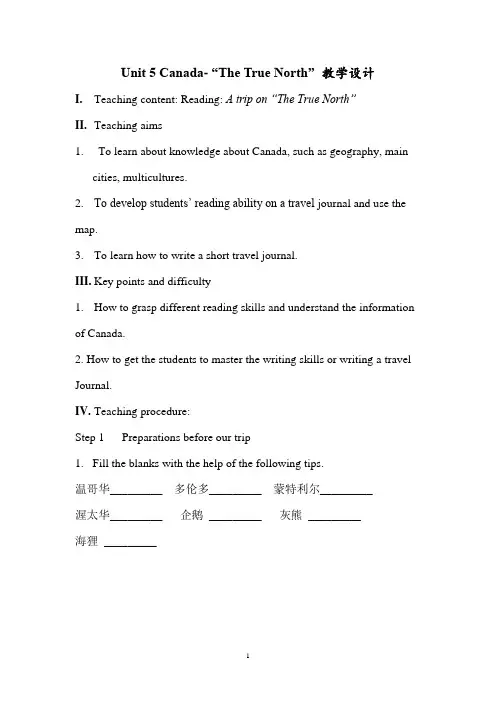
Unit 5 Canada- “The True North”教学设计I. Teaching content: Reading: A trip on “The True North”II. Teaching aims1. To learn about knowledge about Canada, such as geography, maincities, multicultures.2. To develop students’ reading ability on a travel journal and use the map.3. To learn how to write a short travel journal.III. Key points and difficulty1. How to grasp different reading skills and understand the information of Canada.2. How to get the students to master the writing skills or writing a travel Journal.IV. Teaching procedure:Step 1 Preparations before our trip1.Fill the blanks with the help of the following tips.温哥华_________ 多伦多_________ 蒙特利尔_________渥太华_________ 企鹅_________ 灰熊_________海狸_________2.How much do you know about Canada?1)What is the official symbol of Canada?A. Bamboo.B. Maple.C. The Great Wall.D. The Statue of Liberty.2)What language(s) do Canadians speak?A. EnglishB. English and GermanC. English and FrenchD. English and Spanish3)What is the national animal of Canada?A. BeaverB. Grizzly bearC. Polar bearD. Penguin4)What is the capital of Canada?A. VancouverB. TorontoC. CalgaryD. Ottawa5)What is the leader of the country called?A.PresidentB. Prime MinisterC.ChairmanD. King6)How many Great Lakes are there in Canada?A. 4.B. 3.C. 5.D. 6.Let’s begin our magical trip!Step 2 Plans for the trip1.The writing style of this passage is ______________.2.A brief introduction about the tripwho _____ and her cousin ______why To ___________________________how first by ______ , then by ______where ___________________3.Please find out the cities we are going to visit and fill the blanks.First, we will fly to _____________ and then take the______________ train from west to east across Canada. Goingeastward, we will cross the _______ ______________. The next stop is _____________. After two days' travel, we will pass the busy port city of ___________ _________. That night, the train will take us to _____________. Our final stop is ______________.4.Please retell our trip route to your classmates.5.Can you draw our route(路线) from west to east across Canada?Step 3 Adventure on the way1. Three of our foreign friends, John, Sam and Lily, want to visit Canada. However, they only have one day off because of their busy work. Please recommend(推荐) one place for each of them and give your reasons.(1). John, a Western-lover, who always watches horse riding programs on TV. He is anxious for a chance to enjoy it on the spot.Place: ____________Reasons:____________________________________________________________________________________________________________(2). Sam, a geographic knowledge (地理知识) lover, who learns a lot about the Great Lakes and wants to be there to admire the beauty. Place: ____________Reasons:____________________________________________________________________________________________________________(3). Lily, a photographer(摄影师)good at taking photos of the nature, who enjoys water sports. Besides, she wants a warm place.Place: ____________Reasons:____________________________________________________________________________________________________________Step 4 Off the beaten pathTip 1: When we describe a place, we’d better focus on different aspects.a)Here in Vancouver, you’re in Canada’s warmest part._______________b)People say it is Canada’s most beautiful city, surrounded bymountains and the Pacific Ocean.____________________c)Skiing in the Rocky Mountains and sailing in the harbour makeVancouver one of Canada’s most popular cities to live in.Its population is increasing rapidly.______________________d)The coast north of Vancouver has some of the oldest and mostbeautiful forests in the world. It is so wet there that the trees areextremely tall, some measuring over 90 metres._____________________Tip 2 : When we describe different places, we’d better highlight(突出) the features of each one.Vancouver:__________________________________Thunder Bay: __________________________________Calgary: ______________________________________According to the information below and the description of Vancouver, please introduce Toronto to us.___________________________________________________________ ___________________________________________________________ ___________________________________________________________ ____________________________________________________________________ _________________________________________________________________________________________________________________________ ___________________________________________________________ ___________________________________________________________ _______________________________________________________________________ ___________________________________________________________ ______Homework:Write a passage to introduce your hometown to others. You can write mark buildings, unique customs, well-known celebrities and so on. The passage should include at least 120 words.For you:Life is a Journey, not a Destination.There is such a lot of world to see!学情分析第五单元Canada—“the true north”选自人教版高中英语必修三,适用于高一下学期。
高中英语_A TRIP ON THE TRUE NORTH教学设计学情分析教材分析课后反思

Unit5 Canada教学设计一、教学内容介绍人教版必修三第五单元的中心话题是“Canada”。
旅游是一个世界性的时尚话题,随着经济发展、社会进步、人们生活水平的提高,旅游作为现代人的一种生活方式,越来越被更多的人所接受。
该单元的语言知识和技能部分都是围绕加拿大的旅游这一中心话题进行设计的,使学生通过学习,了解加拿大的大体情况,了解的相关注意事项。
教师利用新课标的理念,在教学过程中帮助学生把所学知识和语言运用到生活实际当中,提高学生用英语获取信息、处理信息、分析和解决问题的能力,发展与人沟通和合作的能力。
教学难点掌握相关的生词用法be surrounded by ,rather thanChat, measure, settle down,Catch sight of ,have a gift ofaboard, manage to do教学重点掌握一些常用的阅读技巧如skipping scaning二、设计理念1、新课程提出要有创造性地使用教材,所以我根据教学需要作了一次大胆的尝试,对教材进行了适当取舍。
我上的这节课是本单元的第一课时,是一节较难的阅读课,既要有教师的导,又要有学生的实践活动、自主学习。
2、该课教学抛开传统的教师教学生学的教学方法,让学生在课前通过小组分工合作加拿大的相关知识,并在课堂上开展大量的“任务型”活动来让学生体验语言,在教师的指导下,主动参与计划、组织和实施语言的实践活动。
从而提升学生综合语言运用的能力,并通过活动培养学生自主学习和合作互助的精神,激发学生学习英语的热情。
三、学情分析高一学生已经初步实现从具体思维向抽象思维的过渡。
他们不满足于教科书上的知识,更希望能学到知识性和趣味性兼有的内容,从英语学习中获得更多的知识和能力。
他们喜欢富有个性化的教学设计,喜欢接受新鲜事物。
同时他们还主动扩展和利用学习资源(如电脑操作知识),从多渠道获取信息,并能用所获得的信息进行清楚有条理的表达。
高中英语_A Trip on the True North教学设计学情分析教材分析课后反思
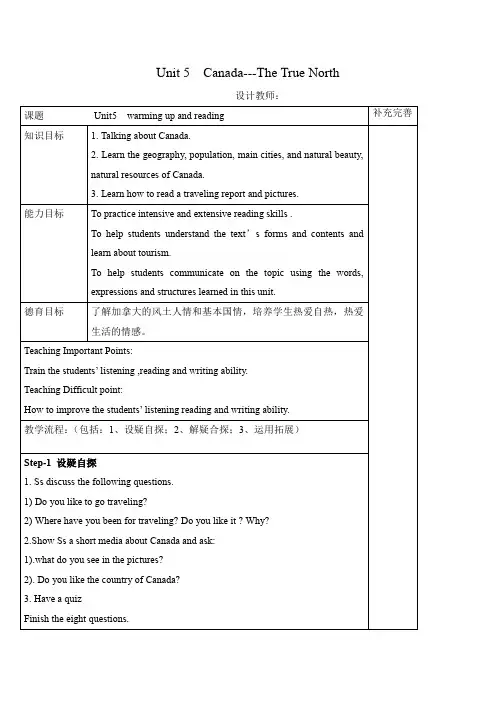
Unit 5Canada---The True North设计教师:学情分析学生是高一普通班的学生,英语基础比较差,平常用英语交流的机会比较少。
经过1-3册英语的学习,基本上适应了上课的流程,转变了对英语的认识,在词汇,口语,理解,表达等各方面都有了很大的进步。
从学生的能力来看,多数学生掌握文章大意,梳理零碎信息,但是在总结归纳关键词和读出文章隐含的“话外之音”方面有欠缺。
因此在教学时,需要对以上几个方面进行进一步的训练。
在学生阅读方法方面,虽然在老师的引导下学生能够做到skimming,scanning 等技巧的应用,但是在独立阅读过程中仍然存在大批学生依靠逐句翻译的方法阅读。
阅读效率低,信息获取慢。
在对文本解读方面,仍然不能够依据文章突出的内容进行观点态度的推断。
不自信,不敢尝试。
因此,在课堂上,要鼓励学生,也要正确引导。
既能够正确理解和延伸,又要做到不过分解读。
在对信息转述方面由于词汇量和表达能力的缺乏,学生在理解文章之后尚不能够做到信息的转述。
在课堂中这个方面的能力还需要进一步培养。
综上作述,英语阅读课要训练学生的综合能力,在学生现阶段表现来看,阅读课的任务任重而道远。
效果分析本节阅读课教学设计符合新课程标准理念。
教学过程完整,教学目标明确,教学活动由浅入深,环环相扣。
具体表现在:1. 预习案部分不但调动了学生学习的兴趣,也激活了学生已有的图式,为接下来的阅读教学进一步的做了铺垫。
2. 能设计多种题型来训练学生的阅读能力,符合学生的实际。
3. 小组讨论引导学生利用已知信息构想和创设新的信息,有利于培养学生综合运用语言的能力。
4. 情感教学的渗透,及时的小结和反馈是另一个亮点。
本节课教学效率高,课堂容量很大,学生思维活跃,从上课学生回答问题的情况来看,准确率高,犯错误的不多见,实现了在知识、能力、情感目标的达成。
教材分析本单元reading(阅读课)部分是一篇游记,记述了李黛予和刘倩去加拿大看她们的表兄妹的途中见闻,向我们展示了加拿大的概况,包括面积、地貌、城市、人口、生态环境等。
高中英语_Book 3 unit 5 A trip on ;The True North;教学设计学情分析教材分析课后反思
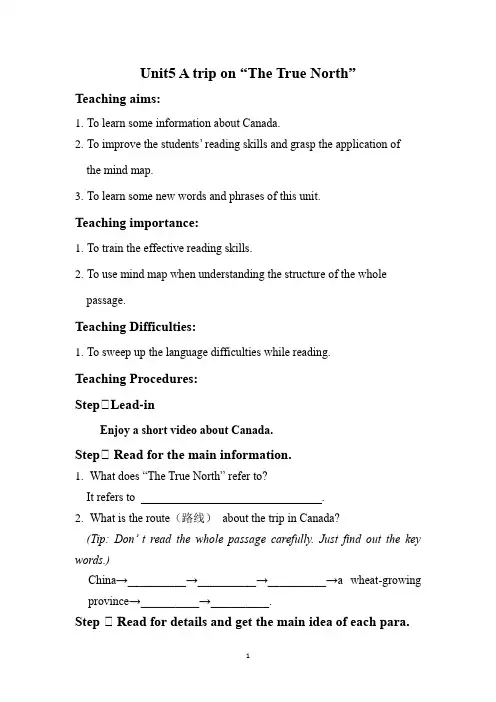
Unit5 A trip on “The True North”Teaching aims:1.To learn some information about Canada.2.To improve the students’ reading skills and grasp the application of the mind map.3.To learn some new words and phrases of this unit.Teaching importance:1.To train the effective reading skills.2.To use mind map when understanding the structure of the whole passage.Teaching Difficulties:1.To sweep up the language difficulties while reading.Teaching Procedures:StepⅠLead-inEnjoy a short video about Canada.StepⅠ Read for the main information.1.What does “The True North” refer to?It refers to .2.What is the route(路线)about the trip in Canada?(Tip: Don’ t read the whole passage carefully. Just find out the key words.)China→__________→__________→__________→a wheat-growing province→__________→__________.Step Ⅰ Read for details and get the main idea of each para.1.Read Para1 carefully and find out the topic sentence.________Main idea: (Think: how to make the sentence shorter? )2.Read Para2 carefully and finish the chart below.____________________________________________________3.Read Para3 and answer the following questions to get the mainidea.Answer the following questions and get the main idea.1. Where is their next stop?_____________________ Mainidea:___________________2. What is it famous for?__________________________________________________If there is no topic sentence, how to get the main idea?_________________________________________________________ ___4. Read Para 4-5 and answer the following question1. What did the girls think about Canada ?__________________________________________________________ 2. Where did they go after dinner? And what did they see and learn?__________________________________________________________ 3. what’s their next destination(目的地)?__________________________________________________________ 4.Please use the key words to summarize the main idea of para 4:5.Summary(总结)1.Draw a mind map to describe the structure of the passage.(Tip: When reading a passage, you can make use of a mind map to help you understand the structure of the whole passage.)2.Main idea of the whole passage____________________________________________________ Step ⅠRead for appreciation.1. The thought _____they could cross the whole Continent was exciting. ( Line3-4)Can you find some more appositive clauses(同位语从句) in the passage?_________________________________________________________ _______________________________________________________________2. Skiing in the Rocky Mountains and sailing in the harbor make Vancouver one of the Canada’s most popular cities to live in.句式分析: 主语为____________________________________________划线部分的结构为____________________________________________3. It is so wet there that the trees are extremely tall, some______________ ( measure) over 90 metres. Step Ⅰ Group discussionSupposing your friend Li Hua wants to have a trip to Canada, which place would you like to recommend (推荐)? And why?Step Ⅰ Summary writing (概要写作)Summarize this passage according to the questions and main idea of each para and the main idea of the whole passage.A summary is a short passage that gives only the main points of apassage, not the details.Tips:Step1. Find out the type of writing and the main idea of the whole passage.Step2. Understand the structure of the passage. (明确文章结构)Step3. Highlight(强调) the key information of each part and summarize its main idea. (Focus on the main idea and ignore the unnecessarydetails )Step 4. Make an outline of the summary.Step 5. Write the first draft●Cover all the key points(who, where, how, what did they see andlearn)●Write in correct tense (时态)●Use proper conjunction s(连词)●Avoid copying the original sentences(同义转换: 近义词、同义词等替换; 调整句子的词类、时态、语态等)●Count the words (60±20)Step 6. Revise(修正) the summaryFor example:Para1-2:Li Daiyu and Liu Qian take “the True North” to visit their cousins in Canada. From their friend, Danny Lin, they knew the distance, beautiful scenery and cities in Canada. And they chatted about Vancouve rStep ⅦHomework1. Recite para 2 and master the charming sentence pattern.2. Write the summary writing on your notebook.学情分析教学内容分析:本节课的内容是人民教育出版社出版的高中教材必修3第五单元的Reading 部分,本单元的话题是Canada--- 李黛予等人在加拿大的旅游经历。
高中英语《A trip on“The True North”》优质课教案、教学设计
必修3 Unit5 Canada ----- The True North 教学设计Period 1 Reading一、教材分析本单元通过两位女孩李黛玉与刘茜的加拿大之旅,向我们展示了加拿大的一些基本概况,包括它的地理位置、主要城市、风土人情以及它的多元文化。
通过学习本单元,让学生对加拿大有更多的了解,使学生能够用所学的词汇与句式表达方向与位置,并学会条理地写出旅游过程中的所见所闻。
本单元阅读部分是一篇游记“在旅途中看加拿大”,两位女孩李黛玉与刘茜沿着从西向东的旅游路线向我们介绍了加拿大的面积、地貌、主要城市、人口、生态环境等。
她们在旅途中看到了自然美景及野生动物,文章还介绍了加拿大的自然资源,让学生对加拿大的美丽、富饶、幅员辽阔、地广人稀有更深的了解。
学生可以通过学习课文掌握新的词汇、句型和游记的写法,提高学生的阅读能力。
二、学情分析本班的学生英语基础一般,平时较少阅读游记题材的文章和知识面相对狭窄,大部分学生缺乏世界地理和历史的知识,阅读理解这篇文章还是有一定难度。
但本班学生的好奇心和学习接受能力比较强,可以布置学生课前上网或去图书馆找出一些有关加拿大的资料,并与多媒体相结合简单介绍加拿大的一些知识,让学生有了一定的知识准备以利于很好的理解课文。
三、设计理念及教学目标这节课的主要目的是培养学生跳读和细读的阅读技巧,使学生学会准确分析阅读问题,懂得从文章中找到关键句子摄取必要的信息,找出正确的答案。
我运用多媒体和学生搜索材料主动参与学习相结合,设计了表格、问答题、画路线题和信息整理题。
这不仅提高学生的阅读技巧,也教会学生怎样处理不同的阅读问题。
1)、情感态度:通过了解其他国家了解世界,扩大学生的知识面,培养学生开放的世界观。
(2)、文化意识:了解加拿大的基本概况,包括它的地理位置、主要城市、风土人情以及它的多元文化,使学生对世界文化有更深的理解。
(3)、学习策略:通过自主学习和小组讨论等方式,培养学生自主探究和合作交流等学习策略。
高中英语_A Trip On The True North教学设计学情分析教材分析课后反思
Teaching DesignTopic: A Trip On “The True North” Teacher:Class: Class 1Time:Teaching Aims Knowledge Aims:1.Students can read the geographical location of Canada on the map.2.Students can develop the reading ability of scanning in reading.3.Students can get the proper usage of “in”, “on” and “to” ingeographical location.Ability Aims1.Students can draw the route of travelling clearly.2. Students can read maps in English.3. Students can express the location of cities in English briefly.Emotion Aims1.Students can enjoy the natural scenery in Canada through reading2.Students can build up the idea that travelling shall be a part of life.3.Students can acknowledge that learning in reality is more vivid. Importance Students can get the basic knowledge of the geography and cultureabout Canada, which are useful to arouse their interest in exploring anddiscovering the outside world.Teaching MethodsStudents-centered & task-based methodsTeaching ProcedureI. Lead-in (4mins)Presentation: Geography Time[Students’ Activity]Suppose you are the host of the program, it’s the time to introduce Canada briefly to us. [Purpose]:1.To check how much the students know about Canada2. To arouse students’ interest in reading the passage.3. To encourage students to speak out in English.II. Pre-readingStep 1. Guess and predict: What is “the true north” in the title?Step 2. Enjoy the song: O Canada[Purpose]:1.To emphasize that the title and pictures are extremely helpful to help readers get the key information of the passage2.To help students get more information about the meaning of “the true north”3. To help students make full preparation for readingIII. Fast readingStep 1. Skim to get the main idea of the passageStep 2. Scan the passage and draw the route of the travel in Canada[Purpose]:1. To train students read as quickly as they can to get the main idea of the passage.2. To train students to get the route first if they are reading a travel journal.3.To help students to read maps.IV. Careful readingStep 1. Read for details about Canada[Students’ Activity]1.Fill in the blanks and get the basic facts on the geographical location, population, natural resourcesetc.2. Get the details about Vancouver, Thunder Bay and Calgary[Purpose]:1.To help students get enough geographical knowledge about Canada.2.To help students get the features of the famous cities in CanadaV. Learning about languageGeographical location.1.Tell students the different function of “in”, ”on” and “to” in describing the location.2.Ask students to read the map and point out the locations of the cities in Canada in English.3.Show students the map of Shandong province and put what we’ve learned into practice.[Students’ Activity]1.Learn to describe the locations with the help of the map.2.Point out the locations of the cities in Shandong Province in their study group. [Purpose]:To help students learn to describe the locations of the cities.VI. Further UnderstandingAsk students to read from L21 to L24.“At school, they had learned that …, and that…,but now they were amazed to see such an empty country.”what does the author want to convey?[Students’ Activity] Discussion:[Purpose]:1. To help students know that a man who travels far knows more.2. To help students build up the idea that travelling is a part of life.VII. After reading[Students’ Activity]Two students in a group and try to put what we have learned into practice. [Purpose]:1.To encourage students to speak English in class2.To train students to organize their words and express themselves clearly.3.To encourage students to travel around our country.VI. Homework (1min)学情分析学生信息:高中一年级I. 学生语言知识情况作为高中二年级的学生无论是在词汇量还是语言理解方面都有一定的局限,但并且我们学校的学生普遍学习基础薄弱,英语语言基础差。