
第二次世界大战简介 希特勒 斯大林简介英语
5. Stalingrad 6. Joseph Stalin
Chronology of the War Date September 1, 1939 April, 1940 Event The Second World War in Europe started with German armies pouring across the Polish frontier. Denmark and Norway were conquered.
Germany surrendered.
II
■
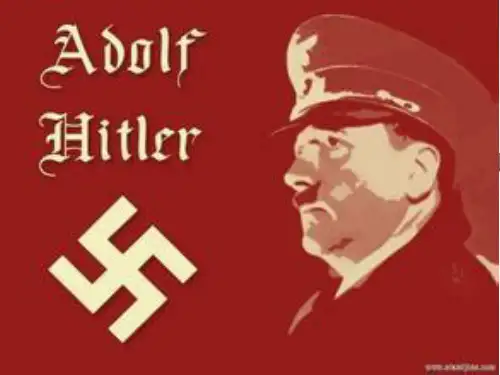
A Brief Introduction to Adolf Hitler
Chronology of the War Date Event
The U. S. A. entered the war after December, 1941 Japanese planes bombed the American naval base at Pearl Harbor. American, British and Canadian forces June 6, 1944 landed in Normandy and opened the second front in Europe. May 2, 1945 May 7, 1945 The Soviet army took Berlin.
Hitler’s troops drove into France and May 10, 1940 within the following six weeks, Holland, Belgium and Luxembourg had surrendered as had France. June 22, 1941 Hitler launched his long-term attack on the Soviet Union. September, 1942 A decisive battle was fought at Stalingrad, ~February, 1943 which was the turning point of the war.
Chronology of the War Date September 1, 1939 April, 1940 Event The Second World War in Europe started with German armies pouring across the Polish frontier. Denmark and Norway were conquered.
Germany surrendered.
Chronology of the War Date ered the war after December, 1941 Japanese planes bombed the American naval base at Pearl Harbor. American, British and Canadian forces June 6, 1944 landed in Normandy and opened the second front in Europe. May 2, 1945 May 7, 1945 The Soviet army took Berlin.
World War II 1. Chronology of the War 2. A Brief Introduction to the War 3. Adolf Hitler A Brief Introduction to Adolf Hitler Hitler’s Chronology 4. Siege of Leningrad
Hitler’s troops drove into France and May 10, 1940 within the following six weeks, Holland, Belgium and Luxembourg had surrendered as had France. June 22, 1941 Hitler launched his long-term attack on the Soviet Union. September, 1942 A decisive battle was fought at Stalingrad, ~February, 1943 which was the turning point of the war.
Chronology of the War Date September 1, 1939 April, 1940 Event The Second World War in Europe started with German armies pouring across the Polish frontier. Denmark and Norway were conquered.
Chronology of the War Date Event
The U. S. A. entered the war after December, 1941 Japanese planes bombed the American naval base at Pearl Harbor. American, British and Canadian forces June 6, 1944 landed in Normandy and opened the second front in Europe. May 2, 1945 May 7, 1945 The Soviet army took Berlin.
Hitler’s troops drove into France and May 10, 1940 within the following six weeks, Holland, Belgium and Luxembourg had surrendered as had France. June 22, 1941 Hitler launched his long-term attack on the Soviet Union. September, 1942 A decisive battle was fought at Stalingrad, ~February, 1943 which was the turning point of the war.
Germany surrendered.
Chronology of the War Date Event
The U. S. A. entered the war after December, 1941 Japanese planes bombed the American naval base at Pearl Harbor. American, British and Canadian forces June 6, 1944 landed in Normandy and opened the second front in Europe. May 2, 1945 May 7, 1945 The Soviet army took Berlin.
Chronology of the War Date September 1, 1939 April, 1940 Event The Second World War in Europe started with German armies pouring across the Polish frontier. Denmark and Norway were conquered.
Hitler’s troops drove into France and May 10, 1940 within the following six weeks, Holland, Belgium and Luxembourg had surrendered as had France. June 22, 1941 Hitler launched his long-term attack on the Soviet Union. September, 1942 A decisive battle was fought at Stalingrad, ~February, 1943 which was the turning point of the war.
Germany surrendered.
Chronology of the War Date September 1, 1939 April, 1940 Event The Second World War in Europe started with German armies pouring across the Polish frontier. Denmark and Norway were conquered.
Hitler’s troops drove into France and May 10, 1940 within the following six weeks, Holland, Belgium and Luxembourg had surrendered as had France. June 22, 1941 Hitler launched his long-term attack on the Soviet Union. September, 1942 A decisive battle was fought at Stalingrad, ~February, 1943 which was the turning point of the war.
Hitler’s troops drove into France and May 10, 1940 within the following six weeks, Holland, Belgium and Luxembourg had surrendered as had France. June 22, 1941 Hitler launched his long-term attack on the Soviet Union. September, 1942 A decisive battle was fought at Stalingrad, ~February, 1943 which was the turning point of the war.
希特勒的英文简介
Dictator of Nazi Germany
from 1934 to
Early yearsu am Inn( 勃 劳 瑙 镇 ), Austria, a town borders Bavaria( 巴 伐 利 亚 ),
Germany. H i t l e r ' s
Entry into politics
In
1923,Hitler attempted an unsuccessful armed uprising in Munich and was imprisoned for nine months , during which time he dictated his book My Struggle( 我 的 奋 斗 ) outlining his political ideology. After his release in 1924,Hitler rapidly regained support by promoting Pan-Germanism , antisemitism ,and anti-communism[`kɔmjunizəm] ( 日 耳曼主 义,反 犹太主 义和反 共产主 义 ) with charismatic [,kærɪz`mætɪk](有魅力的) oratory and propaganda [,prɔpə`ɡændə](宣传).
Something Admirable
Concerned about the National Health
Hitler
paid much attention to the health the citizen. He made a nationwide law ban smoking and recruited a large number scientists to study the dangers nicotine(尼古丁).
希特勒英文版简介

(April 20.1889—April 30 1945)ortant story
effect
1889
1914 1921 1923
been borned in Austria
joined the German army renamed the Labour Party as Nazi Party been sent to prison(munich conspiracy)
4 the United Nations was born .(peace)
proverb:
• 1.I have not come into this world to make men better, but to make use of their weaknesses. 我来到这个世界不是让人们更加完善, 而是来利用他们的弱点的。
Naked body all over the hill and dale .
Nazis is killing the Jews .
the
way to the war
1 In 1938, he began to expand the territory of Germany, the following year ,he sent troops to Austria and the Czech Republic ,invaded Poland, caused World War II and it lasted for nearly five years.
• 2.It `s a weak civilization if it can`t be carried forward and pretected by certain mighty ,and will be conquered by crulty sooner or later. 如果一种文明没有一种强大的力量来发 扬和保护,那么这种文明是脆弱的,迟早 会被野蛮所征服。
希特勒,拿破仑,斯大林历史英文介绍
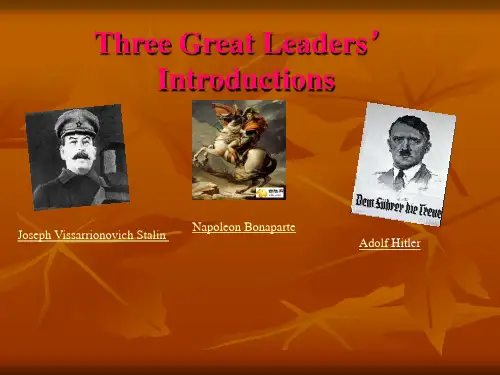
翻译:1804年11月6日,公 民投票通过共和十二年宪 法,法兰西共和国改为法 兰西帝国,拿破仑·波拿 巴为法兰西人的皇帝,称 拿破仑一世。同年12月2日 正式加冕。
1793-1809 years, Britain, Austria, Prussia, the Netherlands, Russia, Denmark, Switzerland, Turkey, Spain, Portugal, countries are participated in five times the law alliance, failed, and napoleon's war self-defense war from into wars of aggression.
翻译:阿道夫· 希特勒,德国人,1921年成为纳 粹党首领,1933年被任命为德国总理,1934年 成为德国元首。他是二战的主要发动者。二战 时,德国势不可挡。然而1942年之后,盟军开 始反攻,德军渐居劣势。1945年德国战败,他 饮弹自杀。
在西欧的战争
On September 1, 1939, Germany against Poland, world war ii began. May 10, 1940 to May 28, ordered the German army invaded the Netherlands, Belgium and Luxembourg. May 13, the German invading France. June 22,, France was forced to signed the document.
翻译பைடு நூலகம்他协助列宁组织和 领导了1917年的十月社会 主义革命。。 1922年至 1952年10月连续当选为党 中央总书记 。
介绍希特勒四十英文作文
探究希特勒:一个复杂的历史人物Adolf Hitler, a figure that has been both vilified and romanticized in history, remains a controversial character even today. Born in 1889 in Austria-Hungary, Hitler rose to power in Germany following the First World War, eventually leading the country into the cataclysmic Second World War. His impact on world history is profound, yet understanding him as a person and the forces that shaped his rise is complex.Hitler's early life was marked by poverty and failure. He experienced the hardships of the Great Depression and the humiliation of defeat in the First World War. These experiences shaped his view of the world as a place of injustice and exploitation, where Germany had been treated unfairly. This sense of victimhood and resentment formed the core of his political ideology.Hitler's rise to power was not solely based on his charisma and propaganda, but also on the social and economic conditions of Germany at that time. The Weimar Republic, established after the war, was unstable and economically weak. The people were disillusioned with thepolitical class and yearned for strong leadership. Hitler's promise of national rejuvenation and revenge against Germany's enemies resonated with many.His Nazi Party, with its antisemitic and racist rhetoric, capitalized on the fears and anxieties of the German people. Hitler's propaganda machine, led by Joseph Goebbels, used every means possible to spread the Nazi message and create a cult of personality around Hitler himself. The result was a powerful movement that swept Hitler into power in 1933.Once in power, Hitler embarked on a campaign ofnational rejuvenation and expansion. He rebuilt the German economy, rearmed the country, and established atotalitarian state that controlled all aspects of life. His foreign policy was aggressive, seeking to restore Germany's lost territorial gains and influence. This led to the annexation of Austria, the Sudetenland, and ultimately the invasion of Poland that triggered the Second World War.Hitler's leadership style was autocratic and dictatorial. He surrounded himself with loyal followers and purged anyone who challenged his authority. His paranoiaand obsession with power led him to commit atrocities such as the Night of the Long Knives, where he eliminated potential rivals within the Nazi Party, and the systematic murder of millions of Jews, Poles, and other perceived enemies of the Reich.Hitler's impact on world history was profound. His aggressive foreign policy led to the deaths of millions and the destruction of entire nations. His legacy of hate and division has had lasting effects on global politics and society. However, it is important to remember that Hitler was not solely responsible for the horrors of the Second World War. The actions of other leaders, such as Joseph Stalin and Winston Churchill, also played a role.In conclusion, Hitler was a complex figure whose rise to power was influenced by both personal and historical factors. Understanding him requires a nuanced understanding of the social and political context of his time. While his actions and ideologies are deeply immoral and abhorrent, it is important to remember that he was not an isolated figure acting alone. The lessons of history must be learned, andHitler's rise and fall serve as a powerful reminder of the consequences of ignoring the warnings of the past.**探究希特勒:一个复杂的历史人物**阿道夫·希特勒,这位历史人物在世人眼中既被妖魔化又被理想化,即使在今天仍然是一个备受争议的人物。
苏联二战介绍英文作文

苏联二战介绍英文作文下载温馨提示:该文档是我店铺精心编制而成,希望大家下载以后,能够帮助大家解决实际的问题。
文档下载后可定制随意修改,请根据实际需要进行相应的调整和使用,谢谢!并且,本店铺为大家提供各种各样类型的实用资料,如教育随笔、日记赏析、句子摘抄、古诗大全、经典美文、话题作文、工作总结、词语解析、文案摘录、其他资料等等,如想了解不同资料格式和写法,敬请关注!Download tips: This document is carefully compiled by theeditor. I hope that after you download them,they can help yousolve practical problems. The document can be customized andmodified after downloading,please adjust and use it according toactual needs, thank you!In addition, our shop provides you with various types ofpractical materials,such as educational essays, diaryappreciation,sentence excerpts,ancient poems,classic articles,topic composition,work summary,word parsing,copyexcerpts,other materials and so on,want to know different data formats andwriting methods,please pay attention!The Soviet Union played a crucial role in World War II. It was a time of immense struggle and sacrifice for the Soviet people. They faced the full force of the German invasion and fought with unwavering determination. The Soviet Union's contribution to the war effort cannot be overstated.The Soviet Union was initially caught off guard by the German invasion in 1941. The German forces swiftly advanced into Soviet territory, causing widespread panic and chaos. However, the Soviet people refused to be defeated. They mobilized their resources and launched a counteroffensive that pushed the Germans back. This marked the beginning of a long and brutal war on the Eastern Front.The Soviet Union's military strength was formidable. They had a large and well-equipped army that was able to withstand the German onslaught. The Soviet soldiers fought with incredible bravery and resilience, often in harshconditions. They were willing to make great sacrifices for the sake of victory. Many Soviet cities and towns were completely destroyed during the war, but the people never gave up.The Soviet Union also played a crucial role in the defeat of Nazi Germany. The Battle of Stalingrad, which took place from 1942 to 1943, was a turning point in the war. The Soviet forces successfully defended the city against the German army, inflicting heavy casualties and forcing a German retreat. This battle marked a major shift in momentum and gave the Allies a much-needed boost.The Soviet Union's contribution to the war effort extended beyond the battlefield. They provided vital supplies and resources to the Allies, helping to sustain the war effort. The Soviet Union also played a key role in the liberation of Eastern Europe from Nazi occupation. They were instrumental in the defeat of Hitler's regime and the ultimate victory of the Allies.The Soviet Union paid a heavy price for their victory.The war took a tremendous toll on the country, withmillions of lives lost and widespread destruction. However, the Soviet people's resilience and determination ensured that they emerged victorious in the end.In conclusion, the Soviet Union's role in World War II was pivotal. They faced immense challenges and made significant sacrifices, but their unwavering determination and military strength played a crucial role in the defeat of Nazi Germany. The Soviet Union's contribution to the war effort cannot be underestimated.。
希特勒英文简介(HitlerEnglishIntroduction)
希特勒英文简介(Hitler English Introduction)个人简介英文姓名:阿道夫·希特勒中文名称:阿道夫。
希特勒性别:男出生日期:1889年4月20日出生地:Braunau的奥地利小镇(靠近德国边境)死亡日期:1945年4月30日死亡地点:柏林阿道夫·希特勒(帮助·信息)(1889年4月20日–1945年4月30日)从1933德国总理和“Fü给”(领袖)德国从1934直到他的死亡。
他是德国国家社会主义工人党的领袖(国家社会主义德意志工人党或纳粹党),更好地称为纳粹党。
独特的身世希特勒的父母都来自贫农家庭。
他的父亲Alois Hitler,一个女仆的私生子,是一个聪明、有野心的人,后来成为一名高级海关官员。
Klara Hitler是alois'third妻子。
阿洛伊斯比克拉拉年长二十三岁,已经有了两个孩子从他以前的婚姻。
Klara和阿洛伊斯有五个孩子,但只有阿道夫和一个妹妹,保拉,存活到成年。
发展过程1.student2.soldier3.do在小学4.stop试图成为第一研究最喜欢的游戏艺术5.move维也纳6.receive父亲的公务员养老7.volunteer FR德国军队在慕尼黑9.rebuild8.be纳粹aarty其他士兵逮捕10.establish第三帝国11.base专制mand他的军队去打仗13.die希特勒与中日关系的两面性希特勒关于中国和日本1的想法。
鄙视日本看好中国他看着日本。
但是,他看好中国。
2。
喜欢中国茶叶希特勒喜欢喝中国茶。
3。
希特勒不准报道南京大屠杀希特勒不允许人们报告南京大屠杀。
阿道夫。
希特勒已经不再是之一个人,他泛指了一个时代的血型与残暴,扭曲与狭隘。
他是法西斯的象征,而他背后,是第二次世界大战的开始与终结。
阿道夫·希特勒不再是一个人,他是指血液和残酷的时代,失真和狭窄。
他是法西斯的象征,在他身后,是第二次世界大战和结束的开始。
介绍斯大林的英文演讲稿
介绍斯大林的英文演讲稿Ladies and gentlemen,。
Today, I am honored to have the opportunity to introduce one of the most influential leaders in the history of the world – Joseph Stalin. Joseph Stalin, born in 1878 in Georgia, was the leader of the Soviet Union from the mid-1920s until his death in 1953. He played a key role in the Allied victory in World War II and the post-war reconstruction of Europe. His leadership and policies had a profound impact on the Soviet Union and the world.Stalin's rise to power began after the death of Vladimir Lenin in 1924. He quickly consolidated power and became the leader of the Soviet Union. Under his rule, the Soviet Union underwent rapid industrialization and collectivization of agriculture. His policies, known as Stalinism, were characterized by a command economy, state ownership of industry, and the suppression of political opposition.Stalin's leadership during World War II was crucial to the defeat of Nazi Germany. He played a key role in coordinating the Allied war effort and was instrumental in the Battle of Stalingrad, a turning point in the war. His leadership and determination were essential in the Soviet Union's victory over the Axis powers.After the war, Stalin's policies led to the establishment of satellite states in Eastern Europe and the beginning of the Cold War. His aggressive tactics and expansionist policies created tensions with the Western powers, leading to a decades-long struggle for global dominance.Stalin's domestic policies were marked by repression and terror. His regime was responsible for the deaths of millions of Soviet citizens, through forced labor camps, executions, and purges of political opponents. The Great Purge of the 1930s resulted in the imprisonment and execution of thousands of Soviet citizens, including many high-ranking officials and military leaders.Despite his controversial legacy, Stalin remains a figure of great historical significance. His leadership shaped the course of the 20th century and continues to influence global politics to this day. His impact on the Soviet Union and the world cannot be overstated.In conclusion, Joseph Stalin was a complex and controversial figure whose leadership had a profound impact on the Soviet Union and the world. His policies and actions continue to be the subject of debate and analysis, and his legacy remains a topic of intense interest for historians and scholars. Thank you for your attention.。
描写希特勒英语作文
Hitler: A Dark Chapter in HistoryAdolf Hitler, the infamous leader of Nazi Germany, remains a controversial figure in history, known for his ruthless ambition, extreme nationalism, and anti-Semitism. His rise to power and subsequent reign of terror during the Second World War have left an indelible mark on the world.Born in Austria in 1889, Hitler's early life wasfraught with poverty and instability. His father, a strict disciplinarian, often beat him, while his mother was overprotective. This dysfunctional family environment shaped Hitler's character, making him insecure and paranoid. As a young man, he moved to Germany and joined the army, where he found a sense of belonging and purpose.After the First World War, Hitler's political career began to take shape. He joined the German Workers' Party, which later became the Nazi Party, and rose through its ranks, eventually becoming its leader. Hitler's powerful oratory skills and charisma enabled him to attract a large following, especially among the disenchanted anddisillusioned Germans.Hitler's political philosophy was based on extreme nationalism, anti-Semitism, and social Darwinism. He believed that the German race was superior to all others and that the Jews were a threat to German society. He advocated for the expansion of German territory and the elimination of all perceived threats to the Reich.Under Hitler's leadership, the Nazi Party gained significant political power in Germany. In 1933, Hitler became the Chancellor of Germany and quickly consolidated his grip on power. He abolished democratic institutions, established a totalitarian state, and began to implement his radical agenda.Hitler's reign of terror was marked by widespread discrimination, persecution, and violence. Jews, homosexuals, political opponents, and others were targeted for elimination. Concentration camps were established, and millions of people were killed or enslaved. Hitler's ambitions led him to invade numerous countries, including France, Belgium, the Netherlands, and Russia, in a bid for world domination.The Allied Powers, led by the United States, Great Britain, and Russia, eventually defeated Germany in the Second World War. Hitler's reign came to an end in April 1945, when he committed suicide in his bunker in Berlin, rather than face capture and trial.The legacy of Hitler and the Nazi era is complex and multifaceted. While Hitler's actions and ideologies were barbaric and reprehensible, they also serve as a stark reminder of the dangers of unchecked ambition, intolerance, and hatred. Hitler's rise to power and the atrocities committed under his leadership are a cautionary tale forall nations and generations.**希特勒:历史中的黑暗篇章**阿道夫·希特勒,纳粹德国的臭名昭著的领导人,以他冷酷无情的野心、极端民族主义和反犹太主义而臭名昭著,在历史中是一个充满争议的人物。
高级英语第一册Speech on Hitler’s Invasion of the U.S.S.R
Aged seven
In military uniform
• Churchill’s Quotations
• • • • • • • • • • • 1. Never, never, never, never give up. 永远,永远,永远,永远都不要放弃。 2. History is written by the victors. 历史是由胜利者书写的。 3. Courage is going from failure to failure without losing enthusiasm. 勇气就是不断失败,而不丧失热情。 4. Courage is what it takes to stand up and speak; courage is also what it takes to sit down and listen. 站起来说话需要勇气;坐下倾听同样需要。
• 希特勒给全世界带来空前灾难
伊希 斯特 希勒 特的 勒父 亲 阿 洛
-
拉希 希特 特勒 勒的 母 亲 克 拉
-
吉莉-劳巴尔是希特 勒一生中真正爱 过的女人,她是希 特勒的外甥女, 1931年在慕尼黑的 公寓里自杀身亡
布希 劳特 恩勒 的 情 Fra bibliotek 爱 娃 - 以希特勒为首的德国纳粹党徒的臂章和旗帜上使 用的变形“卐”字(将“卐”字左旋或右旋45度 而得),是盗用佛教的卍字而来的。流年似水, 人类进入了20 世纪。希特勒认为雅利安人是最优 良的人种,卐是雅利安人的符号;犹太人是低劣 的人种,他在狂热地追求“种族纯洁”时,掀起 了一次又一次的排犹运动。二三十年代,他在为 德国国家社会主义党设计党旗时,在红布上的白 色圆圈中嵌上黑色的“X”(卐旋转45度),作 为反对犹太人的标志,1935年9月,它成为第三 帝国的国旗和徽章。在红白黑三色的“X”符旗 下,纳粹党的排犹运动,第三帝国等法西斯国家 挑起的第二次世界大战,造成人类的浩劫。
高级英语第一册 希特勒简介
Introduction
Important story
effect
1889 1914 1921 1923 1933 1934 1939 1945
been borned in Austria joined the German army renamed the Labour Party as Nazi Party been sent to prison(munich conspiracy) as the German prime minister as the headman of German lead to World War II dead by suicide
Persecuted the Jews
1 Since 1933, the Nazi party began to dictatorship in power , Then, a large anti-Jews action became prevail. ( gun ,waste gas ,Hydrogen Cyanide Gas) 2 The Holocaust from the June 22, 1941 , is a largescale massacres of Jews who living in rural areas of the Soviet Union .In the German ethnic cleaning campaign ,nearly six million Jews were killed. The fundamental purpose is to find an excuse for war (concentration camp )