
九年级英语(牛津译林版)上册Unit1 Know yourself Unit1 Welcome公开课课件
Who is she/he in our class?
• like asking questions • be curious about everything What job can he/she do in the future?
Who is she/he in our class?
• quiet and shy • be talented at writing articles • modest (not proud,never show off) • patient enough to explain problems to others What job can he/she do in the future?
Do you think you can judge someone’s personality by how they look?
Look at these pictures and discuss what you think their personalities are like?
cruel(残忍的) aggressive
Guessing game Who is she/he in our class?
Keep the desk and schoolbag tidy keep all her things in good order be well organized What job can he/she do in the future?
good?
It makes them feel good to share
things with others.
(3) What happens to Eddie’s breakfast
in the end? Hobo has eaten it up. (4) Is Eddie willing to share his breakfast with Hobo?
wise smart
hard-working
(好斗的)
confident
creative handsome athletic modest
intelligent
...
honest
modest 谦虚的
organized
curious 好奇的
energetic 精力充沛的
creative 有创造力的
Samuel is _______. creative He often comes up with new ideas.
• What kind of person are you? • What personalities do you have in common with your classmates? • Is personality important in one’s life? Why? • Does personality matter in finding a satisfactory job? Specify your reasons. • What kind of person would you most like to meet?
Suzy is well _________ organized . She keeps all her things in good order.
Daniel is very clever, but he is _______and never modest shows off.
Mr Wu is patient ______ enough to repeat gramm he isn’t.
Look at the pictures and read their conversation. Then try to act it out.
A Some words are often used to describe people's personalities. Help Millie complete the following sentences with the words in the box. creative modest curious organized energetic patient
Unit 1 Know yourself
Welcome to the unit
Objectives To understand the comic strip To learn to describe people’s personalities To learn to talk about your own personalities and the kind of job you like or dislike To learn the new words and expressions
Who is she/he in our class ?
• draw pictures and decorate the wall • come up with /think of new ideas • be creative
What job can he/she do in the future?
Listen to the comic strip and answer the questions.
(1) What is the interesting article about?
It is about personality.
(2) What makes generous people feel
Who is he/she in our class?
• play for hours without feeling tired • look happy and naughty • be full of energy • be energetic
What job can he/she do in the future?
牛津译林版英语九上Unit 1《Know yourself》(Grammar)教学设计
牛津译林版英语九上Unit 1《Know yourself》(Grammar)教学设计一. 教材分析牛津译林版英语九上Unit 1《Know yourself》主要介绍了关于个人的一些基本信息,如姓名、年龄、兴趣爱好等。
本节课主要围绕一般现在时态进行叙述,通过学习本节课,学生能够掌握一般现在时态的构成和用法,并能运用到实际情景中。
二. 学情分析九年级的学生已经具备了一定的英语基础,能够理解和运用一些基本的英语语法知识。
但是,对于一般现在时态的掌握还不够熟练,需要通过本节课的学习进一步巩固。
同时,学生对于描述自己的个人信息还比较陌生,需要通过本节课的学习来提高这方面的能力。
三. 教学目标1.知识目标:学生能够掌握一般现在时态的构成和用法,并能运用到实际情景中。
学生能够正确运用一般现在时态描述自己的个人信息。
2.能力目标:学生能够通过阅读和听力材料,获取关键信息并运用一般现在时态进行描述。
学生能够在小组讨论中,运用一般现在时态进行自我介绍和相互介绍。
3.情感目标:学生能够增强自信心,更好地了解自己。
学生能够通过学习,培养对英语学习的兴趣。
四. 教学重难点1.教学重点:一般现在时态的构成和用法。
运用一般现在时态描述自己的个人信息。
2.教学难点:一般现在时态的运用,特别是在实际情景中的运用。
五. 教学方法1.任务型教学法:通过设定各种实际情景,让学生在完成任务的过程中,运用和巩固一般现在时态的知识。
2.交际型教学法:通过小组讨论和角色扮演等方式,让学生在实际交际中,运用一般现在时态进行自我介绍和相互介绍。
3.情境教学法:通过创设各种情境,让学生在实际情境中,理解和运用一般现在时态。
六. 教学准备1.教师准备:准备相关的教学材料,如PPT、教案、听力材料等。
准备教学中所需要的一些实物,如图片、卡片等。
2.学生准备:学生需要预习本节课的内容,了解一般现在时态的构成和用法。
七. 教学过程1.导入(5分钟)教师通过提问方式,引导学生回顾已学过的一般现在时态的知识,为新课的学习做好铺垫。
牛津译林版英语九年级上册Unit 1 Know yourself --单元提优卷
Unit 1 Know yourself提优卷Ⅰ.单项选择1. Most people believe that your personality is formed by both nature and environment.A./;/B. a; anC. /; theD. the; the2. Be patient! Give him more time, he will find the answer to the question on his own.A. butB. orC. andD. so3. We teenagers shouldn't be impatient our own problems. they are solved, we can never give up.A. in; TillB. with; SinceC. to; UntilD. with; Until4. The young artist has received high from the art community for this sculpture.A. prideB. praiseC. promiseD. progress5. Driving in rush hours might be very dangerous, so you be too careful.A. can'tB. mustn'tC. canD. must6.—What would you like to have for supper?—Either noodles or rice OK. I don't mind.A. areB. wereC. isD. was7.—Why did Carl look upset yesterday?—Bert didn't invite him to the party, so he felt .A. pulled togetherB. left outC. given upD. kicked off8. It is selfless(无私的) the doctor to devote all the time he had for the patients.A. for; to careB. of; to careC. for; to caringD. of; to caring9.—Did you enjoy yourself at the party last night?—No, not at all! I was blind because I left my glasses in the taxi.A. so good asB. as well asC. as good asD. so well as10. —What do you think of Jason?—He has me with his good sense of humour.A. impressedB. admiredC. remindedD. warned11.—I don't think we can any mistake again. This is our last chance.—I know, and I will try my best.A. affectB. appearC. affordD. offer12.—What else should we pay attention to building the bridge?—The change of the weather, I think.A. finishB. finishedC. to finishD. finishing13. There lots of bad information which is not for teenagers on the Internet.A. seems to be; suitB. seems to have; fitC. seem to have; fitD. seems to be; suitable14.—It's a pity that my teachers parents allow me to swim alone.—After all, you are too young. Safety comes first.A. either; orB. neither; norC. both; andD. not only; but also15.—It's his new book, but I think it is more interesting than his other books.—. His latest book is up to his highest standard.A. I can't agree moreB. That's all rightC. I don't think soD. It doesn't matterⅡ.完形填空“Dana, how are you feeling today?”I ask, noticing her dirty uniform, and the 1 circles under her eyes.“OK,”Dana mumbles(嘟囔).“Have you eaten today?”She nods. Another 2 .“Can I get you anything?”But what could I 3 get her? A bedroom of her own? A family with love?“No, thanks.”Repeated absence from school recently, she has worn out teachers’ 4 . But I don’t want to send her back to class. What 5 is it knowing all the square numbers and all the grammatical rules when she has to work out how to wash, cook and decide between feeding herself or her younger sister?“A biscuit?”I offer. It 6 and Dana takes the biscuits I hand her.I remember the first time I met Dana, the day after she 7 herself in the house when her mum left the family. I remember thinking how 8 she was to have built such a high wall aroundherself and how on earth(究竟) I could break through. As a social worker, it is my 9 to knock down such walls no matter how.I know it would 10 more than a biscuit to move away one of her bricks. But I will try.“How are you feeling?”I push slightly, 11 the biscuit might have softened her.“OK,”she shrugs. I'm about to change 12 when her eyes rest on my arm.“How does that feel, Mia?”Dana stares at me. The sleeve(袖子) of my bl ouse has rolled up, evidence of how deep I had put it into the biscuit can. A scar along my 13 is obvious against my fair skin.I roll my sleeve back down, “It's from a fire. It 14 . But everything will be OK when you think it's OK.”Dana pauses and 15 another biscuit. At that moment, I know something has changed in the room and we might actually be OK.1. A. dark B. light C. small D. new2. A. mistake B. lie C. line D. way3. A. nearly B. hardly C. possibly D. mostly4. A. role B. patience C. pleasure D. style5. A. lesson B. secret C. excuse D. use6. A. arrives B. cares C. works D. tests7. A. taught B. helped C. protected D. locked8. A. calm B. able C. young D. shy9. A. rule B. job C. turn D. chance10. A. affect B. waste C. test D. take11. A. facing B. knowing C. hoping D. promising12. A. opinions B. seats C. topics D. colours13. A. arm B. face C. leg D. neck14. A. drops B. hurts C. rises D. cuts15. A. looks after B. makes up C. picks up D. takes downⅢ.阅读理解AAlways believe in yourself no matter what happens to you and love the person that you are. These are laws of life that are useful to everyone, I think that before people can live happy lives, they must believe in and accept themselves.The hardest thing for you to do is to look in the mirror and like what you see, and then be thankful. And believe you can finish anything you try to do. To live a comfortable life, you must start with believing in yourself.I have struggled with believing in myself so many times in my life. Struggling with little tasks such as completing homework or memorising a piece on the piano, I would get so upset. But you never realise how much easier your life will become until you say,“I can do this!”Four or five years ago, I began taking piano lessons. One day, recital time was coming near, but I had a piece that I couldn't completely memorise. Coming home with a feeling of sadness, I just considered I could not achieve this task. I sat at my piano and told myself that I would never get it finished. But on second thought, I could memorise it. So, I tried my best to play and play. Finally, I did end up finishing the piece, and the recital was able to go smoothly. The important point is that looking back on this time in my life, I can see how important it is to believe that I can complete anything I want to do if I try my best.Now, when I become upset with a piano piece, I never give up and think that I cannot do it. Always beginning with confidence, I sit down and tell myself that I can achieve my goal if I put my mind to it. I realise that I should have this mind in everything I do.So, dear friend, never give up, and believe that you can complete anything if you set your mind and heart on it.1. When you look in the mirror, the most difficult thing for you is to in it.pare with othersB. accept yourselfC. change yourselfD. see anyone else2. What's the Chinese meaning of the underlined word“recital”in Paragraph 4?A. 游戏B. 演奏会C. 歌唱D. 娱乐3. What is the correct order of the following statements of the passage?a. The writer thinks you can achieve your goal if you put your mind to it.b. When becoming sad with a piano piece, the writer never gives up.c. The writer began taking piano lessons four or five years ago.d. When not finishing little tasks, the writer would get upset.e. Always believe in yourself in any condition.A. a-b-c-d-eB. d-c-e-a-bC. e-d-c-b-aD. c-e-d-b-a4. What can we learn from the passage?A. The harder you work, the luckier you will become.B. Try to do anything that you feel difficult to finish.C. Believing in yourself means you can do everything well.D. Nothing is difficult if you put your heart into it.5. The passage probably comes from .A. a magazineB. the newsC. a storybookD. a music bookBVisit a middle or large size of company these days, and you' re likely to find the staff(全体职工) members sharing a large, open space. Instead of having personal offices with doors and walls, most workers sit in cubicles that are half open. Whenever workers talk on the phone, other members of staff nearby can't simply shut their doors. In fact, sometimes they can't help but overhear everything that's said. At times, the best way to focus in this type of office is to reach for one's headphones and listen to music.The open office idea is not new. It was created by a team of consultants(顾问) from Hamburg, Germany, in the 1950s. Called the office landscape(景观) plan, the idea was created to improve communication and the exchange of ideas. The design also encouraged managers and their teams to work near each other, making it easier for managers to guide projects. Now, the open office idea is often used as an excuse for companies to save money on building costs, paying no attention to the effect on working performance.Many start- ups have a great interest in the open office idea. Take Chartbeat for example, the company's 50- plus staff members get to choose their desk and chair styles, and everyone shares an open space with the CEO sitting in the middle. The office space has both single workstations and informal meeting areas where workers can relax themselves on sofas. While this design may be perfect for workers in start- ups, it may not be convenient for workers who have a great need of personal space. In 2011, Matthew Davis, an organisational psychologist(心理学家), checked over a hundred studies about office environments. He found that, to staff in open offices, it was harder to stay focused and more likely to get higher stress than those working in traditional offices. What's worse, a study in Denmark found that workers in open offices took more sick days than those working in traditional offices.Even though open office plans present hidden problems on worker health and personal needs, businesses probably won't return to traditional offices. Modern office workers tend(倾向) to need both time to focus and time to work together with others. So designing offices that account for both needs may be the best way forward.6. What is mainly discussed about the open office in Paragraph 1?A. The benefit.B. The problem.C. The history.D. The management.7. What was the purpose of the office landscape plan at the beginning?A. To save space.B. To reduce cost.C. To improve working conditions.D. To encourage communication.8. If you work in Chartbeat, which of the following CAN'T you do?A. Have a casual(随意的) meeting at your convenience.B. Share an open space with your co- workers.C. Shut your door when someone talks on the phone.D. Exchange your ideas with co- workers at any time.9. What does the underlined phrase “account for”in the last paragraph probably mean?A. Include.B. Record.C. Forget.D. Translate.10. What can we learn from the passage?A. Working in open offices can reduce higher stress.B. The writer suggests working in traditional offices.C. Staff members like wearing headphones to listen to music in the open offices.D. The open offices are good for managers to guide projects and work with the staff.Ⅳ.阅读与回答问题Brian Kane was a rubbish collector in Denver, Colorado. Eight hours a day, five days a week, fifty weeks a year, he rode on the back of a garbage truck. At each stop, he would run to the back of buildings, and then pull heavy rubbish cans to the truck. Brian never complained.Brian saw these hardships as opportunities to become strong and fit. His job was a training ground for his lifelong dream: to climb Mount Qomolangma. On his thirtieth birthday, Brian took a leave from his job and flew to Nepal to begin the long, difficult journey up Mount Qomolangma.Brian first climbed to a basecamp(大本营). He planned to bring three oxygen containers(氧气罐) with him to the top. At 29,028 feet, it would be hard to survive(存活) without extra oxygen. Over the next two months, Brian climbed to 26,000 feet, to Camp Four—the last place to rest below the top of the mountain. But when Brian saw this camp, he fell to his knees.“Rubbish!”he cried. Nearly a thousand empty oxygen containers littered the camp area. Humans had turned this beautiful, far- away place into a big rubbish pile(堆). Brian was very sad. But with a strong determination(决心) he continued to follow his dream. Two days later he stood proudly on the top of Mount Qomolangma. He had reached the “roof of the world”!Two days after this great achievement, Brian put a dozen empty oxygen containers in his pack and walked down the mountain. He smiled to himself as he realised that the work of a rubbish collector is great and never done.每题答案不超过5个词。
牛津译林版英语九年级上册Unit1《Knowyourself.》说课稿3
牛津译林版英语九年级上册 Unit 1 《Know yourself.》说课稿3一. 教材分析《Know yourself》是人教版牛津译林英语九年级上册的第一单元,本节课的主题是了解自己,旨在让学生通过交流和探讨,更好地认识自己,提高自我认知能力。
教材内容丰富,包括听力、口语、阅读和写作等各个方面,通过本节课的学习,让学生在语言运用的过程中,提升自己的综合语言运用能力。
二. 学情分析九年级的学生已经具备了一定的英语基础,对于日常的交流和简单的文章阅读已经没有问题。
但是,对于一些较复杂的语法结构和词汇,他们可能还不能熟练运用。
同时,由于他们已经习惯了应试教育的模式,可能会对主动探讨和表达自己观点的能力有所欠缺。
因此,在教学过程中,需要关注学生的个体差异,充分调动他们的积极性,提高他们的自主学习能力。
三. 说教学目标1.知识目标:学生能够掌握本节课的生词和短语,了解一般现在时的用法。
2.能力目标:学生能够通过听力、口语、阅读和写作等环节,提高自己的综合语言运用能力。
3.情感目标:学生能够通过交流和探讨,更好地认识自己,提高自我认知能力。
四. 说教学重难点1.教学重点:学生能够掌握一般现在时的用法,能够运用所学知识进行日常的交流。
2.教学难点:学生能够熟练运用一般现在时进行复杂的句子构造,能够就主题进行有深度的探讨。
五. 说教学方法与手段在本节课的教学过程中,我将采用任务型教学法,通过设置各种任务,让学生在完成任务的过程中,自然而然地学习和掌握知识。
同时,我会运用多媒体教学手段,如PPT、视频等,提高学生的学习兴趣,帮助学生更好地理解和记忆知识。
六. 说教学过程1.导入:通过播放一段关于自我认知的视频,引发学生的思考,激发他们的学习兴趣。
2.呈现:通过展示图片和实物,引导学生学习本节课的生词和短语。
3.练习:通过各种练习活动,让学生巩固所学知识,提高他们的语言运用能力。
4.任务:设置一个关于自我介绍的任务,让学生在完成任务的过程中,运用所学知识。
Unit 1 Know yourself!-九年级英语上册单元写作深度指导(牛津译林版)
Unit 1 Know yourself!单元写作指导与演练近三年考情分析本单元话题为写一封推荐信。
该板块的活动主题是“推荐班长”,写作要求是以班级中选班长为主题语境,假设你的班级正在推选班干部,请联名写一封推荐信,向老师推荐一名同学,David担任某个职位。
当我们介绍人物时,我们要把自己介绍的人物写得个性鲜明,能明确表现这个人的思想品质或性格特点。
给看推荐信的人留下深刻印象。
本单元写作要求同学们能用所学的词语和句型简单地介绍自己或他人。
写作目标:在具体的写作中,学生应做到以下几点:1.职位特点概括候选人的性格和能力,并使用细节和例子来支撑观点。
2运用所学知识按照推荐信的结构写一封推荐信。
3.学会观察、了解同伴,学习同伴的优秀品质,并通过向他人推荐同伴反思自己的不足。
常用表达:1.We are writing to recommend ... as our new monitor to...我们写信是为了推荐...作为我们的新班长...2.He/She has many strong qualities for this position.他/她胜任这个职位有许多优点。
3.He/She always/often/never他/她总是/经常/从不4.... is very confident/clever/helpful/hard-working.非常自信/聪明/乐于助人/勤奋。
5...We think ... is the most suitable/right person to be .... ...我们认为...是最合适的人...6.We hope that you agree with us.6.我们希望你同意我们的意见。
(以思维导图的形式呈现)【词汇积累】一、Personal Qualities1.be skillful at/ show great skill at sth精通...2.a boy with great potentiality/ability有着极大的潜力/能力的男生3.have a gift for有某事的天赋4.be an expert in是某方面的专家5.speak fluent English讲流利英语6.has a positive influence on sth对某事有积极的影响7.be highly competent for sth在某事上有竞争力的8.be enthusiastic about对某事有热情9.show great interest in.在某事上展示出很大的兴趣10.Mature, dynamic and honest.思想成熟、精明能干、为人诚实。
2023年牛津译林版九年级英语上册《Unit1 Kown yourself》Reading 1 教案

Unit1 Kown yourselfReading 1 教案Teaching goals:knowledge and skills: To learn the keys words and phrasesProcess and method: To do some exercise to consolidate Ss’ basisEmotion and attitude: To learn the four people who are outstanding in their fields.Important and difficult points:To improve Ss’ the reading skillsTo learn to u se conjunctions .Teaching methods:Listening, speaking and readingTeaching procedures:Step One Revision1.Talk about personalities and the things they like to do.2.Make students to say some adjectives to describe people’s personalities according to the description. Keep all her things in order------- organizedDoes not get angry easily------ patientNever show off -------- modestOften had exciting ideas ----- creativeAlways play football for hours------ energeticOften come up with new ideas------creativeLikes asking questio ns-------curiousStep Two Pre-readingWhat jobs will be suitable for them in the future?Encourage students to show their own ideasStep Three While-reading1.We are going to meet some people who are outstanding in their field. Skim the reading and answer the question below.How many people are mentioned in the article?Who and what are they?二、Listen to the tape and do true of false.三、Read after the tape and answer the question of each part to make students understand better. Paragraph1. Does Wu Wei like to talk?What has he won from the art community ?Paragraph2 Is Su Ning active and energetic?What do you think is more suitable for her, an accountant or a manager?Paragraph3. What is Liu Hao’s personality?Is Liu Hao’s personality suitable for his job?====Paragraph4. How long does Fang Yuan often do operations a day?Why do people in the town respect her?Step Four Post-ReadingWork in pairs and choose one paragraph to retell.【课堂检测】一、单词拼写。
Unit1 Know yourself 单元测试 2024-2025学年牛津译林版九年级上册英语
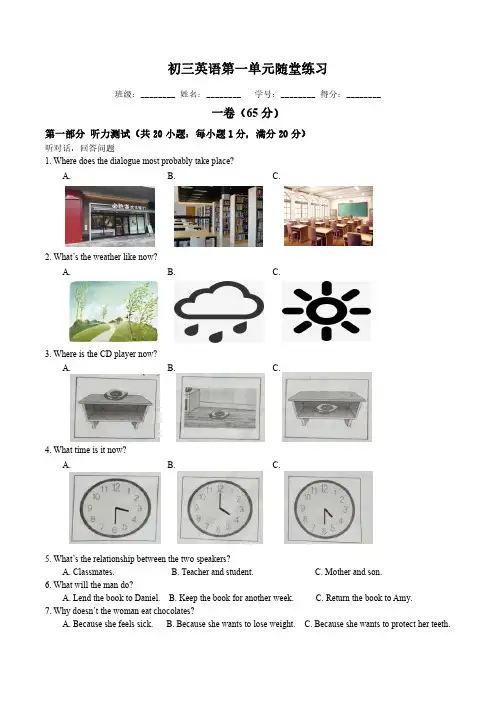
初三英语第一单元随堂练习班级:________姓名:________学号:________得分:________一卷(65分)第一部分听力测试(共20小题:每小题1分,满分20分)听对话,回答问题1.Where does the dialogue most probably take place?A. B. C.2.What’s the weather like now?A. B. C.3.Where is the CD player now?A. B. C.4.What time is it now?A. B. C.5.What’s the relationship between the two speakers?A.Classmates.B.Teacher and student.C.Mother and son.6.What will the man do?A.Lend the book to Daniel.B.Keep the book for another week.C.Return the book to Amy.7.Why doesn’t the woman eat chocolates?A.Because she feels sick.B.Because she wants to lose weight.C.Because she wants to protect her teeth.8.How does the woman feel about the film?A.It’s bad.B.It’s good.C.It’s popular.9.What’s the boy looking for?A.A football.B.A basketball.C.A volleyball.10.What can we learn about Tom?A.He is a top student.B.He doesn’t work hard now.C.He used to play computer games too much.听第一篇对话,回答第11-12小题。
Unit 1 Know yourself Intergrated...课件牛津译林版英语九年级上册
Signs
Animal Signs Star Signs
How many Depend on How long a cycle represents
12
year of birth
12 years
12
date of birth
1 year
Order fixed fixed
▲
A Millie is writing about what she has learnt from the radio. The secret of success is constancy of purpose Listen to the p3rogramme again and help Millie complete the article.
Sheep, (4)__M_o_n_k_e_y_, Rooster, (5)__D_o_g__ and Pig. Some people believe that people born under the same (6) __a_n_i_m_a_l_s_ig_n__ may have similar personalities.
Year of the Tiger are brave. Millie: Mm, you're brave in some ways. Joe: Yes. What it says about me may be true, but for my cousin
Julie, that's not the case. Her animal sign is the Sheep. It says that she's gentle, but in fact, she gets angry easily. Millie: Yes, many people believe similar things. I think we can read about these for fun, but we shouldn't believe in them.
牛津译林版-英语-九上-1单元 Know yourself 重点短语归纳
unit1 know yourself重点短语1.an interesting article 一篇有趣的文章2.agree with sb /agree on sth同意某人/事3.eat up 吃完4.show off炫耀5.he is modest and never shows off.他很谦虚并且从不炫耀。
6.is patient to repeat grammar rules for us.很有耐心的为我们重复语法知识。
e up with 提出He often comes up with new ideas.他经常想出新主意。
8.make a good accountant成为一名好会计9.praise with 赞美(praise v.赞扬,赞美)win high praise from the art community 从美术协会赢得了很高的赞美10.be connected with 把…..和….连接11.be happy with对某人/事感到满意=be pleased /satisfied with sb/sth12.search for /look for搜索,搜寻13.give up 放弃give in 屈服give up her job as an accountant放弃作为一名会计14.fall behind 落后,fall down 跌倒15.pay attention to every detail注意细节16.work to high standards高要求的工作17.be careful at work工作很细心18.his work shouts他的作品具有说服力19.work for the sales department in a big company在一家大公司的销售部门工作20.you either take the lead or fall behind.你要么领先要么落后。
牛津译林版九年级上册Unit 1《Know yourself》(reading 1)教学设计
牛津译林版九年级上册Unit 1《Know yourself》(reading 1)教学设计一. 教材分析《Know yourself》(reading 1)选自牛津译林版九年级上册,本文主要讲述了一个关于如何认识自己的故事。
故事中的主人公Tom通过一次偶然的机会,得到了一本可以了解自己优缺点的书,从而对自己有了更深刻的认识。
文章主题鲜明,旨在引导学生正确认识自己,明确自己的优点和不足,从而更好地发展自己。
二. 学情分析九年级的学生已经具备了一定的英语基础,能够理解和运用所学知识进行简单的交流。
但部分学生对如何正确认识自己,以及如何用英语表达自己的优缺点还有一定的困难。
因此,在教学过程中,教师需要关注学生的个体差异,充分调动学生的积极性,引导他们主动参与课堂活动。
三. 教学目标1.知识目标:学生能够掌握有关描述自己的形容词和短语,如:quiet, outgoing, kind, hard-working等。
学生能够理解并运用目标句型“I am…”进行自我介绍。
2.能力目标:学生能够听懂、读懂《Know yourself》(reading 1)的故事内容,并能够用英语进行简单复述。
学生能够在小组讨论中,用英语表达自己的优缺点,并给出相应的原因。
3.情感目标:学生能够认识到正确认识自己的重要性,学会用积极的态度看待自己的优缺点。
四. 教学重难点学生能够掌握有关描述自己的形容词和短语,并能够用英语进行自我介绍。
学生能够听懂、读懂《Know yourself》(reading 1)的故事内容。
学生能够用英语表达自己的优缺点,并给出相应的原因。
五. 教学方法1.任务型教学法:通过设置各种任务,激发学生的学习兴趣,培养学生主动参与课堂活动的意识。
2.情境教学法:创设真实的情境,让学生在实际语境中练习英语,提高语言运用能力。
3.合作学习法:引导学生进行小组讨论,培养学生的团队协作能力和口头表达能力。
六. 教学准备1.教学课件:制作课件,包括文本、图片、音频等多媒体资源。
牛津译林版英语九上Unit 1《Know yourself》(Reading1)说课稿
牛津译林版英语九上Unit 1《Know yourself》(Reading1)说课稿一. 教材分析《牛津译林版英语九上Unit 1(Reading 1)》是一篇关于人物介绍和性格分析的文章。
文章主要介绍了一位名叫Simon的男孩,他性格开朗、乐观,热爱生活。
通过对Simon的描述,文章传达了了解自己、接受自己的重要性。
本篇文章题材贴近学生生活,有助于激发学生对自我认知的兴趣,提高学生对英语阅读的热爱。
二. 学情分析九年级的学生已经具备了一定的英语阅读能力,能够独立阅读并理解有一定难度的文章。
同时,他们对人物性格和自我认知有一定的了解,因此在学习本篇文章时,能够更好地理解和感悟文章的主题。
然而,部分学生在英语阅读方面存在词汇量不足、阅读速度慢等问题,需要在教学过程中给予关注和帮助。
三. 说教学目标1.知识目标:学生能够掌握文章中的重点词汇和短语,理解文章的主旨大意。
2.能力目标:学生能够运用所学知识,进行人物介绍和性格分析。
3.情感目标:学生能够认识到了解自己、接受自己的重要性,培养乐观的人生态度。
四. 说教学重难点1.重点:文章中重点词汇和短语的掌握,以及文章主旨大意的理解。
2.难点:运用所学知识进行人物介绍和性格分析,以及文章中某些长难句的理解。
五. 说教学方法与手段1.任务型教学法:通过设置各种任务,让学生在完成任务的过程中,自然地学习和掌握知识。
2.合作学习法:引导学生分组讨论,培养学生的团队协作能力和口头表达能力。
3.情境教学法:创设真实的情境,让学生在实际语境中运用所学知识。
4.多媒体教学手段:利用多媒体课件和网络资源,提高课堂教学的趣味性和生动性。
六. 说教学过程1.Pre-reading:引导学生观察文章标题和图片,预测文章内容,激发学生阅读兴趣。
2.While-reading:学生自主阅读文章,回答相关问题,教师辅导学生理解文章难点。
3.Post-reading:学生进行人物介绍和性格分析的实践活动,分享自己的观点和感受。