
七年级英语上册第六单元第四课时教案
The 4th period
Teaching aims:
1. Review all key vocabulary presented in this unit.
2. Review the language used to express likes and dislikes. Function: Talk about three meals
Teaching procedures:
Step1. Warming-up
Let’s Chant
I like apples.
I like oranges.
I like bananas.
They are very nice.
And I like vegetables.
But the best of all I like
The pancakes that my Mum cakes.
Step2. Chatting
Ask and answer
1.Do you like fruit?
2.What fruit do you like?
3.What fruit does he / she like?
4.Does your father like fruit?
5.What fruit does he like?
6.Does your mother eat fruit every day?
7.What fruit does she usually eat?
Step3. Making a group competition
Take turns to write out the names of different fruit on the blackboard.
Encourage Ss to write more words , the more ,the better .
The group which writes out the most words will be the winner
Step4. Making a comparison
1.Ask and answer
(1)When do you usually have fruit after breakfast or supper?
(2)What do you usually have for breakfast?
(3)What does your mother usually have for breakfast?
(4)What do we usually have for breakfast?
(5)What do western people usually have for breakfast?
2.Make a comparison
(1)Discuss in groups
(2)The leader writes down the words of food
(3)Choose several groups to make a report
Step5. Making a suggestion
1. Ask and answer
(1) Where do you have lunch at home or at school?
(2) What do you usually have for lunch at school?
(3) What do you think of the food in our school?
2. Make a suggestion
(1) Draw the food you like to eat for lunch (part 3)
(2) Choose several sheets of picture to show to class.
(3) Ask several students to give a report with the pattern “I like …….for ”
(4) Find someone who likes to eat the same lunch as you and fill in the blanks in Part 4
(5) Ask some students to tell it to class with the pattern
“I like ….. , XXX likes ….. , too.”
Step 6 . Playing a game
1.Discuss and write out at last 8 names of unhealthy food.
2.Have Ss take turns to read one word which they write
3.This group can get one star if we other groups don’t writ the same word as their.
4.Summarize: (1) Which group is the winner.
(2) It’s not good to eat these unhealthy foods.
Step 7. Making a food list
Step 8. Making a dialogue
1.Making a dialogue in groups of three.
Talk about what they like to eat tomorrow.
2.Choose several groups to ac it out. Step 9. Making an evaluation Step 10. Homework。
七年级英语上册 Unit 6 Do you like bananas(第4课时)教案 (新版)人教新
本文档仅供文库使用。
百度文库是百度发布的供网友在线分享文档的平台。
百度文库的文档由百度用户上传 ,需要经过百度的审核才能发布,百度自身不编辑或修改用户上传的文档内容。
网友可以在线阅读和下载这些文档。
百度文库的文档包括教学资料、考试题库、专业资料、公文写作、法律文件等多个领域的资料。
百度用户上传文档可以得到一定的积分,下载有标价的文档则需要消耗积分。
当前平台支持主流的doc (.docx )、.ppt(.pptx )、.xls (.xlsx )、.pot 、.pps 、.vsd 、.rtf 、.wps 、.et 、.dps 、.pdf 、.
txt
文件格式。
Unit 6 Do you like bananas
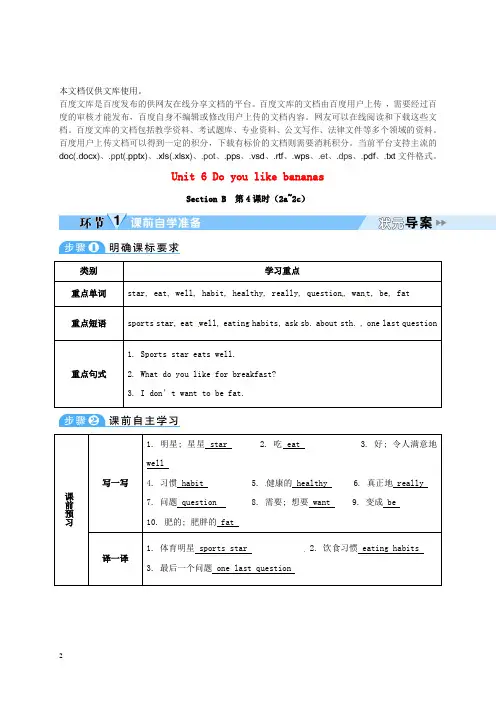
Section B 第4课时(2a~2c )
, wan well, habit 5. 健康的 2.
体育明星吃得好!ll!
读2b does Cindy like for dinner?
喝”。
意为“健康
to do sth. 想要某人(不)做某事
是委婉地改用其他说
布置作业:教师引导学生课后完成本课时对应练习,并预习下一课时内容。
识进行有效的复习和巩固。
由于课时内容多,课程较紧,当堂消化课时知识有难度,需学。
人教版七年级英语上册第六单元教案 (4)
新人教版七年级上册英语教案Unit.6 Unit6 Do you like bananas?Unit6 Do you like bananas?Unit6 Do you like bananas?Unit6 Do you like bananas?新人教版七年级上册英语教案Unit.6 Unit6 Do you like bananas?Unit6 Do you like bananas?Unit6 Do you like bananas?Unit6 Do you like bananas?附赠材料优秀的教学是练出来的在上一堂课里,你已经学会了区分高效教学法和低效教学法之间的区别。
现在,我们还要继续巩固这一概念。
在高效教学法和低效教学法之间,是否存在一个灰色的中间地带呢?是的,这个灰色地带确实存在。
如果能带领那些还不够高效的教师们进人这一中间地带,那也是很大的进步。
当然,本课的主要目的是发掘出教师的最大潜力,以最终实现高效教学。
如果能成功做到这一点,那么你最终会发现学生的表现有了显著的提高。
显而易见,教师能力的优劣会直接影响到学生的表现。
教师越优秀,学生的表现就越好。
课程:首先,我们回顾一下上一节课所学的如何区分高效和低效教学上一节课,我已经要求你总结出自身存在的弱项,并且在课后进行针对性的练习。
今天,请你仔细思考,在下面列举的教学情景中高效和低效的教师将如何做出不同的应对措施。
高效教学与低效教学实践一个学生在课堂上一直和其他学生聊天。
他这个举动非常明显,必须及时制止。
面对这个情形时,低效的教师会如何应对?高效的教师又会如何应对?一个学生在课堂上不断发出声响,这个声音越来越吵,并且影响到了班级里的其他学生。
低效的教师会如何应对?高效的教师又会如何应对一个学生总是没有完成课后布置的家庭作业。
对这个学生低效的教师会如何应对?高效的教师又会如何应对?一个学生总是随便讲话。
教师在讲课的时候她讲话,同学们在做课堂练习的时候她讲话,午餐之前大家都应该安静等待的时候她也在讲话,在类似的其他场合她也经常随便讲话。
七年级英语上册(人教新目标Goforit!)Unit6第4课时(SectionB2a2c)教学设计

(一)教学重难点
1.重点:本课时的教学重点是使学生能够熟练运用一般现在时态描述人们的职业、兴趣和日常活动,掌握相关的词汇和短语,并能在实际语境中正确运用。
难点:一般现在时态在不同情境下的灵活运用,以及听力技巧的提升。
2.重点:通过听力、口语活动,提高学生的语言实际运用能力,增强学生的语感和交际能力。
接着,进行口语练习。为学生提供一些场景,让学生运用本节课所学的词汇和句型编写对话,并进行表演。在此过程中,学生可以充分展示自己的语言表达能力,同时锻炼口语。
(五)总结归纳(500字)
在课堂的最后,我会对本节课的学习内容进行总结归纳。首先,邀请几名学分享他们在课堂上的收获,如新学的词汇、一般现在时态的用法等。然后,我进行点评和补充,强调重点知识,梳理难点。
难点:学生在听力过程中对关键信息的捕捉和口语表达时的流畅性与准确性。
(二)教学设想
1.针对重难点,采用以下教学策略:
a.利用多媒体教学资源,如视频、图片等,为学生提供丰富的视觉和听觉刺激,帮助学生更好地理解词汇和句型。
b.创设真实的语境,让学生在角色扮演、小组讨论等活动中,自然地运用一般现在时态进行表达。
在此过程中,学生可以相互交流、分享观点,提高口语表达能力。我会巡回指导,关注每个小组的讨论情况,并及时给予反馈和指导。
(四)课堂练习(500字)
为了巩固本节课所学知识,我设计了一系列课堂练习。首先,进行听力练习,播放一段关于人们职业、兴趣和日常活动的对话,要求学生回答相关问题。通过这个环节,提高学生的听力水平,同时巩固一般现在时态的用法。
接着,我会提问:“Do you want to be like them when you grow up?”让学生思考并回答。这个问题旨在引导学生关注自己的未来职业规划,同时自然引入一般现在时态的用法。在此基础上,我会简要介绍本节课的学习目标,使学生明确学习内容。
人教版2024七年级上册英语Unit 6 Lesson 4 教案
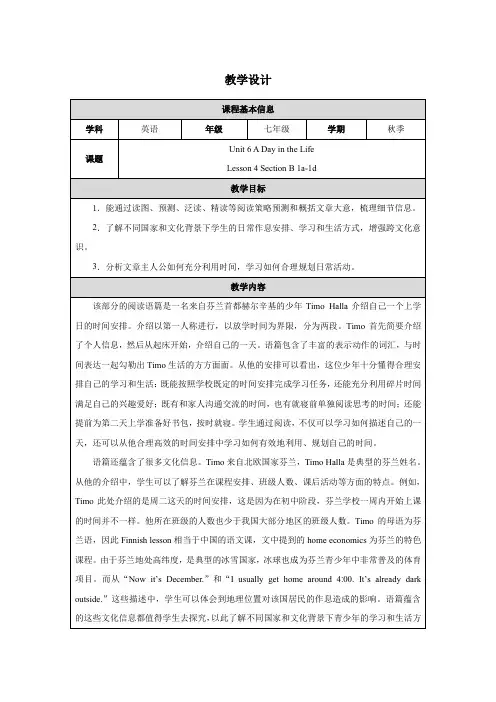
5.帮助学生结构化梳理Timo作息时间安排,为后面的口语输出活动、分析Timo如何充分利用时间做铺垫。
6.培养学生良好的阅读和答题习惯、培养学生获取文本细节信息的能力。第一段的问题1为后面分析Timo如何充分利用时间作了铺垫,问题2引导学生关注中国和芬兰上课时长的相同之处,问题3和4引导学生关注中国和芬兰不同地理位置和文化背景下课程内容、运动类型的不同之处,了解世界多元文化,增强跨文化意识。
教学设计
课程基本信息
学科
英Unit 6ADay in theLife
Lesson 4Section B 1a-1d
教学目标
1.能通过读图、预测、泛读、精读等阅读策略预测和概括文章大意,梳理细节信息。
2.了解不同国家和文化背景下学生的日常作息安排、学习和生活方式,增强跨文化意识。
语篇还蕴含了很多文化信息。Timo来自北欧国家芬兰,Timo Halla是典型的芬兰姓名。从他的介绍中,学生可以了解芬兰在课程安排、班级人数、课后活动等方面的特点。例如,Timo此处介绍的是周二这天的时间安排,这是因为在初中阶段,芬兰学校一周内开始上课的时间并不一样。他所在班级的人数也少于我国大部分地区的班级人数。Timo的母语为芬兰语,因此Finnish lesson相当于中国的语文课,文中提到的home economics为芬兰的特色课程。由于芬兰地处高纬度,是典型的冰雪国家,冰球也成为芬兰青少年中非常普及的体育项目。而从“Now it’s December.”和“I usually get home around 4:00.It’s already dark outside.”这些描述中,学生可以体会到地理位置对该国居民的作息造成的影响。语篇蕴含的这些文化信息都值得学生去探究,以此了解不同国家和文化背景下青少年的学习和生活方式,体味世界多元文化。
人教版七年级英语上册教案:Unit6 Section B(2a2c)

池河中学2017-2018学年度第一学期教学设计年级七科目英语任课教师授课时间11.28 课题Unit6 Do you like bananas? (Section B 2a-2c)授课类型阅读课标依据本节课是人教版英语七年级上册第六单元第四课时的内容。
通过本单元前三个课时的学习,初步掌握了部分食物词汇及询问、谈论某人喜欢或不喜欢某种食物的表达,本课时将在此基础上复习、巩固本单元的食物单词,并通过读写的方式,练习、巩固本单元的重点表达及谓语动词的单复数变化这一语法点,属于读写课。
但课本上的读写任务稍显简单,这就要求老师做适当的拓展。
通过学习,学生将在读写能力,尤其是写的能力上有所提高。
教学目标知识与技能1、知识技能目标:(1)复习本单元食物词汇及询问、谈论一日三餐喜欢吃哪些东西的句型。
(1)掌握新词汇: eat, well, star, habit, healthy, really, question, want, be, fat。
(2)掌握新短语:a sports star, a volleyball star, ask sb. about sth., eating habits, what about…等。
(3)掌握一般现在时中,主语为三单时,助动词及实意动词的变化。
过程与方法1.讲授法2.谈话法3.小组讨论法4.练习法情感态度与价值观培养对家人、同学、朋友的关怀和友爱之情,学会营养配餐。
编号:43教学重点难点教学重点A.Vocabularystar, eat, well, habit, healthy, really, question, want, be, fatB.Target languagesDo you like salad? I like chicken for dinner. I don’t like bananas.教学难点Grammar: Talk about likes and dislikes教学师生活动设计意图过程设计Step1. Lead-inGreeting and Warming upStep2. PresentationWhat do you eat for breakfast, lunch and dinner? Do you eat healthy food? Different people eat different foods. Which food do you think is healthy? Finish 2a, and discuss in pairs.Step3. ReadingRead and explain the title. What’s the meaning of “ sports star” ? What’s the meaning of “ Sports Star Eats Well” ?T: “A sports star” means a person who plays sports very well. Do you know a sports star?Yes,Yao Ming was a sports star. So what does the title mean? OK. “Sports Star Eats Well” means a sports star eats healthy food.You are going to read about a volleyball star. She has healthy eating habits. So what does she eat for breakfast, lunch and dinner?First guess the answers.Choose several students to answer. Then read about her answers to a reporter, David, and you will know.What does Cindy eat for breakfast / lunch/dinner?Check the answers.Read the article again. Answer the following questions.1. Why does Cindy like fruit?2. Why doesn’t Cindy like hamburgers?3. Why doesn’t Cindy eat ice-cream?Read it again and fill in the chart.Fill in the chart with t he food Cindy likes and doesn’t like. Cindy likes…Cindy doesn’t like…Read it again, explain any difficulty.Discussion.How can we keep healthy?What’s your advice?An apple a day keeps the doctor away.Eat healthy food and keep a balanced diet.Listen to the tape, students follow it.Retell the article according to the chart above.Step 4 Writing (Cooperation)Write five sentences , then correct the mistakes each other. 询问学生的喜好,吸引学生的学习兴趣。
Unit 6 第4课时 (Section B 2a-2c) 教学设计-七年级英语上册

读文章,回答问题。
再读一遍文章,完成书本2b部分练习。
勾选出Cindy喜欢和不喜欢的食物。
读文章并完成表格。
读文章,补全思维导图。
完成书本2c部分任务。
通过读前观察图片,获取信息,回答问题,培养学生的阅读技能,掌握文章主旨方向。
通过找中心句,引导学生掌握阅读技巧—泛读。
3.Tasks students to read the passage andfinish the task in 2b--Read the magazine article and circle the food words.
4.Tasks students tocheck the food Cindy like or dislike.
2.通过预测、抓关键词、猜测词义和采访活动,能够对文章主要内容进行推断,理解文章细节并复述文章。
文化意识:
通过目标词汇和语言的学习,能够谈论食物以及了解三餐及各种食物的表达方式,体验不同的文化带来的魅力。
思维品质:
通过小组合作,能够拉近人与人的距离,加强与人沟通交往的能力。
教学
重难点
1.通过情境体验,能够了解三餐及各种食物的表达方式。
完成书本任务,回归课堂基础,拓展训练帮助学生开拓思维,打好阅读基础。
Step 3
While-listening
1.Tasks students toPredict the main idea with the pictures and the title.
2.Tasks students toRead the magazine article and answer questions.
Unit6Do you like bananas?
2023七年级英语上册Unit6Doyoulikebananas第4课时教案(新版)人教新目标版
2.请用一般现在时描述你家人的日常生活,并尝试使用情态动词do进行提问和回答。
例:My mother cooks dinner at 6 o'clock every evening. Yes, she does. Does your mother?
3.请用一般现在时描述你的朋友或同学的日常生活,并尝试使用情态动词do进行提问和回答。
例:My friend goes to school by bus every day.在时描述你的宠物的日常生活,并尝试使用情态动词do进行提问和回答。
例:My cat sleeps on the sofa every afternoon. Yes, it does. Does your cat?
核心素养目标分析
本节课旨在培养学生的语言能力、文化意识、思维品质和学习能力,全面提高学生的英语核心素养。在语言能力方面,通过本节课的学习,学生能够准确运用一般现在时表达自己的喜好和习惯,并能用情态动词do进行恰当的提问和回答。在文化意识方面,学生能够了解和理解不同文化背景下人们对食物喜好的差异,培养尊重和理解他人的文化习惯。在思维品质方面,学生能够通过分析、推理和判断等思维活动,提高思维的逻辑性和准确性。在学习能力方面,学生能够运用自主学习、合作学习和探究学习等策略,提高学习的效果和效率。通过本节课的学习,学生将能够更好地运用英语进行实际交际,提高自身的英语核心素养。
初中初中七年级英语上册 Unit6 Do you like bananas?第4课时教案
Unit6 Do you like bananas?教学重点复习句型 I like/ don’t like…. Do you like…?教学难点画出喜欢吃的食品。
三维目标知识与能力通过谈论和书写自己早餐、午餐、晚餐喜欢吃什么,进一步巩固所识,强化学生说和写的能力。
过程与方法采用Acting,Saying and Writing 等策略,积极开展富有成效的Pair work, Group work, 等口语交际活动,使学生积极参与,谈论自己或他人好恶。
情感目标谈论三餐饮食,增进同学友谊。
教学过程Step 1 Reading (3c)检查作业,让学生读他们写的那段话。
其他学生指出他们三餐喜欢吃什么。
1. 学生标出他们认识的单词,不认识的单词问同桌或其他同学,并让学生大声读读这些单词,找几个学生起来读一下。
纠正发音。
2. Write new words.3. Draw the food students like to eat for lunch.4. Make survey. Ask the classmates what they like to eat lunch. 让学生调查一下同学们午餐喜欢吃什么,运用句型 Do you like …? Yes, I do. / No, I don’t.一般在小组范围内询问,做好统计,填入表格。
5. Find someone who likes to eat the same lunch as you.6. Say the food s tudents like to eat for lunch.Step 4语言能力养成性评价( ) 1. He likes some _________.A. appleB. bananaC. broccoliD. salad( ) 2. Please read your list _______ food to us.A. atB. inC. ofD. on( ) 3. She doesn’t l ike _________.A. tomatoB. tomatoesC. tomatosD. a tomato( ) 4. ________ Clark ________ French fries?A. do;likeB. does;likeC. Does;likeD. Do;likes( ) 5. I have chicken and fruit _________ dinner.A. ofB. forC. atD. in( ) 6. Sandra Clark is a _________ star.A. runB. runningC. runnerD. runs ( ) 7. Bill and Sandra _________ like eating eggs.A. doesB. don’tC. notD. does Step 5 Homework谈论家人三餐喜欢吃什么。
七年级英语上册第六单元第四课时教案
The 4th periodTeaching aims:1. Review all key vocabulary presented in this unit.2. Review the language used to express likes and dislikes. Function: Talk about three mealsTeaching procedures:Step1. Warming-upLet’s ChantI like apples.I like oranges.I like bananas.They are very nice.And I like vegetables.But the best of all I likeThe pancakes that my Mum cakes.Step2. ChattingAsk and answer1.Do you like fruit?2.What fruit do you like?3.What fruit does he / she like?4.Does your father like fruit?5.What fruit does he like?6.Does your mother eat fruit every day?7.What fruit does she usually eat?Step3. Making a group competitionTake turns to write out the names of different fruit on the blackboard.Encourage Ss to write more words , the more ,the better .The group which writes out the most words will be the winnerStep4. Making a comparison1.Ask and answer(1)When do you usually have fruit after breakfast or supper?(2)What do you usually have for breakfast?(3)What does your mother usually have for breakfast?(4)What do we usually have for breakfast?(5)What do western people usually have for breakfast?2.Make a comparison(1)Discuss in groups(2)The leader writes down the words of food(3)Choose several groups to make a reportStep5. Making a suggestion1. Ask and answer(1) Where do you have lunch at home or at school?(2) What do you usually have for lunch at school?(3) What do you think of the food in our school?2. Make a suggestion(1) Draw the food you like to eat for lunch (part 3)(2) Choose several sheets of picture to show to class.(3) Ask several students to give a report with the pattern “I like …….for ”(4) Find someone who likes to eat the same lunch as you and fill in the blanks in Part 4(5) Ask some students to tell it to class with the pattern“I like ….. , XXX likes ….. , too.”Step 6 . Playing a game1.Discuss and write out at last 8 names of unhealthy food.2.Have Ss take turns to read one word which they write3.This group can get one star if we other groups don’t writ the same word as their.4.Summarize: (1) Which group is the winner.(2) It’s not good to eat these unhealthy foods.Step 7. Making a food listStep 8. Making a dialogue1.Making a dialogue in groups of three.Talk about what they like to eat tomorrow.2.Choose several groups to ac it out. Step 9. Making an evaluation Step 10. Homework。
七年级英语上册 Unit 6 Do you like bananas(第4课时)Section B(2a3c)教案 (新版)人教新目标版
Unit6 Do you like bananas?Section B 2a-----3cLearning GoalsIn this lesson, the students learn to read and write a short passage about the food for three meals and describe what other people like to eat for three meals. Learn to get the good habit of eating healthily.Teaching and learning steps:Step1.ReviewingThree pairs role-play the dialogue in the first part of Section B in front of the class. The teacher can give an example like this:Sample dialogue:A: Do you like oranges?B: Yes, I do. What about you?A: No, I don’t. I like bananas.B: Oh, I see. Does Tom(可以是班内的任一学生) like carrots?A: No, he/she doesn’t. He/She likes tomatoes.B: …Step2. Warming up and leading inT: Hello, everybody! Do you like fruit?Ss: Yes, ...T: Is fruit healthy?Ss: Yes.T: Do you like hamburgers?Ss: Yes/No, …T: Are hamburgers healthy?Ss: No.T: Do you like the food of McDonald’s? Do you think the food there is healthy? Ss: Yes/No, …T: I think some food there are healthy, but some are not. Let’s come to 2a.Sample answers:chicken √hamburgers √Ice-cream √(设计说明:通过师生互问答问题导入2a,重点引导生理解healthy一词的含义,因为它体现了2b语篇的核心思想。