
八年级下册第一单元unit1_sectiona(1a-2d)课件
Lisa: OK. Thanks, Mandy.
Language points
1. What’s the matter? 这是询问病人病情时最常用的问句, 意思是“怎么了? ”, 其后通常与介词with连用。类似的问句还有:
What’s wrong? What’s wrong with you? What’s your trouble? What’s the trouble with you? What’s up?
a coat with four pocket
6. …Bus No. 26 was going along Zhonghua Road when the driver saw an old man lying on the side of the road.
1)过去进行时表示在过去某一时刻或某一时间内进 行或发生的动作。 其形式为was/were+ V-ing。常与表示过去的时间状 语连用。如:last night,last Saturday等;或与 when,while,as引导的过去时间状语连用。
2) when常常用来引出时间状语从句,放在过去进行时 构成的主句后,表示某事正在进行时,另一件事情发 生了。
例句
那天下午他们正在商场购物, 就在这时一场大火发生了。 They were shopping in the mall that afternoon when a big fire broke out. 我正想着这件事时,突然听到有人叫我的名字。 I was thinking of this when I heard my name called.
You should __l_i_e_d_o_w_n___ I have a stomachache. _a_n__d_r_e_s_t_.
I have a fever.
You should __ta_k_e__y_o_u_r__ __te_m__p_e_r_a_tu_r_e_.
I cut myself by accident.
2) sore“痛, 疼”, 通常指因发炎引起的肌肉疼, 在表示身 体的某部位疼痛时,常置于部位名词前。
ache常指持续性的疼痛, 它常与身体部位的名词构成 复合词, 如: headache头痛, backache背疼等。
3. have a cold
伤风, 感冒,是固定词组, 表示身体不适的常用词组还有: 牙疼 have a toothache 胃疼 have a stomachache 发烧 have a fever
Conversation 3 Nurse: What’s the matter, Ben?
Ben : I __h_a_v_e__a__s_o_r_e_b__a_c_k____.
Conversation 4 Nurse: What’s the matter, Nancy? Nancy : I _h_a_v_e_a__to_o_t_h_a_c_h_e_. Conversation 5 Nurse: What’s the matter, Judy? Judy : I _h_a_v_e_a__so_r_e__th_r_o_a_t_.
You should __p_u_t_s_o_m__e__ _m_e_d_i_c_in_e__o_n_i_t_. _______.
Role Play
Imagine you are the school doctor. A few students have health problems. Role-play a conversation between the doctor and the students.
1) matter n.问题, 麻烦, 事件, 通常与介词 “with”连用。 2) wrong是形容词, 前面没有“the”; matter和trouble都 是名词, 前面应有“the”, trouble前还可以用形容词性 的物主代词。
What’s your trouble, young man? 年轻人, 你怎么了?
2d Read the conversation and fill in the blanks.
Mandy: Lisa, are you OK? Lisa: I have a headache and I can’t move my neck.
What should I do ? Should I take my temperature ? Mandy: No, it doesn’t sound like you have a feverWhat did you do on the weekend ? Lisa: I played computer games all the weekend.
Mandy: That’s probably why. You need to take breaks away from the computer.
Lisa: Yeah, I think I sat in the same way for too long without moving.
Mandy: I think you should lie down and rest. If your head and neck still hurt tomorrow, then go to a doctor.
2. I have a sore throat. 1) have vt. 患(得)病, (不用于进行时态)
He had a bad cold last week. 他上周患了重感冒。 She often has a stomachache. 她常胃(肚子)疼。 一般情况下用have+a+n. 表示患了某种疾病。如: have a cough 咳嗽 have a cold 感冒
a. lie down and rest b. drink some hot tea with honey c. see a dentist and get an X-ray d. take your temperature e. put some medicine on it
1- d 2- a 3- b 4- c 5- e
Look and say What’s the matter with him/her…?
He has a toothache. She has a toothache.
He has a fever.
She has a fever.
He has a sore throat. She has a sore throat.
Where is his neck?
ear
face mouth
back arm hand
leg foot (feet)
head, hair eye
nose tooth(teeth) stomach
neck
Follow me:
Everybody moves your body Nod your head and touch your face Touch your nose and close your eyes Touch your ears and clap your hands Raise your arms and look at your back Touch your stomach and tap your foot Sit down and move your legs
Nurse: You don’t look well. What’s the matter, Sarah?
Sarah: I h__a_v_e__a_c__o_ld_.
Conversation 2 Nurse: What’s the matter, David?
David : I _h__a_v_e__a_s_t_o_m__a_c_h__a_c_h_e_.
Listen again. Then fill in the blanks.
I have a cough and sore throat
You should drink some hot tea with honey.
I have a toothache.
You should _s_e_e_a__d_e_n_tist _a_n_d__g_et__a_n_X__-r_a_y_.____
初中英语人教版八年级下
Unit1 What’s the matter?
Section A(1a-2d)
内容结构
1
Warm-up
2
Presentation
3
Language points
4
Exercise
Warm-up
Sing a song
Presentation Let’s learn the parts of the body.
4. lie down and rest lie down 躺下 Don’t lie down on the ground. 不要躺在地上。 与down有关的词组 sit down 坐下 come down 下来 get down 下车 write down 写下, 记下
5. hot tea with honey 1) hot adj. 热的 2) with 介词, 意思是“ 有, 用, 同……,由于, 和……一 致, 赞成, 关于”, 此句中是 “有, 带有……”的意思。 如: 有四个口袋的外套
2a Listen and number the pictures [1-5]in the order
you hear them.
2
4
3
1
5
2b Listen again. Match the problems with the advice.
1.fever 2.sore throat 3.stomachache 4.toothache 5.cut myself
Language points
1. What’s the matter? 这是询问病人病情时最常用的问句, 意思是“怎么了? ”, 其后通常与介词with连用。类似的问句还有:
What’s wrong? What’s wrong with you? What’s your trouble? What’s the trouble with you? What’s up?
a coat with four pocket
6. …Bus No. 26 was going along Zhonghua Road when the driver saw an old man lying on the side of the road.
1)过去进行时表示在过去某一时刻或某一时间内进 行或发生的动作。 其形式为was/were+ V-ing。常与表示过去的时间状 语连用。如:last night,last Saturday等;或与 when,while,as引导的过去时间状语连用。
2) when常常用来引出时间状语从句,放在过去进行时 构成的主句后,表示某事正在进行时,另一件事情发 生了。
例句
那天下午他们正在商场购物, 就在这时一场大火发生了。 They were shopping in the mall that afternoon when a big fire broke out. 我正想着这件事时,突然听到有人叫我的名字。 I was thinking of this when I heard my name called.
You should __l_i_e_d_o_w_n___ I have a stomachache. _a_n__d_r_e_s_t_.
I have a fever.
You should __ta_k_e__y_o_u_r__ __te_m__p_e_r_a_tu_r_e_.
I cut myself by accident.
2) sore“痛, 疼”, 通常指因发炎引起的肌肉疼, 在表示身 体的某部位疼痛时,常置于部位名词前。
ache常指持续性的疼痛, 它常与身体部位的名词构成 复合词, 如: headache头痛, backache背疼等。
3. have a cold
伤风, 感冒,是固定词组, 表示身体不适的常用词组还有: 牙疼 have a toothache 胃疼 have a stomachache 发烧 have a fever
Conversation 3 Nurse: What’s the matter, Ben?
Ben : I __h_a_v_e__a__s_o_r_e_b__a_c_k____.
Conversation 4 Nurse: What’s the matter, Nancy? Nancy : I _h_a_v_e_a__to_o_t_h_a_c_h_e_. Conversation 5 Nurse: What’s the matter, Judy? Judy : I _h_a_v_e_a__so_r_e__th_r_o_a_t_.
You should __p_u_t_s_o_m__e__ _m_e_d_i_c_in_e__o_n_i_t_. _______.
Role Play
Imagine you are the school doctor. A few students have health problems. Role-play a conversation between the doctor and the students.
1) matter n.问题, 麻烦, 事件, 通常与介词 “with”连用。 2) wrong是形容词, 前面没有“the”; matter和trouble都 是名词, 前面应有“the”, trouble前还可以用形容词性 的物主代词。
What’s your trouble, young man? 年轻人, 你怎么了?
2d Read the conversation and fill in the blanks.
Mandy: Lisa, are you OK? Lisa: I have a headache and I can’t move my neck.
What should I do ? Should I take my temperature ? Mandy: No, it doesn’t sound like you have a feverWhat did you do on the weekend ? Lisa: I played computer games all the weekend.
Mandy: That’s probably why. You need to take breaks away from the computer.
Lisa: Yeah, I think I sat in the same way for too long without moving.
Mandy: I think you should lie down and rest. If your head and neck still hurt tomorrow, then go to a doctor.
2. I have a sore throat. 1) have vt. 患(得)病, (不用于进行时态)
He had a bad cold last week. 他上周患了重感冒。 She often has a stomachache. 她常胃(肚子)疼。 一般情况下用have+a+n. 表示患了某种疾病。如: have a cough 咳嗽 have a cold 感冒
a. lie down and rest b. drink some hot tea with honey c. see a dentist and get an X-ray d. take your temperature e. put some medicine on it
1- d 2- a 3- b 4- c 5- e
Look and say What’s the matter with him/her…?
He has a toothache. She has a toothache.
He has a fever.
She has a fever.
He has a sore throat. She has a sore throat.
Where is his neck?
ear
face mouth
back arm hand
leg foot (feet)
head, hair eye
nose tooth(teeth) stomach
neck
Follow me:
Everybody moves your body Nod your head and touch your face Touch your nose and close your eyes Touch your ears and clap your hands Raise your arms and look at your back Touch your stomach and tap your foot Sit down and move your legs
Nurse: You don’t look well. What’s the matter, Sarah?
Sarah: I h__a_v_e__a_c__o_ld_.
Conversation 2 Nurse: What’s the matter, David?
David : I _h__a_v_e__a_s_t_o_m__a_c_h__a_c_h_e_.
Listen again. Then fill in the blanks.
I have a cough and sore throat
You should drink some hot tea with honey.
I have a toothache.
You should _s_e_e_a__d_e_n_tist _a_n_d__g_et__a_n_X__-r_a_y_.____
初中英语人教版八年级下
Unit1 What’s the matter?
Section A(1a-2d)
内容结构
1
Warm-up
2
Presentation
3
Language points
4
Exercise
Warm-up
Sing a song
Presentation Let’s learn the parts of the body.
4. lie down and rest lie down 躺下 Don’t lie down on the ground. 不要躺在地上。 与down有关的词组 sit down 坐下 come down 下来 get down 下车 write down 写下, 记下
5. hot tea with honey 1) hot adj. 热的 2) with 介词, 意思是“ 有, 用, 同……,由于, 和……一 致, 赞成, 关于”, 此句中是 “有, 带有……”的意思。 如: 有四个口袋的外套
2a Listen and number the pictures [1-5]in the order
you hear them.
2
4
3
1
5
2b Listen again. Match the problems with the advice.
1.fever 2.sore throat 3.stomachache 4.toothache 5.cut myself
合集下载
【精品】英语八年级下人教版Unit1SectionA同步课件(33张)
arm
hand
foot feet(复数)
Look at the picture. Write the correct letter [a-m] for each part of the body.
Look at the picture. Write the correct 1a letter [a-m] for each part of the body.
1. Nurse: You don’t look well. What’s the matter, Sarah? Sarah: I h_a_v_e__a_c_o_l_d_.
2. Nurse: What’s the matter, David? David : I _h_a_v_e__a_s_t_o_m_a_c_h_a_c_h_e_.
Have enough water.
Eat fruits and vegetables. Get up early and go to bed early.
Be happy .
Write a letter to your friend Sam and give him some advice about how to keep healthy.
I have a stomachache.
Why not _____li_e_d_o_w__n _a_n__d_r_e_s_t _?
I have a fever.
Why don't you __ta__k_e___ y__o_u_r__te_m__p__e_r_a_t_u_r_e___ ?
I cut myself by accident.
Dear Sam, I'm sorry to hear that you have some health
hand
foot feet(复数)
Look at the picture. Write the correct letter [a-m] for each part of the body.
Look at the picture. Write the correct 1a letter [a-m] for each part of the body.
1. Nurse: You don’t look well. What’s the matter, Sarah? Sarah: I h_a_v_e__a_c_o_l_d_.
2. Nurse: What’s the matter, David? David : I _h_a_v_e__a_s_t_o_m_a_c_h_a_c_h_e_.
Have enough water.
Eat fruits and vegetables. Get up early and go to bed early.
Be happy .
Write a letter to your friend Sam and give him some advice about how to keep healthy.
I have a stomachache.
Why not _____li_e_d_o_w__n _a_n__d_r_e_s_t _?
I have a fever.
Why don't you __ta__k_e___ y__o_u_r__te_m__p__e_r_a_t_u_r_e___ ?
I cut myself by accident.
Dear Sam, I'm sorry to hear that you have some health
新目标人教版八年级英语下册Unit1-Section-A(1a-2d)课件优秀版市公开课一等奖省赛课

one’s+部位
例子:What’s wrong with you? I have a sore eye. There is something wrong with my eye.
第8页
Watch and say the illness. have a sore throat
have a sore back
第6页
What’s wrong with her?
She has a stomachache.
第7页
问“某人/某物怎么了”句型
问:What’s the matter with sb/sth.? =What’s wrong with sb/sth?病症 There is something wrong with
又恢复了中年模样,妻子说,你应该选择保送读大学。麦克深情地对妻子说:你是我做过最好选择,只是我忘记了。
你很轻易找到。他是我们三年级二班一个男生,晨会、做操、放学排路队时总是站在第一排,教室里最脏抽屉一定是他。对了,他书包通常不是放在课桌抽屉里,而是扔在地上。几乎 每节课我都要提醒他或是帮他捡起,但下节课再来看,他书包又咧着大嘴躺在了地上,书本散落一地,他双脚,正无情地踩在一个练习本上……每每此时,我都无语凝噎,不忍直视那 么,他抽屉里不放书包放什么?课外书、牛奶盒、瓜皮果壳、小玩具、蚂蚁、毛毛虫、小树枝、黑乎乎樟树籽、金灿灿棕榈树籽……总之,五花八门,应有尽有。老师刚收缴了一批, 立马他又塞进另一批……其更新换代速度堪比火箭发射,让人叹为观止……因为小Z不讲卫生,每到周一换座位时,轮到坐他座位同学总是叫苦连天、自认倒霉,皱着眉头、捂着口鼻 一遍一遍地擦,先用抹布蘸着水擦,再用纸巾擦,直到完全闻不到异味才勉勉强强坐下。尽管如此,小Z同学却有很多好朋友。每次分组活动,大家都抢着要他。为何?第一,他是个 小书迷,知识渊博;第二,他表示能力强,说话幽默幽默有条理;第三,他为人大方,乐于分享。从小Z优点来看,你是不是认为他应该是个学霸?这……怎么说呢,当前算不上,但 未来极有可能……看看作文课上他即兴画思维导图吧,有条理,有创意,让小搭档们佩服得五体投地,怎么看都不像是一个熊孩子,一个“学渣”作品。可是,我天天给孩子们听写十 个词语,他天天正确率只有百分之六十左右,很多字不会写。他是一个不折不扣“君子”,光读光看不动手写,哪怕就是新学几个词语,他也不愿意写一写抄一抄。不论课上课下,凡 是要动笔写时,他不是钻到桌子底下东找找西摸摸,就是在书包里左翻翻右抖抖,总之就是老半天下不了笔。他人已经写完了拿给老师批改,他可能才开始写第一题………那磨磨蹭蹭 样子,活活要把老师气死。他妈妈认为他从小握笔姿势错误怎么也纠正不了,造成写字速度很慢,所以不愿意写字。我却不这么认为,我以为没这么简单,一定另有原因,只不过我现 在还没弄明白而已。上周四早晨第三、四节课,语文单元测试。两节课考试时间过去,试卷一张张收了上来,最终一个交卷是小我快速扫了一下卷面。哦买噶第一页基础题几乎一片空 白!作文也没写完,只写了三四行!这么子,批改出来总分顶多也就二三十分!怎么会这么!再差也不会如此啊!考试时不务正业偷玩蚂蚁去了?还是有意不做?身为语文老师兼班主 任我气得跳脚,一阵胸闷。怎么办?把他叫到办公室狠批一顿?或者请他家长来学校?此时,脑海里突然闪出一幕幕画面:他在班级读书分享会上侃侃而谈,他在课堂上回答下列问题 时妙语如珠,他把自己零食和玩具大方地给同学们分享,他羞涩地笑着把他饼干递到我手中……即使在完成作业方面他确实做得不好,尽管在上课时经常偷看课外书,但不可否定是, 他绝对是个好学上进好孩子!试卷答成这么,可能另有原因吧?不不不,不能那么简单粗暴!我应该先了解一下真实原因。要知道,“刑讯逼供”最轻易“屈打成招”……午餐后自习 时间。我笑眯眯地对小Z说:“小Z,我们教室好脏啊,你愿不愿意为大家服务一下,清扫一下教室?“愿意!”他二话没说,跑着去拿扫把。不要做作业,预计他心里乐开了花。他一 手拿扫把,一把持簸箕,认真地扫着。看到谁脚下有纸屑,他就轻声提醒他抬起脚来,再把纸扫出来,态度友好,而且不影响他人。扫地动作也很是娴熟、麻利不一会儿功夫,他就把 教室清扫得干洁净净,我当众狠狠地表彰了他一番,然后把他叫到我身边,拿了把椅子让他坐下他顺从地坐下了,刚才还因为受了表彰而神采飞扬,此时却目光黯淡,低着头不敢看我, 像是在担心暴风雨降临。我摊开他早晨考那张试卷,和颜悦色地柔声问道:“这么多题没做,我想了半天也想不出原因,你能告诉我为何么?换句话说,我很想知道你是怎么答题,因
例子:What’s wrong with you? I have a sore eye. There is something wrong with my eye.
第8页
Watch and say the illness. have a sore throat
have a sore back
第6页
What’s wrong with her?
She has a stomachache.
第7页
问“某人/某物怎么了”句型
问:What’s the matter with sb/sth.? =What’s wrong with sb/sth?病症 There is something wrong with
又恢复了中年模样,妻子说,你应该选择保送读大学。麦克深情地对妻子说:你是我做过最好选择,只是我忘记了。
你很轻易找到。他是我们三年级二班一个男生,晨会、做操、放学排路队时总是站在第一排,教室里最脏抽屉一定是他。对了,他书包通常不是放在课桌抽屉里,而是扔在地上。几乎 每节课我都要提醒他或是帮他捡起,但下节课再来看,他书包又咧着大嘴躺在了地上,书本散落一地,他双脚,正无情地踩在一个练习本上……每每此时,我都无语凝噎,不忍直视那 么,他抽屉里不放书包放什么?课外书、牛奶盒、瓜皮果壳、小玩具、蚂蚁、毛毛虫、小树枝、黑乎乎樟树籽、金灿灿棕榈树籽……总之,五花八门,应有尽有。老师刚收缴了一批, 立马他又塞进另一批……其更新换代速度堪比火箭发射,让人叹为观止……因为小Z不讲卫生,每到周一换座位时,轮到坐他座位同学总是叫苦连天、自认倒霉,皱着眉头、捂着口鼻 一遍一遍地擦,先用抹布蘸着水擦,再用纸巾擦,直到完全闻不到异味才勉勉强强坐下。尽管如此,小Z同学却有很多好朋友。每次分组活动,大家都抢着要他。为何?第一,他是个 小书迷,知识渊博;第二,他表示能力强,说话幽默幽默有条理;第三,他为人大方,乐于分享。从小Z优点来看,你是不是认为他应该是个学霸?这……怎么说呢,当前算不上,但 未来极有可能……看看作文课上他即兴画思维导图吧,有条理,有创意,让小搭档们佩服得五体投地,怎么看都不像是一个熊孩子,一个“学渣”作品。可是,我天天给孩子们听写十 个词语,他天天正确率只有百分之六十左右,很多字不会写。他是一个不折不扣“君子”,光读光看不动手写,哪怕就是新学几个词语,他也不愿意写一写抄一抄。不论课上课下,凡 是要动笔写时,他不是钻到桌子底下东找找西摸摸,就是在书包里左翻翻右抖抖,总之就是老半天下不了笔。他人已经写完了拿给老师批改,他可能才开始写第一题………那磨磨蹭蹭 样子,活活要把老师气死。他妈妈认为他从小握笔姿势错误怎么也纠正不了,造成写字速度很慢,所以不愿意写字。我却不这么认为,我以为没这么简单,一定另有原因,只不过我现 在还没弄明白而已。上周四早晨第三、四节课,语文单元测试。两节课考试时间过去,试卷一张张收了上来,最终一个交卷是小我快速扫了一下卷面。哦买噶第一页基础题几乎一片空 白!作文也没写完,只写了三四行!这么子,批改出来总分顶多也就二三十分!怎么会这么!再差也不会如此啊!考试时不务正业偷玩蚂蚁去了?还是有意不做?身为语文老师兼班主 任我气得跳脚,一阵胸闷。怎么办?把他叫到办公室狠批一顿?或者请他家长来学校?此时,脑海里突然闪出一幕幕画面:他在班级读书分享会上侃侃而谈,他在课堂上回答下列问题 时妙语如珠,他把自己零食和玩具大方地给同学们分享,他羞涩地笑着把他饼干递到我手中……即使在完成作业方面他确实做得不好,尽管在上课时经常偷看课外书,但不可否定是, 他绝对是个好学上进好孩子!试卷答成这么,可能另有原因吧?不不不,不能那么简单粗暴!我应该先了解一下真实原因。要知道,“刑讯逼供”最轻易“屈打成招”……午餐后自习 时间。我笑眯眯地对小Z说:“小Z,我们教室好脏啊,你愿不愿意为大家服务一下,清扫一下教室?“愿意!”他二话没说,跑着去拿扫把。不要做作业,预计他心里乐开了花。他一 手拿扫把,一把持簸箕,认真地扫着。看到谁脚下有纸屑,他就轻声提醒他抬起脚来,再把纸扫出来,态度友好,而且不影响他人。扫地动作也很是娴熟、麻利不一会儿功夫,他就把 教室清扫得干洁净净,我当众狠狠地表彰了他一番,然后把他叫到我身边,拿了把椅子让他坐下他顺从地坐下了,刚才还因为受了表彰而神采飞扬,此时却目光黯淡,低着头不敢看我, 像是在担心暴风雨降临。我摊开他早晨考那张试卷,和颜悦色地柔声问道:“这么多题没做,我想了半天也想不出原因,你能告诉我为何么?换句话说,我很想知道你是怎么答题,因
新目标八年级下册ppt课件:Unit1SectionA

05
教学反思
教学效果评估
教学目标达成情况
通过课堂互动和课后作业,大部 分学生能够掌握本节课的基本词 汇和句型,理解课文大意,完成
学习目标。
课堂氛围
课堂氛围较为活跃,学生积极参与 课堂活动,师生互动良好,提高了 学生的学习兴趣和积极性。
学生参与度
通过小组讨论和个人展示等环节, 大部分学生能够主动参与课堂活动, 提高口语表达和思维能力。
识并检测自己的掌握程度。
详细描述:学生分组进行讨论,运用所学知识进行情 景对话或话题讨论,培养学生的口语表达和合作能力
。
总结词:个人练习 总结词:小组讨论
总结反馈环节
总结词:总结归纳 总结词:作业布置
详细描述:教师对本节课所学内容进行总结归纳 ,强调重点和难点,帮助学生形成完整的知识体 系。
详细描述:布置与本单元相关的作业,如写短文 、制作海报等,以进一步巩固和拓展所学知识。 同时,教师需及时批改作业并给予反馈,帮助学 生发现并改进不足之处。
教学不足与改进
01
时间安排
在课程时间安排上存在一些不足,部分环节时间过长或过短,导致整体
节奏不够紧凑。需要进一步优化时间分配,确保各个环节的平衡。
02 03
教学内容深度
在讲解课文时,对于一些重点和难点的词汇和句型解析不够深入,导致 部分学生理解不够透彻。未来应增加对重点难点的解析和练习,帮助学 生更好地掌握。
重点词汇和短语
总结词:强化记忆
详细描述:列出课文中的重点词汇和短语,进行解释和例句,帮助学生记忆和应用。
03
教学方法
情景导入法
总结词
通过创设与学习内容相关的真实场景, 激发学生的学习兴趣和探究欲望。
人教英语八年级下册 Unit1Section A 2a—2d 说课课件 (共18张PPT)

Grade8 Book 2
Section A
2a-2d
1Analysis of the Teaching Material
4 Teaching Procedure
2 Analysis of the Students
3 Analysis of Teaching and Learning Methods
Part 4 Teaching Procedure
Suppose(假设) you are a doctor ,could you please answer some letters from the patients (病人) having different illnesses(疾病) and tell them what they should do? [Purpose of my designing] In this part, it’s important to show students’ own ideas and conclude what they have learnt and learn to use the target language.
I have a …. What should I do?
[Purpose of my designing] Throught this, it will be a good beginning of the new lesson.
Part 4 Teaching Procedure
Step3:Practice
Step5:Progress
2d
④Role-play the conversation with your partner.
[Purpose of my designing] Through it . To check the knowledge that students have learned in this lesson. Cheer for the winners, encourage students to take an active part in the competition, reflect the team cooperation spirit.
Section A
2a-2d
1Analysis of the Teaching Material
4 Teaching Procedure
2 Analysis of the Students
3 Analysis of Teaching and Learning Methods
Part 4 Teaching Procedure
Suppose(假设) you are a doctor ,could you please answer some letters from the patients (病人) having different illnesses(疾病) and tell them what they should do? [Purpose of my designing] In this part, it’s important to show students’ own ideas and conclude what they have learnt and learn to use the target language.
I have a …. What should I do?
[Purpose of my designing] Throught this, it will be a good beginning of the new lesson.
Part 4 Teaching Procedure
Step3:Practice
Step5:Progress
2d
④Role-play the conversation with your partner.
[Purpose of my designing] Through it . To check the knowledge that students have learned in this lesson. Cheer for the winners, encourage students to take an active part in the competition, reflect the team cooperation spirit.
人教版英语八年级下册Unit 1 Section A 1a-2d 课件
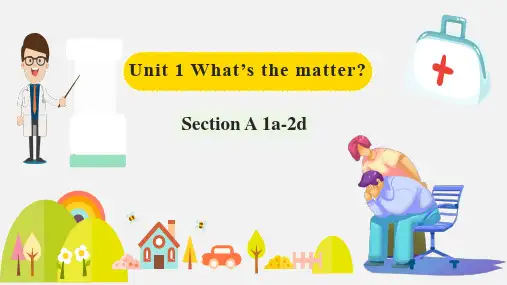
/eɪk/ have a headachehave a stomachache
v. /n. 疼痛
have a toothache
Look at the picture, and tell me what’s the trouble with them?
have/catch a cold
/fi:və(r)/
A: What’s the matter with Judy? B: She talked too much yesterday
and didn’t drink enough water. She has a very sore throat now.
Post-listening
1c Look at the picture. What are the students’ problems?
the first time. 8. If you agree, you can nod yohuera_d_____.
Look at the picture, and tell me what’s the matter with them?
Her eyes ached from lack of sleep. She felt an ache in her back.
Make conversations.
What’s the matter with Judy?
She talked too much yesterday and didn’t drink enough water. She has a very sore throat now.
Pre-listening
1. We look with our e_y__e_s___. 2. We listen with oure_a_r_s____. 3. We smell with ourn_o__s_e___. 4. We walk with our f_e_e_t____. 5. He carries a big bag on hbias_c_k____. 6. We doe_y_e__ exercises to protect our sight. 7. People sometimes shahkaen_d_s____ when they meet for
八年级下册Unit 1 sectionA 1a--2d

1. 牙疼 2. 胃疼 3. 背疼 4. 头疼 5. 喉咙疼 6. 发烧 7. 感冒
have a toothache have a stomachache have a backache have a headache have a sore throat have a fever have a cold
Can you name the parts of the body?
matter n. 问题;事情 sore adj. 疼痛的;酸痛的 have a cold 感冒 stomachache n. 胃痛;腹痛 (stomach) have a stomachache 胃痛 foot n. 脚;足 neck n. 脖子 throat n. 咽喉;喉咙
Mandy: That’s probably why. You need to take breaks away from the computer. Lisa: Yeah, I think I sat in the same way for too long without moving. Mandy: I think you should lie down and rest. If your head and neck still hurt tomorrow, then go to a doctor. Lisa: OK. Thanks, Mandy.
What’s the matter with Sarah?
She didn’t take care of herself on the weekend. She was playing with her friends at the park yesterday. Then it got windy, but she didn’t put on her jacket. Now she has a cold.
八年级下Unit 1 Section A (1a-2d)
Байду номын сангаас
一、 翻译词组.
1. 感冒___h_a_v_e_a__c_o_ld___ 2. 牙痛__h_a_v_e_a__to_o_t_h_a_c_h_e 4. 发烧__h__a_v_e_a_f_e_v_e_r___ 5. 躺下 __l_ie_d__o_w_n______ 6. 看医生__s_e_e_a__d_o_c_t_o_r__
___3____ put a bandage on it. ___1____ run it under water. ___2____ put some medicine on it.
___1____ go to the hospital. ___2____ get an X-ray. ___3____ rest for a few days.
Words and expressions
bandage n. 绷带 v. 用绷带包扎 sick adj. 生病的;有病的 knee n. 膝;膝盖
nosebleed n. 鼻出血
toothache n. 牙痛
1a. When these accidents happen, what
should you do? Put the actions in order.
Unit 1 What’s the matter ?
Follow me:
Everybody moves your body Touch your head and touch your face Touch your nose and touch your eyes Touch your ears and clap(拍手)your hands Raise your arms and look at your back Touch your stomach and tap(轻敲) your foot
一、 翻译词组.
1. 感冒___h_a_v_e_a__c_o_ld___ 2. 牙痛__h_a_v_e_a__to_o_t_h_a_c_h_e 4. 发烧__h__a_v_e_a_f_e_v_e_r___ 5. 躺下 __l_ie_d__o_w_n______ 6. 看医生__s_e_e_a__d_o_c_t_o_r__
___3____ put a bandage on it. ___1____ run it under water. ___2____ put some medicine on it.
___1____ go to the hospital. ___2____ get an X-ray. ___3____ rest for a few days.
Words and expressions
bandage n. 绷带 v. 用绷带包扎 sick adj. 生病的;有病的 knee n. 膝;膝盖
nosebleed n. 鼻出血
toothache n. 牙痛
1a. When these accidents happen, what
should you do? Put the actions in order.
Unit 1 What’s the matter ?
Follow me:
Everybody moves your body Touch your head and touch your face Touch your nose and touch your eyes Touch your ears and clap(拍手)your hands Raise your arms and look at your back Touch your stomach and tap(轻敲) your foot
八年级下册Unit1 Section A 1a-2d 课件(共26张PPT)
Summary
1. Words about body parts
2.Phrases about health problems have a cold, have a fever, have a sore throat/ neck/ back... have a toothache/ stomachache/ headache 3. Sentences about asking health problems What's the matter/trouble with...? What's wrong with...? 4. Expressions to give advice You should/shouldn't...
What’s the matter with …?
Discuss:What is happening in the pictures? Before-listening
Task 2: Listening practice
2a Listen and number the pictures [1-5]
---I have a __s_o_r_e__ (疼痛的) throat. 5. ---How many _f_e_e_t___ (脚) does a cat have ?
---Four.
用所给词适当形式填空
have hurt read drink do
1. She should _d_o_____ her homework first.
You should…
take some medicine go to a doctor see a dentist and get an X-ray drink some hot water lie down and rest take your temperature
Unit1第一课时(Section A 1a-2d)课件人教版英语八年级下册
“患病”的三种表达方式
1. I have a +疾病. I have a cold /fever /cough.
2. I have a/an + 部位 -ache.
I have a toothache / headache / stomachache.
3. I have a sore + 部位.
I have a sore back / throat.
terrible! I can’t really eat anything either. It hurts a lot.
Conversation 5 Nurse: What’s the matter, Judy? Judy: I’m sorry, but it’s very difficult for me to talk. Nurse: Oh, dear. What’s the matter? Judy: I talked too much yesterday and didn’t drink enough water.
Name Problem
Reason/Result
Sarah David Ben
has a cold
got a stomachache last night has a sore back
didn’t put on her jacket (when it got windy). _a_te_ _to_o_ _m_u_c_h_ _ju_n_k__ _fo_o_d__at his friend’s birthday party. __h_u_rt___ _h_im__s_e_lf_when playing soccer.
1b Listen and look at the picture. Then number the names[1-5].
人教版八年级英语下册Unit1 SectionA课件
→ surprising (adj. 令人惊讶的)
短语默写
1. 感冒
have a cold
2. 胃痛 have a stomachache
3. 看牙医 see a dentist / go to a dentist
4. 照X光 get an X-ray
5. 量体温 take one’s temperature
adv. & prep. 离开18(处);不工作;从……去掉
序号 19 20
音标 ,
词性及词义 自测1 自测2 prep. 向;朝 n. 问题;苦恼
序号 音标 21
词性及词义 自测1 自测2
序 音标
号
词性及词义 自测1 自测2
pron. (she的反
22
身代词) 她自己
1. foot → feet 2. lie → lay 3. hurt → hurt
surprise
12. 多亏;由于 thanks to
13. 及时 in time
14. 考虑 think about
15. 立即;马上 right away
16. 陷入麻烦 get into trouble
17. 伤到某人自己 hurt oneself
句子默写
1. ——怎么了? ——我胃疼。
单词拓展
(复数形式)
(过去式)
(过去式)
4. break(n.) → rest (近义词)
5. hit → hit (过去式)
6. trouble → problem (同义词)
→ surprising (adj. 令人惊讶的)
短语默写
1. 感冒
have a cold
2. 胃痛 have a stomachache
3. 看牙医 see a dentist / go to a dentist
4. 照X光 get an X-ray
5. 量体温 take one’s temperature
adv. & prep. 离开18(处);不工作;从……去掉
序号 19 20
音标 ,
词性及词义 自测1 自测2 prep. 向;朝 n. 问题;苦恼
序号 音标 21
词性及词义 自测1 自测2
序 音标
号
词性及词义 自测1 自测2
pron. (she的反
22
身代词) 她自己
1. foot → feet 2. lie → lay 3. hurt → hurt
surprise
12. 多亏;由于 thanks to
13. 及时 in time
14. 考虑 think about
15. 立即;马上 right away
16. 陷入麻烦 get into trouble
17. 伤到某人自己 hurt oneself
句子默写
1. ——怎么了? ——我胃疼。
单词拓展
(复数形式)
(过去式)
(过去式)
4. break(n.) → rest (近义词)
5. hit → hit (过去式)
6. trouble → problem (同义词)