
外研版英语七年级上册M1-M2语法复习
M2语法复习
1】合成词 1. 合成词变复数,一般情况,后面的单词变复数。 boy student _________________ bus driver ___________________ 2. 含woman 和man的合成词变复数,两个都要变 复数。 man teacher _________________ woman doctor ______________
M1-M2 语法复习
提示: 1】认真听课,高效复习。 2】在笔记本上做练习,再研究错题,复习效果翻倍。
M1语法复习
1】Where are you from? 你来自哪里? 回答:I am from Beijing. / I come from Beijing. 2】What about going swimming? 去游泳怎么样? 回答: Good idea! / Sounds great!/ Great! 用法:what about= How about, about 是介词, 后接动词ing. 例: What about _________ (listen)to music? 3】Everyone is here. 每个人都在这里。 Everyone :每个人,是单数, 谓语动词用第三人称 单数形式。 例如:Everyone ________(like) music.
M1语法复习
1】and/but 的用法 and: 和,表示并列或顺承关系。 but: 但是,表示转折关系。 例如:He is from China, ______ he isn’t Chinese. 2】It’s nice to meet you all. 很高兴见到你们。 句型: It’s + 形容词+ to do sth. 例如: It’s difficult ________ (learn)English. 3】My name is Tony Smith. My first name is ______________. my last name is_______________.
M2语法复习
1】What/How 引导的感叹句 What + a/an + 形容词+ 名词 + (主语+谓语) ! = How + 形容词 / 副词+ 主语 +谓语 ! What a big family! =How big the family is! What fine weather! = How fine the weather is! 2】in front of 在前面 / in the front of 在前部 3】名词所有格 两人共有:A and B’s + is 两人分别有: A’s and B’s +are 例如: Mrs Green is ________ mother. A. Lingling and Lucy’s B. Lingling’s and Lucy’s C. Lingling’s and Lucy
M2语法复习
1】方位介词 on the left 在左边; on the right 在右边 in front of 在前面 ; next to = near 紧靠 in the middle of 在中间 2】She and Daming’s mother are at the same hospital. 她 和大明的妈妈在同一家医院工作。 3】My father is a bus driver, and he works in a bus station. policeman; doctor; nurse; teacher; actor; manager.
M1语法复习
1】Be 的用法
1. Be 包括 is,am, are. 2. Be 搭配口诀: I 用am, you 用are, is 用于he, she, it. 单数 和不可数名词用is,复数全用are. 3. Be 的肯定变否定,be + not 4. Be 的缩写: I am = I’m ; you are = you’re he is = he’s ; she is =she’s ; it is =it’s; what is =what’s 5. Be 的疑问句: Be + 主语+ 其他? 回答: Yes, 主语+be. / No, 主语+be not.
2】What’s your father’s job?你的爸爸是做什 么工作的? = What does your father do? = what is your father ? 回答: He is a teacher.
M2语法复习
1】Beijing is the capital of China. 北京是中国的 首都。 China — Chinese England – English Japan – Japanese America – American Africa – African 2】This is a photo of my family. 这是我的一张全 家照。 a photo of … 的一张照片 3】名词所有格 1. 有生命的: Lingling’s books 2. 无生命的 : a door of classroom 3. 表示时间和距离的: two hours’ time 4. 我爸爸的一个朋友: a friend of my father’s
外研社初一上册语法点

七年级上册Guide to language useModule 1 动词说明身份,年龄,状态等如果有人询问你的年龄,身份或现在的身体状况,你会怎么说呢?你可以说:I am twelve years old.我12岁了。
I am a student.I am very well.这几句谈论的都是现在的状态,可以用be的一般现在时。
注意系动词be的形式疑问,否定形式是怎样的呢?请同学们看以下几个句子:Are you from America?你是美国人吗?Yes, I am.是的,我是。
Is he Chinese?他是中国人吗?No, he isn’t.不,他不是。
Are they in Class 1? 他们是1班的吗?No, they aren’t. They are not in Class 1. They are in Class 2. 不,他们不是1班的,他们是2班的。
从以上的句子可以看出,be的一般现在时否定句式的构成是在be后直接加not(可注意:am not一般不缩写一般来说,在一般现在时的表达中,be可以用于以下几种情况:1)be+形容词I am very happy. 我很幸福。
He is very kind. 他人非常好。
The fruit is very fresh. 这水果很新鲜。
2)be+名词Mr Wang is our English teacher.王先生是我们的英语老师。
They are our friends.他们是我们的朋友。
He is a very clever boy. 他是个非常聪明的男孩。
3)be+介词短语The book is on the desk.书在桌子上。
She is at home.她现在在家。
Are they from America? 他们是美国人吗?4)be+副词Class is over.下课了。
We are off now. Thanks for the meal!我们要走了。
外研社七年级上册M1-2知识点语法复习练习
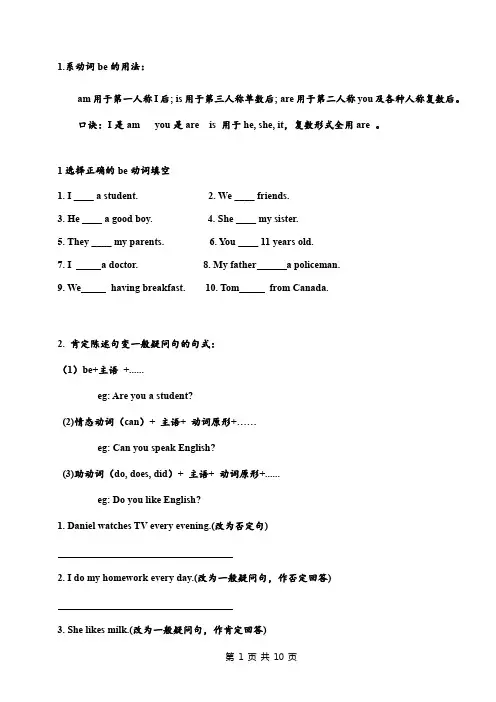
1.系动词be的用法:am用于第一人称I后; is用于第三人称单数后; are用于第二人称you及各种人称复数后。
口诀:I是am you是are is 用于he, she, it,复数形式全用are 。
1选择正确的be动词填空1. I ____ a student.2. We ____ friends.3. He ____ a good boy.4. She ____ my sister.5. They ____ my parents.6. You ____ 11 years old.7. I a doctor. 8. My father a policeman.9. We having breakfast. 10. Tom from Canada.2. 肯定陈述句变一般疑问句的句式:(1)be+主语+......eg: Are you a student?(2)情态动词(can)+ 主语+ 动词原形+……eg: Can you speak English?(3)助动词(do, does, did)+ 主语+ 动词原形+......eg: Do you like English?1. Daniel watches TV every evening.(改为否定句)2. I do my homework every day.(改为一般疑问句,作否定回答)3. She likes milk.(改为一般疑问句,作肯定回答)4. Amy likes playing computer games.(改为一般疑问句,作否定回答)5. We go to school every morning.(改为否定句)6. He speaks English very well.(改为否定句)7. She is always a good student.(改为一般疑问句,作否定回答)8. Simon and Daniel like going skating.(改为否定句)3. 代词(1)人称代词:主格:I we you you he she it they ( 做主语)宾格:me us you you him her it them ( 作宾语/表语)(2)物主代词:形容词性物主代词:my our your your his her its their (做定语)名词性物主代词:mine ours yours yours his hers its theirs (作定语以外成分) 名词性物主代词=形容词性物主代词+名词eg: mine = my book 我的书人称代词和物主代词练习A.从括号内选择正确的代词填空1. Your football clothes are on the desk.Please put _________(they,them,their,theirs) away.2. (We,Us,Our,Ours)_________ English teacher is Mrs. Green.We all like _________(she,her,hers).3. (I,Me,My,Mine)_________ can't get my kite.Could you help _________(I,me,my,mine)?4. Tom can't get down from the tree.Can you help _________(he,him,his)?5. Her kite is broken. Can _________(you,your,yours) mend(修理)it?6. We can't find our bikes.Can you help _________(we,us,our,ours)?7. These are _________(he,him,his) planes.The white ones are _________(I,me,mine).B.填入正确的人称代词和物主代词1. This isn't her knife. _________ is green.2. These are your books,Kate. Put __________ in the desk,please.3. You must look after ________ things.4. Wei Fang,is that ________ ruler? Yes,it's.5. They want a football. Give __________ the green one,please.1.指示代词(1) this / these 意为“这个;这些”,表示在时间或空间上离说话人较近的人或物。
外研版七年级英语上语法专项复习(含答案)

外研版七年级英语上语法专项复习Module 1: 动词be (阅读课本P77)()1.People in China going to the theatre at this moment.A.do B.am C.is D.are()2.There some meat in the fridge. We don't need to go shopping. A.is B.are C.aren't D.isn't()3.Everyone twelve years old in my class.A.is B.are C.am D.be()4.Mike getting ready for a party.A.do B.am C.is D.are()5.This pair of shoes a little expensive.A.be B.am C.is D.areModule 2:指示代词this, these, that, those(阅读课本P78)()1.—What's over there in front of the post office?—I'm not sure. Maybe is a bag of books.A.this; that B.that; it C.that; this D.it; that()2. are my books. Your books are over there.A.These B.It C.This D.That()3.—Look! Do you know man under the tree?—Sorry,it's too far. I can't see clearly.A.his; him B.that; him C.that; his D.this; her()4.—Hello! is Alice speaking.Who's ?—Lucy is speaking.A.That; this B.It; this C.This; that D.This; it()5.—Are those your flowers?—No. are Kate's.A.They B.It C.Those D.TheseModules 3—4:1.“有”—there be句型和have got的用法(阅读课本P79—P81) 2.some, any的用法(阅读课本P81)一、单项填空。
外研版七年级上册英语全册知识点归纳

外研版七年级上册英语全册知识点归纳MODULE 1一、同义句1.My name's Daming. = I'm Daming.2.I'm from England. = I come from England.3.Are you a new student? ≈ Are you new?4.Nice to meet you. = Nice to see you. =Glade to meet you. = Glade to see you.5.What's your name ? = May I have your name?二、特殊疑问句1. 询问姓名:—What's your name? —My name is .... = I’m…—What's his/her name? —His/her name is .... = He/She is…2.询问年龄:—How old are you? = Can you tell me your age?= What's your age?—I'm twelve years old.3.询问来自哪里:—Where are you from? —I'm from...—Where is he/she from? —He’s/She’s from...—Are you from China ? —Yes, I am/ we are. No, I’m not/ we aren’t.4.询问在哪个班:—What class are you in? —I'm in Class One, Grade Seven.三、单词1.China —Chinese America —American England —Englishcapital city2.small — big first— last everyone all四、语法1.代词人称代词主格 I you he she it we you they形容词性物主代词(…的) my your his her its our your their2.be动词:am I am= I’m I am not= I’m notis He /She is = He’s /She’s is not = isn’tare We /You /They are = We’re / You’re /They’re are not= aren’tMODULE 2一、单词grandparents grandfather—grandmother parents father—mother mum---dad daughter—son sister—brother aunt—uncle cousin husband---wife family woman---man women---men职业:job actor driver doctor manager nurse worker teacher policeman工作地点:factory hospital hotel office school theatre bus station shop二、短语a photo/picture of my family in front of in/at the frontof next toon the right --- on the left三、语法1.this---that these---those I---we he/she/it---they2.名词所有格:Miss Li's =her Tom’s = hisLily and Lucy's 两人共有的 eg: Lily and Lucy's desk is big Lily's and Lucy's 两人各有的Lily's and Lucy's desks are small.My parents’ room is very clean.四、句子1.---Is this your sister? --- Yes, it is. No, it isn’t---Are these her books? ---Yes, they are. No, they aren’t.2.---Who is this? --- This is my brother.--- Who are they/these? --- They are my cousins3. ---What’s your sister’s name?---My sister’s name is…/Her name is…4.---What does your father do?=What is your father's job?=What is your father?---He is a ...MODULE 3一、单词1.buildings: classroom, dining/sports hall, library, office, science lab, playground2.something: blackboard, book , room, computer, desk, furniture, map,wall,picture, television3.numbers: thirteen fourteen fifteen sixteen seventeen eighteen nineteenthirty forty fifty sixty seventy eighty ninety4.介词:next to ≈ near behind ≠ in front of in/at the front of:在......里面的前面in on under5. in the middle of on the left of--- on the right ofbetween …and… a map of our school6.right 正确的≠wrong右边的≠left二、句子1. Where is the office building ? It is between the dining hall and the library.2. How many students are there in your class? There are 38 students in my class.三、语法(There be)----Are there any school offices?----Yes, there are. There are some offices.----Is there a computer on Miss Li's desk?----No, there isn't.注意:1.就近原则:1). There is an orange and two apples on the desk.There are two apples and an orange on the desk.2). There are some students in the classroom.Are there any students in the classroom? Yes, there are. No, therearen’t3)There aren’t any students in the classroom.There isn’t an orange on the desk.MODULE 4一、family members:aunt uncle grandma grandmother grandpa grandfather mother father mum dad sister brother二、短语句型Thank you for your email.your help.helping me.asking me.inviting me.Make a family tree for your family.----How many people are there in your family?----There are four. There are my mum and dad, my sister and me.----Have you got an aunt?/any .....?----Yes,I have./No,I haven't.----Have you got a small family or a big family?----I've got a big family.or的用法:①或; (选择疑问句)②并列否定:I don't like swimming or dancing.MODULE 5-6一、单词1. orange 橙汁 have some orange [U]橙色 the oranges are orange [C]橙子 This is an orange [C]2.kind 善良 He is very kind.种类=tyre a kind / type of fruit two kinds /types of fruits3. gym: 不受天气影响的室内体育馆、健身房或运动馆stadium: 周围有看台的露天大型运动场4.healthy ≠ unhealthy keep/stay healthy保持健康in good health ≠ in poor/bad healthbe healthy = be in healthbe good for one’s health ≠be bad for one’s health名词变复数条件变化形式例词一般情况 + - s shops单词以s、x、ch、sh结尾 + - es buses以辅音字母+y结尾去y为i + -es city-cities单词以“o”结尾有生命+ - es tomatoes无生命 + - s zoos 一些以‘f’或‘fe’结尾的单词把’f‘或’fe‘变成’ves' knife-knives二、短语三、句型四、区别MODULE 7一、短语talk about sth.谈论某事talk to sb. 跟某人谈话(一方讲一方听)talk with sb. 跟某人谈话(双方都讲)get up≠go to bedgo home≠leave home(for)study science/history/chemistry/maths/...二、语法①时间表达法:What's the time? =What time it is?顺读法: It's two ten. 2:10 (直接读出数字)逆读法:①It's ten past two.(2:10) ≤30'②It's ten to ten. (2:50) >30'整点表达法:It's two o'clock. (2:00) 注意: (不用介词)②一般现在时(1)【No. 1】一般现在时的功能1.表示事物或人物的特征、状态。
最新外研版英语七年级上册期末语法总复习
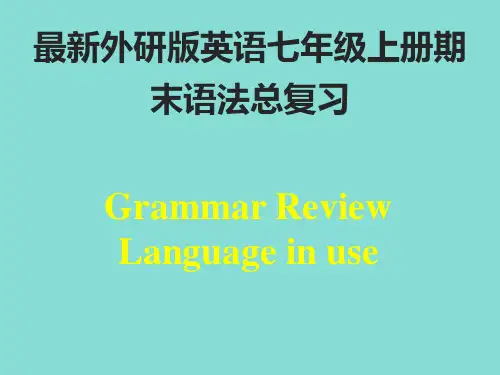
考点2 名词所有格 在表示有生命的东西的名词及某些表示时间、
距离、星球、世界、国家等无生命的东西的名词 后加’s或of来表示所有关系,叫做名词所有格。 考点1【重点】名词所有格构成规则
分类
’s所有 格
规则 在单数名词末尾加“’s”
在以s或es结尾的名词末尾加“’ ”
例句
Lingling’s book玲玲 的书
with __C___.
[重庆B 卷]
A. he B. his C. him D. himself
【点拨】用语法分析法解题。句意:汤姆是我最好的朋友。 我经常和他一起打篮球。he 他,人称代词主格;his 他的, 物主代词;him 他,人称代词宾格;himself 他自己,反身 代词。介词后应用人称代词的宾格。
14.Beijing is a big city.(改为一般疑问句,并作肯定回答) —___I_s____ Beijing a big city? —___Y_e_s___,_____it___ ____i_s___.
15.Lingling and Daming are in Class 5.(改为一般疑问句, 并作否定回答) —____A_r_e__ Lingling and Daming in Class 5? —____N_o___,____th_e_y__ ___a_r_en__'t_.
单数
复数
主格 宾格 主格 宾格
I me 我们 we us
第二人称 你 you you 你们 you you
他 he him 他们
第三人称 她 she her 她们 they them
它 it
it 它们
典例 Tom is my best friend. I often play basketball
外研版初中英语语法目录+
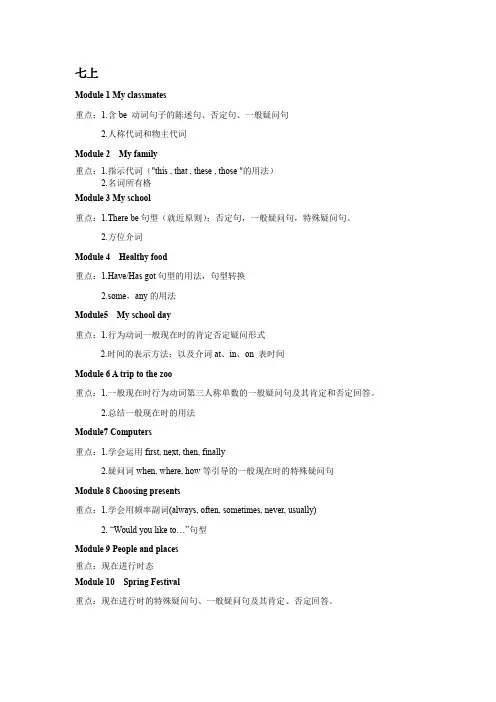
Module 1 My classmates重点:1.含be 动词句子的陈述句、否定句、一般疑问句2.人称代词和物主代词Module 2 My family重点:1.指示代词("this , that , these , those "的用法)2.名词所有格Module 3 My school重点:1.There be句型(就近原则);否定句,一般疑问句,特殊疑问句。
2.方位介词Module 4 Healthy food重点:1.Have/Has got句型的用法,句型转换2.some,any的用法Module5 My school day重点:1.行为动词一般现在时的肯定否定疑问形式2.时间的表示方法;以及介词at、in、on 表时间Module 6 A trip to the zoo重点:1.一般现在时行为动词第三人称单数的一般疑问句及其肯定和否定回答。
2.总结一般现在时的用法Module7 Computers重点:1.学会运用first, next, then, finally2.疑问词when, where, how等引导的一般现在时的特殊疑问句Module 8 Choosing presents重点:1.学会用频率副词(always, often, sometimes, never, usually)2. “Would you like to…”句型Module 9 People and places重点:现在进行时态Module 10 Spring Festival重点:现在进行时的特殊疑问句、一般疑问句及其肯定、否定回答。
M11、名词所有格2、物主代词3、描述人物,会写失物招领M21、情态动词can的用法,及转变为否定句、一般疑问句及肯定回答和否定回答2、用can会描述自己会做什么(比如球类和乐器)M31、一般将来时表达方法———be going to2、一般将来时的时间状语3.一般将来时转变为否定句、一般疑问句和特殊疑问句M41.一般将来时表达方法——will2.一般将来时变否定句、一般疑问句和肯定回答和否定回答M51.特殊疑问词2.特殊疑问句M6表示方向的方位介词M7 、M8、M9、M10一般过去式M11 祈使句M12 选择疑问句Module 1 How to learn English回顾:一般现在时,一般过去时,一般将来时,现在进行时Unit 1 Let’s try to speak English as much as possible.Unit 2 You should smile at her!知识点:提建议句型Module 2 My home town and my country形容词比较级(1)Unit 1 It’s taller than many other buildings.Unit 2 Cambridge is a beautiful city in the east of England.知识点:It做形式主语句型;关于人口的表达及问法Module 3 Sports形容词比较级(2)、副词的基本用法和副词的比较级Unit 1 Nothing is more enjoyable than playing tennis.Unit 2 This year we are training more carefully知识点:So .....that.... such....that......Module 4 Planes , ships and trains形容词、副词的最高级Unit 1 He lives the farthest from school.Unit 2 What is the best way to travel?Module 5 Lao She Teahouse动词不定式和双宾语Unit 1 I wanted to see Beijing Opera.Unit 2 It describes the changes in Chinese society.Module 6 Animals in danger动词不定式(2)Unit 1 It allows people to get closer to themUnit 2 The WWF is working hard to save them all.知识点:need的用法Module 7 A famous story过去进行时(2)Unit 1 Alice was sitting with her sister by the river.Unit 2 She was thinking about her cat.Module 8 Accidents过去进行时(2)Unit 1 While the lights were changing to red, a car suddenly appeared. Unit 2 I was trying to pick it up when it bit me again.Module 9 Population冠词和数字Unit 1 The population of China is about 1.37 billion.Unit 2 Arnwick was a city with 200,000 people.Module 10 The weather情态动词may/might表示可能Unit 1 It might snow.Unit 2 The weather is fine all year round.Module 11 Way of life情态动词must,can,need等Unit 1 In China, we open a gift later.Unit 2 In England, you usually drink tea with milk.Module 12 Help祈使句和情态动词must,can,could表示推测Unit 1 What should we do before help arrives?Unit 2 Stay away from windows and heavy furniture.八下目录M1 感官系动词look feel taste smell soundM2 现在完成时1 用法、构成M3 现在完成时2 have been to /have gone to/have been in ;时间状语M4 现在完成时3 短暂性动词的转化M5 一般现在时、一般过去时、现在完成时的区别M6 英语基本句型M7 并列句and but orM8 that 引导的宾语从句M9 whether/if及疑问词引导的宾语从句M10 宾语从句的时态问题九上Module1 Wonders of the worldUnit 1 It’s more than 2,000 years old.Unit 2 The Grand Canyon was not just big.语法点:时态复习:一般现在时,一般过去时,一般将来时,现在进行时,过去进行时,现在完成时Module 2 Public HolidaysUnit 1 My family always go somewhere interesting as soon as the holiday begins.Unit 2 We have celebrated the festival since the first pioneers arrived in America.语法点:时间状语从句:when, as soon as, before\after, while, until, sinceModule 3 HeroesUnit 1 She trained hard, so she became a great player laterUnit 2 There were few doctors, so he had to work very hard on his own语法点:原因、目的和结果状语从句:because,since, so that, soModule 4 Home aloneUnit 1 I can look after myself, although it won’t be easy for meUnit 2 I became so bored with their orders that I wished they would leave me alone.语法点:结果状语从句和让步状语从句:so...that..., although/though,Module 5 MuseumsUnit 1 Don’t cross that rope!Unit 2 If you ever go to London, make sure you visit the Science Museum语法点:状语从句:if从句+祈使句;表示“禁止做某事”:no+动名词;no+名词;祈使句Module 6 ProblemsUnit 1. If I start after dinner, I’ll finish it before I go to bed.Unit 2 If you tell him the truth now, you will show that you are honest.语法点:if引导的条件状语从句(主将从现);Module 7 Great booksUnit 1 We’re still influenced by Confucius’s ideasUnit 2 It is still read and loved语法点:一般现在时的被动语态Module 8 Sports lifeUnit 1 Daming wasn’t chosen for the team last yearUnit 2 He was invited to competitions around the world.语法点:一般过去时的被动语态Module 9 Great inventionsUnit 1 Will computers be used more than books in the future?Unit 2 Will books be replaced by the Internet?语法点:被动语态语法汇总Module 10 AustraliaUnit 1 I have some photos that I took in Australia last yearUnit 2 The game that they like most is Australian football语法点:that引导的定语从句Module 11 PhotosUnit 1 He’s the boy who won the photo competition last year!Unit 2 The photo which we liked best was taken by Zhao Min语法点:which和who引导的定语从句Module 12 Save our worldUnit 1 If everyone starts to do something, the world will be saved.Unit 2 Repeat these three words daily: reduce, reuse and recycle.语法点:构词法:合成法;派生法;转化法九下1 名词、冠词、数词2 代词3 形容词副词4 情态动词5 时态复习6 被动语态7 状语从句和动词不定式8 宾语从句定语从句。
最新外研版七年级英语上册各单元知识点汇总(全册)
最新外研版七年级英语上册各单元知识点汇总(全册)MODULE1一、同义句1. M yname'sDaming.=I'mDaming.2. I 'mfromEngland.=IcomefromEngland.3.Areyouanewstude nt.?=Areyounew?4.Nicetomeet you.=Nicetoseeyou.=Gladetomeetyou.=Gladetoseeyou.5.What'syourname.=MayIhaveyourname ? 6.Welcometo+地点二、用法集萃 —What'syourname. —Howoldareyou? —Mynameis....—Wheredoyoucomefrom? —Icomefrom...—I'mtwelveyearsold. —I‟m 12.—Whereareyoufrom? —What classareyouin? —I'mfrom...—I'm inClassOne,GradeOne.—Whatabout ...?—Whataboutdoing...?=Howaboutdoing...?With 和andJimandLilygotothebank.(and 表并列) JimwithLily goestothebank.(with 是介词,和...一起,动词的形式要与with 前面的主语一致)三语法专项。
Be 动词用法口诀我用am 你用are,is 跟着他,她,它. 单数名词用is ,复数名词全用are. 变疑问,往前提,句末问号莫丢弃。
变否定,更容易,be 后not 莫忘记。
否定疑问任你变,句首大写莫迟疑。
MODULE2一、短语。
basketballf ootballrideabike\horseplaytennistabletennisth epianospeakEnglish\Japanese\Chinese sing(asong)s wimaphoto\pictureofmyfamilyauniversityan office二.句子(询问职业)twofactoriescitie s universitiess ecretariesWhatdoesyour...do?=Whatis\areyou...'sjob?=Whatisyour...?He\Sheisa... They're...三.语法感叹句1.What 引导的感叹句(修饰名词):What+(a\an )+形容词+名词+(主语+谓语)!Whata bigschoolitis!好大的学校啊!Whatatallboyhe is!他好高啊!Whatheavyrain!好大的雨!2.How引导的感叹句(修饰形容词或副词):How+形容词或副词+主语+谓语!How tallheis! 他好高啊!Howfastheruns!他跑地好快!代词(分类参照笔记)人称代词:代指人或物名称的词。
外研版英语七年级上册语法总结
M1语法1Where are you from 你来自哪里回答:I am from Beijing. / I come from Beijing.2What about going swimming 去游泳怎么样回答: Good idea / Sounds great/ Great用法:what about= How about, about 是介词, 后接动词ing.例: What about __listening__ listento music3Everyone is here. 每个人都在这里.Everyone :每个人,是单数, 谓语动词用第三人称单数形式.例如:Everyone __likes__like music.4and/but 的用法and: 和,表示并列或顺承关系.but: 但是,表示转折关系.例如:He is from China, __but_ he isn’t Chinese.5It’s nice to meet you all. 很高兴见到你们.句型: It’s + 形容词+ to do sth.例如: It’s difficult _to learn__ learnEnglish.6My name is Tony Smith.My first name is ___Tony______.my last name is___Smith______.7Be 的用法1. Be 包括 is,am, are.2. Be 搭配口诀: I 用am, you 用are, is 用于he, she, it. 单数和不可数名词用is,复数全用are.3. Be 的肯定变否定,be + not4. Be 的缩写:I am = I’m ; you are = you’rehe is = he’s ; she is =she’s ; it is =it’s; what is =what’s 5. Be 的疑问句:Be + 主语+ 其他回答: Yes, 主语+be. / No, 主语+be not.M2语法1What/How 引导的感叹句What + a/an + 形容词+ 名词 + 主语+谓语= How + 形容词 / 副词+ 主语 +谓语What a big family it is =How big the family isWhat fine weather it is = How fine the weather is2in front of 在前面 / in the front of 在前部3名词所有格两人共有:A and B’s + is两人分别有: A’s and B’s +are例如: Mrs Green is __A__ mother.A. Lingling and Lucy’sB. Lingling’s and Lucy’sC. Lingling’s and Lucy4合成词合成词变复数,一般情况,后面的单词变复数.boy student ___boy students____bus driver __bus drivers______2. 含woman 和man的合成词变复数,两个都要变复数. man teacher ___men teachers_______woman doctor __women doctors_____5What’s your father’s job你的爸爸是做什么工作的= What does your father do= what is your father回答: He is a teacher.6Beijing is the capital of China. 北京是中国的首都. China — Chinese England – EnglishJapan – Japanese America – AmericanAfrica – African7This is a photo of my family. 这是我的一张全家照.a photo of …的一张照片8名词所有格有生命的: Lingling’s books无生命的: a door of classroom表示时间和距离的: two hours’ time我爸爸的一个朋友: a friend of my father’s9方位介词on the left 在左边; on the right 在右边in front of 在前面; next to = near 紧靠in the middle of 在中间10She and Daming’s mother are at the same hospital. 她和大明的妈妈在同一家医院工作.11My father is a bus driver, and he works in a bus station.职业的单词:policeman; doctor; nurse; teacher; actor; manager.M3语法1数字one, two, three, four, five, six, seven, eight, nine, ten.eleven, twelve, thirteen, fourteen, fifteen , sixteen,seventeen, eighteen, nineteen, twenty.thirty, forty, fifty, sixty, seventy, eighty, ninety, hundred. 2What’s your classroom in England like 你在英国的教室是什么样子的be like = look like 看起来像3 a lot of = lots of 许多a lot of / lots of 后接可数名词复数时,等于many; 后接不可数名词时, 等于much.4furniture 家具总称; food ; drink; information 信息,这些词都是不可数名词,用is5some / any 一些1. Some : 用于肯定句表示请求和建议,希望对方肯定回答的句子Would you like some milkWhat about some milkCan I have some milk2. any: 用于否定句和疑问句中例如:I haven’t got __any__ some/any apples.Would you like _some___ some/any apples6on the wall / in the wall 在墙上/在墙里例如: a door is _in the wall______________a map is __on the wall__________7with / and 的区别with 和 and 都有“和”的意思with 强调前者. 例如: Jack with his father __goes____go to park. and 强调两者都.例如: Jack and his father ___go_____go to park. 8There be 句型There be 表示“有” there is / there are含义:表示某地存在某人/某物have:强调某人/某物拥有句型:1肯定句: There is / are + 某人/某物2否定句: There isn’t / aren’t + 某人/某物3疑问句: Is / Are + there + 某人/某物Yes, there is . / No, there isn’t. Yes, there are . / No, there aren’t4. 就近原则: is 和are 的选择由最靠近它的名词的单复数决定.例如: There __is____ a pen and two books.There ___are____ two books and a pen.M4语法1food/drink 不可数名词1drink “饮料”,是不可数名词,用is2drink : have a drink3drink: “喝”, drink tea.2too much /too many 太多1too much + 不可数名词2too many + 可数名词复数3much too + 形容词 much too big3kind 种类1a kind of 一种2different kinds of 不同种类的3be kind to sb. 对某人和蔼4health / healthy 健康/健康的1I t is good for your health, please keep healthy. 2stay healthy; keep healthy; healthy food.5a bit of一点She has __a bit of _____ money. = a little6remember 记得remember to do sth. 记得去做某事remember doing sth. 记得做过某事7or 或者; 还是在肯定句中:表示”或者”在否定句和疑问句中,常用or 来代替 and: I haven’t got a pen or a book.在并列句中:表示“否则”: Hurry up, or you will be late.8have got/has got 句型1. 定义:拥有. have got = have ; has got =has2. 句型:肯定句:主语+ have got /has got +其他否定句:主语+ haven’t got /hasn’t got +其他疑问句:Have /Has+ 主语+ got + 其他回答: Yes, 主语+have/has.No, 主语+haven’t / hasn’t.3.There be 和have got 的区别There be某地存在某人/某物;强调存在;have got 某人/某物拥有...;强调拥有9特问词what 什么 where 哪里 when 何时 who谁 which 哪一个 How 方式或状态What time 什么时刻 How old 多大What colour 什么颜色How often 多少次once / twice / three times10is good for 对…有益反义词 is bad for对…有害11名词1. 可数名词--单数变复数规律:1一般情况:加s2 以s, x, ch, sh 结尾:加esbuses , boxes, watches3以“辅音+y”结尾的,变y为i, 加es. family -families, city- cities 4以f/fe 结尾:把它变成ves. leaf-leaves, wife-wives, knife-knives 5 以o结尾,记口诀: photo-photosNegroes and heroes like potatoes and tomatoes.黑人和英雄喜欢马铃薯和西红柿.6man – men; woman- women; child- children7oo-ee: foot-feet; tooth-teeth; goose-geese8 单复数同型:三人: Chinese; English; Japanese三物: fish; deer; sheep9 特殊单词mouse- mice ; ox- oxen; German - Germans2. 不可数名词1分类:液体类: water; tea; milk 等肉类: meat; fish; beef 等其他类: chocolate; bread; money; sugar; paper; work; homework; time; food; drink; furniture; information 等2用法1. 不可数名词,不用a/an,不加s /es 变复数2. 不可数名词,看作单数,和is 搭配3. 和 a little / little / a bit of 搭配4. 和 much 搭配M5 语法1时间表达法to1. 顺读法It' s + 点钟+ 分钟2. 逆读法It's + 分钟+... + 点钟1小于30分钟:It's + 分钟+ past + 点钟2等于30 分钟:It's + half past + 点钟3大于30分钟: It's + 60-分钟+to+ 点钟+14整点: It's + 点钟+ o'clock5等于15分钟:It's + a quarter past + 点钟6等于45分钟: It's + a quarter to + 点钟+1 2问时间What time is it = What' s the time /回答: It' s + 时刻3because 因为用Why 来提问, 用because 来回答有because 无so, 有though 无but4talk to / talk with 与...交谈5start to do sth 开始去做某事= begin to do sth6have 的用法have : 拥有have breakfast/ have lunch/have dinner : 吃早餐/中餐/晚餐have Chinese : 上语文课have a look : 看一看7house / home / family 的用法house : 房子强调建筑物home: 家乡带有感情色彩family : 家庭或家人8look / see/ watch / read 的用法look at : 看强调动作see: 看强调结果watch : 观赏watch TV/ watch gamesread : 阅读 read books9一般现在时1. 定义表示经常或反复发生的动作2. 用法:1 表示经常发生的动作V原或者V三单2 表示现在的状态Be3 表示客观事实或普遍真理.3. V形Be is /am /are ; V原; V三单当主语是第三人称单数4. 句型1.肯定句:主语+ be + 其他主语+ V原 + 其他;主语+ V三单+其他2.否定句:主语+be +not +其他主语+ don’t + V原+ 其他主语 + doesn’t + V原 + 其他3.疑问句: Be + 主语 + 其他Do + 主语 + V原 +其他Does + 主语 + V原 +其他注意:在主+谓+宾结构中,否定句和疑问句要借助助动词do 或does,助动词do/does 后加动词原形5. 标志词always, usually , often, sometimes, seldom很少, never从不,every day, on Mondays6. 练习题He __plays___ play basketball everyday.Daming __doesn’t like___ not like art .My friends __don’t come____ not come._Does___ the cat _eat____ eat fishWe always __watch____ watch TV.M6 语法1such as 例如2other 其他other animals = others 其他动物one … the other 一个…另一个some … the others 一些…另一些3Shall we go and see them 我们可以去看看他们吗Shall we + V原型祈使句4a little /little + 不可数名词a few / few + 可数名词复数5as well as 并且;还as well as = with 强调前者例如:He as well as his father ___has____ have lunch. 6be good at = do well in 擅长at 和in是介词,后接动词ing.例如: He is good at __swimming_____swimHe does well in __swimming____swimM7语法1connect …to …把…连接到…2turn on 打开; turn off 关闭turn up 调大声; turn down 调小声例如: It’s so dark, please _turn on_ the light.3first 第一序数词; one 一基数词He is the _first____ one to come here.4 表示顺序的词first: 首先 next : 接下来 then: 然后 finally : 最后5finally 最后__Finally____ final, you can click the mouse.6print 打印; printer 打印机Please use the __printer___print7mouse 老鼠;鼠标 miceThere are some __mice____mouse.8share … with…与…分享9plan 计划What’s your plan for your summer holidayI plan __to go___go to Beijing.10sometimes 有时例如:_____C_____ my mother goes to work by taxi.A.Some timesB. Some timeC. Sometimes 11特殊疑问句1结构:特问词+ 一般疑问句2特问词:What 什么 where 哪里 ; who 谁 ; whose 谁的 ;which哪个; when何时; how如何,方式或状态;What time什么时刻; what colour什么颜色How soon多快; in an hour; how long多长; how often 多少次;once; twice; three times; alwaysHow many问数量;可数名词how much问数量;不可数名词;问价格3做题方法:根据答语选择特问词,问什么答什么M8语法1Would you like to come to my birthday party 你愿意来参加我的生日聚会吗Would you like + sth.Would you like to do sth.回答: Yes, I’d love to. / Yes, please.No, thanks. / I’d love to, but…例如: Would you like ___to visit__ visit the Great Wall2give sth. to sb. = give sb. sth.buy sth. for sb. = buy sb. sth.3exercise 练习泛指练习时,是不可数名词:do some exercise特指具体的练习时,是可数名词复数: do eye exercises; do morning exercises.4search for information 搜索信息5use ... to do …用…做…6Do you sing it in Chinese or in English选择疑问句,问什么答什么,不能用Yes/No回答.7wear 穿戴wear: 强调穿戴的状态 wear + 衣服,帽子,眼镜,鞋子put on : 强调穿的动作 Please _put on_ your coatdress : 装扮 dress sb. He dresses himself8choose 选择choose to do sth. 选择去做9paper 不可数名词,用is10 information 不可数名词,用is11spend 花费1. spend 时间或者金钱2. 人+ spend + 时间/金钱 + on sth.人 + spend + 时间/金钱 + in doing sth.例如: It’s said that we’ll have to _D___ one hour ________ to Beijing.A. take; flyingB. takes; to flyC. spends; to flyD. spend; flyingM9语法1a few ; few / a little ; little 的用法2lie 躺着;说谎1. 躺着: lie - lying2. 说谎: tell a lie3enjoy 享受1. enjoy doing sth.例如:They are enjoying _listening_____listen to music.2. enjoy yourself = have a good time 玩得开心4It' s time to go back to school now. 到时间回学校了.句型: It's time to do sth.例如: It's time __to have____ have lunch.5moment 时刻at the moment = at this moment= now=right now用于现在进行时6leave 离开leave A : 离开Aleave for A : 前往A7get on 上车; get off 下车; get up 起床8sleep 睡觉go to sleep 入睡; go to bed 上床睡觉9现在进行时: V 变Ving1. 一般情况:加ing2. 以e结尾:去e加ing : take- taking; make-making3. 双写末尾辅音:swim-swimming; shop-shopping; run-running; sit-sitting; put-putting;begin-beginning4.特殊: lie-lying; die-dying; tie-tying10on the same day 在同一天11lying in the sun 躺在阳光下12by + 方式by bus; by email; by bikeM10语法1happen 发生1. What's happening to you 你发生了什么事= What' s up= What's the matter= What's wrong with you2. happen to do sth. 碰巧做某事例如:Mary happens __to see______ see a cat.2get ready for 为...做准备get ready for sth. = get ready to do sth.例如:We are getting ready for __learning___ learn a dragon dance. = We are getting ready _to learn____ learn a dragon dance. 3join 加入join + 人; join in + 活动4put away 收拾; sweep away 扫地1.名词可以放中间或者后面put the paper away = put away the papersweep the paper away = sweep away the paper2.代词只能放中间put it away / put them awaysweep it away / sweep them away5hurry up 快点Hurry up, or you will be late 快点,否则你就迟到了.hurry to do sth. 匆忙去做某事6look 看have a look 看一看; look at 看have a look at7mean 意味着It means + doing sth. 意味着做某事It means __learning___ learn English is very important. 8celebrate ... with... 以...方式庆祝。
(完整)外研版七年级上英语重点语法
(完整)外研版七年级上英语重点语法Starter Module 1 My teacher and my friends主系表结构主系表结构由“主语+系动词+表语”构成,系动词主要是指be动词,其变形am, is, are的基本意思为“是”,⽤来说明某⼈的年龄、⾝份、⾝体状况等,在英语中起着⾮常重要的作⽤。
1. 肯定句式为:主语+am/is/are+其他。
I am a student. 我是⼀名学⽣。
(说明主语I的⾝份)主语系动词表语They are my friends. 他们是我的朋友。
2. 动词be的否定式就是在其后加not,且可以缩写为“isn’t,aren’t”,但是am与not不能缩写。
He is not a teacher. He isn’t a teacher. 他不是⼀名教师。
You are not Chinese. You aren’t Chinese. 你/你们不是中国⼈。
3. be动词的⼀般疑问句式是把be动词提⾄句⾸,第⼀个字母要⼤写,句末⽤问号。
This is a map. 这是⼀张地图。
Is this a map? 这是⼀张地图吗?They are from Xinjiang. 他们来⾃新疆。
Are they from Xinjiang? 他们来⾃新疆吗?语法专练⼀、⽤be动词的适当形式填空。
1. I _______ a boy in Class Two.2. Daming ______ my good friend.3. _______ she a student?4. Where ______ you from?We _______ from England.5. How _______ Tony and Betty?They _______ fine.⼆、句型转换。
1. He is in Class Four. (改为否定句)He ________ in Class Four.2. We are from England. (改为否定句)We ________ from England.3. I am from Beijing. (改为⼀般疑问句,并作否定回答)_______ ________ from Beijing?_______, I _______ _________.4. Daming is twelve years old. (改为⼀般疑问句,并作肯定回答)_______ Daming twelve years old?_______, he ______.Starter Module 2 My English lesson祈使句1. 祈使句可⽤来表⽰命令、请求和建议等意义的句⼦。
七年级上册外研版英语课堂笔记
七年级上册外研版英语课堂笔记一、Module 1 My classmates。
1. 重点单词。
- nice:adj. 美好的;令人愉快的。
例如:She is a nice girl.(她是一个好女孩。
)- to:prep. 到;向。
例如:Welcome to Beijing.(欢迎来到北京。
)- meet:v. 遇见;结识。
例如:Nice to meet you.(很高兴见到你。
)- classmate:n. 同学。
例如:He is my classmate.(他是我的同学。
)- his:pron. 他的。
例如:His name is Tom.(他的名字是汤姆。
)- her:pron. 她的。
例如:Her book is very interesting.(她的书非常有趣。
)2. 重点短语。
- be from:来自。
例如:I am from China.(我来自中国。
)- Nice to meet you:很高兴见到你。
这是初次见面时常用的打招呼用语,回答通常是“Nice to meet you too”。
3. 重点句型。
- What's your name? 你叫什么名字?这是询问他人名字的常用句型,回答可以是“My name is...”或者“I'm...”。
- I'm from... 我来自……,用来介绍自己的籍贯。
例如:I'm from Shanghai.(我来自上海。
)二、Module 2 My family。
- family:n. 家;家庭。
例如:This is my family.(这是我的家庭。
)- father:n. 父亲;爸爸。
例如:My father is a teacher.(我的爸爸是一名教师。
)- mother:n. 母亲;妈妈。
例如:My mother likes cooking.(我的妈妈喜欢做饭。
)- sister:n. 姐妹。
例如:My sister is a student.(我的姐姐是一名学生。