
人教版七年级英语上册教案:Unit4 第四课时
第四课时 Section B (1a~1e)
§自主学习方案
学生自学新单词
(教材P22的单词),看谁记得又快又准。
(2 分钟) 【新词自查】
根据句意和汉语提示完成句子。
1.This is my radio (收音机) book. 2.Where is your clock (时钟)? 3.These are some tapes (磁带).
4.Are those her model planes (模型飞机)?
5.Lily’s
player (播放机) is red. §课堂导学方案
Step 1 情景导入
Teacher: Nice to meet you, boys and girls! In Section A, we have learnt how to ask and identify thing’s position. In this lesson, we’ll continue to talk about it. Now please turn to Page 22 and look at this picture in 1a carefully and tell me what are there in the picture and where are they now. Questions:
Teacher:①What is /are there in the picture? ②Where is it/are they?
Students:________________________________
环节说明:承上启下,在总结Section A 的学习内容后给学生下达要完成的任务,让学生迅速进入课堂状态。
Step 2 完成教材1a~1b 的任务 【操作案例】
1.仔细观察1a 中的图片,将方框中的单词与图中物品配对并熟读这些单词。
(2 分钟)
2.仔细观察1a 中的图片3分钟,然后合上书,写下你记住的所有物品及其相对位置。
(4分钟)
3.小组结对练习:学生A 提问物品的位置,学生B 回答。
(学生B 不能打开书)(4分钟)
4.小结训练。
(4分钟)
根据汉语意思完成句子,每空一词。
1.她的书包在桌子下面。
Her schoolbag is under the table. 2.我的帽子在哪里? Where’s my hat?
3.他的笔记本在床上。
His notebook is on the bed.
4.—我的钥匙在哪儿? —在沙发上。
—Where’re my keys? —They’re on the sofa.
环节说明:该环节中学生通过看图搭配词汇加强了对新单词的记忆,并在结对练习中运用新词汇,同时继续练习询问物品位置的句型。
Step 3 完成教材1c~1e 的任务 【操作案例】
1.认真听录音,圈出房间里汤姆想要的东西。
核对答案。
完成1c 。
(3分钟)
2.再听一遍录音,记下汤姆的东西的位置,请两位学生在黑板上书写句子,比一比看谁写得准确又全面。
完成1c 。
(5分钟)
3.根据汤姆房间里的物品的位置进行问答。
(3分钟)
4.小结训练。
(5分钟) 连词成句,注意标点符号。
1.drawer, is, in, the, pencil box, the The pencil box is in the drawer.
2.are, where, computer, your, TV, and Where are your TV and computer?
3. model, these, her, planes, are.
Are these her model planes?
4.under, clock, the, is, bed, the
The clock is under the bed. 5. is, in, the, the, ruler, bag
Is the ruler in the bag?
环节说明:通过听,说,读,写实现本节课的知识目标。
§当堂评价方案(详见当堂训练部分)。
英语人教版(2024)7年级上册 Unit 4 My Favourite Subjec教案 教学设计

I am from ___________. This term, I have ___________and ___________. I like ___________, but my favourite subject is ___________. I like it because ___________.In the class, ___________,___________/
学情分析
学生在小学英语中已经学过介绍喜爱学科及原因的表达方式,包括学科名称、表达喜恶、使用and/but/or、学习星期的表达方式等。学生能够积极探索适合自己的学习方法,定期反思和评价自己学习中的收获与不足。但部分学生不能合理规划、分配、利用和管理时间;不善于利用信息结构图去理解主题;不能运用准确的语言介绍自己的个人信息,在运用准确的语言介绍喜欢或不喜欢的学科及其原因、使用连词描写段落等方面还有一些困难。
2.Look at the passage. What can you see in the picture? What kind of passage is it?
3.Read the message board about students’ favourite subjects. Underline all the school subjects each student has. Let’s check the answers together.
些能力和素质对学生的学业发展和综合素质提升都有重要的影响,对他们未来的发展和成长起到了积极的作用。因此,学生在学习本课的过程中应该认真对待,积极参与,从中获取到更多的收获和成长。
2024秋新人教版英语七年级上册课件 Unit4第四课时
Section B(1a—2b)
Why do we learn different subjects? What can you learn from different subjects?
The online forum(论坛) is an area of a website where people go to discuss things.
Do you like music or maths? Why?
1c Read again and complete the table.
music maths
The class is fun and they learn a lot of new songs. Music always makes him happy.
useful, important, fun, interesting, exciting, meaningful, easy, hard, boring nice, humorous, helpful, kind, hard-working, responsible, experienced active, fun, attractive, easy to understand good with numbers/ language, creative, sensitive to sound, good at reasoning teacher, doctor, scientist, actor, lawyer...
maths, music, French, history, English, IT, science, gym
favorite subject :music
(完整word版)新人教版七年级上册英语教案 Unit4

New words:keys, baseball, computer game
Sentences:Is the baseball on the sofa? No, it isn’t. It’s under the chair.
学情分析
教学方法
任务型教学、分级评价法、直观教学法、模仿示范法、情景教学和合作学习法
学习方法
课前预习、课堂内外练习、听说读写结合
教学过程设计
备注
课题引入
I. Warming-up and revision
1.Greetings.
2.Divide the class into Group A and B. Draw two fishes on the blackboard as their symbols, tell the students that each time they answer questions right, they can get one or more points for their group and draw one or more bubbles around their fish, at the end of the class, the group which gets more bubbles will be the winner today. Say, “One, two, three!” Get the whole class sit straight, thus announce the beginning of the competition.
5. Make up your conversations with some pictures: first in parts, then in pairs.
人教版七年级英语上册Unit 4教案

Unit 4 Where ’s my schoolbag?话题Topic 房间里的物品Things around the house 功能Functions 能够询问并描述物品的位置Talk about where things are A:Where ’s my schoolbag? B:It ’s under the table. A:Where are my books? B:They ’re on the sofa. A:Is my computer game on the table? B:Yes,it is. A:Are my books on the bookcase? B:No,they aren ’t.They ’re on the chair./I don ’t know. 语法Grammar 一、能够正确使用介词on,in,under 描述物品所在的位置Prepositions on,in,under My keys are on the table. The tape is in the tape player. Your computer game is under your bed. 二、能够正确使用where 引导的特殊疑问句询问物品的位置Where questions A:Where ’s the pencil box? B:It ’s in the schoolbag. A:Where are their pens? B:They ’re on the teacher ’s desk. 词汇和常用表达 Words & expressions 1.能正确使用下列词汇Curriculum words(按词性排列) 名词:table,bed,sofa,chair,desk,room,hat,head,radio,clock ,tape,player,model, plane; 代词:their,our; 形容词:tidy; 动词:come,think,know; 副词:where,everywhere,always; 介词:on,under; 其他:but 2.能正确使用下列常用表达Useful expressions tape player,model plane,come on 3.能够认读下列词汇Non-curriculum words bookcase,yeah 学习策略 Strategies 1.进一步练习在听力和阅读过程中寻找关键词 2.学习使用略读(skimming)和寻读(scanning)两种阅读技巧 文化知识Culture 1.了解西方家庭物品的陈设与摆放 2.了解中西方表达空间位置的说法 三维目标 Three-dimensional target 知识与 技能 1.能掌握以下单词:where,table,bed,sofa,chair,on,under,come,d esk,think,room,their, hat,head,know,radio,clock,tape,player,model,p lane,tidy,but,our, everywhere,always 2.熟练掌握单元短语:come on,tape player,model plane 三维目标 Three-dimensional target 知识与 技能 3.能掌握以下句型: A:Where ’s his pencil box? B:It ’s in his schoolbag. A:Where ’s your ruler? B:It ’s under the chair. A:Where are my books? B:They ’re on the sofa. 4.了解以下语法:介词in,on,under 及其短语,where 引导的特殊疑问句询问物品的位置的句型,连词and 。
新人教版英语七年级上册 Unit 4 第四课时 Section B 1a-1d

Review
按要求写出正确的单词、词组或句子。
1.听 (短语) __li_s_te_n_t_o
2. 擅长(短语) _____b_e_good at
3. 记住(动词) _r_e_m_e_ber
4. 每个人(名词) _____e_v_eryone
5. 和……一样(短语) t_h_e_s_a_m__e_as 6. 特别的 (形容词) ____s_p_ec_i_a_l _
numbers. We learn how to work out
in class在课上
feel like感觉像是
maths problems in class. It feels like magic and is really fun. Maths is very
magic n. 魔法
useful adj. 有用的 a useful lesson 一节有用的课
class schedule课程表
English
maths
Chinese
history
PE
biology
music
geography
Prediction(预测)
Look through the passage and answer these questions.
look through浏览
1. What kind of passage is it?
Sunday is the first day of the week. 第一天
Sunday Sun - day
/ˈsʌn/ /deɪ/
Chinese English math music
一周的 第二天
What day is it ? Monday Mon - day
人教版(2024)七年级英语上册Unit 4 My Favourite Subject 单元教案
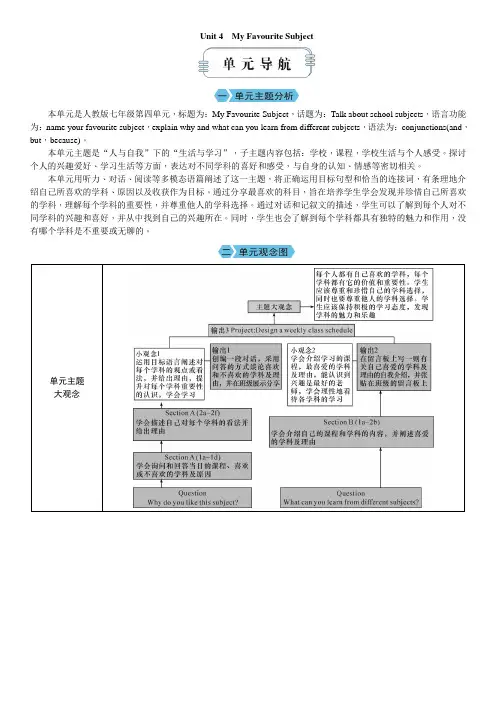
Unit 4 My Favourite Subject本单元是人教版七年级第四单元,标题为:My Favourite Subject,话题为:Talk about school subjects,语言功能为:name your favourite subject,explain why and what can you learn from different subjects,语法为:conjunctions(and,but,because)。
本单元主题是“人与自我”下的“生活与学习”,子主题内容包括:学校,课程,学校生活与个人感受。
探讨个人的兴趣爱好、学习生活等方面,表达对不同学科的喜好和感受,与自身的认知、情感等密切相关。
本单元用听力、对话、阅读等多模态语篇阐述了这一主题,将正确运用目标句型和恰当的连接词,有条理地介绍自己所喜欢的学科、原因以及收获作为目标。
通过分享最喜欢的科目,旨在培养学生学会发现并珍惜自己所喜欢的学科,理解每个学科的重要性,并尊重他人的学科选择。
通过对话和记叙文的描述,学生可以了解到每个人对不同学科的兴趣和喜好,并从中找到自己的兴趣所在。
同时,学生也会了解到每个学科都具有独特的魅力和作用,没有哪个学科是不重要或无聊的。
单元主题大观念单元语言大观念语言能力及技能语言能力:1.掌握与学科相关的词汇和常用表达,如:magic,useful,fun,important,subjects,difficult,easy,Chinese,history,maths,English,music,PE,geography,biology,IT,art,learn about the past,help me with my maths,work out maths problemsKey sentences:①—What's your favourite subject?—My favourite subject is…②—Why do you like…?—Because it's…③I'm good with numbers.④I'm not good at science.2.掌握双元音/e/,/a/,//,/əu/,/au/,/ə/,/eə/,/uə/的字母组合发音和单词连读。
人教版七年级上册英语教案:UNIT4 第四课时
尽量让大部分同学参与探Fra bibliotek突破1 My dictionary and my radio are on the desk.
2 My pencilbox is in my schoolbag and my schoolbag is under the desk.
5在她的桌子里________6在我的书包里_________
7.I_______know his name. A、am notB、don`tC、isn`t
8.Where are _______tapes? ________are under the desk.
A、you;YourB、my;ItC、my;They D、the;The(二)根据要求改写句子
在1句和2句中and分别连接两个并列的语和
试着做两个相似的句子
与教师导学相结合
巩固延伸
诊断评价课前认真预习后,完成下列习题,课后快速核对答案。相信你是最棒的
1在床下面_____________2在椅子后面______________
3在书橱里____________4在他的双肩背包里___________
可采用组内检测或评价展示来进行
板书设计
Unit4 Where 's myschoolbag?
学生板书
教学反思
课题:Unit 4 Where 's my schoolbag?(第4课时共4课时)主备人:
教学目标
知识与技能
1、掌握本节课的个单词.2培养学生阅读能力
过程与方法
导学,合作,探究的方法
情感、态度与价值观
教育学生要养成整洁的好习惯。
教学重点
七年级上册unit4教案(人教版英语七年级)
七年级上册unit4教案(人教版英语七年级)Unit Four Where’s my schoolbag?一.目标叙写1. 学生通过实物和图片掌握有关物品的新单词:table, bed, bookcase, sofa, chair, clock,tape, radio, hat, etc;2. 通过独立思考和小组合作,能灵活运用in, on, under, behind, in front of, near等介词;3. 熟练运用Where问句和一般疑问句及其回答;4. 掌握名词单复数及人称代词的用法。
二.教学重点、难点1.重点:A. 方位介词: in, on, under, behind, in front of, near 等的用法;B.Where 的特殊疑问句和一般疑问句:Is the… in/on/under the …?的肯定、否定回答;C.新单词:bed,table, bookcase,……2.难点:A. 能够准确运用方位介词描述物品所在的位置;B.能够运用Where问句找到物品的位置。
三.教学过程The First Period (Section A, 1a–2d)Step 1: Warming upRevise some school things by ask questions.e.g. What’s this? Is this a ...? How do you spell it? Etc.Learn the new words in, on, under... By helping the teacher to find the lost things.e.g. T: Where is my English book?S1: I think it’s on the desk.T: Where are my pens?S2: ...Teach the new word “where” and the use of “they”.Consolidate the prepositions by looking at the scree and answer the questions:Where’s...? Where’re...?Step2: PresentationLook and findT: Please look at the picture in activity 1a. There are some things in it. Do you know what they are?Match and discussa. T: Would you please match the words with the things in the picture?b. T: How many words do you know? Can you share the words you know with your partners?c. T: Please discuss with your partners and check whether your answers are the same.3.Check the answers4.ReadT: Please read the words after me. Table ...Step 3: Listen and numberT: Listen to the recording of 1b for the first time.T: Number the things in the picture when you listen to it for the second time.Read the sentencesa. T: I would like you to read the tape script together.b. T: Would you please read it by yourselves three times?Translate and explaina. T: Let’s translate the conversation into Chinese.b. T: Who can tell us what it means?c. T: Yes. When we ask the positions of things, we use the word “where”. And from the picture, we know that the word “on” means “在上面” “in” means “在里面” “under”means “在下面”. They are called prepositions “介词”。
人教版七年级英语上册Unit4第四课时SectionB 1a—1d课件
future ?
—I think so.
18.(探教材·P48)我最喜欢的学科是音乐,因为课很有趣,而且 我们可以学到许多新歌。
My favourite subject is music because the class is fun and we can learn a lot of new songs. 19.(新素材·聊天机器人ChatGPT)(新独家原创)现在,ChatGPT 可以帮助我们解决很多问题。 Now, ChatGPT can help us to work out a lot of problems. 20.(2023广东广州中考) 我最喜爱的科目是美术。我也在思 考我怎样能借助数学把画画得更好。 My favourite subject is art. I am also thinking about how
11.(思维品质·评价思维)We all like maths because we think it is a(n) useful subject. 12.What an excellent player he is! He can play basketball very well.
13.We are happy to know that we win first prize of the competition.
Unit 4 My Favourite Subject
第四课时 Section B 1a—1d
基础过关全练
Ⅰ.根据句意和汉语提示写出所缺的单词 1.(探教材·P48)I like it because I'm good with numbers (数字). 2.Lisa's brother wants to learn magic (魔术).
人教版七年级英语上册第4单元Unit4教案
人教版七年级英语上册第4单元Unit4教案Unit 4 Lesson Plan for Grade 7 English (Textbook: People’s Education Press) Lesson Overview- Unit: 4- Textbook: Grade: 7- Subject: English- Duration: 1 week- Lesson Title: Unit 4Lesson Objectives- Develop the students' listening, speaking, reading, and writing skills in English- Enhance the students' understanding of basic grammar rules and vocabularyLesson ContentThis lesson will cover the following topics and activities:1. Vocabulary- Introduce and practice vocabulary related to daily routines, such as wake up, get dressed, eat breakfast, go to school, etc.2. Listening- Listen to audio recordings of different daily routines and identify the corresponding activities3. Speaking- Practice speaking about personal daily routines and ask and answer questions about others' routines4. Reading5. Writing- Write a short paragraph describing a personal daily routine using the vocabulary and grammar learned in class6. Grammar- Review and practice the use of present simple tense in sentences related to daily routines- Engage in pair or group discussions about daily routines and exchange information8. Evaluation- Assess the students' understanding through quizzes, oral presentations, and written assignmentsLesson PlanDay 1: Vocabulary and Listening- Introduce the new vocabulary related to daily routines- Play audio recordings of different daily routines- Have students match the activities with the corresponding recordings- Discuss the correct answers as a classDay 2: Speaking and Reading- Practice speaking about personal daily routines in pairs or small groups- Introduce the reading passage about a teenager's typical day- Discuss the answers as a classDay 3: Writing and Grammar- Review the present simple tense and its usage in sentences related to daily routines- Provide a writing prompt asking students to describe their own daily routines- Have students write a short paragraph using the vocabulary and grammar learned- Divide the class into pairs or small groups- Assign each group a set of questions related to daily routines- Have the groups discuss the questions and exchange information - Assess the students' understanding through oral presentations and participationResources- Textbook: People's Education Press Grade 7 English- Audio recordings of daily routines- Reading passage about a teenager's daily routine- Writing prompts for students to describe their daily routinesAssessment- Quizzes to test vocabulary knowledge- Evaluation of written paragraphs describing daily routines- Oral presentations and participation in group discussionsConclusion。