
小学英语语法——动词知识点讲解+练习
动词
一、动词概述
1、动词的定义:表示动作和状态的词叫作动词。
2、动词的种类:
(1)实义动词:表示行为、动作或状态的词。
实义动词词义完整,能独立作谓语,
亦称为行为动词。
(2)系动词: 亦称连系动词,是用来帮助说明主语“是什么”或“怎么样”的
动词,系动词本身有词义,但不能独立用作谓语,后边必须跟表
语,构成系表结构说明主语的状况、性质、特征等情况。
(3)情态动词: 情态动词用在实义动词前,表示说话人对这一动作或状态的看法
或主观设想。
情态动词本身有一定词义,但是不能独立作谓语,
只能和实义动词一起构成谓语。
(4)助动词: 表示不同的时态、语态以及句子的否定和疑问。
助动词本身无词
义,不可独立作谓语,只能协助主要动词构成谓语。
二、动词考点纵览。
小学英语语法习题——动词
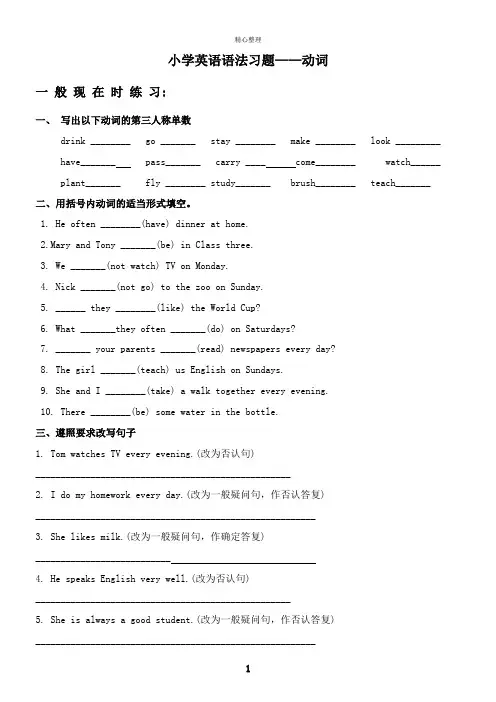
小学英语语法习题——动词一般现在时练习:一、写出以下动词的第三人称单数drink ________ go _______ stay ________ make ________ look _________ have_______ pass_______ carry ____ come________ watch______ plant_______ fly ________ study_______ brush________ teach_______二、用括号内动词的适当形式填空。
1. He often ________(have) dinner at home.2.Mary and Tony _______(be) in Class three.3. We _______(not watch) TV on Monday.4. Nick _______(not go) to the zoo on Sunday.5. ______ they ________(like) the World Cup?6. What _______they often _______(do) on Saturdays?7. _______ your parents _______(read) newspapers every day?8. The girl _______(teach) us English on Sundays.9. She and I ________(take) a walk together every evening.10. There ________(be) some water in the bottle.三、遵照要求改写句子1. Tom watches TV every evening.(改为否认句)___________________________________________________2. I do my homework every day.(改为一般疑问句,作否认答复)________________________________________________________3. She likes milk.(改为一般疑问句,作确定答复)___________________________4. He speaks English very well.(改为否认句)___________________________________________________5. She is always a good student.(改为一般疑问句,作否认答复)________________________________________________________1现在进行时练习:一、写出以下动词的此时此刻分词:play________ run__________ swim _________ make__________ go_________ like________ write________ ski___________ read________ have_________ sing ________ dance_________ put_________ see________ buy _________ live_______ take_________ come ________ get_________ stop_________二、用所给的动词的正确形式填空:1.The boy __________________ ( draw)a picture now.2. Listen !Some girls _______________ ( sing)in the classroom .3. My mother _________________ ( cook )some nice food now.4. What _____ you ______ ( do ) now?5. Look . They _______________( have) an English lesson .6.They ____________(not ,water) the flowers now.7.Look! the girls ________________(dance )in the classroom .8.What is our granddaughter doing? She _________(listen ) to music.9. It’s 5 o’clock now. We _____________(have)supper now10.______Helen____________(wash )clothes? Yes ,she is .三、句型转换:1. They are doing housework .(分别改成一般疑问句和否认句)__________________________________________________________________________________________________________________________2. The students are cleaning the classroom . ( 改一般疑问句并作确定和否认答复)__________________________________________________________________________________________________________________________________3.I’m playing the football in the playground .(对划线局部进展提问)_________________________________________________________________4.Tom is reading books in his study . (对划线局部进展提问)2一般将来时练习一、填空。
小学英语毕业考知识点,语法总汇.
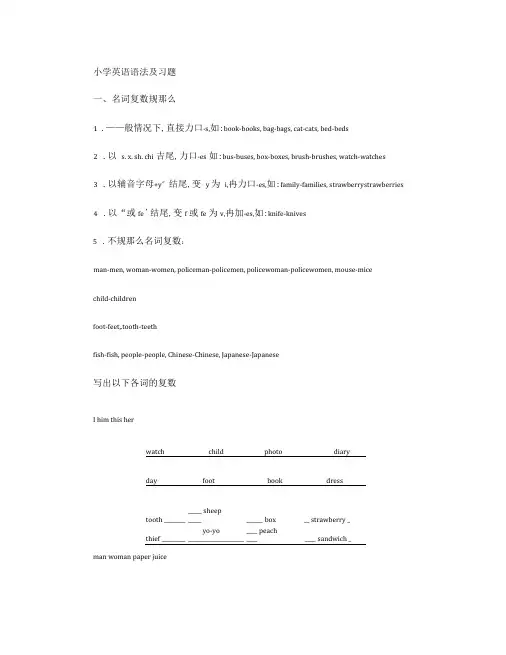
小学英语语法及习题一、名词复数规那么1 .——般情况下,直接力口-s,如:book-books, bag-bags, cat-cats, bed-beds2 .以 s. x. sh. chi 吉尾,力口-es 如:bus-buses, box-boxes, brush-brushes, watch-watches3 .以辅音字母+y 〞结尾,变 y 为 i,冉力口-es,如:family-families, strawberrystrawberries4 .以“或fe '结尾,变f 或fe 为v,冉加-es,如:knife-knives5.不规那么名词复数: man-men, woman-women, policeman-policemen, policewoman-policewomen, mouse-micechild-childrenfoot-feet,.tooth-teethfish-fish, people-people, Chinese-Chinese, Japanese-Japanese写出以下各词的复数I him this herwatch child photo diaryday foot book dresstooth ________ _____ sheep _____ ______ box __ strawberry _thief _________ yo-yo _____________________ ____ peach ____ ____ sandwich _ man woman paper juicewater milk rice tea二、一般现在时一般现在时根本用法介绍[No. 11 一般现在时的功能1.表示事物或人物的特征、状态.如:The sky is blue天空是蓝色的.2.表示经常性或习惯性的动作.如:I get up at six every day我每天六点起床.3.表示客观现实.如:The earth goes around the surtfe球绕着太阳转.一般现在时的构成1. be动词:主语+be〔am,is,are短它.如:I am a boy我是一个男孩.2.行为动词:主语+行为动词〔+其它.如:We study English.我们学习英语.当主语为第三人称单数〔he, she,it时,要在动词后加"-s"或"-es".如:Mary likes Chinese玛丽喜欢汉语.一般现在时的变化1. be动词的变化.否认句:主语+ be + not + 其它.如:He is not a worker他不是工人.一般疑问句:Be +主语+其它.如:"Are you a student?-Yes. I am. / No, I'm not.特殊疑问句:疑问词+一般疑问句.如:Where is my bike?2.行为动词的变化.否认句:主语+ don't( doesn't呦词原形(+其它.如:I don't like bread.当主语为第三人称单数时,要用doesn't构成否认句.如:He doesn't often play.一般疑问句:Do( Does +主语+动词原形+其它.如:-Do you often play football?-Yes, I do. / No, I don't.当主语为第三人称单数时,要用does构成一般疑问句.如:-Does she go to work by bike?-Yes, she does. / No, she doesn't.特殊疑问句:疑问词+一般疑问句.如:How does your father go to work?动词+s 的变化规那么1.一般情况下,直接力口-s,如:cook-cooks, milk-milks2.以s. x. sh. ch. c^尾,力口-es以□:guess-guesses, wash-washes, watch-watches, go- goes3.以辅音字母+y〞结尾,变y为i,再力口-es,如:study-studies一般现在时用法专练:一、写出以下动词的第三人称单数drink ________ ________ g o_________ stay__________________________ make _look have pass carrycome watch plant flystudy_ brush do teach二、用括号内动词的适当形式填空.1.He often(have dinner at home.2.Daniel and Tommy(be in Class One.3.We(not watch TV on Monday.4.Nick(not go to the zoo on Sunday.5.they(like the World Cup?6.What they often(do on Saturdays?7.your parents(read newspapers every day?8.The girl(teach us English on Sundays.9.She and I(take a walk together every evening.10.There(be some water in the bottle.11.Mike(like cooking.12.They(have the same hobby.13.My aunt(look after her baby carefully.14.You always(do your homework well.15.I(be ill. I ' iin staying16.She(go to school from Monday to Friday.17.Liu Tao(do not like PE.18.The child often(watch TV in the evening.19.Su Hai and Su Yang(have eight lessons this term.20.-What day(be it today?-It ' s Satay.三、根据要求改写句子1. Daniel watches TV every evening.改为否认旬________________________________________________________________________________________ 2. I do my homework every day.做为一般疑问句,作否认答复________________________________________________________________________________________ 3. She likes mil吸为一般疑问句,作肯定答复4.Amy likes playing computer games.帔为一般疑问句,作否认答复5.We go to school every morning.改为否认旬________________________________________________________________________________________ 6. He speaks English very well.〔改为否认句7.I like taking photos in the park.附划线局部提问8.John comes from Canad训划线局部提问9.She is always a good student改为一般疑问句,作否认答复10.Simon and Daniel like going skating.帔为否认句三、现在进行时1.现在进行时表示现在正在进行或发生的动作,也可表示当前一段时间内的活动或现阶段正在进行的动作.2.现在进行时的肯定句根本结构为be+动ting.3.现在进行时的否认句在be后加not4.现在进行时的一般疑问句把be动词调到句首.5 .现在进行时的特殊疑问的根本结构为:疑问词+ be +主语+动词ing?但疑问词当主语时其结构为:疑问词+ be +动词ing?动词加ing 的变化规那么1 .一般情况下,直接加ing,如:cook-cooking2 .以不发音的 e 结尾,去 e 力口 ing,如:make-making, taste-tasting3 .如果末尾是一个元音字母和一个辅音字母,双写末尾的辅音字母,再加ing, 如:run-running, stop-stopping现在进行时专项练习:一、写出以下动词的现在分词:play run swim makego like write skiread have sing danceput see buy lovelive take come get stop________ __________ s it __________ _______ begin ______ _______ shop _______________________二、用所给的动词的正确形式填空:1 .The boy( drawa picture now.2 . Listen .Some girls( singin the classroom .3. My mother( cook some nice food now.4. What you( do now?5. Look . They( have an English lesson .6.They(not ,water the flowers now.7.Look! the girls(dance in the classroom .8.What is our granddaughter doing? She(listen to music.9. It ' s 5 o' clock now. We(havesupper now10.Helen(wash clothes? Yes ,she is .四、将来时一、概念:表示将要发生的动作或存在的状态及打算、方案或准备做某事.句中一般有以下时间状语:tomorrow, next day(week, month, year …,soon, the day after tomorrow(后天等.二、根本结构:①be going to + do;② will+ do.三、否认句:在be动词(am, is, are后力口not或情态动词will后加not成won'4例如:I ' m going to have a picnic this afternoon. f I ' m not going to havea picnic this afternoon.四、一般疑问句:be或will提到句首,some改为any, and改为or,第人称互换例如:We are going to go on an outing thisweekend. f Are you going to go on an outing this weekend?五、对划线局部提问.一般情况,一般将来时的对划线局部有三种情况.1.问人.Who 例如:I ' m going to New York soon. f Who s going to New Yorksoon.2.问干什么.What …do例如:My father is going to watch a race with me thisafternoon. fWhat is yfather going to do with you this afternoon. 3.问什么时候.When.例如:She' s going to go to bed at nine. fWhen is she goingto bed?六、同义句:be going to = willI am going to go swimming tomorrow〔明天.=I will go swimming tomorrow. 练习:填空.1.我打算明天和朋友去野炊.I have a picnic with my friends.I have a picnic with my friends.2.下个星期一你打算去干嘛?我想去打篮球.What _________________________________________________________________________________________ next Monday? Iplay basketball.What you do next Monday? I play basketball.3.你妈妈这个周末去购物吗?是,她要去买一些水果.your mother go shopping this? Yes, she. She buy some fruit.你们打算什么时候见面.What time you meet?改句子.5.Nancy is going to go camping.改否认Nancy going to go camping.6.I ' ll go and join them否认I go join them.7.I,m going to get up at 6:30 tomorroW〔股疑问句to get up at 6:30 tomorrow?8.We will meet at the bus stop at 10:30 政一般疑问句meet at the bus stop at 10:30.9.She is going to listen to music after school]寸划线局部提问she after school?10.My father and mother are going to see a play the day after tomorrow^ 上going to see a play the day after tomorrow五、一般过去时1.一般过去时表示过去某个时间发生的动作或存在的状态,常和表示过去的时间状语连用.一般过去时也表示过去经常或反复发生的动作感谢.2.Be动词在一般过去时中的变化:⑴am 和is在一般过去时中变为was.〔was not=wasn ' t⑵are在一般过去时中变为were.〔were not=weren ' t⑶带有was或were的句子,其否认、疑问的变化和is, am, are 一样,即否认句在was或were后力口not,一般疑问句把was或were调到句首.3.句中没有be动词的一般过去时的句子否认句:didn ' 1+司原形,如:Jim didn ' t go home yesterday.一般疑问句:在句首加did,句子中的动词过去式变回原形.如:Did Jim go home yesterday?特殊疑问句:⑴疑问词+did+主语+动词原形?如:What did Jim do yesterday?⑵疑问词当主语时:疑问词+动词过去式?如:Who went to home yesterday?动词过去式变化规那么:1.一般在动词末尾加-ed,如:pull-pulled, cook-cooked2.结尾是e力口d,如:taste-tasted3.末尾只有一个元音字母和一个辅音字母的重读闭音节冉,应双写末尾的辅音字母力口-ed,女口:stop-stopped4.以辅音字母+y〞结尾的,变y为i,再力口-ed,如:study-studied5.不规那么动词过去式:am,is-was, are-were, do-did, see-saw, say-said, give-gave, get-got, go-went, come- came, have-had, eat-ate, take-took, run-ran, sing-sang, put-put, make-made, read-read, write-wrote, draw-drew, drink-drank, fly-flew, ride-rode, speak-spoke, sweep-swept, swim-swam, sit-sat用所给词的适当形式填空.1.I(do my homework every evening.2.Mary(read English yesterday morning.3.There(be no one here a moment acj®(^.4.I(call Mike this morning.5.We(fly kites in the park on Sunday s.6.My mother(clean our room last Sunday.7.Tom(play the piano every Saturday. Now he(play.8.My mother(not do housework yesterday.9.She watches TV every evening. But she(not watch TV last night.10.your father( go to work every day last year?11.--What time you(get to Beijing yesterday?--We(get to Beijing at 9:00 in the evening.st year the teacher(tell us that the earth moves around the sun.13.There a telephone call for you just now. (be14.There not enough people to pick apples that day. ( be15.There( be not any hospitals in my hometown!(乡in 1940.16.There enough milk at home last weekyasn' t there?17.^When you(come to china? Last year.18.Did she(have supper at home?19.Jack(not clean the room just now.20.(be it cold in your city yesterday?21.How many people(be there in your class last term?22.It(be hot yesterday and most children(be outside.23.There(be a football match on TV yesterday evening, butI(have no time to watch it.24.I(have an exciting party last weekend.25.she(practice her guitar yesterday? No, she.26.What Tom(do on Saturday evening?He(watch TV and(read an interesting book.27.They all(go to the mountains yesterday morning.28.She(not visit her aunt last weekend. She(stay at home and (do some cleaning..29.Mr. Li(do the project on Monday morning? Yes, he .30.How(be Jim's weekend? It(be not bad.31.(be your mother a sales assistant last year? No. she.32.She(like swimming. She(swim this weekend.ually my mother(wash the dishes after lunch. But my grandma(wash today.34.Look at the man! He(read a magazine.35.Look! The plane(fly over the building.36.Listen! My aunt(sing in the room.She is a singer. She(like singing. She(have a music show next month. Sheis excited.37.Tom and Mike always(swim in the river. They(swim in the swimming pool this Sunday. Look! They(swim.38.What you usually(do in the evening? I(play computergames.39.What you(do now? I(make a paper plane.40.What he(do now? He(dance.41.What she(do yesterday? She(visit hergrandparents.42.your mother(read newspaper in the morning? Yes, She .43.you(like fishing? No, I. I like(swim,but my brother(like.44.How your father(go to work every day?He(go by bike. But it ' s cold today. He(take the No.21 bus,, and he (go to work by taxi yesterday.45.the monkey(like climbing trees? Yes, it.46.What your father(do after lunch? He(reada comic book. What he(do today? He(clean the kitchen formy grandma. Look! He (clean.47.you(collect stamps? Yes. I.your brother(collect, too? No, he.选择正确答案,将其序号填入题前括号内.(12分(11.I usually get up seven o ' clock in the morning.A .at B. on C. of(12.--is the coat?--Thirty-five yuan, please.A .How B. How much C. How old(13.--Where are your glasses?--I can ' t find them, they here just now.A .are B. was C. were(14. The brown cat is as as the black cat.A .fat B. fatter C. thinner(15.-- Excuse me, can you tell me the way to the Garden Cinema? -- Let me see. You can bus No. 5.A .by B. take C. go(16. --Are there any students in the classroom?--Yes, there students in the classroom.A .any B. some C. a(17.--Hello, is that Liu Tao?--Yes,.A .I am B. it is C. speaking(18.David is playing basketball in the playground.A .a B. the C. \(19.I have two storybooks, but Helen four.A .has B. have C. had(20. This is not my purse.is over there.A. MyB. MineC. I(21.--What' s the capita^都of the UK?A.LondonB.New YorkC.Paris(22.--When is the Teachers ' day in China?--It ' s on.A.September 10B.December 25C.October 31学说正确英语三、根据所给语境,选择适当的答案,将其序号填入题前括号内(8分(23.当别人对你说“Your English is verynice!你可以说:A.Of course.B.Not at all.C.Thank you.D.4.当你上学迟到时,你可以这样对老师说A.It doesn t matter.B. I'm sorry, I m late.B. C. That ' s all right.(25.当别人对你说“Would you like to my birthday party?你可以说:"A.Sure.B.Good night.C.No.(26.当别人对你说“What date is it today?尔可以说,:C. A. Today is Monday. B. It ' s my birthday.C. It ' s August 6.(27.当别人对你说“What' s your job?可以说:A.I'm Kate.B.I ' m a doctor.C.I ' m Li Ming ' s mothe当徵队对你说“Let' s go skating不想去,可以说:A. Sorry, I can ' t.B.OK, let ' s go.C. That ' sood idea. (29当你的朋友说"I' ve got a bad cough可以说:A.How are you?B.I'm sorry to hear that.C.How do you do? (30.开学后,老师第一次见到同学们,会说:A.What ' s your name?B.Welcome back to school, boys and girls.C.Good bye boys and girls.。
PEP小学五年级英语语法要点及习题-现在进行时

PEP小学五年级英语pep英语五年级下册句型when do you do morning exercises? 你什么时候做早操?I usually do morning exercises at 8:00 . 我经常八点种做早操。
I usually get up at 12:00 at noon .我经常在中午十二点起床。
When do you eat dinner ? 你什么时候吃晚餐?I eat dinner at 7:00 in the evening. 我在晚上七点种吃晚餐。
When is the best time to go to Beijing?最好在什么时候去北京?Fall. 秋天。
When is your birthday ?你什么时候生日?It is in May.在五月。
My uncle’s birthday is in June . Uncle Bill’s birthday is in June, too.我叔叔的生日在六月。
标叔叔的生日也在六月。
When is Teacher’s Day ? Children’s Day New Year’s Day Army Day women’s Day什么时候是教师节?儿童节新年建军节妇女节christmas Day National Day Independence Day Tree planting Day圣诞节国庆节美国国庆节植树节April fool’s Day Labour Day愚人节劳动节Which season do you like best ? 你最喜欢是什么季节?I like summer,because I can swim in the lake. Spring is good ,but fall is my favouriteseason.我喜欢夏天。
因为我可以在湖里游泳。
春天是好的。
但是秋天是我最喜欢的季节。
小学六年级英语语法详解与练习(全)-免费下载
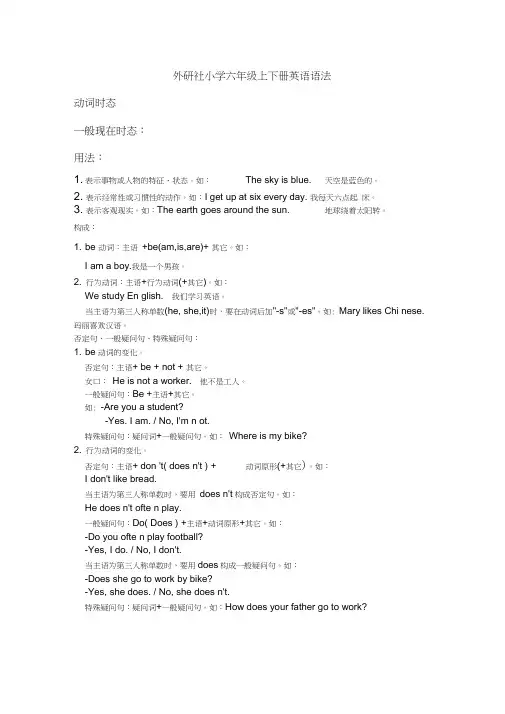
外研社小学六年级上下册英语语法动词时态一般现在时态:用法:1. 表示事物或人物的特征、状态。
如:The sky is blue. 天空是蓝色的。
2. 表示经常性或习惯性的动作。
如:I get up at six every day. 我每天六点起床。
3. 表示客观现实。
如:The earth goes around the sun. 地球绕着太阳转。
构成:1. be 动词:主语+be(am,is,are)+ 其它。
如:I am a boy.我是一个男孩。
2. 行为动词:主语+行为动词(+其它)。
如:We study En glish. 我们学习英语。
当主语为第三人称单数(he, she,it)时,要在动词后加"-s"或"-es"。
如: Mary likes Chi nese. 玛丽喜欢汉语。
否定句、一般疑问句、特殊疑问句:1. be动词的变化。
否定句:主语+ be + not + 其它。
女口:He is not a worker. 他不是工人。
一般疑问句:Be +主语+其它。
如: -Are you a student?-Yes. I am. / No, I'm n ot.特殊疑问句:疑问词+—般疑问句。
如:Where is my bike?2. 行为动词的变化。
否定句:主语+ don 't( does n't ) + 动词原形(+其它)。
如:I don't like bread.当主语为第三人称单数时,要用does n't构成否定句。
如:He does n't ofte n play.一般疑问句:Do( Does ) +主语+动词原形+其它。
如:-Do you ofte n play football?-Yes, I do. / No, I don't.当主语为第三人称单数时,要用does构成一般疑问句。
小学英语语法复习动词时态专项讲解和练习
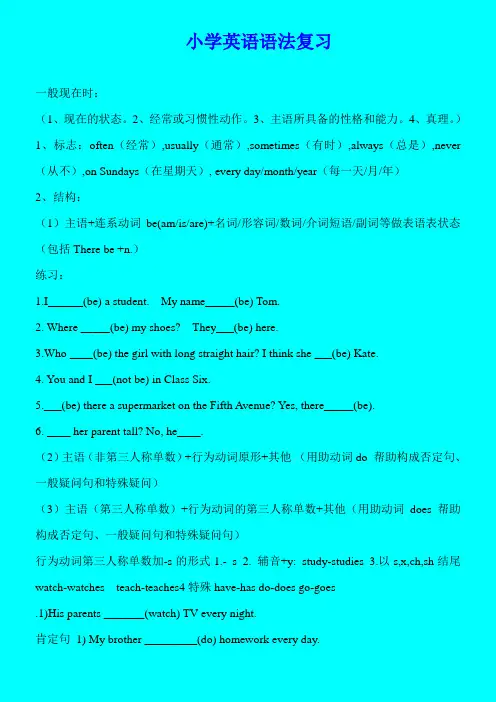
小学英语语法复习一般现在时:(1、现在的状态。
2、经常或习惯性动作。
3、主语所具备的性格和能力。
4、真理。
)1、标志:often(经常),usually(通常),sometimes(有时),always(总是),never (从不),on Sundays(在星期天), every day/month/year(每一天/月/年)2、结构:(1)主语+连系动词be(am/is/are)+名词/形容词/数词/介词短语/副词等做表语表状态(包括There be +n.)练习:1.I______(be) a student. My name_____(be) Tom.2. Where _____(be) my shoes? They___(be) here.3.Who ____(be) the girl with long straight hair? I think she ___(be) Kate.4. You and I ___(not be) in Class Six.5.___(be) there a supermarket on the Fifth Avenue? Yes, there_____(be).6. ____ her parent tall? No, he____.(2)主语(非第三人称单数)+行为动词原形+其他(用助动词do 帮助构成否定句、一般疑问句和特殊疑问)(3)主语(第三人称单数)+行为动词的第三人称单数+其他(用助动词does 帮助构成否定句、一般疑问句和特殊疑问句)行为动词第三人称单数加-s的形式1.- s 2. 辅音+y: study-studies 3.以s,x,ch,sh结尾watch-watches teach-teaches4特殊have-has do-does go-goes.1)His parents _______(watch) TV every night.2)His parents _________(not watch) every night.否定句2)My brother________(not do)homework every day.3)_____his parents_____(watch) TV every night?一般疑3)______ your brother _____ homework every day?Yes, they _______. No, they _______.Yes, he______. No, he _________.4)When___ his parents _____(watch) TV?特疑4)When _____ your brother ____(do) homework?5)They watch TV every night.He does homework every day.二.现在进行时:表示说话瞬间或现阶段正在进行的动作。
小学英语语法讲解-动词情态动词
3)表示允许。
Can I have a look Nhomakorabeaat your new pen?我可以看一看你的新钢笔吗?
He asked whether he could take the book out of the reading-room.
他问他可不可以把书带出阅览室。
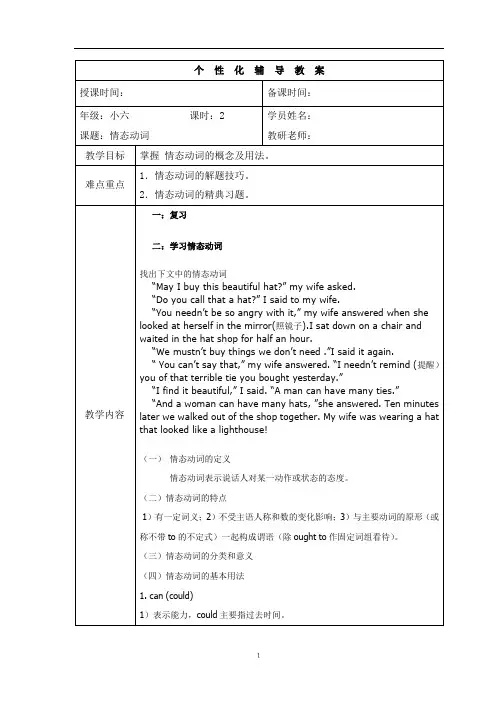
“We mustn’t buy things we don’t need .”I said it again.
“ You can’t say that,” my wife answered. “I needn’t remind (提醒)you of that terrible tie you bought yesterday.”
You may take whatever you like.你喜欢什么就拿什么。
He told me that I might smoke in the room.他告诉我可以在房间里抽烟。
May (Might) I ask for a photo of your baby?我可以要一张你宝宝的照片吗?
“I find it beautiful,” I said. “A man can have many ties.”
“And a woman can have many hats, ”she answered. Ten minutes later we walked out of the shop together. My wife was wearing a hat that looked like a lighthouse!
5)比较委婉客气地提出问题或陈述看法。
Can (Could) you lend me a hand?帮我一把好吗?
小学英语语法时态归纳及练习(含答案解析)
英语时态归纳一、一般现在时:标志词:often(经常) sometimes(有时) always(总是) usually(通常) never(从不) every(每一)行为动词词型变化形式:一般现在时动词只有第三人称有词形变化;其他人称(第一人称:I, we;第二人称:you;第三人称复数:they、my friends)动词均用原形。
当主语是第三人称单数时,一般动词在一般现在时句子中的变化规律:1、多数在动词后加s:play—plays like—likes ,2、以s,x,sh,ch,o结尾的动词加es wash–washes catch–catches do–does3、以辅音字母加y结尾,把y改i再加es fly—flies study—studies4、以元音字母加y结尾,直接加s buy – buys5、不规则变化have—has一般现在时基本用法功能1.表示事物或人物的特征、状态。
如:The sky is blue.天空是蓝色的。
2.表示经常性或习惯性的动作。
如:I get up at six every day.我每天六点起床。
3.表示客观现实。
如:The earth goes around the sun.地球绕着太阳转。
The earth is round.构成1. be动词:主语+be(am,is,are)+其它。
如:I am a boy.我是一个男孩。
2.行为动词:主语+行为动词(+其它)。
如:We study English.我们学习英语。
句型肯定句:A.be动词:主语+ be + 其它成分He is a worker.B.行为动词:主语+动词(注意人称变化) +其它成分We like the little cat.否定句:A.be动词:主语+ be + not+其它成分They are not students.B.行为动词:主语+助动词(do/does) + not+动词原形+其它成分We don’t like the little cat.一般疑问句:A.be动词:Am / Is /Are +主语+ 其它成分Are you a teacher? Yes, I am. / No, I am not.Are they students of your school. Yes, they are / No they aren’t.B.行为动词:助动词(Do/Does)+主语+动词原形+ 其它成分Do you like it? Yes, I do. / No. I don’t .Does he(she) like it? Yes, he( she )does. / No, he ( she )doesn’t.特殊疑问句:疑问词+ 一般疑问句A.be动词:How many students are there in your school?B.行为动词:What do you usually do on Sunday?一般现在时动词be和have的变化形式1.动词Be 叫连系动词, 用法:第一人称单数用am,第三人称单数用is,其它人称用are。
小学英语6年级英语语法专题突破非谓语动词基础知识与练习(学生版)
6 非谓语动词基础知识与练习学生/课程 年级 学科 授课教师 日期 时段 核心内容 非谓语动词基础知识与练习 课型教学目标 1.掌握非谓语动词的三种形式:to do, doing ,do,并能熟练运用知识点于习题训练中2.掌握阅读理解之主旨大意题型的做题技巧重、难点 1.准确区分和使用哪些词汇后跟to do或doing或do三种形式2.主旨大意题的技能训练课首沟通了解学生的学习情况知识导图课首小测1. [单选题]Jack __________ things. Now he is making a model ship.A. like makeB. likes makeC. like makingD. likes making【学有所获】 like表示“喜欢”,后跟动词____________形式。
2. [单选题]There __________ on the plate.A. is breadsB. are breadsC. is some breadD. are some bread【学有所获】bread 是不可数名词,there is+可数名词单数/不可数名词 3. [单选题]__________ Children' s Day my mother goes to the Zoo with me.A. InB. AtC. OfD. On【学有所获】 in后跟_________________________________________________________on 后跟_________________________________________________________at后跟_________________________________________________________4. [单选题]---Would you like something to eat?---_____________________________A. Yes, I amB. Yes, I like it very muchC. Yes, pleaseD. Yes, I'd like some water【学有所获】 Would you like some/something…?肯定回答:_____________________; 否定回答:____________________5. [单选题]Let him __________ what he likes.A. finishesB. finishingC. finishD. to finish【学有所获】 let 后面跟动词________________________. 让某人做某事:___________________________6. [单选题]My parent will leave __________ Guangzhou at 9:00.A. withB. toC. forD. off【学有所获】固定搭配:出发,前往 7. [单选题]Jack is an __________ boy.A. eleven years oldB. eleven-year-oldC. eleven-year oldD. eleven years-old【学有所获】 11岁:_________________________; 11岁的:____________________________ 8. [单选题]Xiao Ming does well in __________ a kite.A. flyingB. flyC. fliesD. flys【学有所获】do well in=be good at 后面跟动词_____________形式9. [单选题]Can you __________ when the dance is over?A. drive meB. carry meC. pick me upD. pick up me【学有所获】 开车接某人:____________________10. [单选题]__________ your parents at home last week?A. DidB. WasC. AreD. Were【学有所获】 助动词开头的一般疑问句,会有_______________ 出现。
小学英语语法及练习1——_be动词的用法
小学英语语法Be动词的用法总结及练习一、Be动词的用法口诀:be动词am\is\are,我(I)用am,你(you)用are,is连着他(he),她(she),它(it);单数名词用is,复数名词全用are。
我们(we)你们(you)和他们(they)都用are;过去式am\is变was,are变 were;变疑问,往前提,句末问号莫丢弃。
变否定,更容易,be后not莫忘记。
疑问否定任你变,句首大写莫迟疑。
二、Be动词专项练习题(一)用be动词的适当形式填空。
1. I ________ from Australia.2. She _______ an English student.3.Mike and Tom _________ my friends.4. My parents _______ very busy every day.6.I ______ an English teacher now.7.Where _________ you from?10.The light _________ green.11.My name _________ Li Lei. I _________ twelve.12._______they your new friends?13. I ______ a boy. ______you a boy? No, I _____ not.14. The girl______ Jack's sister.15. The dog _______ tall and fat.16. ______ your brother in the classroom yesterday?17. Where _____ your mother? She ______at home.18. Whose dress ______ this? 19.That ______ my red skirt.20.Who ______ I?21. Some tea ______ in the glass.22.Jhon ______ busy last weekend..23. My sister's name ______Nancy.24. This ______ not Wang Fang's pencil.25. ______ David and Helen from England?26. We ____ friends.27. She ___ a teacher.28. I ___ a girl.29. Many ants ____ in my house.30.His mother ____ fat.31. I ______ a boy. ______ you a boy? No, I _____ not.32. The girl______ Jack's sister.33. The dog _______ tall and fat.34.The jeans ______ on the desk.(二)写出下列词适当形式:1.I am (缩略形式) ______2.is (复数)______3.we are (缩略形式) ______4.are not(缩略形式) ______5.is not (缩略形式) ______6.is/am(过去式形式) ______7.she's(完整形式) ______8.it's(完整形式) ______9.they're(完整形式) ______10.are(过去式形式) ______(三. )将下列句子变成否定句和一般疑问句,再作肯定和否定回答。
小学英语语法及练习题
小学英语基本语法及练习一般现在时讲解及练习一. 名称:一般现在时二. 构成及变化1.be动词的变化。
肯定句:主语+be(am,is,are)+其它。
如:I am a boy.我是一个男孩。
否定句:主语+ be + not +其它。
如:He is not a worker.他不是工人。
一般疑问句:Be +主语+其它。
如:-Are you a student? -Yes. I am. / No, I'm not. 特殊疑问句:疑问词+一般疑问句。
如:Where is my bike?2. 行为动词的变化。
l、当主语为第一,二人称及复数时,动词为原形do肯定句:主语+动词原形(+其它)。
如:We often play basketball after school.否定句:主语+ don't+动词原形(+其它)。
如:we don’t play basketball after school.一般疑问句:Do +主语+动词原形+其它?如:Do you often play basketball after school l? Yes, we do. / No, we don't.特殊疑问句:疑问词+以do开头的一般疑问句?如:What do you often do after school ?2、当主语为第三人称单数时,动词用单三肯定句:主语+动词三单式(+其它)。
如:He swims well.否定句:主语+ doesn’t+动词原形(+其它)。
如:He doesn’t swim well..一般疑问句:Does +主语+动词原形+其它。
如:Does he swim well ?Yes, he does. / No, he doesn't.特殊疑问句:疑问词+以does开头的一般疑问句?如:How does your father go to work?三.时间标志:always , usually , often , sometimes ,everyday一般现在时练习题1I.用下列单词的适当形式填空1.We often___________(play) in the playground.2.He usually_________(get) up at six o’clock.3.__________you _________(brush) your teeth every morning?4.What____________(do) he usually_________(do) after school?5.Mike sometimes __________(go) to the park with his sister.6.________ Mike________(read) English every day?7.How many lessons_________your classmates________(have) on Monday?8.I like ___________ (swim).9.He _________(read) English every day.10.My mother________(like) ______(go) shopping.11.I can ________(draw) many beautiful pictures.12.Do you ________(like)_________(run)?13.Does he_________(like)_________(jump) ?二、单项选择( )1._____ you have a book ?A Do B. Are C. Is D. Have( )2.Does Li Lei like to watch TV?______________.A. Yes, he like.B. No, he doesn’t.C. Yes, he’d like.D. No, he likes.( )3.She doesn’t ______ her homework in the afternoon.A. doingB. to doC. doesD. do( )4.How ____ Mr. Smith ______ to England?A. do, goB. is , goC. does, goD. does , goes( )5. _____ she ______ home at six every day?A. Is , leaveB. Does , leaveC. Is , leavesD. Does , left三、按要求完成下列各题1.Tomorrow is Saturday.(变成一般疑问句)_________ ________ Saturday ?2.Does he play basketball every weekend? (肯定回答)Yes, ______ _______.3.She looks like her sister.(变一般疑问句)_____ she ______ like her sister ?4.Peter and Sam look the same.(一般疑问句)______ they _____ the same ?5.Do they always go to the movie (电影院) on Sundays ? (否定回答)No, _______ _______.现在进行时态精讲精练1.名称:现在进行时例:I am reading an English book now. 我现在正在读一本英语书。