
高一英语必修一unit3导学案
责任编辑:程吟审核:高一英语组Oct.31. 2011I. Learning aims1. To get familiar with the vocabulary2. To examine different attitude towards various forms of travel.3. To know some background information of readingII. Learning procedures --- to finish different tasks.1.【单词大爆炸】(1). Choose suitable words below in their proper forms to complete the short_______ to cycle to Tibet with his friend in August. Now he is planning for this cycling trip: they are ________ on August 1st from his school, and _________ the first stop on the trip – Kunming three days later. Then they are ________ their journey for five days when they will reach Tibet. They are ________ enough food, water and clothes. Although their ________ is very tight(紧的), they feel very excited about it.(2). Write down the right words according to the explanations and pronunciations._______ [fləu]move along, of liquids ________ [pə'sweid] win agreement or support_______ ['ɔ:ɡənaiz] plan and direct _______ [ri'laiəbl] worthy of being depended on________ ['dʒə:ni] the act of traveling from one place to another2.【求解答】All young people dream of travelling the world. When you are travelling, what kind of transport do you prefer to use? Have a discussion in groups and fill in the chart on page 17.3.【各种背景】(1). Facts about the Mekong RiverLocation: The source is located in the Jifu Mountain in Zaduo County, Yushu Tibet Autonomous Prefecture of northwest China’s Qinghai Province, which is some 5,200 metres above sea level. Countries it passes through: China, Myanmar, Thailand, Laos, Cambodia, and Vietnam.Exact length: 4,909 km.Chinese section: 2,198 km.Names for the Mekong River:●Tibetans --- Dza Chu, which means “River of Rocks”●People of Yunnan --- the Lancang Jiang “wild river”●People of Thailand --- “mother of waters” (or Mekong)●Laos --- “the sea of Laos”●Cambodians --- “great water”\●Vietnam --- “river of nine dragons” since it divide into nine tributaries, or smaller rivers, inthe delta of that country.1.How many countries does the Mekong River pass through?2.What do Vietnam call the Mekong River?(2). World’s Greatest RiversName of River Location Name of River LocationRhein Germany Amazon BrazilNile Egypt Mississippi US责任编辑:程吟审核:高一英语组Oct.31. 2011I. Learning aims1. To get more familiar with the words of the reading passage2. To underline your own difficulties in red.3. To finish some comprehending tasks.II. Learning procedures --- to finish different tasks.Task1: Scan the text quickly and fill in the chart.Task2: True or False?1.The source of Mekong is in Qinghai province.2.Finally Wang Kun agreed with his sister to cycle with her.3.Only a small part of the river is in China.4.As it enters Southeast Asia, it moves slowly.Task3: Write down Wang Wei’s and Wang Kun’s attitude to the trip. Then add your own opinion.责任编辑:程吟审核:高一英语组 Oct.31. 2011I. Learning aims:1. To master the important language points2. To develop a habit of self-study and practise to show yourself.II. Learning procedures --- to finish different tasksPreview the text and find out the usage of the following language points.(我宁愿步行也不骑自行车。
)(2). The people who live in the city ________________________. (生活在城市的人更愿意住在乡下)(3). My father would _______________. (我父亲更愿意让我在大学学德语)2. insista). insist on (doing) sth. 坚持某事b). insist that sb (should) do … (表示主张、意见用虚拟)从句不用虚拟,表示“坚持说……”(事实)(1) The engineer _________ having his plan carrided out. (工程师坚持执行他的计划)(2) I insisted that she _____________ with you. (我坚持她跟你走)3. determine_____________ 决定做某事 be determined to do sth. ____________ eg. He is determined to do better than Jack.4. reliable adj. rely v. ________.用rely, reliable 填空(1). The nes come from a _______ source.(2). You can ’t ________ on the weather.5.give in _______(1). She is very brave and _____________________. (从不屈服)(2). “_______________________(不要让步)”, she said.give的词组呢?_______________________________________________________________________________ ______________________________________________________________________________.5.care aboutI don’t care what they say. (____________)(1). I don’t ________ to have dinner with him.(2). Money is the only thing that she _________.6. make up one’s mindmake up one’s mind跟我们刚刚学的哪个单词意思是一样的呢?__________还能想到哪些词表示“下决心,决定”的意思呢?__________________________________.【句型追踪】1.It was my sister who first had the idea to cycle along the entire Mekong River from where itbegins to where it ends.还记得unit 1讲的强调句型吗?回忆一下它的公式,强调人和强调物时分别用什么引导词?_______________________________________________________________________________ _______________________________________________________________________________ 对下面句子划线部分进行强调(1). I saw the film in Shanghai._______________________________________________________________.(2). I saw the film in Shanghai._______________________________________________________________.(3). I saw the film in Shanghai._______________________________________________________________.2.When I told her the air would be hard to breathe and it would be very cold…主语+be+形容词+to doit is/ was+形容词+to do英汉互译(1)The book is easy to read.________________________________________________________.(2). 我很难回答这个问题。
必修一unit3词汇导学案定稿

5.Schedulen.[c,u]vt.6.be fond of
anizevt.→ n.8.journeyn.[c]
9.pacevi.n.[c]10.as usual
11.reliableadj.12.at midnight
13.viewvt._______________n.14. beneath
十二. view
1.in view看得见的地方;考虑中;
Soon the island was in view.
e into view :进入视野,被看见;
The village will cone into view at the next turn..
3.viewas把……..看作:
Titanic is viewed as one of the most romantic movies ever.
A.setters B transports anizes D.travels
必修一unit3导学案第二课时词汇
主备人:张宏伟刘宝翠刘怡冰授课人时间
Previewing case
1.prefervt.2.ever since
3.persuadevt.4.care about
5.determinedadj.6.give in ( to sb.)
7. One major(不利因素) of the area is the lack of water.
8. They found the box burieda pileof leaves.(在……的下面)
9. She looked down upon those beneath her.
人教高一英语必修一unit3优秀教案
Unit 3第四课时 READING导学案一、课前预习、学案导学Fast-reading Match the paragraph and the main idea.b5E2RGbCAP二、创设情境、提出问题Careful Reading questions三、自主学习、合作探究Key words and phrases词汇要点梳理1.determine vt.决定,决心,确定,测定Determinationn. 决心,毅力determinedadj. 坚毅地,下决心地典型用法 be determined to do sth⑴ She is a girl of great ______________ (determine). p1EanqFDPw⑵ He is determined ________ (face) out the situation. DXDiTa9E3d⑶ There is a ____________ (determine) look on his face.RTCrpUDGiT2.similar adj. 类似地,相似地Similarly adv. 类似地;同样地Similarity n.类似;(可数)相似之处be similar to[搭配]类似于,与……相似 the same ...as...[近义]与……相同5PCzVD7HxA (1)My opinion is ______ yours.⑵ The __________ between them has often been remarked on. jLBHrnAILg⑶ Our bodies are strengthened by taking exercise. ____________,our minds are developed bylearning.xHAQX74J0X3.persuade vt.说服,劝说persuade sb. to do 说服/劝服某人去做persuade sb. into doing 说服/劝服某人去做persuade sb. out of doing说服/劝服某人不做4.care vi.关心;介意 n.关心;照顾care about (to be worried about/concerned with)忧虑;担心;惦念LDAYtRyKfEcare for(=like,love)喜欢take care of(=look after)照料;照顾Zzz6ZB2Ltktake care 小心;提防派生:careful adj.细心地 carefully adv.细心地dvzfvkwMI1carefulness n.细心 carelessly adv. 粗心地 carelessness n.粗心 careless adj.粗心地rqyn14ZNXI即学即用:⑴ The only thing he cares __________ is money.EmxvxOtOco⑵ I don’t really care _____ red shirt.⑶Who will take care ___ your baby if you are out?SixE2yXPq5⑷Many accidents are caused by ________ (care) driving.6ewMyirQFL⑤They studied the question _________ (care) before they made the decision.kavU42VRUs (1)—That’s a lovely dress.—Do you think so?but I don’t thecolor.A.interested inB.care forC.take care ofD.fond of y6v3ALoS89(2)I don’t think Jack what happensto his family.He is so selfish.M2ub6vSTnPA.cares forB.cares aboutC.cares toD.cares of0YujCfmUCw5.attitude n. 态度;看法attitude to/towards ... 对……地态度翻译:我地英语老师改变了对我地态度.My English teacher ________________________ me.eUts8ZQVRd has changed his attitude to/towards me.6.be fond of(=love;like)喜欢;喜爱翻译:虽然她有好多缺点,但是我们都很喜欢她.sQsAEJkW5T She has many shortcomings,but we __________________her.GMsIasNXkA四、师生互动、引导点拨1.Ever since middle school, my sister WangWei and I have dreamed about taking a great bike trip.TIrRGchYzg1). dream n. v.dream of/about sth. (vi.)dream that… (vt.)dream sb. to be … (vt.)7EqZcWLZNX2. Then she persuade me to buy one.然后她动员我也买了一辆.persuade sb. (not) to do sth.=persuade sb. into / out of doing sth.lzq7IGf02E我已说服他做这件事.e.g. I persuaded him to do it.= persuade him into doing it. zvpgeqJ1hk3. It was my sister who first had the idea to cycle along the entire Mekong River from whereit begins to where it ends. 是我姐姐首先想到骑自行车沿湄公河从它地源头行走到入海口.NrpoJac3v1 这是一个强调句.强调句地结构是:It was/is+强调成分+that-/who-分句. 如果强调地部分是人,可用who,也可用that, 强调其他成分与内容都用that.强调时间和地点不能用when或where,只用that.1nowfTG4KIe. g.我看这部电影是在上海.(强调地点状语)It was in Shanghai that I saw the film. fjnFLDa5Zoe. g ⑴ All the students held ②a meeting③in the classroom④yesterday.tfnNhnE6e5⑴It was all the students that/who held a meeting in the classroom yesterday. HbmVN777sL(强调主语, was不能换用were)②It was a meeting that all the students held in the classroom yesterday. V7l4jRB8Hs(强调宾语 a meeting)③It was in the classroom that all the students held a meeting yesterday. 83lcPA59W9(强调地点状语,that不可换用 where)④It was yesterday that all the students held a meeting in the classroom. mZkklkzaaP(强调时间状语that不可换用 when)把这个句子地不同成分改成强调句.John gave Mary a handbag at Christmas.AVktR43bpw高考链接1).Was it ___ that I saw last night at the concert?ORjBnOwcEdA. youB. not youC. that yourself2).It was because of bad weather ___ the football match had to be put off.2MiJTy0dTTA. soB. so thatC. whyD. that gIiSpiue7A3).—Who is making so much noise in the garden?—______ the children.A. It isB. They areC. That isD. There are uEh0U1Yfmh4. Although she didn’t know the best way of getting get to places, she insisted that she organize the trip properly. 尽管她不知道旅行地最佳方式, 但是她还是坚决主张她来合理安排这次旅行.IAg9qLsgBX1) although, though引导让步状语从句不能再和but, and, however连用,although从句多放在句首, though从句可在主句前,中,后任何位置.WwghWvVhPE[考例] ______ he has limited technical knowledge, the old worker has a lot of experience.asfpsfpi4kA. SinceB. UnlessC. AsD. Although ooeyYZTjj12) insist : 坚持认为,坚持主张※insist on/upon one’s doing sth坚持做,坚决做e.g. I insisted on/upon his coming with us.※insist that +从句“坚持说”(后表示一个事实), 后接地从句用陈述语气,既按需要选择时态. e.g. He insisted that he hadn’t stolen the girl’s handbag.BkeGuInkxI ※insist that sb. (should) do sth. 坚决主张做某事,后接地宾语从句常用虚拟语气, 既“should +v.”e.g. Mary was ill. Her parents insisted that she (should) see a doctor.PgdO0sRlMo高考链接1). I insisted that a doctor __ immediately.A has been sent for B. sent forC. will be sent for D. be sent for3cdXwckm152).The doctor insisted that I a high fever and that I a rest for a few days. A.had;hadB.have;haveC.had;haveD.have;had h8c52WOngM3).The man insisted a taxi for me even if/though I told him I lived nearby.v4bdyGiousA.findB.to findC.on findingD.in finding5. My sister doesn’t care about details. 我姐姐是不会考虑细节地.J0bm4qMpJ9care about: be worried about忧虑,关心e.g. 他并不关心我地事情.He doesn’t care much about what happens to me.care for sb/sth: look after, love or like希望, 喜欢, 照顾XVauA9grYP1) He cares for her deeply.2) Who will care for your child if you are out?6. She gave me a determined look –the kind that she wouldn’t change her mind.bR9C6TJscw 她坚定地看了我一眼----这眼神表明她不会改变主意.determine v. 决定, 下定决心, 确定 determine to do sth. =make u p one’s mind 下定决心pN9LBDdtrd e.g. He determined to learn French. be determined to do sth. 决心做DJ8T7nHuGTe.g. She was determined to go to university.change one’s mind 改变某人地主意e.g. No matter what you say, I won’t change my mind.QF81D7bvUA7.at an altitude of = at a height of 在海拔……米处e.g. The plane is flying at a height / altitude of 10,000 feet.4B7a9QFw9h8. When I told her the air would be hard to breath and it would be very cold…ix6iFA8xoX当我告诉她将呼吸困难, 天气严寒……主语 + be + adj.+ to do sth. 是一常用句式既不定式用主动形式表达被动含义e.g. The problem is really hard to work out.My boss is easy to deal with.这类形容词有surprised, moved, disappointed, pleased, happy, sad, delighted, sorry, interested, glad, worried, etc.wt6qbkCyDE9. Finally, I had to give in. 最后, 我只好让步. give in (to sb./sth.) 屈服于, 让步, 递交Kp5zH46zRke.g. He had to give in to my views.\\ It’s time you gave in your papers.Yl4HdOAA61give up 放弃, 认输 ; give out 筋疲力尽;分配; ;give away 捐赠, 泄露ch4PJx4BlI练一练1) After the long trip, both the men and the horses ________.qd3YfhxCzo2) Because of his small salary, he had to _______ his dream trip to Europe.E836L11DO53) Seeing that he could not persuade me, he had to ___________ my view.S42ehLvE3M4) He _________ most of his fortune to the poor.5) Please keep the secret, don’t ____ it _____.思路点拨:gave out; gave up;gave in to ; gave away ; gave away501nNvZFis※ give in (sth. to sb.)屈服让步上交1) He would rather die than give in.2) Wang Kun had to give in because he knew his sister well.jW1viftGw93) Please give your examination papers in ( to the teacher) when you’ve finished.xS0DOYWHLP 选择题---Smoking is bad for your health ---Yes,I know. But I simply can’t ___.LOZMkIqI0wA. give it upB. give it outC. give it inD. give it away ZKZUQsUJed10. It becomes rapids as it passes through deep valleys, traveling across dGY2mcoKtTwestern Yunnan Province穿过深谷流经云南省西部时它变成急流.词汇辨析: Across;through ; over prep. 穿过across 常表示从一定范围地一边到另一边或事物交叉位置, “横穿, 横跨”表面, 含义与on 有关rCYbSWRLIAthrough 表达两边穿过或穿过空间内部, 含义与in 有关over表示“越过”是指越过较高地物体从一侧到另一侧e.g. She swam ________the river.The river flows _________the city from west to east. FyXjoFlMWhWalk _______the square and go _________the gate, then you’ll come to the cafe. TuWrUpPObX The thief climbed ______the wall and ran away.across ; through ;across ; through ;over实例:The new railway winds its way to Hong Kong, ___ mountains ___ tunnels and ___ rivers.7qWAq9jPqEA.across; over; throughB. over; across; . through llVIWTNQFkC. over; through; acrossD. through; over; across yhUQsDgRT1五、巩固练习、拓展提高A.写出下列单词地正确形式:1. He is planning his work _______ (进度表) for the following week.MdUZYnKS8I2. They took many pictures of the _________ (瀑布) yesterday.09T7t6eTno3. What is the ______ (海拔) of this mountain?4. I think you don’t know your own ___________. In fact, no one is perfect.e5TfZQIUB55. He is so s________ that nobody can change his mind.s1SovAcVQM6. Do you know where the s______ of the Changjiang River is?GXRw1kFW5s7.We are looking for someone who is (可靠地) and hard-working.UTREx49Xj98.We tried to p him to give up smoking,but he just wouldn’t listen.8PQN3NDYyP9.Though with great difficulty,I finished all my work f .mLPVzx7ZNw10.Excuse me,what is the f to London?Is $5 enough? AHP35hB02d11.The captain kept a j when he was at sea.He wrote down everything that happened.NDOcB141gT12.Your main d is your lack of job experience.1zOk7Ly2vA点拨:1.Schedule;2.waterfall;3.altitude;4.shortcomings;5.stubborn;6.source;fuNsDv23Kh7.Reliable; 8.persuade; 9.finally; 10.fare ; 11.journal ; 12.disadvantage tqMB9ew4YXB.课文原文重点句型再现1.Two years ago she bought an expensive mountain bike and then she persuaded me to buy oneHmMJFY05dE2. It was my sister who first had the idea to cycle along the entire Mekong River ViLRaIt6sk from where it begins to where it ends.3. Although she didn’t know the best way of getting to places,she insisted that she 9eK0GsX7H1 organize the trip properly.4.When I told her that our journey would begin at an altitude of more than 5,000 metres,naK8ccr8VIshe seemed to be excited about it.5.It makes wide bends or meanders through low valleys to the plains rice grows.B6JgIVV9aoC.高考连接【例1】The CDs are on sale!Buy one and youget completely free. (全国Ⅱ高考)P2IpeFpap5 A.other B.others C.one D.ones【例2】—I’ve read another book this week.—Well,maybe is not how much you read but what you read that counts.(浙江高考)3YIxKpScDM A.this B.that C.there D.it【例3】 the police thought he was themost likely one,since they had no exact gUHFg9mdSsproof about it,they could not arrest him. (湖南高考)A.AlthoughB.As long asC.If onlyD.As soon as uQHOMTQe79D. 词组识记/英汉互译1. take a great bike trip 11. 山地车2. give me a determined look 12. 与…相似IMGWiDkflP3. change one’s mind 13.下决心做某事WHF4OmOgAw4. give in /give up5.make up one’s mind 14. 在海拔5000多米处aDFdk6hhPd6. have an idea 16. 沿着湄公河从源头骑车至终点ozElQQLi4T7. be fond of 17. 梦想做某事CvDtmAfjiA8. as usual 18. 说服某人做某事QrDCRkJkxh9. ever since10.care for版权申明本文部分内容,包括文字、图片、以及设计等在网上搜集整理.版权为个人所有This article includes some parts, including text, pictures, and design.Copyright is personal ownership.4nCKn3dlMX用户可将本文地内容或服务用于个人学习、研究或欣赏,以及其他非商业性或非盈利性用途,但同时应遵守著作权法及其他相关法律地规定,不得侵犯本网站及相关权利人地合法权利.除此以外,将本文任何内容或服务用于其他用途时,须征得本人及相关权利人地书面许可,并支付报酬.ijCSTNGm0EUsers may use the contents or services of this article for personal study, research or appreciation, and other non-commercial or non-profit purposes, butat the same time, they shall abide by the provisions of copyright law and otherrelevant laws, and shall not infringe upon the legitimate rights of this website and its relevant obligees. In addition, when a ny content or service of this article is used for other purposes, written permission and remuneration shall be obtained from the person concerned and the relevant obligee.vfB1pxanfk转载或引用本文内容必须是以新闻性或资料性公共免费信息为使用目地地合理、善意引用,不得对本文内容原意进行曲解、修改,并自负版权等法律责任.JbA9VhEou1 Reproduction or quotation of the content of this article must be reasonableand good-faith citation for the use of news or informative public free information. It shall not misinterpret or modify the original intention of the content of this article, and shall bear legal liability such as copyright.X7Ahr18pJI。
高一英语 Unit3 Celebration导学案
高一英语 Unit3 Celebration导学案一、教学目标1.掌握本单元的词汇和短语;2.学会描述庆祝活动的方式和礼仪;3.提高听说读写的能力;4.培养学生的团队合作与沟通能力。
二、课前准备1.环境准备:课堂上方准备幻灯片,以便展示图片;2.物资准备:为每位学生准备一份导学案。
三、课堂活动1. 自我热身(5分钟)请学生以小组形式讨论以下问题:1.你们最喜欢的庆祝活动是什么?为什么?2.你们参加过哪些庆祝活动?给你们留下了什么印象?2. 新知引入(15分钟)a.展示幻灯片上的图片,引导学生简要讨论图片中发生的庆祝活动。
b.引导学生思考以下问题并讨论:•哪些节日或庆祝活动属于国际性的?有哪些不同的庆祝方式?•不同国家庆祝同一个节日可能存在哪些不同的习俗?3. 词汇与短语学习(20分钟)a.教师呈现单词表,并与学生一起念读。
b.引导学生使用词典查找以下单词的词义,并记录在导学案上:•celebrate•tradition•custom•ceremony•festivalc.学生两两合作,互相测试对方所学的词汇。
4. 阅读理解(20分钟)a.学生独自阅读课本上的《Reading》部分,并回答以下问题:•What are the different ways of celebrating birthdays in China and the UK? •Why do Chinese people give red envelopes with money?b.学生与同桌分享所读的内容,并相互纠正回答错误的问题。
5. 语法学习(15分钟)a.教师引导学生学习本单元的语法:祈使句。
b.学生在导学案上完成练习,填写祈使句的相关内容。
c.学生两两合作,互相测试对方的祈使句使用是否正确。
6. 语言实践(20分钟)a.学生分组进行小组活动。
b.每个小组选择一个庆祝活动,设计一份庆祝活动方案,并用英语进行展示。
c.其他小组听取并提出问题,进行互动交流。
高中英语必修一第3单元导学案
高一英语必修一unit3导学案一.Read new words二.课文中找出从下面的词组并且翻译in the setting sun feel likechildren dressed in long wool coats as usualseem to do sth. be able to do sth.find sb. doing sth. change A for Bput up a tent stay awakefor company can hardly wait to do sth.三课文中找出从下面的句子,并背诵。
(1)一路上,一些穿着羊毛大衣的孩子们停下来看着我们。
(2)上山很艰难,但是当我们环顾四周,眼前的景色让我们感到惊奇。
(3)我们似乎能看到几百里以外的地方。
在某个时刻,我们发现自己置身高处,仿佛骑车穿越云层。
(4)几乎没有风-只有篝火的火焰与我们作伴。
(5)我们迫不及待要见到他们!四【重点单词】1、journey [C]/vi. 旅行journal [C] 日报,杂志,日记;journalist [C]新闻工作journalism [U] 新闻业Thanks to______ and photographers of the _______, I know often from the _____ that the _______ is so interesting .2. persuade v. 说服;劝说[重点用法] persuade sb. to do sth.= persuade sb. into doing sth. 说服某人做某事persuade sb. not to do sth. = persuade sb. out of sth./doing sth. 劝阻某人做某事persuade sb. of sth. 使某人相信某事persuade that-clause 使某人相信...3.prefer vt. 更喜欢;选择某事物(而不选择其他事物)[①Ii prefer playing in defence .我喜欢打防守。
2023年新人教版高中英语必修一《Unit3SportsandFitness》单元教案(附导学案)
《Unit 3 Sports and Fitness》单元教案Unit 3 Sports and FitnessPeriod 1 Listening and Speaking & Listening and Talking【教材分析】In this period, the theme is “sports and health”. Students will have a general understanding of how to invite a friend to a sports event and voice one’s own opinions about sportsmanship by listening and ultimately can form a healthy lifestyle and good attitudes towards sports.Listening and Speaking introduces the topic of sports events with posters advertising them, along with related vocabulary and grammar, and is a warm-up for the activities which follows.Listening and Talking introduces idea of sportsmanship by listening to a conversation, matching speakers’ opinions and giving and discussing one’s own opinions.【教学目标与核心素养】1.Instruct students to get main facts by listening and motivate them to talk about the topics about how to invite a friend to a sports event ,voice one’s own opinions about sportsmanship by listening.2.Develop students’sense of cooperative learning and individual thinking capability.3.Develop students’different listening skills to solve different listening comprehensive problems.【教学重难点】1.Teach students how to focus on key words, not on single words or grammar.2.Prompt Ss to talk about the related topics, such as how to invite a friend to a sports event and voice one’s own opinions about sportsmanship.【教学过程】Part 1: Listening and SpeakingLead inThe teacher is advised to talk with their students about sports events.Boys and girls, look at the posters on p36, what sports events do you like to watch? Which sports would you like to try? After their small talk, the teacher can move on by finishing the following listening task:Play conversation 1 which is about Shen Qi’s main purpose for talking to Amy and after finishing listening for the first time, the students need to solve the following tasks.1.Purpose2.Listen to conversation 1 again and write down the words that the speaker stresses:Listening tip:Listen for main ideas.Try to catch the main ideas instead of trying to remember and translate each word you hear.After finishing the task above, the teacher is expected to play conversation 2 which is about Adam’s inviting Julie to a sports event and after finishing listening, the students need to solve the following task.Listen to Conversation 2. Then answer the following questions:1.When will the event happen?The event will happen2.What”s a “Blue Paint“ run?A “Blue Paint“ run is a fun run that3.Why is it called a “Blue Paint“ run?Because people can buy water ballons flled with and the runners.4.If 200 people take part in the run and 400 balloons are sold, how much money will they collect?Finally, after finishing the task above, the teacher is expected to instruct students to work in groups to finish the following project:Speaking ProjectWhat event or activity would you like to invite your friend to? Make a conversation with a partner.Ski Race: Zhangjiakou, a beautiful city in northern China, will host the Youth Ski Race in December.Track Meet: a great event for track –and –field lovers on 26 October.Gym Class: come and work out at a gym! You can make it.Part 2: Listening and Talking:The teacher is advised to talk with their new students about the related topic:Boys and girls , what do you think of sportsmanship? Let’s listen and find out: Play the listening and match each opinion with the right speaker. Who do you agree with? Why?Cao Jing Lily MaxA.An athlete should do his/her best to win.B.The girl should stop and help the other girl. Good sportsmanship is more important than wining!C.An athlete should think about honor and his/her fans if he/she is competing for his/her country.Listen again and circle the expressions that you hear in the conversation.agreeingI agree.So do I. Exactly!All right Good idea. Yes, I think so. disagreeingI”m sorry, but I disagree/don”t agree. I don”t think so. That”s not right.That doesn”t make any sense! That”s not how I see it.I see what you mean, but …Me too.Sure./Certainly./Of course. You”re right/correct.I guess so.Talking projectWork in groups. Choose one of the situations below and make a conversation:●A soccer player should not pretend to fall down even if it helps his/her team.●In school teams, everyone should get a chance to play, not only the best players.●It is wrong to pay people millions of yuan to play sports.●Athletes should play only for their own country.EXAMPLEA: I agree with the idea that a soccer player should never pretend to fall down even if it helps his or her team. You should never cheat.B: Exactly! It”s important to do the right thing.C: Well, don”t think so. Many players do it, and they think it helps their team to win. A: That doesn”t make any sense!B: I see what you mean, but the audience wants fair play.Unit 3 Sports and Fitness-Listening and Speaking & Listening and Talking【教材分析】This lesson focuses on the discourse analysis of its organization and features. Through the questions, the students are guided to sort out why Lang Ping and Jordan are masters and what role models they set. On this basis, the students are allowed to use the language they have learned to talk about the sports stars in their minds.【教学目标与核心素养】1.Read quickly to get basic information about Lang Ping and Jordan; read deeply to understand why they can be called sports legends.2.Understand the meaning of some languages in the context of the text through question guidance, such as “time seems to stand still, graceful“ and so on.3.Read and clarify the context of each part of the text, learning how to talk a write sports legends.4.Through comparativeanalysis,w e can form the criterif aor judgingthelegendary figures and learn to choose the legendary sports stars we like.【教学重难点】1.Get basic information about Lang Ping and Jordan; read deeply2.Understand why they can be called sports legends.3.Understand the meaning of some languages in the context of the text, such as “time seems to stand still, graceful“ and so on.【教学过程】Step 1 Leading-in1.Have the Ss ask and answer in pairs.Q1: Who are your favorite sports player?Q2: Do you like him/her? Why?2.Then ask the Ss to talk about Lang Ping and Michael Jordan, and have several Ss to share their ideas.Q1: What do you know about Lang Ping and Michael Jordan?Q2: What else do you want to know about them?Step 2Understanding the title and the lead paragraph.Have the Ss think about the title and answer the following questions.Q1: Why do you think the author chooses to write these two sports stars?Q2: What does “living legend” mean?Q3: What are the standards or requirements to be chosen as a living legend of sports star?Then discussthe questionsabove in groups,then have someone to sharetheir ideas.Step 3 Getting detailed information about Lang Ping1.Read to answer the following questions.Living legends Jordan Masters?Good examples?Q1: Is Lang Ping a master in her area? How do you know that?Q2: What good examples does Lang Ping set for others?2.Read again and Focus on the story about Lang Ping. Then try to retell the story of Lang Ping.Step 4 Exploring detailed information about Michael Jordan1.Read the paragraph of Michael Jordan and complete the following table.We have got to know why Lang Ping is a living legend. Now read and find out why Michael Jordan is a living legend on your own by completing the following table.2.Sort out detailed information about Michael Jordan.(1)Understand the transitional sentence.Q: Which part is about Michael Jordan as a master? Which part is about the example he set?(2)Have the Ss Focus on why Michael Jordan is a master and what good examples Michael Jordan set when they’re reading. And think about these questions as below:Q1: How does the author describe his impressive skills?Q2: How do you understand “time seemed to stand still”?Q3: What does “graceful” mean?Q4. Which sentence do you think best describes his mental strength?Q5. Which words is important in the sentence in describing his mental strength? Why?Q6: How do you understand “unique”?Q7: What can we learn from Michael Jordan?Step 5 Discussing and recommendingRecommend their own living legends of sports.Work in groups to choose your own living legend of sports and give the reasons of your choice.Step 6 HomeworkReview the stories of Lang Ping and Michael Jordan, and try to retell them.Unit 3 Sports and FitnessPeriod 3 Discovering Useful Structures—tag questions【教材分析】This teaching period mainly deals with the grammar: tag questions.This period carries a considerable significance to the cultivation of students’spoken English. The teacher is expected to enable students to master this period thoroughly and consolidate the knowledge by doing some exercise of good quality. 【教学目标与核心素养】1.Get students to have a good understanding of the basic usages of tag questions.2.Enable students to use the basic phrases structures flexibly.3.Develop students’ speaking and cooperating abilities.4.Strengthen students’ great interest in grammar learning.【教学重难点】1.How to enable students to have a good understanding of the basic usages of tag questions.2.How to enable students to use the basic usages of tag questions flexibly.【教学过程】Step1: 语法自主探究一、根本组成方法1. 确定式陈述You often play badminton, don’t you?你常常打羽毛球,是吗?局部+否认附加You are going to the gym with me, aren’t you?疑问局部〔前肯你要和我一起去健身房,是吗?她以前去过上海,是后否〕She’s been to shanghai before, hasn’t she?吗?2.否认式陈述It isn”t a beautiful flower, is it?那不是秀丽的花,是吗?局部+确定附加You didn”t go skating yesterday, did you? 你昨天没去滑冰,是疑问局部〔前否吗?后肯〕They can’t finish it by Friday, can they?他们不能在星期五之前完成,是吗?3.含有否认词〔1 〕当陈述句中含有He hardly goes to school by car, 的附加疑问句seldom, hardly, never, does he?rarely, little, few, none, 他几乎不开车去上学,是吗?neither ,no, not, nowhere, You have never been to Paris, havenothing no one, nobody 等you?否认意义的词时,后面的你从没去过巴黎,是吗?附加疑问句则为确定形They seldom come late, do they?式。
人教版 高中英语 必修一unit3 003 导学案(教师版)
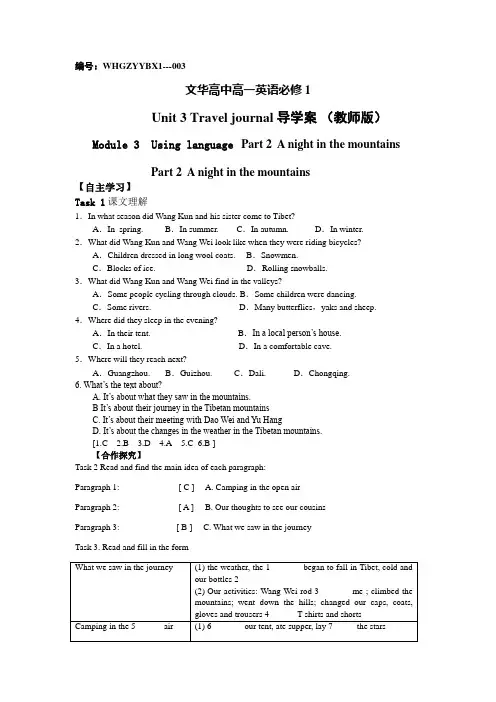
编号:WHGZYYBX1---003文华高中高一英语必修1Unit 3 Travel journal 导学案(教师版)Module 3 Using language Part 2 A night in the mountainsPart 2 A night in the mountains【自主学习】Task 1课文理解1.In what season did Wang Kun and his sister come to Tibet?A.In spring. B.In summer. C.In autumn. D.In winter. 2.What did Wang Kun and Wang Wei look like when they were riding bicycles?A.Children dressed in long wool coats. B.Snowmen.C.Blocks of ice. D.Rolling snowballs.3.What did Wang Kun and Wang Wei find in the valleys?A.Some people cycling through clouds. B.Some children were dancing.C.Some rivers. D.Many butterflies,yaks and sheep. 4.Where did they sleep in the evening?A.In their tent. B.In a local person’s house.C.In a hotel. D.In a comfortable cave.5.Where will they reach next?A.Guangzhou. B.Guizhou. C.Dali. D.Chongqing.6. What’s the text about?A. It’s about what they saw in the mountains.B It’s about their journey in the Tibetan mountainsC. It’s about their meeting with Dao Wei and Yu HangD. It’s about the changes in the weather in the Tibetan mountains.[1.C 2.B 3.D 4.A 5.C 6.B ]【合作探究】Task 2 Read and find the main idea of each paragraph:Paragraph 1:_____________ [ C ] A. Camping in the open airParagraph 2:_____________ [ A ] B. Our thoughts to see our cousinsParagraph 3:_____________[ B ] C. What we saw in the journeyTask 3. Read and fill in the form6.put up7. beneath8. stayed9. where 10. hardly]Task 4能力提升 --- 阅读理解People who like travelling have their reasons. They believe that travelling can help them expand their field of view,especially in the geographical and historical sense. They also think that touring will give them more chances to enjoy different kinds of food and experience new things that would never be brought by other activities. But those who dislike travelling also have some reasons.Travelling,in my opinion,does more good than harm. Most importantly,it broadens(使扩大) our mind. We can get in touch with other civilizations(文明),cultures,customs and ideas.Through history,most people travelled because of necessity—not for pleasure. People travelled just in order to remain alive. They searched for food to eat or places to live in. They sometimes ran away from enemies. This is not to say that no one ever travelled just for the fun of it. In ancient times,for example,rich Romans travelled all the way to Greece to take part in the Olympic Games,and festivals.Of course,some people decided to travel just out of curiosity(好奇心).They wanted to find out what it looked like beyond the horizon(地平线).Also business travel has been going on for centuries. Traders could not only make money but also learn to speak several languages and be introduced to different cultures.So,travelling does enrich our mind and draw new ideas to us. There is no doubt that we can get much from it.1.The underlined word “expand” in Paragraph 1 can be replaced by “________”.A.widen B.protect C.lose D.decide2.According to the passage,in the past most people travelled ________.A.for fun B.for knowledge C.to get experiences D.to make a living3.In the writer’s opinion,travelling can be ________.A.expensive B.funny C.helpful D.tiring4.What’s the main idea of this passage?A.Different kinds of travelling. B.Travelling enriches our mind.C.Ways to enjoy yourself while travelling.D.The advantages and disadvantages of travelling.[1.A2.D3.C4.B]【教学反思】。
高一英语必修1 Unit 3期末复习课导学案
高一英语必修1 Unit 3期末复习课导学案学习目标1.扎实掌握本单元单词,短语和句型,并能灵活运用所学的语言知识。
使用说明:自学:30分钟独立完成学案题目,并上交。
正课:1)浏览,思考,理解相关知识,进一步完善学案,标记出疑难2)组内讨论并把不会的提出质疑,展示点评总结.一.词组翻译1. 下定决心 ___________________________2. 关心,在乎_____________________3. 为...某人所熟悉 ___________________4. 梦想做某事 ____________________5. 说服某人做某事______________________6. 很有乐趣 ____________________7. 一则是...再则是.__________________8. 改变主意 ____________________9. 像平常一样_______________________ 10.搭起, 建立____________________11.使某人对某事感兴趣做_______________ 12.在…的高度_________________13.穿过深谷______________ 14.鼓励某人做某事_______________三.单词拼写1. When I was a child, I __________ (梦想)of becoming a scientist.2. Liu Xiang has set a world _________(记录)in the 28th Olympic Games.3. He ________(坚持)that he should be sent to where he was most needed.4. After a long time, they ________(最后)found the lost child.5.It’s _______(勇敢)of him to enter the burning building to save the child.6. The goods will be ________(运输)to Singapore by air.7. The salesman ________(却说)us into buying his product yesterday.8. These clothes are ________适合)for such an occasion.9. I need a ________(详细的)report about that accident not just a summary.10. Your face seems ________(熟悉). I must have seen you somewhere.11. What’s you’re ________(态度)to this idea? Good or not?12. Her purse(钱包) was stolen so she didn't have money for the taxi f________(费用).三.完成句子1.他们坚持不完工就不休息.They insist that they ______ ______ _______until they finish the work.2.一旦你下了决心就不该轻易改变主意. Once you_____ _____ ______ _______, you should not change your mind easily.3.说服我去参加运动会的是我的好朋友.(强句)It was my good friend who_________ me to ______ ______ ______the sports meeting4.我认为我们不该让步,毕竟这不是我们的错.I don’t think we should______ ______. After all, it’s not our fault.5.父母所关心的是孩子的未来.( care about)What parents ______ ______is the future of their children.四.单项填空1. --- What’s that terrible noise?--- The neighbours ____for a party.A. have preparedB. prepareC. are preparingD. will prepare2. Last Friday when we were talking, I suddenly had ____ idea to go on ____ hike in the valley. A. an, a B. the , a C. an, the D. the, the3. He insisted that we ____ there for the night.A. stayedB. had stayedC. stayD. would stay4. The road ____ be very crowded in the rush hour.A. shallB. needC. mustD. should5. Once we _____, we should work hard until we succeed.A. make up our mindB. make our mindC. make up our mindsD. make our minds6. After the fighting, the enemy ____.A. gave upB. gave outC. gave offD. gave in7. The Great Wall winds its way ____high mountains, ___ deep valleys and ___ great deserts.A. on, across, throughB. over, through, throughC. over, through, acrossD. on, in, across8. Because of the _____, we can’t go high up to the mountains without the oxygen tanks.A. smelly gasB. cold weatherC. high altitudeD. frozen water9. Do what you think right; Never ______ what others say.A. care forB. care ofC. take care ofD. care about10. The twin looks _____ each other. It’s difficult to tell ____.A. similar to, which is whichB. same as, who is whoC. similar to, who is whoD. the same to, which is which10。
必修1unit3导学案
必修一Unit3 Travel journalReview language pointsLearning aims:通过复习,学生能够:1.对本单元重点单词和短语准确地进行英汉互译;2.归纳总结重点单词、句式用法并准确地翻译句子,填空并流利地进行背诵;3.运用所复习的单词、句式,学生完成语篇翻译和语法填空练习。
Assessment task(评价任务):1.通过提问,学生能够对本单元重点单词、短语进行英汉互译,从而准确地掌握重点单词和短语(针对目标1);2.通过学生归纳总结和展示重点单词、句式用法并进行句子翻译和背诵(针对目标2)3.通过小组讨论翻译句子和完成语法填空,学生能灵活运用所学的单词、句式(针对目标3)StepI Revisionprefer_____ever since_______persuade________graduate _______be fond of________care about _________determined________change one’smind________ make up one’s mind__________give in_________attitude___________as usual________stepII知识梳理1.prefer意思为_________prefer(sb) to do sth________Prefer A to B________ Prefer doing A to doing B_______prefer to doA rather than do B________我喜欢在网上做一切事情_________________________________由于下雨,我宁愿呆在家而不愿外出_________________________________我老师宁愿让我靠自己完成作业________________________________________2.ever since_________since意为_____做连词,引导状语从句时,主句常用_______时态。
原创高一必修1第三单元英语导学案.doc
点的掌握。
[使用说明及学法指导]1.5分钟完成课前预习案3. 10分钟完成当堂检测部分。
[学习过程]Unit 3 Travel JournalPeriod 1 Words and expressions姓名:_______________ 班级: ___________________ 完成日期:____________________[学习目标]学习和掌握本单元新学词汇和短语。
[要点•难点]能够学习并掌握一些短语与句型的用法,并会区别其用法。
[做法指导]在做题过程中多思考,提高易错题的辨别能力,学会做题中进一步加深对知识2.25分钟合作学习,完成课内探究案4.5分钟反刍消化。
[课前预习案][预习指导]请同学们认真预习单词从journal到give in。
根据句意及首字母提示,完成下列句子。
1.After g _______ from college, he was sent to the west.2.Have a good rest! After a long j________ , you must be tired.3.The plane can fly at an a __________ of more than 10,000 feet.4.He is sure to come. Fve p _________ him to attend our party.5.It's no use arguing with him. He won't change his mind for he is very s ___________ .[课内探究案]1.prefer vt.更喜欢;选择某事(而不选择其他事物)-pt.______________ pp. _________(不用于进行时)1). prefer A to B . ____________________ ;2). prefer doing A to doing B=prefer to do A rather than do B.______________________ ;3). prefer to do /doing sth. ___________________________ ;4).当prefer后跟从句时,通常要用(should) +动词原形结构下面用以上所列句型翻译句子:1.我更喜欢英语。
2019人教版高中英语必修一Unit3 Reading and Thinking 素养导学案
Unit3 Listening,Reading and Thinking 素养导学案课前预学区I. 匹配词义( ) 1. fitness A. vi. &. n. 慢跑( ) 2. sweat B. adj. 优美的;优雅的( ) 3. medal C. n. 冠军( ) 4. champion D. n. 奖章;勋章( ) 5. graceful E. n. 出汗;汗水vi. 出汗;流汗vt. 使出汗;出汗弄湿( ) 6. jog F. n. 健康;适合( ) 7. lose heart G. 跟随;到达;进步( ) 8. now and then H. 丧失信心;泄气( ) 9. cut. . . out L. 有时;偶尔( ) 10. come along J. 停止做;剪下I. 默写单词1. _______ n. 比赛项目;大事;公开活动2. _______ n. 节目主持人;主人vt. 主办;主持3. _______ n. 高手;主人vt. 精通;掌握4. _______ n. 力量;体力5. _______ n. 失败;失败的人(或事物)6. _______ n. 听众;观众7. _______ adj. 积极的;乐观的;肯定的8. _______ n. 压力;紧张;重音vt. 强调;使焦虑不安vi. 焦虑不安9. _______ n. 规定饮食vi. 节食10. _______ n. 荣誉;尊敬III. Look at the pictures on Page 36 and tell your classmates what they are doing._____________________________________________________________________ _____________________________________________________________________ _____________________________________________________________________课中导学区研读教材Task 1 Pre-readingAnswer the following questions.1. Look at the posters on Page 36 and make a list of sports events.__________________________________________________2. What sports events do you like to watch? Why?__________________________________________________3. Which sport would you like to try, skiing or swimming? Why?__________________________________________________4. Do you know about an e-sports event? What is it?__________________________________________________Task 2 While-reading1. Read the passage on Page 38 quickly and tell the following sentences are true (T) or false (F).( ) (1) As a player,Lang Ping led the China women’s volleyball team to medals at world championships and the Olympics.( ) (2) When the Chinese team was preparing for the 2015 World Cup, the team faced a big challenge.( ) (3) In 2016, Lang Ping led her volleyball team to Olympic gold in Brazil. ( ) (4) Michael Jordan became known as “Air Jordan” in basketball and baseball. ( ) (5) Michael Jordan says that the secret to his success is learning from the failures of his opponents(对手).2. Read the passage on Page 38 carefully and choose the correct answers.(1) What does the phrase “her country” refer to in Paragraph 1?A. Her hometown.B. Her motherland.C. People in her homeland.D. The team in her homeland(2) The Chinese team faced the following challenges EXCEPT that _______ when preparing for the 2015 World Cup.A. one of the best players had been injuredB. the team captain had to leave because of heart problemsC. all players were green handsD. the team that Lang Ping had built was falling apart(3) What does the author think of Michael Jordan’s skills?A. Ordinary(一般).B. Perfect.C. Unattractive.D. Impressive.(4) Which of the following statements(陈述)is NOT true?A. When Michael Jordan’s feet left the ground, time stood still.B. Jordan’s mental strength made him unique.C. Jordan owed the secret to his success to learning from his failures.D. Michael Jordan started a club to help young people.Task 3 Post-reading1. Fill in the blanks according to the passage on Page 38.2. Read the passage on Page 38 again and try to sum marize its main idea in one sentence._____________________________________________________________________ _____________________________________________________________________ _____________________________________________________________________ _____________________________________________________________________ 3. What are the common qualities of successful athletes? You can add more words to the mind map.课堂思学区夯实基础I. 语法填空The Olympic Games are the 1. _______ (big) sports meeting in the world, 2. _______ includes two kinds, the Summer and the Winter Olympics. Both of them 3. _______ (hold) every four years. All countries can take part 4. _______ their athletes have reached the agreed standards for the games. Women are not only allowed 5. _______ (compete) in the games but play a very important role. A special village is built for the competitors to live in, where there is a main reception building, several 6. _______ (stadium) for competitions, a gymnasium as well as seats for those who watch the games. It’s a great honor 7. _______ (host) the Olympic Games. The olive wreath 8. _______ (replace) by medals. But it’s still about 9. _______ (be) able to run faster, jump higher and throw 10. _______ (far) .Ⅱ. 探究活动1. Read the short passage.The ancient Olympic Games started in 776 BC.The ancient Olympic Games were held every four years insummer in Greece. Only Greece free-citizens(公民)couldtake part. Slaves were not allowed to compete. And onlymen could compete in the ancient Olympic Games. Womencould take part in chariot races(敞篷马车比赛)with horses. This was the only event they could join in. Married women were not even allowed to watch the games. If they try to watch the games,they could be put to death. The winners got wreaths made of olive leaves. They didn’t receive money but they could get presents from their hometowns. There was no Winter Olympic Games in the ancient Olympic Games. There were many events, such as boxing,running,horse riding,wrestling(摔跤). And the motto of the ancient Olympic Games was also “Swifter, Higher and Stronger”.2. Try to make an interview according to the above passage. Li Yan is now interviewing Pausanias about the ancient Olympics.Li Yan:My name is Li Yan. May I ask you some questions about the ancient Olympics?Pausanias: Yes, what would you like to know?Li Yan: When and where did the first Olympic Games start?Pausanias: ______________________________________Li Yan: How often...Pausanias: ______________________________________Li Yan: I know women were not allowed to compete. Could they watch the games? Pausanias: ______________________________________Li Yan: ______________________________________Pausanias: ______________________________________Li Yan: Thank you so much for your time.Ⅱ. 读后续写微技能读后续写微技能—细节描写1. 当妈妈亲吻他时,小宝贝开心极了。