
牛津版小学英语2B全册教案集
2b Unit1 Do you like winter?一、教学目标:1、能听懂一般疑问句Do you like…?引导尝试用Yes,I do.和No,I don`t.回答。
2、能听懂、会说、初步认读sping、summer、autumn和winter四个单词,发音正确。
3、初步学习歌曲Season`s song。
二、教学重点难点:1、能听懂一般疑问句Do you like…?引导尝试用Yes,I do.和No,I don`t.回答。
2、能听懂、会说、初步认读sping、summer、autumn和winter四个单词,发音正确。
三、教具准备及辅助活动:配套光盘、词语卡片、挂图四、教学过程:A. Free talk: 更多免费教案下载绿色圃中小学教育网 分站1、播放歌曲Happy New Year,给学生创造新年新气象的愉悦氛围。
2、播放Season`s song给学生欣赏,让学生初步了解本歌曲的曲调和节奏。
B、Learn to say1、由学生的衣服和颜色引出单词:T: Happy New Year!(指着某个学生的衣服表示赞美)You look so beautiful!引导学生用Thank you 回答。
T: Your blue coat is nice. Do you like blue?(根据学生衣服的实际情况引导学生回答)Yes,I do./No, I don`t.2、让学生猜猜教师喜欢的颜色,引出单词winter。
T:What do I like?学生说颜色的单词,引导学生尝试用Do you like …?的句型来问。
T:I like white. Today I`d like to show you a picture of a white winter.教师出示冬天的图片,引出winter,组织学生听单词录音,朗读单词。
3、以相同的方法学习单词sping、summer、autumn。
4、单词巩固1)要求学生根据教师的语言描述和形象动作,猜测是哪个季节:T: It`s hot. I can swim in the winter.It`s cold. I can make snowmen.……2) 集体朗读,加深记忆。
C.Sing a song1、播放Season`s song,让学生听几遍,初步熟悉歌曲歌词和曲调。
2、请学生说说在歌曲中听到了哪几个季节,并用I like …表达自己喜欢的季节。
D、Practise活动手册P3:结合图片带领学生朗读单词,尝试用拼读法,如s-p-r-i-n-g,以加强学生对单词的认知,再让学生做练习。
E、Assign homework(1)听录音,读熟B部分单词。
(2)尝试运用I like …向家里人表达自己的喜欢的季节。
(3)鼓励学生平时用所学的日常交际用语相互打招呼。
一、教学目标:1、能听懂一般疑问句Do you like…?并根据自己的真实感受用Yes,I do.和No,I don`t.回答。
2、能在特定场景中使用一般疑问句Do you like…?和别人作简单交流,语音语调正确。
3、听歌曲Season`s song,熟悉歌曲歌词。
二、教学重点难点:1、能听懂一般疑问句Do you like…?并根据自己的真实感受用Yes,I do.和No,I don`t.回答。
2、能在特定场景中使用一般疑问句Do you like…?和别人作简单交流,语音语调正确。
三、教具准备及辅助活动:录音机、词语卡片、挂图四、教学过程:A. Free talk:1、T:Hello, look!教师出示四季的图片,请学生根据图片来说说是什么季节。
T:Do you like …?引导学生用Yes,I do./No, I don`t.来回答。
2、电脑出示四季的美丽图片,师生继续巩固上面的句型练习。
B、Learn to say1、学习对话:1)出示A部分场景挂图,让学生猜想Mike和Steven是否喜欢冬季。
2)播放课文录音,请学生认真听录音,引导学生边听边理解。
T: Helen`s family are talking about winter. Does Mike like winter? How about Steven?Guess please.3)听录音,集体跟读对话。
2、操练与运用:1)在认真听读对话的基础上,鼓励学生尝试模仿录音中人物的语音语调,要求学生要读书Mike的高兴和Steven 冻得难以忍受的语气。
2)在学生听读对话后,鼓励学生两人一组操练对话或是互换角色对话,尝试脱离课本进行表演。
3)结合以前学习的内容,如颜色、食物、动物、水果等单词的复习,进行对话扩展练习。
T:Hello, do you like bananas?鼓励学生根据实际情况用肯定或否定回答。
C.Sing a song1、播放Season`s song,让学生听几遍,再次熟悉歌曲歌词和曲调。
2、朗读歌曲歌词,理解歌词大意。
D、Practise1、活动手册P1(1)指导学生认真仔细观察图片,了解图片大意。
(2)听录音完成练习。
E、Assign homework(1)听录音,朗读A部分对话,尝试和家长进行角色对话。
(2)听录音,继续熟悉C部分歌曲。
(3)鼓励学有余力的学生学习其他的打招呼用语。
一、教学目标:1、复习、巩固Do you like…?Yes,I do.和No,I don`t. 的回答形式。
2、正确运用Do you like…?向他人询问和确认某人,发音正确。
3、复习巩固单词sping、summer、autumn和winter这四个单词。
4、会唱歌曲Season`s song。
二、教学重点难点:1、复习、巩固Do you like…?Yes,I do.和No,I don`t. 的回答形式。
2、正确运用Do you like…?向他人询问和确认某人,发音正确。
三、教具准备及辅助活动:配套光盘、词语卡片、挂图四、教学过程:A. Free talk:1、教师出示四季的图片,请学生根据图片来说说是什么季节。
T:Do you like …?引导学生用Yes,I do./No, I don`t.来回答。
2、结合以前学习的内容,如颜色、食物、动物、水果等单词,进行对话扩展练习以进一步巩固Do you like …? es,I do./No, I don`t.的句型。
B、Draw and say1、先进行示范添画,让学生用Do you like …?进行猜测,借此复习四个季节类的单词。
2、带领学生构思自己喜欢的一个季节,进行添画。
3、分小组请学生介绍自己的图画。
4、教师可以请一对合作伙伴带着自己添画的作品背靠背站在讲台前,相互用Do you like …?询问,若两个人都喜欢同一个季节,则以鼓掌表示鼓励。
C.Sing a song在学生朗读歌词的基础上,放音乐让学生跟唱歌曲,对容易出错的地方给予指导、练习。
D、Practise1、活动手册P2(1)观察图片理解图片大意。
(2)听录音完成练习。
2、活动手册P4(1)指导学生课前制作有季节代表性的动物头像,以更好得创设交流情境。
(2)引导学生想象,进行对话交流。
D、Assign homework(1)朗读A、B部分至熟练。
(2)鼓励学生平时用本单元所学的日常交际用语相互打招呼。
学有余力的学生学习其他的打招呼用语。
一、教学目标:1、复习巩固本单元重点句型:Do you like…?以及其回答Yes,I do.和No,I don`t.2、在原有基础上拓展对话内容,如:Do you like this pencil case?3、能熟悉的演唱歌曲Season`s song。
4、能通过练习巩固所学知识。
二、教学重点和难点:1、在原有基础上拓展对话内容,如:Do you like this pencil case?2、通过配套练习巩固知识,发现问题及并时解决问题。
三、教具准备:配套光盘、图片、配套练习。
四、教学过程:A. Free talk:1、One by one: 教师出示四季的图片,请学生根据图片来说说是什么季节。
2、Ask and answer:Eg: Do you like winter? Yes , I do. / No, I don’t.3、Practice in pairs:学生之间的问答。
B. Make a dialogue:从Free talk过渡而来:T: Do you like summer? S: Yes, I do.,I like ice-cream.Try to say: I like summer, I like ice-cream.Show time:请几组学生讲,评出最佳的进行表扬。
C.Sing a song:Sing a song” Season’s song”要求学生在理解歌词的基础上熟练的演唱歌曲。
分小组演唱评出最佳小组。
D.Do some exercises1、Listen and respond.a. Do you like spring?b. Do you like summer?c. Do you like autumn?d. Do you like winter?2、Listen and judge.a. I like rice. I like rice,too.b. Do you like winter?Yes, I do.c. Look at the bird. It’s nice.d. Is that a bike? Yes, it is.c.Look, find and colour.d. Look and say.E. Assign homework1、尝试用已学语句来讲述书后D部分图片。
2、课后查找和四季有关的单词。
一、教学目标:1、巩固本单元重点单词和句型,能够在创设的情景中灵活运用所学。
2、在原有基础上适当的拓展一些新知识。
3、认真完成配套补充练习。
4、补充介绍一些国外的风俗习惯。
二、教学重点和难点:1、在原有基础上拓展新知识。
2、按要求完成补充练习。
3、了解国外四季中的一些风俗习惯。
三、教具准备:配套光盘、图片、配套练习四、教学过程:A. Greetings:1、Sing a song: Season’s song.Spring, summer, autumn and winter. Spring, summer, autumn and winter. Oh, do you like spring? Yes I do.Do you like winter? No, I don’t..2、Free talk:T: Hello, how are you?S: Fine, thank you, and you?T: I’m fine, too.T: Do you like …?S:Yes , I do.(课前热身,让学生们更快的把注意力集中到课堂上来。
牛津英语上海版2B教案汇总

Module 1 Using my five sensesUnit 1 What can you see ?教学内容:认知内容: 能听懂会说white/ purple/pink/orange/ brown/black掌握句型I see ...(colour)It is … (colour)能力要求:会用英语与他人交流所见事物的颜色情感态度:我们生活在一个五彩缤纷的世界里,让孩子用色彩来表达对事物直观的感受the second period教学内容:认知内容: 1. 能听懂会说句型What colour is it /are they?It is /They are …能力要求: 1. 能在日常生活中用以上的句型进行对话情感态度:鼓励孩子用所学的句型在公共场合与他人进行交流Module 1 Using my five sensesUnit 2 Touch and feelTeaching aims:Knowledge:1.Learning new words: watch, bag, soft, hard, rough, smooth2.Learning sentence patterns: Is it…? Yes, it. /No. it‟s …Skills:1.Understanding the key words in context.ing the new words and sentence patterns to communicate withothers.Feelings:学生在游戏和表演中学习新的知识, 并能通过有趣的儿歌来巩固新学的词汇及句型。
the second periodTeaching aims:Knowledge:1. Learning the sentence pattern: Is it…? Yes, it. /No. it‟s …2. Using the sentence pattern to express.3. Learning the sounds of the letters: p, b.Language skills:1. Identifying the key words by listening to the pronunciation.2. Understanding the key patterns.3. Identifying the sounds by listening to the pronunciation.Feelings:学生在游戏和表演中学习新的知识, 并通过游戏和表演来巩固新知识,创设良好的活动氛围, 让学生带着愉快的心情去迎接新挑战.Module 1 Using my five sensesUnit 3 Can you hear a train?教学内容:The first period教学内容:认知内容: 1.单词:train, bus, car, van, bicycle, ship。
苏教牛津译林版小学英语2B(二年级下册)全册教学设计
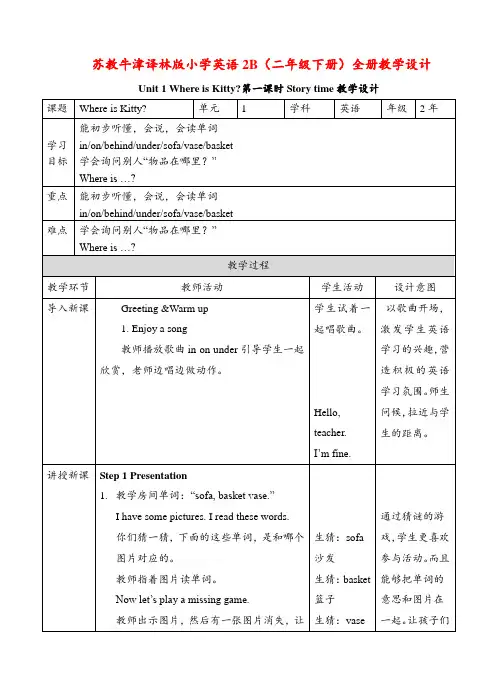
苏教牛津译林版小学英语2B(二年级下册)全册教学设计Unit 1 Where is Kitty?第一课时Story time教学设计Unit 1 Where is Kitty?第二课时Fun time 教学设计课题Where is Kitty? 单元 1 学科英语年级2年学习目标能初步听懂,会说,会读单词in/on/behind/under/sofa/vase/basket学会询问别人“物品在哪里?”Where is …? It’s on /in/under/behind…生答:It’s inthe kitchen.生答:They’re inthe tree.生猜说出句子。
课堂小结学会介词in/on/behind/under学会询问别人“物品在哪里?”Where is …?板书Unit 1 Where is Kitty?in underon behindUnit 1 Where is Kitty?第三课时Rhyme time 教学设计课题 Where is Kitty? 单元1学科英语年级 2年学习 目标 通过学习歌曲Molly the cat.,学会重点句子:It’s in the living room.It’s on the mat.It’s playing with a broom.乐于唱歌,激发对英语的兴趣。
重点 学会重点句子:It’s in the living room.It’s on the mat.It’s playing with a broom.难点 会唱歌曲Molly the cat.1. Where is the monkey?2. Where is the ball?3. Where is the rabbit?4. Where is the bird?5. Where is the dog?sofa. It’s on the floor. It’s on the chair. It’s on the light. It’s under the table. It’s under the table.课堂小结 板书Unit 1 Where is Kitty?W Where is the monkey?It’s on the sofa. Where is the monkey? It’s behind the sofa.Unit 2 Dinner is ready.第一课时Story time教学设计Unit 2 Dinner is ready.第二课时fun time教学设计小猫来了。
牛津小学英语2B全册教案

牛津小学英语2B全册教案让思维的火花在电子白板上蹁跹起舞《牛津小学英语》2B Unit 9 Where,s the plane?说课稿尊敬的各位老师:下午好!我说课的内容是:《牛津小学英语》2B Unit 9 Where's the plane? AB部分。
本课我结合教材的重难点以及学科的特点,利用多种教学方法,在愉快轻松的气氛中进行教学,从视、听、说等方面使学生得到了语言的训练,提高了学生学习英语的兴趣。
我从以下五个方面进行说课:说教材、说设计理念、说教法学法、说教学过程、说板书。
一、] :材【教材分析】本课教学内容是《牛津小学英语》2B Unit9 AB部分的词句教学。
主题是“确定物品位置”。
这一话题与学生的日常学习和生活息息相关,场景便捷,易于创设。
在教学中,教师要充分利用身边的物品和场景,引导学生理解对话的意思,并始终让学生在具体的情境中进行操练和运用。
【教学目标】新课程强调知识与技能、过程与方法、情感态度与价值观三个角度的有机结合,本着这样的认识,我制定如下教学目标。
1、知识目标:(1)能听懂特殊疑问句Where's the---?并能用It's in /on the…,作出正确应答。
(2)能用特殊疑问问Where's the~向他人询问物品的位置。
(3)能听懂、会说、初步认读介词on,in和名词bed,TV。
2、能力目标:能根据场景正确使用介词on或in来表述物品的位置。
3、情感目标:培养学生合理摆放物品的良好习惯。
【教学重难点】本课的重点是(1)能听懂特殊疑问句Where's the---?并能用It,s in /on the…,作出正确应答。
(2)能用特殊疑问问Where's the…?向他人询问物品的位置。
本课的难点是让学生正确使用介词on或in来表述物品的位置。
【教学准备】电子白板课件。
二、设计理念在低年级英语对话教学中,我们要十分重视激发学生的学习兴趣,培养学生基本的学习能力。
小学牛津英语2b教案
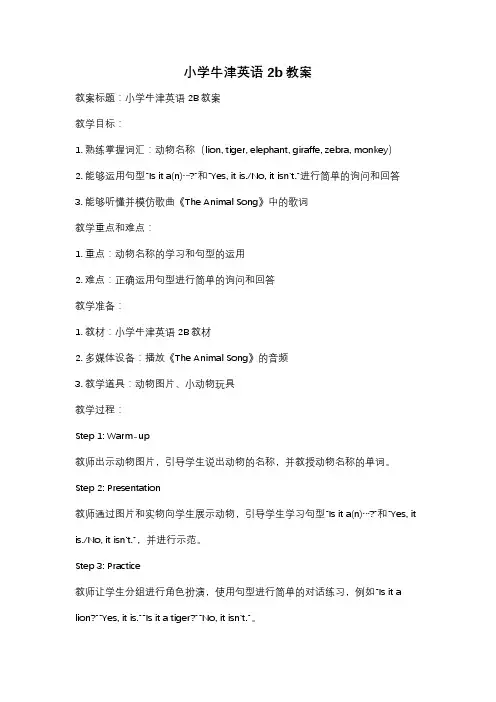
小学牛津英语2b教案教案标题:小学牛津英语2B教案教学目标:1. 熟练掌握词汇:动物名称(lion, tiger, elephant, giraffe, zebra, monkey)2. 能够运用句型“Is it a(n)…?”和“Yes, it is./No, it isn’t.”进行简单的询问和回答3. 能够听懂并模仿歌曲《The Animal Song》中的歌词教学重点和难点:1. 重点:动物名称的学习和句型的运用2. 难点:正确运用句型进行简单的询问和回答教学准备:1. 教材:小学牛津英语2B教材2. 多媒体设备:播放《The Animal Song》的音频3. 教学道具:动物图片、小动物玩具教学过程:Step 1: Warm-up教师出示动物图片,引导学生说出动物的名称,并教授动物名称的单词。
Step 2: Presentation教师通过图片和实物向学生展示动物,引导学生学习句型“Is it a(n)…?”和“Yes, it is./No, it isn’t.”,并进行示范。
Step 3: Practice教师让学生分组进行角色扮演,使用句型进行简单的对话练习,例如“Is it a lion?”“Yes, it is.”“Is it a tiger?”“No, it isn’t.”。
Step 4: Listening and singing教师播放《The Animal Song》的音频,让学生跟随音乐和歌词一起唱歌,并教授歌曲中的动物名称。
Step 5: Production教师让学生自由发挥,用学到的句型和词汇描述自己喜欢的动物,并与同学分享。
Step 6: Homework布置作业,要求学生用英语写一段话描述自己喜欢的动物,并准备下节课的口头表达。
教学反思:通过本节课的教学,学生能够熟练掌握动物名称和句型的运用,同时培养了学生的听、说、读、写能力。
在教学过程中,教师应注重激发学生的学习兴趣,引导学生积极参与,从而提高教学效果。
牛津英语2b教案

牛津英语2b教案教案标题:牛津英语2B教案教案目标:1. 通过本课程,学生将能够掌握牛津英语2B教材中的词汇、语法和句型。
2. 培养学生的听、说、读、写的英语能力,提高他们的综合语言运用能力。
3. 培养学生的学习兴趣和学习策略,激发他们学习英语的热情。
教学重点:1. 掌握本单元的词汇和短语。
2. 熟练运用本单元的语法和句型。
3. 发展学生的听、说、读、写的能力。
教学难点:1. 运用所学的词汇和句型进行实际交流。
2. 培养学生的听力理解能力。
教学准备:1. 牛津英语2B教材和教具。
2. 多媒体设备和投影仪。
3. 单词卡片、图片和练习册。
教学过程:1. Warm-up(热身活动):- 利用图片和单词卡片复习上一单元的词汇。
- 通过唱歌或游戏激发学生的学习兴趣。
2. Presentation(呈现新知):- 利用多媒体设备展示本单元的主题和相关图片。
- 引导学生观察图片,引发他们对话和思考。
3. Practice(练习):- 分组或配对让学生进行对话练习,运用本单元的句型和词汇。
- 利用练习册或工作纸进行书面练习,巩固所学内容。
4. Listening(听力训练):- 播放录音,让学生听力理解并回答问题。
- 分组或个人听写练习,提高学生的听力技能。
5. Speaking(口语训练):- 利用角色扮演或小组讨论的形式,让学生运用所学的句型进行口语练习。
- 引导学生描述图片或讲述故事,培养他们的口语表达能力。
6. Reading(阅读训练):- 分发阅读材料,让学生独立阅读并回答问题。
- 分组或个人朗读练习,提高学生的阅读理解和发音能力。
7. Writing(写作练习):- 引导学生根据所给的提示写一篇短文或完成一篇作文。
- 互相交换作文并进行修改和评价,提高学生的写作能力。
8. Summary and Homework(总结和作业):- 复习本节课的重点内容,概括学生的学习成果。
- 布置相应的作业,如完成练习册的部分习题或写一篇作文。
英语牛津教材2B-Unit1教案

英语牛津教材2B-Unit1教案2b unit 1 farm animalsperiod 1 let’s learncontents: 1.word: hen, chick, duck, cow, pig 2.letter: n n nose, o o orangeaim: ing nouns to identify common farm animals. e.g. hen, chick 2.learn the above names and sounds of the letters ‘n n, o o’. 3.knowning about the farm animals and say something about the animals you like.main points: using nouns to identify common farm animals.difficulties: pronounce words properly.aids: 1.t: picture cards, words cards, tape, student’s book and wordbook. p: picture cards (students prepared beforehand )procedures: ⅰ.pre-task preparation1. let the students listen to the noise of the farm animals.say out what they can hear.t: listen! what can you hear?s1: i can hear a duck.s2: i can hear a2:put the picture cards on the board according to their answers.ⅰ.while-task procedure1. point to the animals and learn to say their names.2. hold up each picture card for farm animals and ask individual students their names.3. repeat the 2nd procedure with other students but this time show the word cards as well. read the words for students to follow.4. listen to the tape of ‘let’s learn’. make the picture cards in order.(one student does so with t’s cards on the board. the others do so with their own cards.)5. listen to the teacher and do quick response.e.g. t: show me a hen./pick out a hen./raise a hen. s: (raise the picture card.) hen, hen, hen.6. repeat the something procedure in the group of four.e.g. s1: pick out a hen. s2.s3.s4: hen, hen, hen.7. look at the picture cards and word cards.listen to the teacher and judge.please clap or repeat.e.g. t: (point to the cow.) cow, cow. s: (repeat) cow, cow. t: (point to the pig.) chick, chick. s: (clap their hands and raise their hands. then correct it.) pig, pig.8. read the words on the board. then guess, what word is missing?9. ask individual students to come up and choose a word card to put next to the appropriate animal on the board. then read it.10.show students the picture cards for ‘nose’ and say “nose begins with the sound ‘n’.” show the word card for ‘nose’ and say “nⅰnose’. repeat . show alphabet cards ‘n’ and ‘n’. read and compare the capital letter ‘n’ with the small letter ‘n’.do the same with ‘o oⅰorange’.play the tape for students to follow in their books.ⅰ.post-task activities1. know more about the animals.e.g. t: i like to eat eggs. do you like to eat eggs? s: yes, i like toⅰ t: where are the eggs from? s: they’re from hens. t: where are the chicks? s: they’re from eggs. t: yes. hens lay eggs. chicks come from eggs. chicks grow and grow. they become hens and cocks. q: where is milk from? where is wool from? where is meat from? conclusion: these animals are very useful to us.2. which animals do you like best? why?ⅰ.consolidation1. listen to the tape and read the words.2. workbook page 3: match and write the correct number in the box.3. workbook page 4: draw lines to help the little animals find their rmal essay after teaching(教后随笔):身临其境,引人入胜。
上海版牛津英语2b教案全册
Unit 1 Where I LiveTeaching aids:A. Words : letters Aa --Bb , bin , park , road , building , ShanghaiB. Structures : I live in …. I love …. I see …. That’s …C. Functions : Give simple instructions; Refer to specific classroom objects.Material:1. Student's Book 2A page 2--62. Cassette 1A and a cassette player3. Wallcharts4. Photograph page 15. Alphabet CardsTeaching times:5 timesLearning targets:A. Basic aims:1. Be able to identify the letters Aa -- Bb2. Be able to give simple instructions3. Be able to use the simple present tense to indicate facts4. Be able to "point to your home"5. Read the rhymeB. Further aims:1.2.Practise saying a new rhyme substituting 'Shanghai' with another places Language focus:1. Using the definite article to refer to specific classroom objects2. Using the simple present tense to express interests and preferences3. Learning the words: bin , park , road , building , ShanghaiPeriod 1Teaching focus:Using imperatives to give simple instructionsUsing the definite article to refer to specific classroom objectsPeriod 2Teaching focus:Using the simple present tense to indicate factsUsing the simple present tense to express interests and preferencesPeriod 3Teaching focus:Using nouns to identify objectUsing proper nouns to refer to placesPeriod 4Teaching focus:Asking ' Wh-' questions to find out various kinds of specific information about a person Using the simple persent tense to express truthUsing the simple persent tense to express interests and preferencesPeriod 5Teaching focus:Using the simple persent tense to express interests and preferencesUnit 4 Going aboutTeaching designing:Teaching aids:A.Words: letters Gg—Hh, plane, ferry, train, taxi, car, bus, van.B.Structures: Get ……How do you go to……C.Functions: Give simple instructions; Using connectives to add information Material:1.Student’s Book 2A page 17-212.Cassette 1A and a cassette player3.Wall charts4.Photograph page 145.Alphabet CardsTeaching times:5 timesLearning targets:A.B asic aims:1.Be able to identify the letters Gg--Hh2.Be able to give simple instructions3.Be able to introduce oneself using I’m.4.Be able to write the sentence Hello, I’m <name>.5.Sing a song.B.Further aims:ing more information to introduce oneself2.The sorts of the alphabetLanguage focus:ing imperatives to give simple instructions2.Asking How questions to find out means and Using prepositions to indicate meas3.Learning the words: plane……Period 1Teaching focus:Using imperative to give simple instructionsTeaching steps:Period 2Teaching focus:Asking How questions to find out mean Using prepositions to indicate means Using formulaic expressions to take leave Teaching steps:Period 3Teaching focus:Using nouns to identify forms of transport. Teaching steps:Period 4Teaching focus:Using formulaic expressions to indicate how people travel Teaching steps:Period 5Teaching focus:Using nouns to identify different forms of transport Teaching steps:Unit 5 Crossing the roadTeaching designing:Teaching aids:D.Words: letters—Ii Jj, stop, light, go, fast, slow.E.Structures: Look at the light. It’s…, Go! / Stop! / Wait! /F.Functions: Using imperatives to give simple instructions; To give simpleinstructions.Material:6.Student’s Book 2A page 22-267.Cassette 1A and a cassette player8.Wall charts9.Photograph page 1410.Alphabet CardsTeaching times:5 timesLearning targets:C.Basic aims:6.Be able to identify the letters Ii--Jj7.Be able to give simple instructions8.Be able to introduce oneself using I’m.9.Be able to write the sentence Hello, I’m <name>.10.Sing a song.D.F urther aims:ing more information to introduce oneself4.The sorts of the alphabetLanguage focus:ing imperatives to give simple instructionsing adjectives to describe objects6.Learning the words: stop……Period 1Teaching focus:Using imperative to give simple instructionsTeaching steps:Period 2Teaching focus:Using imperative to give simple instructions Using adjectives to describe objectsTeaching steps:Period 3Teaching focus:Using imperatives to give simple instructions Using nouns to identify thingsUsing adjectives to describe objects Teaching steps:Period 4Teaching focus:Using imperative to give instructions Using adjectives to describe coloursTeaching steps:Period 5Teaching focus:Using imperatives to give simple instructions Using adjectives to describe objectsTeaching steps:。
英语牛津教材2B-Unit4教案
英语牛津教材2B-Unit4教案教学目标1.能够听懂、会读、会说并正确使用关于家庭成员的单词和短语,如father, mother, sister, brother等。
2.能够通过听力理解简单的关于家庭成员的对话,并能够回答问题。
3.能够口头表达自己的家庭情况,并能够与他人进行简单的交流。
4.能够正确使用以下句型进行简单对话:–Who’s that? That’s my father.–Is she your mother? Yes, she is.–How many brothers do you have? I have two brothers.教学重点1.家庭成员的认知。
2.家庭成员单词和短语的听说能力训练。
3.对话中的基本句型和表达方式。
教学准备1.教材:牛津英语2B Unit 4 Family.2.多媒体课件或投影仪。
3.字卡和图片相关的道具。
4.黑板和彩色粉笔。
教学过程Step 1 导入新知1.Greetings(问候):–T: Good morning, class!–Ss: Good morning, Teacher!–T: How are you today?–Ss: I’m fine, thank you. And you?–T: I’m fine too. Thank you.2.Warming-up(热身):–T: Today, let’s talk about our families. Who is in your family? Can you tell me?–Ss: My family has a father, a mother, and a sister.–T: Great. Today we will learn more about family members. Are you ready?Step 2 呈现新课1.T: Now, let’s look at this picture. Who are they?–Show a picture of a family.–Ss: They are a father, a mother, a sister, and a brother.2.T: Yes, that’s right. These are family members. Can you say their names?–Show flashcards with the words: father, mother, sister, brother.–Ss: Father, mother, sister, brother.3.T: Very good. Let’s practice more. I will show you a picture, and you tell me who it is, OK? Ready?–Show flashcards with different family members, one by one.–Ss: That’s a grandmother. That’s a grandfather.4.T: Excellent. Now, let’s listen to a conversation.Step 3 听力训练1.T: I will play a dialogue for you. Listen carefully and try to answer my questions.–Play the dialogue between two students asking about their families.–T: Who has a sister?–Ss: The first student has a sister.–T: Very good. Who has a brother?–Ss: The second student has a brother.–T: Well done.Step 4 合作活动1.T: Now, I want you to work in pairs. Ask your partner about their family members.–T: Student A, ask Student B about their family.–T: Student B, answer Student A’s questions about your family.–Monitor the students and provide assistance if needed.Step 5 讲解重点句型1.T: Look at the board. These are some sentences we can use when talking about our families.–Write the following sentences on the board:–Who’s that? That’s my father.–Is she your mother? Yes, she is.–How many brothers do you have? I have two brothers.2.T: Let’s practice these sentences together.–Model the sentences and have students repeat after you.–T: Who’s that?–Ss: That’s my father.–T: Is she your mother?–Ss: Yes, she is.–T: How many brothers do you have?–Ss: I have two brothers.3.T: Now, let’s do a role-play. Pair up and practice using these sentences in a conversation about your families.–Monitor and provide fee dback on students’ conversations.Step 6 拓展活动1.T: Great job, everyone! Now, let’s do a family survey. Walk around the classroom and ask your classmates about their families. Use the sentences we just learned.–Provide a survey sheet with questions about family members for each student.–Monitor the students and assist as needed.2.T: Now, I will randomly call on a few students to share their findings with the class.–Choose a few students to share their survey results.Step 7 总结和评价1.T:好了,同学们。
牛津英语2B全册教案英文教案
Unit 1 Do you like winter?ⅠTeaching Aims:1.Ss can understand, read and say the words: spring, summer, autumnand winter.2.Ss can understand ,read and say everyday English:Do you like …?Yes, I do./No, I don’t.3.Ss can sing the song: Season’s song.ⅡTeaching Focus and Difficulties1.The words2.The structures3.The songⅢ Teaching Aids1.Pictures2.Words3.TapeⅣ Teaching TimesPeriod 1: Part A, BPeriod 2: Part C, DPeriod 1Ⅰ Teaching Contents1. Words:spring, summer, autumn, winter2. Everyday English:Do you like …?Yes, I do./No, I don’t.3. Part ABⅡ Teaching Aims1. Ss can understand and read the words correctly.2. Ss can talk with the drills freely.Ⅲ Teaching Focusthe drills, and the wordsⅣ Teaching Materials:tape, picture, cards, photos and so onⅤ Teaching StepsStep1 Free talk1. Greetings.2. Ss sing a song, Happy New Year!3. T: Happy New Year!S: Happy New Year!T: Hello, I’m Miss Ni.S1: Hello, I’m …T: Good morning/afternoon/evening.S2: Good morning/afternoon/evening.T: What’s this?Ss: It’s…Ss: practice.4. T: What can you do?S1:I can …PracticeStep2 Look and learn1. T: You look so beautiful!S: Thank you.T: Your blue coat is nice. Do you like blue?S: Yes,I do./No, I don`t.2. T:What do I like?Ss guess.T:I like white. Today I`d like to show you a picture of a white winter.(Teach ‘winter’)Ss read after T3. T teach ‘spring, summer, autumn’like above.4. Review the new words. Play a guess game.T: It`s hot. I can swim in the winter.It`s cold. I can make snowmen.……5. Ss read the words together.Step3 Learn to say1.Show a picture about PartA. Let the Ss guess who likes winter.2.Play the tape. Ss listen to the tape.T: Helen`s family are talking about winter. Does Mike like winter?How about Steven?Guess please.Ss answer.3.Ss read after the tape together.4.Ss act out the dialogue.5.Ss work in pairs.Step4 PracticeWB on Page1,3Step5 Homework1.Listen and read Part A&B for 5 times.2.Talk with the parents.Blackboard:Unit1 Do you like winter?——Do you like …?spingsummerautumnwinter——Yes,I do./No,I don`t.Period 2Ⅰ Teaching Contents1. Words:spring, summer, autumn, winter2. Everyday English:Do you like …?Yes, I do./No, I don’t.3. Sing a song: Season’s song4. PartCDⅡ Teaching Aims1. Ss can understand and say the words and drills.2. Ss can play the game with the drills learned. Ⅲ Teaching Focusthe drillsⅣ Teaching Materials:tape, picture, cards, photos and so onⅤ Teaching StepsStep1 Free talk1. Greetings.2. T: Do you like winter?S1: Yes, I do.S2: No, I don’t.T:Do you like oranges?S3: Yes, I do.…Step2 Sing a song1.Ss listen to the song.2.Ss read the sentences in the song, and understand the meanings.3.Ss sing after the tape.4.Ss sing together.5.Have a competitionStep3 Draw and say1.T draws a picture.Then let the Ss guess what T likes.Ss use ‘Do you like … ?’2.Ss draw a picture.3.Ss talk about their pictures.4.Ss review everyday English.Step4 PractiseWB on Page2,4Step5 Homework1. Listen and read Part C&D for 5 times.2. Review Part A&B.Blackboard:Unit1 Do you like winter?——Yes,I do.——Do you like…?——No,I donUnit 2 At the zooⅠTeaching Aims:1. Ss can understand, read and say the words: monkey, bear, tiger, lionand panda2.Ss can understand ,read and say everyday English:What do you like?I like….3. Ss can say the rhyme: Five little monkeys.ⅡTeaching Focus and Difficulties1. The words2. The structures3. The rhymeⅢ Teaching Aids1. Pictures2. Words3.TapeⅣ Teaching TimesPeriod 1: Part A, BPeriod 2: Part C, DPeriod 1Ⅰ Teaching Contents1. Words:monkey,bear,tiger,lion,panda2. Everyday English:What do you like?I like….3. Part ABⅡ Teaching Aims1. Ss can understand and read the words correctly.2. Ss can talk with the drills freely.Ⅲ Teaching Focusthe drills, and the wordsⅣ Teaching Materials:tape, picture, cards, photos and so onⅤ Teaching StepsStep1 Free talk1. Greetings.2. Ss sing a song, Season’s song3. T: Hello, I’m Miss Ni.S1: Hello, I’m …T: Good morning/afternoon/evening.S2: Good morning/afternoon/evening.T: Hello,do you remember the rhyme “I am a caw”?Ss: Yes.Review the words: dog,cat,cow,pig,duck4. T: Do you like dogs?S1:Yes, I do./No, I don’t.PracticeStep2 Look and learn1. T: What I am now?T: I like monkeys. Do you like monkeys?Ss: Yes,I do./No,I don`t.2. Teach ‘monkey’and ‘monkeys’.Ss read after T3. T teach ‘bear,tiger,lion,panda’like above.4. Review the new words. Play a game.What’s missing?5. Ss read the words together.Step3 Learn to say1. Show a picture about PartA.2. T:Look at the picture.Is this a monkey?T: Who are these boys?Ss:Mike and Wang Bing.T: Now they`re at the zoo. What are they talking about? Let`s tryto repeat.3. Ss listen to the tape, and read after the tape together.4. Ss act out the dialogue.5. Ss work in pairs.Step4 PracticeWB on Page5,7Step5 Homework4.Listen and read Part A&B for 5 times.5.Talk with the parents.Blackboard:Unit2 At the zoo——What do you like?monkey——I like… bear,tiger,lionpandaPeriod 2Ⅰ Teaching Contents1. Words:monkey,bear,tiger,lion, panda2. Everyday English:What do you like?I like….3. Say a rhymme: Five little monkeys4. PartCDⅡ Teaching Aims1. Ss can understand and say the words and drills.2. Ss can play the game with the drills learned. Ⅲ Teaching Focusthe drillsⅣ Teaching Materials:tape, picture, cards, photos and so onⅤ Teaching StepsStep1 Free talk1. Greetings.2. T: What do you like?S1: I like…Ss work in pairsStep2 Say a rhyme1. Ss listen to the rhyme.2.Ss read the rhyme, and understand the meanings.3.Ss say after the tape.4.Ss say together.5.Have a competitionStep3 Do a survey1.Review the words, then ask and answer——What do you like?——I like…2.Ss work in groups.Step4 PractiseWB on Page6,8Step5 Homework1. Listen and read Part C&D for 5 times.2. Review Part A&B.Blackboard:Unit2 At the zoo——What do you like?monkey——I like… bear,tiger,lionpandaUnit 3 What can you see?ⅠTeaching Aims:1. Ss can understand, read and say the words: plane,train,jeep, boat.2. Ss can understand ,read and say everyday English:What can you see?I can see….3. Ss can sing a song: Row,row,row your boat.ⅡTeaching Focus and Difficultie s1. The words2. The structures3. The songⅢ Teaching Aids1. Pictures2. Words6.TapeⅣ Teaching TimesPeriod 1: Part A, BPeriod 2: Part C, DPeriod 1Ⅰ Teaching Contents1. Words:plane,train,jeep, boat2. Everyday English:What can you see?I can see….3. Part ABⅡ Teaching Aims1. Ss can understand and read the words correctly.2. Ss can talk with the drills freely.Ⅲ Teaching Focusthe drills, and the wordsⅣ Teaching Materials:tape, picture, cards, photos and so onⅤ Teaching StepsStep1 Free talk1. Greetings.2. Ss say a rhyme, Five little monkeys.3. T: Hello, I’m Miss Ni.S1: Hello, I’m …T: Good morning/afternoon/evening.S2: Good morning/afternoon/evening.4. Review the wordsT: Do you like dogs?S1:Yes, I do./No, I don’t.PracticeStep2 Look and learn1. T: What`s this?Ss:Bus.T: What`s this?Ss:Car.T: What`s this?It’s a train.2. Teach ‘train’.Ss read after T3. T teach ‘plane,jeep, boat’like above.4. Review the new words. Play a game.What’s missing?5. Ss read the words together.Step3 Learn to say1. Show a picture about PartA.2. T:Look, who are they?Ss: Su Yang and her dad.T: What are they talking about?3.Ss listen to the tapeT: What can Su Yang see?Ss: A plane.4. Ss read after the tape5. Ss act out the dialogue.6. Ss work in pairs.Step4 PracticeWB on Page9,11Step5 Homework1. Listen and read Part A&B for 5 times.2. Talk with the parents.Blackboard:Unit3 What can you see?——What can you see?——I can see …planetrainjeepboatPeriod 2Ⅰ Teaching Contents1. Words:plane,train,jeep, boat2. Everyday English:What can you see?I can see….3. Sing a song: Row,row,row your boat4. PartCDⅡ Teaching Aims1. Ss can understand and say the words and drills.2. Ss can play the game with the drills learned.Ⅲ Teaching Focusthe drillsⅣ Teaching Materials:tape, picture, cards, photos and so onⅤ Teaching StepsStep1 Free talk1. Greetings.2. T: What can you see?S1: I can see….Ss work in pairsStep2 Sing a song1. Ss listen to the song.2. Ss read the sentences in the song, and understand the meanings.3. Ss sing after the tape.4. Ss sing together.5. Have a competitionStep3 Act and say1.Ss look at the picture, then ask and answer——What can you see?——I can see…Ss work in groups.Step4 PractiseWB on Page10,12Step5 Homework1. Listen and read Part C&D for 5 times.2. Review Part A&B.Blackboard:Unit3 What can you see?——What can you see?——I can see…Unit 4 My toysⅠTeaching Aims:1. Ss can understand, read and say the words: doll,puzzle,yo-yo, puppet.2. Ss can understand ,read and say everyday English:What do you have?I have ….3. Ss can sing a song: My lovely doll.ⅡTeaching Focus and Difficulties1. The words2. The structures3. The songⅢ Teaching Aids1. Pictures2. Words7.TapeⅣ Teaching TimesPeriod 1: Part A, BPeriod 2: Part C, DPeriod 1Ⅰ Teaching Contents1. Words:doll,puzzle,yo-yo, puppet2. Everyday English:What do you have?I have ….3. Part ABⅡ Teaching Aims1. Ss can understand and read the words correctly.2. Ss can talk with the drills freely.Ⅲ Teaching Focusthe drills, and the wordsⅣ Teaching Materials:tape, picture, cards, photos and so onⅤ Teaching StepsStep1 Free talk1. Greetings.2. Ss sing a song, Row, row, row your boat.3. T: Hello, I’m Miss Ni.S1: Hello, I’m …T: Good morning/afternoon/evening.S2: Good morning/afternoon/evening.4. T:What can you see?S:I can see…T:Do you like…?S:Yes,I do./No, I don`t.PracticeStep2 Look and learn1. T puts the toys in the box, the Ss guessT: What do I have?Can you guess?Ss: …T: Look,I have a doll.2. Teach ‘doll’.Ss read after T3. T teach ‘a puzzle,a yo-yo,a puppet’like above.4. Review the new words. Play a game.What’s missing?5. Ss read the words together.Step3 Learn to say1. Show a picture about PartA.2. T:Look, I have a doll.Yang Ling has a doll, too. What does Mikehave? Let`s listen.3.Ss listen to the tape4. Ss read after the tape5. Ss act out the dialogue.6. Ss work in pairs.Step4 PracticeWB on Page13,15Step5 Homework1. Listen and read Part A&B for 5 times.2. Talk with the parents.Blackboard:Unit4 My toysa doll,What do you have?I have… a puzzle,a yo-yo,a puppetPeriod 2Ⅰ Teaching Contents1. Words:doll,puzzle,yo-yo, puppet2. Everyday English:What do you have?I have ….3. Sing a song: My lovely doll4. PartCDⅡ Teaching Aims1. Ss can understand and say the words and drills.2. Ss can play the game with the drills learned.Ⅲ Teaching Focusthe drillsⅣ Teaching Materials:tape, picture, cards, photos and so onⅤ Teaching StepsStep1 Free talk1. Greetings.2. T: What do you have?S1: I have ….Ss work in pairsStep2 Sing a song1. Ss listen to the song.2. Ss read the sentences in the song, and understand the meanings.3. Ss sing after the tape.4. Ss sing together.5. Have a competitionStep3 Play a game1.Ss look at the picture, make the Ss know the rule clearly.——What do you have?——I have …Ss work in groups.Step4 PractiseWB on Page14,16Step5 Homework1. Listen and read Part C&D for 5 times.2. Review Part A&B.Blackboard:Unit4 My toysa doll,What do you have?I have… a puzzle,a yo-yo,a puppetUnit 5 At schoolⅠTeaching Aims:1. Ss can understand, read and say the words: Chinese, Maths, English,Music, PE and Art.8.Ss can understand ,read and say everyday English:What lessons do you have?We have ….3. Ss can say the rhyme: Let`s learn.ⅡTeaching Focus and Difficulties1. The words2. The structures3. The rhymeⅢ Teac hing Aids1. Pictures2. Words9.TapeⅣ Teaching TimesPeriod 1: Part A, BPeriod 2: Part C, DPeriod 1Ⅰ Teaching Contents1. Words:Chinese, Maths, English, Music, PE, Art2. Everyday English:What lessons do you have?We have ….3. Part ABⅡ Teaching Aims1. Ss can understand and read the words correctly.2. Ss can talk with the drills freely.Ⅲ Teaching Focusthe drills, and the wordsⅣ Teaching Materials:tape, picture, cards, photos and so onⅤ Teaching StepsStep1 Free talk1. Greetings.2. Ss sing a song, My lovely doll.3. T: Hello, I’m Miss Ni.S1: Hello, I’m …T: Good morning/afternoon/evening.S2: Good morning/afternoon/evening.4. T: Look, I have a box here, guess, what`s in it ?S: …T: Look, I have a ….What do you have?S: I have a ….T: Boys and girls, I have something in my hand . What do I have ?Guess, please,.S: …T: Look, I have a timetable of our calss. Please look here.Step2 Look and learn1. T show a English book.T: Now, we are having an English lesson.2. Teach ‘English’.Ss read after T3. T teach ‘Chinese, Maths, Music, Art, PE’like above.4. Review the new words. Play a game.What’s missing?5. Ss read the words together.Step3 Learn to say1. Show a picture about PartA.2. T:These are some of foreign visitors. Today they`re visiting Suhai`s school.T:listen! What lessons do you have?3. Ss listen to the tape, and answer the question.4. Ss read after the tape.5. Ss act out the dialogue.6. Ss work in pairs.Step4 PracticeWB on Page17,19Step5 Homework1. Listen and read Part A&B for 5 times.2. Talk with the parents.Blackboard:Unit5 At school——What lessons do you have ?——We have ….ChineseMathsEnglishMusicPEArtPeriod 2Ⅰ Teaching Contents1. Words:Chinese, Maths, English, Music, PE, Art2. Everyday English:What lessons do you have?We have ….3. Say a rhymme: Let’s learn4. PartCDⅡ Teaching Aims1. Ss can understand and say the words and drills.2. Ss can play the game with the drills learned. Ⅲ Teaching Focusthe drillsⅣ Teaching Materials:tape, picture, cards, photos and so onⅤ Teaching StepsStep1 Free talk1. Greetings.2. T: What do I have in my hand?S : (guess) you have …T: yes, I have a book.T: please take out of your books.Review the words.Step2 Say a rhyme1. Ss listen to the rhyme.2. Ss read the rhyme, and understand the meanings.3. Ss say after the tape.4. Ss say together.5. Have a competitionStep3 Play a game1. Fill in the timetable,then ask and answer:——What lessons do you have?——I have…2. Ss work in groups.Step4 PractiseWB on Page18,20Step5 Homework1. Listen and read Part C&D for 5 times.2. Review Part A&B.Blackboard:Unit5 At school——What lessons do you have ?——We have ….ChineseMathsEnglishMusicPEArtUnit 6 Let’s countⅠTeaching Aims:1. Ss can understand, read and say the words: seven, eight, nine, ten,eleven and twelve.2.Ss can understand ,read and say everyday English:Let`s count the…How many?3. Ss can say the rhyme: Numbers.ⅡTeaching Focus and Difficulties1. The words2. The structures3. The rhymeⅢ Teaching Aids1. Pictures2. Words3.TapeⅣ Teaching TimesPeriod 1: Part A, BPeriod 2: Part C, DPeriod 1Ⅰ Teaching Contents1. Words:seven, eight, nine, ten, eleven, twelve2. Everyday English:Let`s count the…How many?3. Part ABⅡ Teaching Aims1. Ss can understand and read the words correctly.2. Ss can talk with the drills freely.Ⅲ Teaching Focusthe drills, and the wordsⅣ Teaching Materials:tape, picture, cards, photos and so onⅤ Teaching StepsStep1 Free talk1. Greetings.2. Ss say a rhyme,Let’s count.3. T: Hello, I’m Miss Ni.S1: Hello, I’m …T: Good morning/afternoon/evening.S2: Good morning/afternoon/evening.4. T:what are these?S: they are pencils.T: how many ?S: one , two, three,…. Pencils.T:what are these?S: they are rulers.T: how many?S : one ,two,….Step2 Look and learn1. T show some pencils.T: How many pencils? Let`s count!Teach ‘count’, Ss know the meaning.S: one ,two, three,……, seven2. Teach ‘seven’.Ss read after T3. T teach ‘eight ,nine, ten, eleven, twelve’like above.4. Ss read the words together.Step3 Learn to say1. Show a picture about PartA.2. Ss listen to the tape, and answer the question.3. Ss read after the tape.4. Ss act out the dialogue.5. Ss work in pairs.Step4 PracticeWB on Page21,23Step5 Homework1. Listen and read Part A&B for 5 times.2. Talk with the parents.Blackboard:Unit6 Let`s count——Let`s count the….——How many?seven eight nine ten eleven twelvePeriod 2Ⅰ Teaching Contents1. Words:seven, eight, nine, ten, eleven, twelve2. Everyday English:Let`s count the…How many?3. Say a rhymme: Numbers.4. PartCDⅡ Teaching Aims1. Ss can understand and say the words and drills.2. Ss can play the game with the drills learned.Ⅲ Teaching Focusthe drillsⅣ Teaching Materials:tape, picture, cards, photos and so onⅤ Teaching StepsStep1 Free talk1. Greetings.2. T: boys and girls, can you read these numbers? Let`s read together.S: one, two,three, four, five, six, seven, eight,nine, ten,eleven, twelve.Review the words.Step2 Say a rhyme1. Ss listen to the rhyme.2. Ss read the rhyme, and understand the meanings.3. Ss say after the tape.4. Ss say together.5. Have a competitionStep3 Count and say1. Ss look at the picture clearly,then ask and answer:——Let`s count the cars/books/toys……——How many?——Six …….2. Ss work in groups.Step4 PractiseWB on Page22,24Step5 Homework1. Listen and read Part C&D for 5 times.2. Review Part A&B.Blackboard:Unit6 Let`s count——Let`s count the….——How many?seven eight nine ten eleven twelveUnit 7 Can I help you?ⅠTeaching Aims:1. Ss can understand, read and say the words: jacket,dress,shirt,blouse2. Ss can understand ,read and say everyday English:Can I help you?I’d like …3. Ss can say the rhyme: Zip,zip, zip.ⅡTeaching Focus and Difficulties1. The words2. The structures3. The rhymeⅢ Teaching Aids1. Pictures2. Words4.TapeⅣ Teaching TimesPeriod 1: Part A, BPeriod 2: Part C, DPeriod 1Ⅰ Teaching Contents1. Words:jacket,dress,shirt,blouse2. Everyday English:Can I help you?I’d like …3. Part ABⅡ Teaching Aims1. Ss can understand and read the words correctly.2. Ss can talk with the drills freely.Ⅲ Teaching Focusthe drills, and the wordsⅣ Teaching Materials:tape, picture, cards, photos and so onⅤ Teaching StepsStep1 Free talk1. Greetings.2. Ss say a rhyme,Let’s count.3. T: Hello, boys and girls. How are you?S : Fine, thank you? And you ?T : Fine ,thanks .Look at *** `s clothes. What colour is it ?S : It`s yellow.T :Look around the class, how many students in yellow clothes?S : One, two, ….4. T: (Point to the S’s coat.) what`s this?S: It`s a coat.(Ss read)T: What`s this?S : It`s a sweater.T: Is it a coat?S : No, it `s a T-shirt.T : What`s this?S : It `s a skirt.Step2 Look and learn1. T:(Point to the S’s jacket)Do you know what`s this?T: It’s a jacket.2. Teach ‘jacket’.Ss read after T3. T teach ‘shirt, dress, blouse’like above.4. Ss read the words together.Step3 Learn to say1. Show a picture about PartA.2. Ss listen to the tape, and answer the question.3. Ss read after the tape.4. Ss act out the dialogue.5. Ss work in pairs.Step4 PracticeWB on Page25,27Step5 Homework1. Listen and read Part A&B for 5 times.2. Talk with the parents.Blackboard:Unit7 Can I help you?——Can I help you?——I `d like a jacket .a dressa shirta blousePeriod 2Ⅰ Teaching Contents1. Words:jacket,dress,shirt,blouse2. Everyday English:Can I help you?I’d like …3. Say a rhymme: Zip,zip, zip.4. PartCDⅡ Teaching Aims1. Ss can understand and say the words and drills.2. Ss can play the game with the drills learned.Ⅲ Teaching Focusthe drillsⅣ Teaching Materials:tape, picture, cards, photos and so onⅤ Teaching StepsStep1 Free talk1. Greetings.2. T:Look at ***`s clothes,do you know what`s this ?S:It `s a jacket./…….Look at my shirt.it`s red. ……Practise.Step2 Say a rhyme1. Ss listen to the rhyme.2. Ss read the rhyme, and understand the meanings.3. Ss say after the tape.4. Ss say together.5. Have a competitionStep3 Act and say1. Ss look at the picture clearly,then ask and answer:——Can I help you?——I’d like …….2. Ss work in groups.Step4 PractiseWB on Page26,28Step5 Homework1. Listen and read Part C&D for 5 times.2. Review Part A&B.Blackboard:Unit7 Can I help you?——Can I help you?——I `d like a jacket .a dressa shirta blouseUnit 8 Keep the water clean!ⅠTeaching Aims:1. Ss can understand, read and say the words: bottle,can ,box2. Ss can understand ,read and say everyday English:There is a …3. Ss can say the rhyme: A bottle.ⅡTeaching Focus and Difficulties1. The words2. The structures3. The rhymeⅢ Teaching Aids1. Pictures2. Words5.TapeⅣ Teaching TimesPeriod 1: Part A, BPeriod 2: Part C, DPeriod 1Ⅰ Teaching Contents1. Words:bottle,can ,box2. Everyday English:There is a …3. Part ABⅡ Teaching Aims1. Ss can understand and read the words correctly.2. Ss can talk with the drills freely.Ⅲ Teaching Focusthe drills, and the wordsⅣ Teaching Materials:tape, picture, cards, photos and so onⅤ Teaching StepsStep1 Free talk1. Greetings.2. Ss say a rhyme,Let’s count.3. T: What can you see ?S: I can see trees.S2: I can see cars……T: What can you see in our classroom?S1: I can see a ruler,.S2: I can see an big apple…….4. T: I can see many clothes .T: look , there is a coat !Ss: There is a coat!T: look, there is a jacket.Teach ‘There is a jacket!’Step2 Look and learn1. Show a bottleT: There is a bottle.2. Teach ‘bottle’.Ss read after T3. T teach ‘box, can’like above.4. Ss read the words together.Step3 Learn to say1. Show a picture about PartA.2. Ss listen to the tape, and answer the question.3. Ss read after the tape.4. Ss act out the dialogue.5. Ss work in pairs.Step4 PracticeWB on Page29,31Step5 Homework1. Listen and read Part A&B for 5 times.2. Talk with the parents.Blackboard: Unit8 Keep the water clean!——There is a bottle.boxcan——Let`s keep the water clean!Period 2Ⅰ Teaching Contents1. Words:bottle,can ,box2. Everyday English:There is a …3. Say a rhymme: A bottle.4. PartCDⅡ Teaching Aims1. Ss can understand and say the words and drills.2. Ss can play the game with the drills learned. Ⅲ Teaching Focusthe drillsⅣ Teaching Materials:tape, picture, cards, photos and so onⅤ Teaching StepsStep1 Free talk1. Greetings.2. T: I can see many clothes .T: look , there is a coat !Ss: There is a coat!T: look, there is a jacket.Practise.Step2 Say a rhyme1. Ss listen to the rhyme.2. Ss read the rhyme, and understand the meanings.3. Ss say after the tape.4. Ss say together.5. Have a competitionStep3 Play a game1. Ss look at the picture , draw the pictures——Look!There is …….2. Ss work in groups.Step4 PractiseWB on Page30,32Step5 Homework1. Listen and read Part C&D for 5 times.2. Review Part A&B.Blackboard:Unit8 Keep the water clean!——There is a bottle.boxcan——Let`s keep the water clean!Unit 9 Where’s the plane?ⅠTeaching Aims:1. Ss can understand, read and say the words: on ,in,a bed, a TV.2. Ss can understand ,read and say everyday English:Where`s the…?It`s in /on….3. Ss can sing a song: The dog is in the plane.ⅡTeaching Focus and Difficulties1. The words2. The structures3. The songⅢ Teachi ng Aids1. Pictures2. Words10.TapeⅣ Teaching TimesPeriod 1: Part A, BPeriod 2: Part C, DPeriod 1Ⅰ Teaching Contents1. Words:on ,in,a bed, a TV2. Everyday English:Where`s the…?It`s in /on….3. Part ABⅡ Teaching Aims1. Ss can understand and read the words correctly.2. Ss can talk with the drills freely.Ⅲ Teaching Focusthe drills, and the wordsⅣ Teaching Materials:tape, picture, cards, photos and so onⅤ Teaching StepsStep1 Free talk1. Greetings.2. Ss say a rhyme, A bottle.3. T: Hello, I’m Miss Ni.S1: Hello, I’m …T: Good morning/afternoon/evening.S2: Good morning/afternoon/evening.4. T: Boys and girls, I have some toys here, what can you see ?S1: I can see a car.PracticeStep2 Look and learn1. T: Yes, there is a car .Where`s the car?Read ‘where’2. T: onRead it , and know the meaning .On the desk .It`s on the desk.Teach ‘on’.Ss read after T3. T teach ‘in, bed, TV’like above.4. Review the new words. Play a game.What’s missing?5. Ss read the words together.Step3 Learn to say1. Show a picture about PartA.2. T:look at this picture. There are two boys and some toys in it .whoare they?Ss:They are Mike and Wang Bing.T:What can you see in the picture?Ss: A car, a boat, a plane and a sofa.T: Mike and Wang Bing are playing with the toys, what are they talking about? Let`s listen.3. Ss listen to the tape4. Ss read after the tape5. Ss act out the dialogue.6. Ss work in pairs.Step4 PracticeWB on Page33,35Step5 Homework1. Listen and read Part A&B for 5 times.2. Talk with the parents.Blackboard:Unit9 Where`s the plane?——Where`s the…?——It`s in the….onPeriod 2Ⅰ Teaching Contents1. Words:on ,in,a bed, a TV2. Everyday English:Where`s the…?It`s in /on….3. Sing a song: The dog is in the plane4. PartCDⅡ Teaching Aims1. Ss can understand and say the words and drills.2. Ss can play the game with the drills learned.Ⅲ Teaching Focusthe drillsⅣ Teaching Materials:tape, picture, cards, photos and so onⅤ Teaching StepsStep1 Free talk1. Greetings.2. T: Where`s the…?S1: It`s in /on….Ss work in pairsStep2 Sing a song1. Ss listen to the song.2. Ss read the sentences in the song, and understand the meanings.。
《OxfordEnglish》2B全册教案
《Oxford English》 2B 全册教案2B Unit 1 Farm animals 【单元分析(UNIT ANALYSIS)】一.教材地位(UNIT POSITION)1.从第一、二单元“动物”的主题来看,本单元教材内容是着重围绕“农场上的动物”这个课题展开。
2.在一年级,学生已会用口语表达I’ve got…以及I see a …句型,在此基础上,本单元巩固了这些句型,并通过有关动物词汇的累积和问答句的使用丰富了句子表述的语意。
3.在本册教材中,学生将继续识认书写大小写字母。
4.本单元学生将学习农场上常见的六种动物:hen, chick, duck, cow, sheep, pig及其相关表述。
5.结合本单元“农场”、“动物”的主题和语境,无论学生是否熟悉农场的环境,都可以让学生通过听觉和视觉感受农场上最常见的人类驯养的动物和野生动物,并且用习得的语言简单表达出自己的所见所闻。
二.学习目标(LEARNING OBJECTIVES)1.本单元学习Oo 、Nn两个字母,字母的教学可与单词教学相结合,要求学生不仅能按字母表顺序背诵字母,能正确认读大小写字母之外,还能正确掌握所学字母大小写的书写。
2.学生应该能够用正确的语音语调表达hen, chick, duck, cow, sheep, pig等动物名称,掌握这些词汇的认读、拼读、简单运用等口语表达;能够正确书写这些单词。
除此之外,可根据学生的学习能力在口语学习中适当增加所学动物的复数表达。
3.培养学生的视听观察能力,能根据实际情况运用What do you see/hear?I see/hear…进行简单的信息交换,表达个人的见闻。
教学资源(TEACHING RESOUCES)1、现代技术支撑(I.P. support)♦录音机♦电脑♦实物投影机♦多媒体软件2、视听材料辅助(Audio-visual aids)♦图片♦实物3、学习材料(Materials)♦学生用书♦配套练习册四.课时划分(PERIOD DIVISION)2B Unit 1 Farm animals【单元分析(UNIT ANALYSIS)】三.教材地位(UNIT POSITION)1.从第一、二单元“动物”的主题来看,本单元教材内容是着重围绕“农场上的动物”这个课题展开。