
七年级英语下册unit 1教案2
Starter Unit 1 Good morning!No. 110 Middle School by Cao Yi课程目标一、知识和能力目标本单元要求学生掌握英文字母A—H,能认读其印刷体和手写体字母的大小写等四种形式。
书写(大写和小写,笔顺,笔画)基本合乎要求。
能看,听,说本单元所列的日常交际用语,重点学会打招呼,并做到语音语调正确。
注意一些字母及日常交际用语的发音,提醒学生不要将C/si:/发成/sei:/; H /e✋ʧ/发成/eʧ/,也不要将Good morning/♈◆♎'❍⏹✋☠说成/♈◆♎♏'❍⏹✋☠/等。
二、过程和方法目标教师要尽量用英语组织教学。
充分利用课堂的40分钟,不讲或少讲汉语,尽量给学生创造英语情景。
教师可以用手势,表情,动作等示意,帮助学生听懂课堂用语和日常交际用语,第一次介绍某个用语时,说英语,加译文及手势,以后可酌情省去译文,最后只说英语,逐步让学生听懂。
三、情感态度和价值观目标万事开头难,首先利用这个单元培养学生们对英语的兴趣,因为兴趣是最好的老师。
学情分析体会打招呼用语的奥妙所在,做到灵活运用。
1.Good morning /afternoon /evening:适用于比较正式客气的场合,双方都应说Good morning /afternoon /evening!例如:A:Good morning,Miss Zhao.早晨好,赵老师。
B:Good morning,Mr.Wang.早晨好,王校长。
2.Morning:适用于比较熟悉的朋友之间或比较繁忙的情况下。
3.Hello:是最广泛、最简单的打招呼语,显得亲切自然。
例如:A:Hello,Kate.你好,凯特。
B:Hero,Li Lei.你好,李雷。
4.Hi:在现代英语中,Hi比Hello用得更多,显得更随和。
例如:A:Hi,Han Meimei.你好,韩梅梅。
B:Hi,Lucy.你好,露西。
教学准备tape—recorder,multi—medium.课时参考四课时Period 1Step 1:IntroductionBegin by greeting the class with a smile and good morning!Now,introduce the words “teacher” and “class”.by using gestures.Repeatthis several times and have the class repeat after you.Students Can answer as a whole group.As rows and as individuals.Repeat “I am your teacher and you a re the class” several times.Now,introduce the class to the instructions:Class,please sit down and class,please stand up by using actions and gestures.They can practice this several times.Step 2:Lead—inYou may want t0 leave the class again to introduce the usual Good morning routine.Say Good morning class.Help students respond with Good morning.Point to yourself and say I’m Miss/,Mr.…Have them repeat.Explain the terms Miss and Mr.in Chinese.Repeat this a few times with rows and individuals or try a “back-chain” drill:Miss,Mr.… (Ss repeat)Morning,Miss/M r.… (S s repeat)Good morning,Miss,Mr.… (Ss repeat)Step 3:PracticeSay:Stand up,please! (Ss stand up)Leave the classroom,return and say Good morning,class! Help the students respond with Good morning,Miss/,Mr.…Say Sit down,please.No w let’s sta rt the lesson.Step 4:Presentation and activityNow point to yourself and say My name is Miss/Mr. … I am your teacher.Find a student you know and say your name is…(Beth).Then ask What is your name? Help them respond with My name is… . When the student answers, respond with Hel lo…Nice to meet you! Repeat this activity several times,first with students you know and then with others.Help them to respond with Nice to meet you,too.Explain the Word “too’’ in Chinese.Step 5:PracticeGet the students to practice the f0llowing dialogue in pairs.S1:Good morning.S2:Good morning.I’m (Ben).What’s your name?Sl:My name is (Dale).Nice to meet you!S2:Nice to meet you.too.Call out several pairs of students to give their performance.Praise their efforts as much as possible.Help the slower students with patience.Step 6:PresentationDo activity 1a:Look at the picture.Find the small letters for these big letters.First present letters a-h,and get the students to repeat these letters.Call the students to attention the letter C/si:/not/sei:/.H /e ʧ/ not /eʧ/Step 7:Listening and writingGet the students to listen to the tape and finish the task list on the book.Make sure all the students know what they should do.Have the students watch the teacher writing the letters on the blackboard, then ask them to follow the teacher and write down these letters on their exercise—books.Let the students know thediffences between the big letters and the small letters.Step 8:Games timeLet the students do some letters games to enjoy your lesson,the following is the instruction.抢读字母游戏:教师将全班分成若干小组,然后逐个出示字母卡片,学生们举手抢答。
教师让最先举手的学生读出该字母,读对的给该组记lO分,得分最多的组为优胜组。
Step 9: HomeworkCopy the conversation and letters. (Do entering famous school)Period 2Step 1:Lead—inDo free talk:Greet students and ask them to greet each other. Play a role game. Ask students to collect information about their idols such as Bill Gates, Thomas Edison, Jacky Cheng and so on and write their names down. Get them act as their idols and introduce themselves to their partners. The following is sample:T: Good morning, My name is Bill Gates.S: Good morning, I’m Jacky Cheng.T: Nice to meet you, Jacky.S: Nice to meet you, too. Bill.Encourage the students to care what kind of English they can find in the street or in the other ways. Show the students some CDs and ask them if they know what it is. Repeat with the other things. And add some more things such as DVD and KFC. Train the students to care the things happening around them, such as: ID means identification card. OK means all right. Then get them to finish the exercise on the screen. Go on doing the above step to ask them to list more about the abbreviation. (See the powerpoint)Step 2:PairworkLet students work in pairs to practice the dialogue on 3a.Get them to act it out after practicing. Do 3b.Make sure all the students know the answers correctly. Let the students try their best to remember how to pronounce all the names.Let the students tryStep 3:PracticePlay the tape and ask the students to sing after it in chorus and individual. Give them a chance to perform.Praise their efforts as much as possible.Help the slower students with patience.Step 4:HomeworkCopy the letters and the new words and finish off the workbook. (Do entering famous school)Period 3Step 1: Lead-inBegin the class with singing the song of “Good morning” together. Free talk. Ask : Hi! Good morning, Tom. Or Morning, Dale. etc. Let the students get used to speaking English in class,even after class, Encourage the students to speak English as much as possible.Say out all the letters in English while you are pointing the letters or things in the classroom.Make sure all the students know what you are saying and what it is in English.Speech Cassette la of section B.Play the tape and ask the students to listen to it carefully, then act it out, also do the task of lb on the book.Next get the students to write down the small letters for each word (abbr.).Step 2:PairworkGet the students to practise the dialogue by pointing out the things they know how to say in English.Ask the students to exchange the roles.Let them fill in the missing letter of each word in pairs.Step 3:Listen and repeatList out the letter A on the blackboard and encourage the students to say out what other words a1so make the same pronunciation.Give them some tips. Present the other letters the same as the 1etter A.Let the students follow the chant after the tape.Step 4:HomeworkFinish off the workbook.(Do entering famous school)Period 4Step 1:Go through all the contents list on this part,make sure all the students understand them.If they don’t,you may use Chinese to explain it. (Do entering famous school)单元教学测评一、写出下列字母左邻右舍1. _____B______2. ______c ______3. _____f______4. ____E_____5. _____g _____二、写出下列大字字母的小写字母。
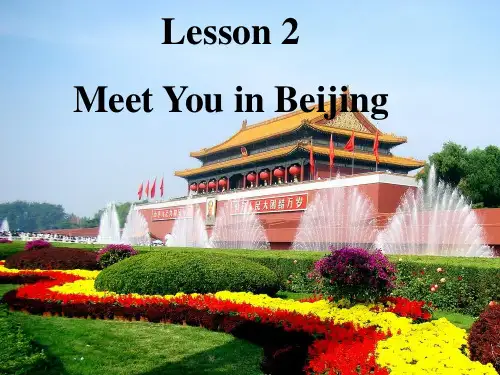
七年级英语下册 Unit 1 Lesson 2 Meet You in Beijing课件1 (新版)冀教版
Hi Jenny, How exciting! You and Danny will come to China and see the Silk Road
with us! We will travel along the Silk Road together. Wang Mei and I will meet you in Beijing. Our first stop will be Xi’an. How far is it from Beijing to Xi’an? It’s about 1114 kilometres.
The history and culture of China
The history and culture of Canada.
4. How will they arrive in Xi’an?
Take a train. Take a plane.
Hi Jenny, How exciting! You and Danny will come to China and see the Silk Road
with us! We will travel along the Silk Road together. Wang Mei and I will meet you in Beijing. Our first stop will be Xi’an. How far is it from Beijing to Xi’an? It’s about 1114 kilometres.
Lesson 2 Meet You in Beijing
Day 1
We will learn about the culture of China.
文化
人教版七年级英语下册Unit 1 Can you play the guitar(1234课时)教案

初中英语人教版(Go for it)七年级下册Unit1Can you play the guitar?教学设计第一课时(Section A1a--2d)【教学目标】Knowledge goals语言知识目标:1能掌握以下单词:guitar,sing,swim,dance,chess,play chess,draw,speak,speak English,join,club能掌握以下句型:①—Can you play the guitar?—Yes,I can./No,I can't.②—What can you do?—I can dance.③—What club do you want to join?—I want to join the chess club.2能了解以下语法:情态动词can的用法want to do sth.的用法Emotional goals情感态度价值观目标:该部分内容贴近学生的生活,谈论的话题是能力。
通过互相询问或谈论自己或对方在某一方面的能力,可以培养学生的一种群体意识。
【教学重难点】1.Teaching Importances教学重点:1)学习询问和谈论彼此的能力,特长和一些俱乐部的英语。
2)掌握一些弹奏乐器的表达方式。
2.Teaching Difficulties教学难点:情态动词can的构成和使用。
能准确表达出自己和组员的能力以及想加入的俱乐部【教学方法】直观教学法、情景教学、任务型教学法、自主探究教学法【教学工具】教学用具:电脑【教学过程设计】教学设计说明:本节课为这一单元的开始,重点在于一些乐器名称和俱乐部的教学,要求学生在学习完本节课时能准确表达出自己及小组成员的能力和特点,以及自己想要加入的俱乐部。
因此教学的过程着重点在于鼓励学生自主探究,小组合作学习,培养学生善于总结归纳知识,善于反思的品质。
设计主线为:新学期学校俱乐部招新,欣赏学生才艺展示。
人教新目标七年级下册英语市级优质课获奖教案-Unit1Canyouplaythe..
Unit1Can you play the guitar?第二课时Section A(la-2d)Learning Goals一、功能1.学会使用can的基本用法。
2.能够使用can进行提问及回答。
3.能够使用can谈论某人的能力。
4.能够根据自己的能力选择适合自己的俱乐部。
二、常用词汇、短语和表达1.词汇:1)名词n.guitar,swim,dance,chess,club,2)动词v. sing,swim,dance,draw,speak,join3)词组play chess,speak English2.句型:Can you...?Yes,I can./No, I can't.I want to join the...club.三、学习策略通过大量的听说练习让学生掌握本课以上的知识和技能。
四、情感态度通过讨论同学们的才艺和能力,使他们互相学习进步。
借机教育学生养成良好地生活和学习习惯。
Teaching steps:Step I Preview:Translate the following Chinese into English.一、你能用英语读出下列单词和短语吗?并试着写下来I.跳舞2.游泳3.唱歌4.画画5.加入,参加6.下象棋7.弹吉他8.说英语9.英语俱乐部10.加入象棋俱乐部—II.游泳俱乐—12.音乐俱乐部13.艺术俱乐部二、你能通过自主探究说出下的句子吗?(每空一词)1.-你会游泳吗?you?-不,我不能。
No,.2.-你想加入什么俱乐部?do you want to?■我想加入象棋俱乐部。
I want to.3.-Lisa想加入什么俱乐部?Lisa want to?■她想加入音乐俱乐部。
She the music club.Step II Warm up and lead in1.T:Will you look at the following pictures and answer the questions about one's ability?guitar[gl'ta:]play the guitar Can you play the guitar?温暖我心窝:.是谁在唱歌-Can you sing?sing[sin |dance[da:ns]—Can you dance?draw[dro:l-Can youdraw?play chess[tfes]—Can you play chess?speak English[spi:k]Can you speak English?Help them to answer:Yes,I can./No,I can't.(设计意图:实物展示形象、直观地引出本单元的课题。
人教版七年级下英语Unit1教案、导学案
Unit1 Canyouplaytheguitar?话题Topic 加入俱乐部(Joiningaclub)功能Functions 能够谈论自己或他人的能力(Talkabouttheabilities) A:Canyouplaytheguitar?B:Yes,Ican./No,Ican’t. A:Whatcanyoudo?B:Icandokungfu.语法Grammar 1.能够正确使用情态动词can(Modelverbcan)Icanplayping-pongandchess.Shecansinganddance.2.能正确使用包含can的一般疑问句并作简略回答 (Yes/Noquestionsandshortanswers)A:Canyoudance?B:Yes,Ican./No,Ican’t.3.能够正确使用what引导的特殊疑问句询问某人的能力及加入俱乐部的倾向(Whatquestions) A:Whatcanyoudo?B:Icandance.A:Whatclubdoyouwanttojoin?B:Iwanttojoinasportsclub.词汇和常用表达Words&expressions 1.能正确使用下列词汇 (Curriculumwords)(按词性排列)名词:guitar,chess,club,story,drum,violin,people,home,center(=centre),weekend,musician 动词:sing,draw,speak,join,tell,write,make,teach名词&动词:swim,dance,show,talk其他:or,also,today2.能正确使用下列常用表达(Usefulexpressions)playchess,speakEnglish,begoodat,begoodwith,talkto…,playthedrums/piano/violin,makefriends,help(sb.)withsth.,ontheweekend,sports/music/art/chessclub,joina(…)club,dokungfu3.能认读下列词汇(Non-curriculumwords)kungfu,piano学习策略Strategies 1.体会语块对于词汇学习的重要性2.通过文章标题猜测文章主题文化知识Culture 1.了解中外课外活动和社团活动的差异2.了解招聘海报的特点三维目标Three-dimensionaltarget 知识与技能1.能掌握以下单词:guitar,sing,swim,dance,draw,chess,speak,join,club,tell,story,write,show,or,talk,drum,violin,also,people,home,make,today,center(=centre),weekend,teach,musician2.能熟练掌握单元短语:playchess,playthedrums/piano/violin,speakEnglish,begoodat,begoodwith,talkto…,makefriends,help(sb.)withsth.,ontheweekend,joina(…)club,dokungfu3.能掌握以下句型:A:Canyouswim?B:Yes,Ican./No,Ican’t.A:Whatcanyoudo?B:Icandance.A:Whatclubdoyouwanttojoin?B:Wewanttojointhechessclub.三维目标Three-dimensionaltarget知识与技能4.了解以下语法:情态动词can表示“能,会”的用法;含有情态动词can的肯定句、否定句和疑问句的构成;what开头、用来询问能够做什么和参加什么俱乐部的疑问句的构成和回答;play 和表示棋类和球类的名词搭配时,和表示乐器的名词搭配时,the的用法。
牛津译林版七年级英语下学期期中复习教学案设计(Unit1-Unit2)

七年级英语下学期期中复习教案(U1-U2)教学目标:1、掌握U1-U2重点单词、重点短语2、掌握基数词、序数词的组成与应用【同步知识梳理】Unit 1一、复习单词A、拼读易错的单词palace, Canada, France, Japan, Russia, capital, mile, garden, centre, bathroom, beach, zero, hundred, thousand, million, square, area, fork, fridge, shower, video, machine, message, double, field, inviteB、重点单词用法1、country(pl)__________ balcony (pl) _________ beach (pl.)__________foot (pl)_____________ knife (pl)___________ video (pl)___________study (pl)__________Key:countries, balconies, beaches, feet, knives, videos, studies2、next to (prep.) 紧邻,在……近旁介词,后面加宾语,人称代词用宾格She sits next to___________(I).His classroom is next to_________(I).Key:me, minedian,Canadian,Britain,British,English,Russian,Russian,Russian4、own①(adj.) 自己的用于形容词性物主代词或名词所有格后,加强语气of one’s own 属于某人自己的I have___________(我自己的) bedroom. = I have the bedroom _____________.When children grow up, they will have families__________________.A. on their ownB. of ownC. their own familiesD. of their ownKey: my own, of my own, D②(vt.) 拥有owner (n.) 物主,所有人He______________(own) a big company in New York.He is the______________(own) of a big company in New York.③on one’s own = by oneself = alone 独自The old man lives a_________. (on his own)Key:owns,owner,alone5、square①(adj.) 平方的square metre 平方米Red Square in Moscow is about 91,000 ___________________in size.莫斯科的红场面积约九万一千平方米。
【冀教版】七年级英语下册:Unit 1 A Trip to the Silk Road全单元教案
Unit 1 A Trip to the Silk RoadLesson 1 A trip to ChinaI. Learning aimsKey vocabulary: trip silk road lead note chance send news Key phrases: learn about(学习,了解);learn(…) from…(向……学习……、从……获得……知识);learn to do sth.(学习做某事)send sb. sth.= send sth. to sb.(把某物寄给某人)tell sb. sth.= tell sth. to sb.(告诉某人某事)think about(考虑、认为)Key structures: What does \do sb. think about sth.?Practice listening、speaking、reading and writing skills.II. Learning important pointsWe are learning about the Silk Road this month in school.这个月我们正在学校学习丝绸之路。
(1).learn about 学习、了解(2).learn(…) from…(向……学习……、从……获得……知识)(3).learn to do sth. 学习做某事learn to swim 学习游泳learn to ride a bike 学习骑自行车(4).the Silk Road2.Mum and dad, may I ask you a question?爸爸妈妈,我可以问你们一个问题吗?May I…? 此句式表达有礼貌地请求对方允许,语气十分委婉,还可以表达为:Could I \ Can I?其肯定回答常用:Yes.可以。
\ Sure.\ Certainly.当然可以。
2024年人教版七年级英语下册教案Unit1 Can you play the guitar
第一课时Section A (1a—2d)教学目标通过本课的学习,学生能够:1.通过课前预习、课上导入图片来学习词汇,完成本节课所涉及的词汇学习,并通过默写准确识记本课词汇,为本节课的进行做好词汇准备。
2.通过同桌、前后桌对话,完成1c/2c/2d的对话活动,能够通过练习,在口语上询问彼此的能力,描述自己的特长,学习并掌握情态动词can的用法。
3.通过独立完成1b/2a/2b的听力练习,熟悉询问同学能力的相关句型,熟悉听力内容,能够在教师的帮助下,提取有用信息,完成听力任务。
语篇研读What:本节课是Section A中的听说课,谈论自己与他人的能力,以及想要参加的学校俱乐部。
通过相关的听力练习,训练学生的听力能力。
而2d则是一个基于听力内容的口语输出活动,主要训练学生之间互相询问彼此的能力和口语表达能力。
Why:通过本课时的学习,学生能够清楚地了解自己和他人的能力,并且通过具备的能力,了解自己和他人想参加的俱乐部,在日常生活中敢于锻炼自己、展示自己。
How:通过学习与学校俱乐部相关的词汇,运用情态动词can的不同句型强化学生对谈论能力句型的掌握;借助本课语境以及参加学校俱乐部的活动鼓励学生勇敢地锻炼自我、展示自我。
教学过程设计理念:以《英语课程标准》核心素养为导向,以单元主题为引领,基于语篇的育人理念,体现《英语课程标准》“学思用创”的英语学习活动观和“教—学—评”一体化设计理念。
板书设计作业设计基础型作业:Make a conversation about joining the club and the abilities.实践型作业:Make a poster to attract others to join the club you want to set up.教学反思。
牛津英语七年级下册Unit1教案
牛津英语七年级下册Unit1教案牛津7BUnit1第四课时教案教学内容(Teachingcontent):牛津初中英语7B第一单元词汇部分第四课时教学目的和要求:复习阅读部分内容及其知识点和句型表达;要求学生对词汇部分有全面的掌握本课类型:教授+操练教学方法:启发式教具准备:图片教学重点、难点和关键:用英文识别家具名称并能灵活使用为重点家具在一个家中的角色.通过学习这部分,如何使学生更深地理解家的概念是关键.教学过程:复习:Askingthestudentstotellwhosehomeheorshelikesbest andwhy.Byansweringthisquestion,wecangetthestudentst oreviewtheReadingpartwhilethinkingaboutwhathisorher idealhomeis.Itispossibletogetananswerlikethis:Ilikemadee’shomebestbecauseitisfuntoliveinahouseoverariverandc limbaladderintothehouseeveryday.Askingfiveorsixstudentstotellabouttheirideas.引入:Q:Homeisimportanttoeveryoneintheworld.whatdoyout hinkhomeis?Imightgetananswerlikethis:Ican’tfeelafraidorhungryathome.Lettingthestudentstalkaboutthequestionandhaveashort discussion.Q:whatmakesupofahome?Lettingthestudentsdiscussandthenpickingsomestudents totellabouttheirideas.Next,byshowingthemapictureoff amilymembers,apictureofahouseandapictureofdifferentroomsandfurniture,Icanmakethestudentsunderstandthat people,housesandfurnituremakeupofahome.Andtheyareal limportant.PEoPLE+HoUSE+FURNITURE=HomE授课内容及练习:ofcourse,withoutfamilymembers,there’snohome.Besidesfamilymembers,housesarethesecondmost important.Inahouse,weusuallyhavedifferentrooms.Basi cally,whatroomsdoneedinahouseforahome?sittingroomdiningroombathroombedroomkitchenstudybalconywealsoneeddifferentfurnitureindifferentrooms.Showin gthestudentssomepicturesoffurniture.whichroomdothey belongto?…Askingthestudentstonameoutthefurnituresaccordingtot heroompicturesshown.Sittingroom:sofacoffeetablearmchairlampTVDiningroom:diningtable.chair.napkinpaper.dinnerset.Bathroom:toilet.basin.shower.mirror.towel.Bedroom:bedbedsidetablelampdressingtablekitchen:cupboardcookermicrowaveovenfridgeStudy:bookshelflampcomputerNext,lookingatPartB.Simonismakingatableshowingtheob jectsindifferentroomsinNeil’shouse,buttherearesomemistakes.Helphimfindthemistak esandcirclethem.Askingthestudentstotakeouttheirfamilypicturesandtal kaboutyourhomewiththeirdeskmate…Askingsomestudentstocometothefrontandtalkabouthisor herhome…Discussion:Supposeyouhaveanemptyhouse.Butyouhaveonlytenthousan dyuan,whatfurniturewouldyouliketobuyfirst?Andwhy?小结:Askingthestudentstowriteasmanynamesoffurnitureasthe ycanwhileonestudentwritesontheblackboard.Atleastfiv eforeachroom.Thencheckingthewritingontheblackboardw iththestudents.作业布置:Pleasewritesomethingaboutthefurnitureyouneedorchang einyourhouserightnowandwhy.Atleast80words板书设计:PEoPLE+HoUSE+FURNITURE=HomEbedsidetable,lamp,coffeetable,sofa,cupboard,armchair↑↑↑↑↑↑bedroomsittingroomsittingroomkitchensittingroombedroombedroom教学后记:本课容量大,并有很大扩展,听、说、读、写都兼顾到;师生互动性强;在授课期间,要节奏快,引导和启发到位,确保学生的知识和能力都有收获.7BUnit1第2课时教案Reading1常州市第二十四中学英语组岳茵教学内容:7BUnit1第2课时Reading1教学目的及要求:1了解不同国家居住环境的情况。
人教版七年级(下)英语教学设计Unit 1 Can you play the guitar 单元教案
人教版七年级(下)英语教学设计 Unit 1 Can you play the guitar 单元教案
(播放 lb 部分的录音让学生听,引导学生根据所听到的内
提高学生“听” 的能力
容,选出对话的顺序,完成 1b 部分的教学任务。)
2. Check the answers: (3, 2, 1 ) StepⅥ. Pair work
初识对话,再 读对话,体会 英语表达,培 养自主学习能 力和合作意 识。检验学生 掌握对话情 况,学会用英 语表达自己的 能力与爱好。 从而将知识拓 展延伸。为难 度稍大的听力 活动做准备。
carefully.)
Then, listen to the recording again, and circle the clubs you hear.
2. Explain something that Ss can't understand.
3. Let Ss read after the teacher or play the recording and let Ss read after the recording.
1、教材分析
本单元主要是学习情态动词 can 的肯定句、否定句、一般疑问句,肯定与否 定回答,以及特殊疑问句的构成和用法。
Section A 的主要内容是运用情态动词 can“询问和谈论能力”;通过谈论 自己在某一方面所具备的才能,学习情态动词 can 的基本用法。
教学背景 分析
Section B 的主要内容是复习情态动词 can 用于“询问和谈论能力”的语言 目标掌握情态动词 can 的基本用法;能够运用所学目标语言表达自己在某一方面 所具有的才能;能够为自己成立的各种俱乐部制作海报或招聘广告。
七年级英语下册 Unit 1 Can you play the guitar五步探究式教学案
【学习目标】
重点
复习词*匚guitar, dance, swim, sing, chess, speak, play, paint, join, music, an, club, piano, drum, trumpet, violin, can, can' t;复习“询问和谈论能力”的目标语言。
学习任务二:阅读3部分内容补全卡上信息。
1.自读3部分对话完成右边卡片.
2.跟读对话,纠正发音.
3.小组讨论,理解对话并找出重难点.
4.教师点拨.
5.复述对话.
三、交流(合作探究10分钟) 小组讨论may和can的用法.
may和can都是动词.意思是后面加
如:can是一种能力。
他能说英语和汉语。Hespeakand
A. to B. or C. inD. /
3.Please call me365-8956.
A. to B. atC. in D. on
4.If(如果)you want to sing well, you can join the
*
A. English club B. art club C. music club D. chess club
【学习重点 难点】
重点
复习词¥匚guitar, dance, swim, sing, chess, speak, play, paint, join, music, an, club, piano, drum, trumpet, violin, can, can' t;复习“询问和谈论能力”的目标语言
3.写出下列单词并展示.
吉他跳舞游泳
国际象棋画画
4.在小组内核对答案.