
中考英语复习知识梳理课时3七年级下starterunit1_4基础知识梳理检测20181121220
课时3 七年级(下) Starter Unit 1~Unit 4基础知识梳理词汇拓展1.story (n.)→ (pl.)故事;小说2.piano (n.)→ (n.) 钢琴家3.violin (n.)→ (n.) 小提琴家4.center (n.)→ (adj.)中心的;中央的5.tooth (n.) → (pl.) 牙齿6.work (n. & v.)→ (n.) 工作者;工人→ (pl.) (音乐、艺术)作品7.life (n.)→ (pl.) 生活;生命8.village (n.)→ (n.) 村民9.rule (n.)→ (n.) 统治者;支配者;尺;直尺10.dish (n.)→ (pl.) 碟;盘11.luck (n.)→ (adj.) 幸运的→ (adv.) 幸运地;好运地→ (反义词)不幸的;不吉利的12.new (adj.)→ (反义词) 旧的13.many/much (adj. & adv.)→(比较级)更多(的)→ (最高级)最多(的)14.true (adj.)→ (adv.) 真诚地;真正→ (n.) 真相;事实15.important (adj.)→ (反义词)不重要的;次要的→(n.)重要性16.quiet (adj.)→ (adv.) 安静地17.dirty (adj.)→ (反义词)干净的18.noisy (adj.)→ (n.) 噪声19.up (adv.)→ (adv.) 向下ually (adv.) → (adj.)通常的;寻常的→ (反义词)特别的;不寻常的21.quickly (adv.) → (反义词)缓慢地;迟缓地→ (adj.) 快的22.far (adv.& adj.)→(比较级)时间或空间上更远→ (最高级)时间或空间上最远→ (adj.)近的23.sing (v.)→ (过去式)→ (过去分词)→ (现在分词)唱歌→ (n.) 歌手24.swim (v.& n.) → (过去式)→ (过去分词)→ (现在分词)游泳25.dance (v.& n.)→ (n.) 跳舞者;舞蹈演员26.draw (v.)→ (过去式)→ (过去分词)画27.speak (v.)→ (过去式) → (过去分词)说(某种语言);说话→ (n.) 讲(某种语言)的人;发言人28.tell (v.)→ (过去式/过去分词)讲述;告诉29.write (v.)→ (过去式)→ (过去分词)→ (现在分词)写作;写字→ (n.) 作者;作家30.make (v.)→ (过去式/过去分词)使成为;制造→ (n.) 生产者;制订者31.teach (v.)→ (过去式/过去分词)教;讲授→ (n.) 教师;老师32.run (v.)→ (过去式)→ (过去分词)→ (现在分词)跑;奔→ (n.) 跑步者33.ride (v. & n.) → (过去式)→ (过去分词)骑34.drive (v.)→ (过去式)→ (过去分词)→ (现在分词)开车→ (n.) 司机;驾驶员35.leave (v.)→ (过去式/过去分词)→ (现在分词)离开;留下36.arrive (v.)→ (n.) 到达;抵达37.fight (v. & n.)→ (过去式/过去分词)打架;战斗→ (n.) 战斗机;战士;拳击者38.bring (v.)→ (过去式/过去分词)带来;取来39.read (v.)→ (过去式/过去分词)读;阅读→ (n.) 读者→ (n.) 阅读;读书活动40.feel (v.)→ (过去式/过去分词)感受;觉得→ (n.) 感觉;感触41.follow (v.)→ (adj.)接下来的→ (n.) 拥护者;追随者42.keep (v.)→ (过去式/过去分词)保持;保留→ (n.) 饲养员;保管人43.learn (v.)→ (过去式/过去分词)学习;学会→ (n.) 学习者重点短语1.下国际象棋2.说英语3.擅长4.敲鼓5.钢琴6.help sb. with sth.7.get dressed8.radio station9.a lot of/lots of 10.take a walk 11.拉小提琴 12.善于应付…… 13.结交朋友 14.在周末 15.起床 16.join the art club 17.take the subway 18.ride a bike 19.be late for 20.take a shower 21.做(某人的)家庭作业 22.要么……要么……;或者……或者…… 23.每天 24.在……和……之间 25.实现 26.(be) on time 27.go out 28.do the dishes 29.make one s bed 30.be strict with sb.31.遵守规则32.去工作/上学33.穿过河流34.餐厅35.听经典句型1.You stories.你很擅长讲故事。
2.In the evening, I watch TV play computer games.在晚上,我要么看电视,要么玩电脑游戏。
3.There is a very big rivertheir school the village.在他们的学校和这个村庄之间,有一条非常大的河。
4.Don’t class.上课不要迟到。
5. in the classroom!不要在教室里吃东西!6.We can’t .我们上课不能迟到。
7.We must .我们必须准时。
8.We clean the classroom.我们必须打扫教室。
情景交际询问能力及爱好1.— you swim? 你会游泳吗?—Yes, ./No, I can’t.是的,我会。
/不,我不会。
2.— ?你会做什么?—I can dance./I can sing.我会跳舞。
/我会唱歌。
3.— do you want to join?你们想加入什么俱乐部? —We want to .我们想加入国际象棋俱乐部。
询问和表达时间 4.— do you usually get up? 你通常什么时候起床? —I usually get up .我通常六点半起床。
5.— does Scott go to work? 斯科特什么时候去上班? —He always goes to work .他总是十一点去上班。
6.—Would you like to go to the cinema with me?你愿意和我一起去电影院吗? —Sure, but ?当然,但是什么时候呀? —Around eight, .大约八点,星期五晚上。
谈论出行方式 7.— does she go to school?她怎样去学校? —She usually .她通常乘公共汽车。
8.— does it take to get to school? 到达学校要花费多长时间?— about 15 minutes.大约15分钟。
9.— is it from your home to school? 从你家到学校有多远? — about .两千米左右。
语法结构 1.情态动词(can, have to 和must)(见本书P135) 2.一般疑问句(助动词/情态动词+主语+其他?)(见本书P150) 3.频度副词(见本书P120) 4.what, what time, when, how, how long 和how far 引导的特殊疑问句(见本书P150) 5.祈使句(Don’t+其他.)(见本书P151) 话题梳理 1.加入俱乐部(Joining a club) 2.日常活动(Daily routines) 3.交通工具(Transportation) 4.规则(Rules)参考答案词汇拓展1.stories2.pianist3.violinist4.central5.teeth6.worker works7.lives8.villager9.ruler 10.dishes 11.lucky luckily unlucky 12.old 13.more most 14.truly truth 15.unimportant importance 16.quietly 17.clean 18.noise 19.down ual unusual 21.slowly quick 22.farther/further farthest/furthest near 23.sang sung singing singer 24.swam swum swimming 25.dancer 26.drew drawn 27.spoke spoken speaker28.told29.wrote written writing writer 30.made maker 31.taught teacher 32.ran run runningrunner 33.roderidden 34.drove driven driving driver 35.left leaving 36.arrival 37.fought fighter38.brought 39.readreader reading 40.felt feeling 41.following follower 42.kept keeper43.learned/learnt learner重点短语1.play chess2.speak English3.be good at/do well in4.play the drums5.play the piano6.在某方面帮助某人7.穿上衣服 8.广播电台 9.许多 10.散步11.play the violin 12.be good with… 13.make friends 14.on the weekend/on weekends 15.get up 16.加入艺术俱乐部 17.乘地铁 18.骑自行车 19.迟到20.洗淋浴21.do (one’s) homework 22.either…or… 23.every day 24.between…and… e true 26.准时 27.外出(娱乐) 28.清洗餐具 29.铺床 30.对某人要求严格 31.follow/obey the rules 32.go to work/school 33.cross the river 34.dining hall 35.listen to经典句型1.are very good at telling2.either or3.between and4.be late for5.Don’t eat6.arrive late for class7.be on time8.have to情景交际1.Can I can2.What can you do3.What club join the chess club4.What time at six thirty5.When at eleven o’clock6.when on Friday night7.How takes the bus8.How long It takes9.How far It’s two kilometers。
七年级英语人教版(2024)Starter+unit+3+词汇语法复习讲义与练习
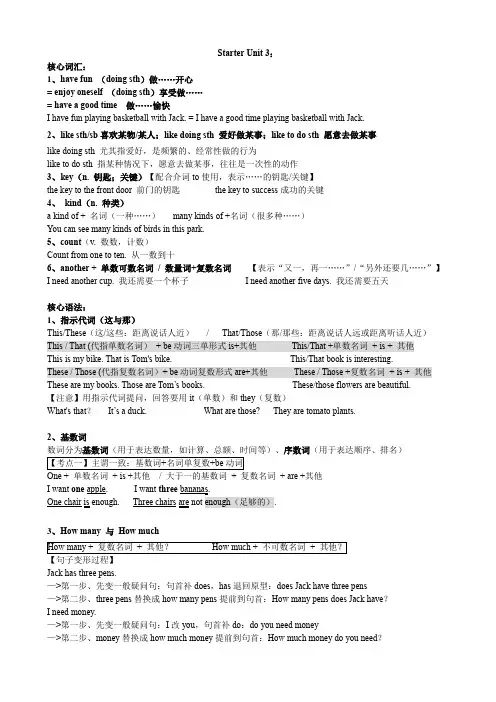
Starter Unit 3:核心词汇:1、have fun (doing sth)做……开心= enjoy oneself (doing sth)享受做……= have a good time 做……愉快I have fun playing basketball with Jack. = I have a good time playing basketball with Jack.2、like sth/sb喜欢某物/某人;like doing sth 爱好做某事;like to do sth 愿意去做某事like doing sth 尤其指爱好,是频繁的、经常性做的行为like to do sth 指某种情况下,愿意去做某事,往往是一次性的动作3、key(n. 钥匙;关键)【配合介词to使用,表示……的钥匙/关键】the key to the front door 前门的钥匙the key to success成功的关键4、kind(n. 种类)a kind of + 名词(一种……)many kinds of +名词(很多种……)You can see many kinds of birds in this park.5、count(v. 数数,计数)Count from one to ten. 从一数到十6、another + 单数可数名词/ 数量词+复数名词【表示“又一,再一……”/“另外还要几……”】I need another cup. 我还需要一个杯子I need another five days. 我还需要五天核心语法:1、指示代词(这与那)This/These(这/这些:距离说话人近)/ That/Those(那/那些:距离说话人远或距离听话人近)This / That (代指单数名词)+ be动词三单形式is+其他This/That +单数名词+ is + 其他This is my bike. That is Tom's bike. This/That book is interesting.These / Those (代指复数名词)+ be动词复数形式are+其他These / Those +复数名词+ is + 其他These are my books. Those are Tom’s books. These/those flowers are beautiful.【注意】用指示代词提问,回答要用it(单数)和they(复数)What's that?It’s a duck. What are those? They are tomato plants.2、基数词数词分为基数词(用于表达数量,如计算、总额、时间等)、序数词(用于表达顺序、排名)One + 单数名词+ is +其他/ 大于一的基数词+ 复数名词+ are +其他I want one apple.One chair is enough.3、How many 与How much【句子变形过程】Jack has three pens.—>第一步、先变一般疑问句:句首补does,has退回原型:does Jack have three pens—>第二步、three pens替换成how many pens提前到句首:How many pens does Jack have?I need money.—>第一步、先变一般疑问句:I改you,句首补do:do you need money—>第二步、money替换成how much money提前到句首:How much money do you need?【练习】第一部分:默写跟我一起来__________________讲笑话__________________坐在阳光下__________________八只兔子__________________在农场__________________听音乐__________________玩得开心__________________番茄苗__________________ 去湖边__________________那是什么__________________第二部分:(A)根据句意及汉语提示填空1、Today is Friday. It's a_____(有趣的) day.2、The boys are playing with a ball in the _____(院子).3、There are many animals(#) on the farm.4、All_____ (植物) need light and water.5、I have _____(胡萝卜) and rice for dinner.(B)用所给单词的适当形式填空6、Mum buys some __________ (tomato) and __________(potato) from the market.7、I fed(喂)__________(chicken)on my grandparents' farm last weekend.8、My grandparents keep some ducks and __________(goose).9 Look! There are some ______(baby) birds in the nest(鸟巢).10 --Are ______(that) your friends? -Yes, they are Tom and Jack.二、单项选择1、——Lucy,let me first______you______our school. ——That will be great.A. show; visitB. show: aroundC. showing; aroundD. showing; visit2、____is my family photo and ____are my parents.A. That: thisB. These; thatC. Those; theseD. This: those3、——What____fruit do you like? ——Apples.A. kindB. kindsC. kind ofD. a kind of4、——____ pets do you have? ——Three. A dog, a cat and a rabbit.A. HowB. How manyC. How muchD. How far5、——Are those his books? ——____.A. No, they're mineB. Yes, it isC.Yes, they are hersD. No,it isn't第三部分:按要求填空根据汉语意思完成句子(每空一词)1、一只猫在阳光下睡觉。
Starter Unit1 基础知识点复习
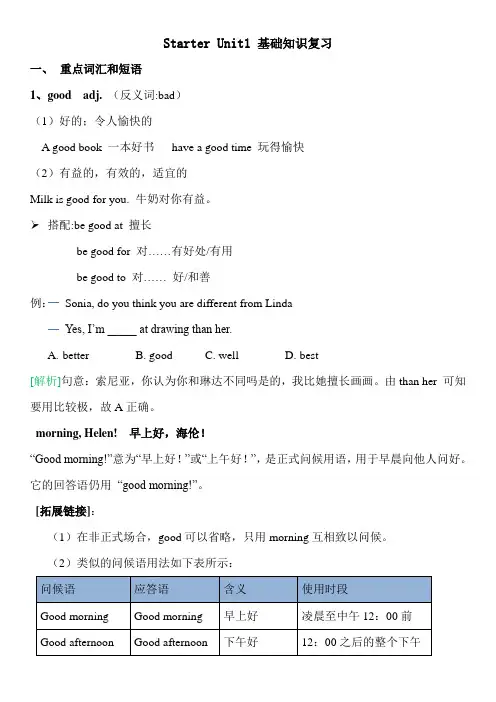
Starter Unit1 基础知识复习一、重点词汇和短语1、good adj. (反义词:bad)(1)好的;令人愉快的A good book 一本好书have a good time 玩得愉快(2)有益的,有效的,适宜的Milk is good for you. 牛奶对你有益。
➢搭配:be good at 擅长be good for 对……有好处/有用be good to 对…… 好/和善例:Sonia, do you think you are different from LindaYes, I’m _____ at drawing than her.A.betterB. goodC. wellD. best[解析]句意:索尼亚,你认为你和琳达不同吗是的,我比她擅长画画。
由than her 可知要用比较极,故A正确。
morning, Helen! 早上好,海伦!“Good morning!”意为“早上好!”或“上午好!”,是正式问候用语,用于早晨向他人问好。
它的回答语仍用“good morning!”。
[拓展链接]:(1)在非正式场合,good可以省略,只用morning互相致以问候。
(2)类似的问候语用法如下表所示:注意:Good night!并不是问候语,而是晚上分别时或就寝前的道别用语,它的含义是“晚安”“再见”。
例:Good morning, Miss Zhang!____________!A. Good morningB. Good afternoonC. Good eveningD. Good night[解析]本题考查交际用语。
A项,早上好。
B项,下午好。
C项,晚上好。
D项,晚安。
句意:早上好,张老师。
早上好。
问候语Good morning 还是用Good morning 来回答。
故A正确。
3、fine adj.(1)晴朗的 a fine day(2)健康的(healthy),身体很好的。
(必考题)初中英语七年级下册Starter Unit 4知识点总结(答案解析)

考试范围:xxx;满分:***分;考试时间:100分钟;命题人:xxx 学校:__________ 姓名:__________ 班级:__________ 考号:__________一、选择题1.The doctor asked him to stay ________ for two or three days.A.in bed B.on bed C.in the bed D.on the bed 2.---Shall I give you a __________ as you look so tired?---Thank you. I am worrying about the long way to go.A.smile B.ride C.rest D.trip3.________you help me ________my work?A.Do,in B.Can,with C.Are,with D.Are,do 4.He’ll ________get up early tomorrow morning (明天早上).A.can B.has C.has to D.have to 5.________wet umbrellas.A.No B.Not C.Don’t D.Aren’t 6.Amy has to go to bed ______ 10:00 every night. She can’t go to bed too late. A.after B.before C.in D.on7.My mother is ill.I ________ look after her at home.A.have to B.mustC.has to D.can8.Please remember ________the class rules.A.follow B.followingC.follows D.to follow9.Miss Wang is strict____ us ______ our work.A.with; with B.in; in C.with; in D.in; with10.Please keep _____ in the reading room.A.quiet B.noisy C.quietly D.Noisily 11.I’m afraid to walk ____ night.A.on B.in C.for D.at12.(题文)Please keep the door ______.A.opening B.open C.opened D.to open13.-What did Mary have ___________breakfast this morning?-She got up late and hurried to school ________ breakfast.A.for, without B.at, without C.for , after D.at, after 14.—Every morning I ________ home at seven thirty and get to school at seven fifty.—Oh, it takes you twenty minutes to get to school.A.get B.leave C.go D.come 15.— Lily, _____ you finish the letter in ten minutes?— Yes, I can.A.must B.should C.need D.can 16.Our teachers are very strict ________ us but we all like them.A.with B.to C.on D.in 17.—Jim, is your mother in the________? —Yes. She is cooking breakfast.A.club B.library C.station D.kitchen 18.—________is it from your home to the train station? —About 15 mminutes’ walk. A.How many B.How far C.How soon D.How much 19.I have ________ rules at school. And I have ________ homework to do every day. A.too many; too much B.too much; many tooC.too many; much too D.much too; many too20.It’s too difficult for us________ the question.A.to answer B.answer C.answering D.answers 21.Do you know how ________to school?A.does Bill go B.Bill go C.Bill goes D.is Bill go 22.Daniel,_______ play with the mobile phone while you’re walking in the street. A.don’t B.doesn’t C.won’t D.can’t 23.All the students are talking and laughing in the classroom and it’s____.A.noisy B.lonely C.quiet D.strict 24.—Don’t ________ when you are doing your homework.—OK. I will listen after I do my homework.A.B.C.D.25.—Do you know ________?—Sorry, I don't know.A.where does Mike live B.where does Mike live in C.where Mike lives D.where Mike lives in26.We can eat in the cafeteria. But we _______ eat in the classroom.A.don’t B.didn’t C.can’t D.aren’t【参考答案】一、选择题1.A2.B3.B4.D5.A6.B7.A8.D9.C10.A11.D12.B13.A14.B15.D16.A17.D18.B20.A21.C22.A23.A24.C25.C26.C【参考解析】一、选择题1.A解析:A【详解】句意:医生让他卧床两三天。
中考英语外研版知识点分册总复习七年级(下) Modules 1-4

wish hope 13.I___h_o_p_e__ it won't rain tomorrow because I plan to have a
picnic with my friends. 14.I___w_i_sh___ I could be a superhero to protect more people from COVID-19. 15.我希望有一天我能上一所重点大学。(汉译英) _I _e_x_p_ec_t__th_a_t_I__co_u_l_d__g_o_t_o_a__k_e_y_u_n_i_v_e_rs_i_ty__s_o_m_e__d_a_y._/I__e_xp__ec_t_t_o__g_o_t_o _a _k_e_y_u_n_i_v_e_r _si_t y__s_o_m_e__d_a_y.____________________________________
5.heavy ►熟义:①___繁__重__的__;__沉__的_____(adj.)
►牛津词典补充: A.adj. (在数量、程度等方面)超出一般的,比一般严重的 B.adj. 工作(或活动)多的;繁忙的 ②Sor ry, I can't go shopping with you, because I have a heavy schedule(行 程).____B____ ③Sara was late for school because of the heavy rain. [2019 重庆 B 卷 70 题] ____A____
to
含义及用法 意为“预料,期待,认为某事会发生”。常见搭配: ①expect(sb.) to do sth.期望(某人)做某事 ②expect+that 从句 期望…… 意为“盼望,期待ook for war d to sth./doing sth.期待某物/做某事
新课标七年级英语Starter unit1- 3知识点汇总

Starter unit1- 3知识点汇总一、文化常识1、英语文化区域,熟人之间见面,常要互相问好。
早上用语Good morning !下午用语Good afternoon ! 晚上(下午5点之后,晚上九点以前)用语Good evening ! 。
晚上九点以后要说“Good night!晚安!”例如:2(1)(2)1I’23三、1aa pen 一支钢笔; an apple 一个苹果a book 一本书 an hour 一小时a “u”一个字母“u” an orange一个橙子;;四.指示代词 this 与 that 的区别this 指代近处的人或物,that指代远处的人或物。
五. How do you do 与 How are you? 的区别二者都有“你好”之意,但二者用法不同。
表现在以下三个方面:(1)意义不同:How are you? 为疑问句,意为“你好吗?”而“How do you do?”形式上是疑问句,但实际上并不是疑问句,意为“你好!”(2)使用场合不同:How are you? 用以询问对方的身体健康状况,它多用于朋友或熟人之间。
How do you——仅供参考do? 则用于初次见面的两个人之间相互问好的问候语。
(3)回答方式不同:回答How are you? 应用“I am fine, thanks. And( How are) you? ”而回答“How do you do?”应用“How do you do?”例如:①—Liu Mei, this is Kate. 刘梅,这是凯特。
—How do you do? 你好!—How do you do? 你好!②—Hi! Li Lei, how are you? 喂,李雷,你好吗?—I’m fine,thanks. And you? 我很好,谢谢!你怎么样?—I’m fine, too. 我也很好。
六.定冠词the 的用法the 是定冠词,表示“这(个),那(个),这些,那些”,在辅音前读,在元音前读,它可以用在2、3(1)(3)4(1)(2)(3)(4)——仅供参考。
【高中教育】陕西省2019中考英语复习知识梳理课时3七年级下册StarterUnit1-4基础知识梳理检测.doc

课时3 七年级(下) Starter Unit 1~Unit 4基础知识梳理词汇拓展1.story (n.)→ (pl.)故事;小说2.piano (n.)→ (n.) 钢琴家3.violin (n.)→ (n.) 小提琴家4.center (n.)→ (adj.)中心的;中央的5.tooth (n.) → (pl.) 牙齿6.work (n. & v.)→ (n.) 工作者;工人→ (pl.) (音乐、艺术)作品7.life (n.)→ (pl.) 生活;生命8.village (n.)→ (n.) 村民9.rule (n.)→ (n.) 统治者;支配者;尺;直尺10.dish (n.)→ (pl.) 碟;盘11.luck (n.)→ (adj.) 幸运的→ (adv.) 幸运地;好运地→ (反义词)不幸的;不吉利的12.new (adj.)→ (反义词) 旧的13.many/much (adj. & adv.)→(比较级)更多(的)→ (最高级)最多(的)14.true (adj.)→ (adv.) 真诚地;真正→ (n.) 真相;事实15.important (adj.)→ (反义词)不重要的;次要的→(n.)重要性16.quiet (adj.)→ (adv.) 安静地17.dirty (adj.)→ (反义词)干净的18.noisy (adj.)→ (n.) 噪声19.up (adv.)→ (adv.) 向下ually (adv.) → (adj.)通常的;寻常的→ (反义词)特别的;不寻常的21.quickly (adv.) → (反义词)缓慢地;迟缓地→ (adj.) 快的22.far (adv.& adj.)→(比较级)时间或空间上更远→ (最高级)时间或空间上最远→ (adj.)近的23.sing (v.)→ (过去式)→ (过去分词)→ (现在分词)唱歌→ (n.) 歌手24.swim (v.& n.) → (过去式) → (过去分词)→ (现在分词)游泳25.dance (v.& n.)→ (n.) 跳舞者;舞蹈演员26.draw (v.)→ (过去式)→ (过去分词)画27.speak (v.)→ (过去式)→ (过去分词)说(某种语言);说话→ (n.) 讲(某种语言)的人;发言人28.tell (v.)→ (过去式/过去分词)讲述;告诉29.write (v.)→ (过去式)→ (过去分词)→ (现在分词)写作;写字→ (n.) 作者;作家30.make (v.)→ (过去式/过去分词)使成为;制造→ (n.) 生产者;制订者31.teach (v.)→ (过去式/过去分词)教;讲授→ (n.) 教师;老师32.run (v.)→ (过去式)→ (过去分词)→ (现在分词)跑;奔→ (n.) 跑步者33.ride (v. & n.) → (过去式) → (过去分词)骑34.drive (v.)→ (过去式) → (过去分词)→ (现在分词)开车→ (n.) 司机;驾驶员35.leave (v.)→ (过去式/过去分词)→ (现在分词)离开;留下36.arrive (v.)→ (n.) 到达;抵达37.fight (v. & n.)→ (过去式/过去分词)打架;战斗→ (n.) 战斗机;战士;拳击者38.bring (v.)→ (过去式/过去分词)带来;取来39.read (v.)→ (过去式/过去分词)读;阅读→ (n.) 读者→ (n.) 阅读;读书活动40.feel (v.)→ (过去式/过去分词)感受;觉得→ (n.) 感觉;感触41.follow (v.)→ (adj.)接下来的→ (n.) 拥护者;追随者42.keep (v.)→ (过去式/过去分词)保持;保留→ (n.) 饲养员;保管人43.learn (v.)→ (过去式/过去分词)学习;学会→ (n.) 学习者重点短语1.下国际象棋2.说英语3.擅长4.敲鼓5.钢琴6.help sb. with sth.7.get dressed8.radio station9.a lot of/lots of10.take a walk11.拉小提琴12.善于应付……13.结交朋友14.在周末15.起床16.join the art club17.take the subway18.ride a bike19.be late for20.take a shower21.做(某人的)家庭作业22.要么……要么……;或者……或者……23.每天24.在……和……之间25.实现26.(be) on time27.go out28.do the dishes29.make one s bed30.be strict with sb.31.遵守规则32.去工作/上学33.穿过河流34.餐厅35.听经典句型1.You stories.你很擅长讲故事。
2023年安徽省中考英语总复习第一轮复习:教材知识精讲:七年级(下) Units 1~4
(3)I’m afraid(that)…用来有礼貌地表达可能令人不愉快的消息。如: I’m afraid that he can’t come.恐怕他来不了了。
(4)用于一些固定句型中。如: I’m afraid so/not.恐怕是这样。/恐怕不行。
即时小练
23.Please hurry up! I’m afraid ___ we will be late for the
用于肯定句、疑 问句
用法 较正式,放于实义动词之前,系动词、 助动词、情态动词之后
too either
用于肯定句、疑 问句
用于否定句
较口语,放于句末,可用逗号隔开,也 可不用,不用时同as well 只能放于句末,可用逗号隔开,也可不 用。
as well 用于肯定句
放于句末,可与too互换,不用逗号
C.on
D.of
8.Tom has already learned how to ___ himself now.
A.test
√B.dress
C.keep
D.risk
9.As a teacher, I really feel worried to see so many students
___ glasses.
25.Phillips used to be a_f_r_a_id__(害怕的) to talk in public, but
now he can express his own thoughts to others.
考点7 remember的用法
Parents and schools are sometimes strict, but remember, they make rules to help us. 父母和学校有时很严厉, 但是要记住, 他们制定规则是为了帮助我们。 (Unit 4 P23)
四川省南充市中考英语-教材知识梳理七年级下册Units1_4知识梳理精练人教新目标版
七年级(下) Units 1—4 单元重点回顾续表玩玩游戏。
9.—Hey,Dave.__How__ do you getto school? 嗨,戴夫。
你是如何到校的?—I walk.__How__about__you,Sally? 我是步行到校的。
萨莉,你呢?18.Don't __leave__ the dirty dishes inthe kitchen! 别把脏碗留在厨房里!语法1.情态动词can,have to,must(详见第二编P140)2.how,how long,how far引导的特殊疑问句(详见第一编P31)3.祈使句(详见第二编P149)4.频度副词(详见第一编P31)话题Unit 1 Joining a club(加入社团、俱乐部)Unit 2 Daily routines(日常活动)★Unit 3 Transportation(交通工具)Unit 4 Rules(规章制度)★单元重难点突破play (七下Unit 1 P4)【举例透析】He likes playing the guitar,but he doesn't like playing football.他喜欢弹吉他,但他不喜欢踢足球。
(play与表示乐器的名词连用时,名词前要加冠词;与球类和棋类连用时,名词前不加冠词。
)(A)1.(2018眉山中考)—Listen! Someone is playing ______ violin.—Wow!______ beautiful music! I like it very much.A.the;WhatB.an;HowC.a;WhatD./;How2.放学后,我经常和朋友们打篮球。
I often __play__basketball__ with my friends after school.辨析speak,talk,say与tell (七下Unit 1 P1,P2,P3)【举例透析】①Can you speak English? 你会讲英语吗?(speak+某种语言。
[精品]2019中考英语复习 知识梳理 课时3 七下 Starter Unit 1-4(基础知识梳理)检测
课时3 七年级(下) Starter Unit 1~Unit 4基础知识梳理词汇拓展1.story (n.)→ (pl.)故事;小说2.piano (n.)→ (n.) 钢琴家3.violin (n.)→ (n.) 小提琴家4.center (n.)→ (adj.)中心的;中央的5.tooth (n.) → (pl.) 牙齿6.work (n. & v.)→ (n.) 工作者;工人→ (pl.) (音乐、艺术)作品7.life (n.)→ (pl.) 生活;生命8.village (n.)→ (n.) 村民9.rule (n.)→ (n.) 统治者;支配者;尺;直尺10.dish (n.)→ (pl.) 碟;盘11.luck (n.)→ (adj.) 幸运的→ (adv.) 幸运地;好运地→ (反义词)不幸的;不吉利的12.new (adj.)→ (反义词) 旧的13.many/much (adj. & adv.)→ (比较级)更多(的)→ (最高级)最多(的)14.true (adj.)→ (adv.) 真诚地;真正→ (n.) 真相;事实15.important (adj.)→ (反义词)不重要的;次要的→(n.)重要性16.quiet (adj.)→ (adv.) 安静地17.dirty (adj.)→ (反义词)干净的18.noisy (adj.)→ (n.) 噪声19.up (adv.)→ (adv.) 向下ually (adv.) → (adj.)通常的;寻常的→ (反义词)特别的;不寻常的21.quickly (adv.) → (反义词)缓慢地;迟缓地→ (adj.) 快的22.far (adv.& adj.)→(比较级)时间或空间上更远→ (最高级)时间或空间上最远→ (adj.)近的23.sing (v.)→ (过去式)→ (过去分词)→ (现在分词)唱歌→ (n.) 歌手24.swim (v.& n.) → (过去式) → (过去分词)→ (现在分词)游泳25.dance (v.& n.)→ (n.) 跳舞者;舞蹈演员26.draw (v.)→ (过去式)→ (过去分词)画27.speak (v.)→ (过去式)→ (过去分词)说(某种语言);说话→ (n.) 讲(某种语言)的人;发言人28.tell (v.)→ (过去式/过去分词)讲述;告诉29.write (v.)→ (过去式)→ (过去分词)→ (现在分词)写作;写字→ (n.) 作者;作家30.make (v.)→ (过去式/过去分词)使成为;制造→ (n.) 生产者;制订者31.teach (v.)→ (过去式/过去分词)教;讲授→ (n.) 教师;老师32.run (v.)→ (过去式)→ (过去分词)→ (现在分词)跑;奔→ (n.) 跑步者33.ride (v. & n.) → (过去式)→ (过去分词)骑34.drive (v.)→ (过去式)→ (过去分词)→ (现在分词)开车→ (n.) 司机;驾驶员35.leave (v.)→ (过去式/过去分词)→ (现在分词)离开;留下36.arrive (v.)→ (n.) 到达;抵达37.fight (v. & n.)→ (过去式/过去分词)打架;战斗→ (n.) 战斗机;战士;拳击者38.bring (v.)→ (过去式/过去分词)带来;取来39.read (v.)→ (过去式/过去分词)读;阅读→ (n.) 读者→ (n.) 阅读;读书活动s bed 30.be strict with sb.遵守规则上学参考答案词汇拓展1.stories2.pianist3.violinist4.central5.teeth6.worker works7.lives8.villager9.ruler 10.dishes 11.lucky luckily unlucky 12.old 13.more most 14.truly truth 15.unimportant importance 16.quietly 17.clean 18.noise 19.down ual unusual 21.slowly quick 22.farther/further farthest/furthest near 23.sang sung singing singer 24.swam swum swimming 25.dancer 26.drew drawn 27.spoke spoken speaker 28.told29.wrote written writing writer 30.made maker 31.taught teacher 32.ran run running runner33.roderidden 34.drove driven driving driver 35.left leaving 36.arrival 37.fought fighter38.brought 39.readreader reading 40.felt feeling 41.following follower 42.kept keeper 43.learned/learnt learner重点短语1.play chess2.speak English3.be good at/do well in4.play the drums5.play the piano6.在某方面帮助某人7.穿上衣服 8.广播电台 9.许多 10.散步11.play the violin 12.be good with… 13.make friends 14.on the weekend/on weekends 15.get up 16.加入艺术俱乐部 17.乘地铁 18.骑自行车 19.迟到 20.洗淋浴21.do (one’s) homework 22.either…or… 23.every day 24.between…and… e true 26.准时 27.外出(娱乐) 28.清洗餐具 29.铺床 30.对某人要求严格 31.follow/obey the rules 32.go to work/school 33.cross the river 34.dining hall 35.listen to经典句型1.are very good at telling2.either or3.between and4.be late for5.Don’t eat6.arrive late for class7.be on time8.have to情景交际1.Can I can2.What can you do3.What club join the chess club4.What time at six thirty5.When at eleven o’clock6.when on Friday night7.How takes the bus8.How long It takes9.How far It’s two kilometers。
七年级starter知识点总结
七年级starter知识点总结作为初中学习生涯的开端,七年级是学生们奋斗的起点。
在这个阶段,我们需要掌握大量的知识点,来为未来的成长打下坚实的基础。
那么,接下来就来详细总结一下七年级starter所需掌握的知识点吧。
1. 语文语文是我们基础学科之一,主要涉及汉字的学习、词语的积累、语法的掌握、作文的写作等方面。
要想学好语文,首先需要进行大量的积累,掌握常见汉字及其笔画、结构。
其次,需要学习各种基本的词语,比如名词、形容词、动词等等,以此来丰富自己的词汇量。
语法方面,需要重点掌握修饰语、句子成分、时态语态等,以此来提高自己的语言表达能力。
最后,作文方面,需要提升阅读能力、分析能力和写作能力,特别是在写作中要注重逻辑性的构建。
2. 数学数学是一门重要的基础学科,涉及到数字、算术、几何、代数、统计等等。
为了学好数学,需要在学习过程中注重掌握基本概念、积累方法和技巧。
对于初学者来说,重点是加减乘除、整数分数小数的相互转化、公式的运用和基础的代数等方面。
而在进一步的学习中,则需要学会几何中的画图方法和抽象思维,以及代数中的方程式、不等式等等。
3. 英语在全球化的背景下,英语已经成为了一门重要的语言,也是我们必须掌握的技能之一。
学好英语需要从声音、语言结构和常用词汇的学习入手。
掌握了这些基础之后,还需要不断地进行阅读、听力和口语的练习,以此来培养自己的英语思维和表达能力。
同时,还需要学好英语的语法、句型和单词,积累更多的语篇和常用表达。
4. 物理物理是一门涉及科学的基础学科,主要涉及到力学、热学、光学、电学等方面。
要学好物理,需要注重实验的学习和探索,以此来理解和加深对知识点的理解。
此外,还需要熟练掌握物理公式和定律,以此来进行实际应用和实践。
5. 化学化学是涉及化学元素和化合物的科学学科。
要学好化学,需要掌握化学元素的周期表、反应方程、物质变化的速度、溶液的性质等知识。
首先需要进行积极的实验活动,深入了解知识点,并利用化学公式和定律进行推理和猜测,进而应用于实践中。