
动词不定式的用法
动词不定式的用法动词不定式的形式:动词不定式的用法1.不定式作主语⑴原则上,可用动词不定式直接作句子的主语,通常用it作句子的形式主语,而把不定式移到后面,形成“It + 谓语… + 动词不定式…”的句型。
如:To catch the 5:00 bus early in the morning is not a good idea.It is not a good idea to catch the 5:00 bus early in the morning.To learn a foreign language well takes painstaking efforts.It takes painstaking efforts to learn a foreign language well.⑵若要说明不定式的动作的执行者,可以在不定式前面加上“for + 名词或代词”结构,或是“of + 名词或代词”结构。
It is a great pleasure for me to talk with him. It is very kind of you to help me .⑶可用于“of + 名词/代词 + 动词不定式”结构中作主语补足语的形容词是指那些可以表示人或事物的性质或品质的好坏的形容词。
这些词如:careful, cruel, foolish, bold, brave,good, honest, kind, rude, polite, nice,stupid, selfish, silly, wicked, wise,thoughtful, wrong等。
2.不定式作宾语不定式作宾语有两种情况:一是及物动词后直接跟带to的不定式,二是“动词+疑问词+带to 的不定式”。
⑴“动词+带to的不定式”结构:常见的以不定式作宾语的动词有afford, appear, agree,ask, believe, decide, demand, desire, fail, hope, intend,learn, mean, offer,promise,refuse, wish等。
如:I can‘t afford to buy a house.⑵“动词+疑问代(副)词+不定式”结构:常见的这类动词有advise, decide, forget, know,learn, remember, see, tell, think, teach, wonder,discover, understand, guess,explain等。
这类疑问代(副)词what, when, which, where, how, whether等(不包含why)。
如:She does not know how to go there. He will tell you how to deal with it.⑶在不定式作宾语时,有时我们会使用it作形式宾语,而把不定式放到后面。
如:They consider it inappropriate to have classes in the evening.(4)可以作形容词的宾语。
这一类形容词有glad, sorry, afraid, pleased, determined, willing, eager, anxious等。
例如:I”m determined to give up smoking.He is willing to help us.(5)在tell, advise, allow, forbid, learn, show, decide等词的后面常用“连接词+不定式”作宾语。
例如:We must decide whether to go or stay.I don”t know how to get in touch with him.3.不定式作表语不定式作表语时,主语通常是一个名词,不定式短语或者从句。
The boss‘s plan is to start building the skyscraper immediately. To work means to earn a living. What you have to do is to push the button.4.不定式作定语不定式作定语相当于一个定语从句,它修饰以下几类名词:⑴由动词派生或转化而来的名词,它们所对应的动词通常有不定式作宾语。
这类名词主要有:attempt, claim, decision, plan, promise, intention, need,resolution,tendency,wish, failure, threat等。
Another attempt to climb the mountain will be made next month.In his speech he expressed his determination to achieve the goal.⑵由可能与不定式搭配的形容词派生出来的名词。
这类名词主要有:anxiety, patience,ability, willingness, ambition等。
Her eagerness to learn a foreign language obvious.⑶不定式作定语还可用来修饰代词something, anything, everything, nothing.不定式做后置定语。
Do you have anything to send? 你有什么东西要寄吗?(不定式to send的动作执行者是you)Do you have anything to be sent? 你有什么要(我或别人)寄的东西吗?不定式to be sent 的动作执行者是已被省略的me或someone else)She has everything to lose and nothing to gain.⑷由only, last, next,序数词或形容词最高级修饰的名词后常用不定式作定语。
Jim is the only student to answer the question correctly in his class.You are the last to undertake the blood test.⑸不定式常作为定语修饰there be结构的真实主语。
在there be结构中,用来修饰主语的不定式有时用主动形式,有时用被动形式。
当说话人考虑的是必须有人完成某件事时,不定式用主动形式。
如果说话人强调的是事情本身必须被完成时,不定式则用被动形式。
例如:There is a lot of work to do.(Somebody has to do the work.)There is a lot of work to be done.(The work has to be done.)⑹有些抽象名词。
主要有:reason, right, time, effort, chance, way等。
如: the time to go to school, the way to get to the clinic, the chance to win the game.(7)如果不定式中的动词是不及物动词,则不定式中要有介词.I have something to say.He has a lot of homework to do .He is looking for a room to live in .There is nothing to worry about.不定式所修饰的名词或代词是不定式动作的地点工具等,即使是及物动词,不定式后面仍须有相应的介词。
Please give me a pen to write with.不定式所修饰的名词如果是time, place或way,不定式后面的介词习惯上要省去。
He had no money and no place to live. 他没钱没地方住。
(8)不定式作定语时,应放在被修饰词的后面,而且放在其他后置定语之后。
不定式做定语与所修饰的词之间有三种关系:1)动宾关系 I have a lot of work to do.我有很多工作要做。
2)主谓关系 He is always the first to come.他总是第一个来。
3)同位关系 We all have a chance to go to college. 我们都有上大学的机会。
5.不定式作状语不定式作状语相当于一个状语从句,表示形为的目的、结果或原因。
⑴表示目的。
在这种情况下,不定式的逻辑主语通常也是全句的主语。
He stayed there to see what would happen.在强调不定式目的状语时,不定式前可加in order, so as等。
如:She asked me to drive her to the airport in order to catch the 5:00 plane.He moved the TV set to the meeting-room so as to let everyone watch it.⑵用so……as to……, such (……) as to……, enough to……, too……to, only to等表示结果,如:Have you got enough room to seat all of us?She is too weak to join us in the outing.⑶将不定式移到句首表示条件,如:To hear the teacher better, you have to sit in the front. = If you are to hear the teacher better,……⑷与形容词连用时,大多表示原因。
这些形容词主要有:happy, kind, surprised,frightened, angry, shocked, glad, delighted, grieved,disappointed等。
They were surprised to be informed of the news. I‘m glad to hear this.6、独立结构To tell the truth, I don’t agree with you.•to be frank,•to be honest,•to tell the truth7、关于小品词to(1).不定式中的动词上文已出现过,下文要省略该动词.eg: Would you like to go with me ? I’d like to .(2). 不定式是to be 结构, be 不可省.eg: Would you like to be a teacher? I’d like to be.•不定式与疑问词who,which, when, how, what 等连用,在句中起名词作用,可充当主语、表语、宾语等。
常见动词不定式词组、句型用法总结

千里之行,始于足下。
常见动词不定式词组、句型用法总结动词不定式是英语语法中的一种形式,由动词原形前加上“to”构成。
动词不定式可以用作名词、形容词或副词,经常用于各种不同的句型和用法。
下面是一些常见的动词不定式词组和句型用法的总结。
1. 动词不定式作主语:例如:To learn a new language is challenging.翻译:学习一种新语言是具有挑战性的。
2. 动词不定式作宾语:例如:I want to go to the beach.翻译:我想去海滩。
3. 动词不定式作形容词的补语:例如:I am happy to help you.翻译:我很兴奋挂念你。
4. 动词不定式用于感官动词后面,表示感受:例如:I saw her cry.翻译:我观察她哭了。
5. 动词不定式用于情态动词后面,表示推想或必要性:例如:He must be busy.翻译:他肯定很忙。
6. 动词不定式用于形容词后面,表示缘由:例如:She was happy to hear the good news.第1页/共3页锲而不舍,金石可镂。
翻译:她听到好消息很兴奋。
7. 动词不定式用于介词后面:例如:I am interested in learning English.翻译:我对学习英语很感爱好。
8. 动词不定式用于短语动词的后面:例如:She wants to give up smoking.翻译:她想戒烟。
9. 动词不定式作定语,修饰名词:例如:He is a person to trust.翻译:他是一个可以信任的人。
10. 动词不定式用于条件句中,表示将来的可能性:例如:If you study hard, you will pass the exam.翻译:假如你努力学习,你会通过考试。
11. 动词不定式用于否定句中,表示不行能或不允许的行为:例如:He refused to eat the vegetables.翻译:他拒绝吃蔬菜。
动词不定式的用法
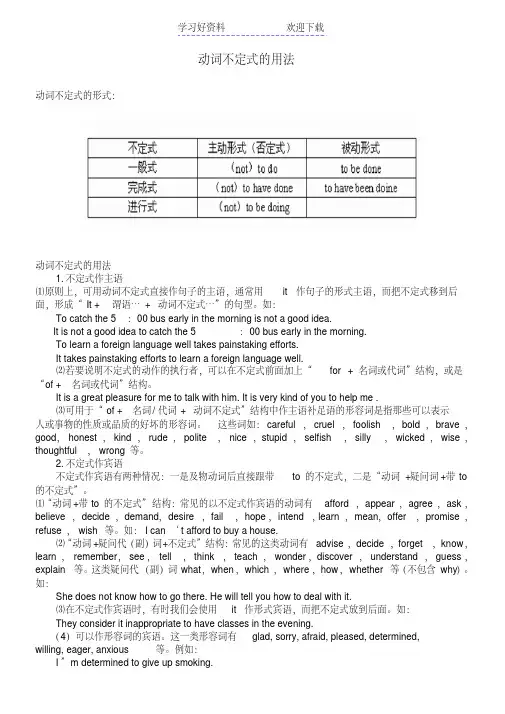
动词不定式的用法动词不定式的形式:动词不定式的用法1.不定式作主语⑴原则上,可用动词不定式直接作句子的主语,通常用it作句子的形式主语,而把不定式移到后面,形成“It + 谓语… + 动词不定式…”的句型。
如:To catch the 5:00 bus early in the morning is not a good idea.It is not a good idea to catch the 5:00 bus early in the morning.To learn a foreign language well takes painstaking efforts.It takes painstaking efforts to learn a foreign language well.⑵若要说明不定式的动作的执行者,可以在不定式前面加上“for + 名词或代词”结构,或是“of + 名词或代词”结构。
It is a great pleasure for me to talk with him. It is very kind of you to help me .⑶可用于“of + 名词/代词 + 动词不定式”结构中作主语补足语的形容词是指那些可以表示人或事物的性质或品质的好坏的形容词。
这些词如:careful, cruel, foolish, bold, brave,good, honest, kind, rude, polite, nice,stupid, selfish, silly, wicked, wise,thoughtful, wrong等。
2.不定式作宾语不定式作宾语有两种情况:一是及物动词后直接跟带to的不定式,二是“动词+疑问词+带to 的不定式”。
⑴“动词+带to的不定式”结构:常见的以不定式作宾语的动词有afford, appear, agree, ask,believe, decide, demand, desire, fail, hope, intend,learn, mean, offer, promise,refuse, wish等。
总结动词不定式用法

总结动词不定式用法动词不定式用法总结动词不定式是英语语法中的一个重要部分,它具有多种用法和功能。
接下来,让我们详细地了解一下动词不定式的常见用法。
一、作主语动词不定式作主语时,通常表示一个具体的、将要发生的动作。
为了避免句子头重脚轻,常用 it 作形式主语,而将真正的主语——动词不定式后置。
例如:“To learn English well is not easy”(学好英语不容易。
)这里“To learn English well”是真正的主语,句子显得头重脚轻,所以常用“It is not easy to learn English well” 这种形式,其中“it”是形式主语,“to learn English well”是真正的主语。
二、作宾语1、有些动词后面只能跟动词不定式作宾语,常见的这类动词有:want(想要),hope(希望),wish(希望),decide(决定),plan (计划),expect(期望)等。
例如:“I want to go shopping this afternoon”(我今天下午想去购物。
)2、动词+疑问词+动词不定式。
常见的动词有:know(知道),learn(学习),wonder(想知道),remember(记得)等。
例如:“I don't know what to do next”(我不知道接下来做什么。
)三、作宾语补足语1、常见的动词如:ask(要求),tell(告诉),want(想要),teach(教),allow(允许)等后面常接动词不定式作宾语补足语。
例如:“The teacher asked us to finish the homework on time”(老师要求我们按时完成作业。
)2、一些使役动词和感官动词如:make(使,让),let(让),have(使,让),see(看见),hear(听见),feel(感觉)等,在主动语态中,接不带 to 的动词不定式作宾语补足语;但在被动语态中,要加上 to。
动词不定式用法归纳

动词不定式用法归纳动词不定式是一种非谓语动词形式,其结构为“to+动词原形”,其中to是其符号,它没有人称和数的变化。
动词不定式在句子中可以用作主语、表语、宾语、补足语、定语、状语等。
1、作主语· To be a doctor is hard. 做医生很难。
· To learn English well is not easy. 学好英语不容易。
· To say is to believe.眼见为实。
动词不定式(短语)作主语时,为了避免句子的头重脚轻,可以用“it”作形式主语,而把真正的主语--动词不定式(短语)放在句子的后部。
上面的句子可以改为:· It is hard to be a doctor. · It is not easy to learn English w ell. · It’s important to plant trees in spring. 如果动词不定式的动作是谁做的,可以在动词不定式前面加一个由介词for引导的短语,称为不定式的复合结构。
· It’s good for us to read English aloud in the morning. 对我们来说每天早晨大声读英语是很有益的。
· It is important for students to use English every day. 对学生来说每天使用英语是很重要的。
2、作表语在形式上,位于系动词后的就是表语。
从含义上讲,表语是回答主语“是什么”或“怎么样”的语法成分。
动词不定式(短语)作表语常用于系词be的后面。
· His work is to drive a car. 他的工作是开车。
· My job is to feed animals. 我的工作是饲养动物。
· Her ambition is to be a doctor. 她的理想是当医生。
动词不定式的形式和用法

动词不定式的形式和用法动词不定式是英语中一种特殊的动词形式,它有自己的形式和用法。
本文将详细介绍动词不定式的形式和用法。
一、动词不定式的形式1. 基本形式:动词不定式的基本形式是“to + 动词原形”,比如:“to go”、“to eat”等。
动词不定式的基本形式没有时态和人称的变化。
2. 完成形式:动词不定式的完成形式是“to have + 动词过去分词”,例如:“to have gone”、“to have eaten”等。
动词不定式的完成形式表示在动词不定式动作之前已经发生或完成的动作。
3. 被动形式:动词不定式的被动形式是“to be + 动词过去分词”,例如:“to be gone”、“to be eaten”等。
动词不定式的被动形式表示动作的接受者是动作的执行者。
二、动词不定式的用法1. 作主语:动词不定式可以作为句子的主语,例如:“To learn English is important for students.”(学习英语对学生来说很重要)。
2. 作宾语:动词不定式可以作及物动词或介词的宾语,例如:“I want to go to the cinema.”(我想去电影院)。
“She is good at playing the piano.”(她擅长弹钢琴)。
3. 作表语:动词不定式可以作系动词的表语,例如:“Her dream isto become a doctor.”(她的梦想是成为一名医生)。
4. 作补语:动词不定式可以作及物动词的宾补,表示动作的目的或结果,例如:“She made a decision to study abroad.”(她决定出国留学)。
5. 作定语:动词不定式可以修饰名词,表示名词的用途、用法等,例如:“a book to read”(一本可以阅读的书)。
6. 作状语:动词不定式可以作句子的状语,表示目的、原因、结果等,例如:“I study hard to pass the exam.”(我努力学习为了通过考试)。
动词不定式的用法总结

动词不定式的用法总结动词不定式(to do)是英语课的一个重点,也是很多考试中要考查的一个项目。
你知道动词不定式的用法有哪些吗?接下来,小编给大家准备了动词不定式的用法总结,欢迎大家参考与借鉴。
●动词不定式的用法总结动词不定式属于非谓语动词的一种形式,很多同学经常把它和谓语动词混在一起,掌握起来有困难。
下面我们对动词不定式的用法做简单归纳,帮助同学们记忆:一、动词不定式在句子中不能充当谓语,没有人称和数的变化。
二、动词不定式是由“to+动词原形”构成(有时可以不带to)。
动词不定式的否定形式是“not+动词不定式”(not不与助动词连用)。
三、动词不定式短语具有名词、形容词和副词等的功能,可在句中用做多种句子成分。
1、主语:常置于句末,而用it代替其做形式主语。
例:To go in for sports helps youstay fit.(book4,L28)It helps you stay fit to go in for sports. It is dangerous to swim in the deep sea on your own.注:此句式中不定式逻辑上的主语可由for或of引出,逻辑主语由of引出时,表语的形容词为kind,nice,good,polite,clever,foolish,right,wrong等表示评价的形容词。
例:It's right of him to refuse the invitation1.(him为逻辑主语)2、表语:Our duty is to protect the enviroment.3、动词宾语:此种情况可按固定搭配或句式去记。
例:would you like to see my photos?Kevin planned to visit his uncle.(book4,L11)和plan用法一样的词还有:start,want,agree,hope,begin,decide等。
动词不定式的用法口诀
动词不定式的用法口诀动词不定式是英语语法中的一个重要部分,学好动词不定式的用法可以帮助我们更准确地表达自己的意思。
下面是一个有关动词不定式用法的口诀,希望能帮助大家更好地掌握动词不定式的用法。
一、改变时态、语态和语气:不定式有三种形式,即基本形、进行形和完成形。
它可以用于表示不同的时态、语态和语气。
例如:1. I want to go to the park. (不定式表示将来时态)2. He seems to be happy. (不定式表示进行时态)3. She is glad to have finished her homework. (不定式表示完成时态)二、作为名词使用:不定式可以作为名词使用,可以用作主语、宾语和表语。
例如:1. To learn is to grow. (不定式作主语)2. She loves to dance. (不定式作宾语)3. His dream is to become a doctor. (不定式作表语)三、表示目的或原因:不定式可以用来表示某个动作、行为或目的。
例如:1. She went to the store to buy some groceries. (不定式表示目的)2. He studied hard to pass the exam. (不定式表示目的)3. I called my friend to ask for help. (不定式表示原因)四、作为形容词或副词使用:不定式可以用作形容词或副词,修饰名词或动词。
例如:1. I have a book to read. (不定式修饰名词)2. He ran fast to catch the bus. (不定式修饰动词)五、作为补语使用:不定式可以用作补语,与表示某些动词的宾语搭配使用。
例如:1. He made me laugh. (不定式作补语)2. The teacher declared the meeting open. (不定式作补语)六、表达建议和意愿:不定式可以用于表达建议、意愿或建立情感。
动词不定式的用法
动词不定式形式为“to+动词原形” 1.动词不定式做主语.谓语用三单形式. 如果主语较长则用it做形式主语,将真正的主 语动词不定式放到句尾. e.g. To see is to believe. It’s a bad habit to run after dinner. 2 做表语( 常位于系动词be后面) My duty is to look after my little sister.
链接中考 B their (2015广东)1.We advise parents children at home alone in order to keep them away danger. A.leaving B.not to leave C. leave D.to leave (2014广东)2.In order A for the meeting,my sister forced herself to get up early this morning. A.not to be late B.not being late C. to be late D.being late (2013广东)---I don’t hear you came in just now. ex ---That’s good.We tried B any noise,for you were sleeping.. A.not make B.not to make C. to make D. making
链接中考 (2017广东)1.For more than once,our head Teacher asks us D the habit of keeping a diary. A.develop B.develops C. developing D.to develop (2017甘肃)2.We’ll do what we can A the sick people. A.to help B.help C. helps D.helped (2016广东)3.Leonardo Dicaprio, a famous American actor,was always expecting A an Oscar and fiinning C. not to win D.not winning
动词不定式用法小结
动词不定式的用法一、做主语例如:To be a doctor is not easy.To learn English well is hard.为了避免头重脚轻,一般在句子前面加上形式主语“It”,而把真正的主语“动词不定式”放到句子后面。
It is not easy to be a doctor.It is hard to learn English well.It is important to plant trees in spring.为了表示动词不定式是说谁的,一般在形容词后面加上“for”引导的短语It is good for us to read English aloud in the morning.It is importang for students to use English every day.二、作宾语动词不定式可以放在一些词后面作宾语。
Want/like/begin/forget/help/need/ remember/start/stop/wish/agree/prefer/try/decide/believe/wish/agree/promise /choose/understand等,其中宾语一定要了解句子中和谓语动词的接续关系。
I want to tell you a story.They begin to work at eight every morning.Don't forget to lock the door.would you like to go and have a picnic with us tomorrow?如果用and连接两个动词不定式,第二个一般省略toHe wants to go and have a swim with us.如果作宾语的动词不定式很长,可以用it做形式宾语I find it interesting to learn English with you.He think it hard to catch up with others.三、做定语不定式作定语一般放在所修饰的名词或代词后面,且有动宾关系。
动词不定式的用法
I am the only man to hear the news.
(6)作状语 ①作原因状语 结构:主语+be+adj.+to do (形容词多为表示情绪或状态的形容 词)
I am sorry to hear you were ill.
We hurried to the station only to be told that the train had left. 我们急匆匆 赶到车站,结果被告知火车已经开走了。
④作评论性状语 to be honest, to tell the truth, to cut a long story short, to put it another way
Mary seems to be thinking deeply.
玛丽似乎在沉思。
(4)不定式的被动形式 当动词不定式的逻辑主语是不定
式所表示的动作的承受者时,一般 要用其被动形式。
The radio needs to be repaired. 收音机需要修理。
2.不定式的句法功能 不定式相当于名词、形容词、副
to be done
完成式
to have done
to have been done
进行式
to be doing
——
完成进行式 to have been doing
——
注意:否定形式是在不定式符号to前加not
(1) 不定式的一般式 表示的动作通常时间性不强,
与谓语动词表示的动作没有时间 先后顺序。
(3)作表语 可以表示主语的具体内容、目的等。
My wish is to have a job in an office. 我的愿望是有一份在办公室里的工作。