
人教版初中英语九年级全册1-2知识点梳理
◆by+时间点,by意为“不迟于”。如:
I shall be back by 5 o’clock. 最迟五点我一定回
来。
◆by+人, by意为“(表示作者)被,由”。如:
You from the star was loved by people all over
the Asia.《来自星星的你》受到全亚洲人们的喜爱。
强调从无到有 Ge You created quite a number create 的“创作 ” ,理论等。
,如艺术作品 play. 在剧中葛优创造了很多精
强调通过研究和实验而 invent “创造,发明”出原来
Bell invented the telephone. 贝尔 发明了电话。
不存在的东西,尤指科
现学现用
考点二
I discovered that listening to something
you are interested in is the secret to language
learning. 我发现听有趣的东西是语言学习的秘诀。
(Unit 1 P3)
【用法归纳】辨析discover,create,invent, find
第一部分
教材知识梳理
九年级(全) Units 1-2
考点精析
考点一 Don’t read word by word. Read word groups. 不要逐词逐句地读,按词组阅读。 (Unit 1 P2)
【用法归纳 】by的用法(2014年2次,2013年
3次,2012年1次) ◆单数名词 +by+ 单数名词 , by意为“接 着,逐一”。如: If translated word by word, the sentence will be meaningless. 如果逐字翻 译,这个句子就没什么意义了。
find out
现学现用
与find out
辨析
用法 强调新发现,
例句 The boy has just discovered a
discover 特别是科学上 的发现。
secret drawer in his father’s old
desk. 男孩在他爸爸的旧课桌里 发现一个神秘的抽屉。 of wonderful characters in his 彩的形象。
技上的发明创造。 侧重偶然发现或经过寻
I found th找到 了这支钢笔。
find
找才得到所需要的东西
或丢失的东西。
指通过调查、探
索之后发现事实 的真相,译成“ 查明;弄清楚” 。
Do you find out who
took my bike by mistake? 你搞清楚 谁错骑了我的自行 车了吗?
◆by +v. –ing 结构, by意为“通过„„, 以„„的方式”。如: I make myself relaxed by dancing to the pop music. 我通过跟着流行音乐跳舞让自己放松。
◆by+地点名词,by意为“在„„旁,靠 近”。如: Our teacher was sitting by the window. 我 们的老师正坐在窗户旁边。
人教版九年级英语Unit 1-2 知识点归纳
compare with拿…和…比较
connect…with…把……和……连接或联系起来
call out大声呼喊
dependon视.......而定;取决于;依靠;依赖
dressup乔装打扮dress up as
endup with..以....结束
end up最终成为;最后处于
be stressed out焦虑不安的
be used to do=be used for doing被用来做某事
be good at在....方面擅长
be/get used to doing习惯于做某事
名词短语
have a hard/difficult time in doing
have conversations with sb.同某人谈话
flyup to飞向fly-flew-flown flight n.
give away分发,赠送
give/hand out分发发放hand in上交
lay out摆开布置ຫໍສະໝຸດ make/earn money挣钱
make/let/have sb do sth让某人做某事
————————变被动还原to
give/pass/send/write/lend/show/offersth to sb.= .....sb. sth.给/递/寄/写/借/展示/提供某物某人
have fun doing
have problems/trouble/difficulty in doing
Of
the importance of ……的重要性
the spirit of ……的精神
the beginning of new life新生命的开始
(全)人教九年级上册英语Unit1-2单元知识点考点总结梳理
人教九年级上册英语Unit1-2单元知识点考点总结梳理Unit 1How can we become good learners?第1课时Section A(1a2d)aloudadv.大声地;出声地pronunciationn.发音;读音。
其动词形式为pronouncepatientadj. 有耐心的。
n. 病人。
其反义词为impatient【拓展】(1)aloud, loud和loudly都意为“大声地”,但用法有区别。
①aloud 强调能让人听得见。
常与动词read, call等连用。
如:Read aloud so that we can all hear you. 大点声读,以便我们大家都能听见你。
②loud 强调声音响亮。
常与动词speak, talk, say, laugh等连用。
常用比较级形式。
如:Facts speak louder than words. 事实胜于雄辩。
③loudly 有时可与loud通用,但含有“喧闹”或者“嘈杂”的意味。
如:Don't talk so loudly. 别这么高声说话。
(2)patient的常用短语:be patient with sb. 对某人有耐心;be patient to do sth. 有耐心做某事;be patient of… 能忍受/容忍……have conversations with和……交谈finish doing sth.完成做某事give a report做报告word by word逐字/词地☆It's too hard to understand spoken English.理解英语口语太难了。
“It is+adj.+to do sth.”结构,it在句中作形式主语,真正的主语是动词不定式的内容。
如:He speaks in a low voice. It's too hard to hear him clearly. 他说话声音很低,太难听清楚他说什么了。
人教版九年级英语上册各单元知识点汇总
人教版九年级英语上册各单元知识点汇总UNIT1 How can we become good learners?SectionA重点单词听,并跟读下列单词l. textbook n.教科书;课本2. conversation n.交谈;谈话3. aloud adv.大声地;出声地4. pronunciation n.发音;读音5. sentence n.句子6. patient adj.有耐心的n.病人7. expression n.表情;表示;表达方式8. discover v.发现;发觉9. secret n.秘密;秘诀adj.秘密的;保密的10. grammar n.语法l1. repeat v.重复;重做l2. note n.笔记;记录v.注意;指出13. pal n.朋友;伙伴14. chemistry n.化学15. memorize v.记忆;记住16. pattern n.模式;方式听,并跟读下列单词变形。
l. conversation —converse (v.会话)2. patient —patience (n.耐心)3. expression —express (v.表达)1. discover —discovery ( n.发现)5. improve —improvement( n.改善)重点短语听,并跟读下列短语。
l. make word cards 制作单词卡片2. ask sb. for ... 向某人寻求……3. have conversations with sb. 和某人谈话4. at first 起初, 起先5. give a report 做报告6. take notes 记/做笔记7. word by word 逐词地8. so... that 如此……以至于9. write e-mails to sb. 给某人写电子邮件10. be afraid to do sth. /be afraid of doing sth.害怕做某事11. because of 由于;因为12. fall in love with 爱上13. a piece of cake 小菜一碟14. look up( 在词典、参考书中或通过电脑)查阅;抬头看15. so that 以便重点句型听,并跟读下列句子。
九年级上册英语人教版笔记

九年级上册英语人教版笔记一、Unit 1 How can we become good learners?1. 重点单词。
- aloud:adv. 大声地;出声地。
例如:Read aloud so that we can all hear you.(大声朗读以便我们都能听到你。
)- pronunciation:n. 发音;读音。
Your pronunciation is very good.(你的发音很好。
)- patient:adj. 有耐心的;n. 病人。
Be patient with children.(对孩子们要有耐心。
)- expression:n. 表达(方式);表示。
Facial expressions can show our feelings.(面部表情能展示我们的感受。
)2. 重点短语。
- by doing sth.:通过做某事。
We can improve our English by reading English books.(我们可以通过读英语书提高英语。
)- make mistakes:犯错。
Everyone makes mistakes when they learn something new.(每个人在学习新东西的时候都会犯错。
)- look up:查阅;抬头看。
Look up the new word in the dictionary.(在词典里查阅这个新单词。
)3. 重点句型。
- How do you study for a test?(你如何为考试而学习?)- I study by working with a group.(我通过小组合作来学习。
)- The more you read, the faster you'll be.(你读得越多,你就会读得越快。
)二、Unit 2 I think that mooncakes are delicious!1. 重点单词。
人教版九年级英语各单元难点概括
人教版九年级英语各单元难点概括1. Unit 1: Friendship- 词汇难点:短语和固定搭配,如make friends, get along with 等;- 语法难点:主从句的用法,如定语从句和宾语从句的使用;- 写作难点:描写朋友的外貌、个性和爱好。
2. Unit 2: Culture- 词汇难点:文化相关词汇,如tradition, custom等;- 语法难点:时间状语从句的使用;- 写作难点:介绍自己的文化和传统。
- 词汇难点:社区相关词汇,如neighbor, resident等;- 语法难点:被动语态的使用;- 听力难点:听懂关于社区生活的对话和信息。
4. Unit 4: Achievement- 词汇难点:描述成就和目标相关的词汇,如success, goal等;- 语法难点:非限制性定语从句的使用;- 阅读难点:理解关于成功人士的文章和资料。
5. Unit 5: Environment- 词汇难点:环境保护相关词汇,如pollution, recycling等;- 语法难点:情态动词的使用;- 写作难点:写一篇关于环境保护的文章。
6. Unit 6: Entertainment- 词汇难点:与娱乐相关的词汇,如concert, performance等;- 语法难点:直接引语和间接引语的转换;- 听力难点:听懂有关娱乐活动的对话和信息。
7. Unit 7: Technology- 语法难点:虚拟语气的使用;- 阅读难点:理解关于科技发展的文章和报告。
8. Unit 8: Health- 词汇难点:与健康相关的词汇,如exercise, diet等;- 语法难点:情态动词和情态动词的一般疑问句;- 听力难点:听懂与健康生活方式相关的对话和广播。
9. Unit 9: Future- 词汇难点:与未来相关的词汇,如dream, plan等;- 语法难点:虚拟语气的运用;- 写作难点:描述自己的未来计划。
人教版九年级英语全册各单元知识点总结
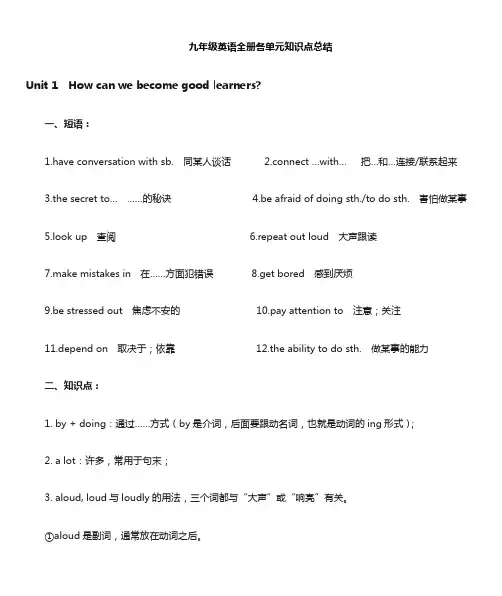
九年级英语全册各单元知识点总结Unit 1 How can we become good learners?一、短语:1.have conversation with sb. 同某人谈话2.connect …with… 把…和…连接/联系起来3.the secret to… ……的秘诀4.be afraid of doing sth./to do sth. 害怕做某事5.look up 查阅6.repeat out loud 大声跟读7.make mistakes in 在……方面犯错误8.get bored 感到厌烦9.be stressed out 焦虑不安的10.pay attention to 注意;关注11.depend on 取决于;依靠12.the ability to do sth. 做某事的能力二、知识点:1. by + doing:通过……方式(by是介词,后面要跟动名词,也就是动词的ing形式);2. a lot:许多,常用于句末;3. aloud, loud与loudly的用法,三个词都与“大声”或“响亮”有关。
①aloud是副词,通常放在动词之后。
②loud可作形容词或副词。
用作副词时,常与speak, talk, laugh等动词连用,多用于比较级,须放在动词之后。
③loudly是副词,与loud同义,有时两者可替换使用,可位于动词之前或之后。
4. not …at all:一点也不,根本不,not经常可以和助动词结合在一起,at all 则放在句尾;5. be / get excited about sth.:对…感到兴奋;6. end up doing sth:终止/结束做某事;end up with sth.:以…结束;7. first of all:首先(这个短语可用在作文中,使得文章有层次);8. make mistakes:犯错make a mistake 犯一个错误;9. laugh at sb.:笑话;取笑(某人)(常见短语)10. take notes:做笔记/记录;11. native speaker 说本国语的人;12. make up:组成、构成;13. deal with:处理、应付;14. perhaps = maybe:也许;15. go by:(时间)过去;16.each other:彼此;17.regard… as … :把…看作为…;18.change… into…:将…变为…;19. with the help of sb. = with one's help 在某人的帮助下(注意介词of和with,容易出题)20. compare … to …:把…比作… compare with 拿…和…作比较;21. instead:代替,用在句末,副词;instead of sth / doing sth:代替,而不是(这个地方考的较多的就是instead of doing sth,也就是说如果of后面跟动词时,要用动名词形式,也就是动词的ing形式)22.Shall we/ I + do sth.? 我们/我…好吗?23. too…to:太…而不能,常用的句型是too+形容词/副词+ to do sth.Unit 2 I think that moon cakes are delicious!一、短语:1. the Lantern Festival 元宵节2. the Dragon Boat Festival 端午节3. the Water Festival 泼水节4. remind sb. of 使某人想起5. eat five meals a day 一天吃五餐6. put on five pounds 体重增加了五磅7. treat sb. with. 用/以……对待某人8. be similar to... 与.......相似9. end up 最终成为/处于10. share sth. with sb. 与……分享……11. as a result结果12. one... the other... (两者中的) 一个…另一个…13. take sb. out for dinner 带某人出去吃饭14. dress up 乔装打扮15. haunted house 鬼屋16. the beginning of new life 新生命的开始二、知识点:1.宾语从句:(三大考点:引导词、时态和语序。
Unit1+知识清单+-2024-2025学年人教版九年级英语全册
中考一轮复习人教新目标Go For It!九年级上册英语Unit 1单元总结一、词汇(附例句)textbook教科书;课本Read the textbook carefully before the test.conversation交谈;谈话We had a nice conversation about the movie last night.aloud大声地;出声地Please read the poem aloud so everyone can hear.pronunciation发音;读音She worked hard to improve her pronunciation.sentence句子The teacher asked us to make a sentence with the new word. patient有耐心的(adj.);病人(n.)Be patient with your child while they are learning. (adj.)She is a patient in the hospital. (n.)expression表达(方式);表示Her facial expression showed her happiness.discover发现;发觉I discovered a new book at the library yesterday.secret秘密;秘密的(adj.)She kept her secret to herself. (n.)This is a secret room in the house. (adj.)grammar语法I need to brush up on my grammar skills.repeat重复;重做Repeat the steps carefully to avoid mistakes.note笔记;记录(n.);注意;指出(v.)She took notes during the lecture. (n.)Please note that the deadline is next Friday. (v.)pal朋友;伙伴(非正式用语)My best pal and I have been friends since childhood.pattern模式;方式He found a pattern in the data that helped him solve the problem. physics物理学I enjoy studying physics because it's interesting.chemistry化学Chemistry is the study of matter and its interactions.partner搭档;同伴We worked on the project as partners.memorize记住;熟记Memorize these key points for the exam.increase增加;增长The population has increased significantly in recent years.speed速度(n.);加速(v.)She drove at a high speed on the highway. (n.)He sped up the car to pass the slow traffic. (v.)ability能力;才能She has a natural ability for music.brain大脑The brain is the control center of the body.active活跃的;积极的She is an active member of the school club.attention注意;关注Pay attention to the details of the problem.connect连接;与……有联系(v.);连接(n.)Connect the wires correctly to avoid sparks. (v.)The internet allows us to connect with people around the world. (n.) overnight一夜之间;在夜间The project was completed overnight by a team of experts.review回顾;复习She spent the evening reviewing her notes for the test. knowledge知识;学问She has a wealth of knowledge in ancient history.wisely明智地;聪明地He made a wise decision to invest in that company.二、短语知识(附例句)by making word cards 通过制作单词卡片释义:这是一种学习新单词的方法,通过制作卡片来加深记忆。
人教版初三英语各单元知识点总结
初三英语各单元知识点详细总结Unit 1一、知识点1.Check in : 在旅馆的登记入住; Check out: 在旅馆结账离开;2.By: ①通过…..方式途径;例:I learn English by listening to tapes.②在…..旁边;例:by the window/the door③乘坐交通工具例:by bus/car④在……之前,到……为止;例:by October在10月前⑤被例:English is spoken by many people.3.how与what的区别:how通常对方式或程度提问,意思有:怎么样如何,通常用来做状语、表语;what通常对动作的发出者或接受者提问,意思为什么,通常做宾语,主语;①How is your summer holiday It’s OK.how表示程度做表语②How did you travel around the world I travel by air.③What do you learn at school I learn English, math and many other subjects.①What…think of… How…like…②What…do with… How…deal with…③What…like about… How…like…④What’s the weather like today How’s the weather today⑤What to do How to do itwhat I should do with how I should deal with it.What do you like about China =How do you like ChinaI don’t know what to do next step =I don’t know how to do it next step㊣What good / bad weather it is todayweather为不可数名词,其前不能加a㊣What a fine / bad day it is today day为可数名词,其前要加a4. aloud, loud与loudly的用法: 三个词都与"大声"或"响亮"有关;①aloud是副词,重点在出声能让人听见,但声音不一定很大,常用在读书或说话上;通常放在动词之后;aloud没有比较级形式;如: He read the story aloud to his son.他朗读那篇故事给他儿子听;②loud可作形容词或副词;用作副词时,常与speak, talk, laugh等动词连用,多用于比较级,须放在动词之后;如:She told us to speak a little louder. 她让我们说大声一点;③loudly是副词,与loud同义,有时两者可替换使用,但往往含有令人讨厌或打扰别人的意思,可位于动词之前或之后;如:He does not talk loudly or laugh loudly in public. 他不当众大声谈笑;5. voice 指人的嗓音也指鸟鸣;sound 指人可以听到的各种声音;noise 指噪音、吵闹声6. find + 宾语+ 宾补名词形容词介词短语分词等例:I find him friendly. I found him working in the garden.We found him in bed. He found the window closed.We found her honest.7. 常见的系动词有:①是:am 、is、are②保持:keep、stay③转变:become、get、turn④ ……起来feel、look、smell、taste、sound8. get + 宾语+宾补形容词过去分词动词不定式使某种情况发生例:Get the shoes clean. 把鞋擦干净Get Mr. Green to come. 让格林先生进来I want to get my bike repaired. 我想去修自行车You can’t get him waiting. 你不能让他老等着9. 动词不定式做定语①与所修饰的名词构成主谓关系The next train to arrive was from New York. He is always the first to come.②与所修饰的名词构成动宾关系I have nothing to say. I need a pen to write with.I need some paper to write on. I don’t have a room to live in.10. practice , fun 做名词为不可数名词11. add 补充说又说12. join 加入某团体并成为其中一员attend 出席参加会议或讲座join in与take part in指参加到某项活动中去;13.all、both、always以及every复合词与not连用构成部分否定;其完全否定为:all---none, both---neither, everything---nothing, everybody---nobody.14. be afraid of doing sth. / sth.害怕be afraid of being alonebe afraid to do sth.害怕be afraid that恐怕担心,表示委婉语气15.either:①放在否定句末表示“也”②两者中的“任一”③either…or…或者…或者.…引导主语部分,谓语动词按照就近原则16plete完成,是个较正式的词,后不能接动名词finish指日常事物的完成17.a,an 与序数词连用表示“又一”,“再一”;例:Please give me a second apple. There comes a fifth girl.18.have trouble/difficult/problem in doing….. 干…..遇到麻烦,困难19.unless 除非,如果不,等于“if not”本身就表示否定,引导条件状语从句,主句为将来时,条件状语从句用一般现在时表示将来;例:My baby sister doesn’t cry unless she’s hungry.=My baby sister doesn’t cry if she isn’t hungry.Unless you take more care, you’ll have an accident.如果你不多加小心的话,你会出事的;20.instead: adv. 代替,更换;例:We have no coffee, would you like tea instead我们没有咖啡了,改喝茶好吗It will take days by car, so let’s fly ins tead.开车去要好几天呢,咱们还是坐飞机吧;Tom was ill, so I went instead.汤姆病了,所以换了我去;instead of doing sth. 作为某人或某事物的替换例:Let’s play cards instead of watching TV.We sometimes eat rice instead of potatoes.Give me the red one instead of the green one.21.spoken 口头的,口语的;spoken English 口头英语speaking 讲话的,说某种语言的;Speaking skills讲英语的能力22. 提建议的句子:①What/ how about +doing sth. 如:What/ How about going shopping②Why don’t you + do sth. 如:Why don’t you go shopping③Why not + do sth. 如:Why not go shopping④Let’s + do sth. 如:Let’s go shopping⑤Shall we/ I + do sth. 如:Shall we/ I go shopping23. a lot 许多常用于句末如:I eat a lot. 我吃了许多;24. too…to 太…而不能常用的句型too+adj./adv. + to do sth.如:I’m too tired to say anything. 我太累了,什么都不想说;25. not …at all 一点也不根本不如:I like milk very much. I don’t like coffee at all.我非常喜欢牛奶;我一点也不喜欢咖啡;not经常可以和助动词结合在一起,at all 则放在句尾26.be / get excited about sth.=== be / get excited about doing sth.=== be excited to do sth. 对…感兴奋如:I am / get excited about going to Beijing.===I am excited to go to Beijing. 我对去北京感到兴奋;27. ① end up doing sth 终止做某事,结束做某事如:The party ended up singing. 晚会以唱歌而结束;② end up with sth. 以…结束如:The party ended up with her singing. 晚会以她的歌唱而告终;28. first of all 首先. to begin with 一开始later on 后来、随29. also 也、而且用于肯定句常在句子的中间either 也用于否定句常在句末too 也用于肯定句常在句末=as well30. make mistakes 犯错mistake sb. for …把……错认为……make mistakes in doing sth. 在干某事方面出错by mistake 错误地;由于搞错mistake---mistook----mistaken如:I often make mistakes. 我经常犯错;I mistook him for his brother.我错把他认成了他的哥哥;make a mistake 犯一个错误如:I have made a mistake.我已经犯了一个错误;31. laugh at sb. 笑话;取笑某人如:Don’t laugh at me不要取笑我32. take notes 做笔记,做记录33. enjoy doing sth . 喜欢做…乐意做… 如:She enjoys playing football. 她喜欢踢足球;enjoy oneself 过得愉快如:He enjoyed himself. 他过得愉快;34. native speaker 说本族语的人35. one of +the+ 形容词比较级+名词复数形式…其中之一如:She is one of the most popular teachers. 她是最受欢迎的教师之一;36. It’s +形容词+for sb. to do sth. 对于某人来说做某事…如:It’s difficult for me to study English.对于我来说学习英语太难了;句中的it 是形式主语,真正的主语是to study English37. practice doing 练习做某事如:She often practice speaking English. 她经常练习说英语;38. decide to do sth. 决定做某事如:LiLei has decided to go to BeiJing . 李雷已经决定去北京;39. deal with 处理如:I dealt with a lot of problem.40. worry about sb./ sth. 担心某人/ 某事如:Mother worried about his son just now. 妈妈刚才担心他的儿子;41. be angry with sb. 对某人生气如:I was angry with her. 我对她生气;42. perhaps === maybe 也许43. go by 时间过去如:Two years went by. 两年过去了;44. see sb. / sth. doing 看见某人正在做某事强调正在发生see sb. / sth. do 看见某人在做某事如:如:She saw him drawing a picture in the classroom.她看见他正在教室里画画;45. each other 彼此46. regard… as … 把…看作为…. 如:The boys regarded Anna as a fool. 这些男孩把安娜看成傻瓜;47. too many许多修饰可数名词如:too many girlstoo much许多修饰不可数名词如:too much milkmuch too太修饰形容词如:much too beautiful48. change…into…将…变为…如:The magician changed the pen into a book. 这个魔术师将这本书变为一本书;49. with the help of sb. == with one’s help 在某人的帮助下如:with the help of LiLei == with LiLei’s help 在李雷的帮助下50. compare … to …把…与…相比如:Compare you to Anna, you are lucky.你和安娜相比,你是幸运的;二、短语:1.by making flashcards 通过做单词抽认卡2. ask…for help 向某人求助3.read aloud 朗读4.that way =in that way 通过那种方式5.improve my speaking skills 提高我的会话技巧6.for example =for instance例如7.have fun 玩得高兴8.have conversations with friends 与朋友对话9.get excited 高兴,激动10.end up speaking in Chinese 以说汉语结束对话11.do a survey about… 做有关…的调查12.keep an English notebook 记英语笔记13.spoken English = oral English 英语口语14.make mistakes 犯错误15.get the pronunciation right 使发音准确16.practise speaking English 练习说英语17.first of all 首先18.begin with 以…开始ter on随后20.in class在课堂上ught at 嘲笑22.take notes 记笔记23.enjoy doing 喜欢干…24.write down 写下,记下25.look up v + adv 查找,查询26.native speakers 说本族话的人27.make up 编造,虚构,化妆,打扮28.around the world 全世界29.deal with 对待,处理,解决30.worry about be worried about 担心,担忧31.be angry with 生某人的气32.stay angry 生气33.go by 消逝34. regard…as… 把…当做…35plain about/of 抱怨36. change…into… 把…变成… = turn into37.with the help of 在…的帮助下38. compare…to with… 把…和…作比较39.think of think about 想起,想到40.physical problems身体上的问题41.break off 中断,突然终止42. not…at all 根本不,全然不三、句子1.How do you study for a test 你怎样为考试做准备2.I have learned a lot that way. 用那种方法,我已经学到了很多东西;3.It’s too hard to understand the voice. 听懂那些声音太难了;4.Memorizing the words of pop songs also helped a little.记流行歌曲的词也起作用;5. Wei Ming feels differently. 卫明有不同的感受;6.He finds watching movies frustrating. 他觉得看电影让人感到沮丧.7.She added that having conversations with friends was not helpful at all.她又说和朋友对话根本没用;8.I don’t have a partner to practice English with.我没有搭档一起练习英语;ter on, I realized that it doesn’t matter if you don’t understand every word.随后,我认识到听不懂每个词并没有关系;10.It’s amazing how much this helped. 我惊异于这些方法竟如此有用;11.My teacher is very impressed. 给老师留下了深刻的印象;12.She had trouble making complete sentences. 她很难造出完整的句子;13.What do you think you are doing 你在做什么14.Most people speak English as a second language.英语对于大多数人来说是第二语言;15.How do we deal with our problem 我们怎样处理我们的问题16.It is our duty to try our best to deal with each challenge in our education with the help of our teachers. 在老师的帮助下尽我们最大的努力来应对挑战是我们的责任;He can’t walk or even speak.他无法走路,甚至无法说话Unit 2一、知识点1. used to 过去常常做某事,暗指现在已经不存在的动作或状态. 后跟动词原形. used to do sth.There used to be ….反意疑问句didn’t there否定形式为: didn’t use to 或usedn’t to疑问形式为: Did…use to… 或Used…to…be/get used to doing sth.习惯于, to 为介词.2. wear 表示状态. =be in +颜色的词put on 表示动作.dress + 人给某人穿衣服.dress sb. / oneselfhave on表示状态不用于进行时态3. on the swim team on 是…的成员,在…供职.4. Don’t you remember me 否定疑问句.考点Yes, I do. 不, 我记得. No, I don’t 是的, 我不记得了.5. 反意疑问句:①陈述部分的主语为this, that, 疑问部分主语用it; 陈述部分主语用these, those, 疑问部分用they 做主语.例: This is a ne w story, isn’t itThose are your parents, aren’t they②陈述部分是there be 结构, 疑问部分仍用there例: There was a man named Paul, wasn’t there③ I am 后的疑问句, 用aren’t I例: I am in Class 2, aren’t I④陈述部分与含有not, no, never, few, little, hardly, seldom, neither, none 等词时,疑问部分用肯定.例: Few people liked this movie, didn’t they但陈述句中若带有否定前缀或后缀的单词时, 这个句子仍视为肯定, 后面仍用否定.例: Your sister is unhappy, isn’t she⑤陈述部分的主语若为不定式或V-ing 短语, 疑问部分主语用it.例: To spend so much money on clothes is unnecessary, isn’t it⑥陈述句中主语是nobody, no one, everyone, everybody 等指人的不定代词时,疑问部分用they做主语;若陈述部分主语是something, anything, noting, everything 等指事物的不定代词时, 疑问部分用it 做主语.例: Nobody says one word about the accident, do theyEverything seems perfect, doesn’t it⑦当主语是第一人称I时, 若谓动为think, believe, guess 等词时, 且其后跟宾丛,这时疑问句部分的人称,时态要与宾语从句保持一致, 同时还要考虑否定转移.例: I don’t think he can finish the work in time, can he⑧前面是祈使句, 后用will you let’s 开头时, 后用shall we6. be terrified of 害怕的程度比be afraid of 深.7. miss: ①思念, 想念例: I really miss the old days.②错过, 未中, 未赶上, 未找到.例: It’s a pity that you miss the bus.The boy shot at the goal, but missed.8. no more 用在句中=not…any more 用在句尾指次数;no longer 用在句中=not…any longer 用在句尾指时间.9. right: ① adj. 正确的, 右边的② n. 右方, 权利③ adv. 直接地.10. It seems that Yu Mei has changed a lot. = Y u Mei seems to have changed a lot.11. afford + n. /pron. afford + to do 常与can, be able to 连用.例: Can you afford a new carThe film couldn’t afford to pay such large salaries.12. as well as 连词, 不但…而且… 强调前者. 若引导主语, 谓动与前者在人称和数上一致例: Living things need air and light as well as water.生命不仅需要水, 还需要空气和阳光.I as well as they am ready to help you.不仅是他们, 我也愿意帮助你.13. alone = by oneself 独自一人. lonely 孤独的, 寂寞的.14. in the last/past + 一段时间during the last/past + 一段时间与现在完成时连用.15. die v. dead adj. death n. dying 垂死的16. play the piano弹钢琴17. ①be/ become interested in sth. 对…感兴趣②be interested in doing sth. 对做…感兴趣③show great interest in 在……方面产生极大的兴趣④a place of interest 一处名胜some places of interest如:He is intere sted in math, but he isn’t interested in speakingEnglish. 他对数学感兴趣,但是他对说英语不感兴趣;⑤ interested adj. 感兴趣的,指人对某事物感兴趣,往往主语是人⑥ interesting adj.有趣的,指某事物/某人具有趣味,主语往往是物⑦ an interesting book / man18. 害怕… be terrified of sth. 如:I am terrified of the dog.be terrified of doing sth. 如:I am terrified of speaking.19. on 副词,表示电灯、电视、机械等在运转中/打开,其反义词off. with the light on 灯开着20. walk to somewhere 步行到某处walk to school 步行到学校21.spend 动词,表示“花费金钱、时间”①spend…on sth. 在某事上花费金钱、时间②spend…doing sth.花费金钱、时间去做某事如:He spends too much time on clothes. 他花费太多的时间在衣着He spend 3 months building the bridge.他花费了三个月去建这座桥;pay for 花费如:I pay 10 yuan for the book. 我花了10元买这本书;take动词有“花费”的意思常用的结构有:It takes sb. … to do sth. 如:It takes me a day to read the book.22. chat with sb. 与某人闲聊如:I like to chat with him.我喜欢和他聊天;23. worry about sb./ sth. 担心某人/某事worry 是动词be worried about sb./sth. 担心某人/某事worried 是形容词如:Don’t worry about him. 不用担心他;Mother is worried about her son. 妈妈担心他的儿子;24. all the time 一直、始终25. take sb. to + 地方送/带某人去某个地方如:A person took him to the hospital. 一个人把他送到了医院;Lui took me home. 刘把我送回了家;home 的前面不能用to26. hardly adv. 几乎不、没有hard 困难的;猛烈地hardly ever 很少hardly 修饰动词时,通常放在助动词、情态动词之后,实义动词之前助动词/情态动词+hardlyhardly + 实义动词如:I can hardly understand them. 我几乎不能够明白他们;I hardly have time to do it. 我几乎没有时间去做了;It rains hard outside, I could hardly go out.27. in the last few years. 在过去的几年内常与完成时连用如:I have lived in China in the last few years. 在过去的几年内我在中国住;28. be different from 与…不同29. how to swim 怎样游泳不定式与疑问词连用:动词不定式可以和what, which, how, where, when 等引导的疑问句连用,构成不定工短语;如:The question is when to start. 问题是什么时候开始;I don’t know where to go. 我不知道去哪;30. make sb./ sth. + 形容词make you happymake sb./ sth. + 动词原形make him laugh31. move to +地方搬到某地如:I moved to Beijing last year.32.It seems that +从句看起来好像……如:It seems that he has changed a lot. 看起来他好像变了许多;33. help sb. with sth. 帮某人某事help sb. to do sth. 帮某人做某事She helped me with English.她帮助我学英语;She helped me to study English;她帮助我学习英语;34. fifteen-year-old 作形容词15岁的fifteen-year-olds 作名词指15岁的人fifteen years old 指年龄15岁如:a fifteen-year-old boy一个15岁的男孩Fifteen-year-olds like to sing. 15岁的人喜欢唱歌;I am fifteen years old . 我是15岁;35.支付不起… can’t /couldn’t afford to do sth.can’t / couldn’t afford sth.如:I can’t/couldn’t afford to buy the car.I can’t/couldn’t afford the car. 我买不起这个辆小车;36. as + 形容词./副词+as sb. could/can 尽某人的…能力如:Zhou run as fast as her could/can. 她尽她最快的能力去跑;37. get into trouble with 遇到麻烦38. in the end 最后39. make a decision 下决定下决心40. to one’s surprise 令某人惊讶如:to their surprise令他们惊讶to Li Lei’s surprise令李雷惊讶41. take pride in sth. 以…而自豪如:His father always take pride in him. 他的爸爸总是以他而自豪42. pay attention to sth. 对…注意,留心如:You must pay attention to your friend. 你应该多注意你的朋友;43. be able to do sth. 能做某事如:She is able to do it. 她能够做到;44. give up doing sth. 放弃做某事如:My father has given up smoking. 我爸爸已经放弃吸烟了;复合句与简单句的转化:①when ------ at the age of …②so…that…----- too… to…. / enough to …③so that…------ in order to do sth.④because…----- because of…⑤if ….----- without / with…⑥if…----- 祈使句+ and / or + 简单句⑦宾语从句----特殊疑问词+动词不定式⑧be afraidbe sure that +从句---- 动词不定式be sorry⑨It seems / seemed that sb….------ sb. seems / seemed to do sth.⑩Sb. hopes / hoped that ….-------sb. hopes / hoped to do sth.二、短语1. be more interested in 对…更感兴趣.2. on the swim team 游泳队的队员.3. be terrified of 害怕.4. gym class 体操课.5. worry about. 担心.6. all the time 一直, 总是7. chat with 与…闲聊8. hardly ever 几乎从不9. walk to school = go to school on foottake the bus to school = go to school by bus10. as well as 不仅…而且11. get into trouble 遇到麻烦12. make a decision 做出决定13. to one’s surprise 使某人吃惊的是14. take pride in 为…感到骄傲15. pay attention to 留心, 注意16. consist of 由…组成/构成. be made up of 由…组成/构成.17. instead of 代替, 而不是18. in the end 最后, 终于19. play the piano 弹钢琴三、句子1.I used to be afraid of the dark. 我以前害怕黑暗.2.I go to sleep with my bedroom light on. 我开着卧室的灯睡觉.3.I used to spend a lot of time playing games with my friends. 以前我常常花很多时间和我的朋友们玩游戏.4.I hardly ever have time for concerts. 我几乎没有时间去听音乐会.5.My life has changed a lot in the last few years.6.It will make you stressed out. 那会使你紧张的.7.It seems that Yu Mei has changed a lot. 玉梅似乎变化很大.Unit 3一、知识点①英语有两种语态:主动语态和补动语态主动语态表示是动作的执行者被动语态表示主语是动作的承受者Cats eat fish. 主动语态猫吃鱼;Fish is eaten by cats.被动语态鱼被猫吃;②被动语态的构成由“助动词be +及物动词的过去分词”构成助动词be 有人称、数和时态的变化,其变化规则与be 作为连系动词时完全一样;时态被动语态结构例句一般现在时amare +过去分词isEnglish is spoken inmany countries.一般过去时was +过去分词were + 过去分词This bridge was built in1989.情态动词can/shouldmay +be+过去分词must/……The work must be doneright now.③被动语态的用法当我们不知道谁是动作的执行者,或者没有必要指出谁是动作的执行者,或者只需强调动作的承受者时,要用被动语态;2. allow sb. to do sth. 允许某人做某事主动语态如:Mother allows me to watch TV every night. 妈妈允许我每晚看电视;be allowed to do sth. 被允许做某事被动语态如:LiLy is allowed to go to Qinzhou. 莉莉被允许去钦州;3. get their ears pierced 穿耳洞让/使别人做某事get sth. done过去分词have sth. done 如:I get my car repaired. == I have my car repaired. 我让别人修好我的车I want to have my hair cut. 我要理发.4. enough 足够形容词+enough 如:beautiful enough足够漂亮enough+名词如:enough food 足够食物enough to 足够…去做…如:I have enough money to go to Beijing. 我有足够的钱去北京;She is old enough to go to school.她够大去读书了;5. stop doing sth. 停止做某事Please stop speaking.请停止说话;stop to do sth. 停止下来去做某事Please stop to speak. 请停下来说话;6. 看起来好像…sb. s eem to do sth. = It seems that +从句He seems to feel very sad.It seems that he feels very sad. 他看起来好像很伤心;7.倒装句:由so+助动词be/do/will/have/情态动词+主语意为:…也是一样Neither/Nor + be动词/助动词/情态动词+主语前为否定表示与前面所述事实一致.She is a student. So am I.她是一个学生,我也是;She went to school just now. So did I . 她刚才去学校了,我也是She has finished the work. So have I . 她已经完成了工作,我也完成了;She will go to school. So will he.她将去学校,他也是;Tom can’t swim. Neither can John.8. yet 仍然,还常用在否定句或疑问句当中可与although/though连用9. stay up 熬夜如:I often stay up until 12:00pm.我经常熬夜到12点;10. clean up 打扫整理如:I have cleaned up the bedroom. 我已经打扫完了卧室;11. 程度副词:always总是usually经常sometimes有时never从不如:I am always/usually/sometimes/never late for school.我总是/经常/有时/从不上学迟到;12. 曾经做某事:Do you eve r get to school late Yes, I do. No, I don’t.Have you ever got to school late Yes, I have. No, I haven’t.13. go shopping去购物, go fishing去钓鱼go swimming去游泳, go boating去划船go hiking去登山, go trekking去徒步14. .be strict with+人. be strict in+事物.例: The head teacher is strict with his studentsHe is strict in the work.15. take the test 参加考试pass the test 通过考试fail a test 考试失败16. the other day前几天,不久前的一天.用于过去时every other day = every two days 每隔一天每两天17. agree 同意反义词disagree不同意动词agreement 同意反义词disagreement 不同意名词18. keep sb/ sth. +形容词使某人/某物保持….如:We should keep our city clean.cleaningⅹ我们应该保持我们的城市干净;Don’t keep me waiting for a long time.别让我等得太久;19. both…and…+动词复数形式如:Both Jim and Li Ming play basketball.20. learn sth. from sb. 向谁学习什么如:Jim learnt English from his English teacher. 吉姆向他的英语老师学习英语21. have an opportunity to do sth. 有机会做某事have a chance of doing sth. 有机会做某事如:I have an opportunity to go to Beijing. I have a chance of going to Beijing.22. at present 目前23. at least 最少at most 最多24. 花费take ,cost, spend , payIt take sb. time to do sth. It took me 10days to read the book.sth. cost sb. …… The book cost me 100yuan.sb. spend … on sth. She spent 10day s on this book.sb. spend …doing sth. She spent 10days reading this book.sb. pay … for sth. She paid 10yuan for this book.25. have +时间段+off 放假,休息如:have 2 days offoff 不工作,不上班,不上学,不值班.例: I think I’ll take the afternoon off. 我想下午歇班.She is off today. 她今天休息.I have three days off next week. 下周我有三天假.They haven’t had a day off since last week. 从上周来,他们没休息过一天.26. reply to 答复某人如:She replayed to MrGreen.27. agree with sth. 同意某事如:I agree with that idea.agree to sb. 同意某人的意见如:I agree to LiLei.28. get in the way of 碍事,妨碍如:Her social life got in the way of her studies. 她的社会生活妨碍了她的学习;29. success n. succeed v. successful adj. successfully adv.30. think about 与think of 的区别①当两者译为:认为、想起、记着时,两者可互用I often think about/ of that day. 我经常想起那天;②think about 还有“考虑”之意,think of 想到、想出时两者不能互用At last, he thought of a good idea. 最后他想出了一个好主意;We are thinking about going Qinzhou. 我们正在考虑去钦州;31. 对… 热衷, 对…兴趣be serious about doing 如:She is serious about dancing. 她对跳舞热衷;be serious about sth. 如:She is serious about him. 她对他感兴趣;32. practice doing 练习做某事She often practice speaking English.33. care about sb. 关心某人如:Mother often care about her son.34. also 也用于句中either也用于否定句且用于句末too=as well 也用于肯定句且用于句末I am also a student. 我也是一个学生I am a student too. 我也是一个学生;I am not a student either. 我也不是一个学生;35.allow sb to do sth 允许某人做… allow doing sth 允许做…36.stupid silly foolish 三个词都有“蠢”的意思.但略有不同.stupid 程度最强,指智力理解力学习能力差. silly 指头脑简单,傻头傻脑,使人觉得可笑,带有感情色彩. foolish 尤其在口语中广泛使用.例: He is stupid in learning math. 他学习数学很笨.Stop asking such silly questions. 别再问这样傻的问题了.You are foolish to throw away such a good chance.你真蠢,丢掉这样一个好机会.37.He doesn’t seem to have many fri ends.=It seems that he doesn’t have many friends.=He seems not to have many friends.38.clean v. 打扫,清理clean up 比较彻底地打扫,清理clean out 打扫,清理地最彻底.39.concentrate on… 全神贯注做…例: He decided to concentrate on physics because he failed the exam.This company concentrates on China market.这家公司把重点放在中国市场上.40. more…than…①与其说…不如说…; 比…更…例: The man is more stupid than nervous.与其说那人紧张,倒不如说他愚蠢.②在这一结构中,more做adj. 修饰名词,表示“比…多”例:I have more books than you. 我的书比你的多.41.volunteer ① n. 自愿者. ② v. volunteer to do sth. 自愿做…例: We all volunteered to help in the old people’s home.我们都志愿到敬老院帮忙.42. get in the way of... 妨碍...例: He never gets in others’ way. 他从不妨碍别人.The bikes over there will get in the way of others. 自行车放在那里会妨碍别人的.43. success n. successful adj. succeed v.44. only 处于句首,并后跟状语时,全句需要倒装.例: Only then did he understand it. 只有到那时,他才明白.Only in this way can we learn English well. 只有这样我们才能把英语学好.Only when she came home, did he learn the news. 当她到家时,他才得知了这消息.45. care about 关心,在乎,在意.例: No one cares about others nowadays. 现在没人关心别人.I don’t care about what he does. 我并不在意他干什么.二、短语1. be allowed to do sth 被允许干…allow sb to do sth 允许某人干…allow doing sth 允许干…2. sixteen-year-olds = sixteen-year-old boys and girls 16岁的孩子3. part-time jobs 兼职工作4. a driver’s license 驾照5. on weekends 在周末6. at that age 在那个年龄段7. on school nights 在上学期间的每个晚上8. stay up 熬夜9. clean up 相当与及物动词清扫10. fail in a test 考试不及格11. take the test 参加考试12. the other day 前几天13. all my classmates 我所有的同学14. concentrate on 全神贯注于15. be good for 对…有益16. in groups 成群的,按组的17. get noisy 吵闹系表结构18. learn from 向某人学习19. at present 目前,现在20. have an opportunity to do sth 有做…的机会21.English-English dictionary 英英词典22. at least 至少23.eight hours’ sleep a night 每晚8小时的睡眠24. an old people’s home 敬老院25. take time to do sth 花费时间干…26. primary schools 小学27. have…off 放假,休息28. reply to 回答,答复29. get in the way of 妨碍30. a professional athlete 职业运动员31. achieve one’s dreams 实现梦想32. think about 思考,考虑33. in the end 最后,终于34. be serious about 对…热忠/极感兴趣35. spend…on + n. spend …in + v-ing 在…上花费时间/金钱36. care about 关心,担心,在乎37. agree with 同意…三.句子1. I don’t think twelve-year-olds should be allowed to get their ears pierced.我认为不应该允许12岁的孩子穿耳孔.2.They talk instead of doing homework. 他们聊天而不是做作业.3.He is allowed to stay up until 11:00 pm. 允许他们熬到晚上11点.4.We should be allowed to take time to do things like that more often.我们应该被允许更加经常的花些时间多做这类事情.5.What school rules do you think should be changed你认为学校的哪些制度应该改一改了6.The two pairs of jeans both look good on me.这两条牛仔裤穿在我身上都适合.7.The classroom is a real mess. 教室太脏了.8.Should I be allowed to make my own decisions9.Only then will I have a chance of achieving my dream.只有这样我才能实现我的梦想.10.They should be allowed to practice their hobbies as much as they want.应该允许他们对业余爱好想练多长时间就练多长时间.11.We have nothing against running. 我们没有理由反对他跑步.Unit 4一、知识点1. if 引导的非真实性条件状语从句即虚拟语气通过动词形式的变化来表示说话人对发生的动作或存在的状态所持的态度或看法的动词形式称为语气,虚拟语气表示说话人所说的。
人教版初中九年级英语Unit1-Unit2知识梳理
7. 老师说得太快了,以至于大部分时间我都理解 不了她的话。 The teacher spoke _so_ _q_u_i_c_k_ly_ _t_h_a_t I did not understand her most of the time.
8. 我发现听有趣的东西是语言学习的秘诀。 I discovered that l_i_st_e_n_i_n_g_to _so_m__e_t_h_in_g_ _i_n_te_r_e_s_ti_n_g_is the secret t_o_language learning. 9. 我没有一位可以一起练习英语的搭档。 I don't have a partner _to_ _p_r_a_ct_i_c_e _E_n_g_l_is_h_ _w_i_th_.
25.处罚;惩罚 v. _p_u_n_i_sh_→n. 惩罚 _p_u_n_i_s_h_m_e_n_t_ 26.温暖;暖和n. _w_a_r_m__th_→adj. _w__a_rm__ 27.传播;展开 v. 蔓延;传播n. s_p_r_e_a_d_→ (过去式/过去分词) _sp_r_e_a_d_
重点短语 1. 查阅;抬头看 _lo_o_k__u_p_
2.天生具有 b__e_b_o_r_n__w_i_th_ 3.关注;注意 _p_a_y_a_t_t_e_n_ti_o_n_t_o_
4.把……和……连接起来 _c_o_n_n_e_c_t_. _. _.w_i_t_h_ 5.增加(体重);发胖 _p_u_t__o_n
九年级 Unit1-Unit2
重点单词 1. 大声地;出声地 adv. a_l_o_u_d_→adv. 大声地 _lo_u_d_l_y_ 2.发音;读音n. _p_r_o_n_u_n_c_i_a_ti_o_n_→v. 发音 _p_r_o_n_o_u_n_c_e_ 3.有耐心的adj. 病人n. _p_a_t_i_en__t →n. 耐心 _p_a_t_ie_n_c_e_ 4.表情; 表达方式;表示n. _e_x_p_r_e_ss_i_o_n_→v. 表达 _e_x_p_r_e_ss_
人教版英语九年级全知识点
人教版英语九年级全知识点英语学习在中国的教育系统中占据着重要的地位。
而针对九年级的学生来说,人教版英语教材无疑是他们的主要学习资料。
下面,我们来总结一下人教版英语九年级所涵盖的全知识点。
首先,我们来介绍第一单元——Unit 1 Friendship。
这一单元主要介绍了人际关系中的朋友关系。
在这个单元中,学生会学习如何介绍自己以及他人,如何描述一个朋友,以及如何表达自己的想法和感受。
同时,学生还会接触一些与友谊相关的主题,例如解决冲突和争吵,以及如何与不同性格的人建立友谊。
接下来是第二单元——Unit 2 English around the World。
这一单元主要介绍了英语在全球范围内的使用情况。
学生将了解到英语作为一门国际语言的重要性,并学习如何描述不同国家的语言状况。
此外,学生还会学习一些关于文化差异的知识,以增加他们的跨文化交流能力。
第三单元是——Unit 3 Travel Journal。
这一单元主要介绍了旅行和旅游的相关知识。
学生将学习如何描述旅行的目的地、行程和所见所闻等。
同时,学生还会学习如何预订机票、酒店以及询问和提供旅行信息的表达方式。
通过这个单元的学习,学生将提升自己的旅行英语能力。
第四单元是——Unit 4 Growing up。
这一单元主要讲述了人的成长过程。
学生将学习如何描述他们的童年回忆,以及描述他人的外貌和个性特点。
此外,学生还将接触一些与年龄和人生阶段相关的话题,例如青少年时期的压力和挑战,以及如何解决这些问题。
接下来是第五单元——Unit 5 Amazing Women。
这一单元主要介绍了一些杰出的女性以及她们的成就。
通过学习这些女性的故事,学生将了解到女性在社会中扮演的重要角色,并且激励他们追求自己的梦想。
第六单元是——Unit 6 Festivals around the World。
这一单元主要介绍了全球各地的节日。
学生将学习如何描述不同节日的庆祝活动,以及了解一些关于节日的文化和传统。