
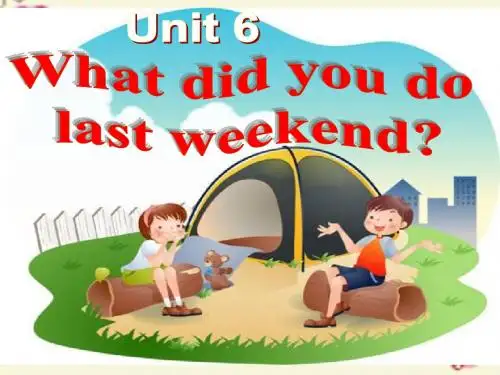
Unit 6 What did you do last weekend
• 4. Mom, shopping, often , goes.
• Mom often goes shopping.
Let's talk
1. What did LiShan do last weekend? She did some housework. 2. Did she clean the window ? No, she didn't. 3. What did her father do ? Her father had some work to do 4. Where was her mather? Her mother was in the hospital. 5. What's wrong with her grandma? She was ill.
did
watched
saw looks
had
went
cleans
句型变换2
• Jack saw his friend last week.
A. (变成一般疑问句)
• • • • • •
Did Jack see his friend last night? 肯定回答:Yes, he did . 否定回答:No, he didn't. B.对划线部分提问 What did Jack do last night? C.变否定句
• Let's go away now. • 5. 现在让我们离开这儿吧!
• • • • • • • • • • • •
句型变换1
1. I do housework every day. (变成一般疑问句) Do you do housework every day? 2. They usually have a match.(对划线部分提问) What do they usually do? 3. She often makes the bed.(变成一般疑问句) Does she often make the bed ? 4. My mother washes the clothes now.(对划线部分提问) What does your mother do now? 5. Lixin was at home yesterday.(变成一般疑问句) Was Lixin at home yesterday? 6.There were some sunglasses.(变成否定句) There weren't any sunglasses.
5. do ho_se_o_ _.
6. g_ a_ a _
(
离开
)
• 1. 我不喜欢看表演。
Make sentences.
• I don't like watch a show.
• 2. 我经常照顾我的奶奶。 • I often/ usually look after my grandma. • He does housework • 3. 他每天都做家务。 every day. • We will see a friend • 4. 明天我们将要去看望一 tomorrow. 个朋友。
• Jack didn't see his friend last week.
分别把下面句子变成否定句,一般疑问句及 肯否定回答,以What引导的特殊疑问句
• 1. We did the dishes at home just now.
• 2. My brother had a match this morning. • 3. They went away a monent ago. • 4. He looked after Grandma yesterday. • 5.Jim made the bed last night.
•
•
动词的过去时态
• • • • • • • am/is ------was are-----were do -----did see------saw have ------had go------went make -----made • • • • • wash------washed watch------watched cook----cooked clean ----cleaned water----watered
Choose the correct answer
• 1.She was _________the hospital. A in B on C at • 2. I’m sorry______ hear that. A for B at C to • 3. My father had some work_________ do. A to B for C in • 4. What did you do last weekend? I_________ some housework? A do B does C did • 5. He went away _________home. A from B of C at
Part A
Think : Can you _______?
cook the meal
clean the windows
water the flowers
wash the clothes
A: I can _____at home. I am helpful. make the bed Are you helpful at home? water the flowers B: Yes, I am. A: What do you do the dishes often/usually/always do? cook the meal B:I often …... A: What about you? wash the clothes B: I usually/always …...
连词成句
• 1. Sam, last, do, night ,What, did ?
• What did Sam do last night?
• 2. last, we, a ,had , match, weekend.
• We had a match last weekend.
• , every, your, does, father, watch month?
Homework
一.句型变换(其余4个句子)
• 分别把下面句子变成否定句, • 一般疑问句及肯否定回答,以What引导的特殊疑问句 • 1. We did the dishes at home just now.
• • • •
2. My brother had a match this morning. 3. They went away a monent ago. 4. He looked after Grandma yesterday. 5.Jim made the bed last night. 二, Unit 6 全部单词 4英2汉 + 1默写
( 默写时先写出汉语,然后自己根据汉语提示写出英语单词)。
复习 一般现在时 动词的单三形式变化规律
• 1、一般情况下,动词后直接加s,如:helps ,gets. • 2、以s,x,ch,sh或o结尾的动词,在后面加es. • 如:guesses, fixes, teaches,washes,goes等。 • 3、以辅音字母加y结尾的动词,把y变为i,再加es, • 如:study--studies,try--tries,carry--carries等。 • 字母y前为元音字母,第三人称单数形式直接在动词后面加-s。 如: plays,says等。 • 4、动词have遇主语是第三人称单数he she it 时,have改为has. • 5、动词be遇有主语是第一人称单数时,be改为am,遇有主语 是第二人称时,be改为are,遇有主语是第三人称单数时,be改 为is。 • I 跟am, you 跟are, is 连着她,他,它。
1.Fill in the blanks and translate intoChinese.
1. wa_ch a s_ o_. ( 观看表演 ). ( 照顾 )
2. look a_ t_ _.
3. s_ _ a fr_en _. 4. have a _ _t _h.
( 看望朋友 )
( 举行比赛 ) (做家务 )
用所给单词的正确形式填空。
• 1. Alice___ housework last night. ( do ) • 2. They __ a show last weekend. (watch) • 3. I ___ my friend last week.(see) • 4. He____ after Grandma every day. (look) • 5. Our school ___ a football match last month. (have) • 6.She __away just now.(go) • 7.His friend often___the classroom.(clean)
动词过去式变化规则
• • • • • • • • • • • • • • 一、规则变化 1、 一般情况下,动词词尾加-ed, 如:work—worked play—played want— wanted ask—asked 2、 以不发音的-e结尾动词,动词词尾加-d, 如:live—lived move—moved taste—tasted 3、 以“辅音字母+y”结尾的动词,把y改成i, 加—ed, 如:study—studied try—tried copy—copied carry—carried 4、 重读闭音节动词,双写词尾辅音字母,再加—ed, 如:stop—stopped 二、不规则变化 1.不规则动词表 2.过去式与动词原形一样:let—let cut—cut put—put read—read 二、动词过去式构成读音 1、 清辅音后读清辅音[t] (清读清) 如:jump like 2、 浊辅音后读浊辅音[d] (浊读浊) 如:listen pull 3、 元音后面读浊辅音[d] (元音后面读浊音) 如:water play 4、 [t][d]后面读[id] want need
陕旅版小学英语六年级上册Unit 6《What did you do last weekend》PPT课件2
○
○
○
What did you do last weekend?
你上周末做了什么?
/'haʊswɜːk/ do housework 做家务
look after 照顾,照看
look after Grandma 照顾奶奶(外婆)
/ʃəʊ/ watch a show看表演
/si:/ see a friend看望朋友
Game 2 What phrase missed?
do housework have a match go away
Game 2 What phrase missed?
see a friend watch a show
look after Grandma
(顺风耳游戏)
Game rules:
老师随机叫两到三组学生(每组六名学生)站到讲台前 排成一排,头一个学生有30秒钟的时间看到单词卡片, 在老师说开始后,头一个学生即用耳语把纸上的单词告 诉前面的学生,这位学生再把听到的单词告诉前面的学 生,这样依次进行下去。最后,末尾的那个学生把所听 到的单词写到黑板上,并读出来及说出相应的汉语意思, 传得最快,最准的组获胜。
Check homework
(两人一组进行对话)
A:Are you helpful at home? 你在家是个有用的小帮手吗? B: Yes, I am. 是的,我是。 A: What do you often do? 那你经常做些什么呢? B: I often …………. 我经常……..。
last weekenew words after class 2.Copy the new words in English Exercise Book
陕旅六上Unit 6 What Did You Do Last Weekend教案(推荐)
Unit 6 What Did You Do Last Weekend?第一课时【教学目标】1.能听、说、读、写短语:watch a show, look after, do housework, see a friend, have a match, go away.2.能在具体的语音环境中灵活运用所学短语.【教学重难点】掌握新词汇.【教学准备】教学卡片,录音机、磁带.【教学过程】Ⅰ.课程导入Ⅱ.新授1.新课展示Part A Let’s learn(1)师生问答.(2)Do you like basketball? Let’s have a basketball match!(3)教授短语see a friend和look after Grandma2.巩固活动(1)带领学生对短语进行拼读和范写,通过看、读、写对本课所学短语加深记忆.(2)播放Let’s learn部分的录音,学生跟读、拼读短语中的生词.(3)巩固练习(4)补一补(5)你来说,我来组.(6)Make a chant第二课时【教学目标】1.掌握动词过去式的构成规律和发音规律.2.能正确使用一般过去时态描述过去发生的动作或活动:What did you do last weekend? Idid some housework. I cleaned the rooms …并能正确模仿对话,做到语音语调自然.3.理解并会用I’m sorry to hear that.对别人的不如意表达关切.【教学重难点】掌握过去式的构成规律和发音规律.【教学准备】录音机、磁带、动词卡片.【教学过程】Ⅰ.课程导入Ⅱ.新授1.新课展示Part A Let’s talk(1)师生对话(2)板书功能结构(3)教读几个动词的过去式(4)提出问题,让学生在阅读时画出答案.(5)出示常见动词的原形和过去式.(6)再次朗读对话,引导学生注意以下对话并予以讲解.(7)巩固活动(8)播放录音,学生边听边画出文中出现的动词过去式,然后在全班内进行交流.(9)带领学生朗读一遍对话,要求学生注意动词过去式的发音方式.(10)再次播放录音,鼓励学生模仿录音中的语言语调,分角色进行朗读,做到自然、流畅.Ⅲ.巩固练习1.你秀我答2.Part C look and talk3.Part B Let’s chant第三课时【教学目标】1.能听懂、会说What happened to …?并能用一般过去时态描述某人曾经发生的事.2.进一步学习行为动词一般过去时的特殊疑问句及其回答,初步了解一般疑问句和否定句并认识when引导的状语从句.能灵活自如地运用所掌握的一般过去时态在生活中与人进行交流.【教学重难点】掌握一般过去时的特殊疑问句及其回答.【教学准备】动词原形卡片和动词过去式的卡片,录音机、磁带.【教学过程】Ⅰ.课程导入Ⅱ.新授1.新课展示(1)新授句子What happened to her?(2)播放视频,让学生描述.2.听读练习(1)仔细观察Let’s learn more部分的图片并根据图片内容提出问题.(2)播放录音,让学生边听边画出文中出现的动词过去式.然后再次播放录音并提出以下问题.(3)学生听录音并回答问题,交流答案.(4)了解一般过去时态的否定形式.(5)When she was 8 years old, her mother was ill in bed.是个复合句,“when +陈述句”构成的是一个状语从句,用来说明其后面的情况发生的时间.3.巩固活动Ⅲ.巩固练习1.编一编,演一演.2.Part B Do a survey3.Part C Make up the sentences and say第四课时【教学目标】1.了解字母组合al, igh在常见单词中的读音规则,并学习运用读音规则拼读新单词.2.能熟练运用一般过去时态描述过去发生的事情,能正确使用动词的过去式,做到发音准确、语音流畅.【教学重难点】熟练运用一般过去时态描述过去发生的事情.【教学准备】动词过去式卡片,录音磁带.【教学过程】Ⅰ.课程导入Ⅱ.新授1.Part B Let’s play(1)用手中的动词过去式造句.(2)学生交流.(3)新一轮造句.2.Part B Read the words(1)播放Read the words部分的录音,要求学生认读并跟读单词,注意字母组合al及igh的发音.(2)试读单词,然后跟读录音读一读Try to read more部分的词汇,进步巩固读音规则.(3)跟多的单词.3.Part C Listen and choose(1)仔细观察图片,先一起说一说每幅图片所表示的短语.(2)播放录音,要求学生听录音,完成选择.4.Part C Look, read and write(1)将全班分成几组,让组内的学生合作完成本部分的练习.(2)以小组为单位展示答案,全班同学一起朗读本部分短文.(3)要求学生仿照本部分使用一般过去时态试着写一篇短文描述其过去的活动.Ⅲ.巩固练习1.词汇复习2.说一说,他们上周末干什么了?It’s Tuesday.单元总目标本单元既对前两个单元的学习内容进行再现与整合,同时又把学校生活这一话题延伸到了周内的活动。
Unit 6 What did you do last weekend 教学设计
Unit 2 I’m Healthy单元总目标:学共分为4课时。
第一课时以词汇教学为主,主要是对Let’s learn中词汇进行学习。
“词不离句”是本课时教学要遵循的原则。
第二课时为会话教学,要求学生在学习重点词汇的基础上能够理解和运用对话 How often do you...?就活动的频率进行问答。
第三课时以Part B中的Let’s learn more为主,拓展学习如何描述一个人的生活习惯。
第四课时在综合复习本单元重难点的基础上,通过故事教学检测学生的学习效果。
单元知识目标:1.能听,说,读,写词汇:healthy,take a walk,play ping-pong,play tennis,go boating,go skating,go shopping,once,twice2.能用句型you look healthy等。
情感目标:1.培养学生养成健康的生活习惯。
2.通过本单元的学习让学生了解健康的重要性。
第二课时教学目标:能理解Let’s talk部分对话的内容。
复习运用一般疑问句Do you often...?就日常生活习惯进行问答;并能运用句型How often do you...?就活动频率进行问答。
.能够完成partB Ask and answer部分的问答练习。
教学重点:1.能听、说、认读对话,语言语调准确。
2.通过对对话的学习,培养学生的会话能力,增加学生的学习兴趣。
教学难点:1.PartB: Ask and answer的掌握及充分运用。
2.能听、说、认读对话,语音语调准确。
教学方法:高效课堂模式教学准备:1.教师准备:录音机,磁带,卡片。
2.学生准备:A4纸一张。
教学方法及过程:Step1: GreetStep2:Revision课前复习1) 快速出示卡片,引导学生复习上节课所学的短语。
2)教师将学生分成两大组,然后给出每个短语中的第一个单词或空第一个动词,要求学生抢答并拼写所缺的单词,补全短语。
Unit6WhatDidYouDoLastWeekend?PartALet'slearn(课件)陕旅

What did you do last weekend?
6
7
8
9
10
11
12
13
14
15
16
17
18
19
一MON
二TUS
三WEN
四THUR
五FRI
六SAT
日SUN
一MON
二TUS
三WEN
四THUR
五FRI
六SAT
日SUN
this weekend
last weekend
I did some housework. I cleaned the rooms,washed the clothes and cooked dinner.
early
What did you do last weekend
Tip:阅读时信息藏在字里行间。
?
busy
Liu:What did your mother do?
LiShan:She was in the .My grandma was ill and my mother looked after her there.Liu: LiShan:It's doesn't matter.She is better now.What did you do,then?Liu:I went to see some friends andLiShan:Sounds great!
Liu:Hi,LiShan!LiShan: Liu:What did your parents do then?LiShan:They were .My father had some work to do.He went away from home in the morning.
陕西旅游2013版六年级英语上册unit6Unit 6 What Did You Do Last Weekend教学设计
Unit 6 What Did You Do Last Weekend ?教学设计第一课时主备人授课人授课时间教学内容Part A Warming-up:Look and tickWarming-up:Talk with your friend Let’s learn教学目标能听、说、读、写短语:watch a show,look after,do housework,see a friend,have a match,go away.重难点能在具体的语言环境中灵活运用所学短语。
教学准备1.Let’s learn 部分的教学卡片、磁带和录音机。
2.Warming-up:Look and tick部分的动词短语卡片。
教学过程一、新课导入1.Part A Warming-up:look and tick向学生出示所准备的本部分的短语卡片。
让学生看图说短语。
如:T:I can ...at home.I am helpful.Are you helpfulat home?S1: Yes,I am.I can...2.Part A Warming-up:Talk with your friend邀请一位学生抽取Look and tick 部分的短语卡片,要求学生根据短语卡片做动作,并与全班完成口语交际练习:Ss:Are you helpful at home?二次备课S1:Yes,I am.Ss:What do you often do?S1:I often...二、新课展示1.对Warming-up部分中活动的完成情况进行小结:T:S1 often...S2 often...S3 often...Great! You are all helpful at home!You can do so much housework.板书词组do housework并领读。
2.和学生继续进行问答:T:Do you often do housework on the weekend?Ss: Yes/No.T:What else do you often do? Do you oftenwatch TV? Now let’s watch a show!板书并教授词组watch a show.3.T:Do you like basketball? Let’s have abasketball match!Ss: Great!T:OK.Ask your friend to have a match with you.4.用同样的方法教授短语see a friend,look afterGrandma,go away.三、巩固活动1.带领学生对所学短语进行拼读和范写,通过看、读、写对本节课所学短语加深记忆。
Unit-6-What-did-you-do-last-weekend-1
听到这个消息我很遗憾.
27/46
Li: It doesn’t matter.She is better now.
没关系.
很好,好转
What did you do, then?
Liu: I went to see some friends and we
探望一些朋友
had a football match.
look after Grandma 照料奶奶
do housework 做家务
see a friend 探望朋友
have a match 举行比赛
go away
离开
15/46
看图, 补全短语
_d_o__ the _d_i_s_h_e_s_ w_a_tc_h_ a s_h_o__w look a_f_t_e_r Grandma _______
some years.
在家里, 她常年做饭、洗衣服、 清扫房间、照料母亲。
34/46
Kitty: Did she go to school?
她上学了吗?
Wu Chen: Yes.And she did very well in her study.
是。而且她学得非常好。
Kitty: What a good girl! 真是个好女孩。
He watered the flowers.
He cleaned the windows.
He looked after his grandpa.
Was he helpful?
Of course he was.
24/46
写出以下动词过去式。
clean --water --cook --wash --watch --look --do ---
陕旅版小学六年U6 What did you do last weekend Part B 教学课件
导入新知 新课学习 习题演练 总结 探究活动
Let’s chant
He did the dishes. He watered the flowers. He cleaned the windows. He looked after his grandpa. Was he helpful? Of course he was.
Let’s learn more 特殊疑问句
特殊疑问句是以特殊疑问词开头,对句 中某一成分提问的句子。常用的疑问词
有(特殊疑问词):what 、who 、whose 、which 、when 、where 、how 、 why等。
导入新知 新课学习 习题演练 总结 探究活动
Let’s learn more 特殊疑问句
导入新知 新课学习 习题演练 总结 探究活动
Read the words
al
chalk
call
fall
/ɔː/
/tʃɔːk/
/kɔːl/
/fɔːl/
导入新知 新课学习 习题演练 总结 探究活动
Read the words
igh
high
fight
bright
/aɪ/
/haɪ/
/faɪt/
/braɪt/
导入新知 新课学习 习题演练 总结 探究活动
做家庭作业
导入新知 新课学习 习题演练 总结 探究活动
看电视
我们一起来交流一下吧!
No2 .新课学习
导入新知 新课学习 习题演练 总结 探究活动
Now let ’ s learn.
大声说出你昨天晚上做了什么事情吧!
导入新知 新课学习 习题演练
Let’s learn more.
六年级上英语课件Unit 6 What did you do last weekend_陕旅版
1.规则动词的过去式:
1)一般情况在动词原形后加-ed
2)以不发音e结尾的加-d
3)以辅音加y结尾的,去y变i加-ed
4)以重读闭音节结尾,末尾只有一个辅音字母, 先双写该辅音字母,再加-ed
watch---watched practice---practiced
clean the windows
water the flowers cook the meal wash the clothes
Let’s learn
watch a show
look after Grandma
do housework
see a friend
have k (我今天碰巧在学校遇到玛丽了 然后我就把书
给了她)
2.by herself(她) 独自
eg.She brought up the three orphans all by herself.(她独自把那三个孤儿抚养成人。)
eg.I often do my homework by myself. 3.do well in(=be good at) 4.What a good girl!
• 4)stop—stopped plan______
• 你知道下列动词的过去式吗?
• do _d_i_d___ go _w__e_n__t have _h_a_d__ sees__a_w__ sit__s_a_t__ read__re__a_d_
is_w_a__s_
busy 忙碌的 eg.I am busy today. He was busy yesterday. go away from 离开……(地方) eg. I went away from home at7:00. I’m sorry to hear that 很抱歉听到……
陕旅版六年级上册英语第六单元
Unit 6课文翻译What Did You Do Last Weekend? 上个周末你做了什么?A 部分Look and tick看一看,勾选Are you helpful at home?你在家帮忙吗?Are you helpful at home?你在家帮忙吗?Yes, I am.是的。
What do you often do?你经常做什么?I often do the dishes.我经常洗碗。
Let's learn一起来学习Hi, Li Shan!嗨,李姗!What did you do last weekend?上周末你做了什么?I did some housework.我做了一些家务。
I cleaned the rooms,我打扫了房间、washed the clothes洗了衣服and cooked dinner.还做了饭。
What did your parents do then?你爸妈做了什么?They were busy.他们非常忙。
My father had some work to do.我爸爸有一些工作要做。
He went away from home early in the morning.他早上很早就出门了。
What did your mother do?你妈妈做了什么?She was in the hospital.她在医院。
My grandma was ill我奶奶生病了,and my motherlooked after her there.我妈妈在那儿照顾她。
I'm sorry to hear that.我很抱歉听到这个消息。
It doesn't matter.没关系。
She is better now.她现在好多了。
What did you do, then?你做了什么?I went to see some friends我去看望了一些朋友,and we had a football match.我们进行了一场足球比赛。
Unit6Whatdidyoudolastweekend?(课件)陕旅版英语六年级上册
Thanks for listening!
I made the bed this morning. See. Su Nan: See, saw. I saw a film last night.
Role-play
Clean
Clean, cleaned. He cleaned the
room last night. Do.
一般过去时句式变换: eg: She played the violin just now.
否定句: She didn’t play the violin just now. 一般疑问句: Did she play the violin just now?
肯定回答: Yes,she did. 否定回答: No,she didn’t.
注意:助动词在句中,动词必须用原形。
一般过去时句式练习: eg: I did my homework yesterday.
Unit6 What Did You Do Last Weekend?
Review and say
—What did you do last weekend? —I...
watched liked
stopped
criyed 元音字母(a e i o u)+y结尾的动词,直接+ed play-played
不规则动词特殊记。(可见英语书P82页:不规则动词表)
动词变过去式:
cookclean-
liveplanstudy-
am\ishave\has-
seego-
washwater-
love-
shoptry-
aredo\does-
makelose-