
人教版七年级下册英语11~12单元重点单词,短语,句型
人教版丨七年级下册英语11~12单元重点单词/短语/句型Unit11 How was your school trip?【重点单词】milk v.挤奶cow n.奶牛milk a cow 给奶牛挤奶horse n.马ride a horse 骑马feed v.喂养;饲养feed chickens 喂鸡farmer n.农民;农场主quite adv.相当;安全quite a lot(of…) 许多anything pron.(常用于否定句或疑问句)任何东西;任何事物grow v.种植;生长;发育farm n.农场;务农;种田pick v.采;摘excellent adj.极好的;优秀的countryside n.乡村;农村in the countryside 在乡下;在农村yesterday n.昨天flower n.花worry v.担心;担忧luckily adv.幸运地;好运地sun n.太阳museum n.博物馆fire n.火灾fire station 消防站painting n.油画;绘画exciting adj.使人兴奋的;令人激动的lovely adj.可爱的expensive adj.昂贵的cheap adj.廉价的;便宜的slow adj.缓慢的;迟缓的fast adv&adj快地(的)robot n.机器人guide n.导游;向导gift n.礼物;赠品all in all 总的说来everything pron.一切;所有事物interested adj.感兴趣的be interested in 对……感兴趣dark adj.黑暗的;昏暗的hear(heard)v.听到;听见【重点短语】1. school trip 学校旅行2. go for a walk 去散步3. milk a cow 挤牛奶4. ride a horse 骑马5. feed chickens 喂鸡6. talk with a farmer 与农民交谈7. take some photos 照相8. ask some questions 问一些问题9. grow apples 种苹果10. show sb. around splace. 带某人逛某地11. learn a lot 学到许多12. pick some strawberries 摘草莓13. last week 上周14.In the countryside 在乡村15. visit my grandparents 拜访我的祖父母16. go fishing 去钓鱼17. sound good 听起来很好18. climb the mountains 去爬山19. play some games 玩一些游戏20. visit a museum 参观博物馆21. visit a fire station 参观消防站22.draw pictures 画画23. go on a school trip 去旅行24 visit the science museum 参观科技博物馆25. how to make a model robot 如何制作机器人模型26. gift shop 礼品店27. buy sth for sb. 为某人买某物28. all in all 总得来说29. be interested in... 对…感兴趣30. be expensive 昂贵的31. not...at all 一点儿也不【重点句型】1.—Did you see any cows?你见到奶牛了吗一Yes, I did. I saw quite a lot.我见到了而且见到了很多很多2.—Did Carol take any photos?罗尔拍照片了吗?—Yes, she did.是的,她拍了。
3.—Hi, Eric, How was your trip last week?你好,Eric,上周旅游怎么样?一It was excellent. I visited my grandparents in the countryside. 精彩极了,我还去乡下看望了爷爷奶奶。
4.We had so much fun!我们玩得非常开心!5.I took a lot of great photos, too.我也拍了好多精彩照片。
6. All in all, it was an exciting day.总之,这是令人兴奋的一天。
7. I’m not interested in that.我对此并不感兴趣。
Unit12 What did you do last weekend?【重点单词】camp v.扎营;扎帐篷lake n.湖,湖泊beach n.海滩,沙滩badminton n.羽毛球运动sheep n.羊,绵羊as adv.&pron.作为,当做natural pron.自然的butterfly n.蝴蝶visitor n.游客;访问者tired adj.疲倦的stay v.停留stay up late深夜不留away adv.离开run away 跑开mouse n.老鼠baby n.幼小的shout v.呼叫,喊叫shout at…冲……大声叫嚷woof v.(狗叫声)汪汪language n.语言fiy v.飞kite n.风筝fiy a kite 放风筝high adj.&adv高的(地)high school中学ago adv.以前India n.印度tent n.帐篷put up 搭起,举起moon n.月亮surprise n.&v.惊奇,惊讶get a surpris 吃惊snake n.蛇scared adj.惊慌的move v.移动shout to…对……大声喊叫start v.开始,着手jump v.跳跃up and down 上上下下wake v.弄醒,醒into prep.到……里面forest n.森林ear n.耳朵【重点短语】1. last weekend 上周末2. do one’s homework 做作业3. go to the cinema 看电影4. go boating 去划船5. camp by the lake 在湖边露营6. go to the beach 去海滩7. play badminton 打羽毛球8. on Saturday morning 在周六的早上9. study for the English test 为了英语考试学习10. feed some cows 喂一些奶牛11. work as a guide 做为一个导游工作12. Natural History Museum 自然历史博物馆13. butterfly house 蝴蝶馆14. over 200 kinds of butterflies 超过200多种蝴蝶15. tell sb about …告诉某人关于…16. living habits 生活习惯17. be kind of tired 有点儿累19. stay up 熬夜20. play with sb. 和某人玩21. lose things 丢东西22. run away 跑开23. fly a kite 放风筝24.as a special gift 作为一个特殊的礼物25. take sb. to sp. 把某人带到某地26. go camping 去露营27. put up the tents 搭建帐篷28. make a fire 生火29. keep sb. warm 使某人保持温暖30. on the first night 在第一天晚上31.so...that... 如此…以至于…32. go to sleep 去睡觉33. get a surprise 吃惊34. see sb. doing sth. 看见某人正在做某事35. jump up and down 上蹦下跳36. climb onto one’s back 爬到某人背上37. shout at/shout to 大声喊叫38 wake …up 把...弄醒39. move into…移入,爬进…中40. a useful lesson 有用的一课【重点句型】1.—What did you do last weekend?Lucy? Lucy,你上周末做了什么?—Well, on Saturday, I played badminton. 噢.周六我打羽毛球了。
2.—Hi,Lisa, How is your weekend?你好,Lisa,周末过得怎么样?—Great, thanks.好极了,谢谢。
3.I worked as a guide at the Natural History Museum.我在自然历史博物馆当了一名导游。
4.They have a beautiful house with over 200 kinds of butterflies!它们(指博物馆)有一个漂亮的房子里有200多种蝴蝶。
5.—Did you have a good weekend?你周末过得愉快吗—Yeah, it was good, but I'm kind of tired now, I stayed up late to watch the soccer game.愉快,但我现在有点累,我熬夜看足球赛了。
6.Where did she go last weekend?她上周六去了什么地方?7. She went to a farm.她去了一家农场。
8.—When did he lose them?他是什么吋候丢的钥匙?—I heard it was yesterday.我听说是咋天。
9.As a special gift, our parents took us to India.作为一份特殊的礼物我爸妈带肴我们去了印。
10. Well, son,that’s why it's important to learn a second language.所以嘛,儿子这就是为什么学习外语的重要性啦。
11.There we put up tents and made a fire to keep us warm and cook food on。
在那里我们架起帐蓬,生火取暖并做饭。
人教版七年级英语下册各知识点归纳总结
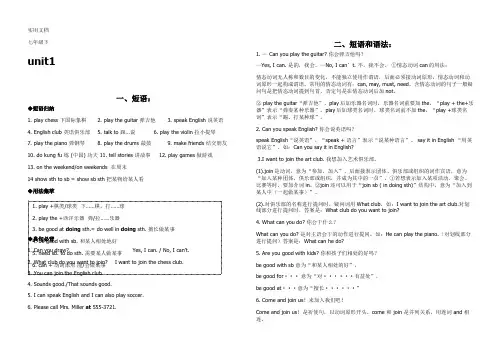
七年级下unit1一、短语:◆短语归纳1. play chess 下国际象棋2. play the guitar 弹吉他3. speak English 说英语4. English club 英语俱乐部5. talk to 跟…说6. play the violin 拉小提琴7. play the piano 弹钢琴8. play the drums 敲鼓9. make friends 结交朋友10. do kung fu 练 (中国) 功夫 11. tell stories 讲故事 12. play games 做游戏13. on the weekend/on weekends 在周末14 show sth to sb = show sb sth 把某物给某人看◆用法集萃◆典句必背1. Can you draw? Yes, I can. / No, I can’t.2. What club do you want to join? I want to join the chess club.3. You can join the English club.4. Sounds good./That sounds good.5. I can speak English and I can also play soccer.6. Please call Mrs. Miller at 555-3721.二、短语和语法:1. — Can you play the guitar? 你会弹吉他吗?—Yes, I can. 是的,我会。
—No, I can’t. 不,我不会。
①情态动词can的用法:情态动词无人称和数目的变化,不能独立使用作谓语,后面必须接动词原形,情态动词和动词原形一起构成谓语。
常用的情态动词有:can, may, must, need。
含情态动词的句子一般疑问句是把情态动词提到句首,否定句是在情态动词后加not。
Unit11句型所含知识点汇总解析人教版英语七年级下册

七下Unit11一、单词k [mɪlk] n.牛奶v.挤奶2.cow [kaʊ] n.奶牛k a cow给奶牛挤奶4.horse [hɔ:s] n.马5.ride a horse 骑马feed [fi:d] v.喂养;饲养6.feed chickens 喂鸡7.quite [kwaɪt] adv.相当;完全8.anything ['eniθɪŋ] pron.任何事物;任何东西9.grow [ɡrəʊ] v.种植;生长;发育10.farm [fɑ:m] n.农场v.务农;种田11.pick [pɪk] v.采;摘12.excelent ['eksələnt] adj.极好的;优秀的二、短语1.at night 在夜晚2.a lot of=lots of 许多;大量3.e out 出来4.go on a school trip 去学校郊游5.along the way 沿线6.after that 之后7.all in all 总的来说8.take a / the train to +地点乘火车去...9.be interested in sth. 对某事感兴趣10.be interested in doing sth. 对做某事感兴趣11.not…at all 根本不……12.something/anything+adj. ...的一些事情13.too many + n.复数太多的……14.teach sb. how to do sth. 教某人怎样做某事三、重点句型1.Luckily, it didn’t, and the sun came out again.幸运的是,天没下雨,并且太阳又出来了。
2.I didn’t know they could play chess with us.我不知道他们可以和我们下象棋。
3.Then the guide taught us how to make a model robot.然后导游教我们怎样制作机器人模型。
人教版七年级下册英语11、12单元知识点总结知识讲解

Unit 11 How was your school trip?一、短语归纳1. go for a walk去散步2. milk a cow 挤牛奶3. ride a horse 骑马4. feed chickens 喂小鸡5. talk with与…谈话6. take photos拍照7. quite a lot相当多8. show...around带领...参观9. learn about 了解10. from... to... 从...到...11. grow/pick strawberries 种植/采草莓12. in the countryside在乡下13. go fishing去钓鱼14. at night在夜晚15. a lot of许多;大量16. come out出来17. go on a school trip去学校郊游18. along the way沿线19. after that之后20. buy sth. for sb. 为某人买某物21. all in all 总的来说22. take a / the train 乘火车23. be interested in 对……感兴趣24. not…at all 根本不……二、重要句型1. How was your school trip?How + be + 主语?= What be +主语+ like?意为“……怎么样?”答语:It was great./ It was OK./ It was /wasn’t good.2.quiet a lot of+可数名词(复数)/不可数名词,也可单独使用。
e.g. We drank quite a lot of milk.I saw quite a lot of cows.I play tennis quite a lot in the summer.1)quite a little +不可数名词,意为“相当多”; e.g. There is quite a little water in the bottle.2) quite a few 相当多+可数名词,意为“相当多”。
人教版七年级下册 Unit 11知识点总结
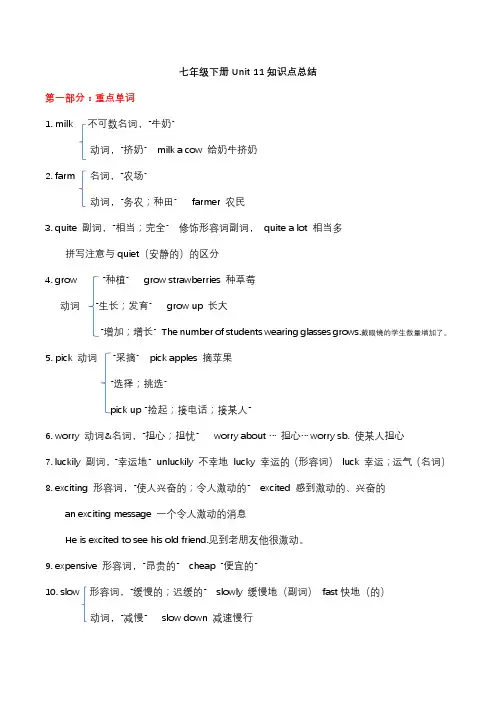
七年级下册Unit 11知识点总结第一部分:重点单词1. milk 不可数名词,“牛奶”动词,“挤奶”milk a cow 给奶牛挤奶2. farm 名词,“农场”动词,“务农;种田”farmer 农民3. quite 副词,“相当;完全”修饰形容词副词,quite a lot 相当多拼写注意与quiet(安静的)的区分4. grow “种植”grow strawberries 种草莓动词“生长;发育”grow up 长大“增加;增长”The number of students wearing glasses grows.戴眼镜的学生数量增加了。
5. pick 动词“采摘”pick apples 摘苹果“选择;挑选”pick up “捡起;接电话;接某人“6. worry 动词&名词,“担心;担忧“worry about … 担心… worry sb. 使某人担心7. luckily 副词,“幸运地“unluckily 不幸地lucky 幸运的(形容词)luck 幸运;运气(名词)8. exciting 形容词,“使人兴奋的;令人激动的“excited 感到激动的、兴奋的an exciting message 一个令人激动的消息He is excited to see his old friend.见到老朋友他很激动。
9. expensive 形容词,“昂贵的“cheap ”便宜的“10. slow 形容词,“缓慢的;迟缓的“slowly 缓慢地(副词)fast快地(的)动词,“减慢“slow down 减速慢行11. guide 名词,“导游,向导“动词,“指导“guide sb. to do … 指导某人做某事12. interested 形容词,“感兴趣的“be interested in … 对…感兴趣interesting 有趣的This is an interesting book. 这是一本有趣的书。
人教版初中英语七年级下册11--12单元讲义重点短语语法归纳配练习答案
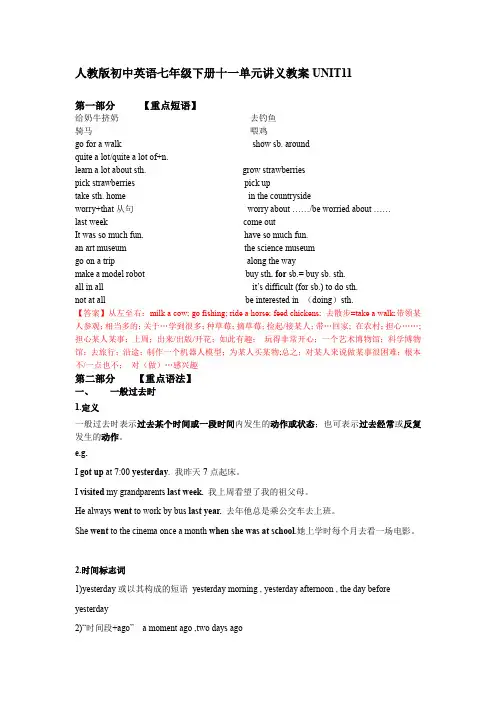
人教版初中英语七年级下册十一单元讲义教案UNIT11第一部分【重点短语】给奶牛挤奶去钓鱼骑马喂鸡go for a walk show sb. aroundquite a lot/quite a lot of+n.learn a lot about sth. grow strawberriespick strawberries pick uptake sth. home in the countrysideworry+that从句worry about ……/be worried about ……last week come outIt was so much fun. have so much fun.an art museum the science museumgo on a trip along the waymake a model robot buy sth. for sb.= buy sb. sth.all in all it’s difficult (for sb.) to do sth.not at all be interested in (doing)sth.【答案】从左至右:milk a cow; go fishing; ride a horse; feed chickens; 去散步=take a walk;带领某人参观;相当多的;关于…学到很多;种草莓;摘草莓;捡起/接某人;带…回家; 在农村;担心……; 担心某人某事;上周;出来/出版/开花;如此有趣;玩得非常开心;一个艺术博物馆;科学博物馆;去旅行;沿途;制作一个机器人模型;为某人买某物;总之;对某人来说做某事很困难;根本不/一点也不;对(做)…感兴趣第二部分【重点语法】一、一般过去时1.定义一般过去时表示过去某个时间或一段时间内发生的动作或状态;也可表示过去经常或反复发生的动作。
e.g.I got up at 7:00 yesterday. 我昨天7点起床。
英语七年级下Units 11~12(中英对照)重点词汇短语句型

重点词组复习1.欢迎来······2.肥皂剧3.棒球帽4.不得不;必须5.运动鞋6.少年宫7.做某事迟到8.太多重点句型自测1.—你认为······怎么样?—我(不)喜欢它(们)/她/他(们)。
—我没在意它(们)/她/他(们)。
—我不能忍受它(们)/她/他(们)。
2.我们现在正与Alan,一个13岁的男孩交谈。
3.我也一样。
4.—你们学校有什么校规?—不要在走廊跑,而且,上课不能迟到。
5.—在学校能戴帽子吗?—能/不能。
6.—在学校你们不得不穿校服吗?7.你们还必须做别的什么事情?8.我们家有太多的规章制度。
1.welcome to2.soap opera3.baseball cap4.have to5.sports shoes6.Children’s Palace7.arrive late for=be late for8.too many /too much1.—What do you think of …=How do you like…=What’s your opinion of…—I (don’t) like it/them.—I don’t mind it/them.—I can’t stand it/them.2.We’re talking to Alan, athirteen-teen-year-old boy.3.I do, too.4.—What are the rules at your school?—Don’t run in the hallways and don’t arrive late for class.5.—Can you wear hats in school?—Yes, we do. /No, we don’t.6.—Do you have to wear a uniform atschool?—Yes, we do. /No, we don’t.7.What else do you have to do?8.I have too many rules in my family.。
人教版七年级下册英语1112单元知识点总结
Unit 11 How was your school trip?一、短语归纳1、go for a walk去散步2、milk a cow 挤牛奶3、ride a horse 骑马4、feed chickens 喂小鸡5、talk with与…谈话6、take photos拍照7、quite a lot相当多8、show、、、around带领、、、参观9、learn about 了解10、from、、、to、、、从、、、到、、、11、grow/pick strawberries 种植/采草莓12、in the countryside在乡下13、go fishing去钓鱼14、at night在夜晚15、a lot of许多;大量16、come out出来17、go on a school trip去学校郊游18、along the way沿线19、after that之后20、buy sth、for sb、为某人买某物21、all in all 总的来说22、take a / the train 乘火车23、be interested in 对……感兴趣24、not…at all 根本不……二、重要句型1、How was your school trip?How + be + 主语?= What be +主语+ like?意为“……怎么样?”答语:It was great、/ It was OK、/ It was /wasn’t good、2.quiet a lot of+可数名词(复数)/不可数名词,也可单独使用。
e、g、We drank quite a lot of milk、I saw quite a lot of cows、I play tennis quite a lot in the summer、1)quite a little +不可数名词,意为“相当多”; e、g、There is quite a little water in the bottle、2) quite a few 相当多+可数名词,意为“相当多”。
Unit11--12知识点必背人教版英语七年级下册
人教英语七下Unit11知识点必背必背单词1.feed v. 喂养;饲养→ fed(过去式)→ feeding(现在分词)2.quite adv. 相当;完全→ quiet(形近词,安静的)→ very(同义词)3.anything pron.任何东西;任何事物→ anything interesting 有趣的事情4.grow v. 种植;生长;发育→ grow up 成长;长大5.pick v. 采;摘→ pick up 拾起;捡起;采摘6.countryside n. 乡村;农村→ village(近义词)k v. 挤奶8.cow n. 奶牛9.farmer n. 农民;农场主10.worry v.& n. 担心;担忧→ worry about 担心;忧虑……11.luckily adv. 幸运地;好运地→ unluckily(反义词,不幸运地)12.yesterday adv. 昨天13.flower n. 花14.sun n. 太阳15.painting n. 油画;绘画→ paint v. 绘画→ painter n. 画家16. f ire n. 火;火灾→ fire station 消防站17. museum n. 博物馆18. exciting adj. 使人兴奋的;令人激动的→ excited adj. 兴奋的19.expensive adj. 昂贵的→ cheap(反义词)→ dear(同义词)20.cheap adj. 便宜的→ expensive(反义词)21.slow adj. 缓慢的;迟缓的→ slowly(副词)→ fast(反义词)22.gift n. 礼物;赠品→ present(同义词)23.interested adj. 感兴趣的→ interest n. 兴趣→ interesting adj. 有趣的24.hear v. 听到;听见→ hear of/about 听说→ hear from sb. 收到某人的来信25. lovely adj. 可爱的26. fast adv.&adj. 快地( 的)27. robot n. 机器人28.guide n. 导游;向导29.everything pron. 所有事物;一切30.dark adj. 黑暗的;昏暗的必背短语k a cow 给奶牛挤奶2.in the countryside 在乡下;在农村3. ride a horse 骑马4. feed chickens 喂鸡5. quite a lot(of...)许多6.all in all 总的说来7.be interested in 对……感兴趣必背句子1.—Did you see any cows? 你看到一些奶牛了吗?—Yes, I did. I saw quite a lot. 是的,我看到了。
人教版英语七年级下册Unit 11 单元知识点
一、词汇精讲1. exciting和excited ed修饰人,ing修饰物exciting是形容词,意为“令人兴奋的”,一般用来说明事物的特征。
例如:I like basketball. I think it’s very exciting.我喜欢篮球,我认为它非常令人兴奋。
excited是形容词,意为“感到兴奋的”,一般用来说明人的感受。
例如:He is very excited,because he get the first place.他非常兴奋,因为他得了第一名。
2. fast(1)fast作副词,意为“快地”,可以用来修饰动词或者动词短语。
例如:We got there so fast by subway.我们乘地铁很快到那儿。
(2)fast作形容词,意为“快的”。
例如:The man runs very fast.这个男人跑得非常快。
3. all in allall in all意为“总的来说”,常位于句首。
例如:all in all,it’s a great success.总的来说,它非常成功。
4. walk 名词,散步go for a walk = take/have a walk 走路,散步walk to + 地点名词(here/there/home不加to)5. quite与very辨析(1)quite需修饰动词、形容词、副词quite a/an + 形容词 + 单数名词“相当…的一个”(2)very常修饰形容词、副词a very + 形容词 + 单数名词“一个非常……的”quite a little + 不可数名词“相当多”quite a few + 可数名词“相当多”quite a lot “相当多”quite a lot + of + 可数或不可数“相当多”6. feed意为“喂养”,过去式fedfeed sth. to sb./sth. 把某物喂给某人或某物feed on 以………为生;以……为食feed……on/with 用……喂……7. How + be + 事物名词的用法?how意为如何,怎样●身体情况 How is your grandmother?●方式、方法 How did you come back home last night?●天气情况 How is the weather in Shanghai today?●程度 How do you like the book?8. show作动词,展示;show sth. to sb. = show sb. sth. 给某人展示某物作名词,节目;TV show电视节目;talk show访谈节目9. anything 任何东西;任何事物;常用于否定句或疑问句●anything作主语时,谓语动词用单数形式●形容词修饰不定代词something,anything时,形容词后置●something常用于肯定句中,但表示请求、建议、征求意见等,希望得到肯定回答的疑问句中常用something。
人教版七年级下册英语Unit 11 知识点语法归纳总结
Unit 11 How was your school trip?1.短语归纳2.典句必背3.用法集萃(1)I saw quite a lot. 我看到了很多。
❖quite a lot表示“许多”,若表示“许多....(人或物)”要用quite a lot of... 的搭配。
例:I ate quite a lot last night. And I didn't feel well. 昨天晚上我吃了许多。
我觉得不舒服。
We saw quite a lot of sheep in the village. 我们在那个村庄里看到了许多绵羊。
(2)But I milked a cow. 但是我给一头奶牛挤奶。
❖milk 作名词,意为“牛奶”,是不可数名词。
例:I’d like a cup of milk. 我想要杯牛奶。
❖milk 作动词,意为“挤奶”。
例:I helped the farmer (to) milk the cow. 我帮助农民挤奶。
(3)Carol picked some strawberries and took them home.卡萝尔摘了一些草莓并且把它们带回了家。
❖pick用作动词,有“采;摘”之意。
此时是及物动词,宾语通常是花或果实等。
例:She went to the garden and picked some strawberries. 她去花园摘了一-些草莓。
❖拓展pick up是固定搭配,意为“捡起;拾起”,它的宾语有两种形式:(4)And I fed the chickens with my grandpa. 我还和我爷爷起喂鸡了。
❖feed作动词,意为“喂养;饲养”,它的过去式是fed。
例:Yesterday I went to the farm and fed chickens there. 昨天我去了农场并且在那里喂鸡了。
(5)But at about two o’clock, it got very cloudy and we worried it would rain.但是在大约两点时,天气变得多云了,我们担心会下雨。