
中医入门(中英文)
把脉(Feel the Pulse)
VS
• 浮脉(Floating Pulse) • 深脉(Deep Pulse)
问舌(Tongue Check)
• 舌体(Tongue body):
健康(Health)----
嫩红tender red
内寒(Internal cold) ---- 浅红pale red
?????
理念 (Concept)
• 中医的基本理念是身心和谐
The basic theory of Chinese medicine is the harmony between body and mind.
• 防病胜于治疗
Taking good care of one’s body is better than giving medical treatment.
针灸穴位(Acupuncture Points )
迎香穴
Yingxiang Point
驱寒
Prevent cold
人中穴
Renzhong Point
急救
First aid
虎口穴
Hukou Point
牙痛、黑眼圈
Toothache,Black eyes
食疗方法(Dietary Therapy Methods )
• 红枣(Chinese Date) 补血气 Supplementing blood and Qi
• 土豆(Potato) 缓解疼痛 Release pain
• 扁鹊(战国)
Bian Que (Warring Period)
• 望闻问切
Watch,listen,ask,feel
• 华佗(东汉)
Hua Tuo (Donghan Dynasty)
• 历史有5000年之久 • More than 5000 years history
• 《黄帝内经》 • Yellow Emperor’s Inner Canon
草药
Herbal Medicine
针灸
Acupuncture
推拿
Massage
气功
Qi Exercise
食疗
Dietary Therapy
• 饮食者人之命脉。——孙思邈 • Good diet could lead to a good health.
中医
Traditional Chinese Medicine
5班
1 • 概述(Introduction)
2 • 中医“体检”(Self-examination)
3
• 求医不如求己 (Helping yourself rather than seeing a doctor)
背景(Background)
正常(Normal): 拇指(Thumb): 1/4 ~1/5 其他手指(Other fingers): < 1/5
求人不如求己
(Helping yourself rather than seeing a doctor)
• 穴位(Points )
• 食疗方法(Dietary Therapy Methods)
内热(Internal heat) 黄色舌苔
yellow tongue coating
消化系统问题 (Digestion problem)
黄腻舌苔 slimy yellow tongue coating 黑色舌苔
black tongue coating
指甲(Nail Check)
• 新月区(The new moon area)
• 麻沸散
Anesthetic
• 孙思邈(唐)
Sun Simiao (Tang Dynasty)
• 药王
King of Medicine
名言(Famous Quotations )
• 不能为良相,亦当为良医。——华佗 • If you cannot be a good minister, you
at least could be a good doctor
内热(Internal heat) ---- 深红deep red
问舌(Tongue Check)
• 舌苔(Tongue coating):
健康(Healthy)
略湿润、发白 little wet and white
内寒(Internal cold) 白色舌苔
white tongue coating
• 相信人体有自我恢复能力
Believe your own body can recover by itself.
环境 Environment
Disease 疾病
中医“体检”(Self-
examination)
• 把脉( Feel the Pulse )
• 问舌( Tongue Check )
• 指甲( Nail Check )
中医英语基础教程
中医英语基础教程Chinese Medicine Basic English CourseIntroduction:中医(zhōng yī) - Chinese Medicine, also known as Traditional Chinese Medicine (TCM), is a comprehensive medical system that has been practiced for thousands of years in China. It includes various techniques such as acupuncture, herbal medicine, cupping, and t chi.Course Objectives:- To introduce the basic concepts and principles of Chinese Medicine- To learn common English terms and vocabulary used in Chinese Medicine- To understand the unique diagnostic methods and treatment approaches in Chinese MedicineCourse Outline:1. Introduction to Chinese Medicine:- Historical background and development of Chinese Medicine- Key principles and theories of Chinese Medicine2. Diagnosis in Chinese Medicine:- Examination techniques, including observation, listening, questioning, and pulse diagnosis- Understanding the concept of yin-yang and the five elements in diagnosis3. Basic Concepts in Chinese Medicine:- Qi (energy), blood, and body fluids in Chinese Medicine- Meridians and acupuncture points4. Treatment Methods in Chinese Medicine:- Acupuncture and moxibustion- Herbal medicine and formulas- Tuina (Chinese medical massage) and other therapeutic techniques5. Common Conditions and Treatments in Chinese Medicine:- Pn management- Digestive disorders- Respiratory conditions- Mental and emotional health- Women's health and fertility6. Integration of Chinese Medicine in Western Healthcare:- Understanding the role of Chinese Medicine in modern healthcare- Collaborative approaches between Chinese Medicine and Western medicine7. Case Studies and Practical Application:- Analyzing and discussing case studies to apply Chinese Medicine principles and treatment methods- Practical exercises and demonstrations of acupuncture and herbal medicineNote: This outline is just a basic framework and can be customized and expanded based on the level and specific needs of the learners.。
中医基础英语(词汇+基础理论大段)
中草药Chinese medicinal herbs炮制processing四气五味four properties and five tastes清除杂质eliminating impurity入药部分the part used for medical purpose作用和缓mild effect药物采集collection of herbs发散解表relieving exterior syndrome by dispersion收敛astringency方剂学science of prescriptions软坚散结softening hardness to dissipate stagnation配伍关系compatibility燥湿健脾drying dampness and strengthening the spleen 组成规律prescription-formulating principle升降沉浮ascending, descending, sinking and floating 方剂的加减modification of prescriptions归经meridian tropism剂型和剂量drug form and dosage用药禁忌contraindication in using herbs君臣佐使monarch, minister, assistant and guide药物用量dosage药物毒性toxicity of medicinal herbs辛温解表药relieving exterior syndrome with herbs pungent in taste and warm in nature 十八反与十九畏eighteen incompatible herbs and nineteen herbs of mutual antagonism 袪风湿药herbs for expelling wind and dampness调和诸药moderating the property of herbs胸痛彻背thoracic pain involving the back温经散寒warming meridians to dissipate cold清热凉血药herbs for clearing away heat and cooling blood宣肺平喘disperse lung qi to stop asthma引经报使guiding action灵活化裁flexible modification针灸疗法acupuncture and moxibustion therapy, acumox清散郁热clearing away and dispersing stagnant heat针刺补泻reinforcing and reducing techniques for needling随症加减modification according to symptoms针刺手法needling techniques, manipulation药物饮片processed herbs进针手法methods for inserting the needle内服散剂powder for oral taking针刺止痛alleviating pain with acupuncture外用膏剂medicinal extract for exterior application针刺麻醉acupuncture anesthesia, acu-anesthesia开水冲服mixing in boiled water for oral taking针感needling sensation浓缩浸膏condensed extract皮内针intradermal needle耳针疗法ear acupuncture treatment针刺的角度与深度angle and depth of needling提插捻转lifting, thrusting, swirling and rotating双手进针法insertion of needle with double hands水针疗法hydro-acupuncture therapy行针manipulating the needle头针疗法scalp-acupuncture therapy化脓灸blistering moxibustion推拿手法manipulations for tuina, manipulating techniques 瘢痕灸scarring moxibustion减轻疼痛alleviating pain艾炷灸moxibustion with moxa cone功法训练exercise for practicing tuina灯火灸lamp moxibustion放松肌肉relaxing muscles温针灸warm needling method解除肌肉紧张relieving muscular tension一指禅推法pushing manipulation with one finger活动受限confined activity点按法point-pressing manipulation关节脱位dislocation of joint大鱼际揉法kneading manipulation with the large thenar医.学全.在.线网站 腰椎间盘突出protrusion of lumbar vertebral disc交替搓揉alternative rubbing and kneading旋转复位rotating reduction腰肌劳损injury of lumbar muscles软组织损伤injury of soft tissues解除痉挛relieving spasm关节粘连僵硬adhesion and stiffness of joint外感发热exogenous fever滑利关节lubricating joint脉象浮紧floating and tense pulse手法补泻reinforcing and reducing manipulations寒邪束表pathogenic cold hampering the exterior拇指平推法horizontal pushing with the thumb邪热入里interior invasion of pathogenic heat午后潮热afternoon tidal fever四肢厥冷cold limbs热扰神明heat disturbing mind阳气不振inactivation of yang-qi形体消瘦emaciation少气懒言lack of qi and no desire to speak祛痰止咳药herbs for eliminating phlegm and stopping cough中国医药学Traditional Chinese Medicine治未病prevention of disease中医基础理论Basic theory of traditional Chinese medicine 脏腑zang-organs and fu-organs, viscera临床经验clinical experience功能活动functional activities辨证论治treatment based on syndrome differentiation形神统一unity of the body and spirit本草materia medica, herbs阴阳失调imbalance of yin and yang中药Chinese materia medica, Chinese medicinal herbs条达舒畅free development四气五味four properties and five tastes延年益寿prolonging life, promising longevity针灸acupuncture and moxibustion, acumox养生防病cultivating health to prevent disease各家学说theories of different schools正气healthy qi, vital qi汗法diaphoresis, sweating therapy病邪pathogenic factor下法purgative therapy, purgation整体观念concept of holism吐法emetic therapy, vomiting therapy疾病的本质与现象nature and manifestations of disease补土派school of invigorating the earth阴阳的相对平衡relative balance between yin and yang病因学说etiology疾病的发生与发展occurrence and development of disease 养生health-cultivation,同病异治treating the same disease with different therapies医疗实践medical practice异病同治treating different diseases with the same therapy 治疗原则therapeutic principles五脏five zang-organs, five zang-viscera寒凉药物herbs of cold and cool nature, cold-natured herbs 六腑six fu-organs, six fu-viscera滋阴降火nourishing yin to lower/reduce fire经络系统system of meridians and collaterals滋水涵木enriching water to nourish wood余热未尽incomplete abatement of heat瘀血致泻disease caused by blood stasis有机整体organic wholeness/integrity先天之精congenital essence表里关系exterior and interior relation形与神俱inseparability of the body and spirit开窍opening into开胃promoting appetite自然现象natural phenomena脉象pulse conditions, pulse pattern哲学概念philosophical concept邪正关系states of pathogenic factors and healthy qi对立统一unity of opposites发热恶寒fever and aversion to cold相互消长mutual waning and waxing头身疼痛headache and body pain相互转化mutual transformation久痢脱肛proctoptosis due to prolonged dysentery阴阳属性nature of yin and yang养阴清热nourishing yin and clearing away heat相互联系interrelation清肺热clear away lung-heat相互制约mutual restraint, mutual restriction/interaction 湿邪犯肺pathogenic dampness invading the lung动态平衡dynamic equilibrium清热泻火clearing away heat and reducing fire阴平阳秘yin and yang in equilibrium腠理muscular interstices, striae, interstitial space阴阳的互根互用interdependence of yin and yang水湿停滞retention of water and dampness, water retention 相互依存interdependence癃闭retention of urine阴阳离绝separation of yin and yang气血运行circulation/flow of qi and blood相反相成opposite and supplementary to each阴阳转化transformation between yin and yang生理功能physiological functions阳消阴长yang waning and yin waxing病理变化pathological changes阴胜则阳病predominance of yin leading to disorder of yang 临床诊断clinical diagnosis阴胜则阳病an excess of yin leads to deficiency of yang阳胜生外热exuberance of yang leading to exterior heat阳胜则热predominance of yang generating heat阳中求阴obtaining yang from yin寒极生热extreme cold generating heat绝对偏盛absolute predominance热极生寒extreme heat generating cold阳虚则寒yang deficiency leading to cold阳损及阴impairment of yang involving yin阴阳俱损simultaneous consumption of yin and yang阴液不足insufficiency of yin-fluid阴阳两虚simultaneous deficiency of both yin and yang病机总纲general principle of pathogenesis阳虚发热fever due to yang deficiency病机pathomechanism, pathological mechanism阴阳自和natural harmony between yin and yang阴阳胜复alternative predominance of yin and yang木乘土the wood over-restrains the earth虚寒证deficiency-cold syndrome木火刑金wood-fire impairs the metal扶阳退阴strengthening yang to reduce yin金水相生generation between the metal and water祛风散寒expelling/eliminating wind to dispersing cold生克制化interrelationship between generation and restriction消导积滞promoting digestion and removing food retention制则生化restriction ensuring generation潜阳熄风suppressing yang to quench wind母病及子disease of the mother-organ affecting the child-organ五行学说theory of five elements传变transmission of disease, progress of disease运动变化motion and variation子病犯母disease of the child-organ affecting the mother-organ正邪相争struggle/combat between healthy qi and pathogenic factors 肝肾精血不足insufficiency of liver and kidney essence and blood 相生相克mutual generation and restriction肝阳上亢hyperactivity of liver yang生我,我生to be generated and to generate心肝血虚asthenia / deficiency of heart and liver blood克我,我克to be restricted and to restrict心肝火旺exuberance of heart and liver fire生中有制restriction within generation心火亢盛hyperactivity/exuberance of heart fire克中有生generation within restriction滋肾养肝nourishing the kidney and liver木曰曲直wood is characterized by growing freely and peripherally 方位配五行correspondence of the directions to the five elements 火曰炎上fire is characterized by flaming up温肾健脾warming the kidney and strengthening the spleen土爰稼穑earth is characterized by cultivation and reaping肾阳式微declination of kidney yang金曰从革metal is characterized by change脾阳不振inactivation of spleen yang病缓起gradual onset of disease脾胃虚弱hypofunction/weakness of the spleen and stomach肝阴不足insufficiency of liver yin地道不通menopause相乘相侮over-restriction and reverse restriction平肝和胃soothing the liver and harmonizing the stomach水湿停聚retention of water-dampness水火不济discordance between water and fire肾阴不足insufficiency of kidney yin藏象学说theory of visceral manifestations心肾不交disharmony between the heart and kidney奇恒之腑extraordinary fu-organs宣通水道dredging water passage水谷精微cereal nutrients, essence of water and food通调水道dredging and regulating water passage传化水谷transmission and transformation of food行气利水activating qi to excrete water贮藏精气storage of essence水液停滞retention of fluid治疗效果curative / therapeutic effect后天之本postnatal / acquired base of life藏而不泻storage without excretion调畅气机regulating qi activity泻而不藏excretion without storage肝气上逆upward flow of liver qi表热里寒exterior heat and interior cold水曰润下water is characterized by moistening and downward flowing肝旺脾虚hyperfunction of the liver and weakness of the spleen医.学.全.在线.网.站.提供脾主运化the spleen governing transportation and transformation大肉陷下obvious emaciation and muscular atrophy, extreme emaciation肝气郁结stagnation of liver qi面色红润ruddy complexion, rosy cheeks胆虚证gallbladder deficiency syndrome胆虚不得眠insomnia due to gallbladder asthenia腐熟水谷digesting food导便法laxation食欲不振poor appetite跌打损伤traumatic injury脘腹胀闷epigastric distension and depression动静结合integration of motion and quietness/stillness嗳气酸腐eructation with fetid odor定喘relieving asthma泌别清浊separating the clear from the turbid心主血脉the heart controlling blood and vessels食物残渣residue of food心气充沛abundance of heart qi大肠主传导the large intestine governing transmission and transportation 防御外邪入侵preventing the invasion of exogenous pathogenic factor 癃闭dysuria, retention of urine, anuria and dysuria血液充盈plenty of blood面黄肌瘦emaciation with sallow complexion脉道不利unsmoothness of vessels止珠偏斜strabismus, squint, ocular deviation面色无华lusterless complexion调节水液regulation of water脉象细弱thin and weak pulse排泄糟粕excretion of waste material面色萎黄sallow complexion髓海不足insufficiency of marrow-sea汗血同源sweat and blood sharing the same origin精神委靡dispiritedness, listlessness, lower spirit升降出入ascending, descending, coming in and going out 月经不调irregular menstruation气为血帅qi serves as the commander of the blood冲任不固weakness of thoroughfare and conception vessels 气血凝滞stagnation of qi and blood经期延长prolonged menstruation血瘀blood stasis小肠实热sthenia-heat in the small intestine气滞腰痛lumbago due to qi stagnation气机调畅smooth activity of qi气虚滑胎habitual abortion due to qi asthenia中医的基本特点The Basic Characteristics of TCM中医以整体观念和阴阳五行学说为指导思想和理论方法,以脏腑经络学说为理论核心,以辨证论治为诊疗方法。
中医英语基础教程
中医英语基础教程1. 简介中医是中国传统的医学体系,拥有悠久的历史和深厚的理论基础。
随着中医在国际间的推广和应用,掌握中医英语成为了越来越重要的技能。
本教程将为你介绍中医英语的基础知识和常用词汇,帮助你更好地了解和运用中医英语。
2. 中医基础概念2.1 中医理论中医理论的核心是阴阳和五行学说。
阴阳学说认为宇宙和人体都是由阴阳两个相对而又统一的方面构成的。
五行学说将万物分为金、木、水、火、土五种元素,这五种元素相互关联并相互作用。
2.2 望、闻、问、切四诊法中医的主要诊断方法是望、闻、问、切四诊法。
医生通过观察患者的面色、眼神、舌苔等来进行望诊;通过听患者的声音、气味来进行闻诊;通过与患者进行交谈来进行问诊;通过触摸患者的脉搏、腹部等来进行切诊。
3. 常用中医词汇以下是一些常用的中医词汇及其对应的英文翻译:•中医 (Traditional Chinese Medicine)•阴阳 (Yin and Yang)•五行 (Five Elements)•望诊 (Observation)•闻诊 (Olfaction)•问诊 (Interrogation)•切诊 (Pulse Examination)•脉搏 (Pulse)•舌苔 (Coating of Tongue)4. 常见中医疗法4.1 针灸针灸是中医的一种疗法,通过在人体特定穴位插入针具来调节人体的阴阳平衡以治疗疾病。
针灸的英文翻译是Acupuncture。
4.2 中药中药是中医的另一种重要疗法,通过使用植物、动物或矿物的药材来治疗疾病。
中药的英文翻译是Chinese Herbal Medicine。
4.3 推拿推拿是中医的按摩疗法,通过对人体的特定部位施以按摩、拍打等手法来促进气血循环以治疗疾病。
推拿的英文翻译是Tuina。
5. 中医英语实践在实际应用中医英语的过程中,以下是一些建议:•学习专业的中医英语词汇和表达方式,如参加中医英语课程或阅读相关文献。
中医专业英语基础
中医专业英语基础1. 医学基础(Medical foundation)- Human anatomy: The study of the structure and organs of the human body.- Physiology: The study of how the body functions and its various systems.- Pathology: The study of diseases, their causes, and progression. - Pharmacology: The study of drugs and their effects on the body. - Biochemistry: The study of chemical processes and substances in living organisms.- Microbiology: The study of microorganisms and their effects on health.- Immunology: The study of the immune system and its response to diseases.- Genetics: The study of genes and heredity.2. 中医理论(Theory of Traditional Chinese Medicine)- Yin and Yang: The concept of opposing yet complementary forces in the body.- Qi (Chi): The vital energy that flows through the body and maintains health.- Meridians: The channels through which Qi flows in the body.- Five Elements Theory: The belief that the body is made up of the five elements - wood, fire, earth, metal, and water - which are interconnected and influence health.- Zang-Fu Organs: The system of organs in traditional Chinese medicine, including the Yin and Yang organs.- Eight Principles: The classification of diseases according to four pairs of opposites - Yin/Yang, Cold/Heat, Deficiency/Excess, andInterior/Exterior.- Syndromes: The patterns in which symptoms present in traditional Chinese medicine, used for diagnosing and treating diseases.3. 中药学(Pharmacology of Traditional Chinese Medicine)- Traditional Chinese herbs: The various plants, minerals, and animal substances used in traditional Chinese medicine.- Herbal formulas: The combinations of herbs used to treat specific diseases or conditions.- Herbal identification and processing: The methods used to identify and prepare herbs for medicinal use.- Prescription and dosage: The principles and guidelines for prescribing and administering herbal treatments.- Toxicology: The study of the potential toxicity and side effects of traditional Chinese herbs.4. 中医诊断(Diagnosis in Traditional Chinese Medicine)- Observation: The examination of a patient's physical appearance, including the tongue, face, and body.- Listening and smelling: The assessment of a patient's voice, breath, and body odors.- Inquiry: The gathering of information about a patient's medical history, symptoms, and lifestyle.- Palpation: The use of touch to assess pulse, acupuncture points, and areas of tenderness.- Diagnosis methods: The different approaches used to diagnose diseases in traditional Chinese medicine, such as the Eight Principles, Five Elements, and Zang-Fu organs.5. 中医治疗(Treatment in Traditional Chinese Medicine)- Acupuncture: The insertion of thin needles into specific points on the body to stimulate Qi flow and balance Yin and Yang.- Herbal medicine: The use of traditional Chinese herbs in various forms, such as decoctions, powders, or pills, to treat diseases.- Tuina (Chinese massage): The manipulation of the body's muscles and soft tissues to promote circulation and relieve pain.- Cupping: The application of heated cups to the skin to create suction and promote blood flow.- Moxibustion: The burning of dried herbs (usually Artemisia vulgaris) near the skin to warm and stimulate acupuncture points. - Qigong: A combination of physical exercises, breathing techniques, and meditation aimed at cultivating Qi and improving overall health.6. 中医研究方法(Research Methods in Traditional Chinese Medicine)- Clinical trials: The systematic study of the safety and effectiveness of traditional Chinese medicine treatments in humans. - Pharmacological research: The investigation of the active components and mechanisms of action of traditional Chinese herbs. - Epidemiological studies: The analysis of disease patterns and risk factors in specific populations.- Case studies: The examination of individual patients' experiences and responses to traditional Chinese medicine treatments.- Experimental studies: The use of laboratory or animal models to investigate the effects of traditional Chinese medicine interventions.- Systematic reviews and meta-analyses: The synthesis of multiplestudies to evaluate the overall effectiveness of traditional Chinese medicine treatments.。
中医术语的中英文参考对照

中医术语的中英文参考对照治则principle of treatment 在对临床的具体立法、处方、用药等具有普遍的指导意义,因而在治疗疾病时必须遵循的基本原则。
治病求本treatment aiming at its pathogenesis 针对产生疾病的根本原因进行治疗的原则。
急则治标symptomatic treatment in acute condition 与缓则治本相对而言,在大出血、暴泻、剧痛等标症甚急的情况,及时救治标病。
缓则治本radical treatment in chronic case 与急则治标相对而言,针对病势缓和、病情缓慢的情况,从本病的病机出发,采取调理、补益为主的治疗原则。
标本兼治treating both manifestation and root cause of disease 针对病证出现的标本并重的情况,采用治标与治本相结合的治疗原则。
治未病preventive treatment of disease 采取一定的措施防止疾病产生和发展的治疗原则,包括未病先防和既病防变两个方面。
同病异治treating same disease with different methods 表现相同的病证,可因人、因时、因地的不同,或由于病情的发展、病机的变化、病型的各异、正邪消长等差异,采取不同治法的治疗原则。
异病同治treating different diseases with same method 表现不同的病证,由于发病机理相同,采取相同治法的治疗原则。
因时制宜treatment in accordance with seasonal conditions 考虑到时令气候寒热燥湿的不同而选择适宜的治法、方药的治疗原则。
因地制宜treatment in accordance with local conditions 考虑到地域环境的不同而选择适宜的治法、方药的治疗原则。
中医基础理论英文单词
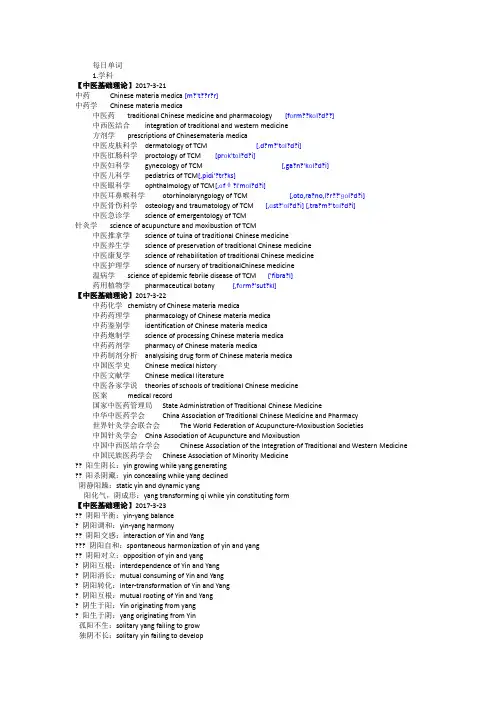
每日单词1.学科【中医基础理论】2017-3-21中药Chinese materia medica [m?'t??r?r]中药学Chinese materia medica中医药traditional Chinese medicine and pharmacology [fɑrm??kɑl?d??]中西医结合integration of traditional and western medicine方剂学prescriptions of Chinesemateria medica中医皮肤科学dermatology of TCM [,d?m?'tɑl?d?i]中医肛肠科学proctology of TCM [prɑk'tɑl?d?i]中医妇科学gynecology of TCM [,ga?n?'kɑl?d?i]中医儿科学pediatrics of TCM[,pidi'?tr?ks]中医眼科学ophthalmology of TCM [,ɑfθ?l'mɑl?d?i]中医耳鼻喉科学otorhinolaryngology of TCM [,oto,ra?no,l?r??'ɡɑl?d?i]中医骨伤科学osteology and traumatology of TCM [,ɑst?'ɑl?d?i] [,tra?m?'tɑl?d?i]中医急诊学science of emergentology of TCM针灸学science of acupuncture and moxibustion of TCM中医推拿学science of tuina of traditional Chinese medicine中医养生学science of preservation of traditional Chinese medicine中医康复学science of rehabilitation of traditional Chinese medicine中医护理学science of nursery of traditionalChinese medicine温病学science of epidemic febrile disease of TCM ['fibra?l]药用植物学pharmaceutical botany [,fɑrm?'sut?kl]【中医基础理论】2017-3-22中药化学 chemistry of Chinese materia medica中药药理学pharmacology of Chinese materia medica中药鉴别学identification of Chinese materia medica中药炮制学science of processing Chinese materia medica中药药剂学pharmacy of Chinese materia medica中药制剂分析analysising drug form of Chinese materia medica中国医学史Chinese medical history中医文献学Chinese medical literature中医各家学说theories of schools of traditional Chinese medicine医案medical record国家中医药管理局State Administration of Traditional Chinese Medicine中华中医药学会China Association of Traditional Chinese Medicine and Pharmacy世界针灸学会联合会The World Federation of Acupuncture-Moxibustion Societies中国针灸学会China Association of Acupuncture and Moxibustion中国中西医结合学会Chinese Association of the Integration of Traditional and Western Medicine 中国民族医药学会Chinese Association of Minority Medicine?? 阳生阴长:yin growing while yang generating?? 阳杀阴藏:yin concealing while yang declined阴静阳躁:static yin and dynamic yang阳化气,阴成形:yang transforming qi while yin constituting form【中医基础理论】2017-3-23?? 阴阳平衡:yin-yang balance? 阴阳调和:yin-yang harmony?? 阴阳交感:interaction of Yin and Yang??? 阴阳自和:spontaneous harmonization of yin and yang?? 阴阳对立:opposition of yin and yang? 阴阳互根:interdependence of Yin and Yang? 阴阳消长:mutual consuming of Yin and Yang? 阴阳转化:Inter-transformation of Yin and Yang? 阴阳互根:mutual rooting of Yin and Yang? 阴生于阳:Yin originating from yang? 阳生于阴:yang originating from Yin孤阳不生:solitary yang failing to grow独阴不长:solitary yin failing to develop阴偏盛:Preponderance (Excess) of Yin?? 阳偏盛:Preponderance (Excess) of Yang[pr?'pɑnd?r?ns]阴偏衰:Weakness (Deficiency) of Yin? 阳偏衰:Weakness (Deficiency) of Yang重阴必阳:extreme yin turning into yang?? 重阳必阴:extreme yang turning into yin?? 阴平阳秘,精神乃治:when yin is at peace and yang is compact essence-spirit is normal?? 阴阳离决,精气乃绝:when yin and yang separate, essential qi expires【中医基础理论】2017-3-24阴阳偏盛:preponderance of yin or yang阴阳两虚:Dual deficiency of yin and yang? 阴虚阳亢:Yin deficiency with yang hyperactivity阴盛阳衰:Exuberance of yin with decline of yang [?g'zj?b?r?ns]亡阴亡阳:yin collapse; yang exhaustion阳胜则阴病:when yang prevails, yin ails? 阴胜则阳病:when yin prevails, yang ails阴阳失调:yin-yang disharmony? 阳损及阴:yang impairment affects yin? 阴阳乖戾:yin-yang perversion?? 阴阳胜复:Alternative preponderance of yin and yang阴竭阳脱:Yin exhaustion and yang collapse? 阴盛格阳:exuberant yin repelling yang阳胜则热:excess of yang causing heat; exuberance of yang leads to heat阴盛阳衰:exuberance of yin with decline of yang阴阳俱损:simultaneous consumption of yin and yang扶阳退阴:strengthening yang to reduce yin滋阴抑阳:enrich yin and repressing yang? 阳中求阴:seek yin from yang? 阳病治阴:Treating yang disease from yin【中医基础理论】2017-3-25阴阳平衡:balance of yin and yang; Yin-yang balance; balance between yin and yang阴平阳秘:Yin is even (steady) and yang is sound (firm).?阴阳失调:disharmony of yin and yang; imbalance of yin and yang??阴阳调和:Harmony of yin and yang调和肝胃:Harmonizing the liver and stomach水曰润下:Water characterized by moistening and descending火曰炎上:Fire characterized by flaring up木曰曲直:Wood characterized by bending and straightening金曰从革:Metal characterized by changing土爰稼穑:Earth characterized by sowing and reaping木克土,土生金,金克木:Wood controls Earth, but Earth generates Metal, which controls Wood 母病及子:disease of the mother affects the child子病及母:disease of the child affects the mother子盗母气:child stealing the mother's qi【中医基础理论】2017-3-28虚则补其母:deficiency is treated by supplementing the mother实则泻其子:excess is treated by draining the child补母泻子:supplementing the mother and draining the child滋水涵木:replenishing water to nourish wood? 培土生金:reinforcing earth to generate metal益火补土:tonifying fire to supplement earth金水相生:mutual generation between metal and water抑强扶弱:restrain the powerful and help the weak抑木扶土:inhibiting wood and strengthening earth培土制水:cultivating earth to control water佐金平木:assisting metal and calming wood泻南补北:purging the south (fire) and nourishing the north (water)精:Essence【中医基础理论】2017-3-29三宝:three treasures先天之精:prenatal/innate essence [,pri'netl]后天之精:postnatal/acquired essence脏腑之精:essence of the bowels and viscera ['v?s?r?]生殖之精:reproductive essence水谷之精:essence of grain and water推动作用:Propelling温煦作用:Warming防御作用:Protecting固摄作用:Fixating ['f?kset]气化作用:Qi-transforming气机:qi movement气化:qi transformation升:upward movement / ascending降:downward movement / descending出:Outward / going out入:inward / coming in【中医基础理论】2017-3-30? 元气:primary qi / genuine qi (most essential qi in the body)宗气:pectoral qi; ancestral qi (it accumulates in the chest) ['p?kt?r?l] 营气:nutrient qi (forms blood to nourish body)卫气:defensive qi; protective真气:genuine qi正气:healthy qi; normal qi中气:middle qi藏象viscera manifestation肾间动气:stirring qi of the kidney region心主血:the heart governs the blood肝藏血:the liver stores the blood脾统血:the spleen manages the blood津:thin fluid/fluid liquid液:thick fluid/liquid humor五液:five humors;visceral humor2017-3-31? 汗:sweat?? 泪:tears? 涕:snivel美['sn?vl]? 涎:drool; thinner saliva[drul] [s?'la?v?]唾:spittle; thicker saliva['sp?tl]气为血之帅:qi is the commander of the blood? 血为气之母:blood is the mother of qi? 精血同源:essence and blood are of the same source? 津血同源:liquid and blood are of the same source? 神:Mind? 魂:Ethereal Soul[?'θ?r??l]? 魄:Corporeal Soul[k?r'p?r??l]?? 意:Intellect?? 志:Will-power五脏:five viscera六腑:six bowels奇恒之府:extraordinary organs【中医基础理论】2017-4-1心主血脉:It governs Blood & vessels心藏神:It houses the Mind其华在面:It manifests in the complexion开窍于舌:It opens into the tongue在志为喜:It is related to joy在液为汗:It controls sweat君主之官monarch organ主血脉governing blood and vessels主藏神storing spirit主通明governing smoothness and brightness? 肺为娇脏:delicate viscus主宣发与肃降:They control diffusing and descending of Qi and Body Fluids主气司呼吸:They govern Qi and respiration主通调水道:They regulate Water passages朝百脉,主治节:They control channels and blood vessels,and regulate all physiological activities 在体合皮:They control the skin其华在毛:They manifest in the body hair开窍为鼻:They open into the nose在液为涕:The control nasal mucus在神为魄:They house the Corporeal Soul在志为忧(悲):They are affected by worry, grief and sadness【中医基础理论】2017-4-2脾气主升:It controls the ascending of Qi喜燥恶湿:likes dryness and is averse to dampness主运化:It governs transformation and transportation主统血:It controls the Blood在体合肉,主四肢:It controls the muscles and the four limbs? 在窍为口,其华在唇:It opens into the mouth and manifests in the lips在液为涎:It controls saliva? 脾舍意:It houses the Intellect在志为思:It is affected by pensiveness肝为刚脏:liver is the unyielding viscus肝主升发:liver governs upbearing and effusion主疏泄:It ensures the smooth flow of Qi主藏血:It stores Blood??在体合筋:It controls the sinews其华在爪:It manifests in the nails在窍为目:It opens into the eyes在液为泪:It controls tears?? 肝舍魂:It houses the Ethereal Soul在志为怒:It is affected by anger【中医基础理论】2017-4-3藏精,主生长发育与生殖:Store Essence and govern birth, growth, reproduction and development 主水:Govern Water主纳气:Control the reception of Qi在体合骨,生髓:Produce Marrow, fill up the brain and control bones在窍为耳及二阴:Open into the ears &the two lower orifices['?r?f?s?z]其华在发:Manifest in the hair在液为唾:Control spittle ['sp?tl]肾舍志:House the Will-power肾主命门:Control the Gate of Life (Minister Fire)The Gallbladder贮藏和排泄胆汁:It stores and excretes bile [?k'skrit] [ba?l]主决断:It controls decisiveness [d?'sa?s?vn?s]The Stomach后天之气之根:Root of Post-Heaven Qi水谷之海:the Sea of water and grains主通降:Controls the descending of Qi/free downflow喜润恶燥:likes moisture and is averse to dryness ['m??st??]主受纳:Controls receiving / intake主腐熟水谷:Controls the rotting and ripening of food['r?ti?] ['ra?p?n]太仓:Great Granary['gr?n?ri]【中医基础理论】2017-4-4The Small Intestine主受盛化物:controls receiving and transforming主泌别清浊:separates the clear and turbid['t?b?d]The Large Intestine主传化糟粕:Controls passage and conduction//governs the conveyance and transformation of waste大肠主津:it governs fluids? 通行元气:It mobilizes the Original Qi运行水液:It controls the transportation and penetration of Qi [,p?n?'tre??n]上焦如雾:The Upper Burner is like mist.中焦如沤:The Middle Burner is like foam (fermenter). [fom] [f?'m?nt?下焦如渎:The Lower Burner is compared to sluice (drainage ditch).[slus] 水闸脑:Brain髓:Marrow骨:Bones脉:Blood Vessels? 胆:Gall Bladder?? 女子胞:Uterus['jut?r?s]?? 主持月经:it regulates menstruation?? 孕育胎儿:it houses the fetus during pregnancy?['fit?s]?? 心肾相交:heart-kidney interaction?? 心肾不交:heart and kidney failing to interact水火既济:coordination between water and fire肝肾同源:liver and kidney are of the same source【中医基础理论】2017-4-5脾为生痰之源,肺为贮痰之器:spleen is the source of phlegm formation, lung is the receptacle that holds phlegm五体:five constituents筋:sinew; tendon ['s?nju]脉:vessel肉:flesh皮:skin骨:bone? 皮毛:skin and hair腠理:striae and interstices['straii:]玄府:sweat pore(mysterious mansion)[p?r]. 气孔['m?n??n] 大厦气门:sweat pore (qi gate)肌:muscle; flesh宗筋:convergence of tendon; penis (and testes)['pin?s]面:face颈项:neck (and nape)[nep]胸胁:chest and hypochondrium[,ha?p?'kɑndr??m]脘腹:stomach duct and abdomen腰背:lumbus and back四肢:Four limbs? 前阴:external genitalia (anterior yin) [,d??n?'telj?]?? 后阴:anus (posterior yin)['en?s]五官:five sense【中医基础理论】2017-4-6七窍:seven orifices九窍:nine orifices清窍:clear orifice上窍:upper orifice下窍:lower orifice苗窍:signal orifice?外因:external cause内因:internal cause不内外因:cause neither internal nor external / miscessaneous causes of disease其他致病因素:other pathogens病理产物:pathological products六淫:six excesses疠气:pestilential qi [,p?st?'l?n?l]风:wind寒:cold暑:summer-heat湿:dampness燥:dryness火:fire喜:joy怒:anger :忧:worry/anxiety思:pensiveness/thought悲:sadness/sorrow?恐:fear 惊:shock/fright【中医基础理论】2017-4-7怒伤肝: anger affecting the Liver喜伤心: joy affecting the Heart思伤脾: pensiveness affecting the Spleen悲伤肺: sadness affecting the Lungs恐伤肾: fear affecting the Kidneys.饮食失宜:improper diet饮食不节:improper eating habit过饥(进食不足):insufficient eating过饱:overeating饮食不洁:eating unclean food五味偏嗜:flavor predilection偏嗜肥甘:predilection for greasy food ['grisi] [,pr?dl'?k??n]过食生冷:overconsumption of raw or cold foods劳逸不当:overwork or lack of exercise过劳:overwork/overstrain劳力过度:excessive physical work劳神过度:excessive mental work房劳过度:excessive sexual activity过逸:lack of exercise体逸太过:lack of physical exercise神逸太过:lack of mental exercise邪气、病邪:evil/pathogen/pathogenic factor外邪:external evil【中医基础理论】2017-4-8内生五邪:five endogenous evil客邪:visiting evil/intruding pathogen时邪:seasonal evil合邪:combined evil浊邪:turbid evil毒:toxin热毒:heat toxin胎毒:fetal toxin蛊毒:parasitic toxinFrom: 国医英语QQ 群恶气:malign qi外感:external contraction内伤:internal damage劳倦:fatigue due to overstrain劳复:relapse due to overwork跌打损伤:injuries due to knocks and falls禀赋不足:constitutional insufficiency先天不足:inadequate natural endowment后天失调:lack of proper care after birth水土不服:failure to acclimatize to a new environment【中医基础理论】2017-4-9心藏神heart storing spirit肺藏魄 lung storing inferior spirit肝藏魂liver storing soul脾藏意 spleen storing idea肾藏志kidney storing will调节脏腑机能regulate viscera function主宰dominate/dictate/govern/decide疏泄catharsis [k?'θɑrs?s]升降出入coming out and entering维系hold together精 jing (as the world origin in ancient philosophy )气 qi (as the world origin in ancient philosophy )精气学说 theory of jingqi生殖之精 essential substance for reproduction有形物质 tangible material感应 induction水地说 hypothesis of jing originating from water and earth [ha?'p ɑθ?s?s]运气说 hypothesis of qi originating from cloud and air元气 primordial qi[pra?'m?rd??l]【中医基础理论】2017-4-10(元)气一元论 monism of qi阴阳:yin and yang the two opposing principles in nature变化:variation子午线:meridian (厥阴:jueyin meridian)太阴:lunar太阳:sunshine阴阳交感:interaction of yin anyang阴阳互藏:yinyang mutual hidingFrom: 国医英语QQ 群From: 国医英语QQ 群阴阳转化:mutual transformation between yin and yang阴阳消长:waxing and waning of yinyang阴阳相关:the relativity of yin and yang阴阳对立制约the opposition of yin and yang阴阳互根互用interdependence and interpromotion of yin and yang筋骨~阳中之阴skin and muscles~yang within yangtendon and bone~yin within yang阴阳失调imbalance of yin and yang ;五行学说doctrine of five elements春夏养阳reinforcing yang in summer to treat yang deficiency.秋冬养阴nourishing yin in water to treat yin deficiency.夏病冬治treating summer disease from winter【中医基础理论】2017-4-11木曰曲直;wood can be flexed and extended火曰炎上fire flames up土爰稼穑 earth can grow props ;水曰润下water moistens and flows downward气机qi activity气化qi transformation五行相生inter-promotion of five elements五行相克inter-inhibition of five elements五行制化relationship of promotion and restriction of five elements五行相乘inter-invasion of five elements五行相侮reverse restriction in five elements五行胜复resistance of oppressed elements母病及子mother-organ disorder involving its child-organ子病及母child-organ disorder involving its mother-organ滋水涵木 replenishing water to nourish wood培土生金 reinforcing earth to generate metal益火补土 tonifying fire to supplement earth金水相生 mutual generation between metal and water抑木扶土 inhibiting wood and strengthening earth培土制水 cultivating earth to control water佐金平木 assisting metal and calming wood泻南补北 purging the south (fire) and nourishing the north(water)阴阳自和 reestablishment to yin-yang equilibrium阴阳平衡 both yin and yang in equilibrium满而不实:full of essence without foodstuff实而不满:full of foodstuff without essence【中医基础理论】2017-4-12From: 国医英语QQ 群From: 国医英语QQ 群心主神明:heart controlling metal activities肺为娇脏:lung being the delicate organ肝为刚脏:liver being the resolute zang-organ脾为孤脏:spleen being the solitary zang-organ泌别清浊: separating the clear from the turbid脑为髓海:brain being the marrow sea命门:vital gate罢极之本:source of endurance五脏之本 the source of vital essence of five ZANG-organs水谷之海 reservoir of water and grains腐熟水谷 digesting food以降为和 taking descent as the normal functional tendency of FU-organs小肠主液 the small intestine being concerned with the thick and turbid body fluid大肠主津 the large intestine governing the body fluids州都之官 the viscus likened to a pond;?the urinary bladder?决渎之官 the organ in charge of water circulation上焦如雾 upper energizer acting as fog女子胞uterus【中医基础理论】2017-4-13后天之本 source of acquired constitution先天之本 congenital foundation罢极之本 source of endurance上焦如雾 upper —jiao resembling mist中焦如沤 middle —jiao resembling fermenter下焦如渎 lower —jiao resembling drainage三焦 three warmers ,three burners ,tri-jiao奇恒之腑 extraordinary fu-organs肝开窍于目 the liver opens into the eyes惊恐伤肾 fear impairing kidney悲忧伤肺 melancholy impairing lung思虑伤脾 worry impairing spleen暴喜伤心 overwhelming joy impairing heart大怒伤肝 rage impairing liver精气为满 essence is characterized by fullness水谷为实 food is characterized by solidness魄 inferior spirit心为君主之官 the heart is the monarch organ心在窍为舌 the heart opens into the tongue在志为喜 associating with joy in emotions在液为汗 sweat in secretions其华在面 manifesting on the face主血脉 control the blood and vessel心藏神 the heart is to govern the mindFrom: 国医英语QQ 群【中医基础理论】2017-4-14心与小肠相表里 it meridian connects with the small intestine with which it is internally and externally related 肺为华盖 the lung is compared to the “canopy ”肺与大肠相表里 it's meridian is internally and externally related to the large intestine肾藏精 kidney storesessence在时为 the time supports spring在志为怒 with aspiration in fury五脏 five solid organs辩证论证 selection of treatment based on the differential diagnosi小肠 intestinum tenue膀胱 cystitis命门 vitaport;相火 prime-minister fire;怒伤肝 excessive rage impairs the liver天癸 sexual function of both sexes月经 menstruation心肾不交 disharmony between the heart and kidney生痰之源 source of phlegm纳运相得 inter-promotion between containing and digestion升降相因 interdependence between ascending and descending后天之本 source of acquired constitution冲脉 chong channel元气 vigour【中医基础理论】2017-4-15藏泄互用 interdependence between storing and discharging精血同源 the essence and blood share the same orgin血液运行 blood circulation血虚 blood asthenia 血瘀 blood stasis血热 blood-heat 血寒 blood-cold血液生化不足 insufficiency of blood面色无华 pale complexion急慢性出血 acute and chronic hemorrhage血脉和利 harmony of blood and smoothness of the vessels气虚血瘀 qi asthenia and blood stasis气滞 qi stagnation气不摄血 failure of qi to control blood经脉meridian ;络脉collateral经络学说 theory of meridians and collaterals十二正经 twelve regular channels From: 国医英语QQ 群From: 国医英语QQ 群奇经八脉 eight extra channels十二经别 twelve divergent channels十五别络 fifteen large collaterals十二经筋 twelve meridian musculatures十二皮部 twelve cutaneous areas孙 络 minute collateral浮 络superficial collaterals【中医基础理论】2017-4-16阴胜则阳病?an?excess?of?yin?leads?to?deficiency?of?yang?(阳胜则热?predominance?of?yang?generating?heat?)木乘木虚 the?wood?over-restrains?the?earth虚寒证?deficiency-cold?syndrome?木火刑金?wood-fire?impairs?the?metal?金水相生?generation?between?the?metal?and?water??生克制化?interrelationship?between?generation?and?restriction?相乘相侮?over-restriction?and?reverse?restriction生中有制?restriction?within?generation?相生相克?mutual?generation?and?restriction??生我,我生?to?be?generated?and?to?generate?阴阳胜复?alternative?predominance?of?yin?and?yang?扶阳退阴?strengthening?yang?to?reduce?yin??祛风散寒?expelling/eliminating?wind?to?dispersing?cold?督脉 governor vessel任脉 conception vessel冲脉 thoroughfare vessel带脉 belt vessel阴蹻、阳蹻脉 Yinqiao vessel, Yangqiao vessel阴维、阳维脉 Yinwei vessel and Yangwei vessel.脾之大络 the large spleen collateral缺盆中痛 pain in the supraclavicular fossa肺经the lung vessel【中医基础理论】2017-4-17阳脉之海sea of yang meridians(governor vessel)阴脉之海sea of yin meridians(conception vessel)任主胞胎conception vessel governing uterus and gestation十二经脉之海sea of the twelve meridians(thoroughfare vessel)血海blood sea手太阴肺经lung channel of hand taiyin手阳明大肠经large intestine channel of hang yangmingFrom: 国医英语QQ 群From: 国医英语QQ 群足阳明胃经stomach channel of foot yangming足太阴脾经spleen channel of food taiyin手少阴心经heart channel of hand shaoyin手太阳小肠经 small intestine channel of hand taiyang足太阳膀胱经 bladder channel of foot taiyang足少阴肾经 kidney channel of foot shaoyin手厥阴心包经 pericardium channel of hand jueyin手少阳三焦经 tri-jiao(energizer) channel of hand shaoyang足少阳胆经 gallbladder channel of foot shaoyang足厥阴肝经 liver channel of foot jueyin虚里 heart apex人迎脉 man's prognosis pulse头为诸阳之会 the head is the junction of all yang meridians体质physique【中医基础理论】2017-4-18禀赋 natural endowment稚阴稚阳 immature yin and yang劳则气耗 overexertion leading to qi consumption痰湿体质 the phlegm –dampness constitution个体差异性 individual variation相对稳定性 relay satellite群体趋同性 group convergence动态可变性 dynamic variability形神合一 harmonization between soma and spirit体格 physique体型 body type人格 personality气质 temperament性格 character素质 heredity理想体质 ideal body constitutions病势 disease tendency质化(从化)property transformation【中医基础理论】2017-4-19体质强弱 (body )constitutional state/?conditions of?constitution?平和质 mild constitution因人制宜 ?treatment in accordance with the patient's individuality?生长发育水平 level of production营养状况 condition of nutritionFrom: 国医英语QQ 群From: 国医英语QQ 群体质的评价指标 the evaluation index of constitution先天禀赋 natural endowment?体质强壮 robust?constitution体质虚弱 weak constitution机体的抗病能力 body resistance外邪 exterior pernicious influences语声低微 whispering voice懒言?reluctance to speak ?自汗 spontaneous sweating盗汗 night sweats思虑太过 excessive mental activities形寒肢冷cold extremities淋雨涉水 being drenched by rain [drent?d]渴不欲饮 thirst without the desire to drink大渴 unquenchable thirst[?n'kwen(t)??b(?)l]【中医基础理论】2017-4-20六淫 six evils行痹 wind arthralgia [ɑr'θr?ld??]痛痹 arthritis着痹 localized pain disorder caused by moist heteropathy /,het?'r?p?θi/ 反应性异常风邪 wind evil阳邪 yang pathogens内因 internal cause风疹 nettle rash病起过用 overuse causing disease三因学说 theory of three types of disease causes六淫 six excesses外风 external wind内风 internal wind内寒 internal cold内湿 internal dampness内燥 internal dryness内火 internal fire戾气 pestilent qi淤血 static blood血热 blood heat痰饮phlegm retention湿热damp heat【中医基础理论】2017-4-21From: 国医英语QQ 群From: 国医英语QQ 群风寒表证superficial cold syndrome里热证internal heat syndrome湿性重浊dampness is heavy and turbid眩晕耳鸣dizziness and vertigo气机失调disorder of qi movement大怒郁怒伤肝rage and depression impair liver七情内伤internal impairment due to seven emotions得温则减,遇寒加剧relieved by warming,aggravated by more cold正气 healthy qi邪气 pathogenic factors感邪即发 acute onset after affected徐发 chornic onset伏而后发 latent onset继发 secondary onset合病 simultaneous onset并病 following onset复病recurrence【中医基础理论】2017-4-22重感致复 re-affectedness causing recurrence内伤七情 internal injury due to seven emotions怒则气上 excessive anger drives qi to flow upward喜则气缓 excessive joy makes qi sluggish悲则气消 excessive sorrow consumes qi恐则气下 excessive fear drives qi to flow downward惊则气乱 excessive fright disorders qi思则气结 excessive thought stagnates qi内生五邪 five internal excesses饮食劳倦 improper diet and over strain不内外因 causes neither internal nor external病机学说:pathology虚实错杂:mixture of asthenia and sthenia邪胜正衰:prosperous pathogen with asthenic healthy qi虚:asthenia 实: sthenia大实有羸状:excessive sthenia manifesting as excessive asthenia虚实真假:pseudo or ture manifestation of asthenia and sthenia正虚邪恋:asthenia healthy qi with pathogen lingering虚中夹实:asthenia with sthenia【中医基础理论】2017-4-23虚实转化:inter-transformation between asthenia and stheniaFrom: 国医英语QQ 群From: 国医英语QQ 群因虚致实:sthenic symptoms caused by asthenia风气内动:internal generation of wind热极生风:extreme heat causing wind syndrome肝阳化风:hyperactive liver-YANG causing syndrome of liver-wind阴虚风动:wind formation from yin deficiency血虚生风:wind formation from blood deficiency血燥生风:wind formation from blood dryness痰瘀生风:phlegm stasis causing wind?寒从中生: endogenous cold formation湿浊内生:dampness originating from interior津伤化燥:dryness caused by consumption of body fluid邪气盛则实 exuberance of pathogenic factors leads to sthenia精气夺则虚 loss of essence leads to asthenia邪正盛衰superabundance or decline between healthy qi and pathogenic factors阴阳失调 imbalance between yin and yang气血失常 disorder of qi and blood经络和脏腑功能紊乱 dysfunction of the viscera and meridians阴阳互损 mutual consumption of yin or yang阴阳的格拒 mutual rejection between yin and yang阴阳的亡失loss of yin or yang【中医基础理论】2017-4-24内生五邪 five endogenous pathogenic factors气滞血瘀 blood stasis due to qi deficiency气不摄血 qi fails to consolidate blood气不行水 qi not moving water气津两虚 deficiency of both qi and fluids瘀血痰饮 stagnated blood and phlegm retention津液耗伤 consumption of body fluid热扰心神 pathogenic heat disturbing the mind风痰阻络 wind-phlegm obstructing the channels胸闷如窒 a suffocating sensation in the chest内生五邪 five endogenous evils饮食不洁:unhygienic diet五味偏嗜: be addicted to one of the five flavours疳积:infantile malnutrition痰饮证phlegm retention syndrome体质差异the discrepancy of physique发育障碍eccyliosis戾气:epidemic pathogenic factor综合症:syndrome诊断失误 the error of diagnosis烧烫伤pathogeny burn and scald [p?'θ?d?ini]发病 disease onsetFrom: 国医英语QQ 群【中医基础理论】2017-4-25正气 healthy qi邪气 pathogenic qi卒发 acute onset徐发 chronic onset伏发 latent onset继发 secondary onset合病 simultaneous onset并病 following onset复发 recurrence治病求本 treatment aiming at its pathogenesis急则治标 symptomatic treatment in acute condition缓则治本 radical treatment in chronic case标本兼治 treating both manifestationand root couse of disease治未病 preventive treatment of disease同病异治 treating same disease with different methods异病同治 treating different diseases with same methods因时治宜 treating in accordance with seasonal condition因地制宜 treating in accordance with local condition因人制宜 treating in accordance with the patient's individuality望神inspection of spirit【中医基础理论】2017-4-26眼神 expression in one's eyes气色 complexion神情 expression体态 posture望色 inspection of color常色 normal complexion病色 sickly complexion五色主病 diseases reflected by five colours;?望色十法 ten-principle examination of the complexion四诊合参 comprehensive analysisof data gained by fourdiagnostic methods?内证 interior syndrome外证 ?exterior syndrome?平人 healthy person八纲辨证 eight principal syndrome differentiation六经辨证 syndrome-differentiation of the six meridians辨病 disease differentiation卫气营血辨证 wei-qi-camp-blood syndrome differentiationFrom: 国医英语QQ 群From: 国医英语QQ 群常规医学:Conventional Medicine主流医学:Mainstream health care对抗疗法:Allopathic Therapy顺势疗法:Homeopathic therapy【中医基础理论】2017-4-27中西医结合:Integration of traditional Chinese and western medicine有机整体:organic whole形神统一:unity of the body and spirit天人相应:correspondence between human and universe证:Syndrome/Pattern症:symptom征:sign辨证:Syndrome Differentiation/Pattern Identification辨证论治:①Treatment based on Pattern Identification②Pattern Identification and Treatment诊断与保健体系 a system of diagnosis and health-care approaches ?一套非常成熟的治疗及保健方法?A highly sophisticated set of practices designed to cure illness and to maintain health and wellbeing? 辅助医学:Complementary Medicine 替代医学:Alternative Medicine天气 celetial qi地气 earth qi气立 establishment of general qi【中医基础理论】2017-4-28天人相应 adaptation of human body to natural environment辨证论治 treatment based on syndrome differentiation理法方药 principle-method-recipe-medicines阴阳 yin-yang阴阳学说 yin-yang theory阳气 yang qi阴气 yin qi生之本 root of life阴阳对立 opposition of yin-yang阴静阳躁 steady yin and vexed yang阳化气 yang transforming qi阴成形 yin shaping up body阴阳互根 mutual rooting of yin-yang阴阳消长 waxing and waning of yin-yang阴阳转化 mutual convertibility of yin-yangFrom: 国医英语QQ 群From: 国医英语QQ 群。
中医常用词汇英文翻译
中医常用词汇英文翻译/yingyu/2008/23228.shtml 中医常用词汇Terms Commonly Used in TCM中国医药学Traditional Chinese Medicine治未病prevention of disease中医基础理论Basic theory of traditional Chinese medicine脏腑zang-organs and fu-organs, viscera临床经验clinical experience功能活动functional activities辨证论治treatment based on syndrome differentiation形神统一unity of the body and spirit本草materiamedica, herbs阴阳失调imbalance of yin and yang中药Chinese materiamedica, Chinese medicinal herbs条达舒畅free development四气五味four properties and five tastes延年益寿prolonging life, promising longevity针灸acupuncture and moxibustion, acumox养生防病cultivating health to prevent disease各家学说theories of different schools正气healthy qi, vital qi汗法diaphoresis, sweating therapy病邪pathogenic factor下法purgative therapy, purgation整体观念concept of holism吐法emetic therapy, vomiting therapy疾病的本质与现象nature and manifestations of disease补土派school of invigorating the earth阴阳的相对平衡relative balance between yin and yang病因学说etiology疾病的发生与发展occurrence and development of disease养生health-cultivation,同病异治treating the same disease with different therapies医疗实践medical practice异病同治treating different diseases with the same therapy治疗原则therapeutic principles五脏five zang-organs, five zang-viscera寒凉药物herbs of cold and cool nature, cold-natured herbs 六腑six fu-organs, six fu-viscera滋阴降火nourishing yin to lower/reduce fire经络系统system of meridians and collaterals滋水涵木enriching water to nourish wood余热未尽incomplete abatement of heat瘀血致泻disease caused by blood stasis有机整体organic wholeness/integrity先天之精congenital essence表里关系exterior and interior relation形与神俱inseparability of the body and spirit开窍opening into开胃promoting appetite自然现象natural phenomena脉象pulse conditions, pulse pattern哲学概念philosophical concept邪正关系states of pathogenic factors and healthy qi对立统一unity of opposites发热恶寒fever and aversion to cold相互消长mutual waning and waxing头身疼痛headache and body pain相互转化mutual transformation久痢脱肛proctoptosis due to prolonged dysentery阴阳属性nature of yin and yang养阴清热nourishing yin and clearing away heat相互联系interrelation清肺热clear away lung-heat相互制约mutual restraint, mutual restriction/interaction湿邪犯肺pathogenic dampness invading the lung动态平衡dynamic equilibrium清热泻火clearing away heat and reducing fire阴平阳秘yin and yang in equilibrium腠理muscular interstices, striae, interstitial space阴阳的互根互用interdependence of yin and yang水湿停滞retention of water and dampness, water retention 相互依存interdependence癃闭retention of urine阴阳离绝separation of yin and yang气血运行circulation/flow of qi and blood相反相成opposite and supplementary to each阴阳转化transformation between yin and yang生理功能physiological functions阳消阴长yang waning and yin waxing病理变化pathological changes阴胜则阳病predominance of yin leading to disorder of yang临床诊断clinical diagnosis阴胜则阳病an excess of yin leads to deficiency of yang阳胜生外热exuberance of yang leading to exterior heat阳胜则热predominance of yang generating heat阳中求阴obtaining yang from yin寒极生热extreme cold generating heat绝对偏盛absolute predominance热极生寒extreme heat generating cold阳虚则寒yang deficiency leading to cold阳损及阴impairment of yang involving yin阴阳俱损simultaneous consumption of yin and yang阴液不足insufficiency of yin-fluid阴阳两虚simultaneous deficiency of both yin and yang病机总纲general principle of pathogenesis阳虚发热fever due to yang deficiency病机pathomechanism, pathological mechanism阴阳自和natural harmony between yin and yang阴阳胜复alternative predominance of yin and yang木乘土the wood over-restrains the earth虚寒证deficiency-cold syndrome木火刑金wood-fire impairs the metal扶阳退阴strengthening yang to reduce yin金水相生generation between the metal and water祛风散寒expelling/eliminating wind to dispersing cold生克制化interrelationship between generation and restriction消导积滞promoting digestion and removing food retention制则生化restriction ensuring generation潜阳熄风suppressing yang to quench wind母病及子disease of the mother-organ affecting the child-organ五行学说theory of five elements传变transmission of disease, progress of disease运动变化motion and variation子病犯母disease of the child-organ affecting the mother-organ正邪相争struggle/combat between healthy qi and pathogenic factors 肝肾精血不足insufficiency of liver and kidney essence and blood相生相克mutual generation and restriction肝阳上亢hyperactivity of liver yang生我,我生to be generated and to generate心肝血虚asthenia / deficiency of heart and liver blood克我,我克to be restricted and to restrict心肝火旺exuberance of heart and liver fire生中有制restriction within generation心火亢盛hyperactivity/exuberance of heart fire克中有生generation within restriction滋肾养肝nourishing the kidney and liver木曰曲直wood is characterized by growing freely and peripherally方位配五行correspondence of the directions to the five elements火曰炎上fire is characterized by flaming up温肾健脾warming the kidney and strengthening the spleen土爰稼穑earth is characterized by cultivation and reaping肾阳式微declination of kidney yang金曰从革metal is characterized by change脾阳不振inactivation of spleen yang病缓起gradual onset of disease脾胃虚弱hypofunction/weakness of the spleen and stomach肝阴不足insufficiency of liver yin地道不通menopause相乘相侮over-restriction and reverse restriction平肝和胃soothing the liver and harmonizing the stomach水湿停聚retention of water-dampness水火不济discordance between water and fire肾阴不足insufficiency of kidney yin藏象学说theory of visceral manifestations心肾不交disharmony between the heart and kidney奇恒之腑extraordinary fu-organs宣通水道dredging water passage水谷精微cereal nutrients, essence of water and food通调水道dredging and regulating water passage传化水谷transmission and transformation of food行气利水activating qi to excrete water贮藏精气storage of essence水液停滞retention of fluid治疗效果curative / therapeutic effect后天之本postnatal / acquired base of life藏而不泻storage without excretion调畅气机regulating qi activity泻而不藏excretion without storage肝气上逆upward flow of liver qi表热里寒exterior heat and interior cold水曰润下water is characterized by moistening and downward flowing肝旺脾虚hyperfunction of the liver and weakness of the spleen医.学.全.在线.网.站.提供脾主运化the spleen governing transportation and transformation大肉陷下obvious emaciation and muscular atrophy, extreme emaciation肝气郁结stagnation of liver qi面色红润ruddy complexion, rosy cheeks胆虚证gallbladder deficiency syndrome胆虚不得眠insomnia due to gallbladder asthenia腐熟水谷digesting food导便法laxation食欲不振poor appetite跌打损伤traumatic injury脘腹胀闷epigastric distension and depression动静结合integration of motion and quietness/stillness嗳气酸腐eructation with fetid odor定喘relieving asthma泌别清浊separating the clear from the turbid心主血脉the heart controlling blood and vessels食物残渣residue of food心气充沛abundance of heart qi大肠主传导the large intestine governing transmission and transportation 防御外邪入侵preventing the invasion of exogenous pathogenic factor癃闭dysuria, retention of urine, anuria and dysuria血液充盈plenty of blood面黄肌瘦emaciation with sallow complexion脉道不利unsmoothness of vessels止珠偏斜strabismus, squint, ocular deviation面色无华lusterless complexion调节水液regulation of water脉象细弱thin and weak pulse排泄糟粕excretion of waste material面色萎黄sallow complexion髓海不足insufficiency of marrow-sea汗血同源sweat and blood sharing the same origin精神委靡dispiritedness, listlessness, lower spirit升降出入ascending, descending, coming in and going out月经不调irregular menstruation气为血帅qi serves as the commander of the blood冲任不固weakness of thoroughfare and conception vessels气血凝滞stagnation of qi and blood经期延长prolonged menstruation血瘀blood stasis小肠实热sthenia-heat in the small intestine气滞腰痛lumbago due to qi stagnation气机调畅smooth activity of qi气虚滑胎habitual abortion due to qi asthenia气化不利dysfunction of qi in transformation畏寒喜热aversion to cold and preference for heat气分热盛excessive heat at qi phase气郁化热stagnation of qi transforming into heat温养脏腑warming and nourishing the viscera瘀血阻络blood stasis obstructing the collaterals清肺润燥clearing the lung and moistening dryness破瘀通经breaking blood stasis to promote menstruation内伤头疼headache due to internal injury祛瘀eliminating stasis, expelling stasis逆传心包reverse transmission into the pericardium气不摄血failure of qi to check the blood宁心安神calming the heart and tranquilizing the mind血液循行circulation of the blood惊悸不安palpitation due to fright气的运动形式the moving styles of qi血液生成不足insufficient production of the blood平肝止血soothing the liver to stop bleeding血液亏虚deficiency of the blood离经之血abnormal flow of the blood津液的形状、功能与分布form, function, and distribution of the body fluid气血生化之源source for the production and transformation of qi and blood脉细无力thin and weak pulse肌肤干燥dry skin肌肤甲错squamous and dry skin血脉调和流畅smooth and normal flow of the blood脏腑火热炽盛exuberant fire and heat in the viscera机体正常水液normal fluid inside the body热迫血分heat invading the blood phase气滞津停retention of fluid due to stagnation of qi寒凝气滞stagnation of cold and qi身倦乏力lassitude气滞血瘀qi stagnation and blood stasis伤津脱液consumption and loss of the body fluid津液的营养和滋润作用the nourishing and moistening functions of the body fluid 津液的生成、输布和排泄production, distribution, and excretion of the body fluid 腹痛拒按unpalpable abdominal pain脾的“散精”功能the function of the spleen to “dissipate essence”津液不足insufficiency of the body fluid水液停聚retention of water奇经八脉eight extraordinary vessels, eight extraordinary meridians胃的“游溢精气”the function of the stomach to “distribute essence”津液生化匮乏scanty production of the body fluid津液的代谢平衡the metabolic balance of the body fluid热盛耗伤津液consumption of the body fluid due to excessive heat风为百病之长wind is the leading factor in causing various diseases水液代谢障碍disturbance of water metabolism气随津脱exhaustion of qi due to loss of body fluid水湿困脾dampness encumbering the spleen濡养肌肤moistening and nourishing the skin湿邪内盛exuberance of interior dampness经脉之海sea of meridians脾虚水肿edema due to spleen deficiency滋养脏腑moistening and nourishing the viscera运行全身气血transporting qi and blood in the whole body十二经别twelve branches of meridians联络脏腑肢节connecting with viscera, limbs and joints经别divergent meridians循行路线running route经气meridian qi十二正经twelve regular meridians十二皮部twelve skin areas, twelve skin regions/divisions经隧阻滞blockage of meridians十二经筋twelve meridian tendons经穴meridian acupoints, Jing-River acupoint饮食劳倦improper diet and overstrain经络辨证syndrome differentiation according to meridians风寒感冒common cold due to wind-cold经络感传meridian conduction, channel transmission湿热泄泻diarrhea due to damp-heat经络现象meridian phenomena内生五邪five endogenous pathogenic factors经络阻滞blockage of meridians风邪外袭pathogenic wind attacking the superficies舒筋活络relaxing tendons and activating collaterals游走性关节疼痛migratory arthralgias刺血疗法blood-pricking therapy阳气衰退decline of yang-qi外感六淫attacked by six climate pathogenic factors六淫six climatic evils感受寒邪attacked by pathogenic cold经闭发肿amenorrhea with edema虚实夹杂deficiency complicated with excess, asthenia complicated with sthenia 邪正盛衰predominance or decline of pathogenic factors and healthy qi寒性凝滞cold tending to stagnate by nature病症的虚实变化asthenia and sthenia changes of disease腠理闭塞blockage of muscular interstices机体的抗病能力body resistance经脉拘急收引contraction of tendons五心烦热feverish sensation over the five centers湿邪困脾pathogenic dampness encumbering the spleen五心five centers (palms, soles and chest)疾病的发生、发展与变化occurrence, development and changes of disease生津安神promoting the production of body fluid and tranquilizing the mind 体质强弱conditions of constitution阴阳偏盛大relative predominance of yin and yang脾阳不振inactivation of spleen yang气血功能紊乱dysfunction of qi and blood蓄血发黄jaundice due to blood accumulation五志过极extreme changes of emotions阴虚生内热yin deficiency generating interior heat七情内伤internal injury due to emotional disorder精气夺则虚depletion of essence causing deficiency热极生风extreme heat producing wind阴阳互损mutual consumption of yin and yang饮食不节improper diet真热假寒true heat and false cold暴饮暴食craputence气机郁滞不畅stagnation of qi activity神昏谵语coma and delirium津液代谢失常disorder of fluid metabolism四诊合参combined use of the four diagnostic methods寒热往来alternate attacks of chill and fever精神活动mental activities津伤化燥consumption of fluid transforming into dryness面部表情facial expressions风火胁痛hypochondriac pain due to wind-fire精充气足sufficient essence and abundant qi口眼歪斜wry mouth with distorted eyes, facial distortion预后良好favorable prognosis湿浊内生endogenous turbid dampness表情淡漠apathetic facial expressions虚火上炎flaming of asthenia-fire精神不振dispiritedness邪气内陷internal invasion of pathogenic factors神志不清unconsciousness大肠热结retention of heat in the large intestine轻宣润燥dispersing lung qi and moistening dryness心脉瘀阻blood stasis in the heart vessels四肢抽搐convulsion of the limbs镜面舌mirror-like tongue脏腑辨证syndrome differentiation of viscera饥不欲食hunger without desire for food病位与病性location and nature of disease脉有胃气pulse with stomach qi表里同病disease involving both the exterior and interior清里泄热clearing away heat in the interior风热眩晕vertigo due to wind-heat寒证化热cold syndrome transforming into heat syndrome寒热错杂simultaneous occurrence of cold and heat舌淡苔白而润滑light-colored tongue with white and slippery coating 表邪入里invasion of the exterior pathogenic factors into the interior 祛风解痉expelling wind to relieve convulsion外感胃脘痛stomachache due to exogenous pathogenic factors恶寒与恶热aversion to cold and aversion to heat潮热盗汗tidal fever and night sweating口干唇裂dry mouth with cracked lips高热谵妄high fever with delirium脉数无力rapid and weak pulse和血止痛regulating blood to alleviate pain寒邪郁而化热stagnation of pathogenic cold changing into heat寒因寒用treating pseudo-cold syndrome with herbs of cold nature 未病先防preventing measures taken before the occurrence of disease 热因热用treating pseudo-heat syndrome with herbs of heat nature 补气健脾invigorating qi and strengthening the spleen塞因塞用treating obstructive syndrome with tonifying therapy补血养心enriching blood to nourish the heart发汗解表relieving exterior syndrome by diaphoresis水气凌心water attacking the heart风热乳蛾tonsillitis due to wind-heat心悸多梦palpitation and dreaminess痰饮咳嗽cough due to fluid retention血为气母the blood serving as the mother of qi实热蕴结accumulation of sthenia-heat调摄精神regulating mental states舒肝和胃soothing the liver and harmonizing the stomach血脉流畅smooth circulation of blood清热泻火clearing away heat and reducing fire关节通利smooth movement of joints疏风泄热dispelling wind and reducing heat气机调畅free activity of qi行气消瘀activating qi to resolve stagnation益寿延年promoting longevity养血润肠nourishing the blood and moistening the intestine治病求本treatment of disease must concentrate on the principle cause of disease因时、因地、因人制宜applying proper therapeutic measure in line with season, local conditions and individuality急则治其标relieving the secondary symptoms first in treating acute disease缓则治其本relieving the primary symptoms in treating chronic disease通腑泄热purging fu-organs to eliminate heat燥湿化痰drying dampness and resolving phlegm标本兼治treatment focusing on relieving both the secondary and primary symptoms正虚邪实asthenia of healthy qi and sthenia of pathogenic factors痰湿壅肺accumulation of phlegm-dampness in the lung血枯经闭amenorrhea due to blood exhaustion祛虫消积removing parasites to eliminate accumulation中草药Chinese medicinal herbs炮制processing四气五味four properties and five tastes清除杂质eliminating impurity入药部分the part used for medical purpose作用和缓mild effect药物采集collection of herbs发散解表relieving exterior syndrome by dispersion收敛astringency软坚散结softening hardness to dissipate stagnation方剂学science of prescriptions配伍关系compatibility燥湿健脾drying dampness and strengthening the spleen组成规律prescription-formulating principle升降沉浮ascending, descending, sinking and floating方剂的加减modification of prescriptions归经meridian tropism剂型和剂量drug form and dosage用药禁忌contraindication in using herbs君臣佐使monarch, minister, assistant and guide药物用量dosage药物毒性toxicity of medicinal herbs辛温解表药relieving exterior syndrome with herbs pungent in taste and warm in nature 十八反与十九畏eighteen incompatible herbs and nineteen herbs of mutual antagonism 袪风湿药herbs for expelling wind and dampness调和诸药moderating the property of herbs胸痛彻背thoracic pain involving the back温经散寒warming meridians to dissipate cold清热凉血药herbs for clearing away heat and cooling blood 宣肺平喘disperse lung qi to stop asthma引经报使guiding action灵活化裁flexible modification针灸疗法acupuncture and moxibustion therapy, acumox 清散郁热clearing away and dispersing stagnant heat针刺补泻reinforcing and reducing techniques for needling 随症加减modification according to symptoms针刺手法needling techniques, manipulation药物饮片processed herbs进针手法methods for inserting the needle内服散剂powder for oral taking针刺止痛alleviating pain with acupuncture外用膏剂medicinal extract for exterior application针刺麻醉acupuncture anesthesia, acu-anesthesia开水冲服mixing in boiled water for oral taking针感needling sensation浓缩浸膏condensed extract皮内针intradermal needle耳针疗法ear acupuncture treatment针刺的角度与深度angle and depth of needling提插捻转lifting, thrusting, swirling and rotating双手进针法insertion of needle with double hands水针疗法hydro-acupuncture therapy行针manipulating the needle头针疗法scalp-acupuncture therapy化脓灸blistering moxibustion推拿手法manipulations for tuina, manipulating techniques 瘢痕灸scarring moxibustion减轻疼痛alleviating pain艾炷灸moxibustion with moxa cone功法训练exercise for practicing tuina灯火灸lamp moxibustion放松肌肉relaxing muscles温针灸warm needling method解除肌肉紧张relieving muscular tension一指禅推法pushing manipulation with one finger活动受限confined activity点按法point-pressing manipulation关节脱位dislocation of joint大鱼际揉法kneading manipulation with the largethenar 腰椎间盘突出protrusion of lumbar vertebral disc交替搓揉alternative rubbing and kneading旋转复位rotating reduction腰肌劳损injury of lumbar muscles软组织损伤injury of soft tissues解除痉挛relieving spasm关节粘连僵硬adhesion and stiffness of joint外感发热exogenous fever滑利关节lubricating joint脉象浮紧floating and tense pulse手法补泻reinforcing and reducing manipulations寒邪束表pathogenic cold hampering the exterior拇指平推法horizontal pushing with the thumb邪热入里interior invasion of pathogenic heat午后潮热afternoon tidal fever四肢厥冷cold limbs热扰神明heat disturbing mind阳气不振inactivation of yang-qi形体消瘦emaciation少气懒言lack of qi and no desire to speak祛痰止咳药herbs for eliminating phlegm and stopping cough。
中医中英文对照词汇一览对应
中医中英文对照一览表一、绪论中医学TCM(Traditional Chinese Medicine),中医学理论体系的形成Origination of TCM, 形成formation, 发展development中医学理论体系的基本特点The basic characteristic of Traditional Chinese Medicine theory整体观the whole concept, 辨证论治syndrome differentiation and treatment第一章阴阳五行学说阴阳Yin-yang , 阴阳的特性the property of yin-yang阴阳之间的相互关系Interaction between yin and yang阴阳对立制约Opposition of yin and yang阴阳互根互用Interdependence between yin and yang阴阳消长平衡Wane and Wax between yin and yang阴阳相互转化Mutual transformation between yin and yang阴阳学说在中医学中的应用The applications of the theory of yin-yang in TCM说明人体的组织结构Explanation of the histological structure of the human body解释人体的生理功能Explanation of the physiology function activity of the human body阐释病理变化Explanation of pathogenesis阴阳偏盛Relative predominance of yin or yang阳偏盛Relative predominance of yang阴偏盛Relative predominance of yin阴阳偏衰Relative decline of yin or yang阳偏衰Relative decline of yang阴偏衰Relative decline of yin五行the five elements,五行特性the five elements property第二章中医学的生理观藏象“Zangxiang” ,五脏five Zang-organs, 六腑six fu-organs,生理功能the physiological functions ,气qi, 血blood , 津液body fluid,气的生成、运动和分类the production ,moving and classification of qi,血的生成和运行the production and circulation of blood津液的生成、输布和排泄the production and transportation and metabolism of body fluid.气、血、津液的功能The physiological functions of qi, blood and body fluid心The heart,主血脉Governing blood主神志controlling the mind在体合脉governs the vessels开窍于舌opens into the tongue其华在面External manifestation on the face肝The liver,主疏泄To dredge and regulate, 主藏血Storing blood在体合筋The liver governing the tendons其华在爪The external manifestation of the liver on the nails开窍于目The liver opening into the eyes脾the spleen,主运化To govern the transportation and transformation主统血To command blood, 主升elevating在体合肌肉,主四肢the spleen governing the muscles and the four limbs开窍于口The spleen opening into the mouth其华在唇The external manifestation on the lip肺The lung,主气,司呼吸Dominating qi,controlling the respiratory movement主宣发、肃降dispersing and descending通调水道The regulation of water passage朝百脉、主治节‘the lung is connected with all the vessels, regulation the qi activity in the whole body在体合皮the lung governing the skin其华在毛Eexternal manifestation on the body hair开窍于鼻The lung opening into the nose肾The kidney,藏精store essence, 主水To govern water, 主纳气To govern reception of qi在体合骨The kidney governing the bones开窍于耳及二阴The kidney opening into the ears, the external genitals and the anus 其华在发External manifestation on the hair胆The gallbladder, 贮藏和排泄胆汁store and excrete the bile胃The stomach, 受纳、腐熟水谷receive and digest food主通降‘the stomach functions to descend’,‘unobstructed condition小肠The small intestine, 受盛化物To receive the chime and transform泌别清浊To separate the lucid from the turbid大肠The large intestine, 主传化糟粕transmitting and excreting the waste of food膀胱The bladder ,storing and discharging urine气的生成The production of qi气的运动The moving of qi气的功能The physiological functions of qi推动作用Propelling function温煦作用Warming function防御作用Protecting and defencive function固摄作用Fixating function气化作用Qi-transforming function元气primordial qi, 宗气pectoral qi, 营气nutrient-qi, 卫气defensive qi第三章中医学的病理观病因 Causes of disease病因的概念及分类concept, classification of causes of disease.六淫的概念concept of six pathogenic factors;,,六淫致病的共同特点the general pathogenic characters of six pathogenic factors;六淫各自的性质与致病特点nature, pathogenic characters and main clinic manifestations of every six pathogenic factors(including wind, cold,Summer-heat,Dampness,Dryness,Heat (fire))风Wind其性开泄,易袭阳位Wind tend to float, disperse, go upward attack the upper and outside parts风性善行而数变wind tends to move and change风为百病之长,易夹杂其他外感之邪Wind tends to be complicated by other pathogenic factors寒Cold易伤阳气Cold tends to impair yang寒性凝滞Cold tends to coagulate寒性收引Cold tends to contract暑Summer-heat其性炎热Summer-heat is hot暑性升散,耗气伤津Summer-heat tends to disperse and elevate,consume the qi and body fluid暑多夹湿Summer-heat often complicated by dampness湿Dampness湿性重浊dampness is heavy and turbid湿易阻遏气机dampness tends to block qi湿性黏滞dampness is sticky and stagnant湿性趋下, 易袭阴位dampness tends to move downward,attack the lower and inside parts燥Dryness燥易伤津Dryness consume the body fluid燥性干涩Dryness is xerotic and unsmooth燥易伤肺Dryness tends to impair the lung火Heat (fire)其性炎上Heat(fire) tends to flame up易伤津耗气Heat(fire) tends to consume qi and impair body fluid易生风动血Heat(fire) tends to produce wind and disturb blood易致肿疡Heat(fire) tends to cause swelling and ulceration七情内伤的概念、The concept of internal impairment due to the seven emotions,七情致病的特点the pathogenic characters of the seven emotions痰饮、瘀血的概念、形成及致病特点The basic concept, the formation and the pathogenic characteristics of phlegm ,rheum and blood stasis痰饮phlegm ,rheum 瘀血blood stasis发病的基本原理The pathogenesis of occurrence of disease in TCM病机的概念,The concept of mechanism of pathological changes;病机the mechanism of pathological changes;邪正盛衰predomination and decline of pathogenic factors and healthy qi;阴阳失调imbalance between yin and yang;气血津液失常disorder of qi, blood and body fluid.第四章中医诊断疾病的方法中医诊法The concept of the TCM diagnostic methods中医诊断的理论依据the theory foundation of the TCM diagnostic methods.望神Inspection of spirit, 望色Inspection of complexion, 望排出物Inspection of excreta ,望舌Inspection of tongue,Existence of spirit (得神),Lack of spirit(少神),Loss of spirit (失神)False spirit(假神)Normal complexion 常色Morbid complexion 病色Red colour ,White colour ,Yellow colour, Bluish colour,Blackish colour临床意义clinical significance ;望舌的方法Methods for inspection of tongue问诊inquiry, 主诉chief complaint, 病史history of present illness问现在症inquiry of the present symptomsAversion to cold and fever(恶寒发热)Cold sensation without fever(但寒不热)Fever without cold sensation(但热不寒)Alternate cold and fever(寒热往来)诊脉的部位与方法The Regions and methods for taking pulse脉诊taking pulse, 正常脉象normal pulseCunkou(寸口)cun(寸), guan(关),chi(尺).辨证的概念The concept of differentiation of syndrome表里辨证External and internal differentiation of syndromes,表证External syndromes,里证internal syndromes,寒热辨证cold and heat differentiation of syndromes,寒证cold f syndromes,热证heat syndromes,虚实辨证asthenia and sthenia differentiation of Syndromes,虚证asthenia Syndromes,实证sthenia Syndromes,临床特点clinical character and difference.八纲辨证Syndromes differentiation with eight principles气血津液辨证syndrome differentiation with qi, blood and body fluid,第五章中医学的防治原则治则therapeutic principles , 治法therapeutic methods正治Routine treatment , 反治Contrary treatment,治本treat “ben”(deal with the root cause)治标Treating biao(acute symptoms bring on great suffering to the patients, or threaten life or tend to transmit and change) in emergency ,扶正与祛邪Strengthening healthy qi and eliminating pathogenic factors,调整阴阳Regulation of yin and yang,三因制宜Abidance by individuality, locality and seasons.第六章中药基本知识中药Chinese Medicinal Herbs四气four properties、五味five flavors、升降浮沉the action of lifting, lowering, floating and sinking,、归经channel tropism、毒性toxicity中药的配伍、用药禁忌Contraindication and Compatibility of Chinese Medicinal Herbs中药的剂量Dosage of Chinese Medicinal Herbs第七章方剂基本知识方剂的组成原则The principle of the composition of prescriptions,组成变化the modification of the composition of a prescription.方剂的组成、用法、功效、临床应用、方解:Ingredients, administration, function,clinical application and elucidation of the prescriptions下列方剂的组成、用法、功效、应用、方解:银翘散、平胃散、藿香正气散、大承气汤、大黄附子汤第二章中医学的生理观第三节经络经络the meridians;十二经脉twelve regular meridians十二经脉走向与交接规律direction, joint law of the twelve channels、十二经脉循行分布规律distributing law of the twelve channels ,十二经脉表里络属关系exterior-interior relationship of the twelve channels ,十二经脉流注方向和次序等flowing direction and order of the twelve channels;第八章针灸学基本知识第二节刺灸方法刺法(针法)Acupuncture techniques; 进针Needling methods (insertion methods, Needling manipulation methods)得气arrival of Qi针刺意外和防治处理Management of possible accidents (emphasize 晕针fainting) 灸法moxibustion,第八章针灸学基本知识第一节腧穴腧穴概念;腧穴分类;腧穴定位方法;腧穴功效the points (definition, classification, location method, function)腧穴的定位、归经、基本主治功能:location, channel tropism and the basic special treatment function下列腧穴的定位、基本主治功能:手太阴肺经:列缺;手阳明大肠经:合谷、曲池;足阳明胃经:足三里;足太阴脾经:三阴交;手少阴心经:神门;手太阳小肠经:听宫;足太阳膀胱经:委中;足少阴肾经:涌泉;手厥阴心包经:内关;手少阳三焦经:外关;足少阳胆经:风池、阳陵泉;足厥阴肝经:太冲;任脉:关元、膻中;督脉:大椎、人中;经外奇穴:印堂、太阳;。
《中医入门》(节选)汉英翻译实践报告
《中医入门》(节选)汉英翻译实践报告《中医入门》(节选)汉英翻译实践报告一、引言中医是中华文化的瑰宝,具有悠久的历史和博大精深的理论体系。
随着中医在国际间的影响力逐渐扩大,对中医的翻译需求也日益增长。
因此,在本次翻译实践中,我们选取了《中医入门》这本书的节选作为研究对象,旨在通过汉英翻译实践来探讨如何更好地传播中医文化。
二、翻译方法和策略在翻译实践中,我们采用了对等翻译和意译相结合的方法。
对于一些已经有明确对应英文表达的中医术语,我们选择了对等翻译;而对于一些语言文化不同的概念,我们则借助意译的手段进行翻译。
同时,为了更好地传达中医的理论体系和思维方式,我们还使用了解释性的翻译策略。
在特定情境下,适当加入解释性的信息,可以让目标读者更好地理解其中的含义。
三、遇到的问题1. 中医术语翻译难题中医术语是中医翻译中最有挑战性的部分之一。
这些术语大多具有独特的含义和概念,很难用单个单词或短语来准确表达。
例如,“气血”一词,我们用“Qi and Blood”来翻译,但这样的翻译并不能完全传达其中微妙的意义。
2. 语言文化差异导致的翻译困惑中英两种语言和文化有很大的差异,这对于翻译工作提出了很多挑战。
例如,“四季养生”这个概念,中文中强调与自然环境的和谐,而英文中则强调个体化的养生方式。
在翻译时,我们必须在保持原意的基础上,做到精确而自然的表达。
四、解决方法和经验总结1. 注意语言风格的适应英语和汉语有不同的表达习惯和风格。
在翻译中,我们要注意适应英语语境和读者习惯,使翻译更符合目标读者的理解和接受。
2. 注重信息选择和加工在中医翻译中,有时需要舍弃一些无法准确翻译的信息,保留重要的关键词或概念。
同时,我们还要根据目标读者的背景和知识水平,加工信息,以保证翻译的准确性和可读性。
3. 增进专业知识和跨学科素养为了更好地完成中医翻译工作,我们需要增进对中医理论的理解和专业知识的积累。
同时,也需要拓展跨学科的知识,以便更好地应对中医文化的翻译挑战。
中医基础理论(中英文对照)
中医基础理论(中英文对照)/index/TCM/index.htmPart One: RADITIONAL- CHINESE MEDICINE WITH A LONG HISTORY第一部分: 历史悠久的中国传统医学Traditional Chinese medicine ( TCM) has a history of several years. Its origin can be traced back to remote antiquity.In a long course of struggling against diseases, TCM evolved into a unique and integrated theoretical systcm of TCM. It is an important part of Chinese culture. More than 2,000 years ago, came out Huangdi's Classic on Medicine( Huang Di Nei jing ), which is the earliest medical classic extant in China. It consists of two parts—Basic Questions ( Su Wen ) and Miraculous Pivot( Ling Shu ), each comprising) nine volumes, each of which, in turn, contains nine chapters, totaling up to 162 chapters.The book gives a complete and systematic exposition to the following various subjects : the relationship between man and nature, the physiology and pathology of the human body, and the diagnosis, treatment and prevention ot diseases. It also uses the theories of yin-yang and the five elements to deal fully with the principles of treatment by differentiation of syndromes (TDS) according to the climatic and seasonal conditions, geographical localities and individual constitution. Hence( giving expression) to the holistic concept of taking the human body as an organic whole and taking the human body with the surrounding environment as the integrity. It laid a preliminary foundation for the theoretical formation of TCM. After Huangdi's Classic on Medicine another classic of medicine, Classic on Medical Problems ( Nan Jing ), was given birth to the world before the Eastern Han Dynasty. The book deals mainly with the basic theory of TCM, such as physiology, pathology, diagnosis and treatment of diseases and so on. It supplemented what Huangdi's Classic on Medicine lacked. From then on, many medical schools and various classics on medicine were brought into being in succession, each having its own strong points.中医有着几千年的历史, 起源可追溯至远古时代。