
英语演讲-冬至 PPT课件
Some people love to draw “九九消 寒图”for entertainment. Firstly,drawing nine cold plum in the white paper and nine flowers for per branch.Secondly,according to the weather to fill a plum blossom with a specific color. 民间流行填九九消寒图以供消遣。在白 纸上绘制九枝寒梅,每枝九朵,一枝对 应一九,一朵对应一天,每天根据天气 实况用特定的颜色填充一朵梅花。
The Winter Solstice festival originated from the Han Dynasty,and flourished in the Tang and Song Dynasties.The ancients put important on the winter solstice festival.
冬至节源于汉代,盛于唐宋。古人对冬至是十分重视的。
In Tang and Song Dynasties, the Winter Solstice is the day of ancestor worship.The emperor in this day will hold heaven worship ceremony in outside,and the people will worship their parents or elders. 唐、宋时期,冬至是祭天祭祀祖的日子,皇帝在这天要到郊外举行祭 天大典,百姓在这一天要向父母尊长祭拜
In Northern China during winter solstice there is a custom of eating dumplings.
冬至节是个美食盛节,南方吃馄饨、汤圆,北方吃饺子。
Actually, the tradition of eating dumplings during winter solstice has its origin in early times. 冬至吃饺子的习俗由来已久。
It is said that dumplings were invented by Zhang Zhongjing, a wellknown doctor from the Eastern-Han Dynasty. 据说,饺子是东汉名医张仲景 发明 One winter, he saw that many people’s ears were frozen and it troubled him. When he went home, he asked his disciples to boil mutton, chilies and other ingredients with medicinal properties for fending off cold in a pot. After these were boiled, they ladled the mutton and other ingredients out of the pot, chopped them into pieces, and then wrapped them with dough skins in the shape of ears. Afterward, they put these into pots to boil again. 有一年冬天,他看到很多人耳朵冻烂了,心里很难受。他 让他的弟子用羊肉、辣椒和一些驱寒药放在锅里煮。等煮好后,捞出来切碎,用面皮 包成一只只耳朵形状,再放在锅里煮
The Winter Solstice is one of twenty-four solar terms. On this day, in the Northern Hemisphere the period of daytime is the shortest of the year and the period of night is longest.
The Winter Solstice, as the name implies, means the coming of winter. As an important solar term in the traditional Chinese calendar, it is also a traditional holiday for Chinese, which is also called “冬节”,“长至 节”,“亚岁”.In generally,the Winter Solstice occurs between December 21st and 23rd.
《滦京杂咏》
元朝 杨允孚
试数窗间九九图, 余寒消尽暖回初。 梅花点徧无nter Solstice is a rich festival.According to legend,the Winter Solstice in the history of the Zhou Dai is the new year's day.That was a very lively day. 冬至 是一个内容丰富的节日,据传,冬至在 历史上的周代是新年元旦,曾经是个很 热闹的日子。
Afterwards, Zhang Zhongjing died on the day of Winter Solstice. In order to honor his memory, every year on the day of the winter solstice every household makes dumplings. 后来,张仲景在冬至那天 去世。人们为了纪念他,每年冬至家家 户户包饺子吃。
After thousands of years's development,the Winter Solstice has formed a unique food culture festival.
In the south of China,eating wonton(馄饨) is very common in Winter Solstice.In addition,eating glutinous rice balls(汤圆) is also the Winter Solstice traditions.
We Chinese always call it "JinJiu", which means once Winter Solstice comes, we will meet the coldest time ahead. 冬至就是二十四节气之一。这一天是北半球全年中白天最短、夜晚最 长的一天。我们中国人称它为“进九”,这意味着一旦冬至来临的时 候,我们会遇到最冷的时间
On the day of the Winter Solstice, the people whose ears were frozen were sent to eat the dumplings. Zhang Zhongjing called it “cold dispelling dumpling soup”. People who ate it felt warm from head to toe. Their ears heated up, healing ailments caused by the cold. 冬至那天,专门送给冻伤的人吃。张仲景把这种治伤的药叫“祛寒娇耳汤”,吃 过的人只觉得浑身发暖,两耳生热,耳朵上的冻伤都好了。
英文介绍中国节气冬至
英文介绍中国节气冬至The Winter Solstice is one of the 24 solar terms in the traditional Chinese lunar calendar. As the name suggests, it marks the arrival of winter and the shortest day of the year. This important seasonal milestone has been observed and celebrated in China for thousands of years.The exact date of the Winter Solstice varies from year to year but typically falls around December 21 or 22 in the Gregorian calendar. This is the time when the sun reaches its southernmost point in the sky and the northern hemisphere experiences the longest night and shortest day of the year. After the solstice, the days will slowly begin to grow longer as the sun starts its journey back northward.In ancient China, the Winter Solstice was considered one of the most important festivals, second only to the Lunar New Year. It was a time to honor the forces of yin and yang, with yin representing darkness, cold, and femininity reaching its peak, and yang representing light, warmth, and masculinity at its lowest point. The solstice was seen as a crucial turning point, marking the gradual return of yang energyand the slow progression towards spring.Traditionally, families would gather together to celebrate the Winter Solstice with a feast known as Dongzhi. The meal typically consisted of warm, nourishing foods like rice balls in sweet soup, dumplings, and tangyuan (glutinous rice balls). These foods were believed to provide warmth and energy during the coldest time of year. Households would also make offerings to their ancestors and deities, asking for blessings and protection in the coming year.Beyond the domestic celebrations, the Winter Solstice also held great significance in the imperial courts of ancient China. The emperor would personally oversee elaborate rituals and ceremonies to mark the event, which was seen as a mandate from the heavens. These rituals were intended to bring balance and harmony to the natural world and ensure a prosperous year ahead.One of the most famous Winter Solstice traditions is the lighting of lanterns. During the solstice, people would hang lanterns outside their homes and release paper lanterns into the sky. The lanterns were symbols of yang energy and were meant to guide the return of the sun. This practice is still observed in many parts of China today, adding a warm and festive glow to the long winter nights.The cultural significance of the Winter Solstice extends beyond justthe calendar and rituals. It is also deeply woven into Chinese philosophy, art, and literature. The solstice has been a source of inspiration for poets, painters, and scholars throughout Chinese history, who have used it as a metaphor for the cyclical nature of life and the balance between light and dark, growth and dormancy.For example, the famous Tang dynasty poet Du Fu wrote a poem called "The Winter Solstice" that eloquently captures the melancholy and reflective mood of the season:"The year's last day, the year's last night,The year's last fire burns low and bright.I sit alone, my spirit chilled,My thoughts with memories are filled."Similarly, the renowned Song dynasty painter Guo Xi created a masterpiece called "Early Winter Clearing" that depicts the serene beauty of a snow-covered landscape during the solstice period.Today, the observance of the Winter Solstice remains an important part of Chinese culture, though the specific traditions and celebrations may vary across different regions. In many places, it is still marked with family gatherings, ritual offerings, and the lighting of lanterns. The solstice is also increasingly recognized as an opportunity to reflect on the natural cycles of the earth and ourplace within them.As the world continues to modernize and globalize, the enduring significance of the Winter Solstice in Chinese culture serves as a reminder of the profound wisdom and deep connection to nature that has been cultivated over millennia. It is a testament to the timeless beauty and richness of this ancient tradition.。
英文传统节日介绍寒食节(课堂PPT)

Characteris
❖ It has long history,and it dated back to Spring and Autumn Period.
❖ It lasted at least 2640 years. ❖ It contain a lot of profound in culture.Jie Zitui’s
Let us talking about
1
Hale Waihona Puke The origin❖ Name:介子推割肉奉君 亡命绵山 ❖ Character: 晋国的公子重耳 & 介子推 ❖ Time: Spring and Autumn Period
2
Story time
1
2
3
4
3
5
6
7
8
4
9
10
5
Introduction
love to his country and to his mom and so on. ❖ This festival was wildly spread.
11
but
Do you know that in Korea people also celebrate this festival?
12
Please:
❖Save our festival ❖Save our culture!
Thinking:What can we do?
13
Showing time is over…
Before I end my speech,I just to say:
I really enjoy the our class, and I’m happy to spend this unforgettable time with you all…
英语演讲冬至
英语演讲冬至Ladies and gentlemen,Good morning/afternoon/evening! Today, I stand before you to deliver a speech on the topic of "Winter Solstice" in English. As we all know, Winter Solstice is an important traditional festival in many parts of the world. It holds significant cultural and historical value, allowing us to reflect upon our traditions and embrace the changes brought by the seasons. In this speech, I will shed light on the background, customs, and symbols associated with Winter Solstice.To begin with, let's delve into the background of Winter Solstice. The Winter Solstice, also known as Dongzhi in Chinese, is an astronomical event occurring annually around December 21st in the Northern Hemisphere. It marks the shortest day and longest night of the year, when the sun reaches its lowest point in the sky. This day holds great symbolic meaning, as it represents the triumph of light over darkness, warmth over cold, and the welcoming of longer daylight hours.Next, let's explore the customs related to Winter Solstice. In China, the celebration of Dongzhi dates back thousands of years. Families gather together and enjoy a special meal called "Tangyuan." Tangyuan, also known as glutinous rice balls, are made from glutinous rice flour and filled with various sweet or savory fillings. They symbolize unity and harmony within the family. Eating Tangyuan during Winter Solstice is believed to bring good luck and prosperity for the coming year. People also eat hearty, warming foods such as dumplings, hot pot, and glutinous rice cakes to counter the cold weather.In addition to the delicious food, another custom during Winter Solstice is the practice of making and displaying colorful, handmade lanterns. Lanterns are hung both indoors and outdoors to bring light and joy to the prolonged night. Various traditional games and activities are organized, such as solving riddles written on lanterns, which adds excitement to the celebrations. Additionally, some regions in China have dragon and lion dances or even traditional operas to commemorate this special day.Furthermore, Winter Solstice is not only celebrated in China but also holds cultural significance in other parts of the world. In Western countries, the Winter Solstice is celebrated with festivals, bonfires, and yule logs. The yule log, a large wooden log burned in the hearth, symbolizes the return of the sun and warmth. Festivals often include singing, dancing, and storytelling, creating a warm and merry atmosphere during the darkest time of the year.Lastly, let's touch upon the symbols associated with Winter Solstice. The most notable symbol is the evergreen tree, which is used as a symbol of life and renewal. Evergreen trees are decorated with lights and ornaments in homes and public spaces, representing hope and the promise of the coming spring. Another symbol associated with Winter Solstice is the sun and its return. This is represented through the lighting of bonfires or candles, signifying the triumph of light over darkness.In conclusion, Winter Solstice is a significant festival celebrated in various parts of the world. It symbolizes the transition of seasons and the hope for a brighter future. Whether it's the Tangyuan in China or the yulelog in Western countries, people come together to embrace the spirit of unity,family, and warmth. Let us cherish the traditions and customs of Winter Solstice, and may it remind us of the importance of coming together and spreading light and joy in our lives.Thank you for your attention!。
festival 传统节日写作-冬至(共15张PPT)
三、作文
Having learnt that you are interested in the Chinese Winter Solstice, I'm writing to introduce it to you.
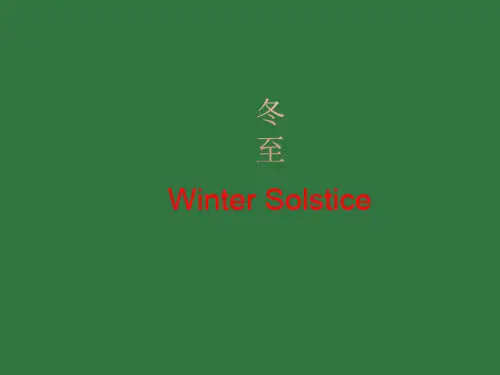
The winter solstice festival was originated from the Han Dynasty.It is a time for the family to get together. One activity that occurs during these get-togethers is the making and eating of Tangyuan, which symbolize reunion. On this daya, people eat tangyuan (sticky riceballs) to symbolize family unity and harmony.
• 在中国,人们吃汤圆象征着家庭的团圆、和谐。
二、佳句
•In places such as Shanghai, people eat tangyuan, a kind of stuffed small dumpling ball made of glutinous rice flour to celebrate Winter Solstice. • 在上海等地,人们吃汤圆庆祝冬至。汤圆是圆 形的糯米粉团,中间塞满馅料。
三、作文
custom for Chinese to sacrifice to the heaven and worship their ancestors.
As the approaching of Winter Solstice, my classmates and I are going to hold an activity to celebrate it this Sunday. And I wonder if it is convenient for you to join us.
英语演讲-冬至PPT课件
轮廓化鼻内镜手术对难治性鼻窦炎患者的效果及价值评价发布时间:2021-09-01T13:52:01.100Z 来源:《健康世界》2021年13期作者:黄官盛[导读] 目的:此次主要探究轮廓化鼻内镜手术治疗难治性鼻窦炎患者临床效果黄官盛四川省旺苍县人民医院四川广元 628200【摘要】目的:此次主要探究轮廓化鼻内镜手术治疗难治性鼻窦炎患者临床效果。
方法:随机选取我院2015年1月至2020年1月接收共200例难治性鼻窦炎患者展开研究,并分成参照组与研究组,参照组进行功能性鼻内镜治疗,研究组进行轮廓化鼻内镜治疗,观察临床效果。
结果:研究组鼻腔功能评分与嗅觉功能评分均高于参照组,治疗有效率高于参照组,P<0.05。
结论:轮廓化鼻内镜手术治疗难治性鼻窦炎患者可以有效改善鼻腔功能与嗅觉功能,效果显著。
【关键词】轮廓化鼻内镜手术;难治性鼻窦炎;临床效果难治性鼻窦炎主要指经过药物治疗或者其他治疗后未能彻底治愈的鼻窦炎疾病,由于病情反复所以会给患者日常生活造成极大影响,需要再次进行鼻内镜手术治疗。
根据相关研究表明,轮廓化鼻内镜手术具有独特优势,基于此就轮廓化鼻内镜手术效果展开探究。
1 资料与方法1.1基础资料随机选取我院2015年1月至2020年1月时间内收治共200例难治性鼻窦炎患者当作研究对象,纳入标准:①经过CT与鼻内镜等临床检查确认符合难治性鼻窦炎标准;②均符合手术治疗指征;③知情同意下签署研究同意书。
排除标准:①手术禁忌症;②变严重精神疾病或者认知障碍。
利用数字表法将患者分成参照组与研究组,各100例,参照组男女比重61:39,年龄界限22-59岁,年龄均值(45.37±2.58)岁,病程时间在1-7年,平均病程(3.03±0.25)年;研究组男女比重60:40,年龄界限23-60岁,年龄均值(45.41±2.49)岁,病程时间在1-6年,平均病程(3.01±0.24)年;两组难治性鼻窦炎患者资料在统计学软件计算下发现无显著差异(P>0.05)。
英语演讲冬至通用版
英语演讲冬至通用版Winter Solstice: A Celebration of Light and RenewalLadies and gentlemen, esteemed guests,I stand before you today to celebrate the arrival of winter solstice, a momentous event that marks the longest night and the shortest day of the year. Winter solstice holds great significance across various cultures and has been celebrated for centuries as a time of reflection, renewal, and hope.1. Origin and Significance of Winter SolsticeWinter solstice, also known as the hibernal solstice, has its roots in astronomy and occurs when one of the Earth's poles has its maximum tilt away from the Sun. This tilt results in the shortest duration of daylight and the longest night of the year. The word "solstice" itself derives from the Latin word "solstitium," meaning "sun stands still," as it appears during this time that the sun's daily path comes to a halt before reversing its direction.Throughout history, diverse cultures have attached different customs and beliefs to the winter solstice. In ancient times, people saw the solstice as a turning point, symbolizing the rebirth of the sun and the triumph of light over darkness. It served as an opportunity to honor nature, express gratitude for bountiful harvests, and acknowledge the cycles of the seasons.2. Winter Solstice Celebrations around the Worlda. China: The Dongzhi FestivalIn China, winter solstice is celebrated with the Dongzhi Festival. Families gather to share a meal of glutinous rice balls called tangyuan,symbolizing reunion and harmony. This festival emphasizes the importance of unity, togetherness, and gratitude for the year's blessings.b. Scandinavia: YuleIn Scandinavian countries, winter solstice is known as Yule, a festival deeply rooted in Norse mythology. Yule celebrates the return of the sun and the promise of longer days ahead. Festivities include lighting bonfires, feasting, exchanging gifts, and decorating homes with evergreen boughs to symbolize life and fertility.c. Native American Tribes: Winter Solstice CeremoniesVarious Native American tribes hold winter solstice ceremonies to honor and express gratitude to the earth and its bountiful resources. These ceremonies often involve storytelling, music, dance, and the sharing of traditional foods. Such celebrations serve as a reminder of the interconnectedness of all living beings and the importance of preserving the natural world.3. Winter Solstice as a Time of Reflection and RenewalAs winter solstice heralds the return of longer days and an eventual shift towards spring, it serves as a powerful reminder of the cyclical nature of life. This time invites us to reflect on the past year, acknowledging both its joys and challenges, and to contemplate our aspirations for the future.It is an opportunity to reassess our priorities, set new goals, and rejuvenate our spirits. Just as the Earth undergoes a period of dormancy during winter, we too can take this time to cultivate inner growth and self-reflection. Winter solstice reminds us that even in our darkest moments, there is always the promise of renewed light and vitality.4. Winter Solstice in Modern TimesIn our fast-paced and interconnected world, the significance of winter solstice remains as relevant as ever. It offers us a chance to pause, reconnect with nature, and honor the timeless rhythms of the universe. Despite our geographical and cultural differences, the shared experience of the solstice serves as a reminder of our common humanity and interconnectedness.As we celebrate this annual event, let us cherish the diversity of our traditions and embrace the universal themes winter solstice represents: hope, renewal, and the enduring power of light. May this occasion inspire us to approach the coming year with resilience, kindness, and an unwavering commitment to creating a brighter future for all.In conclusion, the winter solstice is a time of celebration and reflection –a moment when we bid farewell to the lengthening nights and welcome the return of the sun's warmth. Let us embrace this opportunity to illuminate our lives with joy, gratitude, and a renewed sense of purpose. Together, may we illuminate the world with compassion and understanding. Thank you.。
英语演讲-冬至
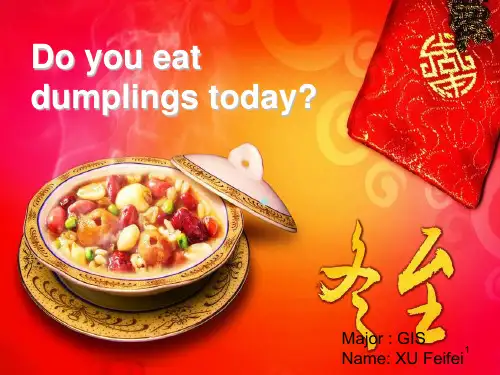
Actually, the tradition of eating dumplings during
winter solstice has its origin in early times.
冬至吃饺子的习俗由来已久。
It is said that dumplings were invented by Zhang Zhongjing, a wellknown doctor from the Eastern-Han Dynasty. 据说,饺子是东汉名医张仲景发明 One winter, he saw that many people ’s ears were frozen and it troubled him. When he went home, he asked his disciples to boil mutton, chilies and other ingredients with medicinal properties for fending off cold in a pot. After these were boiled, they ladled the mutton and other
Afterwards, Zhang Zhongjing
died on the day of Winter Solstice.
In order to honor his memory,
every year on the day of the winter solstice every household makes dumplings. 后来,张仲景在冬
ingredients out of the pot, chopped them into pieces, and then wrapped them with dough skins in the shape of ears. Afterward, they put these into pots to boil again. 有一年冬天,他看到很多人耳朵冻烂了,心里很难受。 他让他的弟子用羊肉、辣椒和一些驱寒药放在锅里煮。等煮好后,捞出来切碎,用
立冬英文介绍主题班会PPT课件
Custom for The Start of Winter 立冬风俗
Yifan Festival of Mulam Ethnic Minority仫佬族的依饭节
“立冬”是冬季的第一个节气,它意味着冬天到来,秋季丰收的作物全部 要储存起来。“立冬”是冬季的第一个节气,它意味着冬天到来,秋季丰 收的作物全部要储存起来。“立冬”是冬季的第一个节气,它意味着冬天 到来,秋季丰收的作物全部要储存起来。
Custom for The Start of Winter 立冬风俗
The Start of Winter
秋/风/吹/尽/旧/庭/柯/黄/叶/丹/枫/客/里/过
Start of Winter is the 19th solar term in the 24 solar terms. The handle of the bucket points to the northwest and the sun reaches 225 degrees. It crosses between November 7 and 8 in the Gregorian calendar.
Custom for The Start of Winter 立冬风俗
Eating tuanzi in Wuxi无锡人吃团子
“立冬”是冬季的第一个节气,它意味着冬天到 来,秋季丰收的作物全部要储存起来。“立冬” 是冬季的第一个节气,它意味着冬天到来,秋季 丰收的作物全部要储存起来。“立冬”是冬季的 第一个节气,它意味着冬天到来,秋季丰收的作 物全部要储存起来。
Start of Winter is the 19th solar term in the 24 solar terms. The handle of the bucket points to the northwest and the sun reaches 225 degrees. It crosses between November 7 and 8 in the Gregorian calendar.
SolarTerms-WinterSolstice(冬至)-中国文化之24节气课件
to drive away ghosts and other evil things.
赶走
节日PPT模板
Vocabulary
词汇积累 1.the traditional Chinese lunar calendar传统中国农历 2.The Winter Solstice冬至 3.during the Han Dynasty 汉朝期间 4.have a rest休息 5.There is a saying that goes "Have dumplings on the first day of Winter Solstice and noodles on the first day of Summer Solstice."
"Ghost Festival". On that day, it is customary for people there to drink mutton and
习惯
vermicelli soup and eat the dumplings in the soup. They give the midwinter soup
Cold (小寒), and Major Cold (大寒).
节日PPT模板
the past, before the approach of the winter solstice, every household would make
过去
...的到来
the cakes to worship their ancestors or use as gifts for relatives and friends. Today,
A. warmth B. counterparts C. bitterly
冬至节日英语介绍
rose
Different colours -- different meanings
Red roses: romance, beauty, respect, courage,
passionate love
White roses: unity, loyalty, sincerity, purity, silence
Made by: Sunshine
精选课件
15
gentility and style ,but being combined with fun
and light-heartedness.
Purple roses: opulence, majesty and glory,"I will
always love you!" 精选课件
14ThBiblioteka nk you~!Different quantities -- different meanings
1 rose: love at first sight,you are the only one 3 roses: I love you 5 roses: I love you very much 6 roses: I love you, I miss you 9 roses: I'll love you forever 10 roses: You're pretty 12 roses: "I love you" and I am grateful for your presence 13 roses: Forever friends 15 roses: I'm really sorry 24 roses: You're always on my mind 36 roses: I'll remember our romantic moments 99 roses: I'll love you till the day i die 100 roses: 100% love, I'm totally devoted to you 101 roses: Best of all, you're my one and only 365 roses: I love you every single day 999 roses: my love will last till the end of time