
08牛津译林版 8A Unit 8 Natural disasters语法知识点
8A Unit 8 Natural disasters语法知识点讲解
一【课文重点内容和语法】
1 about a person surviving an earthquake 关于地震中的幸存者
2 to use the new words to talk about a natural disaster story 用新单词来谈论一次自然灾害中的故事
3 to use the past continuous tense 使用过去进行时
to use when, while and as 使用when,while,和as
4 to create compound words 创造复合词
二【重点短语】
1 wake up 醒来
2 crash into 撞上……
3 fall from 从……上跌落下来
4 mop up 把……拖干净
5 wash away 冲走
6 catch fire 着火
7 feel a slight shake 感到轻微震动8 run out of 从……中跑出
9 in all directions 四面八方10 come down 坍塌
11 not…at all 一点也不12 a moment of fear 片刻的恐惧
13 calm down 冷静下来14 shout for help 呼救
15 move away 移开16 find one’s way out 找到出路
17 at last 最后,终于18 break down 出故障,坏掉
19 because of 因为,由于20 as…as possible 尽可能
三【重点句型】
1 Who will mop up the water if I go home without you? 如果你不跟我回家,谁将拖干水呢?
2 There was a heavy storm with thunder and lighting. 有一场暴风雨,电闪雷鸣。
3 Lighting hit a classroom building and it caught fire. 闪电击中了一栋教学楼,并引发了火灾。
4 I was sleeping when the earthquake started. 地震发生时我正在睡觉。
5 Outside, people were running in all directions while pieces of glass and bricks were failing down. 外面,人们四处奔跑,成片的玻璃与砖头纷纷落下。
6 A moment of fear went through my mind, but I told myself to calm down since I was still alive. 我的脑海里闪过片刻的恐惧,但我告诉自己要冷静,因为自己还活着。
7 Luckily, there was just enough space for me to move. 幸运的是,有足够的空间来容我移动。
8 …I was trying to find my way out, I suddenly heard some noise above me. 当我正在尽力寻找出路时,我突然听到楼上有嘈杂声。
四【重点语法】
一、过去进行时的结构及用法
过去进行时态表示过去某一时间正在进行的动作行为。
过去进行时与一般过去时一样,也常和表示过去的时间状语连用。
肯定结构:主语+was/were + doing+其他
否定结构:主语+was/were + not + doing+其他
一般疑问句结构:Was/Were+主语+doing+其他?
答语:Yes,主语+was/were,/ No,主语+wasn’t/weren’t.
特殊疑问句结构:特殊疑问词+ was/were+主语+ doing+其他?
二、when,while和as的用法
(一)as的意思是“正当……时候(just as,at the same moment that)”“随着……(while,when)”,它既可表示一个具体的时间点,也可以表示一段时间。
as可表示主句和从句的动作同时发生或同时持续,即“点点重合”“线线重合”;又可表示一个动作发生在另一个动作的持续过程中,即“点线重合”,但不能表示两个动作一前一后发生。
如果主句和从句的谓语动词都表示持续性的动作,二者均可用进行时,也可以一
个用进行时,一个用一般时或者都用一般时。
例如:
1、As I got on the bus,he got off.
我上车,他下车。
(点点重合)
2、He was writing as I was reading.
我看书时,他在写字。
(线线重合)
3、The students were talking as the teacher came in.
老师进来时,学生们正在讲话。
(点线重合)
(二)while的意思是“在……同时(at the same time that )”“在……期间(for as long as, during the time that)”。
从while的本身词义来看,它只能表示一段时间,不能表示具体的时间点。
在时间上可以是“线线重合”或“点线重合”,但不能表示“点点重合”。
例如:
1、He was watching TV while she was cooking.
她做饭时,他在看电视。
(线线重合)
2、He was waiting for me while I was working.
我工作的时候,他正等着我。
(线线重合)
3、He asked me a question while I was speaking.
我在讲话时,他问了我一个问题。
(点线重合)
(三)when的意思是“当……时候(at the time that)”“无论什么时候(whenever)”“一……就……(as soon as )”“在……以后(after)”。
它表示的时间概念比较广泛,上述例句中的as或while均可用when 代替,因为when不但可以表示具体的时间点,而且也可以表示一段时间。
在时间上它既能表示“点点重合”“线线重合”,又能表示“点线重合”。
例如:
1、When he came in,she went out.
他进来,她出去。
(点点重合)
此句中when从句的动作表示的是一个时间点,when可以用as代替,但不能用while代替。
2、When he came back,I was doing some washing.
他回来时,我在洗衣服。
(点线重合)
此句中when从句的动作表示的是一个时间点,所以只能用as代替,不能用while代替。
3、When Mary was writing a letter, the children were playing outside.
玛丽写信时,孩子们都在外面玩。
(线线重合)
此句中的when从句的动作表示的是一段时间,故可用as 或while代替。
五【写作指导】
如何描述一场灾害
谢你曾经经历过或听人叙述的自然灾害,把事情的经过写出来。
从几个方面着手:
1 灾害发生前的征兆;
2 灾害发生的时间、地点;
3 灾害发生的具体经过;
4 自然灾害造成的结果或影响以及事后的处理方法等等
常用写作句型:
1 An earthquake/A flood/A snowstorm/…hit…
2 There is a serious earthquake in…
3 His mother tried to…
4 The baby was safe.
5 …was really terrible.。
牛津译林版八年级上册Unit8《Naturaldisasters》(Reading2)说课稿
牛津译林版八年级上册Unit 8《Natural disasters》(Reading 2)说课稿一. 教材分析《牛津译林版八年级上册Unit 8 Natural disasters》的Reading 2部分主要介绍了龙卷风的发生原因、特点以及给人们带来的危害。
文章通过讲述一个发生在龙卷风中的真实故事,让学生了解和认识这一自然灾害。
文章语言简练,内容丰富,贴近学生生活,能够激发学生的学习兴趣,培养他们关爱生命、敬畏自然的意识。
二. 学情分析八年级的学生已经具备了一定的英语基础,能够听、说、读、写简单的英语句子。
但他们在阅读理解方面还存在一定的困难,特别是对于长篇文章的理解和分析能力。
此外,学生对于龙卷风这一自然灾害的了解并不深入,因此需要在课堂上进行引导和拓展。
三. 说教学目标1.知识目标:学生能够掌握Reading 2中出现的关键词汇和短语,如tornado、destroy、emergency等;能够理解文章的主旨大意,了解龙卷风的成因、特点和危害。
2.能力目标:学生能够运用所学知识,进行阅读理解和信息提取;能够运用英语进行简单的交流和讨论。
3.情感目标:学生能够培养关爱自然、敬畏生命的意识,提高自我保护能力。
四. 说教学重难点1.重点:学生能够掌握Reading 2中出现的关键词汇和短语,理解文章的主旨大意。
2.难点:学生能够运用所学知识,进行阅读理解和信息提取;能够运用英语进行关于龙卷风的讨论。
五. 说教学方法与手段1.教学方法:采用任务型教学法,让学生在完成任务的过程中,掌握知识、提高能力。
2.教学手段:利用多媒体课件、图片、视频等辅助教学,激发学生的学习兴趣,提高课堂效果。
六. 说教学过程1.导入:通过展示龙卷风的图片和视频,引导学生关注这一自然灾害,激发学习兴趣。
2.预习:让学生预习Reading 2,自主学习生词和短语,了解文章大意。
3.课堂讲解:教师引导学生学习Reading 2,讲解生词和短语,分析文章结构,讲解龙卷风的成因、特点和危害。
8A Unit 8 Natural disasters知识讲解

Unit 8 Natural disasters词句精讲精练词汇精讲1. thousands ofthousand; hundred; million; billion等数词,当与基数词连用表达确定数量时,要用单数形式,并且后面不接of;当表达概数时,要用复数形式,且后面接of。
例如:Our school is so famous that hundreds of people come and visit it every day.我们学校太有名了以至于每天有数百人来参观。
The volunteer sent two hundreds of books to a mountain village school on Children’s Day.这些志愿者在儿童节这一天给一所山里的乡村学校送去了二百本书。
2. beatbeat是及物动词,有以下用法:(1) 意为“赢;打败;战胜”,后接人或某一团队、组织等,其过去式为beat。
例如:I beat him at long jump yesterday. 昨天跳远我赢了他。
(2) 意为“打;击”,表示连续不断的打击。
例如:Who is beating the drum? 谁在打鼓?(3) 表示“(心脏)等跳动”。
例如:I feel my heart is beating fast. 我觉得我的心脏在剧烈跳动。
【拓展】beat和win都有“赢”的意思,但用法不同:beat的宾语为人或相当于人的团体、组织;而win的宾语为比赛或某个项目,过去式为won。
例如:Though we were weak, we beat them. 虽然我们弱,但我们赢了他们。
Who win the first prize in the competition? 谁在比赛中赢得了一等奖?3. asleepasleep是表语形容词,意为“睡着的”,在句中常作表语而不能作定语。
(完整版)8AUnit8Naturaldisasters知识点,推荐文档
8上 Unit 8 Natural disasters一、复习单词表A .拼读易错单词disaster, accident, coach, village, slight, silent, direction, nervous,heart, trapped, daughter, boardB .四会单词(1)词性变化1. ⎩⎨⎧disastersview/ natural adj. natural naturein the n. nature 2. ⎩⎨⎧mopa floor with clean the n. mop up water the mop mopping mopped/ v.mop --3. ⎪⎩⎪⎨⎧less fear ful/ fear sthdo fear to .fear v fear in other each at look n.fear --4. one of the survivors⎩⎨⎧c n. survivor v.survive ①vi. It’s difficult for giant pandas to survive in the wild.②vt. Timmy survived the earthquake in 1999.I’m afraid the two sick boys may not survive the winter.5. mind①n. change one’s mindmake up one’s mind②v.mind doing sth(2)、重点单词用法1. start①开始start to shake ②引起(大火)start a big fire ③发动start the car ④创办,组建start a band/ factory ⑤出发,动身when are you going to start?2. 区别几组词a. b. ⎪⎪⎩⎪⎪⎨⎧live lively living alive ⎪⎪⎩⎪⎪⎨⎧excitement excitedly exciting excited/ excite c. d. ⎪⎪⎩⎪⎪⎨⎧oneself tell oneselftalk to oneself say to oneself ask ⎪⎪⎩⎪⎪⎨⎧down cut downfall down come down calm 3. ⎩⎨⎧foggiestfoggier/ adj.foggy n.fog -⎩⎨⎧ tomorrow.____________much be It will tomorrow._________much be will There 9. cover1)cover sth2)cover A with B3)be covered with4)be covered live4. ⎩⎨⎧n.arrival v.arrive What was the time of his arrival?When the vet arrived, the dog ⎩⎨⎧hour an half for dead been had died had 5. hurt-hurt/ hurt①vi.My back hurt.②vt.He hurt his left leg.③adj.be/ get (badly) hurt 6. ⎩⎨⎧-可与表否定的词连用用-不可与表否定的词连almost nearly ①nearly the same②He’s almost/ nearly as tall as me.③Almost nothing can prevent him going there.二、 重要词组、句型用法1. natural 词性__________ 意思是________e.g.自然灾害____________ 自然科学(n.)______ 意思是_______e.g. nature reserve 意思是_____________Milk is the __________food for young babies. 牛奶是婴儿的天然食物。
译林版牛津初中英语八年级上册Unit8Naturaldisasters单元重点词汇及语法归纳
译林版牛津初中英语八年级上册Unit8 Natural disasters单元重点词汇及语法归纳Comic strip & Welcome to the unit单词1 disaster n 灾难2 mop vt 用抹布擦3 earthquake n 地震4 thousands of 成千上万5. accident n 事故6. coach n 长途汽车7. crash vi vt 猛撞碰撞8. flood n 洪水水灾9. village n 村庄10. lightening n 闪电11. storm n 风暴暴风雨12. thunder n 雷声短语1. wash away 冲走2. be all wet 全湿了3. start to rain 开始下雨4. wake up 醒来5. mop up the water 把水拖干净6. crash into a tree 撞在树上7. start big fire 引起大火8. fall from the tree 从树上掉下来9. a heavy storm with thunder and lightening 伴有雷电的大暴雨10. catch fire 着火11. I was sleeping when it started to rain. 我正在睡觉,突然下起雨来。
12. Didn’t you hear the rain? 你没听到下雨吗?13. Who will mop up the water if I go without you? 你如果你不和我一起去的话,谁把水拖干净呢?14. hear about the fire 听说火灾15. Was anyone hurt? 有没有受伤?Reading单词1 slight adj 轻微的2. shake vi vt shaking shook 摇晃晃动3. loud adj adv 大声的4. fear v fearful fearless 害怕5. direction n in all directions 方向方位四面八方6. while conj 当…时候和…同时7. calm down 平静下来8. silent silence silently 安静寂静的。
译林牛津版8A Unit 8 Natural disasters Grammar 教学课件 (共17张PPT)
now
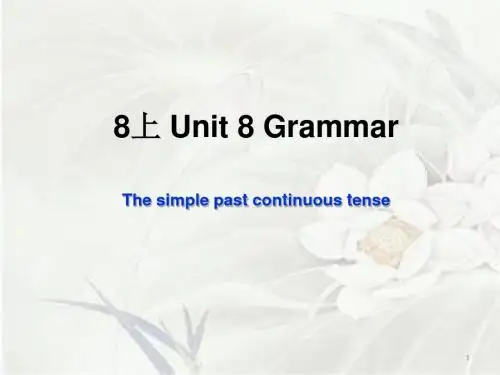
• What were you doing when the phone rang?
(background description – I was watching T.V.)
• What happened when you were watching T.V.?
3
PAST CONTINUOUS TENSE
• The Past Continuous describes an action that was already happening at a time in the past and was not finished at the time.
• It means that the action was in progress at a certain time in the past. Example: At 5 o´clock Mark was playing football with his friends.
Key word: when
Past Continuous
1. To say that something was in progress at a certain time in the past
2. To describe a background situation (was / were + ING)
•I was watching T.V. at 8.30 pm last night. (I started at 8.00 pm
and was still watching T.V. at 8.30 pm).
Unit8Naturaldisasters各部分单词短语句型讲义2023-2024学年牛津译林版八年
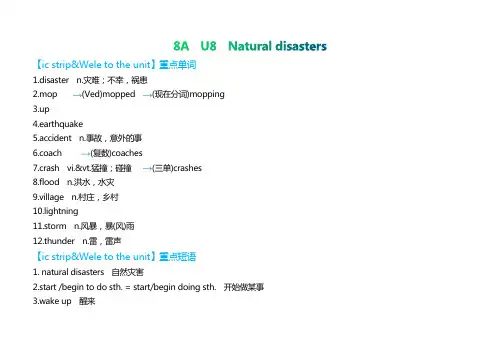
【ic strip&Wele to the unit】重点单词1.disaster n.灾难;不幸,祸患2.mop (Ved)mopped (现在分词)mopping3.up4.earthquake5.accident n.事故,意外的事6.coach (复数)coaches7.crash vi.&vt.猛撞;碰撞(三单)crashes8.flood n.洪水,水灾9.village n.村庄,乡村10.lightning11.storm n.风暴,暴(风)雨12.thunder n.雷,雷声【ic strip&Wele to the unit】重点短语1. natural disasters 自然灾害2.start /begin to do sth. = start/begin doing sth. 开始做某事3.wake up 醒来4.mop up 把......拖干净5.mop up the water 把水拖干净6.thousands of people 成千上万的人7.thousands of 成千上万的8.crash into 撞上9.wash away 冲走10.fall from ... 从...·落下11.hear about/of 听说12.what happened 发生了什么13.a heavy storm with thunder and lightning 一场雷电交加的大风暴14.catch fire 着火【ic strip&Wele to the unit】重点句型1. Didn't you hear the rain?难道你没听到雨声吗?2. Who will mop up the water if I go home without you? 如果你不跟我回家,谁将拖干水呢?3. Lightning hit a classroom building and it caught fire. 一幢教学楼被闪电击中而着火了。
牛津译林版8AUnit8 Natural disasters Grammar精讲(有答案)
牛津译林版8AUnit8 Natural disasters Grammar精讲(共2个语法【有答案】)【一. 过去进行时】1.定义过去进行时表示过去某一时刻正在进行的动作或过去某一阶段一直在进行的动作。
It was raining at 6 o’clock this morning. 今天早上六点钟时正在下雨。
They were building a dam last winter.去年冬天他们在建大坝。
2.构成过去进行时由“was/were+现在分词”构成。
I was having breakfast at six this morning.今天早上六点钟时我在吃早饭。
My younger brother was watching TV at that time.那时我弟弟在看电视。
They were playing football at four yesterday after-noon.昨天下午四点他们在踢足球。
3.句式变化(1)一般疑问句及回答变一般疑问句时应将was/were移到句首。
肯定回答为Yes,主语+was/were;否定回答为No,主语+wasn't/weren't.。
【例句一】一Was it raining at 6 o'clock this morning? 今天早上六点钟时正在下雨吗?一Yes, it was. , 是的,在下。
/—No, it wasn't.不,没在下。
【例句二】一Were they building a dam last winter?去年冬天他们在建大坝吗?一Yes, they were. No, they weren't. 是的,他们在建。
/不,他们没在建。
(2)否定句肯定句变否定句时在was/were之后加not,was not常缩写为wasn't,were not常缩写为weren't。
牛津译林版八年级上册Unit8《Naturaldisasters》(Grammar)说课稿
牛津译林版八年级上册Unit 8《Natural disasters》(Grammar)说课稿一. 教材分析《Natural disasters》是人教版牛津译林八年级上册的一篇课文,主要介绍了一些自然灾害的成因及应对方法。
通过本节课的学习,学生能够掌握一般现在时的被动语态,提高阅读理解能力,同时增强对自然灾害的防范意识。
二. 学情分析八年级的学生已经具备了一定的英语基础,对一般现在时态和被动语态有所了解。
但部分学生对英语阅读兴趣不高,且对于自然灾害相关知识了解有限。
因此,在教学过程中,需要关注学生的兴趣,引导学生主动参与课堂活动,提高他们的阅读理解能力。
三. 说教学目标1.知识目标:学生能够掌握一般现在时的被动语态,正确运用动词的过去式和被动式。
2.能力目标:学生能够阅读并理解关于自然灾害的英语文章,提高阅读理解能力。
3.情感目标:学生能够增强对自然灾害的防范意识,学会保护自己和他人。
四. 说教学重难点1.重点:学生能够掌握一般现在时的被动语态。
2.难点:学生能够运用一般现在时的被动语态描述自然灾害。
五. 说教学方法与手段1.教学方法:采用任务型教学法,让学生在完成任务的过程中,自然而然地掌握语言知识。
2.教学手段:利用多媒体课件、图片、视频等,激发学生的学习兴趣,提高课堂效果。
六. 说教学过程1.导入:展示一些自然灾害的图片,如地震、洪水等,引导学生谈论对这些灾害的了解和感受。
2.阅读理解:让学生阅读课文《Natural disasters》,回答相关问题,检测学生对文章内容的理解。
3.语法讲解:讲解一般现在时的被动语态,让学生通过例句和实践,掌握这一语法知识。
4.小组讨论:学生分成小组,讨论如何用英语描述一种自然灾害,以及如何防范。
5.展示与评价:每个小组选择一名代表,展示他们的讨论成果,其他同学和老师进行评价。
6.总结与反思:教师引导学生总结课堂所学,让学生反思自己在课堂上的表现,以及如何提高。
新译林8AUnit8Naturaldisasters知识总结
8A Unit8 Natural disasters一.词汇拓展1.shak.v.→shakin.(n..摇.2.direc.v.→direction(n..方向3.liv.v.→aliv.(adj..活着的4.saf.adj.→safety(n..安全5.fear (n.) →fearful(adj.)可怕的、担心的二.重点短语1.was.awa.冲..was.代词away2.b.al.we.全湿了3.star.t.rai.开始下雨4.wak.u.醒.wake..u.wak.up+名词5.mo.u.th.wate.把水拖干净6.cras.int..tre.撞在树上7.star.bi.fir.引起大火8.fal.fro.th.tre.从树上掉下来9..heav.stor.wit.thunde.an.lightenin.伴有雷电的大暴雨10.catc.fir.着火11.in the early morning 在清晨12.feel a slight shake 感觉到轻微的晃动13.hear a loud noise like thunder 听到像雷声的噪音14.star.t.shak.开始摇. shak.hand.wit.sb.15.scream in fear 恐惧地尖叫16.ru.ou.o.th.buildin.跑出楼房17.try my best to run out 尽我所能的跑出18.begin to calm down 开始平静下来19.say to oneself 自言自语20.cal.dow.平静下来21.silen.silenc.silentl.安.寂静的22.no.a.al.一点也不23 find one’s way out 找到出路24.hea.abou.th.fir.听说火.hea.o. 听.hea.from收到...的来.25.Wa.anyon.hurt.有没有受伤? hur.v.adj.26.fea.v.fearfu.fearles.害..momen.o.fea.wen.throug.m.mind.一丝恐...掠过我的脑海。
牛津译林版八年级英语8AUnit8Naturaldisasters知识点复习
Unit8 Natural disasters知识点复习一.重点短语Welcome to the unit1.bring sb sth / bring sth to sb把某物带给某人bring me my clothes 把我的衣服拿来2.I bet you’ll look cool and feel cool with nothing on.我打赌你什么都不穿会看起来酷而且觉得凉快(betted) 3.It’s the best time to play football outside. 这是在外面踢足球最好的时候Reading4.A be full of B = A be filled with B A充满B、A里全是B;A被B填满5.forget to grow忘记生长6.forget /remember to do sth 忘记/记得要做某事(未做)forget/remember doing sth 忘记/记得做过某事(已做)7.fly far away飞往远方(fly—flew)The birds fly far away to find a warm and sunny day. 为了找到温暖而晴朗的日子,鸟儿飞向远方8.play among flowers在花丛中嬉戏9.hide from the April showers躲避四月的阵雨10.sweet memories of summer days夏日甜蜜的回忆11.what a perfect time to fly a kite ! 真是放风筝的好时节zy afternoon慵懒的下午13.by a pool 在池塘边14.autumn leaves( leaf) 秋天的落叶15.turn brown/ red变成褐色/红色16.fall into piles upon the ground落地成堆(fall—fell)fall on the ground落在地上17.harvest crops收割庄稼Farmers work to harvest crops as the days are shorter and the temperature drops.(a little/a lot/much)随着白天更短,气温下降,农民们忙着收获庄稼。