
英语中的主动与被动ppt课件
teacher. 大家认为李先生是位好老师。
8
例4. he is believed to be deeply interested in the subject.
人们认为他对这一学科十分感兴趣。 句式二: 施动者+“把、给”等+受动者+主动
式谓语 例1. rivers are controlled by dams. 拦河坝把河流控制住了。 例2. the famous hotel had been
10
3.2.6 用汉语“被”,“受”等词表示被动 着重被动动作的英语被动句,可译成汉语的
完全被动态,用表示被动的助词”被“或跟 “被”意义相同的“受、给、挨、叫、让、 由、使”等构成,或用“加以”、“予以” 等后加谓语动词表示被动。如:
practically destroyed by the big fire. 大火把这家著名的旅馆几乎完全毁掉了。
9
例3. we are brought freedom and happiness by socialism.
社会主义给我们带来了自由和幸福。 3.2.5 有些应用被动句可译为汉语的判断句,
1
Chapter 3 被动与主动
英语被动结构使用非常广泛,绝大多数及物动 词和相当于及物动词的短语动词(phrasal verbs)都有被动式。另外,被动语态的广泛 应用在科技英语中反映更为突出,因为被动 语态把所要论证的、说明的科技信息放在主 语的位置上,以便使叙述更加开门见山,简 短明快,引起读者注意。此外,被动语态比 主动语态更少主观色彩,更能体现科技语体 的习惯特征。
2
3.2 英译汉中语态的转换 3.2.1 保留原主语,被动转换为主动 例1. the president was assassinated in a
theatre last night. 总统昨晚在一家剧院遇刺。 例2. many basins were formed by the
subsidence of the earth’s crust. 许多盆地都是因地壳陷落而形成的。 例3. the speed of the molecules is
increased when they are heated.
例4. bearing must be lubricated. 轴承必须上油。
3.2.2 无施动者的被动句转换为汉语句中具有 主动形式的简化被动态。
汉语中简化被动语态是由主语和谓语配合起来, 自然表示被动意义,句中不要任何被动的词 语。这种被动态的特点是:不带表示被动态 的词语;不带施动者;受动者多为物,间或 也可以是人或物,主动形式而具有被动意义。 英语中无施动者的被动句一般可以译成汉语 的简化被动态。如:
Chapter 3 被动与主动
3.1英汉两种语言中主动与被动的应用比较 汉 语中有一种倾向,就是尽量避免使用“被” 字,在行文中尽量选择能从主动角度恰当表 达其被动含义的词语。
如:我也许是太自私了,也许是被别的东西迷 住了眼睛。 我也许太自私了,也许是别的东西迷住了 我的眼睛。 上身的衣服完全被打湿了 上身的衣服完全打湿了。
即用汉语的“是...的”表示。 例1. this pamphlet of technical glossary
is redacted by an engineer. 这本技术词汇小册子是一位工程师编写的。 例2. my first thirty years were spent in
Western America. 我的前30年是在美国西部度过的。
4
例1. he was scared out of his wits. 他吓得魂飞魄散。 例2. the movie will be shown again
tomorrow. 这部电影明天还要放映。 例3. the novel has already been translated
into many languages. 这本小说已译成好几种语言。 例4. some books are to be tasted, others to
made in the exploration of the sea depths. 在海底勘探方面(…) 进行了巨额投资。 3.2.4 转化为汉语的“施动者+主动式谓语+
受动者“等句式 把英语被动句的主语改作为宾语,以原句中
的施动者作主语。这种译法,就是把英语的
7
被动句转换成汉语的如下句式: 句式一:施动者+主动式谓语+受动者 例1. yet, only a part of this energy is used
by man. 然而,人类只利用了这种能源的一部分。 例2. he is revered and admired by all of
us. 我们大家都敬仰他,钦佩他。 如原句未说出施动者,可以补上 “大家、人
们、有人”之类的泛称词作为主语。如: 例3. Mr.Li is considered to be a good
例2. tremendous research work has been done to bring about such fantastic speeds.
6
为了达到这样神奇的速度,(…)进行了大 量的研究工作。
例3. some pictures were hung on the wall. 墙上(…)挂了一些画。 例4. A considerable investment has been
be swallowed, and some few to be chewed and digested.
5
书有可浅尝者,有可吞食者,少数则须咀嚼消 化。
3.2.3 转化为汉语无主句
汉语中只有谓语而无主语的句子比比皆是。如: “几年前发现了一种新的彗星”,“市郊建 了许多别墅”等等。英语中不带施动者的被 动句可译为汉语的无主句。如:例1. the matter was never mentioned again.后来 (…)再也没提这件事。
8
例4. he is believed to be deeply interested in the subject.
人们认为他对这一学科十分感兴趣。 句式二: 施动者+“把、给”等+受动者+主动
式谓语 例1. rivers are controlled by dams. 拦河坝把河流控制住了。 例2. the famous hotel had been
10
3.2.6 用汉语“被”,“受”等词表示被动 着重被动动作的英语被动句,可译成汉语的
完全被动态,用表示被动的助词”被“或跟 “被”意义相同的“受、给、挨、叫、让、 由、使”等构成,或用“加以”、“予以” 等后加谓语动词表示被动。如:
practically destroyed by the big fire. 大火把这家著名的旅馆几乎完全毁掉了。
9
例3. we are brought freedom and happiness by socialism.
社会主义给我们带来了自由和幸福。 3.2.5 有些应用被动句可译为汉语的判断句,
1
Chapter 3 被动与主动
英语被动结构使用非常广泛,绝大多数及物动 词和相当于及物动词的短语动词(phrasal verbs)都有被动式。另外,被动语态的广泛 应用在科技英语中反映更为突出,因为被动 语态把所要论证的、说明的科技信息放在主 语的位置上,以便使叙述更加开门见山,简 短明快,引起读者注意。此外,被动语态比 主动语态更少主观色彩,更能体现科技语体 的习惯特征。
2
3.2 英译汉中语态的转换 3.2.1 保留原主语,被动转换为主动 例1. the president was assassinated in a
theatre last night. 总统昨晚在一家剧院遇刺。 例2. many basins were formed by the
subsidence of the earth’s crust. 许多盆地都是因地壳陷落而形成的。 例3. the speed of the molecules is
increased when they are heated.
例4. bearing must be lubricated. 轴承必须上油。
3.2.2 无施动者的被动句转换为汉语句中具有 主动形式的简化被动态。
汉语中简化被动语态是由主语和谓语配合起来, 自然表示被动意义,句中不要任何被动的词 语。这种被动态的特点是:不带表示被动态 的词语;不带施动者;受动者多为物,间或 也可以是人或物,主动形式而具有被动意义。 英语中无施动者的被动句一般可以译成汉语 的简化被动态。如:
Chapter 3 被动与主动
3.1英汉两种语言中主动与被动的应用比较 汉 语中有一种倾向,就是尽量避免使用“被” 字,在行文中尽量选择能从主动角度恰当表 达其被动含义的词语。
如:我也许是太自私了,也许是被别的东西迷 住了眼睛。 我也许太自私了,也许是别的东西迷住了 我的眼睛。 上身的衣服完全被打湿了 上身的衣服完全打湿了。
即用汉语的“是...的”表示。 例1. this pamphlet of technical glossary
is redacted by an engineer. 这本技术词汇小册子是一位工程师编写的。 例2. my first thirty years were spent in
Western America. 我的前30年是在美国西部度过的。
4
例1. he was scared out of his wits. 他吓得魂飞魄散。 例2. the movie will be shown again
tomorrow. 这部电影明天还要放映。 例3. the novel has already been translated
into many languages. 这本小说已译成好几种语言。 例4. some books are to be tasted, others to
made in the exploration of the sea depths. 在海底勘探方面(…) 进行了巨额投资。 3.2.4 转化为汉语的“施动者+主动式谓语+
受动者“等句式 把英语被动句的主语改作为宾语,以原句中
的施动者作主语。这种译法,就是把英语的
7
被动句转换成汉语的如下句式: 句式一:施动者+主动式谓语+受动者 例1. yet, only a part of this energy is used
by man. 然而,人类只利用了这种能源的一部分。 例2. he is revered and admired by all of
us. 我们大家都敬仰他,钦佩他。 如原句未说出施动者,可以补上 “大家、人
们、有人”之类的泛称词作为主语。如: 例3. Mr.Li is considered to be a good
例2. tremendous research work has been done to bring about such fantastic speeds.
6
为了达到这样神奇的速度,(…)进行了大 量的研究工作。
例3. some pictures were hung on the wall. 墙上(…)挂了一些画。 例4. A considerable investment has been
be swallowed, and some few to be chewed and digested.
5
书有可浅尝者,有可吞食者,少数则须咀嚼消 化。
3.2.3 转化为汉语无主句
汉语中只有谓语而无主语的句子比比皆是。如: “几年前发现了一种新的彗星”,“市郊建 了许多别墅”等等。英语中不带施动者的被 动句可译为汉语的无主句。如:例1. the matter was never mentioned again.后来 (…)再也没提这件事。
合集下载
Active vs Passive Voice:主动与被动语态幻灯片PPT

People can visit his home, a national historic landmark in Queens.
精品文档
1. William Shakespeare has been called the greatest writer of the English language. P 2. People feel his influence in many ways. A 3. Many words and phrases were invented by Shakespeare. P 4. He created the words “moonbeam”, “elbow”, and “buzzer.” A 5. Most people know Shakespeare for his plays. A 6. He wrote 37 plays in his lifetime. A 7. Additional plays might have been written by Shakespeare and another writer. P 8. Shakespeare also created beautiful poems, including many sonnets. A 9. Shakespeare’s plays have been enjoyed by millions of people. P 10. His plays have been explained in different ways by different audiences. P 11. The play The Taming of the Shrew was made by Gil Junger into the movie 10 Things I Hate About You. P 12. The part of the “shrew” was played by Julia Stiles. P 13. Whatever you think about the play, it will be enjoyed by you. P 14. Shakespeare’s plays are loved by people who have read them. P
精品文档
1. William Shakespeare has been called the greatest writer of the English language. P 2. People feel his influence in many ways. A 3. Many words and phrases were invented by Shakespeare. P 4. He created the words “moonbeam”, “elbow”, and “buzzer.” A 5. Most people know Shakespeare for his plays. A 6. He wrote 37 plays in his lifetime. A 7. Additional plays might have been written by Shakespeare and another writer. P 8. Shakespeare also created beautiful poems, including many sonnets. A 9. Shakespeare’s plays have been enjoyed by millions of people. P 10. His plays have been explained in different ways by different audiences. P 11. The play The Taming of the Shrew was made by Gil Junger into the movie 10 Things I Hate About You. P 12. The part of the “shrew” was played by Julia Stiles. P 13. Whatever you think about the play, it will be enjoyed by you. P 14. Shakespeare’s plays are loved by people who have read them. P
主动语态和被动语态(课堂PPT)

1. People play football all over the world.
Football is played all over the world by people .
2. Mr. Green teaches us this term.
We are taught (by Mr. Green) this term.
I bPealiessvieveI cVaonicfely
被动语态
This song is enjoyed by people all
over the world.
1
EEnnglgislihsh iiss ssppookkeenn bpyetohpele most people in the world.
2. The students in this school study German.
German __is_____ __s_tu_d_i_e_d_ by the
students in this school.
11
3.I found the ticket on the floor. The ticket __w_a_s__ f_o_u_n_d__ on the floor. 4.I told her to return the book in time. She __w__a_s_ __t_o_ld___ to return the book in time.
2
TThheeGGrreeat wWaalll wasbubilutilt by Chinese people.
3
The ttrreeeess wereplpalnatnedted by students.
4
Football is played all over the world by people .
2. Mr. Green teaches us this term.
We are taught (by Mr. Green) this term.
I bPealiessvieveI cVaonicfely
被动语态
This song is enjoyed by people all
over the world.
1
EEnnglgislihsh iiss ssppookkeenn bpyetohpele most people in the world.
2. The students in this school study German.
German __is_____ __s_tu_d_i_e_d_ by the
students in this school.
11
3.I found the ticket on the floor. The ticket __w_a_s__ f_o_u_n_d__ on the floor. 4.I told her to return the book in time. She __w__a_s_ __t_o_ld___ to return the book in time.
2
TThheeGGrreeat wWaalll wasbubilutilt by Chinese people.
3
The ttrreeeess wereplpalnatnedted by students.
4
英语语法讲解之主动和被动语态PPT课件
lab without a teacher. We are not allowed to enter the chemistry lab
without a teacher.
第8页/共37页
2. 一般过去时: They agreed on the building of a new car
factory last month. The building of a new car factory was
tickets had already been sold out. The whole country was very sad at the
news of his death; People had considered him to be a great leader.
He had been considered to be a great leader.
第5页/共37页
• (2)英语中被动语态由“助动词be +动词的过去分词”构成。助动词be 有时态、人称和数的变化。被动语态后的by短语有时可省去。具体结构 见下表:
现在时态 一般现在时 现在进行时
一般将来时
现在完成 时
am
am
will + be+p.p.
have(has)
谓语动词 is +p.p. is
• 相似动词see, watch, hear, notice, listen to, look at, make, feel,have,let
第22页/共37页
• ③“动词+…+介词”改为被动时,介词一般在原位不动。如:The girl takes good care of her little brother.→ The girl’s little brother is taken good care of by her.
without a teacher.
第8页/共37页
2. 一般过去时: They agreed on the building of a new car
factory last month. The building of a new car factory was
tickets had already been sold out. The whole country was very sad at the
news of his death; People had considered him to be a great leader.
He had been considered to be a great leader.
第5页/共37页
• (2)英语中被动语态由“助动词be +动词的过去分词”构成。助动词be 有时态、人称和数的变化。被动语态后的by短语有时可省去。具体结构 见下表:
现在时态 一般现在时 现在进行时
一般将来时
现在完成 时
am
am
will + be+p.p.
have(has)
谓语动词 is +p.p. is
• 相似动词see, watch, hear, notice, listen to, look at, make, feel,have,let
第22页/共37页
• ③“动词+…+介词”改为被动时,介词一般在原位不动。如:The girl takes good care of her little brother.→ The girl’s little brother is taken good care of by her.
九年级英语主动语态和被动语态课件ppt
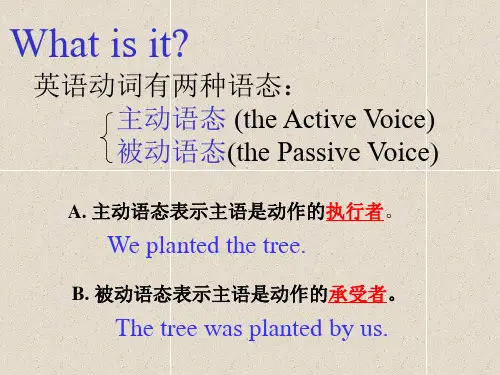
A. 主动语态表示主语是动作的执行者。
We planted the tree.
B. 被动语态表示主语是动作的承受者。
The tree was planted by us.
经营者提供商品或者服务有欺诈行为 的,应 当按照 消费者 的要求 增加赔 偿其受 到的损 失,增 加赔偿 的金额 为消费 者购买 商品的 价款或 接受服 务的费 用
A birthday party
is going to held by Tom
.
情态动词的被动语态: 经营者提供商品或者服务有欺诈行为的,应当按照消费者的要求增加赔偿其受到的损失,增加赔偿的金额为消费者购买商品的价款或接受服务的费用
must/have to/can等 + be + 过去分词
8. You must throw the broken pottery
典型题例
例1 将下列句子改为被动语态。 We clean our classroom every day.
Our classroom is cleaned (by us) every day.
在改写中应注意:
1.把原来的宾语提到前面作被动语态的主语; 2.把动词变成“be + 过去分词”; 3.主动语态中的主语变为介词by的宾语。
We speak
主语
谓语
English.
宾语
主动语态
English is spoken by us.
主语
谓语
宾语
被动语态
当主语是动作的执行者时,动词用主动语态 经营者提供商品或者服务有欺诈行为的,应当按照消费者的要求增加赔偿其受到的损失,增加赔偿的金额为消费者购买商品的价款或接受服务的费用 (Active Voice);如果主语是动作的承受者, 动词便用被动语态(Passive Voice)。
We planted the tree.
B. 被动语态表示主语是动作的承受者。
The tree was planted by us.
经营者提供商品或者服务有欺诈行为 的,应 当按照 消费者 的要求 增加赔 偿其受 到的损 失,增 加赔偿 的金额 为消费 者购买 商品的 价款或 接受服 务的费 用
A birthday party
is going to held by Tom
.
情态动词的被动语态: 经营者提供商品或者服务有欺诈行为的,应当按照消费者的要求增加赔偿其受到的损失,增加赔偿的金额为消费者购买商品的价款或接受服务的费用
must/have to/can等 + be + 过去分词
8. You must throw the broken pottery
典型题例
例1 将下列句子改为被动语态。 We clean our classroom every day.
Our classroom is cleaned (by us) every day.
在改写中应注意:
1.把原来的宾语提到前面作被动语态的主语; 2.把动词变成“be + 过去分词”; 3.主动语态中的主语变为介词by的宾语。
We speak
主语
谓语
English.
宾语
主动语态
English is spoken by us.
主语
谓语
宾语
被动语态
当主语是动作的执行者时,动词用主动语态 经营者提供商品或者服务有欺诈行为的,应当按照消费者的要求增加赔偿其受到的损失,增加赔偿的金额为消费者购买商品的价款或接受服务的费用 (Active Voice);如果主语是动作的承受者, 动词便用被动语态(Passive Voice)。
主动表被动的几种情况ppt课件

完整版ppt课件
21
◆ 7.不定式与疑问词连用 e.g. Which movie to watch has not been decided yet.
I don’t know what to do next.
◆ 8. 在“with + 宾语 + to do”结构中。 例如:
With nothing __t_o_d__o_ (do) ,he lay in bed.
完整版ppt课件
20
◆ The plants need wateringevery day . = need to be watered.
The wall wants repairing =to be repaired.
He is ill. He deserves sending to hospital. =to be sent to hospital.
They had been warned many times before they carried out the plan.
(发生在谓语动词之前)
完整版ppt课件
4
完整版ppt课件
5
谓语动词主动表被动
◆ 主动表被动
非谓语动词主动表被动
完整版ppt课件
6
一、谓语动词主动表被动的四种情形
1. 有些不及物动词或短语,如 exist, appear, happen, occur, come true, take place, break out, run out, 等常以主动形 式表被动意义。
The water ___f_e_lt__ (feel) cool when I jumped into the pool.
The ice-cream _t_a_st_e_s__ (taste) delicious.
高考英语中主动表被动现象PPT教学课件

“主语+谓语+宾语+to do” 主谓关系
动宾关系
①He has many problems to solve. ②White has lots of things to do. ③I have a room to live in.
He has a family to support. Tom is looking for a room to live in.
例如: The door won‘’t open.
It can''t move. 它不能动。
(这些动词与can’t,won’t等连用, 表示事物“拒绝”我们要它们“做”的事.)
2020/12/10
6
5、在“there be”句型中作主语的定语如 果现在分词时,所用的现在分词要用主动表 被动意义。
There is nothin没事干。
Beijing. ③be+in the charge of, e.g. The factory is in the charge of my brother.
①This kind of book sells well.
②The pen writes smoothly.
③ The cloth washes well.
④The poem reads smoothly.
⑤The table doesn’t clean easily.
⑥This kind of rice cooks more easily than that kind.
I see there’s a good idea planning. 我知道又在打好主意。
2020/12/10
7
7. “sb. has sth. to do”不定式作定语结构,也用主动结 构表被动意思, 此时主语与to do 存在逻辑主谓关系, to do 与宾语存在逻辑动宾关系,用公式表示为:
动宾关系
①He has many problems to solve. ②White has lots of things to do. ③I have a room to live in.
He has a family to support. Tom is looking for a room to live in.
例如: The door won‘’t open.
It can''t move. 它不能动。
(这些动词与can’t,won’t等连用, 表示事物“拒绝”我们要它们“做”的事.)
2020/12/10
6
5、在“there be”句型中作主语的定语如 果现在分词时,所用的现在分词要用主动表 被动意义。
There is nothin没事干。
Beijing. ③be+in the charge of, e.g. The factory is in the charge of my brother.
①This kind of book sells well.
②The pen writes smoothly.
③ The cloth washes well.
④The poem reads smoothly.
⑤The table doesn’t clean easily.
⑥This kind of rice cooks more easily than that kind.
I see there’s a good idea planning. 我知道又在打好主意。
2020/12/10
7
7. “sb. has sth. to do”不定式作定语结构,也用主动结 构表被动意思, 此时主语与to do 存在逻辑主谓关系, to do 与宾语存在逻辑动宾关系,用公式表示为:
主动语态与被动语态ppt
注意:need后可接动名词表被动,又可接动词不定式的被动形式。但若有附加成分有用动词不定式的被动形式。比较: The desk needs repairing. The desk needs to be repaired.
4) 注意动名词的被动形式,(being done) Nobody likes being laughed of. 没人喜欢被嘲笑。
何时用被动语态
4)有些短语不用被动语态 do one’s best, make a face, make room(腾位子), make up one’s mind, belong to
不用被动语态的情况
1)不及物动词不用被动语态;注意:happen, break out ,take place The story was happened in 1934. ( × )
过去进行时态:was/were + being +过去分词
一般将来时态:will + be+过去分词
过去将来时态:would + be+过去分词
7、With the help of the Hope Project, more and more new schools _____ in the poor area. A. built B. have built C. have been built D. have been building 8、He came out and told us that the work __________. A. finished B. was finished C. had finished D. had been finished 9、The programmes _______ easily if you use a short wave radio. A. can pick up B. pick up C. picked up D. can be picked up
4) 注意动名词的被动形式,(being done) Nobody likes being laughed of. 没人喜欢被嘲笑。
何时用被动语态
4)有些短语不用被动语态 do one’s best, make a face, make room(腾位子), make up one’s mind, belong to
不用被动语态的情况
1)不及物动词不用被动语态;注意:happen, break out ,take place The story was happened in 1934. ( × )
过去进行时态:was/were + being +过去分词
一般将来时态:will + be+过去分词
过去将来时态:would + be+过去分词
7、With the help of the Hope Project, more and more new schools _____ in the poor area. A. built B. have built C. have been built D. have been building 8、He came out and told us that the work __________. A. finished B. was finished C. had finished D. had been finished 9、The programmes _______ easily if you use a short wave radio. A. can pick up B. pick up C. picked up D. can be picked up
英语主动语态和被动语态课件
Detailed description
The teacher provides sentences containing grammar errors for students to identify and correct, while explaining the reasons for the errors and the correct usage.
action
It is more direct and consensus, making it suitable for most writing and speaking
situations
The subject of the presence is typically the doorstep of the
Impersonality
The active voice is less personal, focusing on the action compared to the person performing it
Energy and Emphasis
The active voice brings energy and emphasis to the presence, drawing attention to the subject
Passive Voice • Practice of active and passive voice • Notes on active and passive voice
01
The definitions of active and passive
voice
The definition of active voice
It is often used when the focus of the presence is on the action rather than the doer
The teacher provides sentences containing grammar errors for students to identify and correct, while explaining the reasons for the errors and the correct usage.
action
It is more direct and consensus, making it suitable for most writing and speaking
situations
The subject of the presence is typically the doorstep of the
Impersonality
The active voice is less personal, focusing on the action compared to the person performing it
Energy and Emphasis
The active voice brings energy and emphasis to the presence, drawing attention to the subject
Passive Voice • Practice of active and passive voice • Notes on active and passive voice
01
The definitions of active and passive
voice
The definition of active voice
It is often used when the focus of the presence is on the action rather than the doer
语言对比与翻译(8)主动与被动课件
减译
在翻译过程中,删去一些不必要的词句,使译文更加简洁、 明了。
词义选择与词序调整
词义选择
根据上下文和语境选择最合适的词义进行翻译,确保译文准确传达原文的含义。
词序调整
根据目标语言的语法规则和表达习惯,调整原文的词序,使译文更加符合目标语 言的阅读习惯。
03
主动与被动翻译实例
常见句型的主动与被动翻译
商务合同的主动与被动翻译
商务合同中,被动句型的使用也较为频繁,强调合同条款的客观性和权 威性。在翻译时,应注重保持原文的准确性和规范性,将被动句型翻译 成符合中文表达习惯的主动句型或被动句型。
例如,“The contract will be terminated by either party”(合同可 由任何一方终止)可以翻译为“任何一方都可以终止这个合同”,更符
合中文表达习惯。
此外,在商务合同中,还有一些特殊的被动句型,如“be bound by” (受…约束)和“be subject to”(受…约束),在翻译时也需要特别 注意。
04
主动与被动翻译实践
翻译练习
总结词
通过实际翻译练习,学生可以更好地掌握主动与被动语态的转换技巧,提高语言运用能 力。
详细描述
科技文献的主动与被动翻译
科技文献中,被动句型的使用频率较高,强调客观性和事实 性。在翻译时,应注重保持原文的客观性和准确性,将被动 句型翻译成符合中文表达习惯的主动句型或被动句型。
例如,“The experiment was conducted by the researchers”(实验由研究人员进行)可以翻译为“研究人 员进行了这个实验”,更符合中文表达习惯。
在对比和评价的基础上,学生对自己的译文进行修改和完 善,进一步提高翻译质量。
在翻译过程中,删去一些不必要的词句,使译文更加简洁、 明了。
词义选择与词序调整
词义选择
根据上下文和语境选择最合适的词义进行翻译,确保译文准确传达原文的含义。
词序调整
根据目标语言的语法规则和表达习惯,调整原文的词序,使译文更加符合目标语 言的阅读习惯。
03
主动与被动翻译实例
常见句型的主动与被动翻译
商务合同的主动与被动翻译
商务合同中,被动句型的使用也较为频繁,强调合同条款的客观性和权 威性。在翻译时,应注重保持原文的准确性和规范性,将被动句型翻译 成符合中文表达习惯的主动句型或被动句型。
例如,“The contract will be terminated by either party”(合同可 由任何一方终止)可以翻译为“任何一方都可以终止这个合同”,更符
合中文表达习惯。
此外,在商务合同中,还有一些特殊的被动句型,如“be bound by” (受…约束)和“be subject to”(受…约束),在翻译时也需要特别 注意。
04
主动与被动翻译实践
翻译练习
总结词
通过实际翻译练习,学生可以更好地掌握主动与被动语态的转换技巧,提高语言运用能 力。
详细描述
科技文献的主动与被动翻译
科技文献中,被动句型的使用频率较高,强调客观性和事实 性。在翻译时,应注重保持原文的客观性和准确性,将被动 句型翻译成符合中文表达习惯的主动句型或被动句型。
例如,“The experiment was conducted by the researchers”(实验由研究人员进行)可以翻译为“研究人 员进行了这个实验”,更符合中文表达习惯。
在对比和评价的基础上,学生对自己的译文进行修改和完 善,进一步提高翻译质量。
九年级英语主动语态和被动语态课件
Emphasize the action receiver
01
The passive voice can be used to focus attention on the recipient of the action, rather than the person performing it
02
The Conversion of
04 Active Voice and Passive Voice
Convert active voice to passive voice
Identifying the executor of an action: In active voice sentences, the action is performed by a certain executor, and we need to find that executor.
Emphasize the initiator of the action
Use active voice to emphasize the person or thing responsible for the action described in a sentence
Active voice helps to bring focus on the initiator of the action, making it clear who or what is performing the task or action
9th grade English active and passive voice courseware
contents
目录
• The definitions of active and passive voice