
外研版七年级英语上册 Module 5 Unit 2 We start work at nine o’clock教案
Module 5 My school day一、教学内容:Unit 2We start work at nine o’clock.二、课型:Reading and writing三、教学目标:(2)I get up at half past seven in the morning, and then have breakfast.3、能读懂介绍学校生活的文章。
4、能使用and, but联进两个简单句。
5、能够简单描写个人一天的学校生活。
四、教学重难点:1、学会使用一般现在时态描述习惯性或习惯性的动作。
(重点)2、能够使用一般现在时态描述习惯性或习惯性的动作。
(难点)五、教学准备:在阅读活动的设计中,我采用了填表、回答问题、简单复述等形式,引导学生明白阅读的目的、提高阅读的兴趣、训练阅读的技巧、培养学生阅读的能力。
因此,本节课需准备:PPT课件、挂图、录音机、课堂练习表格、奖品六、教学过程:教学步骤教师活动学生活动设计意图Step One Warming-up (3’)Lead in1 Daily work:Morning Report.2 Free talkAsk: What day is it today?What are your lessons today?What’s your favourite lesson?What time do you have Chinese?Etc.1 One student give a MorningReport.2 Free talkTalk about with the teacher.日常汇报可以形成学生良好的说英语习惯,训练口语。
通过自由谈话引入本课话题。
2Step Two Pre- reading (5’)Task: Learn the new words.Show some pictures on thecomputer and get the Ss to talkab out them to learn t he newwords.T: What time do you get up?T: What do you do then?Look at the pictures on thecomputer and talk about them tolearn the new words.S: I get up at half past six.S: I wash my face and havebreakfast. Etc.引导学生谈论图片,训练学生描述人物的能力。
在描述的同时学习新单词和句型,为学生扫清阅读障碍。
Step Three While- reading (24’)1. Ask students to read thepassage quickly and put thepictures in order.2 ScanningAsk students to match the timeswith the pictures in Activity1.3 Skimming1. Read the passage quickly andput the pictures in order.2 ScanningMatch the times with thepictures in Activity 1.3 Skimming训练听力,对课文有整体的感知。
通过scanning和skimming,培养学生在阅读过程中掌握1. 掌握下列单词和短语: go to school, weekday, get up, have breakfast/lunch/dinner, start, house, work, break, go home, evening, watch, do, homework, go to bed, sleep2. 掌握并灵活运用下列句子:(1) I go to school on weekdays, but not on Saturday and Sunday.Step Three While- reading (24’)Ask students to skim thepassage and answer:How many lessons do they haveevery day?5. Careful reading.Task 1 Ask them to read thepassage and finish Activity 3.Underline the correctexpressions.Then check the answers byasking individual student.Task 2 Ask them to readcarefully, complete the tablein groups.Task 3: Reading(1) Organize the students toread the passage.(2).Ask the Ss to read ingroups.(3) Have a competition: Readthe dialogue in groups andchoose the best group.Task 4: Solve the languagepoints(1).Organize students to cometo the front and show out somedifficult language points thatthey found.Read the passage and answer:How many lessons do they haveevery day?Read the passage and finishActivity 3.1 )I get up / start work at halfpast seven.2 )We have a break / havelunch at half past twelve.3 )I go home / watch TV inthe evening.4 )I do my homework / see myfriends in the evening.5 )I go home / go to sleepat ten o’clock.Read carefully, complete thetable in g roups.WhattimeWhat todoin themorning7:308:30 go toschoolstartwork11:00in theafternoon andevening12:301:303:30 go homego to bed1. Watch the video and read withit then read the passagetogether.2. Work in groups to practice.3. Try to read the best.(1). Students come to theblackboard to show out somelanguage points, the otherstudents listen to themcarefully and note . The phrasesthey may tell:have lunch,have rice,drink浏览、跳读等阅读技巧。
通过观看录像来调动他们视觉、听觉和记忆力来参与语言活动。
让学生带着问题去读文章,并且让学生质疑、与老师进行探讨,这都能很好地诱发学生自主尝试的动机,培养其自主学习的能力。
第二次阅读篇章,旨在使学生掌握篇章是的细节信息,并通过信息归纳来检查学生对篇章的初步理解程度。
熟读课文内容,掌握课文单词和词汇,培养合作精神。
锻炼学生的口头表达能力及(2).Help the students to solve the other difficult points which they didn’t mention,To teach to join the sentences with and then.Grammar: Explain the simple past tense. water, go home,watch TV,havedinner,do my homeworkgo to bed,in the morningin the afternoon,in the evening(2)Listen carefully to theteacher. Take notes.胆量,培养他们自主学习的能力。
教师点拨、补充语言点,让学生进一步理解知识点。
Step Four Post- reading (10’)1.Retell.①Let the students fillin the blanks accordingto the picture and thetable .②Call b ack the answersfrom some students thenread the short passagein the whole class .2.SpeakingOrganize the students to sharetheir school day in a grou p offour.1.Look at the pictureand the table to fillin the blanks.I’m Alex Greenall. I ____ ___at half past seven ___ themorning. I go to school at_____ ____ _____ and lessons_____ at nine o’clock. We have_____ lessons in the morning. I____ __ _____ at eleveno’clock. I don’t like________. We have lunch at _________ ______. Lessons start inthe afternoon at _____ ________ . We have ____ lessons inthe afternoon . We ____ _____ athalf past three. I go to bed at_____ o’clock.Share your day in group of four.通过对课文内容的复述,进一步对课文内容和语言点的巩固,并使语言点的运用落实在篇章之中,使运用更具意义。
+Module5+Unit2+教案 外研版英语七年级上册

Module 5 My school dayUnit 2 We start work at nine o’clock.【学习目标】1. To be able to put pictures in order according to the reading material.2. To get information from a description of a school day.3. To enjoy our school day.【教学重难点】重点:Time expressions and the language points.难点:W rite a passage about one’s school day.【教学方法】创设情境法、小组合作法。
【教学过程】Step 1 Leading inShow some pictures. Ask and answer.A: When is your Chinese lesson?B: We have Chinese at half past eight.Step 2 Pre-taskLook at the pictures and talk what I do in my school day.Step 3 While-taskFast-reading.Activity 1 Read the passage and put the pictures in order.Careful-reading.Activity 1 Read the passage and check the sentences true or false.1. I have breakfast at 7:00 in the morning.2. I go to school at 8:30.3. I play football at 11:00.4. We have meat and rice with vegetables or hamburgers at 12:30.5. Lessons finish at 3:30.6. I do my homework at 10:00 in the evening.Activity 2 Read and match the time with the picture.a. 7:30 amb. 10:00 pmc. 11:00 amd. 12:30 pme. 3:30 pmf. 9:00 amWhen What to do in the morning7:30get up8:30start work11:0012:301:30go home10:00Activity 4 Underline the correct expressions.1. I get up / start work at half past seven.2. We have a break / have lunch at half past twelve.3. I go home / watch TV in the evening.4. I do my homework / see my friends in the evening.5. I go home / go to sleep at ten o’clock.Step 4 Post-readingActivity 1 Work in pairs. Talk about your school day.Show pictures and talk about Lilly’s s chool day.Activity 2 Join these sentences with and then.Look at these sentences and join these sentences with and then.I get up at seven o’clock. I go to school at eight o’clock.then go to school at eight o’clock.Finish Part 6.Activity 3 Exercise.一、根据汉语写单词。
外研版七年级英语上册Module 5 Unit 2 We start work at nine案
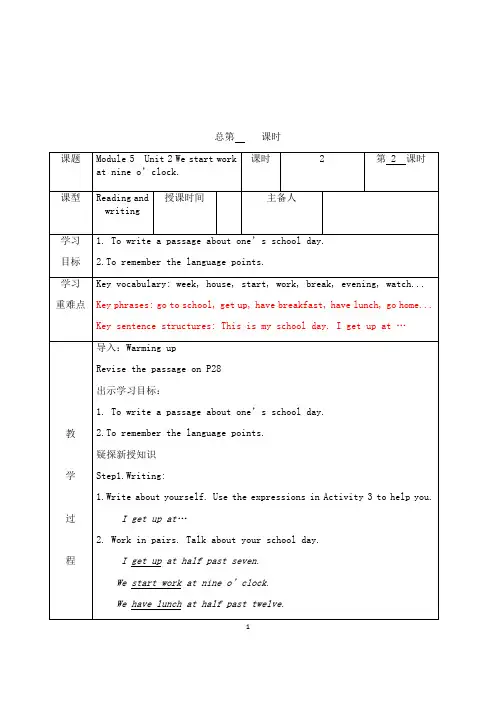
课题
Module 5Unit 2 We start work at nine o’clock.
课时
2
第2课时
课型
Reading and writing
授课时间
主备人
学习
目标
1. To writea passageabout one’s school day.
2.To remember the language points.
10. We start _______ (工作)at half past eight in the morning.
B.汉译英。
1.起床__________________
2.在7点30分__________________
3.吃早餐__________________
4.在……旁边__________________
I do homework at …
教
学
反
思
1.九点开始上课。Lessons _____ ____ nine _______.
2.早上我七点半起床。I ________ at _____________.
3.晚上十点我做作业。I do my homework _________________________.
4.下午我们看电视然后踢足球。We watch TV _____________________.
5.有些工人在工厂吃中午饭。Some workers ____________ at the factory.
作业及总结:
Write a passage about your whole day. Use the sentences in the lesson.
外研社英语七年级上册Module 5 My school day Unit 2 We start work adoc
课中探究
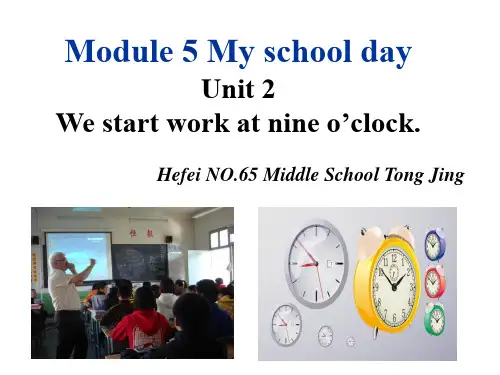
Let’s have a look at his school day.
Park School in Oxford(牛津)
Alex Greenall
Read quickly and put the pictures in order.
12:30 have lunch
I have lunch at half past twelve.
1:30 pm have a break I have a break at half past one.
When do you ...? Warm-up
5:00 pm go home I go home at five o’clock.
a
b
c
4
d
e
5
6
f
3
1
2
Read again and match the times with thபைடு நூலகம் pictures.
a
b
c
d
e
f
7:30 am __e__ 10:00 pm __c__ 11:00 am __d__ 12:30 pm __a__ 3:30 pm __b__ 9:00 am __f__
What do I do?
Warm-up
play football go home do homework
have dinner watch TV go to bed
When do you ...? Warm-up
6:00 am get up I get up at six o’clock.
7:00 am have breakfast I have breakfast at seven o’clock.
We+start+work+at+nine+o'clock 外研版英语七年级上册
the morning and three in the afternoon.
( B )1.A.Saturday
B.Monday
C.Thursday
D.Tuesday
( D )2.A.dinners B.questions C.schools
D.classes
Today is Friday.I have English at 8:00.The science class is at 9:00.I think
A.Alex's weekdays. C.Alex's friends.
B.Alex's subjects. D.Alex's family.
二、细读Unit 2 Act.1课文,完成思维导图,并复述课文。 breakfast lessons
home have dinner go to bed
考点梳理
▶点拨
( C )3.We often have three meals
have
breakfast at 8:00 every morning.
day.And we usually
A.a; the
B.a; a
C.a; /
D./; the
4.We have milk and bread for breakfast.(盲填,一词)
my friends.They go to the playground and play football, 7 I don't like
football.
We have lunch in the dining hall at half past twelve.I like school lunch!
外研版七年级英语上册Module5 unit2 We start work at nine o’clock. 课件 (共31页)

我们知道:
1. 要表达经常性或习惯性的动作,要 使用一般现在时。如: I do my homework in the evening. 我晚上做作业。 2. 要表示现在的状态,也可以用一般 现在时。如: I know him very well.
行为动词的一般现在时 表示经常性或习惯性的动作,也可以 表示现在的状态。 eg: I do my homework in the evening. 我晚上做作业。 I like English very much. 我非常喜欢英语。
the 5 Lessons start in __ __afternoon ______ at half past one. We have ___ ___ two ______ lessons in the afternoon. We ___ go home ____ at half ___ past ___ three.
next __ to my house. I ___ 2 My school is ___ __ ____ go to school at half past eight and lessons _____ start ___ at ____ _____. nine o’clock We have ____ three ______ lessons in the morning. My favourite lesson is art. ________
at five past six (6:05) 在6点5分
at twenty to seven (6:40) 在6点40分
注意:如果是半小时以内的时间,一般 用几点过几分的表达方式,即 “…past…”, 如: 5:25可以表达为 twenty-five past five; 如果超过了半小时,则用还差几分不到几 点的表达方式,即 “…to…”, 如: 5:45 就要表达为 fifteen to six。
外研七年级英语上册Module5 unit2 课件(共26张PPT)

合作探究
----四人小组分享你的一天!
… What about you
合作探究
get up
6:00 in the morning
have breakfast go to school have classes have lunch play… go home have dinner
6:30 7:00 8:00 12:00 4:00 in the afternoon 4:40 6:30
…
Hi! I’m _____. I study in_______
________________________________
________________________________
精讲点拨
1. I get up at half past seven in the morning and have breakfast.
我早上7点半起床,然后吃早餐。 have是英语中常见的一个动词,和不同的 词搭配有不同的意思。 have lessons 上课 have dinner 吃饭 have a rest 休息 have a look 看一看 have a good time 玩得愉快
Exercise
1、_____dinner
get up
2. 课间休息
have a break
3. 去上学
go to school
4. 吃早饭
have breakfast
5. 喝水
drink water
6. at half past ten
在十点半
7. go to bed
去睡觉
8. go to the playground
去操场
外研版七年级上册课件Module 5 My school day Unit 2 We start work at nine o’clock
vegetables or hamburgers at 12:30. T
Slept in all my clothes like I didn't care Hopped into a cab, take me anywhere I'm in if you're down to get down tonight Cuz it's always a good time
Good Time
Read para 5-6 and fill in the blanks.
We have _tw__o_ lessons in the afternoon. We _g__o_h_o_m__e_ at half past three. I _w_a_t_c_h_T_V__ and _h_a_v_e__d_in_n_e_r__with family. I go to bed at _t_e_n__ o’clock.
Good morning and good night I wake up at twilight It's gonna be alright We don't even have to try It's always a good time。
Woah-oh-oh-oh Woahoh-oh-oh It's always a good time Woah-oh-oh-oh Woahoh-oh-oh We don't even have to try, it's always a good time. Feet down dropped my phone in the pool again Checked out of my room hit the ATM
外研版七年级英语上册 Module 5 Unit 2 We start work at nine
Module 5 My school day祸兮福之所倚,福兮祸之所伏。
《老子·五十八章》涵亚学校陈冠宇满招损,谦受益。
《尚书》怀辰学校陈海峰组长工欲善其事,必先利其器。
《论语·卫灵公》翰皓学校陈阵语一、教学内容:Unit 2We start work at nine o’clock.二、课型:Reading and writing三、教学目标:1. 掌握下列单词和短语: go to school, weekday, get up,have breakfast/lunch/dinner, start, house, work, break, go home, evening, watch, do, homework, go to bed, sleep2. 掌握并灵活运用下列句子:(1) I go to school on weekdays, but not on Saturday andSunday.(2)I get up at half past seven in the morning, and then have breakfast.3、能读懂介绍学校生活的文章。
4、能使用and, but联进两个简单句。
5、能够简单描写个人一天的学校生活。
四、教学重难点:1、学会使用一般现在时态描述习惯性或习惯性的动作。
(重点)2、能够使用一般现在时态描述习惯性或习惯性的动作。
(难点)五、教学准备:在阅读活动的设计中,我采用了填表、回答问题、简单复述等形式,引导学生明白阅读的目的、提高阅读的兴趣、训练阅读的技巧、培养学生阅读的能力。
因此,本节课需准备:PPT课件、挂图、录音机、课堂练习表格、奖品六、教学过程:rming-up (3’) lessons today?What’s yourfavourite lesson?What time do youhave Chinese? Ec.通过自由谈话引入本课话题。
精美课件PPT七年级英语上册 Module 5 Unit 2 We start work at nine o’clock课件 (新版)外研版
… but I don’t like football.
1 复习巩固:复习所学内容,整理课堂笔记
study English/art
go home
have dinner
watch TV
go to bed
根据汉语意思完成句子(5分) 当堂检测
1.我早上七点起床。 I __g_e_t_ __u_p__ _a_t___ 7 o’clock _i_n___th__e___m_o_r_n_i_n_g__.
What is your favourite lesson ?
What’s the time? It’s…
ten past ten
12
five to five
9
3
6
half past eight
three o’clock
Check (√) the true sentences for Alex:
1. I have breakfast at 7:00 in the morning. ( )
then have breakfast. have是英语中常见的一个动词,和不同的 词搭配有不同的意思。
have lessons 上课 have dinner 吃晚饭 have water 喝水 have a break 课间休息 have a look 看一看 have a good time 玩得愉快
(√ ) (√ )
6. I do my homework at 10:00 in the evening.( )
外研版七年级上册Module 5 My school dayUnit 2 We start work
Unit2 核心词汇讲解1.weekday / 'wiːkdeɪ/ n. 工作日在5天工作制的国家,指星期一到星期五;在6天工作制的国家,指星期一至星期六,与weekend(周末)相对,为可数名词。
表示“在工作日”,英语中常用on weekdays。
Weekdays are always busy here.这里除周末外每天都很忙。
2.house / haʊs/ n. 房子;住宅That house is on sale.那座房子在出售。
【拓展】由house构成的合成词:housewife家庭主妇housework 家务3.start / stɑːt/ v. 开始The film starts at two o’clock.电影两点钟开始。
【拓展】start + doing sth 开始做某事It starts raining outside. 天气开始下雨了。
start with … 以……开始4.work / wɜːk/ n. 工作I have much work to do.我有很多工作要做。
【拓展】job 为可数名词,常常表示某一项具体的工作,多指零工或短工。
work 为不可数名词,指需要花脑力、体力的本职工作,一般表示抽象意义上的工作。
He has a job as a teacher. 他担任老师的工作。
He’s got a lot more work to do on the book.关于这本书他还有许多工作要做。
5.break / breɪk/ n. (课件)休息I must have a break. 我必须休息一下。
【拓展】break v.打破Don’t break the egg. 不要把鸡蛋打碎了。
固定搭配:take/have a break 短暂休息一下6.watch / wɒtʃ/ v. 看,观看Let’s watch TV. 让我们看电视吧。
【拓展】辨析look, see, watch, readlook 强调看得动作,表示有意识集中精力去看,look at sth.。