
北京市西城区2014-2015学年九年级上学期期末考试英语试题
北京市西城区2014 2015学年度第一学期期末试卷九年级英语2015.1听力理解(共26分)一㊁听对话,从下面各题所给的A㊁B㊁C三幅图片中选择与对话内容相符的图片㊂每段对话你将听两遍㊂(共4分,每小题1分)1.2.3.4.二㊁听对话或独白,根据对话或独白的内容,从下面各题所给的A㊁B㊁C三个选项中选择最佳选项㊂每段对话或独白你将听两遍㊂(共12分,每小题1分)请听一段对话,完成第5至第6小题㊂5.When are the woman and her sister leaving for the holiday?A.Tomorrow.B.Next week.C.Next month.6.Where will they go this year?A.Canada.B.Australia.C.The UK.请听一段对话,完成第7至第8小题㊂7.What does the woman want to do at first?A.Return the gloves.B.Try on the gloves.C.Change the gloves.8.How much will the woman pay to get the gloves she wants?A.$29.B.$35.C.$6.请听一段对话,完成第9至第10小题㊂9.What did the man probably do last night?A.He watched a football game.B.He talked with the woman.C.He did some work on his own.10.How much of the film did the woman see?A.The start of the film.B.The end of the film.C.The whole film.请听一段对话,完成第11至第13小题㊂11.Where are the man and the woman going?A.The bus station.B.The police station.C.The railway station.12.What does the woman suggest doing?A.Taking a taxi.B.Walking down the road.C.Leaving the bags with the police.13.Why does the man want to walk to the station?A.Walking is good for health.B.The traffic is moving too slowly.C.The policeman can help them carry the bags.请听一段独白,完成第14至第16小题㊂14.What is the passage mainly about?A.Different language schools.B.Four skills in learning English.C.The ways of practicing spoken English.15.Why should English learners often go to cafes and bars?A.They can enjoy themselves there.B.They can listen to English songs there.C.They can meet many English speakers there.16.What can we learn from the passage?A.English is all around you.B.Speaking alone is very interesting.C.Correct as many mistakes as possible.三㊁听对话,根据所听到的对话内容和提示词语,记录关键信息㊂对话你将听两遍㊂(共10分,每小题2分)Booking Tickets for Modern Dance FestivalDate:㊀17㊀10thNumber&Row:Two tickets,㊀18㊀rows11to15Price:㊀19㊀dollars for oneName:George㊀20㊀Address:21㊀104,Thomas Place,74William Avenue知识运用(共25分)四㊁单项填空(共13分,每小题1分)从下面各题所给的A㊁B㊁C㊁D四个选项中,选择可以填入空白处的最佳选项㊂22.My brother is coming to Beijing.I d like to show around.A.himB.hisC.heD.himself23.Amy loves reading and often borrows books the library.A.onB.forC.byD.frome on,you ll be late.A.andB.butC.orD.so25. I ask you a question,Mr.Green?Yes,please.A.MustB.ShouldC.NeedD.May26. Do you think computers are than three years ago?Yes,that s why I bought a new one yesterday.A.cheapB.cheaperC.cheapestD.the cheapest27. Mom,I m hungry.can we have dinner?In half an hour.A.How soonB.How longC.How farD.How often28.The30th Olympic Games in London in2012.A.holdB.are heldC.heldD.were held29. Bob,turn down the TV,please.I on the phone.OK,sorry.A.talkB.talkedC.am talkingD.have talked30.The building Tony talked about is the Capital Museum.A.whoB.whichC.whomD.whose31. Have a nice trip!Thanks.I ll call you as soon as I there.A.will arriveB.was arrivingC.arriveD.arrived32. Your English is so good.Thank you.I it since I was six years old.A.learnB.have learnedC.will learnD.learned33.I the newspaper and didn t find anything interesting.A.looked throughB.looked afterC.tried onD.tried out34. What are you looking for?My car key.I don t remember yesterday.A.where will I put itB.where did I put itC.where I put itD.where I will put it五、完形填空(共12分,每小题1分)阅读下面短文,掌握其大意,然后从短文后各题所给的A㊁B㊁C㊁D四个选项中,选择最佳选项㊂Karen,Judy and I were back in the classroom after lunch.All of the other students were still outside.Look what I have found, said Karen,holding up a box filled with short pieces of chalk in every 35㊀of the rainbow.Wow!What fun it would be to write on the chalkboard while㊀36㊀is outside, Judy said. But Mrs.Eiffler doesn t allow writing on the chalkboard, I said,already feeling guilty(有罪恶感的)㊀37㊀we had not yet done a thing.Don t be afraid,Janet.No one will ever know, said Karen,reaching into the box and㊀38㊀out a piece of chalk.Right,and we re㊀39㊀.No one will tell on us. Judy was already drawing a house.I finally㊀40㊀my friends in the artwork,wanting to be part of what was going on,but afraid of being caught.I knew well that we were㊀41㊀not one,but two class rules.The second rule was that no one was allowed to stay inside at noon without a written excuse from home if the weather was nice. Trying different colors,we drew houses,trees and other things.It was fun!All the time we were 42㊀the clock,knowing that our fun would be over if anyone walked into the room.We d better get this board cleaned off before Mrs.Eiffler comes back, said Judy.Finally, everything came off but my name!In disbelief,I looked at the chalk in my hand.On closer㊀43㊀,it wasn t chalk at all,but a piece of white color crayon mixed in with the chalk.After cleaning the board,my name came off all right,but while removing it,we㊀44㊀an abrasion (磨损)on the chalkboard.We were just sitting at our desks as the bell rang and the other students began entering the room. Mrs.Eiffler㊀45㊀asked about the abrasion and maybe never noticed it.But I did.Every time I walked past the chalkboard,I remembered.The lesson I learned that day is one I ll never forget,even though over forty years have passed since the event. No one will ever know is never true.Even if no one else㊀46㊀,God knows and I know. Sometimes living with a guilty conscience(良心)is punishment enough.35.A.shape B.color C.kind D.size36.A.everyone B.anyone C.no one D.someone37.A.if B.after C.because D.although38.A.drawing B.carrying C.sending D.giving39.A.brave B.smart C.safe D.crazy40.A.asked B.taught C.refused D.joined41.A.breaking B.trying C.writing D.fighting42.A.noticing B.watching C.setting D.studying43.A.discussion B.operation C.examination D.introduction44.A.painted B.copied C.created D.left45.A.just B.never C.once D.still46.A.works out B.goes out C.finds out D.looks out阅读理解(共44分)六㊁阅读下列短文,根据短文内容,从短文后各题所给的A㊁B㊁C㊁D四个选项中,选择最佳选项㊂(共26分,每小题2分)AWelcome to our Program Math-A-Thon!For more than35years,the program has been one of the country s most popular programs.Students who take part in the program have funwhile:Ңsolving math problemsҢlearning about the importance of helping othersҢwinning great prizesSince1979,the Program Math-A-Thon has raised more than$450million,and helped about 300,000sick children every year.And now Math-A-Thon is on the Internet,making it possible for more children to learn about the program,and easier to help improve math skills.This week the students will bring home a piece of paper,and on this paper there will be some math exercises.They will have5weeks to prepare for the test.And the test will be on February13,2015.We expect to raise$7,000this year to buy medical tools for the sick children.47.What do the students do in the Program Math-A-Thon?A.Do sports.B.Solve math problems.C.Learn medicine.D.Make money.48.What makes it possible for more children to know about the program?A.The Internet.B.Advice from friends.C.Newspapers.D.Help from parents.49.How much money is expected to get this year?A.$8,000.B.$450million.C.$7,000.D.$300million.BIt s easy to forget something on an airplane,and usually youwill not get it back.KLM Royal Airlines is trying to change thissituation with the help from their dog Beagle Sherlock!After a landed plane is empty,the people working in it cleanthe cabin(客舱)and look for anything a passenger may have leftbehind like a cell phone,head phones,or a baby toy.If they find something,they show the object to Sherlock.He takes a good sniff(嗅)of it to get the person s smell.Then,they place the object in a pocket on Sherlock s coat(or tie it on if it s a little too large)and he sets off to find its owner!Our main goal is to return lost things to the owners as fast as possible, said Sandra List,amember of the airport s Team Lost&Found in a video. He did a good job.We are able to return 80%of things with the help from Sherlock and social media, she said.Sherlock is given some training to develop his skills of looking for people who lost things,according to Dirk van Driel,Sherlock s trainer.When Sherlock isn t busy with its work,he likes to stop by Chantal Kremer s check-in desk.50.Beagle Sherlock is a dog that can help.A.return things to their ownersB.guide people to their seatsC.clean the house for peopleD.find smokers on a plane51.What does Sandra List think of Sherlock s work?A.Dangerous.B.Simple.C.Strange.D.Excellent.52.How does Sherlock develop his skills?A.By working long hours.B.By receiving training.C.By living with passengers.D.By getting into good habits.CDo you know that more than half of the people living in Copenhagen,the Danish capital,ride a bicycle to school or work every day?The city has set a goal to become the world s first carbon neutral(碳中立)capital by2025.Cycling is actually a faster and more time-saving way to travel in Copenhagen.That s why you ll find more bicycles than people and more than5times as many bicycles than cars in this city! Copenhagen is a cycling paradise(天堂).The city has gone all out in encouraging its cyclists it has built more than1,000km of cycling roads,and added footrests and handrails at junctions(交叉路口).The city planners have even added bike butlers who help park cycles and carry out free thoughtful repairs as a thank-you wow!No wonder Copenhagen s cyclists hardly break traffic rules.Several of the city s main streets are closed to cars and used for bicycle lanes(车道)instead.Bike lanes along major roads are wide and slightly raised.Copenhagen is developing38bike super-highways along the main city roads.The city s light rail system has recently allowed cyclists to bring their bikes on board,free of cost.The city planners are working hard to make cyclists feel safe.So when cyclists get closer to a major junction,sensors(传感器)a little way down the streets tell the traffic lights to give them a green signal,which means cyclists are seldom held up by traffic.Isn t that cool?One smooth continuous journey from home to school!Even in the bitterly cold winters,the cycling lanes are cleared of snow before car lanes.Lately,however,the city is facing a new problem there are not enough parking lots for cyclists. Some have even now started leaving their cycles just about anywhere.Perhaps the best way to deal with it is to make more space for bicycles or build underground parking lots.At the same time,other big cities are following Copenhagen s example,such as London,Paris,New York,Beijing and San Francisco.They are all taking actions to encourage cyclists,inspired by the City of Cyclists.53.What goal does Copenhagen hope to reach by2025?A.To build more and wider roads for cyclists.B.To set a good example for other cities to follow.C.To encourage more people to go to work by bike.D.To become the world s first carbon neutral capital.54.What problem is the city facing now?A.Too many bicycles are produced.B.Some cyclists often break traffic rules.C.There isn t enough space for bike parking.D.Car drivers are not satisfied with cyclists.55.What can we learn from the passage?A.The needs of drivers are not paid attention to.B.Cyclists are often held up at the key junctions.C.The city planners try to support the light rail system.D.The city has done its best to encourage its cyclists.DIf you ski in cold weather,you ve probably heard about hypothermia.If you haven t,it s something you should know about.The word hypo means under,and therm means heat so hypothermia means under heating, cooling,or even freezing of the body.The cooling could be fast enough to kill a person.Outside air temperature doesn t have to be very low.In fact,hypothermia can happen when the temperature is40ʎor 50ʎF.When hypothermia happens,memory works poorly,people have trouble saying words properly, and they may fall down or drop things because their muscles aren t working well.For the body to operate well,its temperature must remain about at98.6ʎF.People produce more heat than they need.In hypothermia,however,the body loses more heat than it produces.This often happens when a person gets wet.One of the deadliest accidents to a fisherman is to be washed overboard.Fishermen describe a50-50-50law of survival(生存):When the water is50ʎF,a person has only a50 percent chance of surviving for50minutes.Also wind speeds up heat loss.Wet clothing in the wind is dangerous because heat moves rapidly from the body to the water.Whenever you re outside,keep dry.Wear rain clothes.Woolen clothing is the best choice,even when it is wet.While you re moving skiing,for example your body makes a lot more heat than when you re resting.That s why some people don t realize they can suffer from hypothermia.They think they can go on and on,even though they may be wet and cold.But this is when they should be most careful.Once they stop skiing,they may find their production of body heat may drop suddenly by as much as50percent. They may start to shiver(颤抖)and fail to control the shivering.Their speech will slow,they won t remember well,and they will not be able to walk well and find they cannot hold things.They may become tired and drowsy,but they must not sleep or they might die.Those suffering from hypothermia will find it difficult to help themselves,but other people can help. In more serious hypothermia,a person may be only semiconscious(半清醒).It s important to keep awake and somehow be given warm drinks .If you are careful,you ll never suffer from hypothermia.If you ski or backpack,always remember: keep warm,keep active but do not become too tired,know when to stop,and keep dry.56.When hypothermia happens,.A.you stand little chance of survivalB.your temperature will drop suddenlyC.your body and your brain fail to work wellD.your body produces more heat than you need57.The writer uses the example of the50-50-50law of survival to.A.explain the danger of hypothermiaB.describe the hard life of a fishermanC.introduce the ways of preventing hypothermiaD.discuss the possibilities of survival in cold water58.The underlined word drowsy means.A.coldB.sleepyC.hungryD.thirsty59.From the passage we know we should to avoid hypothermia.A.stay fit and have a strong willB.take more exercise and sleep wellC.keep conscious,warm and dryD.dress warmly and keep active all the time七㊁阅读短文,根据短文内容,从短文后的五个选项中选出能填入空白处的最佳选项㊂选项中有一项为多余选项㊂(共8分,每小题2分)Sit less,live longerIf you cut down on the time you spend sitting,you might live longer.New research shows that sitting less than three hours a day might make your life two years longer.㊀60㊀.But modern lifestyles seldom give us the chance to move around.㊀61㊀.You know,we sit while we re eating,we sit in the car,and we sit while we watch TV. And many people sit for many hours at work.Americans report that they usually sit between four and a half to five hours a day.Sitting too much does little good to us.㊀62㊀.But,even that does not mean you can sit for the rest of your waking hours.You can t throw away physical activity.It s very important.We have60years of research showing us that.Even if you exercise for30minutes a day,what does it go on in the other23-and-a-half hours?Change is already coming to some offices,especially inthe design of desks.㊀63㊀.Another new design is calledthe treadmill desk. A treadmill is an exercise machine thatlets you walk in one place.Even some U.S.schools arebeginning to experiment with desks that are part bicycle tokeep children moving.Here are some suggestions for a few simple changes.ҢGet up from your desk as often as you can.ҢTake walks at lunch time.ҢInstead of emailing classmates,walk to them and talk directly.A.You may exercise oftenB.People usually like to sit at the tableC.The human body is designed to moveD.Sitting seems to be everywhere in our lives todayE.A standing desk lets people stand while they work八㊁阅读短文,根据短文内容回答问题㊂(共10分,每小题2分)SALT LAKE CITY The Utah Jazz announced(宣布)that the team signed a five-year-old boy JP Gibson to a one-day contract(合同).The Utah Jazz has just made his dream come true.The boy has suffered from blood cancer since2012.JP Gibson in uniform joined the Jazz for a practice game at6:30p.m.onOctober6,2014.He signed his contract with Jazz President Randy Rigby at5:30p.m.in the Jazz interview room.JP was joined by his parents,Josh and Megan,and his2-year-old sister,Elsie.The family were interviewed by theJazz.Photographer Jon Diaz s Anything Can Be project provides support andhope to families like the Gibsons.Jon Diaz asks children with cancer what theirdreams and wishes are,and he writes their stories in a book.JP s mother Megan said, JP loves most sports,but basketball is his favorite.When he was just over a year old,he would sit with his father watching games.He started shooting basket for an hour each night before bedtime when he was just15months old.He knows he has to be six before he can play Junior Jazz,and he reminds us all the time that he can t wait until he s six.The Jazz signed JP to a one-day contract allowing him to be a part of the team,and even let him come in to the game to lay down a dunk(扣篮).JP,wearing a No.1jersey(球衣)passed the ball and Rudy Gobert lifted him up so he could dunk and slap hands(击掌)with some players.As fans,his dad Josh,mom Megan and two-year-old sister Elsie cheered him on.No5-year-old children should ever have to go through a fight against blood cancer,but he does,and there are people in this world who are helping with his fight in any way that they can.64.Did the Utah Jazz sign the one-day contract with JP Gibson?65.What is the name of photographer Jon Diaz s project?66.When did JP start shooting basket for an hour?67.How did Rudy Gobert help JP dunk?68.Why could JP Gibson s dream come true?书面表达(共25分)九㊁完成句子(共10分,每小题2分)根据中文意思完成句子㊂69.你为什么不参加一个运动俱乐部呢?join a sports club?70.上周,妈妈生气了,因为他看了太长时间的电视㊂Last week his mother him because he spent too much time watching TV.71.我们为古代思想家的智慧而自豪㊂We the wisdom of the great ancient thinkers.72.大家训练得太刻苦了,有些同学甚至伤到了脚踝㊂Everyone trained some students even hurt their ankles.73.我们尽力不让动物受到伤害㊂We should any harm.十、文段表达(15分)74.根据中文大意和英文提示词语,写出意思连贯㊁符合逻辑㊁不少于50词的短文㊂所给的英语提示词仅供选用㊂请不要写出你的校名和姓名㊂假如你叫李华,最近收到英国朋友Tom发来的邮件,谈到了他在生活中遇到的一些问题㊂他想了解你在生活遇到过的一个问题,是如何解决的,从中学到了什么㊂请你根据他的问题回复邮件㊂提示词语:have a problem with,talk with,keep practicing,never give up。
人教版九年级英语Unit1测试题 +答案

2014—2015学年度九年级英语单元作业Unit 1 How can we become good learners ?一.单项选择( ) 1. —Do you know who __________ America, Andy?—Sorry, I have no idea.A. inventedB. createdC. discoveredD. noted( ) 2. —Do you often learn English ___________ listening to VOA?—Yes. And I also have conversations with friends _________ English.A. for; inB. for; byC. by; byD. by; in( ) 3. Books are our good friends because the more we read , ______ our future will be.A. betterB. the betterC. bestD. the best( ) 4. —________ do you listen to tapes?—Almost every day. Sometimes I even listen to them at breakfast.A. How longB. How muchC. How manyD. How often( ) 5. -----____you ever ____with a group?--- -Yes, I have .A. Have ;studyB. Have; studiedC. Do; study D; Are , study( ) 6. What about ____English-language videos?A. lookingB. looking atC. seeingD. watching( )7. I failed Engl ish, so I’m going to _____it this year.A. practiceB. growC. improveD. increase( ) 8. Some students think that studying grammer is not helpful____.A. at allB. allC. veryD. not at all.( ) 9. Lots of practice is ____to improve our English .A. the best wayB. the best answerC. the right problemD. the right skill( ) 10. I have _____the English club for three terms.A. joinedB. been inC. taken part inD. become a member of二、完形填空Last year my English class was ____1___for me. First of all, it wasn’t easy for me to understand the teacher when she ___2___to the class. To begin with, she spoke too quickly, and I couldn’t ___3___every word. Later on , I realized it 4 matter if you don’t understa nd every word,.I was afraid to speak in class because I thought my classmates might laugh ___5__me. I couldn’t always make complete sentences, either. Then I started to ___6___ English-language TV. It helped a lot. I think that doing lots of listening practice is one of the secrets of ___7___a good language learner. Another thing that I found very difficult was English ___8___. So I decided to 9 lots of grammar notes 10 every class.( )1. A. lucky B. happy C. difficult D. great.( )2. A. talked B. talk C. sing D. sang( )3. A. think B. believe C. forget D. understand( )4. A. don’t B. isn’t C. doesn’t D. not( )5. A. to B. with C. at D. in( )6. A. watched B. watch C. watches D. watching( )7. A. making B. becoming C. changing D. turning( )8. A. grammar B. words C. pronunciation D. tests( )9. A. make B. write C. take D. listen( )10. A. on B. at C. in D. with三、阅读理解AI often hear some students say English is difficult, and it gives them a headache. So they can’t learn it well. But English is very easy for me. I’m good at it. I’m very glad to tell you something about how I study English.First, I think an interest in English is very important. When I was in Grade One, we had a new subject –English. It was fresh for me . I was interested in it, so I worked hard at it. Soon we had an English exam and I got a very good mark. How happy I was! After that, I learned English harder and harder. Our English teacher often teaches us English songs, the songs sound nice. I often think how interesting English is!Second, I think English is a foreign language. I should learn it well in the following ways: Listen to the teacher carefully, speak bravely, read aloud and have a good vocabulary(词汇). Then practice again and again, never be tired. And I also have a good habit: Asking whenever(不论何时)I have a question, I must make it clear by asking our English teacher. How happy I am when I understand! Beside s this, I often read English stories, jokes and easy novels. From these I know English is not only interesting, but also useful. They help me understand a lot of things. So to do more reading is an important way to learn English well.And I also do some exercises from our class magazines, and I often write English diaries. English has become a close friend of mine.Now I have learned English for more than two years. I always keep the first position in our school. From these words, I hope every student can learn English well.1. Why do some students often “have a headache”?A. Because they are easy to catch cold.B. Because it’s often very coldC. Because they think English is easy.D. Because they don’t thi nk English is easy.2. The writer tells us that we should be____in English if we want to learn it well.A. interestB. interestedC. interestingD. strict3 The sentence “I got a very good mark” means ______.got a good way.B. I had a good idea.C. I did badly in the exam .D. I did well in the exam.4. The writer thinks English is interesting because________.A. English is full of stories.B. English is full of jokes.C. his teacher often teaches them nice English songs.D. of nothing5. Which of the following is not the way the writer studies by?A. speaking bravelyB. Writing to foreign friendsC. Reading aloudD. Writing English diariesBCan you swim? Do you like swimming? Yes? Well, how can you learn to swim? I think the best way is to go into the water and learn. I’m afraid you’ll never learn to swim just by reading books about swimmi ng or looking at others swimming. It’s the same with the English study. We must practice, practice and practice.Listening and speaking are very important for beginners. The children in English-speaking countries first listen to others. Then they try to imitate and speak. We can listen to English programs on radio. You may just understand a few words. It doesn’t matter. Just be relaxed, try to catch every word. Somebody may be a good listener. But he dare not speak. He’s afraid of making mistakes. You know we sometimes make mistakes when we speak Chinese. Don’t be afraid. We must be brave. If you really want to learn English well, you must try to speak with everyone so long as he knows English. Whether you know him or not is not important when there’s nobody to talk with, you can talk to yourself in English. It’s interesting and also a good way to practice your spo ken English. Remember, the more you speak, the fewer mistakes you’ll make.Reading and writing are more important for senior school students. First we must choose the books we’re interested in. A lot of reading will improve your l anguage sense. This is the most important. Keep writing English diaries. We can also write English articles. You may even post them to English magazines. Don’t be afraid of failure. Failure is the mother of success.Easier said than done. Well, let’s do more practice from now on. I’m sure you’ll learn English well in this way.1. You can learn to swim by_______.A. reading books aboutB. looking at others swimmingC. having lessons on itD. going into the river and learning2. We should learn English by _______.A. listening and speakingB. reading and writingC. A and BD. swimming3. What will you do with mistakes when you speak?A. Don’t make mistakes.B. Study hardC. Try not to speak EnglishD. Don’t be afraid.4. What’s more important for senior school students?A. listeningB. speakingC. reading and writingD. learning5. We can listen to English ______, according to the passage.A. by trainB. on the radioC. every minuteD. now and then四、完成单词1. It’s a good idea to take some n___________while listening to teachers in class.2. These s_____________ are too long for me to understand.3. Do you ever practice c__________________ with friends?don’t know how to i______________ my reading speed.could get the m____________ by listening for just the key words.6. One of my favorite subjects at school is ______________ (化学).7. Ladies in Western countries like to keep their ages a _______________(秘密).8. I learn English by reading _____________(教科书).9. I am weak in English _____________ (语法).10. His English ________________(发音) is not good, but it is improving.五.用所给词的适当形式填空。
北京市西城区2014—2015学年度第一学期期末试卷

北京市西城区2014—2015学年度第一学期期末试卷第二部分:知识运用(共两节,45分)21. They’ve moved to a different house _____ their children can attend a better school.A. in caseB. as long asC. so thatD. even though22. _____ his ID card, Philip had to go to the police station in person and reapply for a new one.A. Having lostB. LosingC. To loseD. Lose23. I believe that the world is _____ you think it is. So smile at the world and it will smile back.A. whatB. howC. thatD. which24. —I was very angry with Kelvin yesterday.—I know your feelings, but if you forgive him, you _____ a bigger man.A. have beenB. would beC. will beD. were25. —What do you do as a volunteer in Africa?—_____! There are many poor people there. They need a lot of help.A. NoneB. SomethingC. LittleD. Everything26. Arriving at the party in a great hurry, we were disappointed to find that the band _____ playing.A. stoppedB. will stopC. has stoppedD. had stopped27. The sign at Gate 8 reads that you _____ show your boarding pass and passport before getting onthe plane.A. canB. mustC. mayD. would28. This ferryboat _____ to transport passengers between the harbor and the island for years.A. is usedB. was being usedC. is being usedD. has been used29. It is becoming a threat to the Chinese language and culture _____ some people can’t writeChinese characters properly.A. whichB. thatC. whetherD. how30. _____ the travelling needs of passengers, China Railway Corporation has decided that peoplecan book tickets 60 days in advance.A. MeetB. To meetC. MetD. Meeting31. The Alibaba Group, _____ was founded in 1999, has become China’s largest e-commercecompany.A. whichB. whatC. whoseD. that32. —Hi, Lucy! What’s the schedule for tomorrow?—Let me check. You _____ an appointment with Thomas at three o’clock.A. haveB. hadC. were havingD. have had33. Peter would have the chance to present his talents in the competition now if he _____ last term.A. signed upB. had signed upC. signs upD. has signed up34. There are 12 lamps hanging _____ the ceiling in the restaurant.A. onB. inC. fromD. around35. In Singapore, people _____ eating or drinking on the subway can be fined up to 500 Singaporedollars.A. having caughtB. catchingC. caughtD. catchCAACD DBDBB AABCC第二节完形填空(共20小题;每小题1.5分,共30分)Each of us struggles for self-respect and self-worth to some degree. I spent much time trying to achieve perfection in every aspect of my life.I was a happy kid with a lot of friends and a supportive family. But growing up was really36 and even scary sometimes.During my childhood, I was constantly involved in something that included people’s viewing my achievements or my 37 . I wanted everyone’s praise and acceptance, but I was my own toughest critic(挑剔的人).After I graduated from high school, my 38 to be “thin” began to trouble me. I began trying to diet by 39 my food.In the beginning, I felt great—attractive and successful, almost superhuman. I even thought that I was better than everyone else. What I di dn’t see was that I was slowly 40 myself.People around me began to 41 my weight loss. They said with concern. “You’re losing too much weight.” “Elisa, you’re so thin.” All their words only suggested that I was getting closer to “42 ” .Sadly, I took my physical 43 the first important in my life, 44 that it was the way to become successful and accepted.Then I cut down my 45 more and more, until a 46 day consisted of half a teaspoon of nonfat yoghurt and coffee in the morning, and a cup of grapes at night.But my poor 47 began to cause me to lose 48 . Then one night, like many nights before, I couldn’t sleep, and my heart felt as though it might beat out of my chest. I tried to49 , but I couldn’t. The beating became so rapid and so strong that I could no longer50 . What I had done to diet nearly caused me to have a heart attack. I stood up, and immediately fell down. I was really 51 , and I knew I needed help. My roommate rushed me to the52 , beginning the long road to my 53 . It took a lot—doctors, nurses, nutritionists, food supplements…And most important, a sense of what was true about myself got back on track with reality. I realized that, with my 54 of trying to be “perfect” on the 55 , I had sacrificed who I was on the inside. What I know now is, we are—each and every one of us—already perfect.36.A. natural B. hard C. easy D. possible37.A. natures B. backgrounds C. failures D. scores38.A. problem B. desire C. way D. promise39.A. collecting B. checking C. controlling D. balancing40.A. killing B. forgetting C. asking D. questioning41.A. help B. accept C. reject D. notice42.A. perfection B. devotion C. destination D. attention43.A. strength B. exercise C. examination D. appearance44.A. believing B. realizing C. pretending D. declaring45.A. expense B. movement C. food D. travel46.A. pleasant B. difficult C. different D. typical47.A. memory B. nutrition C. knowledge D. taste48.A. weight B. h ope C. sleep D. job49.A. walk B. relax C. cry D. talk50.A. breathe B. resist C. wake D. remember51.A. scared B. annoyed C. discouraged D. disappointed52.A. bed B. office C. school D. hospital53.A. glory B. recovery C. discovery D. victory54.A. skill B. decision C. experience D. deal55.A. whole B. face C. mind D. outsideBCBCA DADAC DBCBA ADBCD第三部分:阅读理解(共两节,40分)AWelcome to OysterOyster is a smart card which can hold Pay as you go credit, Travelcard and Bus & Tram(有轨电车) Pass season tickets. It is the cheapest way for you to pay for single journeys on bus, Tube, tram, DLR, London Overground and most National Rail services in London.Pay as you go on your Oyster cardUsing Pay as you go is cheaper than paying cash for most journeys.Daily limitIf you’re unsure of the number of journeys you’re going to make, Oyster pay is easy for you to use. Make as many journeys as you like and you’ll never pay more than the daily limit for the zones you’ve travelled in. Daily limits are calculated over a 24-hour period, covering all the journeys starting between 4:30 and 4:29 the next day. There are different limits for different types of transport and times of day.The system calculates the daily limit based on when and how you travel. Money will be taken away from your card each time you travel, until you reach a daily limit. This includes Pay as you go travel on bus, Tube, tram, London Overground and most National Rail services in London. River services and the Emirates Air Line do not contribute to your daily limit. For more information, visit /oyster.Season tickets on your Oyster cardYou can buy Travelcards and Bus & Tram Passes on Oyster. With a Travelcard, you can travel as many times as you like on bus, Tube, London Overground and National Rail services on the dates, and across the trav el zones you’ve paid for. Please ensure your Travelcard covers all the zones you travel through. If your Travelcard includes zone 3, 4, 5 or 6, you can also use it on tram services. Bus & Tram Passes can be used on trams and London buses displaying the red roundel bus symbol on the dates you’ve paid for.The red roundelWhen you first get an Oyster card, you will need to pay a £5 refundable (可退款的) deposit. If you no longer need your Oyster card, we’ll refund any remain ing pay. Find out more at /refunds.56. What do we know about the daily limit?A. You’ll stop paying once you reach the daily limit.B. River services help contribute to your daily limit.C. The daily limit is fixed no matter when you travel.D. You’ll pay more than the daily limit for your travel.57. Season tickets include _____.A. Oyster card and TravelcardsB. Pay as you go and TravelcardsC. Travelcards and Bus & Tram PassesD. Pay as you go and Bus & Tram Passes58. Where is the text probably taken from?A. A brochure.B. A report.C. A novel.D. An essay.56.A 57.C 58.ABMy morning routine varies little from day to day. I walk the dog, eat breakfast at the kitchen counter with Katie and Matt, and then settle in for a day at the computer. And because I work mostly from home, I have learned that little walks into the outside world are important for psychological well-being. So before I begin attempting to put sentences together, I walk over to a little coffee shop in my neighborhood, and chat with the folks behind the counter.The coffee shop is on the other side of the historic Chesapeaker & Ohio Canal from my house. Whenever in season, tourists line up to take a slow boat, if not to India, at least into the 19th century.One warm day last fall, I turned the corner to see one of the boatmen sitting alone on the boat, bathed in early-morning light. He was playing the violin. The scene stopped me in my tracks. What I witnessed could only be described as a perfect moment. Ten seconds at most. But months later I still remember just standing there, watching, listening, and taking it all in.We all have such moments put before us. Little surprises. Whether we’re wise enough to see them is another thing.I thought of the violin man one Sunday afternoon while reading the biographies of those killed in the Columbia incident. The specialist Laurel Clark, talking from the shuttle a few days before it was to land, said it was blissful to see the simple unexpected wonders of space, like a sunset. “There’s a flash; the whole payload bay turns this rosy pink,” she said. “It only lasts about 15 seconds, and then it’s gone.”I once had a friend who had a strange habit that never stopped to amuse me, maybe because I never quite knew when she was going to spring it on me. It could come in the middle of a particularly lively dinner with old friends. Out of the blue, she’d say, “Stop! I want to remember this moment.” I realize now, after her death, what wise advice that is.59. The author goes out for a walk every day in the morning mainly because _____.A. she needs to walk the dog and enjoy the fresh airB. she considers that it is good for her physical healthC. she hates to be left alone at home when others are outD. she benefits psychologically from contacting the outside world60. The underlined word “blissful” in Paragraph 5 probably means _____.A. enjoyableB. valuableC. agreeableD. reasonable61. The main purpose of the passage is to tell people to _____.A. develop a good habitB. enjoy life to the fullestC. catch the valuable moments in lifeD. be willing to follow friends’ advice62. “I” in the passage is probably a _____.A. violinistB. writerC. sailorD. waitress59.D 60.A 61.C 62.BCA lot of us think that we should visit the dentist every six months. Whether those check-ups are really necessary is, however, a matter of debate. In 2000, three-quarters of dentists surveyed in New York were recommending six-monthly check-ups, despite the absence of evidence. Today, many organizations still recommend six-monthly check-ups. But for several decades some have been arguing that the choice of six months as the ideal space between visits is rather questionable. For example, Aubrey Sheiham, a professor of dental public health, published a paper complaining about the lack of evidence for six-monthly check-ups. Almost 40 years, he’s still making the same point.Last year the Cochrane Collaboration performed a review of the research that had been done and they were disappointed with what they found. The quality and quantity of the research was simply too poor to back up the idea of six-monthly check-ups.There’s something else we have to bear in mind. Even when a study finds, for example, that children who go to the dentist frequently have fewer fillings, there may be other factors(因素) at work. Those same children may have other advantages; they may eat more healthily and have better quality dental equipment.How often should you visit the dentist, then? Bodies like Nice, which provides guidance for the National Health Service in England and Wales, say that the frequency of dental visits all depends on the individual. They recommend that children go at least once a year because their teeth can decay(蛀蚀) faster, while adults without problems can wait as long as two years. They even go as far as to say that longer than two years is OK for people who have shown commitment to caring for their teeth.Where does this leave the rest of us the next time we receive a card in the mail reminding us our next dental visit is due? We’d all like an excuse to go less often, and the good news is that if you don’t have any problems you can probably w ait a little longer than six months between visits. But exactly how long you can wait before your appointment with the dentist’s chair will depend on the assessment you and your dentist make of your own risk.63. Who supports six-monthly dental check-ups?A. All the dentists.B. Many organizations.C. Aubrey Sheiham.D. The National Health Service.64. The research may not prove the idea of six-monthly check-ups because _____.A. the researchers were not qualifiedB. the number of the subjects was bigC. there might be other factors at workD. there was a lack of quality dental equipment65. We can learn from the last two paragraphs that _____.A. people often find excuses to avoid the next dental visitB. the frequency of dental visits varies for different peopleC. people should decide when to go to the dentist by themselvesD. the healthier a person is, the less frequent the dental visits are66. What is the best title for this passage?A. How can we go to the dentist less?B. Why do we need to visit our dentist?C. Who should go to the dentist frequently?D. How often do we need to visit our dentist?63.B 64.C 65.B 66.DDDo we really know our best friends?I like my close friends a lot, and yet, on an almost daily basis, they shocked me. I have a friend who thinks voting is a waste of time; I have another friend who never takes any arrangement to meet at a given time and place seriously.It’s generally held that friends are people with whom we choose to develop relationships because we find their personalities agreeable, or similar to our own, and yet experience regularly contradicts this. What is a friend, really? All that one can safely say is that a friend is someone one likes and wishes to see again.The truth is that we don’t know our friends. Numerous studies show that we tend to assume our friends agree with us more than they really do. The striking part is that the problem doesn’t appear to lessen as a friendship deepens. When the researchers Michael Gill and Bill Swann questioned students sharing rooms, they found that, as time passed, people became even more confident in the accuracy of their judgments about the other, and yet, in reality, the judgments grew no more accurate. Two people might become dear friends, yet remain ignorant about vast areas of each other’s inner lives.This seems strange, until you consider, that many of the benefits that friendship provides don’t necessarily depend on perfect familiarity; they come from something closer to reliability. Friendship may be less about being drawn to someone’s personality than about finding someone willing to keep you company, or lend an ear. A friend provides the “social-identity support” we desire. You needn’t be a close match with someone, nor deeply familiar with their mind. And once a friendship has begun, you want to like it, if only to confirm that you made the right decisi on. We don’t want to know everything about our friends. We don’t base friendships on what we learn about people; we decide what to learn about people, and what to ignore, based on having decided to be friends.Perhaps there’s something moving about viewing friendshipas an agreement to keep each other company, ignore each other’sfaults and not probe (刨根问底) too deeply in ways that mightweaken the friendship. Perhaps a true friend is someone whodoesn’t ask many awkward questions.67. Why does the author tell the stories of his two friends in thefirst paragraph?A. To provide background information.B. To introduce the topic of the passage.C. To stress the importance of friendship.D. To show the difference between friends.68. The underlined word “they” in Paragraph 4 refers to _____.A. friendsB. judgmentsC. researchersD. benefits69. It can be concluded from the passage that _____.A. close friends usually know each other in depthB. real friends are people you like but don’t wish to see oftenC. we do not necessarily share personalities with close friendsD. the longer we stay with friends, the more accurately we judge them70. Which statement about friends will the author probably accept?A. Stay friends but keep a distance.B. It takes a long time to grow an old friend.C. Real friends will tell you when your face is dirty.D. True friends know all about you and still like you.67.B 68.D 69.C 70.A第二节(共5小题;每小题2分,共10分)Real-life Room Escape GamesReal-life room escape games are a type of physical adventure game in which people are locked in a room with other participants and have to use the things in the room to settle a series of puzzles, find clues (线索), and escape the room within a set time limit.The games are based off Escape the Room video games, such as Crimson Room and QP-Shot, created by TAKAGISM Inc. by Toshimitsu Takagi in 2005, in which the player is locked inside a room and must explore his or her surroundings in order to escape. 71 Other inspirations include adventure board games and movies. Real-life room escape games are becoming popular in the United States, Japan, and China. 72 For example, some games require you escape prison cells while others require you escape space stations.73 Soon, they were exported to North America, Asia and Australia. Examples include the two pioneer companies Hint Hunt and Adventure Rooms.The games were so successful that new locations began opening up across China, in cities big and small, according to Want China Times. In the southern city of Shenzhen, for example, the first escape game location opened last August. 74 “These real-life escape games can help those who stay at home on their computers and iPads all day to experience real social circles,” Tian Xiaochuan, who owns two room escape game stores in Jinan, told Want China Times.Earlier this year, The South China Morning Po s t said the real-life escape games are a hit among “highly stressed students and overworked young professionals.” 75 Some players get so involved that they tear down equipment or decorations inside their “prisons”, as Zhu Yumeng, chief operating officer of Beijing room escape game store Taoquan told China Daily.A. Each game adds local themes to settings.B. And seven new game locations quickly followed.C. They should also be brave enough to face their fears.D. Sometimes the excitement becomes a bit much, though.E. Weekend or day event escape games have been held in some stores.F. Permanent real life escape games in a fixed location were first opened in Europe.G. Players must be observant and use their critical thinking skills to escape the room.71.G 72.A 73.F 74.B 75.D第四部分:书面表达(共两节,35分)第一节(15分)你的英国笔友Chris要来北京参加一个汉语冬令营。
2011-2012年北京市西城区初三第一学期英语期末考试试题及答案
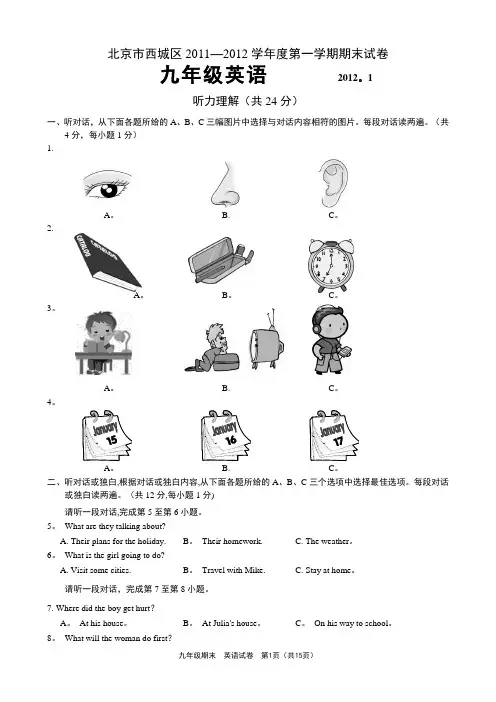
北京市西城区2011—2012学年度第一学期期末试卷九年级英语2012。
1听力理解(共24分)一、听对话,从下面各题所给的A、B、C三幅图片中选择与对话内容相符的图片。
每段对话读两遍。
(共4分,每小题1分)1.A。
B. C。
2.A。
B。
C。
3。
A。
B. C。
4。
A。
B. C。
二、听对话或独白,根据对话或独白内容,从下面各题所给的A、B、C三个选项中选择最佳选项。
每段对话或独白读两遍。
(共12分,每小题1分)请听一段对话,完成第5至第6小题。
5。
What are they talking about?A. Their plans for the holiday. B。
Their homework. C. The weather。
6。
What is the girl going to do?A. Visit some cities. B。
Travel with Mike. C. Stay at home。
请听一段对话,完成第7至第8小题。
7. Where did the boy get hurt?A。
At his house。
B。
At Julia's house。
C。
On his way to school。
8。
What will the woman do first?A。
Take the boy to the hospital. B. Give the doctor a call。
C. Ask Julia for help.请听一段对话,完成第9至第10小题.9. What does George do?A。
He is a reporter。
B. He is an English teacher。
C。
He is a postman。
10. Who is the richest person in the city?A。
George。
B。
Peter Gates。
C。
The woman.请听一段对话,完成第11至第13小题。
九年级英语竞赛试题 A卷(含答案)

2014—2015学年度第一学期期末考试(A 卷)九年级英语一、单项选择 (20分)1. --- do you improve your English? ---By listening to tapes and reading aloud.A. HowB. WhyC. WhoseD. When2. He was so when he heard the news that he got the first prize in the contest. A. exciting, exciting B. exciting, excitedC. excited, excitedD. excited, exciting3. Do you know Zunyi or not tomorrow?A. whether are they leaving forB. whether they are leaving forC. if they are leaving forD. if are they leaving for4. I bought two pens. One is black, is red.A. otherB. othersC. anotherD. the other 5. Our country a lot in the last few years.A. changesB. changedC. will changeD. has changed 6. Her son Coke, but now he milk.A. used to drink, is used to drinkingB. used to drinking, drinksC. is used to drinking, used to drinkD. is used to drink, is drinking7. We can’t do well in examinations we study hard in school time.A. ifB. andC. sinceD. unless8.________ beautiful these postcards are! Where did you get them? A. What a B. How a C. How D What9. I found _____ necessary to save energy and protect the environment.A. thatB. thisC. itD. one10.In our city, _____ middle school students want to work as a teacher in the future. A. thousand B. thousand of C. thousands of D. two thousands of 11. We often see Betty ____ the old man with his housework. A. help B. to help C. helped D. helping 12. My parents like the music ____ is quiet and gentle.A. whoB. thatC. whoseD. those13.—Jack, your hair is too long! —Really? I’ll have it _____ right now.A. cutsB. cuttingC. to cutD. cut14. ---Look! The woman standing there is Mrs Green.---It be Mrs Green , she has been to England.A. mayB. canC. can’tD. mustn’t 15.____you study, ____grades you will get.A. The hard ;the betterB. The harder; the betterC. The hard ;the goodD. The harder ;the good16. My brother is good at drawing. He’s often made make the wall-newspaper.学校 年级 班级 姓名 考号 密 封 线 内 不 准 答 题 ------------------------------------------ ---------密-------------------------------------封------------------------------------------线---------------------------------A. to helpB. help toC. helpD. helps17. ----Would you like some juice or tea ?---- . I only like some water.A .Neither B. None C. All D. Both18.Not only Jim but also Tom and Mary the Great Wall since they came to China.A has visitedB have visitedC will visitD visited19.We prefer to basketball rather than TV.A. to play /.to watch B play /watch C playing / watch D play /watching20.I’m not sure if she me to her party. If she me , I will be pleased.A will invite/ invitesB will invite /will inviteC invites /will inviteD invites / invites二. 完形填空(10分)Every child has his own dream. Every child hopes to be an adult.21, is it really like what they imagine? As a boy22lives in moderntimes and in a modern city, I feel greater pressure(压力)on me with thecity’s development. Although we23worry about money, we still have24problems, such as competition among classmates and expectations from parents. These experiences are very25to our future. But in fact, they really give me a lot of pressure. I still clearly26the happiness of my childhood. 27, we had to face the fact with time passing by. We began to feel this invisible(无形的)pressure come upon us. We28before sunrise and come back after sunset. We work and study like an adult, even harder. What we do is in order to 29an excellent mark. Oh, growing up is boring, but we30try to find happiness while growing up. I think the friendship among our friends, the support from our parents and the encouragement from our teachers can help us. Why not enjoy the pleasure of growing up and its delicious taste?21. A. However B. And C. So D. Although22. A. which B. who C. whom D. whose23. A. always B. usually C. often D. seldom24. A. other B. another C. others D. the others25. A. helpful B. happy C. bad D. hard26. A. think B. remember C. forget D. find27. A. Luckily B. Unluckily C. Impossibly D. Fortunately28. A. get up B. put up C. set up D. give up29. A. become B. get C. buy D. show30. A. should B. shouldn’t C. mustn’t D. can’t三、阅读理解( 30分)AADVERTISEMENTS31. If you want to go out for lunch, you can call .A.83383989B.87969760C.87787238D.8386322332. isn’t closed all year round.A.NEW STAR HOTELB.CHILDREN’S PALACEC.DENNIS SUPERMARKETD.Coffee Shop33. If you want to buy a new dress, you can go to .A.350 Zhong zhou RoadB.743 Nan Chang RoadC.658 Jie fang RoadD.56 East Jian kang Road34. If you daughter wants to take the dance lesson for two weeks, you have to pay .A.160 yuanB.320 yuanC.240 yuanD.300 yuan35. On Oct 5,you can buy something cheaper than it used to be if you come at .A.9:00amB.10:00 pmC.9:30pmD.7:00amB“Homestay” is a form of study abroad program. It allows the visitor to rent a room from a local (当地的) family to better understand the local lifestyle. It also helps to improve the visitor’s language ability, ” said a teacher during a school meeting last term. “Students who wish to learn more about foreign cultures or to get foreign experience should join this kind of holiday. I am sure you won’t be disappointed (失望的). ”After this special meeting, I always thought about this kind of holiday. Last month, I had a chance at last to go on such a holiday with some of my schoolmates and we went to London, a place where I had wanted to go since years ago.As we were still young, we had a group leader who planned things for us and looked after us. After we got to London, we went to stay with different families. I was lucky that my host family (寄宿家庭) was a white couple who had a daughter about my age. They treated me as a daughter of their family during my stay there. They were interested in me and I learnt a lot of things from them, too.The holiday was filled with activities every day. After breakfast, a local teacher would come to take us in his car. Then we would have classes or go on a sight-seeing trip to different places of interest like the Big Ben, the London Bridge, and the Buckingham Palace. We would go back to our own homes after the activities.The holiday was a valuable experience for me. I enjoyed every minute of it. Yet, time really flew fast. Three weeks later, we had to leave “home” for Hong Kong.36. In the “homestay” program, a visitor can.A. learn more about holidaysB. understand his culture betterC. improve the language abilityD. take part in foreign meetings37. The writer had wanted to visit London since .A. last monthB. years agoC. the special meetingD. her stay abroad38. The group leader should .A. make plans for the familyB. take care of the studentsC. stay with different familiesD. rent rooms to the students39. The writer’s host family.A. was very kind to herB. went sight-seeing with herC. had two white daughtersD. was interested in her activities40. From the passage, we know that the writer in London.A. wished to stay a little longerB. spent three weeks in her homeC. had classes in many interesting placesD. helped the teacher take the students in a carCWe have to accept (接受) the truth: sometimes, we just want to shout out loud.For example, we all have days like this: our dog has made a mess on the floor we just cleaned, or our friend called to tell us he or she couldn't come at the last minute when we had cooked dinner for him or her. We may be really angry but we tried to bear things like those. According to ancient Chinese wisdom (智慧).We should shout in a loud voice instead of keeping silent. In fact, it's good for our health.“Chinese people have passed on the practice from ancient times to now as a part of traditional medicine.” said Mrs. Li, a 60-year-old woman from Hangzhou.“My parents taught me to do this. It's a part of our folk (民间的) culture.”Mrs. Li is member of a group of people who love shouting. Each morning, she and some of her friends climb to top of the hill, and let out loud shouts before starting their daily exercise. They believe that shouting is good exercise for their lungs (肺) and it brings them a lot of fun.“Sometimes I shout out and other shout back,” said Mrs. Gu , another shouting lover.“It makes you happy. You laugh and then you feel very comfortable.” X Kb1. ComDr. Peter Calafiura , an American doctor, agrees that shouting can have a positive influence on people's health.So, next time you start your morning run, why not try to shout out first? It will make you healthier.41.The underline word “bear” in Paragraph 2 means “________” in Chinese.A.纠正B.忍受C.铭记D.杜绝42.Mrs.Li learnt to shout to make herself feel better from ________.A. her parentsB. her teacherC. Mrs. Gu D . Dr. Peter Calafiura43.Where does Mrs. Li shout every day?A. In a park.B. At a square.C. In her house.D. On a hill.44.What does Dr. Caliafiura think of shouting?A. It's great fun.B. It's good for people's health.C. It's easy to learn.D. It's good exercise especially for kids.45.The passage is mainly about________.A. a shouting loverB. a shouting clubC. the advantages of shoutingD. the history of shoutingDIf you want to do a school project on children’s rights(权利), you can look on the Internet for some information. A United Nations website can show you plenty of useful information for the project.The United Nations lists the rights of children. Most countries agree all of them, but some countries do not. The following are some of the most important rights of children:◆Children have the right to be properly fed, clothed and sheltered (庇护)by their family. If their family can’t do so, the government should take responsibility.◆Children have the right to an education and medical care, which should be provided by the government.◆Children must not be cruelly punished (惩罚)by their parents or any others.◆Children have the right to expect the government to protect them from all kinds of abuse (虐待)and neglect(忽略).◆No child under fifteen should be made to fight in an army.Children have the right to be protected from being made to work too hard to make money for other people.In some countries children do not have these rights. Many youn g children are made to work long hours in factories and on farms. In some countries there are so few schools that only rich children get an education. There are not enough doctors or nurses to help many children when they are sick.The rights of children are, therefore, the rights people think children should have. They are not always the rights children really have.46. agree with the United Nations’ list of children’s rights.A. All countriesB. A few countriesC. No countriesD. Most countries47. The underlined word “responsibility” in the passage means .A. something people have to doB. something people want to doC. something people know how to doD. something people love to do48. Which of the following sentences is TRUE according to the passage?A. Parents should punish their children.B. Children should make money for other people.C. Governments should protect children from neglect.D. Children under sixteen should not fight in an army.49. S ome children can’t get an education because .A. there aren’t enough schoolsB. there are no schoolsC. they come from rich familiesD. they want to work in factories50. What’s the main idea of this passage?A. Children are made to work long hours on farms.B. The United Nations website is useful for the school project.C. Children have the right to be properly fed, clothed and sheltered.D. The United Nations has listed the rights it thinks children should have.四、词汇运用(一)单词拼写(共5小题;每小题1分,满分5分)1. The naughty boy ran into the(花园)and frightened the little cat away.2 It is the first time that I speak in p_____________. So I’m very nervous.3. We must keep s_______________ in the library..4. Everyone went to the zoo(除了)Wei Ming last Tuesday. Because he had to look after his little brother.5. In China, who(发明)tea that is now very popular all over the world?(二)综合填空(共10小题;每小题1分,满分10分)根据短文内容,用方框中所给词语的适当形式填空,使文章通顺、完整。
2014-2015学年度第一学期期末学九年级英语检测题
2014-2015学年度第一学期期末学九年级英语检测题第Ⅰ卷选择题(90)一、听力。
(每小题1分,共20分)I.听录音,找出你所听到的单词。
读两遍。
( ) 1. A. close B. clean C. clothes( ) 2. A. blackboard B. basketball C. breakfast( ) 3. A. picture B. picnic C. police( ) 4. A. wash B. walk C. watch( ) 5. A. small B. smell C. smileII. 听句子,选择正确的答语。
读两遍。
( ) 6. A. Y ou are welcome. B. Nice to meet you, too. C. Thank you. ( ) 7. A. Sorry to hear that. B. That’s fine. C. Here you are ( ) 8. A. Not very far from here . B. Good idea. C. This way, please. ( ) 9. A. Good to get your message.B. Sure. That’s smith@.C. The Internet is busy enough.( ) 10. A. At two o’clock. B. T wo meters. C. T wo weeks. III. 听对话,回答问题。
每段对话读两遍。
( )11. What will Dorothy do on the weekend ?A. Go out with her friend.B. W ork on her paper.C. Make some plans. ( )12. What was the normal price of the T-shirt?A. $ 15B. $ 30C. $ 50( )13. What has the woman decided to do on Sunday afternoon?A. T o attend a wedding.B. T o visit an exhibition.C. T o meet a friend. ( ) 14. Where does the bank close on Saturday ?A. At 1 : 00 pm.B. At 3 : 00 pm.C. At 4 : 00 pm.( ) 15. A. In a store B. In a classroom. C. In a hotelIV.听短文,回答问题。
北京市西城区2015届九年级上学期期末考试英语试题及答案

北京市西城区 2014—2015 学年度第一学期期末试卷九年级英语2015. 1听力理解( 共 26 分)一、 听对话,从下面各题所给的 A 、B 、C 三幅图片中选择与对话内容相符的图片。
每段对话你将听两遍。
( 共 4 分,每小题 1 分)1.2.3.4.二、 听对话或独白,根据对话或独白的内容,从下面各题所给的 A 、B 、C 三个选项中选择最佳选项。
每段对话或独白你将听两遍。
( 共 12 分,每小题 1 分) 5. 请听一段对话,完成第 5 至第 6 小题。
When are the woman and her sister leaving for the holiday? C. Next month.6. A. Tomorrow.B. Next week.Where will they go this year?B. Australia.C. The UK.A. Canada.7. 请听一段对话,完成第 7 至第 8 小题。
What does the woman want to do at first? C. Change the gloves.8. A. Return the gloves.B. Try on the gloves.How much will the woman pay to get the gloves she wants?C. $ 6.A. $ 29.B. $ 35.请听一段对话,完成第 9 至第 10 小题。
9. What did the man probably do last night?A. He watched a football game.B. He talked with the woman.C. He did some work on his own.10. How much of the film did the woman see?A. The start of the film.B. The end of the film.C. The whole film.请听一段对话,完成第 11 至第 13 小题。
2014-2015学年度第一学期期中检测英语试卷
2014-2015学年度第一学期期中检测九年级英语试题(全卷共120分,考试时间100分钟)一、听力(每小题1分,满分20分)第一部分听对话回答问题本部分共有10道小题,每小题你将听到一段对话,每段对话听两遍。
在听每段对话前,你将有5秒钟的时间阅读题目;听完后,你将有5秒钟的时间选出你认为最合适的答案。
请在听到“嘀”的信号后,进入下一小题。
1.What fruit will the boy have?A. B. C.2.What’s the weather like now?A. B. C.3.What’s Simon’s mother now?A. B. C.4.What sign is mentioned?A. B. C.5.How much does the woman’s daughter pay for the coat? A.$200.B.$100.C.$50.6.What time will Mike watch the concert?A.9:00~12:30 on August l2th.B.8:00~11:30 on August l2th.C.9:00~12:30 on August 20th.7.What Bob is like than he was two years ago?A.He is taller.B.He is stronger.C.Both A and B 8.What does Tom’s mother want him to buy? A.Tomatoes.B.Potatoes.C.Oranges.9.What kind of book does Jane want to borrow?A.Books about pollution B.Books about space C.Books about science 10.Why doesn’t Jim like the Forest Restaurant?A.Because it’s crowded and noisy.B.Because the service is not so good.C.Because the food is terrible.第二部分听对话和短文回答问题你将听到一段对话和两篇短文,各听两遍。
2014-2015学年度上学期期末联考试卷九年级英语(含答案)
2014-2015学年度上学期期末联考试卷九年级英语(全卷四个部分,共8页;满分100分,考试用时120分钟)第一部分听力(共四节,满分25分)做题时,先将答案标在试题卷的相应位置,听力测试结束后,请将试题卷上的答案填到答题卡的相应位置上。
第一节听句子,从题中A, B, C三个选项中选出与所听句子内容相关的图画。
每个句子听两遍。
(共5小题;每小题1分,满分5分)1、A、B、C、2、A、B、C、3、A、B、C、4、A、B、C、5、A、B、C、第二节听句子,从题中A, B, C三个选项中选出与所听句子内容相符的正确答语。
每个句子听两遍。
(共5小题;每小题1分,满分5分)6. A. He’s five. B. I’m ten. C. I’m fine.7. A. It’s his. B. It’s her. C. It’s a cat.8. A. No, I don’t think so. B. My father gave it to me. C. Thank you.9. A. Good idea. B. It’s a fine day. C. I don’t feel well.10. A. In 1989. B. In Beijing. C. In October.第三节听对话,从题中A, B, C三个选项中选出能回答问题的正确选项。
每段对话听两遍。
(共5小题;每小题1分,满分5分)听第一段对话,回答第11,12小题。
11.What’s the conversation about?A. Asking the way.B. Making an order.C. Invitation for supper.12. What doesn’t the man order?A. A bowl of rice.B. Chicken sandwiches.C. Sweet desserts.听第二段对话,回答第13—15小题。
人教版2014-2015学年度上期九年级英语期末复习考试题及答案
人教版2014—2015学年度上期九年级英语期末复习考试题注意:1.本试卷分为听力和笔试两部分。
听力20分,笔试80分,总分100分。
完成时间80分钟。
答 题 卡第一节 听句子,选出该句的最佳答语。
每个句子听两遍。
(共5小题,满分5分)( ) 1. A. No, thanks. I can do it myself. B. Yes, I am. C. Sure. I’ll be glad to.( ) 2. A. No. I went straight home. B. Yes, I’d love to. C. No. I’ll go to the barber’s.( ) 3. A. My pleasure. B. Never mind. C. It’s very kind of you.( ) 4. A. I ’ve no idea. B. No problem. C. It doesn’t matter.( ) 5. A. Yes, I will B. Very well done. C. Thanks. A cup of tea for me, please.第二节 听对话和问题,选择适当的选项。
每段对话听两遍。
(共5小题,每题1分,满分5分)( ) 6. What day is it today?A. It is Monday.B. It is Saturday.C. It is Sunday.( ) 7. How long has the man waited for the bus?A. 5 minutes.B. 30 minutes.C. 35 minutes.( ) 8. How often does Mr. Green go to see his parents?A. Twice a week.B. Tree times a year.C. Twice a month.( ) 9. What’s the date today?A. May 16thB. May 15thC. June 16th( ) 10. What did the man do last night?B. He went to see his friendC. He had a long talk with his friend.第三节听下面一段长对话,然后从每小题A,B,C 中选出能回答每个问题的正确答案。
2014~2015学年上学期期末考试九年级英语试卷附答案
2014~2015学年上学期期末考试九年级英语试卷一、听力理解(20小题,每小题1分,共20分)第一节听下面5段对话。
每段对话后有一个小题,从题中所给的A、B、C三个选项中选出最佳答案,并将其标号填入题前括号内。
每段对话读两遍。
1.Where is Alicc now?A. At home. B,At the supermarket. C.At school.2.Who has got longer hair?A. Sam.B.Tom.C.Tina.3. How is the weather today?A. Windy.B.Rainy.C.Sunny.4.What would the woman like to eat?A. The beef noodles,B.The mutton noodles.C.The tomato noodles.5. When did the woman become an art teacher?A. In 2004.B.In 2006.C.In 2008.第二节听下面几段对话或独白。
每段对话或独白后有几个小题,从题中所给的A、B、C三个选项中选出最佳答案,并将其标号填入题前括号内。
每段对话或独白读两遍。
听下面一段对话。
回答第6至第7两个小题。
6. What are they going to do together?A. Play tennis.B.Watch movies.C.Have violin lessons.7. What time will they meet?A. At 5:30.B.At 6:30.C.At 7:30.听下面一段对话,回答第8至第9两个小题。
8. What did Megan see in the omce?A.A bee.B.A mouse.C.A bird.9. Where did they see it in the office?A. On a chair.B.On a desk.C.Under a desk.听下面一段独白,回答第10至第12三个小题。