
2013年研究生入学考试英语一试题
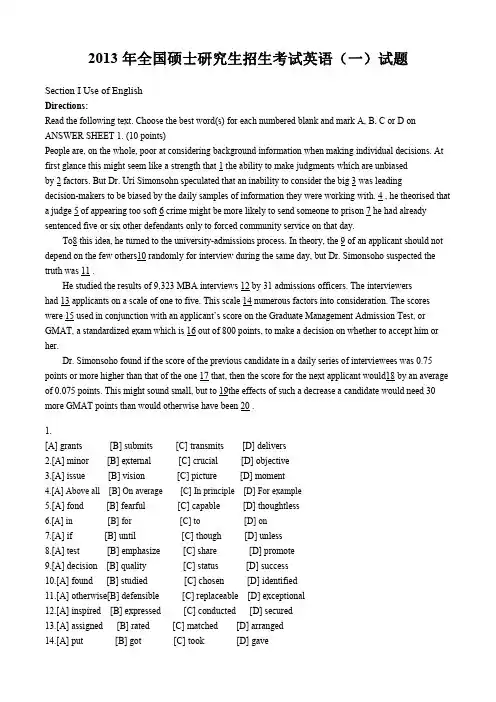
Section I Use of EnglishDirections:Read the following text. Choose the best word(s) for each numbered blank and mark A, B, C or D on ANSWER SHEET 1. (10 points)People are, on the whole, poor at considering background information when makingonly to forced community service on that day。
conjunction with an applicant’s score on the Granduate Managent Adimssion Test,on whether to accept him or her。
Dr. Simonsoho found if the score of the previous candidate in a daily series1.[A]grants [B]submits [C]transmits [D]delivers2. [A] minor [B]objective [C]crucial [D] external3. [A] issue [B]vision [C]picture [D]external4. [A] For example [B] On average [C]In principle [D]Above all5. [A] fond [B] fearful [C]capable [D] thoughtless6. [A] in [B] on [C] to [D] for7. [A] if [B] until [C] though [D] unless8. [A] promote [B] emphasize [C] share [D]success9. [A] decision [B] quality [C] status [D] success10. [A] chosen [B] studied [C] found [D] identified11. [A] exceptional [B] defensible [C] replaceable [D] otherwise12. [A] inspired [B] expressed [C] conducted [D] secured13. [A] assigned [B] rated [C] matched [D] arranged14. [A] put [B] got [C] gave [D] took15. [A] instead [B] then [C] ever [D] rather16. [A] selected [B] passed [C] marked [D] introduced17. [A] before [B] after [C] above [D] below18. [A] jump [B] float [C] drop [D] fluctuate19. [A] achieve [B] undo [C] maintain [D] disregard20. [A] promising [B] possible [C] necessary [D] helpfulSection II Reading ComprehensionPart ADirections:Read the following four texts. Answer the questions below each text by choosing A, B, C or D. Mark your answers on ANSWER SHEET 1. (40 points)Text 1In the 2006 film version of The Devil Wears Prada ,Miranda Priestly, played by Meryl Streep, scolds her unattractive assistant for imagining that high fashion doesn’t affect her, Priestly explains how the deep blue color of the assistant’s sweater descended over the years from fashion shows to departments stores and to the bargain bin in which the poor girl doubtless found her garment。
This top-down conception of the fashion business couldn’t be more out of date or at odds with the feverish would described in Overdressed, Eliazabeth Cline’stechnology have allowed mass-market labels such as Zara ,H&M, and Uniqlo to react to trends more quickly and anticipate demand more precisely. Quicker turnarounds mean less wasted inventory, more frequent release, and more profit. These labelsencourage style-conscious consumers to see clothes as disposable-meant to last only a wash or two, although they don’t advertise that –and to renew their wardrobe every few weeks. By offering on-trend items at dirt-cheap prices, Cline argues, these brands have hijacked fashion cycles, shaking an industry long accustomed to a seasonal pace。
The victims of this revolution , of course ,are not limited to designers. For H&M to offer a $5.95 knit miniskirt in all its 2,300-pius stores around the world, it must rely on low-wage overseas labor, order in volumes that strain natural resources, and use massive amounts of harmful chemicals。
Overdressed is the fashion world’s answer to consumer-activist bestsellers like Michael Pollan’s The Omnivore’s Dilemma. “Mass-produced clothing ,like fast food, fills a hunger and need, yet is non-durable and wasteful,” Cline argues. Americans, she finds, buy roughly 20 billion garments a year – about 64 items per person –and no matter how much they give away, this excess leads to waste。
Towards the end of Overdressed, Cline introduced her ideal, a Brooklyn woman named Sarah Kate Beaumont, who since 2008 has made all of her own clothes – and beautifully. But as Cline is the first to note, it took Beaumont decades to perfect her craft; her example can’t be knocked off。
Though several fast-fashion companies have made efforts to curb their impact on labor and the environment – including H&M, with its green Conscious Collection line –Cline believes lasting change can only be effected by the customer. She exhibits the idealism common to many advocates of sustainability, be it in food or in energy. Vanity is a constant; people will only start shopping more sustainably when they can’t afford not to。
21. Priestly criticizes her assistant for her[A] poor bargaining skill。
[B] insensitivity to fashion。
[C] obsession with high fashion。
[D] lack of imagination。
22. According to Cline, mass-maket labels urge consumers to[A] combat unnecessary waste。
2013年全国考研英语一真题及答案.doc
2013年全国硕士研究生入学考试英语一真题及答案Section I Use of EnglishPeople are, on the whole, poor at considering background information when making individual decisions. At first glance this might seem like a strength that 1 the ability to make judgments which are unbiased by 2 factors. But Dr. Uri Simonsohn speculated that an inability to consider the big 3 was leading decision-makers to be biased by the daily samples of information they were working with. 4 , he theorised that a judge 5 of appearing too soft 6 crime might be more likely to send someone to prison 7 he had already sentenced five or six other defendants only to forced community service on that day.To 8 this idea, he turned to the university-admissions process. In theory, the 9 of an applicant should not depend on the few others 10 randomly for interview during the same day, but Dr. Simonsohn suspected the truth was 11 .He studied the results of 9,323 MBA interviews 12 by 31 admissions officers. The interviewers had 13 applicants on a scale of one to five. This scale 14 numerous factors into consideration. The scores were 15 used in conjunction with an applicant’s score on the Graduate Management Admission Test, or GMAT, a standardized exam which is 16 out of 800 points, to make a decision on whether to accept him or her.Dr. Simonsohn found if the score of the previous candidate in a daily series of interviewees was 0.75 points or more higher than that of the one 17 that, then the score for the next applicant would 18 by an average of 0.075 points. This might sound small, but to 19 the effects of such a decrease a candidate could need 30 more GMAT points than would otherwise have been 20 .1. [A]grants [B]submits [C]transmits [D]delivers2. [A]minor [B]objective [C]crucial [D] external3. [A]issue [B]vision [C]picture [D]external4. [A] For example [B] On average [C]In principle [D]Above all5. [A]fond [B]fearful [C]capable [D] thoughtless6. [A] in [B] on [C]to [D] for7. [A] if [B] until [C] though [D] unless8. [A] promote [B] emphasize [C]share [D]test9. [A] decision [B] quality [C] status [D] success10. [A] chosen [B] studied [C] found [D] identified11. [A] exceptional [B] defensible [C] replaceable [D] otherwise12. [A] inspired [B] expressed [C] conducted [D] secured13. [A] assigned [B] rated [C] matched [D] arranged14. [A] put [B] got [C] gave [D] took15. [A] instead [B] then [C] ever [D] rather16. [A] selected [B] passed [C] marked [D] introduced17. [A] before [B] after [C] above [D] below18. [A] jump [B] float [C] drop [D] fluctuate19. [A] achieve [B] undo [C] maintain [D] disregard20. [A] promising [B] possible [C] necessary [D] helpfulText 1In the 2006 film version of The Devil Wears Prada, Miranda Priestly, played by Meryl Streep, scolds her unattractive assistant for imagini ng that high fashion doesn’t affect her, Priestly explains how the deep blue color of the assistant’s sweater descended over the years from fashion shows to departments stores and to the bargain bin in which the poor girl doubtless found her garment.This top-down conception of the fashion business couldn’t be more out of date or at odds with the feverish would be described in Overdressed, Elizabeth Cline’s three-year indictment of “fast fashion”. In the last decade or so, advances in technology have allowe d mass-market labels such as Zara, H&M, and Uniqlo to react to trends more quickly and anticipate demand more precisely. Quicker turnarounds mean less wasted inventory, more frequent release, and more profit. These labels encourage style-conscious consumers to see clothes as disposable-meant to last only a wash or two, although they don’t advertise that –and to renew their wardrobe every few weeks. By offering on-trend items at dirt-cheap prices, Cline argues, these brands have hijacked fashion cycles, shaking an industry long accustomed to a seasonal pace.The victims of this revolution, of course, are not limited to designers. For H&M to offer a $5.95 knit miniskirt in all its 2,300-pius stores around the world, it must rely on low-wage overseas labor, order in volumes that strain natural resources, and use massive amounts of harmful chemicals.Overdressed is the fashion world’s answer to consumer-activist bestsellers like Michael Pollan’s The Omnivore’s Dilemma. “Mass-produced clothing, like fast food, fills a hunger and need, yet is non-durable and wasteful,” Cline argues. Americans, she finds, buy roughly 20 billion garments a year – about 64 items per person – and no matter how much they give away, this excess leads to waste.Towards the end of Overdressed, Cline introduced her ideal, a Brooklyn woman named Sarah Kate Beaumont, who since 2008 has made all of her own clothes – and beautifully. But as Cline is the first to note, it took Beaumont decades to perfect her craft; her example can’t be knocked off.Though several fast-fashion companies have made efforts to curb their impact on labor and the environment – including H&M, with its green Conscious Collection line –Cline believes lasting change can only be effected by the customer. She exhibits the idealism common to many advocates of sustainability, be it in food or in energy. Vanity is a constant; people will only start shopping more sustainably when they can’t afford not to.21. Priestly criticizes her assistant for her[A] poor bargaining skill.[B] insensitivity to fashion.[C] obsession with high fashion.[D] lack of imagination.22. According to Cline, mass-market labels urge consumers to[A] combat unnecessary waste.[B] shut out the feverish fashion world.[C] resist the influence of advertisements.[D] shop for their garments more frequently.23. The word “indictment” (Line 3, Para.2) is closest in meaning to[A] accusation.[B] enthusiasm.[C] indifference.[D] tolerance.24. Which of the following can be inferred from the last paragraph?[A] Vanity has more often been found in idealists.[B] The fast-fashion industry ignores sustainability.[C] People are more interested in unaffordable garments.[D] Pricing is vital to environment-friendly purchasing.25. What is the subject of the text?[A] Satire on an extravagant lifestyle.[B] Challenge to a high-fashion myth.[C] Criticism of the fast-fashion industry.[D] Exposure of a mass-market secret.Text 2An old saying has it that half of all advertising budgets are wasted-the trouble is, no one knows which half. In the internet age, at least in theory, this fraction can be much reduced. By watching what people search for, click on and say online, companies can aim “behavioural” ads at those most likely to buy.In the past couple of weeks a quarrel has illustrated the value to advertisers of such fine-grained information: Should advertisers assume that people are happy to be tracked and sent behavioural ads? Or should they have explicit permission?In December 2010 America's Federal Trade Commission (FTC) proposed adding a "do not track "(DNT) option to internet browsers ,so that users could tell advertisers that they did not want to be followed .Microsoft's Internet Explorer and Apple's Safari both offer DNT ;Google's Chrome is due to do so this year. In February the FTC and Digital Advertising Alliance (DAA) agreed that the industry would get cracking on responding to DNT requests.On May 31st Microsoft Set off the row: It said that Internet Explorer 10, the version due to appear windows 8, would have DNT as a default.It is not yet clear how advertisers will respond. Getting a DNT signal does not oblige anyone to stop tracking, although some companies have promised to do so. Unable to tell whether someone really objects to behavioural ads or whether they are sticking with Microsoft’s default, some may ignore a DNT signal and press on anyway.Also unclear is why Microsoft has gone it alone. After all, it has an ad business too, which it says will comply with DNT requests, though it is still working out how. If it is trying to upset Google, which relies almost wholly on default will become the norm. DNT does not seem an obviously huge selling point for windows 8-though the firm has compared some of its other products favourably with Google's on that count before. Brendon Lynch, Microsoft's chief privacy officer, blogged: "we believe consumers should have more control." Could it really be that simple?26. It is suggested in paragraph 1 that “behavioural” ads help advertisers to:[A] ease competition among themselves[B] lower their operational costs[C] avoid complaints from consumers[D] provide better online services27. “The industry” (Line 6,Para.3) refers to:[A] online advertisers[B] e-commerce conductors[C] digital information analysis[D] internet browser developers28. Bob Liodice holds that setting DNT as a default[A] many cut the number of junk ads[B] fails to affect the ad industry[C] will not benefit consumers[D] goes against human nature29. Which of the following is true according to Paragraph.6?[A] DNT may not serve its intended purpose[B] Advertisers are willing to implement DNT[C] DNT is losing its popularity among consumers[D] Advertisers are obliged to offer behavioural ads30. The author's attitude towards what Brendon Lynch said in his blog is one of:[A] indulgence[B] understanding[C] appreciation[D] skepticismText 3Up until a few decades ago, our visions of the future were largely - though by no means uniformly - glowingly positive. Science and technology would cure all the ills of humanity, leading to lives of fulfillment and opportunity for all.Now utopia has grown unfashionable, as we have gained a deeper appreciation of the range of threats facing us, from asteroid strike to epidemic flu and to climate change. You might even be tempted to assume that humanity has little future to look forward to.But such gloominess is misplaced. The fossil record shows that many species have endured for millions of years - so why shouldn't we? Take a broader look at our species' place in the universe, and it becomes clear that we have an excellent chance of surviving for tens, if not hundreds, of thousands of years. Look up Homo sapiens in the "Red List" of threatened species of the International Union for the Conversation of Nature (IUCN) ,and you will read: "Listed as Least Concern as the species is very widely distributed, adaptable, currently increasing, and there are no major threats resulting in an overall population decline."So what does our deep future hold? A growing number of researchers and organizations are now thinking seriously about that question. For example, the Long Now Foundation has its flagship project a medical clock that is designed to still be marking time thousands of years hence.Perhaps willfully, it may be easier to think about such lengthy timescales than about the more immediate future. The potential evolution of today's technology, and its social consequences, is dazzlingly complicated, and it's perhaps best left to science fiction writers and futurologists to explore the many possibilities we can envisage. That's one reason why we have launched Arc, a new publication dedicated to the near future.But take a longer view and there is a surprising amount that we can say with considerable assurance. As so often, the past holds the key to the future: we have now identified enough of the long-term patterns shaping the history of the planet, and our species, to make evidence-based forecasts about the situations in which our descendants will find themselves.This long perspective makes the pessimistic view of our prospects seem more likely to be a passing fad. To be sure, the future is not all rosy. But we are now knowledgeable enough to reduce many of the risks that threatened the existence of earlier humans, and to improve the lot of those to come.31. Our vision of the future used to be inspired by[A] our desire for lives of fulfillment[B] our faith in science and technology[C] our awareness of potential risks[D] our belief in equal opportunity32. The IUCN’s “Red List” suggest that human being are[A] a sustained species[B] a threaten to the environment[C] the world’s dominant power[D] a misplaced race33. Which of the following is true according to Paragraph 5?[A] Arc helps limit the scope of futurological studies.[B] Technology offers solutions to social problem.[C] The interest in science fiction is on the rise.[D] Our Immediate future is hard to conceive.34. To ensure the future of mankind, it is crucial to[A] explore our planet’s abundant resources[B] adopt an optimistic view of the world[C] draw on our experience from the past[D] curb our ambition to reshape history35. Which of the following would be the best title for the text?[A] Uncertainty about Our Future[B] Evolution of the Human Species[C] The Ever-bright Prospects of Mankind[D] Science, Technology and HumanityText 4On a five to three vote, the Supreme Court knocked out much of Arizona’s immigration law Monday-a modest policy victory for the Obama Administration. But on the more important matter of the Constitution, the decision was an 8-0 defeat for the Administration’s effort to upset the balance of power between the federal government and the states.In Arizona v. United States, the majority overturned three of the four contested provisions of Arizona’s controversial plan to have state and local police enforce federal immigration law. The Constitutional principles that Washington alone has the power to “establish a uniform Rule of Naturalization ”and that federal laws precede st ate laws are noncontroversial . Arizona had attempted to fashion state policies that ran parallel to the existing federal ones.Justice Anthony Kennedy, joined by Chief Justice John Roberts and the Court’s liberals, ruled that the state flew too close to the federal sun. On the overturned provisions the majority held the congress had deliberately “occupied the field” and Arizona had thus intruded on the federal’s privileged powers.However, the Justices said that Arizona police would be allowed to verify the legal status of people who come in contact with law enforcement. That’s because Congress has always envisioned joint federal-state immigration enforcement and explicitly encourages state officers to share information and cooperate with federal colleagues.Two of the three objecting Justice-Samuel Alito and Clarence Thomas-agreed with this Constitutional logic but disagreed about which Arizona rules conflicted with the federal statute. The only major objection came from Justice Antonin Scalia, who offered an even more robust defense of state privileges going back to the Alien and Sedition Acts.The 8-0 objection to President Obama turns on what Justice Samuel Alito describes in his objection as “a shocking assertion of federal executive power”. The White Ho use argued that Arizona’s laws conflicted with its enforcement priorities, even if state laws complied with federal statutes to the letter. In effect, the White House claimed that it could invalidate any otherwise legitimate state law that it disagrees with.Some powers do belong exclusively to the federal government, and control of citizenship and the borders is among them. But if Congress wanted to prevent states from using theirown resources to check immigration status, it could. It never did so. The administration was in essence asserting that because it didn’t want to carry out Congress’s immigration wishes, no state should be allowed to do so either. Every Justice rightly rejected this remarkable claim.36. Three provisions of Arizona’s plan were over turned because they[A] deprived the federal police of Constitutional powers.[B] disturbed the power balance between different states.[C] overstepped the authority of federal immigration law.[D] contradicted both the federal and state policies.37. On which of the following did the Justices agree, according to Paragraph4?[A] Federal officers’ duty to withhold immigrants ‘information.[B] States’ independence from federal immigration law.[C] States’ legitimate role in immigration enforcement.[D] Congre ss’s intervention in immigration enforcement.38. It can be inferred from Paragraph 5 that the Alien and Sedition Acts[A] violated the Constitution.[B] undermined the states’ interests.[C] supported the federal statute.[D] stood in favor of the states.39. The White House claims that its power of enforcement[A] outweighs that held by the states.[B] is dependent on the states’ support.[C] is established by federal statutes.[D] rarely goes against state laws.40. What can be learned from the last paragraph?[A] Immigration issues are usually decided by Congress.[B] Justices intended to check the power of the Administration.[C] Justices wanted to strengthen its coordination with Congress.[D] The Administration is dominant over immigration issues.Section IV WritingPart A51. Directions:Write an e-mail of about 100 words to a foreign teacher in your college, inviting him/her to be a judge for the upcoming English speech contest.You should include the details you think necessary.You should write neatly on the ANSWER SHEET 2.Do not sign your own name at the end of the e-mail, Use "Li Ming" instead.Do not write the address. (10 points)Part B52. Directions:Write an essay of 160-200 words based on the following drawing. In your essay you should1) describe the drawing briefly2) explain its intended meaning, and3) give your commentsYou should write neatly on ANSWER SHEET 2. (20 points)参考答案Section I Use of English1. A. grants2. D. external3. C. picture4. A. For example5. B. fearful6. B. on7. A. if8. D. test9. D. success10. A. chosen11. D. otherwise12. C. conducted13. B. rated14. D. took15. B. then16. C. marked17. A. before18. C. drop19. B. undo20. C. necessarySection II Reading ComprehensionPart AText 1 (In the 2006)21. B. insensitivity to fashion22. D. shop for their garment more frequently23. A. accusation24. D. pricing is vital to environment-friendly purchasing25. C. criticism of the fast-fashion industryText 2 (An old saying)26. B. lower their operational costs27. D. internet browser developers28. C. will not benefit consumers29. A. DNT may not serve its intended purpose30. D. skepticismText 3 (Now utopia)31. B. our faith in science and technology32. A. sustained species33. D. our immediate future is hard to conceive34. C. draw on our experience from the past35. C. the ever-bright prospects of mankindText 4 (On a five to three)36. C. overstepped the authority of federal immigration37. C. states’ legitimate role in immigration enforcement38. D. stood in favor of the states39. A. outweighs that held by the states40. D. The Administration is dominant over immigration issues.Part B41. E. These issues all have root causes in human behavior...42. F. Despite these factors...43. B. However, the numbers are still small...44. G. During the late 1990s...45. C. The idea is to force social to integrate...Section III Translation46. 然而,看着无家可归者绘制出的花园图片时,人们会突然意识到,尽管这些花园风格多样,它们都显示了人类除了装饰和创造性表达之外的其他各种基本诉求47. 一块神圣的和平之地,不管它有多么粗糙,它都是一种人类本能的需求,和庇护所相反,那只是动物的本能需求。
2013年全国硕士研究生入学统一考试英语一试题
2013年全国硕士研究生入学统一考试英语一试题(完整版)Section ⅠUse of EnglishDirections: Read the following text. Choose the best word(s)for each numbered blank and mark A, B, C or D on ANSWER SHEET 1. (10 points)People are, on the whole, poor at considering background information when making individual decisions. At first glance this might seem like a strength that 1 the ability to make judgments which are unbiased by 2 factors. But Dr. Uri Simonsohn speculated that an inability to consider the big 3 was leading decision-makers to be biased by the daily samples of information they were working with. 4 , he theorised that a judge 5 of appearing too soft 6 crime might be more likely to send someone to prison 7 he had already sentenced five or six other defendants only to probation on that day.To 8 this idea, he turned to the university-admissions process. In theory, the 9 of an applicant should not depend on the few others 10 randomly for interview during the same day, but Dr Simonsohn suspected the truth was 11 .He studied the results of 9,323 MBA interviews, 12 by 31 admissions officers. The interviewers had 13 applicants on a scale of one to five. This scale 14 numerous factors into consideration. The scores were 15 used in conjunction with an applicant's score on the Graduate Management Admission Test, or GMAT, a standardised exam which is 16 out of 800 points, to make a decision on whether to accept him or her.Dr Simonsohn found if the score of the previous candidate in a daily series of interviewees was 0.75 points or more higher than that of the one 17 that, then the score for the next applicant would 18 by an average of 0.075 points. This might sound small, but to 19 the effects of such a decrease a candidate would need 30 more GMAT points than would otherwise have been 20 .1.[A] grant [B] submits [C] transmits [D] delivers2.[A] minor [B]objective [C] crucial [D] external3.[A] issue [B] vision [C] picture[D] moment4.[A] For example [B] On average[C] In principle[D] Above all5.[A] fond [B]fearful [C] capable [D] thoughtless6.[A] in [B] on [C] to [D] for7.[A] if [B]until [C] though[D] unless8.[A] promote [B]emphasize [C] share[D] test9.[A] decision [B] quality [C] status [D] success10.[A] chosen[B]stupid [C]found [D] identified11.[A] exceptional [B] defensible[C] replaceable[D] otherwise12.[A] inspired [B]expressed [C] conducted [D] secured13.[A] assigned [B]rated [C] matched [D] arranged14.[A] put [B]got [C]gave [D] took15.[A]instead [B]then [C] ever[D] rather16.[A]selected [B]passed [C] marked [D] introduced17.[A]before [B] after[C] above [D] below18.[A] jump [B] float [C] drop [D] fluctuate19.[A]achieve [B]undo [C] maintain[D]disregard20. [A] promising [B] possible[C] necessary [D] helpfulSection ⅡReading ComprehensionPart ADirections:Read the following four texts. Answer the questions after each text by choosing A, B, Cor D. Mark your answers on ANSWER SHEET 1. (40 points)Text 1In the 2006 film version of The Devil Wears Prada, Miranda Priestly, played by Meryl Streep, scold her unattractive assistant for imagining that high fashion doesn’t affect her. Priestly explains how the deep blue color of the assistant’s sweater descended o ver the years from fashion shows to department stores and to the bargain bin in which the poor girl doubtless found her garment.This top-down conception of the fashion business couldn’t be more out of date or at odds with feverish world described in O verdressed, Elizabeth Cline’s three-year indictment of “fast fashion”。
2013年考研英语真题及答案(完整版)
3.[A] issue [B] vision [C] picture [D] moment4.[A] For example [B] On average [C] In principle [D] Above all5.[A] fond [B]fearful [C] capable [D] thoughtless6.[A] in [B] on [C] to [D] for7.[A] if [B]until [C] though [D] unless8.[A] promote [B]emphasize [C] share [D] test9.[A] decision [B] quality [C] status [D] success10.[A] chosen [B]stupid [C]found [D] identified11.[A] exceptional [B] defensible [C] replaceable [D] otherwise12.[A] inspired [B]expressed [C] conducted [D] secured13.[A] assigned [B]rated [C] matched [D] arranged14.[A] put [B]got [C]gave [D] took15.[A]instead [B]then [C] ever [D] rather16.[A]selected [B]passed [C] marked [D] introduced17.[A]before [B] after [C] above [D] below18.[A] jump [B] float [C] drop [D] fluctuate19.[A]achieve [B]undo [C] maintain [D]disregard20. [A] promising [B] possible [C] necessary [D] helpful答案:1-5: ADCAB6-10: BADDA11-15: DCBDB16-20: CACBC答案详解:2013年的完型填空是一篇选自《经济学人》名为A Question of Judgment的文章。
2013年考研英语(一)真题及参考答案
2013年全国硕士研究生入学统一考试英语(一)真题及参考答案Section I Use of EnglishDirections: Read the following text. Choose the best word(s) for each numbered blank and mark A, B, C or D on ANSWER SHEET 1. (10 points)People are, on the whole, poor at considering background information when making individual decisions. At first glance this might seem like a strength that __1_ the ability to make judgments which are unbiased by _2_ factors. But Dr Simonsohn speculated that an inability to consider the big _3_ was leading decision-makers to be biased by the daily samples of information they were working with. _4_, he theorised that a judge _5_ of appearing too soft _6_crime might be more likely to send someone to prison __7_he had already sentenced five or six other defendants only to forced community service on that day.To __8__this idea, they turned their attention to the university-admissions process. In theory, the ____9___ of an applicant should not depend on the few others___10____ randomly for interview during the same day, but Dr Simonsohn suspected the truth was____11____.He studied the results of 9,323 MBA interviews _12_ by 31 admissions officers. The interviewers had _13_ applicants on a scale of one to five. This scale _14_ numerous factors into consideration. The scores were _15_ used in conjunction with an applicant’s score on the GMAT, a standardised exam which is _16_out of 800 points, to make a decision on whether to accept him or her.Dr Simonsohn found if the score of the previous candidate in a daily series of interviewees was 0.75 points or more higher than that of the one _17__ that, then the score for the next applicant would_18_ by an average of 0.075 points. This might sound small, but to_19_the effects of such a decrease a candidate would need 30 more GMAT points than would otherwise have been _20__.1. A grants B submits C transmits D dilivers2. A minor B external C crucial D objective3. A issue B vision C picture D moment4. A Above all B On average C In principle D For example5. A fond B fearful C capable D thoughtless6. A in B for C to D on7. A if B until C though D unless8. A. test B.emphasize C.share D.promote9. A.decision B.quality C.status D.success10. A.found B.studied C.chosen D.identified11. A.otherwise B.defensible C.replaceable D.exceptional12. A. inspired B. expressed C. conducted D. secured13. A. assigned B. rated C. matched D. arranged14. A. put B. got C. took D. gave15. A. instead B. then C. ever D. rather16. A. selected B. passed C. marked D. introduced17. A below B after C above D before18. A jump B float C fluctuate D drop19. A achieve B undo C maintain D disregard20. A necessary B possible C promising D helpfulSection II Reading ComprehensionPart ADirections: Read the following fourtexts. Answer the questions below each text by choosing A, B, C or D. Mark your answers on ANSWER SHEET 1. (40 points)Text 1In the 2006 film version of The Devil Wears Prada ,Miranda Priestly, played by Meryl Streep, scolds her unattractive assistant for imagining that high fashion doesn’t affect her, Priestly explains how the deep blue color of the assistant’s sweater descended over the years from fashion shows to departments stores and to the bargain bin in which the poor girl doubtless found her garment.This top-down conception of the fashion business couldn’t be more out of date or at odds with the feverish would described in Overdressed, Eliazabeth Cline’s three-year indictment of “fast fashion”. In the last decade or so ,advances in technology have allowed mass-market labels such as Zara ,H&M, and Uniqlo to react to trends more quickly and anticipate demand more precisely. Quicker turnarounds mean less wasted inventory, more frequent release, and more profit. These labels encourage style-conscious consumers to see clothes as disposable-meant to last only a wash or two, although they don’t advertise that –and to renew their wardrobe every few weeks. By offering on-trend items at dirt-cheap prices, Cline argues, these brands have hijacked fashion cycles, shaking an industry long accustomed to a seasonal pace.The victims of this revolution , of course ,are not limited to designers. For H&M to offer a $5.95 knit miniskirt in all its 2,300-pius stores around the world, it must rely on low-wage overseas labor, order in volumes that strain natural resources, and use massive amounts of harmful chemicals.Overdressed is the fashion world’s answer to consumer-activist bestsellers like Michael Pollan’s The Omnivore’s Dilemma. “Mass-produced clothing ,like fast food, fills a hunger and need, yet is non-durable and wasteful,”Cline argues. Americans, she finds, buy roughly 20 billion garments a year –about 64 items per person –and no matter how much they give away, this excess leads to waste.Towards the end of Overdressed, Cline introduced her ideal, a Brooklyn woman named Sarah Kate Beaumont, who since 2008 has made all of her own clothes –and beautifully. But as Cline is the first to note, it took Beaumont decades to perfect her craft; her example can’t be knocked off.Though several fast-fashion companies have made efforts to curb their impact on labor and the environment –including H&M, with its green Conscious Collection line –Cline believes lasting change can only be effected by the customer. She exhibits the idealism common to many advocates of sustainability, be it in food or in energy. Vanity is a constant; people will only start shopping more sustainably when they can’t afford not to.21. Priestly criticizes her assistant for her[A] poor bargaining skill.[B] insensitivity to fashion.[C] obsession with high fashion.[D] lack of imagination.22. According to Cline, mass-maket labels urge consumers to[A] combat unnecessary waste.[B] shut out the feverish fashion world.[C] resist the influence of advertisements.[D] shop for their garments more frequently.23. The word “indictment”(Line 3, Para.2) is closest in meaning to[A] accusation.[B] enthusiasm.[C] indifference.[D] tolerance.24. Which of the following can be inferred from the lase paragraph?[A] Vanity has more often been found in idealists.[B] The fast-fashion industry ignores sustainability.[C] People are more interested in unaffordable garments.[D] Pricing is vital to environment-friendly purchasing.25. What is the subject of the text?[A] Satire on an extravagant lifestyle.[B] Challenge to a high-fashion myth.[C] Criticism of the fast-fashion industry.[D] Exposure of a mass-market secret.Text 2An old saying has it that half of all advertising budgets are wasted-the trouble is, no one knows which half . In the internet age, at least in theory ,this fraction can be much reduced . By watching what people search for, click on and say online, companies can aim “behavioural”ads at those most likely to buy.In the past couple of weeks a quarrel has illustrated the value to advertisers of such fine-grained information: Should advertisers assume that people are happy to be tracked and sent behavioural ads? Or should they have explicit permission?In December 2010 America's Federal Trade Cornmission (FTC) proposed adding a "do not track "(DNT) option to internet browsers ,so that users could tell adwertisers that they did not want to be followed .Microsoft's Internet Explorer and Apple's Safari both offer DNT ;Google's Chrome is due to do so this year. In February the FTC and Digltal Adwertising Alliance (DAA) agreed that the industry would get cracking on responging to DNT requests.On May 31st Microsoft Set off the row: It said that Internet Explorer 10,the version due to appear windows 8, would have DNT as a default.It is not yet clear how advertisers will respond. Geting a DNT signal does not oblige anyone to stop tracking, although some companies have promised to do so. Unable to tell whether someone really objects to behavioural ads or whether they are sticking with Microsoft’s default, some may ignore a DNT signal and press on anyway.Also unclear is why Microsoft has gone it alone. Atter all, it has an ad business too, which it says will comply with DNT requests, though it is still working out how. If it is trying to upset Google, which relies almost wholly on default will become the norm. DNT does not seem an obviously huge selling point for windows 8-though the firm has compared some of its other products favourably with Google's on that count before. Brendon Lynch, MMicrosoft's chief privacy officer, bloggde:"we believe consumers should have more control." Could it really be that simple?26. It is suggested in paragraph 1 that “behavioural”ads help advertisers to:[A] ease competition among themselves[B] lower their operational costs[C] avoid complaints from consumers[D] provide better online services27. “The industry”(Line 6,Para.3) refers to:[A] online advertisers[B] e-commerce conductors[C] digital information analysis[D] internet browser developers28. Bob Liodice holds that setting DNT as a default[A] many cut the number of junk ads[B] fails to affect the ad industry[C] will not benefit consumers[D] goes against human nature29. which of the following is ture according to Paragraph.6?[A] DNT may not serve its intended purpose[B] Advertisers are willing to implement DNT[C] DNT is losing its popularity among consumers[D] Advertisers are obliged to offer behavioural ads30. The author's attitude towards what Brendon Lynch said in his blog is one of:[A] indulgence[B] understanding[C] appreciaction[D] skepticismText 3Up until a few decades ago, our visions of the future were largely - though by no means uniformly - glowingly positive. Science and technology would cure all the ills of humanity, leading to lives of fulfillment and opportunity for all.Now utopia has grown unfashionable, as we have gained a deeper appreciation of the range of threats facing us, from asteroid strike to epidemic flu and to climate change. You might even be tempted to assume that humanity has little future to look forward to.But such gloominess is misplaced. The fossil record shows that many species have endured for millions of years - so why shouldn't we? Take a broader look at our species' place in the universe, and it becomes clear that we have an excellent chance of surviving for tens, if not hundreds, of thousands of years . Look up Homo sapiens in the "Red List" of threatened species of the International Union for the Conversation of Nature (IUCN) ,and you will read: "Listed as Least Concern as the species is very widely distributed, adaptable, currently increasing, and there are no major threats resulting in an overall population decline."So what does our deep future hold? A growing number of researchers and organisations are now thinking seriously about that question. For example, the Long Now Foundation has its flagship project a medical clock that is designed to still be marking time thousands of years hence .Perhaps willfully , it may be easier to think about such lengthy timescales than about the more immediate future. The potential evolution of today's technology, and its socialconsequences, is dazzlingly complicated, and it's perhaps best left to science fiction writers and futurologists to explore the many possibilities we can envisage. That's one reason why we have launched Arc, a new publication dedicated to the near future.But take a longer view and there is a surprising amount that we can say with considerable assurance. As so often, the past holds the key to the future: we have now identified enough of the long-term patterns shaping the history of the planet, and our species, to make evidence-based forecasts about the situations in which our descendants will find themselves.This long perspective makes the pessimistic view of our prospects seem more likely to be a passing fad. To be sure, the future is not all rosy. But we are now knowledgeable enough to reduce many of the risks that threatened the existence of earlier humans, and to improve the lot of those to come.31. Our vision of the future used to be inspired by[A] our desire for lives of fulfillment[B] our faith in science and technology[C] our awareness of potential risks[D] our belief in equal opportunity32. The IUCN’s “Red List”suggest that human being are[A] a sustained species[B] a threaten to the environment[C] the world’s dominant power[D] a misplaced race33. Which of the following is true according to Paragraph 5?[A] Arc helps limit the scope of futurological studies.[B] Technology offers solutions to social problem.[C] The interest in science fiction is on the rise.[D] Our Immediate future is hard to conceive.34. To ensure the future of mankind, it is crucial to[A] explore our planet’s abundant resources[B] adopt an optimistic view of the world[C] draw on our experience from the past[D] curb our ambition to reshape history35. Which of the following would be the best title for the text?[A] Uncertainty about Our Future[B] Evolution of the Human Species[C] The Ever-bright Prospects of Mankind[D] Science, Technology and HumanityText 4On a five to three vote,the Supreme Court knocked out much of Arizona's immigration law Monday-a modest policy victory for the Obama Aministration.But on the more important matter of the Constitution,the decision was an 8-0 defeat for the federal government and the states.An arizona.United States,the majority overturned three of the four contested provisions of Arizona's controversial plan to have state and local police enfour federal immigrations law.The Constitutional principles that Washington alone has the power to "establish a uniform Rule of Anturalization" and that federal laws precede state laws are noncontroversial.Arizona had attempted to fashion state police that ran to the existing federal ones.Justice Anthony Kennedy,joined by Chief Justice John Roberts and the Court's liberals,ruled that the state flew too close to the federal sun .On the overturned provisions the majority held the congress had deliberately "occupied the field " and Arizona had thus intruded on the federal's privileged powersHowever,the Justices said that Arizona police would be allowed to verify the legal status of people who come in contact with law enforcement.That’s because Congress has always envisioned joint federal-state immigration enforcement and explicitly encourages state officers to share information and cooperate with federal colleagues.Two of the three objecting Justice-Samuel Alito and Clarence Thomas-agreed with this Constitutional logic but disagreed about which Arizona rules conflicted with the federal statute. The only major objection came from Justice Antonin Scalia,who offered an even more robust defense of state privileges going back to the alien and Sedition Acts.The 8-0 objection to President Obama tures on what Justice Samuel Alito describes in his objection as “a shocking assertion assertion of federal executive power”. The White House argued tha Arizona’s laws conflicted with its enforcement priorities, even if state laws complied with federal statutes to the letter. In effect, the White House claimed that it could invalidate any otherwise legitimate state law that it disagrees with.Some powers do belong exclusively to the federal government,and control of citizenship and the borders is among them. But if Congress wanted to prevent states from using their own resources to check immigration status,it could.It could.It never did so.The administration was in essence asserting that because it didn't want to carry out Congress's immigration wishes,no state should be allowed to do so either.Every Justice rightly rejected this remarkable claim.36. Three provisions of Arizona’s plan were overturned because they[A] deprived the federal police of Constitutional powers.[B] disturbed the power balance between different states.[C] overstepped the authority of federal immigration law.[D] contradicted both the federal and state policies.37. On which of the following did the Justices agree,according to Paragraph4?[A] Federal officers’duty to withhold immigrants’information.[B] States’independence from federal immigration law.[C] States’legitimate role in immigration enforcement.[D] Congress’s intervention in immigration enforcement.38. It can be inferred from Paragraph 5 that the Alien and Sedition Acts[A] violated the Constitution.[B] undermined the states’interests.[C] supported the federal statute.[D] stood in favor of the states.39. The White House claims that its power of enforcement[A] outweighs that held by the states.[B] is dependent on the states’support.[C] is established by federal statutes.[D] rarely goes against state laws.40. What can be learned from the last paragraph?[A] Immigration issues are usually decided by Congress.[B] Justices intended to check the power of the Administrstion.[C] Justices wanted to strengthen its coordination with Congress.[D] The Administration is dominant over immigration issues.Part BDirections:In the following text, some sentences have been removed. For Questions 41-45, choose the most suitable one from the list A-G to fit into each of the numbered blanks. There are two extra choices, which do not fit in any of the blanks. Mark your answers on ANSWER SHEET1.(10 points)The social sciences are flourishing.As of 2005,there were almost half a million professional social scientists from all fields in the world, working both inside and outside academia. According to the World Social Science Report 2010,the number of social-science students worldwide has swollen by about 11% every year since 2000.Yet this enormous resource in not contributing enough to today’s global challenges including climate change, security,sustainable development and health.(41)______Humanity has the necessary agro-technological tools to eradicate hunger , from genetically engineered crops to arificial fertilizers . Here , too, the problems are social: the organization anddistribution of food, wealth and prosperity.(42)____This is a shame—the community should be grasping the opportunity to raise its influence in the real world. To paraphrase the great social scientist Joseph Schumpeter:there is no radical innovation without creative destruction .Today ,the social sciences are largely focused on disciplinary problems and internal scholarly debates,rather than on topics with external impact.Analyses reveal that the number of papers including the keywords “environmental changed”or “climate change”have increased rapidly since 2004,(43)____When social scientists do tackle practical issues ,their scope is often local:Belgium is interested mainly in the effects of poverty on Belgium for example .And whether the community’s work contributes much to an overall accumulation of knowledge is doubtful.The problem is not necessarily the amount of available funding (44)____this is an adequate amount so long as it is aimed in the right direction. Social scientists who complain about a lack of funding should not expect more in today’s economic climate.The trick is to direct these funds better.The European Union Framework funding programs have long had a category specifically targeted at social scientists.This year,it was proposed that system be changed:Horizon 2020,a new program to be enacted in 2014,would not have such a category ,This has resulted in protests from social scientists.But the intention is not to neglect social science ; rather ,the complete opposite.(45)____That should create more collaborative endeavors and help to develop projects aimed directly at solving global problems.[A] It could be that we are evolving two communities of socialscientists:one that is discipline-oriented and publishing in highlyspecialized journals,and one that is problem-oriented and publishingelsewhere,such as policy briefs.[B] However,the numbers are still small:in 2010,about 1,600 of the100,000 social-sciences papers published globally included one of theseKeywords.[C] the idea is to force social to integrate their work with other categories, including health and demographic change food security, marine research and the bio-economy, clear, efficientenergy; and inclusive, innovative and secure societies.[D] the solution is to change the mindset of the academic community, and what it considers to be its main goal. Global challenges and social innovation ought to receive much more attention from scientists, especially the young ones.[E] These issues all have root causes in human behavior . all require behavioral change and social innovations , as well as technological development . Stemming climate change , for example , is as much about changing consumption patterns and promoting tax acceptance as it is about developing clean energy.[F] Despite these factors , many social scientists seem reluctant to tackle such problems . And in Europe , some are up in arms over a proposal to drop a specific funding category for social-science research and to integrate it within cross-cutting topics of sustainable development .[G] During the late 1990s , national spending on social sciences and the humanities as a percentage of all research and development funds-including government, higher education, non-profit and corporate -varied from around 4% to 25%; in most European nations , it is about 15%.Part CDirections: Read the following text carefully and then translate the underlined segments into Chinese. Your translation should be written clearly on ANSWER SHEET 2. (10 points)It is speculated that gardens arise from a basic need in the individuals who made them: the need for creative expression. There is no doubt that gardens evidence an impossible urge to create, express, fashion, and beautify and that self-expression is a basic human urge; (46) Yet when one looks at the photographs of the garden created by the homeless, it strikes one that , for all their diversity of styles, these gardens speak os various other fundamental urges, beyond that of decoration and creative expression.One of these urges had to do with creating a state of peace in the midst of turbulence, a “still point of the turning world,”to borrow a phrase from T. S. Eliot. (47)A sacred place of peace, however crude it may be, is a distinctly human need, as opposed to shelter, which is a distinctly animal need. This distinction is so much so that where the latter is lacking, as it is for these unlikely gardens, the foemer becomes all the more urgent. Composure is a state of mind made possible by the structuring of one’s relation to one’s environment. (48) The gardens of the homeless which are in effect homeless gardens introduce from into an urban environment where it either didn’t exist or was not discernible as such. In so doing they give composure to a segment of the inarticulate environment in which they take their stand.Another urge or need that these gardens appear to respond to, or to arise from is so intrinsicthat we are barely ever conscious of its abiding claims on us. When we are deprived of green, of plants, of trees, (49)most of us give into a demoralization of spirit which we usually blame on some psychological conditions, until one day we find ourselves in garden and feel the expression vanish as if by magic. In most of the homeless gardens of New York City the actual cultivation of plants is unfeasible, yet even so the compositions often seem to represent attempts to call arrangement of materials, an institution of colors, small pool of water, and a frequent presence of petals or leaves as well as of stuffed animals. On display here are various fantasy elements whose reference, at some basic level, seems to be the natural world. (50)It is this implicit or explicit reference to nature that fully justifies the use of word garden though in a “liberated”sense, to describe these synthetic constructions. In them we can see biophilia- a yearning for contact with nonhuman life-assuming uncanny representational forms.46. yet when one looks at the photographs of the gardens created by the homeless, it strikes one that, for all their diversity of styles, these gardens speak of various other fundamental urges beyond that of decoration and creative expression.47. A sacred place of peace, however, crude it may be, is a distinctly human need, as opposed to shelt which is a distinctly animal need.48. The gardens of the homeless which are in efffect homeless garden introduce from in to an urban environment where it either didn’t exist or was not discernible as such49 . Mast of us give in to a demoralization of spirit which we usually blame on some psychological conditions until one day we find ourselves in a garden and feel the oppression vanish as if by magic50. It is this implicit or explicit reference to nature that fully justifies the use of the word garden, though in a “liberated”sense, to describe these synthetic constructions.Section III WritingPart A51.Directions:Write an e-mail of about 100 words to a foreign teacher in your college,inviting him/her to be a judge for the upcoming English speech contest.You should include the details you think necessary.You should write neatly on the ANSWER SHEET.Do not sign your own name at the end of the e “Li Ming”instead.Do not write the address.(10 points)Part B52.Directions:Write an essay of 160-200 words based on the following drawing .In your essay,you should1) describe the drawing briefly.2) interpret its intended meaning ,and3) give your comments.You should write neatly on the ANSWER SHEET.(20points)2013年全国研究生入学考试英语一答案1.A(grants)2. B(external)3. C(picture)4. D(for example)5. B(fearful)6. D(on)7. A(if)8. A(test)9. D(success)10.C(chosen)11.A(otherwise)12.C(conducted)13.B(rated)14.C(took)15.B(then)16.C(marked)17.D(before)18.D(drop)19.B(undo)20.A(necessary)Text 121. Priestly criticizes her assistant for her[B] insensitivity to fashion.22. According to Cline, mass-maket labels urge consumers to[D] shop for their garments more frequently.23. The word “indictment”(Line 3, Para.2) is closest in meaning to[A] accusation.24. Which of the following can be inferred from the lase paragraph[D] Pricing is vital to environment-friendly purchasing25. What is the subject of the text[C] Criticism of the fast-fashion industry.Text 226. It is suggested in paragraph 1 that “behavioural”ads help advertisers to:[B] lower their operational costs27. “The industry”(Line 6,Para.3) refers to:[A] online advertisers28. Bob Liodice holds that setting DNT as a default[C] will not benefit consumers29. which of the following is ture according to Paragraph.6[A] DNT may not serve its intended purpose30. The author's attitude towards what Brendon Lynch said in his blog is one of:[D] skepticismText331·[B] our faith in science and technology32·[A] a sustained species33·[D] Our Immediate future is hard to conceive34·[C] draw onour experience from the past35·[C] TheEver-bright Prospects of MankindText 436. [C]overstepped the authority of federal immigration law37. [C]States’legitimate role in immigration enforcement.38. [D]stood in favor of the states39. [A] outweighs that held by the states40. [B]Justices intended to check the power of the Administrstion.41.[E] These issues all have root causes in human behavior .all require behavioral change and social innovations , as well as technological development . Stemming climate change , for example , is as much about changing consumption patterns and promoting tax acceptance as it is about developing clean energy.42.[F] Despite these factors , many social scientists seem reluctant to tackle such problems . And in Europe , some are up in arms over a proposal to drop a specific funding category for social-science research and to integrate it within cross-cutting topics of sustainable development .43.[B] However, the numbers are still small:in 2010,about 1,600 of the 100,000social-sciences papers published globally included one of these keywords.44.[G] During the late 1990s , national spending on social sciences and the humanities as a percentage of all research and development funds-including government, higher education, non-profit and corporate -varied from around 4% to 25%; in most European nations , it is about 15%.45.[C] the idea is to force social scientists to integrate their work with other categories,。
2013考研英语一真题(含答案解析)
12.[A] inspired [B] expressed [C] conducted [D] secured
13.[A] assigned [B] rated [C] matched [D] arranged
14.[A] put
[B] got
[C] took
[D] gave
1
15.[A] instead 16.[A] selected 17.[A] below 18.[A] jump 19.[A] achieve 20.[A] necessary
To8 this idea, he turned to the university-admissions process. In theory, the 9 of an applicant should not depend on the few others10 randomly for interview during the same day, but Dr. Simonsoho suspected the truth was 11 .
5.[A] fond [B] fearful
[C] capable [D] thoughtless
6.[A] in
[B] for
[C] to
[D] on
7.[A] if
[B] until
[C] though [D] unless
8.[A] test
[B] emphasize [C] share
[D] promote
2013 年全国硕士研究生招生考试英语(一)试题
Section I Use of English Directions: Read the following text. Choose the best word(s) for each numbered blank and mark A, B, C or D on ANSWER SHEET 1. (10 points) People are, on the whole, poor at considering background information when making individual decisions. At first glance this might seem like a strength that 1 the ability to make judgments which are unbiased by 2 factors. But Dr. Uri Simonsohn speculated that an inability to consider the big 3 was leading decision-makers to be biased by the daily samples of information they were working with. 4 , he theorised that a judge 5 of appearing too soft 6 crime might be more likely to send someone to prison 7 he had already sentenced five or six other defendants only to forced community service on that day.
2013年考研英语一试题

2013年全国硕士研究生入学考试英语一真题及答案Section I Use of EnglishDirections: Read the following text. Choose the best word(s) for each numbered blank and mark A, B, C or D on ANSWER SHEET 1. (10 points)People are, on the whole, poor at considering background information when making individual decisions. At first glance this might seem like a strength that 1 the ability to make judgments which are unbiased by 2 factors. But Dr. Uri Simonsohn speculated that an inability to consider the big 3 was leading decision-makers to be biased by the daily samples of information they were working with. 4 , he theorised that a judge 5 of appearing too soft 6 crime might be more likely to send someone to prison 7 he had already sentenced five or six other defendants only to forced community service on that day.To 8 this idea, he turned to the university-admissions process. In theory, the 9 of an applicant should not depend on the few others 10 randomly for interview during the same day, but Dr. Simonsohn suspected the truth was 11 .He studied the results of 9,323 MBA interviews 12 by 31 admissions officers. The interviewers had 13 applicants on a scale of one to five. This scale 14 numerous factors into consideration. The scores were 15 used in conjunction with an applicant’s score on the Graduate Management Admission Test, or GMAT, a standardized exam which is 16 out of 800 points, to make a decision on whether to accept him or her.Dr. Simonsohn found if the score of the previous candidate in a daily series of interviewees was 0.75 points or more higher than that of the one 17 that, then the score for the next applicant would 18 by an average of 0.075 points. This might sound small, but to 19 the effects of such a decrease a candidate could need 30 more GMAT points than would otherwise have been 20 .1. [A]grants [B]submits [C]transmits [D]delivers2. [A]minor [B]objective [C]crucial [D] external3. [A]issue [B]vision [C]picture [D]external4. [A] For example [B] On average [C]In principle [D]Above all5. [A]fond [B]fearful [C]capable [D] thoughtless6. [A] in [B] on [C]to [D] for7. [A] if [B] until [C] though [D] unless8. [A] promote [B] emphasize [C]share [D]test9. [A] decision [B] quality [C] status [D] success10. [A] chosen [B] studied [C] found [D] identified11. [A] exceptional [B] defensible [C] replaceable [D] otherwise12. [A] inspired [B] expressed [C] conducted [D] secured13. [A] assigned [B] rated [C] matched [D] arranged14. [A] put [B] got [C] gave [D] took15. [A] instead [B] then [C] ever [D] rather16. [A] selected [B] passed [C] marked [D] introduced17. [A] before [B] after [C] above [D] below18. [A] jump [B] float [C] drop [D] fluctuate19. [A] achieve [B] undo [C] maintain [D] disregard20. [A] promising [B] possible [C] necessary [D] helpfulSection II Reading ComprehensionPart ADirections:Read the following four texts. Answer the questions below each text by choosing A, B, C or D. Mark your answers on ANSWER SHEET 1. (40 points)Text 1In the 2006 film version of The Devil Wears Prada, Miranda Priestly, played by Meryl Streep, scolds her unattractive assistant for imagining that high fashion doesn’t affect her, Priestly explains how the deep blue color of the assistant’s sweater descended over the years from fashion shows to departments stores and to the bargain bin in which the poor girl doubtless found her garment.This top-down conception of the fashion business couldn’t be more out of date or at odds with the feverish would be described in Overdressed, Elizabeth Cline’s three-year indictment of “fast fashion”. In the last decade or so, advances in technology have allowed mass-market labels such as Zara, H&M, and Uniqlo to react to trends more quickly and anticipate demand more precisely. Quicker turnarounds mean less wasted inventory, more frequent release, and more profit. These labels encourage style-conscious consumers to see clothes as disposable-meant to last only a wash or two, although they don’t advertise that –and to renew their wardrobe every few weeks. By offering on-trend items at dirt-cheap prices, Cline argues, these brands have hijacked fashion cycles, shaking an industry long accustomed to a seasonal pace.The victims of this revolution, of course, are not limited to designers. For H&M to offer a $5.95 knit miniskirt in all its 2,300-pius stores around the world, it must rely on low-wage overseas labor, order in volumes that strain natural resources, and use massive amounts of harmful chemicals.Overdressed is the fashion world’s answer to consumer-activist bestsellers like Michael Pollan’s The Omnivore’s Dilemma. “Mass-produced clothing, like fast food, fills a hunger and need, yet is non-durable and wasteful,” Cline argues. Americans, she finds, buy roughly 20 billion garments a year – about 64 items per person – and no matter how much they give away, this excess leads to waste.Towards the end of Overdressed, Cline introduced her ideal, a Brooklyn woman named Sarah Kate Beaumont, who since 2008 has made all of her own clothes – and beautifully. But as Cline is the first to note, it took Bea umont decades to perfect her craft; her example can’t be knocked off.Though several fast-fashion companies have made efforts to curb their impact on labor and the environment – including H&M, with its green Conscious Collection line –Cline believes lasting change can only be effected by the customer. She exhibits the idealism common to many advocates of sustainability, be it in food or in energy. Vanity is a constant; people will only start shopping more sustainably when they can’t afford not to.21. Priestly criticizes her assistant for her[A] poor bargaining skill.[B] insensitivity to fashion.[C] obsession with high fashion.[D] lack of imagination.22. According to Cline, mass-market labels urge consumers to[A] combat unnecessary waste.[B] shut out the feverish fashion world.[C] resist the influence of advertisements.[D] shop for their garments more frequently.23. The word “indictment” (Line 3, Para.2) is closest in meaning to[A] accusation.[B] enthusiasm.[C] indifference.[D] tolerance.24. Which of the following can be inferred from the last paragraph?[A] Vanity has more often been found in idealists.[B] The fast-fashion industry ignores sustainability.[C] People are more interested in unaffordable garments.[D] Pricing is vital to environment-friendly purchasing.25. What is the subject of the text?[A] Satire on an extravagant lifestyle.[B] Challenge to a high-fashion myth.[C] Criticism of the fast-fashion industry.[D] Exposure of a mass-market secret.Text 2An old saying has it that half of all advertising budgets are wasted-the trouble is, no one knows which half. In the internet age, at least in theory, this fraction can be much reduced. By watching what people search for, click on and say online, companies can aim “behavioural” ads at those most likely to buy.In the past couple of weeks a quarrel has illustrated the value to advertisers of such fine-grained information: Should advertisers assume that people are happy to be tracked and sent behavioural ads? Or should they have explicit permission?In December 2010 America's Federal Trade Commission (FTC) proposed adding a "do not track "(DNT) option to internet browsers ,so that users could tell advertisers that they did not want to befollowed .Microsoft's Internet Explorer and Apple's Safari both offer DNT ;Google's Chrome is due to do so this year. In February the FTC and Digital Advertising Alliance (DAA) agreed that the industry would get cracking on responding to DNT requests.On May 31st Microsoft Set off the row: It said that Internet Explorer 10, the version due to appear windows 8, would have DNT as a default.It is not yet clear how advertisers will respond. Getting a DNT signal does not oblige anyone to stop tracking, although some companies have promised to do so. Unable to tell whether someone really objects to behavioural ads or whether they are sticking with Microsoft’s default, some may ignore a DNT signal and press on anyway.Also unclear is why Microsoft has gone it alone. After all, it has an ad business too, which it says will comply with DNT requests, though it is still working out how. If it is trying to upset Google, which relies almost wholly on default will become the norm. DNT does not seem an obviously huge selling point for windows8-though the firm has compared some of its other products favourably with Google's on that count before.Brendon Lynch, Microsoft's chief privacy officer, blogged: "we believe consumers should have more control." Could it really be that simple?26. It is suggested in paragraph 1 that “behavioural” ads help advertisers to:[A] ease competition among themselves[B] lower their operational costs[C] avoid complaints from consumers[D] provide better online services27. “The industry” (Line 6,Para.3) refers to:[A] online advertisers[B] e-commerce conductors[C] digital information analysis[D] internet browser developers28. Bob Liodice holds that setting DNT as a default[A] many cut the number of junk ads[B] fails to affect the ad industry[C] will not benefit consumers[D] goes against human nature29. Which of the following is true according to Paragraph.6?[A] DNT may not serve its intended purpose[B] Advertisers are willing to implement DNT[C] DNT is losing its popularity among consumers[D] Advertisers are obliged to offer behavioural ads30. The author's attitude towards what Brendon Lynch said in his blog is one of:[A] indulgence[B] understanding[C] appreciation[D] skepticismText 3Up until a few decades ago, our visions of the future were largely - though by no means uniformly - glowingly positive. Science and technology would cure all the ills of humanity, leading to lives of fulfillment and opportunity for all.Now utopia has grown unfashionable, as we have gained a deeper appreciation of the range of threats facing us, from asteroid strike to epidemic flu and to climate change. You might even be tempted to assume that humanity has little future to look forward to.But such gloominess is misplaced. The fossil record shows that many species have endured for millions of years - so why shouldn't we? Take a broader look at our species' place in the universe, and it becomes clear that we have an excellent chance of surviving for tens, if not hundreds, of thousands of years. Look up Homo sapiens in the "Red List" of threatened species of the International Union for the Conversation of Nature (IUCN) ,and you will read: "Listed as Least Concern as the species is very widely distributed, adaptable, currently increasing, and there are no major threats resulting in an overall population decline."So what does our deep future hold? A growing number of researchers and organizations are now thinking seriously about that question. For example, the Long Now Foundation has its flagship project a medical clock that is designed to still be marking time thousands of years hence.Perhaps willfully, it may be easier to think about such lengthy timescales than about the more immediate future. The potential evolution of today's technology, and its social consequences, is dazzlingly complicated, and it's perhaps best left to science fiction writers and futurologists to explore the many possibilities we can envisage. That's one reason why we have launched Arc, a new publication dedicated to the near future.But take a longer view and there is a surprising amount that we can say with considerable assurance. As so often, the past holds the key to the future: we have now identified enough of the long-term patterns shaping the history of the planet, and our species, to make evidence-based forecasts about the situations in which our descendants will find themselves.This long perspective makes the pessimistic view of our prospects seem more likely to be a passing fad. To be sure, the future is not all rosy. But we are now knowledgeable enough to reduce many of the risks that threatened the existence of earlier humans, and to improve the lot of those to come.31. Our vision of the future used to be inspired by[A] our desire for lives of fulfillment[B] our faith in science and technology[C] our awareness of potential risks[D] our belief in equal opportunity32. The IUCN’s “Red List” suggest that human being are[A] a sustained species[B] a threaten to the environment[C] the world’s dominant power[D] a misplaced race33. Which of the following is true according to Paragraph 5?[A] Arc helps limit the scope of futurological studies.[B] Technology offers solutions to social problem.[C] The interest in science fiction is on the rise.[D] Our Immediate future is hard to conceive.34. To ensure the future of mankind, it is crucial to[A] explore our planet’s abundant resources[B] adopt an optimistic view of the world[C] draw on our experience from the past[D] curb our ambition to reshape history35. Which of the following would be the best title for the text?[A] Uncertainty about Our Future[B] Evolution of the Human Species[C] The Ever-bright Prospects of Mankind[D] Science, Technology and HumanityText 4On a five to three vote, the Supreme Court knocked out much of Arizona’s immigration law Monday-a modest policy victory for the Obama Administration. But on the more important matter of the Constitution, the decision was an 8-0 defeat for the Administration’s effort to upset the balance of power between the federal government and the states.In Arizona v. United States, the majority overturned three of the four contested provisions of Arizona’s controversial plan to have state and local police enforce federal immigration law. The Constitutional principles that Washington alone has the power to “establish a uniform Rule of Naturalization ”and that federal laws precede state laws are noncontroversial . Arizona had attempted to fashion state policies that ran parallel to the existing federal ones.Justice Anthony Kennedy, joined by Chief Justice John Roberts an d the Court’s liberals, ruled that the state flew too close to the federal sun. On the overturned provisions the majority held the congress had deliberately “occupied the field” and Arizona had thus intruded on the federal’s privileged powers.However, the Justices said that Arizona police would be allowed to verify the legal status of people who come in contact with law enforcement. That’s because Congress has always envisioned joint federal-state immigration enforcement and explicitly encourages state officers to share information and cooperate with federal colleagues.Two of the three objecting Justice-Samuel Alito and Clarence Thomas-agreed with this Constitutional logic but disagreed about which Arizona rules conflicted with the federal statute. The only major objection came from Justice Antonin Scalia, who offered an even more robust defense of state privileges going back to the Alien and Sedition Acts.The 8-0 objection to President Obama turns on what Justice Samuel Alito describes in his objection as “a shocking assertion of federal executive power”. The White House argued that Arizona’s laws conflicted with its enforcement priorities, even if state laws complied with federal statutes to the letter. In effect, the White House claimed that it could invalidate any otherwise legitimate state law that it disagrees with.Some powers do belong exclusively to the federal government, and control of citizenship and the borders is among them. But if Congress wanted to prevent states from using their own resources to check immigration status, it could. It never did so. The administration was in essence asserting that because it didn’t want to carry out Congress’s immigration wishes, no state should be allowed to do so either. Every Justice rightly rejected this remarkable claim.36. Three provisions of Arizona’s plan were overturned because they[A] deprived the federal police of Constitutional powers.[B] disturbed the power balance between different states.[C] overstepped the authority of federal immigration law.[D] contradicted both the federal and state policies.37. On which of the following did the Justices agree, according to Paragraph4?[A] Federal officers’ duty to withhold immigrants ‘information.[B] States’ independence from federal immigration law.[C] States’ legitimate role in immigration enforcement.[D] Congress’s intervention in immigration enforcement.38. It can be inferred from Paragraph 5 that the Alien and Sedition Acts[A] violated the Constitution.[B] undermined the states’ interests.[C] supported the federal statute.[D] stood in favor of the states.39. The White House claims that its power of enforcement[A] outweighs that held by the states.[B] is dependent on the states’ support.[C] is established by federal statutes.[D] rarely goes against state laws.40. What can be learned from the last paragraph?[A] Immigration issues are usually decided by Congress.[B] Justices intended to check the power of the Administration.[C] Justices wanted to strengthen its coordination with Congress.[D] The Administration is dominant over immigration issues.Part BDirections:In the following article, some sentences have been removed. For Questions 41-45, choose the most suitable one from the list A-G to fit into each of the numbered blank. There are two extra choices, which do not fit in any of the gaps. Mark your answers on ANSWER SHEET 1. (10 points)The social sciences are flourishing. As of 2005, there were almost half a million professional social scientists from all fields in the world, working both inside and outside academia. According to the World Social Science Report 2010, the number of social-science students worldwide has swollen by about 11% every year since 2000.Yet this enormous resource in not contributing enough to today’s global c hallenges including climate change, security, sustainable development and health.(41)______Humanity has the necessary agro-technological tools to eradicate hunger, from genetically engineered crops to artificial fertilizers . Here, too, the problems are social: the organization and distribution of food, wealth and prosperity.(42)____This is a shame—the community should be grasping the opportunity to raise its influence in the real world. To paraphrase the great social scientist Joseph Schumpeter: there is no radical innovation without creative destruction.Today, the social sciences are largely focused on disciplinary problems and internal scholarly debates, rather than on topics with external impact.Analyses reveal that the number of papers including the keywords “environmental changed” or “climate change” have increased rapidly since 2004,(43)____When social scientists do tackle practical issues ,their scope is often local: Belgium is interested mainly in the effects of poverty on Belgium for example .An d whether the community’s work contributes much to an overall accumulation of knowledge is doubtful.The problem is not necessarily the amount of available funding (44)____this is an adequate amount so long as it is aimed in the right direction. Social scientists who complain about a lack of funding should not expect more in today’s economic climate.The trick is to direct these funds better. The European Union Framework funding programs have long had a category specifically targeted at social scientists. This year, it was proposed that system be changed: Horizon 2020,a new program to be enacted in 2014,would not have such a category ,This has resulted in protests from social scientists. But the intention is not to neglect social science; rather, the complete opposite. (45)____That should create more collaborative endeavors and help to develop projects aimed directly at solving global problems.[A] It could be that we are evolving two communities of social scientists: one that is discipline-oriented and publishing in highly specialized journals, and one that is problem-oriented and publishing elsewhere, such as policy briefs.[B] However, the numbers are still small: in 2010, about 1,600 of the 100,000 social-sciences papers published globally included one of these Keywords.[C] the idea is to force social to integrate their work with other categories, including health and demographic change food security, marine research and the bio-economy, clear, efficient energy; and inclusive, innovative and secure societies.[D] the solution is to change the mindset of the academic community, and what it considers to be its main goal. Global challenges and social innovation ought to receive much more attention from scientists, especially the young ones.[E] These issues all have root causes in human behavior. All require behavioral change and social innovations, as well as technological development. Stemming climate change, for example, is as much about changing consumption patterns and promoting tax acceptance as it is about developing clean energy.[F] Despite these factors, many social scientists seem reluctant to tackle such problems. And in Europe, some are up in arms over a proposal to drop a specific funding category for social-science research and to integrate it within cross-cutting topics of sustainable development.[G]During the late 1990s , national spending on social sciences and the humanities as a percentage of all research and development funds-including government, higher education, non-profit and corporate -varied from around 4% to 25%; in most European nations , it is about 15%.Section III Translation46. Directions:Read the following text carefully and then translate the underlined segments into Chinese. Your translation should be written clearly on ANSWER SHEET 2. (10 points)It is speculated that gardens arise from a basic need in the individuals who made them: the need for creative expression. There is no doubt that gardens evidence an impossible urge to create, express, fashion, and beautify and that self-expression is a basic human urge; (46) Yet when one looks at the photographs of the garden created by the homeless, it strikes one that , for all their diversity of styles, these gardens speak of various other fundamental urges, beyond that of decoration and creative expression.One of these urges had to do with creating a state of peace in the midst of turbulence, a “still point of the turning world,” to borrow a phrase from T. S. Eliot. (47)A sacred place of peace, however crude it may be, is a distinctly human need, as opposed to shelter, which is a distinctly animal need. This distinction is so much so that where the latter is lacking, as it is for these unlikely gardens, the former becomes all the more urgent. Composure is a state of mind made possi ble by the structuring of one’s relation to one’s environment.(48) The gardens of the homeless which are in effect homeless gardens introduce from into an urban environment where it either didn’t exist or was not discernible as such. In so doing they give composure to a segment of the inarticulate environment in which they take their stand.Another urge or need that these gardens appear to respond to, or to arise from is so intrinsic that we are barely ever conscious of its abiding claims on us. When we are deprived of green, of plants, of trees, (49) most of us give into a demoralization of spirit which we usually blame on some psychological conditions, until one day we find ourselves in garden and feel the expression vanish as if by magic. In most of the homeless gardens of New York City the actual cultivation of plants is unfeasible, yet even so the compositions often seem to represent attempts to call arrangement of materials, an institution of colors, small pool of water, and a frequent presence of petals or leaves as well as of stuffed animals. On display here are various fantasy elements whose reference, at some basic level, seems to be the natural world. (50)It is this implicit or explicit reference to nature that fully justifies the use of word garde n though in a “liberated” sense, to describe these synthetic constructions. In them we can see biophilia- a yearning for contact with nonhuman life-assuming uncanny representational forms.Section IV WritingPart A51. Directions:Write an e-mail of about 100 words to a foreign teacher in your college, inviting him/her to be a judge for the upcoming English speech contest.You should include the details you think necessary.You should write neatly on the ANSWER SHEET 2.Do not sign your own name at the end of the e-mail, Use "Li Ming" instead.Do not write the address. (10 points)Part B52. Directions:Write an essay of 160-200 words based on the following drawing. In your essay you should1) describe the drawing briefly2) explain its intended meaning, and3) give your commentsYou should write neatly on ANSWER SHEET 2. (20 points)。
2013年考研英语真题及解析
2013年硕士研究生入学考试英语一试题(完整版)Section Ⅰ Use of EnglishDirections: Read the following text. Choose the best word(s) for each numbered blank and mark A, B, C or D on ANSWER SHEET 1. (10 points)People are, on the whole, poor at considering background information when making individual decisions. At first glance this might seem like a strength that 1 the ability to make judgments which are unbiased by 2 factors. But Dr. Uri Simonsohn speculated that an inability to consider the big 3 was leading decision-makers to be biased by the daily samples of information they were working with. 4 , he theorised that a judge 5 of appearing too soft 6 crime might be more likely to send someone to prison 7 he had already sentenced five or six other defendants only to probation on that day.To 8 this idea, he turned to the university-admissions process. In theory, the 9 of an applicant should not depend on the few others 10 randomly for interview during the same day, but Dr Simonsohn suspected the truth was 11 .He studied the results of 9,323 MBA interviews, 12 by 31 admissions officers. The interviewers had 13 applicants on a scale of one to five. This scale 14 numerous factors into consideration. The scores were 15 used in conjunction with an applicant's score on the Graduate Management Admission Test, or GMA T, a standardised exam which is 16 out of 800 points, to make a decision on whether to accept him or her.Dr Simonsohn found if the score of the previous candidate in a daily series of interviewees was 0.75 points or more higher than that of the one 17 that, then the score for the next applicant would 18 by an average of 0.075 points. This might sound small, but to 19 the effects of such a decrease a candidate would need 30 more GMAT points than would otherwise have been 20 .1.[A] grant [B] submits [C] transmits [D] delivers2.[A] minor [B]objective [C] crucial [D] external3.[A] issue [B] vision [C] picture [D] moment4.[A] For example [B] On average [C] In principle[D] Above all5.[A] fond [B]fearful [C] capable [D] thoughtless6.[A] in [B] on [C] to [D] for7.[A] if [B]until [C] though [D] unless8.[A] promote [B]emphasize [C] share [D] test9.[A] decision [B] quality [C] status [D] success10.[A] chosen [B]stupid [C]found [D] identified11.[A] exceptional [B] defensible [C] replaceable [D] otherwise12.[A] inspired [B]expressed [C] conducted [D] secured13.[A] assigned [B]rated [C] matched [D] arranged14.[A] put [B]got [C]gave [D] took15.[A]instead [B]then [C] ever [D] rather16.[A]selected [B]passed [C] marked [D] introduced17.[A]before [B] after [C] above [D] below18.[A] jump [B] float [C] drop [D] fluctuate19.[A]achieve [B]undo [C] maintain [D]disregard20. [A] promising [B] possible [C] necessary [D] helpfulSection Ⅱ Reading ComprehensionPart ADirections:Read the following four texts. Answer the questions after each text by choosing A, B, C or D.Mark your answers on ANSWER SHEET 1. (40 points)Text 1In the 2006 film version of The Devil Wears Prada, Miranda Priestly, played by Meryl Streep, scold her unattractive assistant for imagining that high fashion doesn’t affect her. Priestly explains how the deep blue color of the assistant’s sweater descended over the years from fashion shows to department stores an d to the bargain bin in which the poor girl doubtless found her garment.This top-down conception of the fashion business couldn’t be more out of date or at odds with feverish world described in Overdressed, Elizabeth Cline’s three-year indictment of “fast fashion”. In the last decades or so, advances in technology have allowed mass-market labels such as Zara, H&M, and Uniqlo to react to trends more quickly and anticipate demand more precisely. Quckier turnrounds mean less wasted inventory, more frequent releases, and more profit. Those labels encourage style-conscious consumers to see clothes as disposal—— meant to last only a wash or two, although they don’t advertise that——and to renew their wardrobe every few weeks. By offering on-trend items at dirt-cheap prices, Cline argues, these brands have hijacked fashion cycles, shaking all industry long accustomed to a seasonal pace.The victims of this revolution, of course, are not limited to designers. For H&M to offer a 5.95 knit miniskirt in all its 2300-plus stores around the world, it must rely on low-wage, overseas labor, order in volumes that strain natural resources, and use massive amount of harmful chemicals.Overdressed is the fashion world’s answer to consumer activist bestsellers like Michael Pollan’s The Omnivore’s Dilemma. Mass-produced clothing, like fast food, fills a hunger and need, yet is non-durable, and wasteful,” Cline argues, Americans, she finds, buy roughly 20 billion garments a year——about 64 items per person——and no matter how much they give away, this excess leads to waste.Towards the end of Overdressed, Cline introduced her ideal, a Brooklyn woman named SKB, who, since 2008 has make all of her own clothes——and beautifully. But as Cline is the first to note, it took Beaumont decades to perfect her craft; her example, can’t be knocked off.Though several fast-fashion companies have made efforts to curb their impact on labor and the environment——including H&M, with its green Conscious Collection Line——Cline believes lasting-change can only be effected by the customer. She exhibits the idealism common to many advocates of sustainability, be it in food or in energy. Vanity is a constant; people will only start shopping more sustainably when they can’t afford to it.21. Priestly criticizes her assistant for her[A] poor bargaining skill.[B] insensitivity to fashion.[C] obsession with high fashion.[D]lack of imagination.22. According to Cline, mass-maket labels urge consumers to[A] combat unnecessary waste.[B] shut out the feverish fashion world.[C] resist the influence of advertisements.[D] shop for their garments more frequently.23. The word “indictment” (Line 3, Para.2) is closest in meaning to[A] accusation.[B] enthusiasm.[C] indifference.[D] tolerance.24. Which of the following can be inferred from the lase paragraph?[A] Vanity has more often been found in idealists.[B] The fast-fashion industry ignores sustainability.[C] People are more interested in unaffordable garments.[D] Pricing is vital to environment-friendly purchasing.25. What is the subject of the text?[A] Satire on an extravagant lifestyle.[B] Challenge to a high-fashion myth.[C] Criticism of the fast-fashion industry.[D] Exposure of a mass-market secret.Text 2An old saying has it that half of all advertising budgets are wasted-the trouble is, no one knows which half . In the internet age, at least in theory ,this fraction can be much reduced . By watching what people search for, click on and say onli ne, companies can aim “behavioural” ads at those most likely to buy.In the past couple of weeks a quarrel has illustrated the value to advertisers of such fine-grained information: Should advertisers assume that people are happy to be tracked and sent behavioural ads? Or should they have explicit permission?In December 2010 America's Federal Trade Cornmission (FTC) proposed adding a "do not track "(DNT) option to internet browsers ,so that users could tell adwertisers that they did not want to be followed .Microsoft's Internet Explorer and Apple's Safari both offer DNT ;Google's Chrome is due to do so this year. In February the FTC and Digltal Adwertising Alliance (DAA) agreed that the industry would get cracking on responging to DNT requests.On May 31st Microsoft Set off the row: It said that Internet Explorer 10,the version due to appear windows 8, would have DNT as a default.It is not yet clear how advertisers will respond. Geting a DNT signal does not oblige anyone to stop tracking, although some companies have promised to do so. Unable to tell whether someone really objects to behavioural ads or whether they are sticking with Microsoft’s default, some may ignore a DNT signal and press on anyway.Also unclear is why Microsoft has gone it alone. Atter all, it has an ad business too, which it says will comply with DNT requests, though it is still working out how. If it is trying to upset Google, which relies almost wholly on default will become the norm. DNT does not seem an obviously huge selling point for windows 8-though the firm has compared some of its other products favourably with Google's on that count before. Brendon Lynch, Microsoft's chief privacy officer, bloggde:"we believe consumers should have more control." Could it really be that simple?26. It is suggested in paragraph 1 that “behavioural” ads help advertisers to:[A] ease competition among themselves[B] lower their operational costs[C] avoid complaints from consumers[D]provide better online services27. “The industry” (Line 6,Para.3) refers to:[A] online advertisers[B] e-commerce conductors[C] digital information analysis[D]internet browser developers28. Bob Liodice holds that setting DNT as a default[A] many cut the number of junk ads[B] fails to affect the ad industry[C] will not benefit consumers[D]goes against human nature29. which of the following is ture according to Paragraph.6?[A] DNT may not serve its intended purpose[B] Advertisers are willing to implement DNT[C] DNT is losing its popularity among consumers[D] Advertisers are obliged to offer behavioural ads30. The author's attitude towards what Brendon Lynch said in his blog is one of:[A] indulgence[B] understanding[C] appreciaction[D] skepticismText 3Up until a few decades ago, our visions of the future were largely - though by no means uniformly - glowingly positive. Science and technology would cure all the ills of humanity, leading to lives of fulfillment and opportunity for all.Now utopia has grown unfashionable, as we have gained a deeper appreciation of the range of threats facing us, from asteroid strike to epidemic flu and to climate change. You might even be tempted to assume that humanity has little future to look forward to.But such gloominess is misplaced. The fossil record shows that many species have endured for millions of years - so why shouldn't we? Take a broader look at our species' place in the universe, and it becomes clear that we have an excellent chance of surviving for tens, if not hundreds, of thousands of years . Look up Homo sapiens in the "Red List" of threatened species of the International Union for the Conversation of Nature (IUCN) ,and you will read: "Listed as Least Concern as the species is very widely distributed, adaptable, currently increasing, and there are no major threats resulting in an overall population decline."So what does our deep future hold? A growing number of researchers and organisations are now thinking seriously about that question. For example, the Long Now Foundation has its flagship project a medical clock that is designed to still be marking time thousands of years hence .Perhaps willfully , it may be easier to think about such lengthy timescales than about the more immediate future. The potential evolution of today's technology, and its social consequences, is dazzlingly complicated, and it's perhaps best left to science fiction writers and futurologists to explore the many possibilities we can envisage. That's one reason why we have launched Arc, a new publication dedicated to the near future.But take a longer view and there is a surprising amount that we can say with considerable assurance. As so often, the past holds the key to the future: we have now identified enough of the long-term patterns shaping the history of the planet, and our species, to make evidence-based forecasts about the situations in which our descendants will find themselves.This long perspective makes the pessimistic view of our prospects seem more likely to be a passing fad. To be sure, the future is not all rosy. But we are now knowledgeable enough to reduce many of the risks that threatened the existence of earlier humans, and to improve the lot of those to come.31. Our vision of the future used to be inspired by[A] our desire for lives of fulfillment[B] our faith in science and technology[C] our awareness of potential risks[D] our belief in equal opportunity32. The IUCN’s “Red List” suggest that human being are[A] a sustained species[B] a threaten to the environment[C] the world’s dominant power[D] a misplaced race33. Which of the following is true according to Paragraph 5?[A] Arc helps limit the scope of futurological studies.[B] Technology offers solutions to social problem.[C] The interest in science fiction is on the rise.[D] Our Immediate future is hard to conceive.34. To ensure the future of mankind, it is crucial to[A] explore our planet’s abundant resources[B] adopt an optimistic view of the world[C] draw on our experience from the past[D] curb our ambition to reshape history35. Which of the following would be the best title for the text?[A] Uncertainty about Our Future[B] Evolution of the Human Species[C] The Ever-bright Prospects of Mankind[D] Science, Technology and HumanityText 4On a five to three vote, the Supreme Court knocked out much of Arizona’s immigration law Monday-a modest policy victory for the Obama Administration. But on the more important matter of the Constitution,the decision was an 8-0 defeat for the Administration’s effort to upset the balance of power between the federal government and the states.In Arizona v. United States, the majority overturned three of the four contested provisions of Arizona’s controversial plan to have state and local police enforce federal immigration law. The Constitutional principles that Washington alone has the power to “establish a uniform Rule of Naturalization ”and that federal laws precede state laws are noncontroversial . Arizona had attempted to fashion state policies that ran parallel to the existing federal ones.Justice Anthony Kennedy, joined by Chief Justice John Roberts and the Court’s liberals, ruled that the state flew too close to the federal sun. On the overturned pro visions the majority held the congress had deliberately “occupied the field” and Arizona had thus intruded on the federal’s privileged powers.However,the Justices said that Arizona police would be allowed to verify the legal status of people who come in contact with law enforcement.That’s because Congress has always envisioned joint federal-state immigration enforcement and explicitly encourages state officers to share information and cooperate with federal colleagues.Two of the three objecting Justice-Samuel Alito and Clarence Thomas-agreed with this Constitutional logic but disagreed about which Arizona rules conflicted with the federal statute.The only major objection came from Justice Antonin Scalia,who offered an even more robust defense of state privileges going back to the alien and Sedition Acts.The 8-0 objection to President Obama turns on what Justice Samuel Alito describes in his objection as “a shocking assertion assertion of federal executive power”.The White House argued that Arizona’s laws conflicted with its enforcement priorities,even if state laws complied with federal statutes to the letter.In effect, the White House claimed that it could invalidate any otherwise legitimate state law that it disagrees with .Some powers do belong exclusively to the federal government, and control of citizenship and the borders is among them. But if Congress wanted to prevent states from using their own resources to check immigration status, it could. It never did so. The administration was in essen ce asserting that because it didn’t want to carry out Congress’s immigration wishes, no state should be allowed to do so either. Every Justice rightly rejected this remarkable claim.36. Three provisions of Arizona’s plan were overturned because they[A] deprived the federal police of Constitutional powers.[B] disturbed the power balance between different states.[C] overstepped the authority of federal immigration law.[D] contradicted both the federal and state policies.37. On which of the following did the Justices agree,according to Paragraph4?[A] Federal officers’ duty to withhold immigrants’information.[B] States’ independence from federal immigration law.[C] States’ legitimate role in immigration enforcement.[D] Congress’s in tervention in immigration enforcement.38. It can be inferred from Paragraph 5 that the Alien and Sedition Acts[A] violated the Constitution.[B] undermined the states’ interests.[C] supported the federal statute.[D] stood in favor of the states.39. The White House claims that its power of enforcement[A] outweighs that held by the states.[B] is dependent on the states’ support.[C] is established by federal statutes.[D] rarely goes against state laws.40. What can be learned from the last paragraph?[A] Immigration issues are usually decided by Congress.[B] Justices intended to check the power of the Administrstion.[C] Justices wanted to strengthen its coordination with Congress.[D] The Administration is dominant over immigration issues.Part BDirections:In the following article, some sentences have been removed. For Questions 41-45, choose the most suitable one from the list A-G to fit into each of the numbered blank. There are two extra choices, which do not fit in any of the gaps. Mark your answers on ANSWER SHEET 1. (10 points)The social sciences are flourishing.As of 2005,there were almost half a million professional social scientists from all fields in the world, working both inside and outside academia. According to the World Social Science Report 2010,the number of social-science students worldwide has swollen by about 11% every year since 2000.Yet this enormous resource in not contributing enough to today’s global challenges including climate change, security,sustainable development and health.(41)______Humanity has the necessary agro-technological tools to eradicate hunger , from genetically engineered crops to arificial fertilizers . Here , too, the problems are social: the organization and distribution of food, wealth and prosperity.(42)____This is a shame—the community should be grasping the opportunity to raise its influence in the real world. To paraphrase the great social scientist Joseph Schumpeter:there is no radical innovation without creative destruction .Today ,the social sciences are largely focused on disciplinary problems and internal scholarly debates,rather than on topics with external impact.Analyses reveal that the number of papers including the keywords “environmental changed” or “climate change” have increased rapidly since 2004,(43)____When social scientists do tackle practical issues ,their scope is often local:Belgium is interested mainly in the effects of poverty on Belgium for example .And whether the community’s work co ntributes much to an overall accumulation of knowledge is doubtful.The problem is not necessarily the amount of available funding (44)____this is an adequate amount so long as it is aimed in the right direction. Social scientists who complain about a lack of funding should not expect more in today’s economic climate.The trick is to direct these funds better.The European Union Framework funding programs have long had a category specifically targeted at social scientists.This year,it was proposed that system be changed:Horizon 2020,a new program to be enacted in 2014,would not have such a category ,This has resulted in protests from social scientists.But the intention is not to neglect social science ; rather ,the complete opposite.(45)____That should create more collaborative endeavors and help to develop projects aimed directly at solving global problems.[A] It could be that we are evolving two communities of socialscientists:one that is discipline-oriented and publishing in highlyspecialized journals,and one that is problem-oriented and publishingelsewhere,such as policy briefs.[B] However,the numbers are still small:in 2010,about 1,600 of the100,000 social-sciences papers published globally included one of theseKeywords.[C] the idea is to force social to integrate their work with other categories, including health and demographic change food security, marine research and the bio-economy, clear, efficient energy; and inclusive, innovative and secure societies.[D] the solution is to change the mindset of the academic community, and what it considers to be its main goal. Global challenges and social innovation ought to receive much more attention from scientists, especially the young ones.[E] These issues all have root causes in human behavior . all require behavioral change and social innovations , as well as technological development . Stemming climate change , for example , is as much about changing consumption patterns and promoting tax acceptance as it is about developing clean energy.[F] Despite these factors , many social scientists seem reluctant to tackle such problems . And in Europe , some are up in arms over a proposal to drop a specific funding category for social-science research and to integrate it within cross-cutting topics of sustainable development .[G] During the late 1990s , national spending on social sciences and the humanities as a percentage of all research and development funds-including government, higher education, non-profit and corporate -varied from around 4% to 25%; in most European nations , it is about 15%.Part B: (10 points)Section III Translation46. Directions: Translate the following text from English to Chinese. Write your translation on ANSWER SHEET2. (10 points)Directions:Read the following text carefully and then translate the underlined segments into Chinese. Your translation should be written clearly on ANSWER SHEET 2. (10 points)It is speculated that gardens arise from a basic need in the individuals who made them: the need for creative expression. There is no doubt that gardens evidence an impossible urge to create, express, fashion, and beautify and that self-expression is a basic human urge; (46) Yet when one looks at the photographs of the garden created by the homeless, it strikes one that , for all their diversity of styles, these gardens speak os various other fundamental urges, beyond that of decoration and creative expression.One of these urges had to do with creating a state of peace in the midst of turbulence, a “still point of the turning world,” to borrow a phrase from T. S. Eliot. (47)A sacred place of peace, however crude it may be, is a distinctly human need, as opposed to shelter, which is a distinctly animal need. This distinction is so much so that where the latter is lacking, as it is for these unlikely gardens, the foemer becomes all the more urgent. Composure is a state of mind made possible by the structuring of one’s relation to one’s environment. (48) The gardens of the homeless which are in effect homeless gardens introduce from into an urban environment where it either didn’t exist or was not discernible as such. In so doing they give composure to a segment of the inarticulate environment in which they take their stand.Another urge or need that these gardens appear to respond to, or to arise from is so intrinsic that we are barely ever conscious of its abiding claims on us. When we are deprived of green, of plants, of trees, (49)most of us give into a demoralization of spirit which we usually blame on some psychological conditions, until one day we find ourselves in garden and feel the expression vanish as if by magic. In most of the homeless gardens of New York City the actual cultivation of plants is unfeasible, yet even so the compositions often seem to represent attempts to call arrangement of materials, an institution of colors, small pool of water, and a frequent presence of petals orleaves as well as of stuffed animals. On display here are various fantasy elements whose reference, at some basic level, seems to be the natural world. (50)It is this implicit or explicit reference to nature that fully justifies the use of word garden though in a “liberated” sense, to describe these synthetic constructions. In them we can see biophilia- a yearning for contact with nonhuman life-assuming uncanny representational forms.Section III WritingParty A51 Directions:Write an e-mail of about 100 words to a foreign teacher in your college inviting him/her to be a judge for the upcoming English speech contest.You should include the details you think necessary.You should write neatly on the ANSWER SHEET.Do not sign your own name at the end of the e-mail. Use “Li Ming” instead.Do not write the address. (10 points)Part B: (20 points)Part B52 Directions:Write an essay of about 160 – 200 words based on the following drawing. In your essay, you should(1) describe the drawing briefly,(2) interpret its intended meaning, and(3) give your comments.You should write neatly on the ANSWER SHEET. (20 points)2013年考研英语一真题答案解析1.【答案】A【解析】第一句提到“总体而言,当人们自己做决定时,并不擅长考虑背景信息。
2013年研究生入学考试一
2013年研究生入学考试《英语》试题(一)英语知识运用1. Section ⅠUse of EnglishRead the following text. Choose the best word(s)for each numbered blank and mark A, B, C or D on ANSWER SHEET 1.Read the following text. Choose the best word(s)for each numbered blank and mark A, B, C or D on ANSWER SHEET 1. (10 points)A few years ago, Facebook was forced to retreat from a new service called Beacon. It tracked what the social network's users were doing elsewhere on the web—which caused ahuge (1) because of the loss of personal privacy. (2) , Facebook promised tomake (3) efforts to better protect people's information.But (4) the firm has not been trying very hard. On November 29th America's Federal Trade Commission (FTC) (5) the results of an investigation it had conducted of Facebook. They showed that the world's biggest social network, which now (6) more than 800m users, has been making information public that it had (7) to keep private.The FTC's findings come at a(n) (8) time for Facebook, which is preparing for an initial public offering (IPO) that is almost (9) to take place next year. Some recent reportshave (10) that the firm may seek a listing as early as next spring, and that it will tryto (11) a whopping $10 billion in an IPO that would (12) it at $100 billion. To (13) the way for an offering, Facebook (14) needs to resolve some of the regulatory tussles over privacy that it has become embroiled in.(15) the FTC's announcement, which came as part of a settlement struck between the commission and Facebook. The FTC's investigation (16) a litany of instances in which the social network had (17) its users. In what is perhaps the most damning of the findings, the agency documents that Facebook has been (18) people's personal information with advertisers—a practice its senior executives have (19) sworn it does not indulge in. The FTC also says that the firm failed to make photos and videos on deactivated and deleted user accounts (20) after promising to do so. (295 words)2. [A] panic [B] fuss [C] indifference [D] mirth3. [A] At the meantime [B] At times [C] At a time [D] At the time4. [A] strenuous [B] intensive [C] legitimate [D] minute5. [A] turbulently [B] exclusively [C] apparently [D] unfortunately6. [A] manifested [B] clarified [C] released [D] renounced7. [A] boasts [B] claims [C] manipulates [D] exaggerates8. [A] confirmed [B] denied [C] appealed [D] pledged9. [A] sensitive [B] essential [C] beneficial [D] confidential10. [A] certain [B] due [C] inclined [D] reluctant11. [A] conjured [B] prospected [C] speculated [D] approved12. [A] raise [B] increase [C] collect [D] boom13. [A] consume [B] evaluate [C] apportion [D] value14. [A] lead [B] set [C] clear [D] cut15. [A] badly [B] consequently [C] evidently [D] absolutely16. [A] In a word [B] All in all [C] After all [D] Hence17. [A] predicted [B] apprehended [C] reproached [D] highlighted18. [A] suspected [B] deceived [C] induced [D] recompensed19. [A] sharing [B] inflaming [C] furnishing [D] purchasing20. [A] reluctantly [B] readily [C] repeatedly [D] intermittently21. [A] inaccessible [B] accessible [C] unsustainable [D] indispensable阅读理解1. Section ⅡReading ComprehensionPart ADirections:Read the following four texts. Answer the questions below each text by choosing A, B, C or D. Mark your answers on ANSWER SHEET 1.Text 1It's not that we thought things were fine. It's just that this year there were no fixes to the messes we made—no underwater oil-well caps, no AIG bailouts, no reuniting the island castaways in a church and sending them to heaven. We had to idly watch things completely fall apart, making us feel so pathetic that planking seemed like a cool thing to do. This was the year of the meltdown. If a meltdown could happen at a nuclear reactor in Japan—a country so obsessed with keeping up to date that its citizens annually get new cell phones and a new Prime Minister—we should have known we were all doomed. Meltdowns happened to the most unlikely victims. Everyone was so vulnerable to meltdowns that even Canadians rioted, though they did it only so the rest of the world wouldn't feel bad about their riots.It didn't take a tsunami; anything could trigger a meltdown. Greece, a country so economicallyinsignificant that its biggest global financial contribution to this century was that Nia Vardalos movie, sent the entire European economy into a meltdown. A meltdown of both the U.S. credit rating and Congress's approval rating was unleashed over raising the debt ceiling, something so routine and boring. Sometimes, it didn't take an actual sexual affair to ruin your promising political career.Sometimes, crises sprang out of tiny mistakes that usually have no consequences whatsoever, like that day in college when you went to a protest, charged a couple more things on your nearly maxed-out credit card and drunkenly told the pizza guy with all the dumb ideas that he should totally run for President. Well, when the entire country does that at once, you get a meltdown.There was even a meltdown of the once powerful American middle class. A year ago ours was still a country that pretended there was no class system, where rich people all called themselves "upper-middle class". Now we are full-on feudal, with an angry 99% and a 1% who actually understand the things which the 99% are inarticulately complaining about. The meltdown itself melted down when Occupy Wall Street protesters and police couldn't agree on lawn care.It's too late to cool the rods. We are either going to abandon the old structures altogether—nuclear power, the euro, Arab secular role, unregulated capitalism—or wait a really long time for things to get better. We are finally going to have to choose between our modem love of constant drama and our modem laziness. I know which I'm betting on. Laziness has a really high melting point. (434 words)2. Text 2Recalculating the global use of phosphorus, an important fertilizer element of modem agriculture, a team of researchers warns that the world's stocks may soon be in short supply and that overuse i n the industrialized world has become a leading cause of the pollution of lakes, rivers and streams. Writing in the Feb. 14 edition of the journal Environmental Research Letters, Stephen Carpente r of the University of Wisconsin-Madison and Elena Bennett of McGill University report that the human use of phosphorus, primarily in the industrialized world, is causing the widespread eutroph ication of fresh surface water. What's more, the minable global stocks of phosphorus are concentra ted in just a few countries and are in decline, posing the risk of global shortages within the next 20 years. "There is a finite amount of phosphorus in the world," says Carpenter, one of the world's le ading authorities on lakes and streams. "This is a material that's becoming rarer and we need to us e it more efficiently."Phosphorus is an essential element for life. Living organisms, including humans, have small am ounts and the element is crucial for driving the energetic processes of cells. In agriculture, phosph orus mined from ancient marine deposits is widely used to boost crop yields. The element also has other industrial uses.But excess phosphorus from fertilizer that washes from farm fields and suburban lawns into lake s and streams is the primary cause of the algae blooms that destroy freshwater ecosystems arid deg rade water quality. Phosphorus pollution poses a risk to fish and other water life as well as to the a nimals and humans who depend on clean fresh water. In some instances, excess phosphorus sparks blooms of toxic algae, which pose a direct threat to human and animal life."If you have too much phosphorus, you get eutrophication," explains Carpenter, of the cycle of excessive plant and algae growth that significantly degrades bodies of fresh water. "Phosphorus sti mulates the growth of algae and weeds near shore and some of the algae can contain cyanobacteria, which are toxic. You lose fish. You lose water quality for drinking." The fertilizer-fueled algae bl ooms themselves amplify the problem as the algae die and release accumulated phosphorus back i nto the water.Complicating the problem, says Carpenter, is the fact that excess phosphorus in the environmen t is a problem primarily in the industrialized world, mainly Europe, North America and parts of As ia. In other parts of the world, notably Africa and Australia, soils are phosphorus poor, creating a s tark imbalance. Ironically, soils in places like North America, where fertilizers with phosphorus ar e most commonly applied, are already loaded with the element. Bennett and Carpenter argue that a griculture practices to better conserve phosphate within agricultural ecosystems are necessary to a vert the widespread pollution of surface waters. Phosphorus from parts of the world where the ele ment is abundant, they say, can be moved to phosphorus deficient regions of the world by extracti ng phosphorus from manure, for example, using manure digesters. (490 word s)3. Text 3It's been called the Gig Economy, Freelance Nation, the Rise of the Creative Class, and thee-economy, with the "e" standing for electronic, entrepreneurial. Everywhere we look, we can see the U.S. workforce undergoing a massive change. No longer do we work at the same company for 25 years, waiting for the gold watch, expecting the benefits and security that come with full-time employment. We're no longer simply lawyers, or photographers, or writers. Instead, we'repart-time lawyers-cure-amateur' photographers who write on the side.Today, careers consist of piecing together various types of work, juggling multiple clients, learning to be marketing and accounting experts, and creating offices in bedrooms/coffee shops. Independent workers abound. We call them freelancers, contractors, sole proprietors, consultants, temps, and the self-employed.This transition is nothing less than a revolution. We haven't seen a shift in the workforce so significant in almost 100 years since we transitioned from an agricultural to an industrial economy. Now, employees are leaving the traditional workplace and opting to piece together a professional life on their own. As of 2005, one-third of our workforce participated in this "freelance economy". Statistics show that number has only increased over the past six years. While the economy has unwillingly pushed some people into independent work, many have chosen it because of greater flexibility that lets them skip the dreary office environment and focus on more personally fulfilling projects.These trends will have an enormous impact on our economy and our society:We don't actually know the true composition of the new workforce. After 2005, the government stopped counting independent workers in a meaningful and accurate way. Studies have shown that the independent workforce has grown and changed significantly since then.Jobs no longer provide the protections and security that workers used to expect. The basics such as health insurance, protection from unpaid wages, a retirement plan, and unemployment insurance are out of reach for one-third of working Americans. Independent workers are forced to seek them elsewhere, and if they can't find or afford them, then they go without. Therefore, it's time to build a new support system that allows for the flexible and mobile way that people are working.This new, changing workforce needs to build economic security in profoundly new ways. Forthe new workforce, the New Deal is irrelevant. When it was passed in the 1930s, the New Deal provided workers with important protections and benefits but those securities were built for a traditional employer-employee relationship. The New Deal has not evolved to include independent workers. (424 words)4. Text 4Richard Holbrooke, who died at the age of 69 after suffering a ruptured aorta, was not the most universally beloved, but was certainly one of the ablest, 'the most admired and the most effective of American diplomats. He is one of the few of that profession in the past 40 years who can be compared with the giants of the "founding generation" of American hegemony, such as Dean Acheson and George Kennan.Holbrooke was tough as well as exceptionally bright. He was a loyal, liberal Democrat, but also a patriot who was prepared to be ruthless in what he saw as his nation's interest. To his friends, he was kind and charming, but he could be abrasive: no doubt that characteristic helped prevent him becoming Secretary of State on two occasions, under Bill Clinton and again when Barack Obama became president.He held almost every other important job in the international service of the US. He was ambassador to the United Nations, where he dealt with the vexed problem of America's debts to the organization, and to Germany. He was the only person in history to be assistant Secretary of State—the key level in routine diplomacy—in two regions of the world, Europe and Asia. He distinguished himself as an investment banker, a magazine editor, a charity executive and an author, but he will be remembered most of all for his success in negotiating an end to the war in Bosnia-Herzegovina at an Ohio airbase, and for his part in the American intervention in Kosovo. At the time of his death, he was Obama's special representative for Afghanistan and Pakistan.Holbrooke joined the Foreign Service, and in 1963 was sent as a civilian official to Vietnam, where he was one of a talented cohort of young men who were to become leaders in American diplomacy. Once back in Washington in 1966, Holbrooke worked for two years in the White House under Johnson, and then at the State Department, where he was a junior member of the delegation to the fruitless initial peace talks with North Vietnam in Paris.By 1972, Holbrooke was ready for a change. He became the first editor of the magazine Foreign Policy, created as a less stuffy competitor to the august Foreign Affairs. He also worked for Newsweek magazine. In 1976, he went to work for Governor Jimmy Carter of Georgia, who was beginning his campaign for president and badly needed some foreign policy expertise. When Carter became president, in 1977, Holbrooke became his assistant Secretary of State for Asian affairs. (425 words)5. Part BDirections:In the following text, some segments have been removed. For Questions 41-45, choose the most suitable one from the list A-G to fit into each of the numbered blanks. There are two extra choices, which do not fit in any of the blanks. Mark your answers on ANSWER SHEET 1.Music comes in many forms; most countries have a style of their own. Poland has its polkas. Hungary has its czardas, Brazil is famous for the bossa nova, Caribbean countries for the merengue, and Argentina for the tango. The U. S. is known for jazz, a completely original type ofmusic that has gained world-wide popularity.(41) . Brash, uninhibited, exciting, it has a modem sound. In the 1920's jazz sounded like America. And so it does today.The origins of this music are as interesting as the music itself. Jazz was invented by American Negroes, or blacks, as they are called today, who were brought to the Southern states as slaves. (42) .A band often accompanied the procession. On the way to the cemetery the band played slow, solemn music suited to the occasion. But on the way home the mood changed. Spirits lifted. Everybody was happy. This music made everyone want to dance. It was an early form of jazz. But there were other influences, too.Music has always been important in Negro life. (43) . As these people settled into their new life in the plantations of the South, music retained its importance. In the fields, they made up work songs. Singing made the hard work go faster. And as the people were converted to Christianity, they composed lovely spirituals which have become a permanent part of American music.(44)In fact, there was hardly any activity or social event that could not be set to music. Weddings, births, christenings, funerals, picnics, parades—all had their musical accompaniment.After the American Civil War (1861-1865), the Negroes had gained their freedom and were ready for a new type of music, one that would preserve their musical traditions but be fast and happy to express their new-found freedom. They wanted something they could play as professional musicians for both black and white audiences. (45) . To be good, a musician had not only to remember his part but also to be able to invent new variations on the spur of the moment.[A] Coming mainly from West Africa, the blacks who were brought to America already possessed a rich musical tradition. This music centered on religious ceremonies in which dancing, singing, clapping, and stamping to the beat of a drum were important forms of musical and rhythmic expression.[B] Jazz was the answer. It combined themes from Negro work songs, spirituals and blues, set to a fast beat, with the musicians improvising as they went along, like the funeral marching bands.[C] They were sold to plantation owners and forced to work long hours in the cotton and tobacco fields. This work was hard and life was short. When a Negro died his friends and relatives formed a Sprocession to carry the body to the cemetery.[D] Jazz belongs to the people, but popular taste is changeable. Jazz had to keep up to date. Over the last half century it has changed many times in form, style, and tempo. Each change added something new.[E] Another musical form which contributed to jazz was the blues. Blues songs always describe something sad—an unhappy love affair, a money problem, bad luck. To this day, the expression "feeling blue" means being sad or depressed.[F] Death had removed one of their number, but the living were glad to be alive. The band played happy music, improvising on both the harmony and the melody of the tunes presented at the funeral.[G] Jazz is America's contribution to popular music. In contrast to classical music, whichfollows formal European traditions, jazz is spontaneous and free-form. It bubbles with energy, expressing the moods interests, and emotions of the people.6. Part CDirections:Read the following text carefully and then translate the underlined segments into Chinese. Your translation should be written clearly on ANSWER SHEET 2.I think that a successful old age is easiest for those who have strong impersonal interests involving appropriate activities. (46) It is in this sphere that long experience is really fruitful, and it is in this sphere that the wisdom born of experience can be exercised without being oppressive. It is no use telling grown-up children not to make mistakes, both because they will not believe you, and because mistakes are an essential part of education. (47) But if you are one of those who are incapable of impersonal interests, you may find that your life will be empty unless you concern yourself with your children and grandchildren. In that case you must realize that while you can still render them material services, such as making them an allowance or knitting them jumpers, you must not expect that they will enjoy your company.Some old people are oppressed by the fear of death. In the young there is a justification for this feeling. (48) Young men who have reason to fear that they will be killed in battle may justifiably feel bitter in the thought that they have been cheated of the best things that life has to offer. But in an old man who has known human joys and sorrows, and has achieved whatever work it was in him to do, the fear of death is somewhat abject and ignoble. (49) The best way to overcome it—so at least it seems to me—is to make your interests gradually wider and more impersonal, until bit by bit the walls of the ego recede, and your life becomes increasingly merged in the universal life . An individual human existence should be like a river—small at first, narrowly contained within its banks, and rushing passionately past rocks and over waterfalls. Gradually the river grows wider, the banks recede, the waters flow more quietly, and in the end, without any visible break, they become merged in the sea, and painlessly lose their individual being. The man who, in old age, can see his life in this way, will not suffer from the fear of death, since the things he cares for will continue. And if, with the decay of vitality, weariness increases, the thought of rest will not be unwelcome. (50) I should wish to die while still at work, knowing that others will carry on what I can no longer do and content in the thought that what was possible has been done. (423 words)7. According to the author, what could we do about the messes we made?[A] We could spare our efforts to change them.[B] We could watch things fall apart leisurely.[C] We were incapable of doing anything.[D] We could stay cool in face of the messes.8. Which of the following is true of the second paragraph?[A] Japanese fall victims to meltdowns easily.[B] Japanese rarely change cell phones and Prime Ministers.[C] Canadians rioted because the rest of the world wouldn't feel bad about their riots.[D] Everyone could become victim of meltdowns.9. The word "unleashed" (Line 4, Para. 3) is closest in meaning to ______.[A] triggered off[B] recovered[C] realized[D] restated10. What do the 1% people know according to Paragraph 5?[A] They know that rich people are called "upper-middle class" in their country.[B] They know what the 99% are not satisfied with.[C] They know that there is no class system in their country.[D] They know that their country is completely feudal.11. Regarding all the meltdowns happening in the world this year, the author feels ______.[A] indifferent[B] optimistic[C] pessimistic[D] puzzled12. We learn from Paragraph 1 that the pollution of lakes, rivers and streams is mainly caused by ______.[A] the global use of phosphorus[B] short supply of the world's phosphorus stocks[C] overuse of phosphorus in the industrialized world[D] use of phosphorus in modern agriculture13. The word "eutrophication" (Line 3, Para. 2) most probably means ______.[A] pollution[B] excess of nutrients[C] increase of algae[D] growth of bacteria14. Which of the following is not correct about the use of phosphorus?[A] It is used in industry.[B] It is used to increase crop yields.[C] It is used to drive the energetic processes of cells.[D] It is used only in small amounts in living organism.15. What is the result if the algae blooms?[A] It will cause the fish and other water life to die.[B] It will release accumulated phosphorus into the water.[C] It will destroy freshwater ecosystems.[D] It will improve water quality.16. According to the last paragraph, we learn that ______.[A] environmental problems exist only in the industrialized countries[B] agriculture practices should conserve phosphate within agricultural ecosystems[C] phosphorus can be created by using manure digesters[D] soils are not short of phosphorus in Africa and Australia17. It can be inferred from Paragraph 1 that ______.[A] the U.S. laboring force has changed slightly[B] the Americans used to work quite a long time at the same company[C] only full-time employees are entitled to social benefits and security[D] now the Americans prefer e-economy to traditional economy18. By saying "Independent workers abound" (Lines 2-3, Para. 2), the author probably means ______.[A] more and more independent workers are suffering[B] the independent workers are bound to be minority[C] the independent workers are around you[D] there are large numbers of independent workers19. Which of the following is true according to Paragraph 3?[A] There was a significant shift in the U.S. workforce 100 years ago.[B] It took the Americans almost 100 years to shift from an agricultural to an industrial economy.[C] Now many Americans choose independent work because they enjoy the great flexibility.[D] Now about one-third of U.S. employees are leaving their farms to work in large cities.20. From Paragraph 5 and Paragraph 6, we can draw the conclusion that ______.[A] only one-third of working Americans can get protections and security from jobs[B] the U.S. independent workers get unemployment insurance and health insurance from the government[C] the U.S. government has got accurate statistics of the new workforce[D] a new support system is necessary for the independent workers21. From the last paragraph, we can learn that ______.[A] the New Deal provided workers with significant protections and benefits in early 20th century[B] the New Deal took the interests of independent workers into consideration[C] the New Deal was designed for both traditional employees and independent workers[D] the New Deal was passed to realize the transition from an agricultural to an industrial economy22. What is common between Richard Holbrooke and Dean Acheson?[A] They were both effective American diplomats.[B] They were both loved by people all over the world.[C] They were both giants of "founding generation" of American hegemony.[D] They were both the most professional in the past 40 years.23. Why didn't Holbrooke become Secretary of State?[A] Because he was a loyal Democrat.[B] Because he was strong-minded.[C] Because he was rough to his friends.[D] Because his characteristic is unique.24. We can learn from Paragraph 3 that ______.[A] he dealt with the problem of America's debts to Germany[ B] he was not successful as an investment banker[C] he was assistant Secretary of State in Europe and Asia[D] he ended the war in Bosnia-Herzegovina25. According to the text, which of the following is true of Holbrooke?[A] He presided over the fruitless initial peace talks with North Vietnam in Paris.[B] He became the first editor of Foreign Affairs in 1972.[C] He liked change.[D] He became assistant Secretary of State for Asian affairs in 1977.26. Regarding Holbrooke's role in American Foreign Service, the author feels[A] doubtful[B] indifferent[C] interesting[D] praise-worthy27.(41)28. (42)29. (43)30. (44)31. (45)32. (46) It is in this sphere that long experience is really fruitful, and it is in this sphere that the wisdom born of experience can be exercised without being oppressive.33. (47) But if you are one of those who are incapable of impersonal interests, you may find that your life will be empty unless you concern yourself with your children and grandchildren.34. (48) Young men who have reason to fear that they will be killed in battle may justifiably feel bitter in the thought that they have been cheated of the best things that life has to offer.35. (49) The best way to overcome it—so at least it seems to me—is to make your interests gradually wider and more impersonal, until bit by bit the walls of the ego recede, and your life becomes increasingly merged in the universal life .36. (50) I should wish to die while still at work, knowing that others will carry on what I can no longer do and content in the thought that what was possible has been done.写作1. Section Ⅲ Writing2. Part A51、Recently your best friend Linda has been offered a full scholarship from Stanford University. Write a letter to Linda to congratulate her on her excellent performance in winning this scholarship.You should write about 100 words on ANSWER SHEET 2.Do not sign your name at the end of the letter. Use "Li Ming" instead.Do not write the address.3. Part B52、Write an essay of 160-200 words based on the following drawing. In your essay you should1) describe the drawing,2) interpret its intended meaning, and3) give your comment on itY ou should' write neatly on ANSWER SHEET 2.11。
2013年全国硕士研究生入学统一考试英语(一)试题与解析答案
2013年考研英语一真题原文及答案完整版Section I Use of EnglishDirections:Read the following text.Choose the best word(s)for each numbered blank and mark A,B,C or D on ANSWER SHEET1.(10points)Given the advantages of electronic money,you might think that we would move quickly to the cashless society in which all payments are made electronically.1 a true cashless society is probably not around the corner.Indeed,predictions have been2for two decades but have not yet come to fruition.For example,Business Week predicted in1975that electronic means of payment would soon"revolutionize the very3of money itself,"only to4itself several years later.Why has the movement to a cashless society been so5in coming?Although electronic means of payment may be more efficient than a payments system based on paper,several factors work6the disappearance of the paper system.First, it is very7to set up the computer,card reader,and telecornmunications networks necessary to make electronic money the8form of payment Second,paper checks have the advantage that they9receipts,something that many consumers are unwilling to 10.Third,the use of paper checks gives consumers several days of"float"-it takes several days11a check is cashed and funds are12from the issuer's account, which means that the writer of the check can cam interest on the funds in the meantime. 13electronic payments arc immediate,they eliminate the float for the consumer.Fourth,electronic means of payment may14security and privacy concerns.We often hear media reports that an unauthorized hacker has been able to access a computer database and to alter information15there.The fact that this is not an 16occurrence means that dishonest persons might be able to access bank accounts in electronic payments systems and17from someone else's accounts.The18of this type of fraud is no easy task,and a new field of computer science is developing to19security issues.A further concern is that the use of electronic means of payment leaves an electronic20that contains a large amount of personal data.There are concerns that government,employers,and marketers might be able to access these data,thereby violating our privacy.1.[A]However[B]Moreover[C]Therefore[D]Otherwise2.[A]off[B]back[C]over[D]around3.[A]power[B]concept[C]history[D]role4.[A]reward[B]resist[C]resume[D]reverse5.[A]silent[B]sudden[C]slow[D]steady6.[A]for[B]against[C]with[D]on7.[A]imaginative[B]expensive[C]sensitive[D]productive8.[A]similar[B]original[C]temporary[D]dominant9.[A]collect[B]provide[C]copy[D]print10.[A]give up[B]take over[C]bring back[D]pass down11.[A]before[B]after[C]since[D]when12.[A]kept[B]borrowed[C]released[D]withdrawn13.[A]Unless[B]Until[C]Because[D]Though14.[A]hide[B]express[C]raise[D]ease15.[A]analyzed[B]shared[C]stored[D]displayed16.[A]unsafe[B]unnatural[C]uncommon[D]unclear17.[A]steal[B]choose[C]benefit[D]return18.[A]consideration[B]prevention[C]manipulation[D]justification19.[A]cope with[B]fight against[C]adapt to[D]call for20.[A]chunk[B]chip[C]path[D]trailSection II Reading ComprehensionPart ADirections:Read the following four texts.Answer the questions after each text by choosing A,B,C or D.Mark your answers on ANSWER SHEET 1.(40points) Text1In an essay entitled“Making It in America”,the author Adam Davidson relates a joke from cotton about just how much a modern textile mill has been automated: The average mill only two employees today,”a man and a dog.The man is there to feed the dog is there to keep the man away from the machines.”Davidson’s article is one of a number of pieces that have recently appeared making the point that the reason we have such stubbornly high unemployment and declining middle-class incomes today is also because of the advances in both globalization and the information technology revolution,which are more rapidly than ever replacing labor with machines or foreign worker.In the past,workers with average skills,doing an average job,could earn an average lifestyle,But,today,average is officially over.Being average just won’t earn you what it used to.It can’t when so many more employers have so much more access to so much more above average cheap foreign labor,cheap robotics,cheap software,cheap automation and cheap genius.Therefore,everyone needs to find their extra-their unique value contribution that makes them stand out in whatever is their field of employment.Yes,new technology has been eating jobs forever,and always will.But there’s been an acceleration.As Davidson notes,”In the10years ending in2009,[U.S.] factories shed workers so fast that they erased almost all the gains of the previous 70years;roughly one out of every three manufacturing jobs-about6million in total -disappeared.There will always be changed-new jobs,new products,new services.But the one thing we know for sure is that with each advance in globalization and the I.T. revolution,the best jobs will require workers to have more and better education to make themselves above average.In a world where average is officially over,there are many things we need to do to support employment,but nothing would be more important than passing some kind of G.I.Bill for the21st century that ensures that every American has access to poet-high school education.21.The joke in Paragraph1is used to illustrate_______[A]the impact of technological advances[B]the alleviation of job pressure[C]the shrinkage of textile mills[D]the decline of middle-class incomes22.According to Paragraph3,to be a successful employee,one has to______[A]work on cheap software[B]ask for a moderate salary[C]adopt an average lifestyle[D]contribute something unique23.The quotation in Paragraph4explains that______[A]gains of technology have been erased[B]job opportunities are disappearing at a high speed[C]factories are making much less money than before[D]new jobs and services have been offered24.According to the author,to reduce unemployment,the most important is_____[A]to accelerate the I.T.revolution[B]to ensure more education for people[C]ro advance economic globalization[D]to pass more bills in the21st century25.Which of the following would be the most appropriate title for the text?[A]New Law Takes Effect[B]Technology Goes Cheap[C]Average Is Over[D]Recession Is BadText2A century ago,the immigrants from across the Atlantic inclued settlers and sojourners.Along with the many folks looking to make a permanent home in the United States came those who had no intention to stay,and7millin people arrived while about2million departed.About a quarter of all Italian immigrants,for exanmle, eventually returned to Italy for good.They even had an affectionate nickname,“uccelli di passaggio,”birds of passage.Today,we are much more rigid about immigrants.We divide nemcomers into two categories:legal or illegal,good or bad.We hail them as Americans in the making, or our broken immigrantion system and the long political paralysis over how to fix it.We don’t need more categories,but we need to change the way we think about categories.We need to look beyond strick definitions of legal and illegal.To start, we can recognize the new birds of passage,those living and thriving in the gray areas.We might then begin to solve our immigration challenges.Crop pickers,violinists,construction workers,entrepreneurs,engineers,home health-care aides and physicists are among today’s birds of passage.They are energetic participants in a global economy driven by the flow of work,money and ideas.They prefer to come and go as opportunity calls them,They can manage to have a job in one place and a family in another.With or without permission,they straddle laws,jurisdictions and identities with ease.We need them to imagine the United States as a place where they can beproductive for a while without committing themselves to staying forever.We need them to feel that home can be both here and there and that they can belong to two nations honorably.Accommodating this new world of people in motion will require new attitudes on both sides of the immigration battle.Looking beyond the culture war logic of right or wrong means opening up the middle ground and understanding that managing immigration today requires multiple paths and multiple outcomes.Including some that are not easy to accomplish legally in the existing system.26“Birds of passage”refers to those who____[A]immigrate across the Atlantic.[B]leave their home countries for good.[C]stay in a foregin temporaily.[D]find permanent jobs overseas.27It is implied in paragraph2that the current immigration stystem in the US____[A]needs new immigrant categories.[B]has loosened control over immigrants.[C]should be adopted to meet challenges.[D]has been fixeed via political means.28According to the author,today’s birds of passage want___[A]fiancial incentives.[B]a global recognition.[C]opportunities to get regular jobs.[D]the freedom to stay and leave.29The author suggests that the birds of passage today should be treated__[A]as faithful partners.[B]with economic favors.[C]with legal tolerance.[D]as mighty rivals.30which of the best title for the passage?[A]come and go:big mistake.[B]living and thriving:great risk.[C]with or without:great risk.[D]legal or illegal:big mistake.Text3Scientists have found that although we are prone to snap overreactions,if we take a moment and think about how we are likely to react,we can reduce or even eliminate the negative effects of our quick,hard-wired responses.Snap decisions can be important defense mechanisms;if we are judging whether someone is dangerous,our brains and bodies are hard-wired to react very quickly, within milliseconds.But we need more time to assess other factors.To accurately tell whether someone is sociable,studies show,we need at least a minute,preferably five.It takes a while to judge complex aspects of personality,like neuroticism or open-mindedness.But snap decisions in reaction to rapid stimuli aren’t exclusive to the interpersonal realm.Psychologists at the University of Toronto found that viewing a fast-food logo for just a few milliseconds primes us to read20percent faster, even though reading has little to do with eating.We unconsciously associate fast food with speed and impatience and carry those impulses into whatever else we’re doing,Subjects exposed to fast-food flashes also tend to think a musical piece lasts too long.Yet we can reverse such influences.If we know we will overreact to consumer products or housing options when we see a happy face(one reason good sales representatives and real estate agents are always smiling),we can take a moment before buying.If we know female job screeners are more likely to reject attractive female applicants,we can help screeners understand their biases-or hire outside screeners.John Gottman,the marriage expert,explains that we quickly“thin slice”information reliably only after we ground such snap reactions in“thick sliced”long-term study.When Dr.Gottman really wants to assess whether a couple will stay together,he invites them to his island retreat for a muck longer evaluation;two days,not two seconds.Our ability to mute our hard-wired reactions by pausing is what differentiates us from animals:doge can think about the future only intermittently or for a few minutes.But historically we have spent about12percent of our days contemplating the longer term.Although technology might change the way we react,it hasn’t changed our nature.We still have the imaginative capacity to rise above temptation and reverse the high-speed trend.31.The time needed in making decisions may____.[A]vary according to the urgency of the situation[B]prove the complexity of our brain reaction[C]depend on the importance of the assessment[D]predetermine the accuracy of our judgment32.Our reaction to a fast-food logo shows that snap decisions____.[A]can be associative[B]are not unconscious[C]can be dangerous[D]are not impulsive33.To reverse the negative influences of snap decisions,we should____.[A]trust our first impression[B]do as people usually do[C]think before we act[D]ask for expert advice34.John Gottman says that reliable snap reaction are based on____.[A]critical assessment[B]‘‘thin sliced’’study[C]sensible explanation[D]adequate information35.The author’s attitude toward reversing the high-speed trend is____.[A]tolerant[B]uncertain[C]optimistic[D]doubtfulText4Europe is not a gender-equality heaven.In particular,the corporate workplace will never be completely family—friendly until women are part of senior management decisions,and Europe’s top corporate-governance positions remain overwhelmingly male.indeed,women hold only14percent of positions on Europe corporate boards.The Europe Union is now considering legislation to compel corporate boards to maintain a certain proportion of women-up to60percent.This proposed mandate was born of st year,Europe Commission Vice President Viviane Reding issued a call to voluntary action.Reding invited corporations to sign up for gender balance goal of40percent female board membership.But her appeal was considered a failure:only24companies took it up.Do we need quotas to ensure that women can continue to climb the corporate Ladder fairy as they balance work and family?“Personally,I don’t like quotas,”Reding said recently.“But i like what the quotas do.”Quotas get action:they“open the way to equality and they break through the glass ceiling,”according to Reding,a result seen in France and other countries with legally binding provisions on placing women in top business positions.I understand Reding’s reluctance-and her frustration.I don’t like quotas either; they run counter to my belief in meritocracy,government by the capable.Bur,when one considers the obstacles to achieving the meritocratic ideal,it does look as if a fairer world must be temporarily ordered.After all,four decades of evidence has now shown that corporations in Europe as the US are evading the meritocratic hiring and promotion of women to top position —no matter how much“soft pressure”is put upon them.When women do break through to the summit of corporate power--as,for example,Sheryl Sandberg recently did at Facebook—they attract massive attention precisely because they remain the exception to the rule.If appropriate pubic policies were in place to help all women---whether CEOs or their children’s caregivers--and all families,Sandberg would be no more newsworthy than any other highly capable person living in a more just society.36.In the European corporate workplace,generally_____.[A]women take the lead[B]men have the final say[C]corporate governance is overwhelmed[D]senior management is family-friendly37.The European Union’s intended legislation is________.[A]a reflection of gender balance[B]a reluctant choice[C]a response to Reding’s call[D]a voluntary action38.According to Reding,quotas may help women______.[A]get top business positions[B]see through the glass ceiling[C]balance work and family[D]anticipate legal results39.The author’s attitude toward Reding’s appeal is one of_________.[A]skepticism[B]objectiveness[C]indifference[D]approval40.Women entering top management become headlines due to the lack of______.[A]more social justice[B]massive media attention[C]suitable public policies[D]greater“soft pressure”Part BDirections:You are going to read a list of headings and a text.Choose the most suitable heading from the list A-F for each numbered paragraph(41-45).Mark your answers on ANSWER SHEET1.(10points)[A]Live like a peasant[B]Balance your diet[C]Shopkeepers are your friends[D]Remember to treat yourself[E]Stick to what you need[F]Planning is everything[G]Waste not,want notThe hugely popular blog the Skint Foodie chronicles how Tony balances his love of good food with living on benefits.After bills,Tony has£60a week to spend,£40of which goes on food,but10years ago he was earning£130,000a I year working in corporate communications and eating at London's best restaurants'"at least twice a week.Then his marriage failed,his career burned out and his drinking became serious."The community mental health team saved my life.And I felt like that again, to a certain degree,when people responded to the blog so well.It gave me the validation and confidence that I'd lost.But it's still a day-by-day thing."Now he's living in a council flat and fielding offers from literary agents.He's feeling positive,but he'll carry on blogging-not about eating as cheaply as you can-"there are so many people in a much worse state,with barely any money to spend on food"-but eating well on a budget.Here's his advice for economical foodies.41._____________________Impulsive spending isn't an option,so plan your week's menu in advance,making shopping lists for your ingredients in their exact quantities.I have an Exceltemplate for a week of breakfast,lunch and dinner.Stop laughing:it's not just cost effective but helps you balance your diet.It's also a good idea to shop daily instead of weekly,because,being-human,you'll sometimes change your mind about what you fancy.42____________________________________________________________This is where supermarkets and their anonymity come in handy.With them, there's not the same embarrassment as when buying one carrot in a little greengrocer.And if you plan properly,you'll know that you only need,say,350g of shin of beef and six rashers of bacon,not whatever weight is pre-packed in thesupermarket chiller.43_________You may proudly claim to only have frozen peas in the freezer-that's not good enough.Mine is filled with leftovers,bread,stock,meat and fish.Planning ahead should eliminate wastage,but if you have surplus vegetables you'll do avegetable soup,and all fruits threatening to"go off'will be cooked or juiced.44___________________________________Everyone says this,but it really is a top tip for frugal eaters.Shop at butchers,delis and fish-sellers regularly,even for small things,and be super friendly. Soonyou'll feel comfortable asking if they've any knuckles of ham for soups and stews,or beef bones,chicken carcasses and fish heads for stock which,more often than not,they'll let you have for free.45__________________You won't be eating out a lot,but save your pennies and once every fewmonths treat yourself to a set lunch at a good restaurant-£1.75a week for threemonths gives you£21-more than"enough for a three-course lunch atMichelin-starred Arbutus.It's£16.95there-or£12.99for a large pizza from Domino's:I know which I'd rather eat.Section III TranslationDirections:Translate the following text from English into Chinese.Write your translation on ANSWER SHEET 2.(15points)I can pick a date from the past53years and know instantly where I was,what happened in the news and even the day of the week,I’ve been able to do this,since I was four.I never feel overwhelmed with the amount of information my brain absorbs.My mind seems to be able to cope and the information is stored away neatly.When I think of a sad memory,I do what everybody does-try to put it to one side.I don’t think it’s harder for me just because my memory is clearer.Powerful memory doesn’t makemy emotions any more acute or vivid.I can recall the day my grandfather died and the sadness I felt when we went to the hospital the day of the week the day of the week day before.I also remember that the musical play Hair opened on Broadway on the same day-they both just pop into my mind in the same way.Section IV Writing47.Suppose your class is to hold a charity sale foe kids in need of help.Write your classmates an email to1)inform them about the details and encourage them to participate.2)Don’t use your own name,use“Li Ming”instead.Don’t write your address.(10 points)48.write an essay based on the following chart.In your writing,you should1)interpret the chart and2)give your commentsYou should write about150words on the ANSWER SHEET.2013年考研英语二真题答案Section I Use of English1-5:ADBDC6-10:BBDBA11-15:ADCCC16-20:CABADSection II Reading ComprehensionPart A21-25:ADBBC26-30:CCDCD31-35:DACDC36-40:BAADCPart B41-45:FEGCDSection III Translation从过去的53年里随便找出哪一天,我都能够立刻想起那一天我在哪里,那一天发生了什么新闻,甚至那一天是星期几。
2013年考研英语(一)、(二)真题、答案及解析[完整版]
2013年全国硕士研究生入学统一考试英语(一)试题National Entrance Test of English for MA/MS Candidates(NETEM)Section I Use of EnglishDirections:Read the following text. Choose the best word(s) for each numbered blank and mark [A], [B], [C] or [D] on ANSWER SHEET 1. (10 points)People are, on the whole, poor at considering background information when making individual. At first glance this might seem like a strength that 1 the ability to make judgment which are unbiased by 2 factors. But Dr Uri Simonsohn speculated that an inability to consider the big 3 was leading decision-makers to be biased by the daily samples of information they were working with. 4 , he theorized that a judges 5 of appearing too soft 6 crime might be more likely to send someone to prison 7 he had already sentenced five or six other defendants only to forced community service on that day.To 8 this idea, he turned to the university-admissions process. In theory, the 9 of an applicant should not depend on the few others 10 randomly for interview during the same day, but Dr Simonsohn suspected the truth was 11 .He studied the results of 9,323 MBA interviews 12 by 31 admissions officers. The interviews had 13 applicants on a scale of one to five .This scale 14 numerous factors into consideration. The scores were 15 used in conjunction with an applicant’s score on the Graduate Management Admission Test, or GMAT, a standardized exam which is 16 out of 800 points, to make a decision on whether to accept him or herDr Simonsohn found if the score of the previous candidate in a daily series of interviewees was 0.75 points or more higher than that of the one 17 that, then the score for the next applicant would 18 by an average of 0.075 points. This might sound small, but to 19 the effects of such a decrease a candidate would need 30 more GMAT points than would otherwise have been 20.1.[A] grants [B]submits [C]transmits [D]delivers2.[A]minor [B]objective [C]crucial [D]external3.[A]issue [B]vision [C]picture [D]moment4.[A]For example [B]On average [C]In principle [D]Above all5.[A]fond [B]fearful [C]capable [D]thoughtless6.[A]in [B]on [C]to [D]for7.[A]if [B]until [C]though [D]unless8.[A]promote [B]emphasize [C]share [D]test9.[A]decision [B]quality [C]status [D]success10.[A]chosen [B]studied [C]found [D]identified11. [A]exceptional [B]defensible [C]replaceable [D]otherwise12. [A]inspired [B]expressed [C]conducted [D]secured13. [A]assigned [B]rated [C]matched [D]arranged14. [A]put [B]got [C]gave [D]took15. [A]instead [B]then [C]ever [D]rather16. [A]selected [B]passed [C]marked [D]introduced17. [A]before [B]after [C]above [D]below18. [A]jump [B]flat [C]drop [D]fluctuate19. [A]achieve [B]undo [C]maintain [D]disregard20. [A]promising [B]possible [C]necessary [D]helpfulSection II Reading ComprehensionPart ADirections:Read the following four texts. Answer the questions below each text by choosing [A], [B], [C] or [D]. Mark your answers on ANSWER SHEET 1. (40 points)Text 1In the 2006 film version of The Devil Wears Prada, Miranda Priestly, played by Meryl Streep, scold her unattractive assistant for imagining that high fashion doesn’t affect her. Priestly explains how the deep blue color of the assistant’s sweater descended over the years from fashion shows to department stores and to the bargain bin in which the poor girl doubtless found her garment.This top-down conception of the fashion business couldn’t be more out of date or at odds with feverish world described in Overdressed, Elizabeth Cline’s three-year indictment of “fast fashion”. In the last decades or so, advances in technology have allowed mass-market labels such as Zara, H&M, and Uniqlo to react to trends more quickly and anticipate demand more precisely. Quckier turnrounds mean less wasted inventory, more frequent releases, and more profit. Those labels encourage style-conscious consumers tosee clothes as disposal— meant to last only a wash or two, alth ough they don’t advertise that—and to renew their wardrobe every few weeks. By offering on-trend items at dirt-cheap prices, Cline argues, these brands have hijacked fashion cycles, shaking all industry long accustomed to a seasonal pace.The victims of this revolution, of course, are not limited to designers. For H&M to offer a 5.95 knit miniskirt in all its 2300-plus stores around the world, it must rely on low-wage, overseas labor, order in volumes that strain natural resources, and use massive amount of harmful chemicals.Overdressed is the fashion world’s answer to consumer activist bestsellers like Michael Pollan’s The Omnivore’s Dilemma. Mass-produced clothing, like fast food, fills a hunger and need, yet is non-durable, and wasteful,” Cline argues, Americans, she finds, buy roughly 20 billion garments a year—about 64 items per person—and no matter how much they give away, this excess leads to waste.Towards the end of Overdressed, Cline introduced her ideal, a Brooklyn woman named SKB, who, since 2008 has make all of her own clothes—and beautifully. But as Cline is the first to note, it took Beaumont decades to perfect her craft; her example, can’t be knocked off.Though several fast-fashion companies have made efforts to curb their impact on labor and the environment—including H&M, with its green Conscious Collection Line—Cline believes lasting-change can only be effected by the customer. She exhibits the idealism common to many advocates of sustainability, be it in food or in energy. Vanity is a constant; people will only start shopping more sustainably when they can’t afford to it.21. Priestly criticizes her assistant for her ______.[A] poor bargaining skill [B] insensitivity to fashion[C] obsession with high fashion [D] lack of imagination22. According to Cline, mass-market labels urge consumers to ______.[A] combat unnecessary waste [B] shut out the feverish fashion world[C] resist the influence of advertisements [D] shop for their garments more frequently23. The word “indictment” (Line 3, Para.2) is closest in meaning to[A] accusation. [B] enthusiasm. [C] indifference. [D] tolerance.24. Which of the following can be inferred from the last paragraph?[A] V anity has more often been found in idealists.[B] The fast-fashion industry ignores sustainability.[C] People are more interested in unaffordable garments.[D] Pricing is vital to environment-friendly purchasing.25. What is the subject of the text?[A] Satire on an extravagant lifestyle[B] Challenge to a high-fashion myth[C] Criticism of the fast-fashion industry[D] Exposure of a mass-market secret.Text 2An old saying has it that half of all advertising budgets are wasted-the trouble is, no one knows which half. In the internet age, at least in theory, this fraction can be much reduced. By watching what people search for, click on and say online, companies can aim “behavioural” ads at those most likely to buy.In the past couple of weeks a quarrel has illustrated the value to advertisers of such fine-grained information: Should advertisers assume that people are happy to be tracked and sent behavioural ads? Or should they have explicit permission?In December 2010 America's Federal Trade Cornmission (FTC) proposed adding a "do not track "(DNT) option to internet browsers ,so that users could tell advertisers that they did not want to be followed .Microsoft's Internet Explorer and Apple's Safari both offer DNT; Google's Chrome is due to do so this year. In February the FTC and Digital Advertising Alliance (DAA) agreed that the industry would get cracking on responding to DNT requests.On May 31st Microsoft Set off the row: It said that Internet Explorer 10, the version due to appear windows 8, would have DNT as a default.It is not yet clear how advertisers will respond. Getting a DNT signal does not oblige anyone to stop tracking, although some companies have promised to do so. Unable to tell whether someone really objects to behavioural ads or whether they are sticking with Microsoft’s default, some may ignore a DNT signal and press on anyway.Also unclear is why Microsoft has gone it alone. After all, it has an ad business too, which it says will comply with DNT requests, though it is still working out how. If it is trying to upset Google, which relies almost wholly on default will become the norm. DNT does not seem an obviously huge selling point for windows 8-though the firm has compared some of its other products favourably with Google's on that count before.Brendon Lynch, Microsoft's chief privacy officer, blogged: “we believe consumers should have more control.” Could it really be that simple?26. It is suggested in paragraph 1 that “behavioural” ads help advertisers to ______.[A] ease competition among themselves [B] lower their operational costs[C] avoid complaints from consumers [D] provide better online services27. “The industry” (Line 6,Para.3) refers to ______.[A] online advertisers [B] e-commerce conductors[C] digital information analysis [D] internet browser developers28. Bob Liodice holds that setting DNT as a default ______.[A] many cut the number of junk ads [B] fails to affect the ad industry[C] will not benefit consumers [D] goes against human nature29. Which of the following is true according to Paragraph.6?[A] DNT may not serve its intended purpose[B] Advertisers are willing to implement DNT[C] DNT is losing its popularity among consumers[D] Advertisers are obliged to offer behavioural ads30. The author’s attitude towards what Brendon Lynch said in his blog is one of ______.[A] indulgence [B] understanding [C] appreciation [D] skepticismText 3Up until a few decades ago, our visions of the future were largely - though by no means uniformly - glowingly positive. Science and technology would cure all the ills of humanity, leading to lives of fulfillment and opportunity for all.Now utopia has grown unfashionable, as we have gained a deeper appreciation of the range of threats facing us, from asteroid strike to epidemic flu and to climate change. You might even be tempted to assume that humanity has little future to look forward to.But such gloominess is misplaced. The fossil record shows that many species have endured for millions of years—so why shouldn't we? Take a broader look at our species’place in the universe, and it becomes clear that we have an excellent chance of surviving for tens, if not hundreds, of thousands of years. Look up Homo sapiens in the “Red List” of threatened species of the International Union for the Conversation of Nature (IUCN) ,and you will read: “Listed as Least Concern as the species is very widely distributed, adaptable, currently increasing, and there are no major threats resulting in an overall population decline.”So what does our deep future hold? A growing number of researchers and organizations are now thinking seriously about that question. For example, the Long Now Foundation has its flagship project a medical clock that is designed to still be marking time thousands of years hence.Perhaps willfully, it may be easier to think about such lengthy timescales than about the more immediate future. The potential evolution of today’s technology, and its social consequences, is dazzlingly complicated, and it’s perhaps best left to science fiction writers and futurologists to explore the many possibilities we can envisage. That's one reason why we have launched Arc, a new publication dedicated to the near future.But take a longer view and there is a surprising amount that we can say with considerable assurance. As so often, the past holds the key to the future: we have now identified enough of the long-term patterns shaping the history of the planet, and our species, to make evidence-based forecasts about the situations in which our descendants will find themselves.31. Our vision of the future used to be inspired by ______.[A] our desire for lives of fulfillment [B] our faith in science and technology[C] our awareness of potential risks [D] our belief in equal opportunity32. The IUCN’s “Red List” suggest that human being are ______.[A] a sustained species [B] a threaten to the environment[C] the world’s dominant power [D] a misplaced race33. Which of the following is true according to Paragraph 5?[A] Arc helps limit the scope of futurological studies.[B] Technology offers solutions to social problem.[C] The interest in science fiction is on the rise.[D] Our Immediate future is hard to conceive.34. To ensure the future of mankind, it is crucial to ______.[A] explore our planet’s abundant resources[B] adopt an optimistic view of the world[C] draw on our experience from the past [D] curb our ambition to reshape history35. Which of the following would be the best title for the text?[A] Uncertainty about Our Future [B] Evolution of the Human Species[C] The Ever-bright Prospects of Mankind [D] Science, Technology and HumanityText 4On a five to three vote,the Supreme Court knocked out much of Arizona’s immigration law Monday-a modest policy victory for the Obama Administration. But on the more important matter of the Construction, the decision was an 8-0 defeat for the Administration’s effort to upset. The balance of power between the federal government and the states.In Arizona v United States ,the majority overturned three of the four contested provision of Arizena’s controversial plan plan to have states and local police enforce federal immigration law. The Construction principles that Washington alone has power to “establish a uniform Rule of Naturalization” and that federal laws precede states laws are noncontroversial. Arizona had attempted to fashion state polices that ran parallel to the existing federal ones.Justice Anthory Kennedy,joined by Chief Justice John Robrts and the Court’s liberals,ruled that the state flew too close to the federal sun. on the overturned provisions the majority held the congress had deliberately “occupied the field”and Arizona had thus intruded on the federal’s privileged powers.However,the Justices said that Arizona police would be allowed to verify the legal status of people who come in contact with law enforcement .That’s because Congress has always envisioned joint federal-state immigration enforcement and explicitly encourages state officers to share information and cooperate with federal colleagues.Two of the three objecting Justice-Samuel Alito and Clarence Thomas-agreed with this Constitutional logic but disagreed about which Arizona rules conflicted with federal statute. The only major objection came from Justice Antonin Scalia, who offered an even more robust defense of state privileges going back to the alien and Sedition Acts.The 8-0 objection to President Obama turns on what Justice Samuel Alito describes in his objection as “a shocking assertion of federal executive power”. The White House argued that Arizona’s laws conflicted with its enforcement priorities ,even if state laws complied with federal statutes to the letter .In effect, the White House claimed that it claimed that it could invalidate any otherwise legitimate state law that it disagrees with.Some powers do belong exclusively to the federal government, and control of citizenship and the borders is among them. But if Congress wanted to prevent states from using their own resources to check immigration status, it could. It never did so. The administration was in essence asserting that because it didn’t want to carry out Congress’s immigration wishes, no state should be allowed to do so either. Every Justice rightly rejected this remarkable claim.36. The provisions of Arizona’s plan were overturned because they ______.[A]deprived the federal police of Constitutional powers[B]disturbed the power balance between different states[C]overstepped the authority of federal immigration law[D]contradicted both the federal and state policies37. On which of the following did the Justices agree, according to Paragraph 4?[A]Federal officers’ duty to withhold immigrants’ information[B]States’ independence from federal immigration law[C]States’ legitimate role in immigration enforcement[D]Congress’s intervention in immigration enforcement38. It can be inferred from Paragraph 5 that the Alien and Sedition Acts ______.[A]violated the Constitution [B]undermined the states’ interests[C]supported the federal statute [D]stood in favor of the states39. The White House claims that its power of enforcement ______.[A] Outweighs that held by the states [B] Is dependent on the states’ support[C] Is established by federal statutes [D] Rarely goes against state laws40. What can be learned from the last paragraph?[A] Immigration issues are usually decided by Congress.[B] Justices intended to check the power of the Administration.[C] Justices wanted to strengthen its coordination with Congress.[D] The Administration is dominant over immigration issues.Part BDirections:In the following text, some sentences have been removed. For Questions 41-45, choose the most suitable one from the list A-G to fit into each of the numbered blanks. There are two extra choices, which do not fit in any of the blanks. Mark your answers on ANSWER SHEET1.(10 points)The social sciences are flourishing. As of 2005, there were almost half a millionprofessional social scientists from all fields in the world, working both inside and outside academia. According to the World Social Science Report 2010, the number of social-science students worldwide has swollen by about 11% every year since 2000.Yet this enormous resource in not contributing enough to today’s global challenges including climate change, security, sustainable development and health. (41)__________ Humanity has the necessary agro-technological tools to eradicate hunger, from genetically engineered crops to artificial fertilizers. Here, too, the problems are social: the organization and distribution of food, wealth and prosperity.(42)__________This is a shame—the community should be grasping the opportunity to raise its influence in the real world. To paraphrase the great social scientist Joseph Schumpeter: there is no radical innovation without creative destruction.Today, the social sciences are largely focused on disciplinary problems and internal scholarly debates, rather than on topics with external impact.Analyses reveal that the number of papers including the keywords “environmental changed” or “climate change” have increased rapidly since 2004, (43)__________ When social scientists do tackle practical issues, their scope is often local: Belgium is interested mainly in the effects of poverty on Belgium for example. And whether the community’s work contributes much to an overall accumulation of knowledge is doubtful.The problem is not necessarily the amount of available funding (44)__________ this is an adequate amount so long as it is aimed in the right direction. Social scientists who complain about a lack of funding should not expect more in today’s economic climate.The trick is to direct these funds better. The European Union Framework funding programs have long had a category specifically targeted at social scientists. This year, it was proposed that system be changed: Horizon 2020, a new program to be enacted in 2014,would not have such a category ,This has resulted in protests from social scientists. But the intention is not to neglect social science; rather, the complete opposite. (45) __________That should create more collaborative endeavors and help to develop projects aimed directly at solving global problems.[A] It could be that we are evolving two communities of social scientists: one that is discipline-oriented and publishing in highly specialized journals, and one that is problem- oriented and publishing elsewhere, such as policy briefs.[B] However, the numbers are still small: in 2010, about 1,600 of the 100,000 social-sciences papers published globally included one of these keywords.[C] the idea is to force social to integrate their work with other categories, including health and demographic change food security, marine research and the bio-economy, clear, efficient energy; and inclusive, innovative and secure societies.[D] the solution is to change the mindset of the academic community, and what it considers to be its main goal. Global challenges and social innovation ought to receive much more attention from scientists, especially the young ones.[E] These issues all have root causes in human behavior. All require behavioral change and social innovations, as well as technological development. Stemming climate change, for example, is as much about changing consumption patterns and promoting tax acceptance as it is about developing clean energy.[F] Despite these factors, many social scientists seem reluctant to tackle such problems. And in Europe, some are up in arms over a proposal to drop a specific funding category for social-science research and to integrate it within cross-cutting topics of sustainable development.[G] During the late 1990s , national spending on social sciences and the humanities as a percentage of all research and development funds-including government, higher education, non-profit and corporate-varied from around 4% to 25%; in most European nations, it is about 15%.Section III TranslationDirections:Read the following text carefully and then translate the underlined segments into Chinese. Your translation should be written clearly on ANSWER SHEET 2. (10 points) It is speculated that gardens arise from a basic need in the individuals who made them: the need for creative expression. There is no doubt that gardens evidence an impossible urge to create, express, fashion, and beautify and that self-expression is a basic human urge;(46) yet when one looks at the photographs of the garden created by the homeless, it strikes one that, for all their diversity of styles, these gardens speak of various other fundamental urges, beyond that of decoration and creative expression.One of these urges had to do with creating a state of peace in the midst of turbulence, a “still point of the turning world,” to borrow a phrase from T. S. Eliot. (47)A sacred place of peace, however crude it may be, is a distinctly human need, as opposed to shelter, which isa distinctly animal need. This distinction is so much so that where the latter is lacking, as it is for these unlikely gardens, the former becomes all the more urgent. Composure is a state of mind made possible by the structuring of one’s relation to one’s environment. (48) The gardens of the homeless which are in effect homeless gardens introduce from into an urban environment where it either didn’t exist or was not discernible as such. In so doing they give composure to a segment of the inarticulate environment in which they take their stand.Another urge or need that these gardens appear to respond to, or to arise from is so intrinsic that we are barely ever conscious of its abiding claims on us. When we are deprived of green, of plants, of trees, (49)most of us give into a demoralization of spirit which we usually blame on some psychological conditions, until one day we find ourselves in garden and feel the expression vanish as if by magic. In most of the homeless gardens of New Y ork City the actual cultivation of plants is unfeasible, yet even so the compositions often seem to represent attempts to call arrangement of materials, an institution of colors, small pool of water, and a frequent presence of petals or leaves as well as of stuffed animals. On display here are various fantasy elements whose reference, at some basic level, seems to be the natural world. (50)It is this implicit or explicit reference to nature that fully justifies the use of word garden though in a “liberated”sense, to describe these synthetic constructions.Section IV WritingPart A51. Directions:Write an email of about 100 words to a foreign teacher in your college inviting him/her to be a judge for the upcoming English speech contest.You should include the details you think necessary.You should write neatly on the ANSWER SHEET.Do not sign your own name at the end of the e-mail Use “Li Ming” instead.Do not write the address.Part B52. Directions:Write an essay of 160-200 words based on the following drawing. In your essay, you should1) describe the drawing briefly, 2) interpret its intended meaning, and3) give your commentsYou should write neatly on ANSWER SHEET2.(20 points)2013年全国硕士研究生入学统一考试英语(一)试题答案Section I Use of English (10 points)1-5. ADCAB 6-10. BADDA 11-15. DCBDB 16-20. CACBCSection II Reading Comprehension (50 points)Part A (40 points) 21-25. BDADC 26-30. BDCAD 31-35. BADCC 36-40. CCDAD Part B (10 points) 41-45. EFBGCSection ⅢTranslation (10 points)46. 然而,当人们观看那些由无家可归的人创建的花园的照片时,人们能会深深的震撼。