
牛津沪教版六年级英语上6BModule 1 Unit 1语法及拓展
四、课堂练习
Ⅰ Choose the best answer.
介词 in, on, to 的用法?
三、新课讲解
1. Miss Guo and her students are at an exhibition about great cities in Asia. 郭老师和她的学生们出 席了一场关于亚洲大城市的展览会。
at an exhibition 意为“出席展览会;在展览会现场”。 great cities 指的是“大城市”。
牛津沪教版六年级英语上 6BModule 1 Unit 1 语法及拓展
学 科 英语 课题名称
6B M1 Unit1 Great cities in Asia.语法及拓展
Unit1 Great cities in Asia 语法及拓展
一、课前回顾
单词默写:
名词 noun
1.
亚洲
2.
日本
3.
东京
4.
泰国
5. How far is it from Shanghai to Beijing? 北京距离上海有多远? How far … 意为“距离(多远)”,用 How far 引导的特殊疑问句来询问距离的远近。 不定代词 it 在这里指代“距离” 介词结构 from … to … 表示“从……到……”
6. ----How long does it take to travel from Shanghai to Beijing by train? 乘火车从上海到北京要多久? ---- It takes about ten hours. 大约 10 小时。 How long 表示“多久”,用于对一段时间的提问。 这里 take 意为“花费”。it 在这里是形式主语,真正的主语是后面的动词不定式 to do sth. It takes sb. some time to do sth. 表示做某事花费某人多少时间
5.
曼谷
6.
展览会
7.
首都,省会
8.
千米
9.
信息
10.
宫殿
11.
游客
12.
建筑物
13.
寿司
副词 adv.
14.
东北
1ห้องสมุดไป่ตู้.
西北
16.
东南
17.
西南
形容词 adj.
18.
巨大的
19.
著名的
数词 num.
20.
百万
二、新课导入
【思考】
1 / 14
牛津沪教版六年级英语上 6BModule 1 Unit 1 语法及拓展
A B A、B 两地接壤 2 / 14
A B
A 包含 B
牛津沪教版六年级英语上 6BModule 1 Unit 1 语法及拓展
B is south of A. B is to the south of A.
B is on the south of A.
B is in the south of A.
A. by … by
B. by … on C. on …by D. on …on
( ) 6. How___________ is it from here to there?
A. long
B. far
C. many
D. often
( ) 7. How ___________ does it take by train?
7. 3.5 hours three hours and a half / three and a half hours 1.5 hours one and a half hours/ an hour and a half
8. In the past, people travelled to other places by ship. Today, people usually travel to other places by plane or by train.
More exercises:
Ⅰ. Choose the best answer.
1. Tokyo is ___________capital of __________ Japan.
A. the, /
B. a, /
C. /,/
D. /, the
2. I’ve got __________ information from the Internet.
11. They also love eating spicy food. 他们还喜欢吃辣的食物。 also, too, either, else 都有“也,还”的意思。 too 和 also 直用于肯定句,其中 too 用在句末,also 用在句中的行为动词之前、系动词之后。either
用于否定句的句末。else 用于疑问词或不定代词之后。 e.g. I’ m a student, too.
__________ __________ you __________ ___________ on Sundays? 2. Tokyo is the capital of Japan. (就划线部分提问)
__________ ___________ is the capital of Japan? 3. Tourists usually visit the Great wall in Beijing?(就划线部分提问)
5 / 14
牛津沪教版六年级英语上 6BModule 1 Unit 1 语法及拓展
5. You can see a lot of tall ____________ in Shanghai. (build)
Ⅲ Rewrite the following sentences as required. 1. I like shopping on Sundays. (就划线部分提问)
__________ ___________ people ___________ ___________ in this city? 6. It takes about 15 minutes to travel to that city. (就划线部分提问)
__________ ___________ does it take to travel to that city? 7. It’s about 2,100 kilometres from Beijing to Tokyo. (就划线部分提问)
A. find B. to find C. finding D. finds
Ⅱ Fill in the blanks with the proper forms of the given words. 1. We are going to visit some big ____________ in Asia. (city) 2. I like to go _____________ with my mother. (shop) 3. A lot of _____________ come to Shanghai every year. (tour) 4. Beijing is the capital of ______________.(Chinese)
___________ __________ is it from Beijing to Tokyo? 8. In the past, people travelled to other places by ship. (就划线部分提问)
___________ _________ people travel to other places in the past?
2. Beijing is the capital of China. 北京是中国的首都。 the capital of 意为“……的首都”
3. Which city is the capital of Japan? 日本的首都是哪座城市? 用 which 引导的特殊疑问句来询问具体的事物,通常后接名词或代词。
__________ __________ tourists ____________ visit in Beijing? 4. We can see beautiful parks in great cities. (就划线部分提问)
__________ __________ you _____________ in great cities? 5. There are 12 million people in this city. (就划线部分提问)
( ) 1. There is ___________ exhibition in the City Centre.
A. a
B. an
C. the
D. /
( ) 2. ____________ city is the biggest in the world?
A. What B. Which C. Where D. This
( ) 3. Russia is ___________ China.
A. in the north of B. the north of C. on the north of D. to the north of
( ) 4. ----Which city is the capital of Thailand?
A. many B. much
C. than D. then
( ) 11. There is plenty ___________ rain this year.
沪教牛津英语六年级上册Module 1单元全套优秀课件
I was about seven years old. I was a student. I was short. I had short hair.
I was about seventeen years old. I was a high school student. I was tall. I had short hair.
√ green
She has …
√ four legs
a long tail
√ a big mouth
black
no legs
√ no tail
a round head
Think and say
In Photo 1, Kitty was a cute baby. She was about six months old.
在照片1中,萨莉是一个 婴儿。她大约两个月大。她 很小并且很可爱。
In Photo 2, Sally was one year old. Her hair was short and her eyes were big.
在照片2中,萨莉一岁。她 的头发很短,她的眼睛很大。
In Photo 3, Sally was about six years old. She was a primary school student.
后来,小贾斯廷有四条腿。他是绿色的。他遇见一只乌龟。 贾斯廷:你是我的妈妈吗?
乌龟:不,我不是你的妈妈。你的妈妈有一张大嘴。她 能捉苍蝇。
Little Justin finds his mother. What does his mother look like? Think and tick.
She is …
牛津上海版英语六年级上学期Module 1 Family and friends Uni

• Before going on a trip with your family or friends, what do you need to think about first?
• When? • What time? • Which place? • How to get there? • How much?
How are we going to get there?
Let’s go by ; v.原形…
How much does it cost? 将要做…
taking a bus to Ocean Park
When are we going to come back?
10:00 = 10 a.m. = 10 o’clock in the morning
Listening and speaking: Planning a visit
Unit 3 Spending a day out together
• Have you been on a one-day trip (旅行) with your • Wfamheilrye?do you usually go on a trip with your family? • Where do you usually go on a trip with your friends?
Plan (计划) a trip !
• date • time • place • way • cost
/kɒst/ v. 花费 n. 花费
• What do they talk about?
• When? • What time? • Which place? • How to get there?
牛津沪教版英语六上Unit1-Unit12全册课件-附教学设计

y
easy very happy
1. 课后的练习题 2. 用本节课所学的单词和句型向别人介绍 你的同桌或者你的朋友
Module 1 Getting to know each other
Unit 2 My summer
holiday
famous
countryside
everyone
during spend
How was your holiday?
great gym brother
museum\ classmatபைடு நூலகம்s
library\ family
用学到的句型与家人、 朋友谈论假期过得如何。
Module 1 Getting to know each other
Unit 3 Healthy or unhealthy?
Yes, I did. I played chess with him in my home.
Did you go to beach last weekend? …
… Yes, I did.
用学到的句型与家人、 朋友交谈。
5 Unit 5 Animals in danger
What’s your favourite animal?
That’s healthy.
A: What did you have for breakfast this morning? B: I had... A: That’s healthy.\ That’s not healthy. You should...
A
What did you have for breakfast this morning?
I had one hamburger and some cola.
沪教牛津版(深圳用)英语六年级上册Module 1 Unit 1 Growing up第1课时课件
The difference before & after summer holiday
Let’s talk about your differences
before & after summer holiday
I was
I am
short white thin weak in Grade 5
tall black fat strong in Grade 6
This is Brain.
Look. This is Brain. He is thin. His hair is long. He is handsome.
He is growing up.
What does “growing up” mean?
To be taller?
To be smarter?
Now Sally is _fo_u_r_t_e_e_n_ years old. She goes to __j_u_n_io_r_h_i_g_h_s_c_h_o_o_l_. She is _ta_l_l _a_n_d_p_r_e_tt_y_. Her hair is __lo_n_g__.
14 long short
What did she like when she was a baby? month(s)/year(s) old?
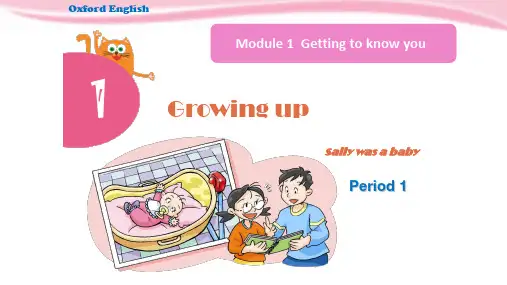
In Photo 1, Sally was a _b_a_b_y_. She was about _t_w_o__m_o_n_t_h_s_ old. She was ___sm__a_ll_a_n_d__c_u_te____.
Oxford English
Module 1 Getting to know you
新沪教牛津版六年级上Unit 1教案
Module 1 Getting to know each otherUnit 1 Growing upTeaching Aims(教学目标):知识目标:1.能听、说、读、写本课的核心词汇:month, cute, pretty, handsome, catch2.能熟练掌握核心句型:She was two months old.She was small and cute.Her hair was short and her eyes were big.能力目标:1.能听懂对Sally不同成长阶段年龄和特征的描述。
2.能综合运用所学语言描述人在不同成长阶段的情况。
情感目标:对所学内容能主动联系生活实际,能尽量用英语交流,培养学生的小组合作精神。
Teaching Importances and Difficulties (教学重难点):1.能在语境中运用本课的核心词汇和句型。
2.在句型His/her...was/were... 中根据名词的单复数形式正确使用was或were.Teaching Tools(教学用具):录音机、自制课件、照片等Teaching Procedures(教学过程):StepⅠ.Warm up and revision(热身与复习)1. Greetings.2. Do some warming-up exercises.3. Review the numbers.Step Ⅱ.Presentation and practice(呈现新语言知识和练习)1. Lead in.T: How old are you?S1: I’m eleven years oldT: You’ll be twelve years old next year. You’re growing up.2. Show some photos and introduce the new words.3. Learn to say and use the words.4. Talk about the photos of Sally.5. Watch the screen and learn to say the sentences.6. Ask pupils to practise in groups.Sept Ⅲ. Learn the story (学习课文)1. Read the story and learn to say the useful sentences.2. Watch the cartoon.Unit 7 Helping others◆教材分析Understand the ideographic functions of different tenses through the situational dialogue of Listen and say. Talk about how to help others.◆教学目标【知识目标】Through the teaching activities of Look and learn, read new words and review the same words in front of them.【能力目标】Help students practice different tenses through the activities of Ask and answer【情感目标】Guide students to realize that helping others is also the source of their own happiness.◆教学重难点【教学重点】Sentence:How can you help others? I can...【教学难点】Help students to practice different tenses.◆课前准备Tape recorder, Multimedia◆教学过程Step 1. Listen and enjoyLead students enjoy and sing along with the tape and know the topic of this Unit.Step 2. Think and discuss1)Did you ever help other people?Did anyone help you before?How do you feel when you help other people?Why do people help each other?Step 3. Ask and answer◆Talk about how to help others in your daily life.help the blind cross the streetpick up rubbish (sweep the floor)read the newspaper to old peoplegive seats to those in need (old people/ the disabled/pregnantwomen/the sick)help tourists find their way◆Make a short dialogueStep 4. Listen and say1) Look and predict: What’s happening in the picture?2) read and answer1. Where are they?2. Why is the boy crying?3. What does the lost dog look like? (explain the new words in Look and learn)4. how did they help the boy?3) Read and fill in the table.Sally and peter cannot find the dog? Please complete the notice about a lost dog.4) read aloud and act it out.Step 5. Read a story1)Read and guess◆I am an insect. I am small and yellow. I fly among flowers.I have a sting on my tail. What am I?◆I am an insect. I am small and black.I live in a nest under the ground.Do you know me?2) Read and answer the questions in page 45.3) Think and answer◆Why do people like the bee instead of the ant?Because the bee works for flowers and people while the ant only works for himself and his queen.◆What do you think of the ant and the bee?◆Do you have any suggestions for the ant?Don’t be selfish.Work for people and plants.Do good things for others.4)Talk and shareWhat do you learn from the story?A selfish person cannot earn people’s respect.Helping other people makes you popular.A kind heart is better than a smart mind.Step 6. Learn the sounds1)Show the flashcards of words in this part and lead students read aloud.2)Find out the rules of pronunciations.Step 7. HomeworkRead the dialogue in Listen and say. Retell the story in Read a story.。
6B Module 1 Unit 4 P21 going shopping----
Make a dialogue
A: I’m going to the shops today. Would you like to come with me? B: Yes, I’d like to. What do you need? A: I ____________________. B: What else do you need to buy? A: I also ______ __________.
Things to buy
For whom
Which shopቤተ መጻሕፍቲ ባይዱ
Tom a computer book Alice’s dad a pair of shoes Mrs Wang some food the whole family
a pair of jeans a shirt
Alice
What does Mrs Wang need to buy?
jeans
trousers
pineapple apple juice biscuits meatballs
chocolate tomato
prawns
chicken
bookshelf
wardrobe
1 2 3
tea table
sports shoes canvas shoes
high heels
j_____
a clothes shop
c_____
g_________
s_______
s____
w_______
c______ b______
a furniture shop
t_____
s_______
a_________
六年级上册英语沪教牛津版知识要点
Module1Getting to know each other一、核心词汇1.表示时间名词:month一个月的时间;月份yesterday昨天2.形容词:cute可爱的pretty漂亮的handsome英俊的;帅气的famous著名的;出名的healthy健康的;有益于健康的unhealthy不健康的;损害健康的3.动词:catch逮住;捕捉spend度过pick采摘4.食物名词:hamburger汉堡包fruit水果pie馅饼pizza比萨饼cola可乐sandwich三明治vegetable蔬菜chicken鸡肉chocolate巧克力5.表示动物名词:turtle乌龟fly苍蝇6.其他:during在……期间everyone每个人;所有人countryside乡村;农村7.核心词组:grow up长大;成长junior high school初级中学(be)born出生summer holiday暑假the Great Wall长城the Palace Museum故宫博物院Tian’an men Square天安门广场go swimming去游泳go to the museum去博物馆go to the cinema去电影院junior high school初级中学do my homework做我的家庭作业watch TV看电视visit my friends拜访我的朋友a little少量的fish and chips炸鱼薯条二、了解词汇1.一些动词及过去式:go(去)—went do(做)—didhave/has(有)—had watch(观看)—watchedvisit(访问;探望)—visited am/is(是)—was are(是)—were2.一些食物名词:egg鸡蛋bread面包noodles面条dumplings饺子3.其他:menu菜单三、核心句型1.Her hair was short and her eyes were big.她那时头发很短而且眼睛很大。
上海牛津英语六年级第二学期6B英语知识点汇总U1-U9
六年级第二学期牛津英语知识点梳理Unit One Great cities in Asia打*的知识点仅供参考知识点梳理:I 词组1. at an exhibition 在展览会上2. the capital of China 中国的首都3. north-east of Shanghai 在上海东北面east/ west/ south / north of 在……的东、西、南、北面north-east /north-west of 在……的东北、西北south-east /south- west of 在……东南,西南* in/on/to the east ofeg. Shanghai is in the east of China.Korea is on the east of China.Japan is to the east of China.3. how far 多远4. how 如何/怎样5. how long 多久6. in the past 在过去7. other places 其他城市8. from shanghai to Beijing 从上海到北京9. read some information about Beijing 阅读关于北京的信息10. the Great Wall 长城* the Summer Palace 颐和园* the Palace Museum 故宫博物院11. more than= over 超过* less than = under 少于12. 15 million people 一千五百万人*millions of, thousands of13. huge department store 大型百货公司*huge= very big14. spicy food 辣的食物15. in Asia 在亚洲16. great cities= big cities 大城市17. which city 哪个城市18. by plane=by air; 乘飞机by ship=by sea; 乘船by train/ ferry 乘火车/ 渡轮19. That’s right. 对的。
上海小学六年级第一学期英语(牛津上海版)教材同步教案单词记忆课件Module 1 Unit 1 Family and relatives
六年级第一学期模块一第一单元:Module 1 Unit 1 Family and relatives
(牛津上海版)英语教材
用PPT动画特效活跃单词学习的过程,由静变动
内置最准确的英式和美式真人发音对照,学活单词 对长单词的结构进行拆解,简化记忆 用词源学洞悉单词的来龙去脉,珍惜现在单词的拼写 配备最实用的单词词组,学以致用 用形象的图片激活形象思维对抽象单词的关联
提示:本演示文稿采用Microsoft office PowerPoint 2013 制作,PPT动画特效在其他软件播放可能出现失真。
构成:relate+ive=relative relate: 相联系,有关联
re-: 前缀,表示重复,重新
lat: 词根,表示携带,拿出 -ive: 形容词或名词后缀。 “重复/重新携带(血源)有关联的人” 来源:relate源自古典拉丁语的relatus:re (重新) + latus (携带),意为重新取得。
词组:new classmate 新同学 old classmate 老同学
来源:源自古英语的scoppa,意为货摊。
词组: coffee shop 咖啡店 set up shop 开店
构成:shop+p+ing=shopping shop: 商店 -ing: 名词后缀。
来源:go源自古英语的gan,意为去。
来源:family源自古典拉丁语的familia,意为家庭,住户。 tree源自古英语的treo,意为树木。
构成:grand+daughter=granddaughter grand: 大的;极其重要的。 daughter: 女儿 “强调孙女在家庭中受宠爱的程度极高”
沪版牛津英语六年级上知识点整理
Module 1 Family and friendsUnit 1 Family and relatives1.family and relatives 家庭和亲戚2. a family tree 一个家谱3.grandsons and granddaughters 孙子和孙女们/外孙和外孙女们4.get a lot of presents 得到许多礼物5.Happy Birthday (to sb.) ! 生日快乐!6.get a birthday card from sb. 从某人那儿得到一张生日卡7.one of my family members 我的家庭成员之一8.only have one aunt 仅仅有一个阿姨9.my classmates 我的同班同学10.go shopping 去购物11.what else 其他什么12.play badminton 打羽毛球13.go cycling 去骑自行车14.go swimming 去游泳15.two cousins 两个堂/表兄弟/妹16.how many + 名词复数多少……语言点1. This is my grandfather.这是我的(外)祖父。
These are my family and relatives.这些是我的家人和亲戚。
注意句中各成分保持单复数同形。
2. I‟m their son.. 我是他们的儿子。
We‟re their sons.我们是他们的儿子。
3. How many uncles do you have?你有多少个叔叔?How many后面接可数名词的复数形式。
4. What do you do with your…?你和你的…干什么?5. What else do you do with your…?你和你的…还干什么?6. What else do you do with your…?你和你的…还干什么?With是个介词,后面接人称代词时,要用宾格的形式。