
外研版英语七年级下册Module 7 Unit 1课件
Choose the correct answer. 1. Was Lingling born in Xucun? Yes, she was./ No, she wasn’t. 2. Was Tony’s first school called Darwin Primary School? Yes, it was. / No, it wasn’t. 3. Was his teacher’s name Mrs Smith? Yes, it was. / No, it wasn’t. 4. Was Mrs Smith Lingling’s teacher? Yes, she was./ No, she wasn’t.
5. Betty’s first teacher was strict.
Listen and read
点击查看 动画
下一页
Tony:
Hey, Lingling. Where were you born? Lingling: I was born in a small village in Shanxi Province. Tony: What was the name of the village? Lingling: Xucun. Where were you born, Tony?
Tony:
My first teacher was Mrs Lane. She was strict but very nice. Who was your first teacher? Lingling: Ms Yao. She was very friendly. Who were your first friends? What were they like?
外研版英语七年级下册课件born in a small village.
Teaching aims and demands
Teaching aims: 1. To understand conversations containing past simple “be”. 2. To process information of past life in the listening material. 3. To talk about one’s past life. The teaching points: Important points: 1. Important words and expressions:be born, first, friendly, naughty, nice, strict, well-behaved 2. Key structures:Where were you born?
Warming-up
Introduce to each other: Where were you born? Were you born in..? When were you born? Were you born in...
Words and expressions
born strict 出生 严格的,严肃的 友好的 初等的,初级的 小学
I was born in Cambridge. It’s a small city in England. Lingling: What was the name of your first school? Tony: It was Darwin Primary School. Lingling: Who was your first teacher? Tony:
3 2 1
4
Listen again and check (√) the true sentences. 1.Betty was born in the US.
2.Betty was born in a small town.
3.Betty’s first school was a big school. 4. There were twenty-two students in Betty’s class.
New words
点击查看 动画词汇
下一页
nice adj. 友好的;亲切的
Listening and vocabulary
Listen and number the questions as you hear them. a) Who was your first teacher? b) What was your first school like ? c) Where were you born ? d) Was she strict ?
friendly
primary
primary school
town
城镇,市镇
Words and expressions
US 美国
hey
village nice good difficult
嘿,喂
村庄 友好的,亲切的 乖的;守规矩的 难的,难对付的
New words
点击查看 动画词汇
下一页
village n.村庄
5. Was Ms Yao very friendly? Yes, she was./ No, she wasn’t. 6. Were Becky and Adam Tony’s friends? Yes, they were. / No, they weren’t.
7. Was Adam good at school? Yes, she was. / No, she wasn’t. 8. Was Tony difficult at school? Yes, he was./ No, he wasn’t.
Tony:
Their names were Becky and Adam. Becky was very good in class but Adam wasn’t. He was quite difficult. Lingling: And what were you like? Were you difficult in class too? Tony: No, I wasn’t. I was very good!
合集下载
外研版七年级英语下Module7 Unit2 课件 (共35张PPT)
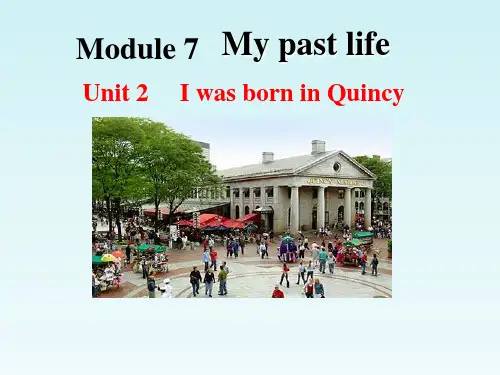
Unit 2 I was born in Quincy
第二课时
阅读课文找出下列词组和句子。
• 1十二年前____1_2_y_e_a_r_s__a_g_o • 2在美国东海岸___o_n__th_e__e_a_s_t_c_o_ast of America • 3很多事情要做_l_o_t_s_o_f_t_h_i_n_g_s_t_o__d_o4很无聊__b_e__b_o_r_e_d___ • 5两个电影院____t_w_o__m__o_v_ie__t_h_e_a_te_r_s____ • 6两位美国总统____tw__o__p_r_e_si_d_e_n_t_s of the US • 7一个有许多树木的花园__a__g_a_r_d_e_n__w_i_t_h_l_o_t_s_o_f_t_r_e_e_s__ • 8在我卧室的墙上__o_n__m__y_b__e_d_r_o_o_m__walls • 9 有鱼的小湖____a_s_m__a_ll__la_k_e__w_i_t_h_f_i_sh in it
3. How many bedrooms were there?
A√. Three. B. Seven
4. Was there a garden?
√A. Yes, there was. B. No, there wasn’t.
1 一般过去时的标志词:①yesterday,yesterday morning/afternoon /evening ,the day before yesterday, ②last+表示时间的词,last week last year ,last month ③时间+ago,two days ago ④in+ 过去 的时间,in 2012 ⑤ in the past 2 用 be 动词的适当形式填空 Betty w__a_s___ born in Quincy twelve years ago . Betty __w__a_s_n_`t____( be not )bored in Quincy in the past . __W__e_r_e you at home yesterday afternoon ? There __w_e_r_e_n_`_t____(be not ) many rooms in his house last year . John Adams_w__a_s__ born in 1735 .
外研版七年级下册英语精品教学课件 Module 6 Around town Unit 1
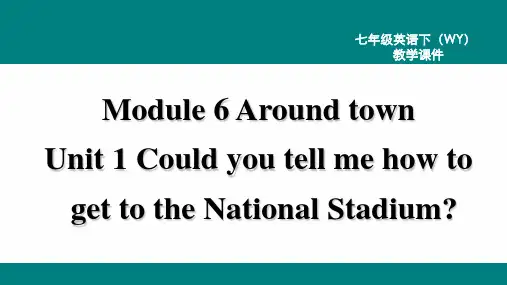
along across cross opposite
A: Is there a museum in your home town? B: Yes, there is. A: Where is it? B: It’s opposite the East Lake.
3. Listen and read. Tourist: Excuse me! Can you tell me the way to Wangfujing Dajie?
A: There’s a bookshop near here. What’s the name of the street?
B: It’s Xi Chang’an Jie.
round 1
find out the treasure(宝藏)
turn left turn right go straight
七年级英语下(WY) 教学课件
Module 6 Around town Unit 1 Could you tell me how to
get to the National Stadium?
学习目标
➢ Key words & phrases: bank; museum; along; cross; across; opposite; tourist; excuse;
把(某人)带往;使(某人)到
➢Do you know these places around you ?
A: Do you like this park? B: Yes, I do. /ˈrestrɒnt/ /ˈrestərɑːnt/餐馆 A: Is there a restaurant near here? B: Yes, there is.
A: Is there a museum in your home town? B: Yes, there is. A: Where is it? B: It’s opposite the East Lake.
3. Listen and read. Tourist: Excuse me! Can you tell me the way to Wangfujing Dajie?
A: There’s a bookshop near here. What’s the name of the street?
B: It’s Xi Chang’an Jie.
round 1
find out the treasure(宝藏)
turn left turn right go straight
七年级英语下(WY) 教学课件
Module 6 Around town Unit 1 Could you tell me how to
get to the National Stadium?
学习目标
➢ Key words & phrases: bank; museum; along; cross; across; opposite; tourist; excuse;
把(某人)带往;使(某人)到
➢Do you know these places around you ?
A: Do you like this park? B: Yes, I do. /ˈrestrɒnt/ /ˈrestərɑːnt/餐馆 A: Is there a restaurant near here? B: Yes, there is.
外研版七年级下册英语精品教学课件 Module 11 Body language Unit 1

2. That’s because people do different things in different countries. (教材P66)
That’s because….. 是一个常用句式,意为“那是因为……”其中,that 表示刚刚谈到的内容。 注意,这里要用that,而不能用 this , 因为this 表示将要谈及的内容。 e.g. ---Mum, why do I always make the same mistake?
India kiss Russia together touch visitor
In China, people shake hands and smile
American people shake hands and sometimes (1) ____k_i_ss_
In (2) ____I_n_d,iapeople put their hands (3) ___t_o_g_e_t_her and nod their heads
bow kiss shake shake hands smile British German Japanese
v. 鞠躬,弯腰
v. & n. 吻,亲吻
v.
摇晃
握手
v. & n. 微笑
adj. 英国的,英国人的
n. 德国人;德语 adj. 德国(人)的;德语的
n. 日本人;日语 adj. 日本(人)的;日语的
5. Work in pairs. Talk about what you do and say when you meet:
• your teacher • your head teacher • your parents after school • your best friend • your best friend’s parents • your favourite film star • a visitor to your school • an American • a Russian
外研版七年级英语下册《Module7 Unit2》优质课课件(共33张PPT)

living room somewhere you relax at home
bathroom somewhere you wash your body.
work in pairs
- where were you born? - I was born in… - Who was your first teacher? - My first teacher was… - What was she/he like? - She/He was strict(friendly,kind…)
Who are they?
John Adams and his son John Quincy Adams
3.When was Betty there for the last time?
In 2020.
Time to read! 多层阅读 二读:分段阅读课文 ①读第一段完成下题
1. How old is Betty King? 12/twelve.
Time to read!
③读第四、五段完成下题 1. 找出短语“回去,回到”go__b_a__c_k___ 和“期待,期望”lo_o_k__fo__rw__a_r_d__to____
2. It was great_t_o__p_la_y__(play) there. 该句的主语是:_t_o_p_l_ay__th_e_r_e______.
Time to talk!
The house today
is There be
are
The old houses
There be
was were
Match the key words with each paragraph.
Module7 Unit2 课件外研版英语七年级下册
式主语,不定式短语to do sth.为句子真正的主语,意为“做某事 是……的”。 e.g. It was difficult to finish the work.
做完这项工作是很难的。
知识讲解
5. One day I’ll back, and I’m looking forward to seeing my friends again. 总有一天我会回去,我期待与我的朋友再见面。
知识讲解
1. There were lots of things to do in Quincy... 在昆西有很多事情可做…… 此句为there be句型的过去时。there be句型的过去时为There was / were ...,
否定句是在was或were后加not,一般疑问句是将was或were提到句首。 e.g. There was a boy here just now.
2 Read Para. 1. Fill in the chart.
The things to do in Quincy
There were lots of things to do, with (1)__m_a_n_y__st_o_r_e_s__, two movie theaters, football clubs and basketball teams.
→There wasn’t a boy here just now. →— Was there a boy here just now?
—Yes, there was./ No, there wasn’t.
知识讲解
【拓展】 there be 句型的时态
一般现在时态
一般过去时态
there is
there was
做完这项工作是很难的。
知识讲解
5. One day I’ll back, and I’m looking forward to seeing my friends again. 总有一天我会回去,我期待与我的朋友再见面。
知识讲解
1. There were lots of things to do in Quincy... 在昆西有很多事情可做…… 此句为there be句型的过去时。there be句型的过去时为There was / were ...,
否定句是在was或were后加not,一般疑问句是将was或were提到句首。 e.g. There was a boy here just now.
2 Read Para. 1. Fill in the chart.
The things to do in Quincy
There were lots of things to do, with (1)__m_a_n_y__st_o_r_e_s__, two movie theaters, football clubs and basketball teams.
→There wasn’t a boy here just now. →— Was there a boy here just now?
—Yes, there was./ No, there wasn’t.
知识讲解
【拓展】 there be 句型的时态
一般现在时态
一般过去时态
there is
there was
外研版七年级英语下册同步教学课件Unit 1 Whose bag is this?

I 5 a good friend at school. 6 name is Zhang Liang.He 7 English and now he can say “How are you?”,“What’s 8 name?” or “What’s this in English?” He is nice to me 9 I like him very much.
Unit 1 Whose bag is this?
外研社版
七年级英语下册
教学目录
1.课前导学 2.课堂基础训练 3.培优提高训练
◆ 课前导学 ◆
一、根据汉语提示写出英语短语,做到会运用。
1.首先;第一 2.失物招领箱 3.别客气。
_f_ir_s_t_o_f_a_l_l __________ _l_o_s_t_a_n_d__fo_u_n__d_b_o_x____ _Y_o__u_’r_e_w__e_lc_o_m__e_._____
A.in the end
B.all the time C.first of all
D.as a result
( B )6.—Do you eat fruit and vegetables every day?
—Yes,I like them .
A.a lot;a lot of
B.a lot of;a lot C.a lot of;a lot of D.a lot;a
C.his
D.him
( A )4.—Excuse me,how can I get to the restaurant?
— ,you need to go to the park.And then you can find it.
A.First of all B.At last
Unit 1 Whose bag is this?
外研社版
七年级英语下册
教学目录
1.课前导学 2.课堂基础训练 3.培优提高训练
◆ 课前导学 ◆
一、根据汉语提示写出英语短语,做到会运用。
1.首先;第一 2.失物招领箱 3.别客气。
_f_ir_s_t_o_f_a_l_l __________ _l_o_s_t_a_n_d__fo_u_n__d_b_o_x____ _Y_o__u_’r_e_w__e_lc_o_m__e_._____
A.in the end
B.all the time C.first of all
D.as a result
( B )6.—Do you eat fruit and vegetables every day?
—Yes,I like them .
A.a lot;a lot of
B.a lot of;a lot C.a lot of;a lot of D.a lot;a
C.his
D.him
( A )4.—Excuse me,how can I get to the restaurant?
— ,you need to go to the park.And then you can find it.
A.First of all B.At last
外研版七年级英语下册Module1 Unit1 Whose bag is this优课件
本句为there be 句型,意为“某处有某物” ①如果there be 后为可数名词单数或不可数
名词,be用is,若为可数名词复数,be用 are。
There is some food in the fridge. 冰箱里有一些食物。
②如果there be后的主语包含两者或两者以上, be的形式适用于就近原则,故be与离它最 近的主语在数上保持一致。
• 1. This is _____(my ,mine) sister. • 2. _____(She, Her) name is Lisa. • 3. Lily’s mother is a worker and _____(he, she )
works in a factory. • 4. That is my cat. _____(It, Its) name is Mimi. • 5. This is ________(our, ours) classroom and it is big. • 6. The girl is Linda. _____(Her, Hers) bike is green. • 7. The football is ________(Tom, Tom’s). • 8. —Is this your computer?
❖ 4. I don’t want to _lo__s_e (失去)you.
❖ You are my good friend.
❖ 5. My sister is _c_a_r_e_fu__l _(认真的)and she works hard. ❖ 6. I have got some _c_ra__y_o_n_s_ (蜡笔). ❖ 7. Is this __a_n_____ _e__ra_s_e__r _(一块橡皮)?
外研版七年级下册英语精品教学课件 Module 3 Making plans Unit 1
be a fantastic weekend!
Would you like to join us? Don’t be silly!
Now answer the questions. 1. What's Daming going to do on Saturday morning? He is going to check his email and do his homework and then help with the housework. 2.What's Betty going to do on Saturday afternoon? She is going to see a movie.
e.g. The student likes reading English in the morning.
e.g. See you on Sunday morning.
辨析on/in/at
on 表示在具体的某一天,如:日 on Monday
期、星期、节日等
on my birthday
on Teachers’ Day
表示在某一天的上午/下午/ 晚 on a cold winter morning
上
on the afternoon of Sunday
in 表示在较长时间内,如:年份 in Spring
/ 月份/ 季节/实际等
in July
用于某些固定搭配
in the morning/afternoon/evening
this afternoon / evening, tonight tomorrow (morning / afternoon / evening ) the day after tomorrow next Sunday / week / month / year...
Would you like to join us? Don’t be silly!
Now answer the questions. 1. What's Daming going to do on Saturday morning? He is going to check his email and do his homework and then help with the housework. 2.What's Betty going to do on Saturday afternoon? She is going to see a movie.
e.g. The student likes reading English in the morning.
e.g. See you on Sunday morning.
辨析on/in/at
on 表示在具体的某一天,如:日 on Monday
期、星期、节日等
on my birthday
on Teachers’ Day
表示在某一天的上午/下午/ 晚 on a cold winter morning
上
on the afternoon of Sunday
in 表示在较长时间内,如:年份 in Spring
/ 月份/ 季节/实际等
in July
用于某些固定搭配
in the morning/afternoon/evening
this afternoon / evening, tonight tomorrow (morning / afternoon / evening ) the day after tomorrow next Sunday / week / month / year...
Module+3+Unit+1++听说课课件2022-2023学年外研版英语七年级下册
Lingling On Saturday afternoon
Betty and
Daming
have a 8. p_i_a_n_o_____ lesson 9. _s_e_e_a__m_o_v_i_e__________
On Sunday afternoon all the children have a 10._p_i_c_n_i_c____
Sally经常在数h学e方lp面m帮e l助oo同k学fo。r Can you help _________________ my wallet?
你能帮我找一下我的钱包吗?
alone vs lonely
独自的 孤独的
THE END
What do you usually do on weekends?
I usually go to the park, take a walk or go shopping on weekends.
In this beautiful spring, what are you going to do at weekends?
Read and think
1. Who isn’t going to see a movie at the weekend?
A. Betty. B. Lingling. C. Daming.
2. When are they going to meet on Sunday?
A. At 1 pm. B. At 10 am. C. At 1:30 pm.
What is he going to do? He is going to help with housework.
What are they going to do? They are going to see a movie.
Module7Unit1教案外研版七年级英语下册
教学设计
课题:Module7Unit1
Iwasborninasmallvillage.
教学对象:七年级下
课时:第1课时
一、文本分析
[What]主题意义和主要内容
本模块的话题是“过去的生活”。第一单元的语言输入材料是两段对话。第一段短对话是在Daming和Betty之间展开,Daming向Betty询问她的家乡,小学以及小学老师的情况。而在第二段长对话中,Tony和Lingling又通过互相询问,对自己的家乡,小学和小学老师及朋友作了介绍。两段对话虽然简单,却充满了对家乡,老师和朋友的怀念之情。这主要通过对各自首任学校,老师和朋友的评价体现出来的。
born?
*What was herfirstschoollike?
*Whatwasherteacherlike?
*Whatwasherfriendlike?
提供背景知识,并做语言上的铺垫。
教师回答学生的问题后,展示第一幅有关过去生活经历的思维导图。
学生阅读思维导图的信息后,回答问题。
本活动目的是培养学生通过使用思维导图来提高概括信息的能力。
[Why]写作意图
两段对话都是围绕小学的事情展开的,学生们可以通过对话了解不同国家同龄人的童年生活,从而帮助他们开阔视野,进一步探究不同国家的文化,教育以及生活等。同时唤醒学生对童年生活的美好回忆,培养他们对家乡和生活的热爱。[How]文体结构和语言修辞
两段对话内容都展开了中外学生对自己家乡,小学,老师和
的认知和理解,同时也提升了学生自主学习能力和思维能力。
五、教学重点及难点
本节课的重难点是学习含有动词“be”的一般过去式,能用它来询问对方过去的经历,并能表述自己过去的生活。所以我在设计听前活动时,有意识地让学生关注如何询问过去的经历。在听中环节,针对两段听力材料设计的活动,也都涵盖了“be”动词的陈述句及一般疑问句的肯定和否定回答形式,还有呈现了与主题意义相关的特殊疑问句。这些活动都能很好地帮助学生突破重难点。尤其是思维导图的加入,能帮助
课题:Module7Unit1
Iwasborninasmallvillage.
教学对象:七年级下
课时:第1课时
一、文本分析
[What]主题意义和主要内容
本模块的话题是“过去的生活”。第一单元的语言输入材料是两段对话。第一段短对话是在Daming和Betty之间展开,Daming向Betty询问她的家乡,小学以及小学老师的情况。而在第二段长对话中,Tony和Lingling又通过互相询问,对自己的家乡,小学和小学老师及朋友作了介绍。两段对话虽然简单,却充满了对家乡,老师和朋友的怀念之情。这主要通过对各自首任学校,老师和朋友的评价体现出来的。
born?
*What was herfirstschoollike?
*Whatwasherteacherlike?
*Whatwasherfriendlike?
提供背景知识,并做语言上的铺垫。
教师回答学生的问题后,展示第一幅有关过去生活经历的思维导图。
学生阅读思维导图的信息后,回答问题。
本活动目的是培养学生通过使用思维导图来提高概括信息的能力。
[Why]写作意图
两段对话都是围绕小学的事情展开的,学生们可以通过对话了解不同国家同龄人的童年生活,从而帮助他们开阔视野,进一步探究不同国家的文化,教育以及生活等。同时唤醒学生对童年生活的美好回忆,培养他们对家乡和生活的热爱。[How]文体结构和语言修辞
两段对话内容都展开了中外学生对自己家乡,小学,老师和
的认知和理解,同时也提升了学生自主学习能力和思维能力。
五、教学重点及难点
本节课的重难点是学习含有动词“be”的一般过去式,能用它来询问对方过去的经历,并能表述自己过去的生活。所以我在设计听前活动时,有意识地让学生关注如何询问过去的经历。在听中环节,针对两段听力材料设计的活动,也都涵盖了“be”动词的陈述句及一般疑问句的肯定和否定回答形式,还有呈现了与主题意义相关的特殊疑问句。这些活动都能很好地帮助学生突破重难点。尤其是思维导图的加入,能帮助