
高二英语Music教案
————来源网络整理,仅供供参考
1
高二英语Music教案
unit 5 music
period 4(speaking & writing)
teaching aims:
students will be able to:
write a letter for advice
talk about music: forming a band
make suggestions and talk about preference properly
procedure:
step 1speaking (group work)
1.brainstorm
do you know what a band is? what is your favorite band? how many
people is a band usually formed? …
2.speaking
you and your friends want to start your own band. however,, you have
never played in a band before. talk with your friends about the band you
are going to start. what things do you have to consider? what problems
————来源网络整理,仅供供参考
2
do you have?
3.activity and performance
imagine that you have a chance to form a band. how to form a band?
according to the following information discuss in your group.
1)what is name of your band?
2)who will play what instruments and who will sing?
3)what kind of band you will be?
4)choose an english song for your “band” to perform.
step 2writing
you and your friends want to start your own band. however, you have
never played in a band before. you write an e-mail to freddy for his
advice. the e-mail is started for you, but you have to finish it.
you’d better do some brainstorming in small groups before writing your
letters. you should follow the procedure for brainstorming and outlining
introduced in module 1 unit 2.
writing tips:
1.in groups discuss some questions you would like to ask freddy.
1)make a list of them and choose the best questions.
————来源网络整理,仅供供参考
3
2)share your ideas with another pair; discuss all questions and then
decide which ones you want to ask freddy.
3)use each question to start a new paragraph.
4)write your question first; then add extra information to show freddy
why you need help.
5)finish the letter politely and thank freddy for his help.
2.reading freddy’s reply
let’s read freddy’s reply and answer the questions:
--- how was freddy’s band formed?
--- what advice does freddy give?
3.writing a note and a paragraph
please turn to page 74. now in pairs you are going to decide on the best
way to tell a foreign friend about one kind of chinese folk music. what do
you think they need to know before they can enjoy it? why do you like it?
who are your favorite singers? discuss it with your partner and write
notes to remind you of your most important ideas.
step 3homework
1.write a paragraph telling your foreign friend about the type of chinese
————来源网络整理,仅供供参考
4
folk music you have chosen. use a dictionary and other reference books
to help you.
finish off the summing up in student’s book.
最新高中英语Unit5Music教案1-新人教版

Unit 5 MusicTeaching goals:1. To have a good understanding of music.2. To learn about a band that was popular long ago.3. Talk about the function of music.The importance of this period:By leaning the text, get to know something of music.The difficulty of this period:Understand the main idea of this text.Teaching aids: Computer, recorder and projectorTeaching procedures:Step 1: Warming-upThrough listening to an English song” Take me to your heart”, attract the stu dent’s attention.Step 2: Pre-reading1. Ask the them what kind of music they like best.2. List some kinds of music.3. Present some different music and let them guess.4. lead to some bands5. Focus on the Monkees(通过英语歌曲、音乐的分类、以及他们所熟悉的乐队来增长学生的音乐知识,激发学生的兴趣,引出课文的主题“门基乐队。
)Step 3: Reading1. PredictionWith the help of pictures of the band and the title, let the students understand the meaning of the title and predict the text.What does the title mean “The band that wasn’t”2. Scan the text and get the main idea of each paragraph.Para1 Dreaming of being a famous musician or singer.Para2 How a band is formed?Para3 The Monkees got their start in a different way.Para4 How The Monkees became popular and developed as a real2. Detailed readingTrue or False Exercises.( T )1.Most musicians meet and form a band because they like to write and play music.( F)2. Each week the group that was called “The Beatles” would play a song or two written by other musicians.(T)3. “The Monkees” broke up in about 1970, but reunited in mid-1980s.(F)4. Students form a band to play in the street so that they can attract passers–by.3. Replace the following sentenceMany people think it important to have money and become famous.A lot of people attach great importance to becoming rich and famous4. Explain the difficult phrases.1)To think something is important and should be considered seriously(看重,重视)2) The musicians were to play jokes on each other as well as play music, most of whichwas based loosely on the Beatles.3) What’s the writer’s attitude towards the band?A. LikesB. DislikesC. Not mentioned(因为高考中阅读理解和阅读表达有替换、翻译以及深层理解题目的考查,这些又是学生的难点,所以我在阅读中加强了此类题目的训练)5 . a brief Summery of the band1) At first not a real band2) Play jokes as well as play music3) A year or so became serious about their music4) Became the most popular band in the USA.5) “I’m a believer”, top 10 hits6) Broke up in about 1970and reunited in the mid-1980s.Step4 Enjoy the VideoThe most famous song” I am A believer” by the MonkeesStep 5 DiscussionHow does music make you feel ?It makes me feel happy/confident ….I prefer /hate… because….If I am worried/frightened…I like to….I enjoy/appreciate…because….I attach great importance to…Step 6 SummaryMusic is fun and for your spirit!Try many different styles of music, and always remember that music will never be a waste of time.Without music, life is a journey through a desert.Step7 HomeworkWrite a short passage about what you feel about music.。
高中英语Module3《Music》教案-Introducation外研版必修二
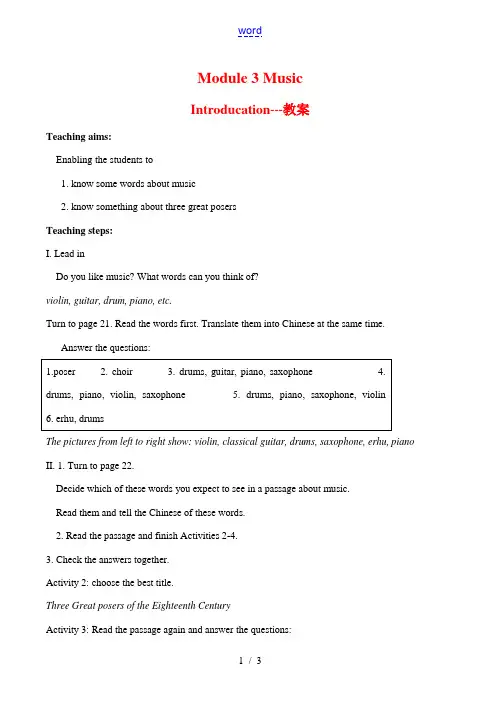
Module 3 MusicIntroducation---教案Teaching aims:Enabling the students to1. know some words about music2. know something about three great posersTeaching steps:I. Lead inDo you like music? What words can you think of?violin, guitar, drum, piano, etc.Turn to page 21. Read the words first. Translate them into Chinese at the same time.Answer the questions:The pictures from left to right show: violin, classical guitar, drums, saxophone, erhu, piano II. 1. Turn to page 22.Decide which of these words you expect to see in a passage about music.Read them and tell the Chinese of these words.2. Read the passage and finish Activities 2-4.3. Check the answers together.Activity 2: choose the best title.Three Great posers of the Eighteenth CenturyActivity 3: Read the passage again and answer the questions:Which of the posers…1. Haydn, Mozart2. Beethoven3. Haydn4. Mozart5. Beethoven6. They all met each other.7. Mozart, Beethoven8. HaydnActivity 4. Work in pairs. Answer these questions:1. He made them longer and for a larger orchestra.2. He worked in eastern Austria for 30 years.3. He posed over 600 pieces of music.4. He was six years old.5. They were friends for ten years.6. His father taught him.7. No, he continued posing when he became deaf.III. Read the text for more details and try to say something about one of the three great posers. IV. Language points:1. be known asbe known forbe known to2. change…into3. have a beautiful singing voice4. where 定于从句5. of all time6. live 35 years7. have musical talent8. play the harpsichord9. by the time10. as well11. give concerts12. be impressed with/ by13. it was Haydn who encouraged Beethoven to move to Vienna.14. go deafV. Homework:Read the passage.Make some sentences with the language points.。
人教新课标高中英语必修二Unit 5 Music教案

Unit 5 MusicPeriod 1 Warming up & Reading★ Teaching aims:1. To activate the Ss in learning “music ”.2. To develop the Ss ’ ability of reading.3. To help the Ss know something about the different styles of music.★Difficult and Important Points:1. Help the Ss to sum up the main idea of each paragraph.2. Enable the Ss to understand the details about the passage The Band that Wasn ’t.★Teaching Methods:1. Task-based method2. Discussion★ Teaching proceduresStep 1 Warming up ( 6minutes )1) Task: Brain-storming ( 2minutes )Ask the students to name different music styles. Show some styles of music that they are not familiar with.folkpop2) Task: Listening and Matching ( 4minutes )1)Tell Ss: we are going to listen to eight kinds of music. Here are the pictures for them. Listen to them carefully and choose the proper picture for each of them.2) Guide the Ss to sum up the Characteristics for each music style.3) Check the answers on the computer screen.Step 3 Pre-reading ( 2minutes )1)Task :ListingHave you heard about any of the famous bands in the world? List some of them.Which one do you like best? Why?2) PresentationAsk the Ss to search the information about “The Monkees ” before class, and now encourage them to share their information with their teammate.Step 4 While-reading ( 23minutes )1) Task: Fast reading( 10minutes ) Read fast and then do some exercises①.Which band does the passage mainly talk about?③.Go over the passage and look for the main idea of each paragraph.2) Task: detailed reading ( 8minutes )Read the passage again very carefully and answer the detailed questions:①. What are the advantages if people form a band to play in the street?②. When did “The Monkees” break up and when did it reunite ?③. Why was “The Monkees” successful in their work?5) True or false ( 5minutes )①.Most musicians meet and form a band because they like to write and play music.②.The TV organizers had looked for five musicians who were lovely and who could make good music.③.Each week the group that was called “The Beatles” would play a song or two written by other musician.④. “The Monkees” broke up in about 1960,but reunited in 1980.Step 5 Discussion ( 9minutes )1) Find the music in our life!2) What are the functions of music ?3) Enjoy the song of the Monkees “I wanna be free”(4minutes)Step 6 Homework1). Read more about “The Monkees”.2). Find out the important language points in the passage。
人教版高中英语必修二Unit5 Music-Listening and Speaking教案

2019新人教高中英语必修二Unit5Music-Listening and Speaking 公开课教案Analysis of the materials:The theme of this class is music(listening and speaking part). In order to arouse students’ interest in this class, teacher chooses this topic to connect with the students. The listening skill-paraphrase and the reasons for liking music should be emphasized. Except those key points, students should understand the basic knowledge of music and know to enjoy the Chinese music-Peking opera to enhance their patriotism.Analysis of the students:The students of Grade One haven’t got a good listening ability, which still needs to practise and improve. Compared to listening ability, their speaking ability is worse and they don’t dare to speak English. They don’t have chances to talk in English. Also, students are of different levels. However, this topic is related to our daily life. Students may be easy to get themselves involved in the class.Teaching aims:1.Core values(核心价值):Comprehend the profoundly musical culture especially Chinese music-- Peking opera and enhance students’ love for national culture.2.Subject quality(学科素养):(1) Theme: Music( listening and speaking part )(2) Expression: Know how to express music preferences and reasons for liking music.3. Key competency(关键能力):Use the listening skill -predicting, paraphrasing - to process specific information and answer the relevant listening questions.Insist accurate and fluent principles to express reasons for liking music.4.Essential knowledge(必备知识):After the class, the students are supposed to⑴know the common types of music.⑴grasp one listening skill --- Paraphrase.⑴express music preferences and reasons for liking music⑴polish your reasons for liking Peking Opera simplyTeaching key and difficult points:1.Help students to get familiar with different kinds of music through listening practice and know the function of paraphrase in listening.2.Enable students to be aware of the function of paraphrase in listening.Teaching procedures:StepⅠLead-inActivity1 The teacher is advised to talk with their students about music festival.Boys and girls, before our listen, let’s work in pairs and discuss what music festival is.What would you like to do in the music festival? Share your ideas with partner.Activity 2 Look at the opening page and talk about it.1.What are they doing?2.Can you name some of the musical instruments that the performers are using?Suggested answers:1.They are performing classical music.2.Piano, violin, flute, drum, bagpipes, saxophone,etc.StepⅠListeningActivity 1 Warming upBefore listening,match the pictures with the correct types of music.A.Chinese traditionalB.classicalC.country musicD.hip-hopSuggested answers:1. B2.A3.C4.DActivity 2First listeningListen to the interviews and find out what kind of music the three students each like.1.The first student likes to .2.The second student likes to .3.The third student likes to .Suggested answers:1.listen to country music2.dance to hip-hop music3.play country musicActivity 3Second listeningThe reporter paraphrased some of the answers.Listen to the interviews again and complete the sentences with the words you hear.1.A:Country music touches my heart.B:So you like music that’s of ?2.A:When I listen to hip-hop,I just have to move!B:So it makes you want to ?3.A:Classical music makes me feel like I’m sitting beside a quiet stream and enjoying nature.B:So to you,it’s and ?Suggested answers:1.full of feelings2.want to dance3.peaceful and beautifulActivity 4Third listeningListen to the interviews again and think about the function of paraphrase inlistening.Suggested answers:1.to check if the listener’s understanding is correct.2.to show interest in what the speaker has said.StepⅠ SpeakingActivity 1 Enjoy some pieces of music and tell us your feelings.1.the first piece of music—played by a symphony orchestra2.the second piece of music—rock music3.the third piece of music—played by pipaSuggested answers:1.I like listening to music played by orchestras.I can hear things played on instruments from all of the different families—woodwinds,strings,percussion and brass.Also,classical music tends to be slower,so it makes me feel calm when I listen to it.2.Rock music lets me have a strong feeling,happy or sad.3.It brings me peace and beauty,letting me feel relaxed.Activity 2 Talk in pairs.Interview each other about e the pictures below for ideas.These expressions may help you.Reasonsforlikingmusictouchesmyheart/soulmakesmehappy/wanttodancegivesmeenergy/hope helpsmeexercise/studysoundspeaceful/beautifulremindsmeofhome/peopleIloveExample:A:What kind of music do you like?B:I like music played by saxophone.A:What makes it so special to you?B:Because it sounds peaceful and it often reminds me of someone I love.Suggested answers:A:What kind of music do you like?B:I like Chinese folk music,for example,pipa music.A:What makes it so special to you?B:I like to listen to it when I have leisure time.It brings peace and beauty to me,which makes me feel like I’m lying by a stream in a forest.StepⅣHomework1. After the class, write a short essay on your feelings of Peking opera and try to polish it.2.Do more practices to consolidate the important listening skill-paraphrase.板书设计Unit 5 Music1.Listening skill--ParaphraseReasons for liking music课后反思通过学习:1.学生学习英语的信心增强;2.学生学会抓住听力中的答案;3.锻炼学生的口语能力!通过本节内容学习,理解并讨论主题图,预测单元的主题和内容,通过问题链引导学生谈论单元内容,该板块以听为本,学生通过听取信息和选择依据来学习语言知识,同时内化所学关于本单元的内容。
高中英语必修2·Unit5·Music教案新部编本(人教新课标

教师学科教案[ 20 – 20 学年度第__学期]任教学科:_____________任教年级:_____________任教老师:_____________xx市实验学校Unit 5 Music教案Contents: (1) Enable students to appreciate and classify different kinds of music by doing the exercise in Warming up(2) Developing their abilities to express their feeling on music and enlarge theirknowledge on music(3) Moral aim:Procedures:Step1warming up1、Introduce the topic of music through asking some question such as “Are you fondof music ,Are you good at singing, Can you play a musical instrument”Ask students to answer the 4 questions in groups actively while introducingdifferent kinds of music in the world.Step2 pre—reading(1)Get the students to discuss the questions with their partners and then ask themto report their work.. Encourage them express their opinion freely1、Have you heard about any of famous bands in the words, please list them ifyou have (Beatles, Back—street boy, West—life )2、Which one do you like best?(2)Introd uce something about “The Monkeys”Step2 skimmingLet the students listen to the tape and find out the answers to the following twoquestions.1、What are the benefits if students former a band to play in the street?2、When did “The Monkeys” break up and when did it reunite?Step3 Second readingIn this part, students will read the text again and try to understand the sentences andthe main idea of each paragraph, and then finish the exercise 2 and 4 in ComprendingStep4 Homework: Fin out some language points in Reading and recite the new words in unit 5Step5:FeedbackPeriod 2Contents: Deal with the language points in the textAim: Master the usage of the important pointsProcedures:Step1: Ask students to retell the storyStep2: Deal with the following language points.(1)famous adj well or widely knownHe is famous as a teacherBe famous forThis town is famous for its beautiful buildings(2)dream of sth/doing sth梦想dream of a better futuredream of becoming famouswhen she was young, she dream of being a doctor in the future.(3)with +n + 现在分词或过去分词构成复合结构在句中做状语With winter coming it’s time for us to prepare for oust final exam.With she was young, she dream of being a doctor in the future.With +n/pron doing sth (伴随的动作)Done (已经完成被动的动作)To do (将来执行的动作)AdjAdvPre phraseThe professor came in with a lot students following.With the problem solved, we all feel very happy.With lily to help us, we can finish the work in an hour.He likes to sleep with the door open.With her son away from home, the girl went home happily.With a bag on her back, the girl went home happily.(4)clap(clapped, clapping) vt拍,轻拍,振翼,拍翅膀vi 拍手They clapped their hands.The audience clapped after his speech.(5)pretend “假装,假扮”.后面常跟不顶式作定语He pretend not to know the faces.He pretend to be reading an important when the boss entered.He pretended that he was ill so that he could stay at home.(6)be honest with 对….说老实话,对…诚实I shall be quite honest with you.我会跟你说实话的.(7)extra adj 剩余的,特别的adv 剩余地,特别地He is strong enough to carry the cargo , I don’t think he need some extra help.I bought this picture at an extra high price.(8)play jokes on sb : speak highly of or amusingly about sb/sth 拿某人开玩笑,与某人开玩笑He is a serious , don’t play jokes on himDon’t play jokes on the disables.(9)be based on: use something as grounds 根据….以….为基础.The story is based on real life.The news repose is based on entirely on fact.(10)at first,起初,开头,含有后来不好的意思At first, she was afraid of water, but she soon later to swim.(11) attractive adj 有吸引力的,有魅力的.Attract vt 吸引力,引起Attraction n 吸引力The girl is very attractiveLike attracts like 物以类聚(12)even +比较级It’s even colder than yesterdayEven/much/a lot/far+比较级The garden is much more beautiful than one(13) break up: make something separated using force 解散,分裂,解体,驱散The crowd started to break up when the night fellTheir marriage broke up a few years later.(14) by chance=by accident 偶然地,意外地反义词on purposeI met her quite by chance(15) sort out: separate from a mass or a large group分类,拣出The farmer sorted the best apples for eatingStep3:Homework1、Use the language points in this period to make sentence2、Exercise1,2,3 in using languageStep4:FeedbackPeriod 3Contents: (1)Learning about language(2)Grammar: Discovering useful structureAims: (1)Let Ss can use correct words and expressions to finish the exercise(2)Master the grammar on P36-37Procedures:Step1、Dictate the new words and phases which we learnt in the last periodStep2、Check the answer of the Ex 1,2,3and explain some language pointsStep3、The Attributive clause with preposition ahead of the relative clauseAsk students to find the Attributive clause out of textFinish the exercise on P36Summary up the usage of the Attributive clause with preposition ahead of relativeclause with help of teacherStep4、Homework: preview the Using language on P37Step5、FeedbackPeriod 4Contents: Listening and Reading on P37Aims: Train the students to listen to the story about FreedTrain the students’ abilities to express the advantages and disadvantages ofbeing famousMoral Aims: Tell students everything has both advantage and disadvantage ,just like every coins has two sidesTeaching procedures:Step1: Listen to the tape and answer the following questions1、Let’s listen to the story about Freed and see what Freed found when he swamslowly towards the sound2、Listen to for the detail information and decide which of the statements aretrue or false on P37Step2: Fast readingRead the text, then answer the following questions1、Did Freedy and his hand get a great success in Britain?2、What disadvantages of Freed become famous?3、Did Freedy and his band leave Britain at last? WhyStep3: The language points in the reading1、be confident +从句对---有信心be confident of (about, in)对---有信心He is quite confident that he’ll pass the driving textDon’t be too confident in your own opinionTom is confident of his ability to overcome the difficulty2、afterwards v: Later, after that以后,后来,然后We saw the film and afterwards home together.我们看完电影后一起走回家3、performance n 表演performer n 表演者perform v 表演,履行,执行,表现perform one’s promise 履行perform one’s duties 尽责任perform an operation 施行手术perform an experiment 做实验You should always perform what yourpromise 你永远履行你的诺言He has successfully performed a brain operation on the patients 他已成功为病人实施了胸部手术Step4: If time permitted deal with the exercise on P38Step5: HomeworkTranslate the five sentences on P71Step6: Feedback:Period 5Contents : Speaking and writing on P38Aims : (1)Get students to be familiar with the steps to write an e —mail(2)Enable the students to write an e —mail to ask for advicesStep1: Retell the story of the Freedy with the help of the following chartStep2: 1、Ask the students to list of the things they have to consider when forming a band2、group work: form the band and out the most difficult thing for them to decide whilediscussing the questions , students have to give out the information w hy it’s hard forthem to decide and why they need helpStep3: Read the freed reply and explain some language points1、stick to sth信守,遵守,坚守stick to rules =obey the rulesWe said we’d give her the cash , and we must stick to our agreement2、above all首先,首要的是Step4: Read some saying about musicStep5: HomeworkWrite a letter to the Freedy to ask for helpStep6: FeedbackPeriod 6Contents: Listening on P69 and Reading task on P72Procedures:Step1: ListeningStep2: Reading task1、Introduce the background: cat’s in the cradle was Harry Chapin’s most popularsong ,becoming the biggest hit of 1974 and one of the best ---loved songs of the1970s,It is about the relationship between a father and son and the missedopportunities or them to be together.2、Get the main idea of each partStep3: FeedbackPeriod 7A quiz on vocabulary and deal with the exercise in the newspaperFeedback:Translation:(1)教学是建立在科学的基础之上的艺术(be based on)(2)这两个孩子计划捉弄一下他们的父母亲(play tricks on)(3)警察驱散人群以防斗殴(break up)(4)如果你坚持真理,你就会无所畏惧(stick to)(5)我年轻时经常梦想成名(dream of)(6)孩子躺在床上,我没法上床睡觉(用with短语)Key to translations(1)Teaching is an art based on a science(2)The two children planned to play tricks on their parents(3)The police broke up the crowd to stop the fighting(4)If you stick to the truth, you will have nothing to fear(5)I often dream of being famous when I was young(6)With the baby lying on the bed, I can’t go to bedUnit 5 Useful expression1、hear about 听说42、cross out划出2、want to do 想要做….. 43、hate doing讨厌干某事3、dream of 梦想44、give advice给建议4、in front of 在…..前面45、would like to愿意干…5、be honest with对…说实话,对….诚实46、share…with…和…分享6、most of大多数47、add…to…增加…到…7、get to do 48、ask sb for advice向…要建议8、pass-by过路人49、agree with同意..意见9、earn some extra money赚额外的钱50、comp up with提出想出,赶上10、give sb a chance 给某人一次机会51、stick to坚持11、play jokes on sb戏弄某人52、above all首先,最重要的是12、look for寻找53、decide to do决定干…13、make good music熟练地演奏音乐54、pay for付款14、put an advertisement登广告55、leave a note留言15、be able to do sth 能够干某事56、help sb do sth帮助某人干…16、at first起初,首先57、according to根据17、pretend to do sth 假装干某事58、pay attention to注意18、or so大约,…..左右用于数词之后59、as a result of由于…结果19、start to do/doing sth开始做某事60、as a long as只要20、break up打碎,分裂,解体61、a piece of一段音乐21、join….together把…连接在一起62、be ready to 准备22、get together聚在一起63、in church在教堂23、come true变成现实64、in the cradle在摇篮里24、by chance偶然地,无意地65、the other day前天25、in different directions朝…不同方向66、learn to do学会26、get out of从小汽车里下来67、have a good time玩的开心27、expect sth to happen期望某事发生68、walk away走开28、send message传递信息69、be proud of以..为自豪29、mix up迷惑,弄错,搅和,搅拌70、move away走开30、sort out分类,拣出,整理,解决71、call up(给)..打电话31、change from…to…从…变成… 72、have the flu流感32、as well as和…一样好73、hang up放下听筒挂断电话33、not long after在…之后不久74、occur to sb (想法)被想起not long before在…之前不久75、grow up长大34、on a tour观光,巡回演出35、be confident of/about对…有信心36、enjoy doing sth喜欢干某事37、go wrong出了毛病38、try to do试图干…39、as if好象,似乎40、at last最后41、go back to 返回育人犹如春风化雨,授业不惜蜡炬成灰。
高中英语 Module 3 music教案 外研版必修2 教案

Module 3 musicAims and requirements●To enable the students to listen and talk about likes and dislikes (especially about music and musicians),encouraging them to try the vocabulary and everyday English in this unit●To develop the students’ reading ability●To help the students learn and use two grammars (adverbial clause of time and the past perfect tense) in different situations●To help the students to write a biography of a person, using the time expressions in Grammar 1Teaching proceduresPeriod 1 Introduction ,Warming up Teaching aims:Enabling the students to1. know some words about music2. know something about three great posersstep1. Warming up by listening pieces of music and asking questions Play several pieces of music (music from Haydn, Mozart and Beethoven will be best) to let the students listen and appreciate, then ask them:1) Do you like music?2) What about these pieces?3) What is your favorite kind of music?4) Who is your favorite musician? And who is your favorite poser?step2. Warming up by showing some pictures and discussing1) Do you know who they are?2) What kind of things are these pictures connected with, science, culture, politics, painting, drawing or music?step3. Warming up by listening to a piece of musicGood morning, class. Today we are going to read a passage about three great musicians who are all posers. A poser is a musician who writes pieces of beautiful music for others to sing or to play. Now,let’s listen to a piece of music.(the teacher plays a piece of music ----er quan yingyue)1.do you know what kind of music it is?2.whose work is it?3.what kind of music is it?4.what is your feeling after listening to it?Step 4 show the following picturesAnd make the students familiar with these new words:Piano violin saxphone drum erhu guitarste p4.now please match these musical instruments with their names.Step 5 work in groups to discuss these questions:1.which of the instruments do you like listening to?2.which famous musicians play them?3.is the chinese instruments different from the otherinstruments?describe the difference,if there is one.Step6 summary and homework:Today we’ve learnt the Introduction,know something about music,and we’ve also learnt some new words.The homework:1.Try to instruct your favorite musician to your class orally.2.Learn the new words again, using the dictionary if necessaryPeriods 2 Reading and Vocabulary Teaching Aims:Train the students' reading ability.Learn some useful words and expressions.Teaching Important Points.Help the students to understand the passage better.Learn and master some important words and phrases in this period. Teaching Difficult Points:How to help the students improve their reading and understand the passage better.Teaching Methods:Fast reading to get the general idea of the text.Careful reading to understand the passage better.Discussion to help the students understand what they've learned better. Teaching procedure.Step 1 Lead --inThe teacher may play a kind of music written by Beethoven.------- What kind of music do you think it?----- Who do you know wrote it ?The teacher may discuss the questions and answer them freely.T: As we know, there are various kinds of music around the world. They all have their own obvious characteristic. And also there were famous posers such as Joseph Haydn, Mozart, and Beethoven. Today we may learn of their life from the text.Step 2 Reading prehension.Fast reading: Read the passage quickly and choose the best title.A.Three Great Austrian posers.B.Three Great poser of the eighteenth Century.C.Three Great Child posers.Key: B.Now let's read the passage again, underline new words in the text and decide whether the following statements are right or not.1.The three posers were all born in Austria.2.Mozart had a beautiful singing voice.3.Mozart died before his fortieth birthday.4.Beethoven once worked at the court of a prince, who began to go deaf when he grew older.5.Beethoven had ever met Haydn, but he didn't think he taught him a lot.6.Both Haydn and Mozart had fathers who were musicians.Key:1.F Beethoven was born in Bonn, Germany.2.F. Haydn had a good singing voice.3.T4.F. Haydn once worked at the court of a prince, but he didn't go deaf.5.T6.F. Haydn was the son of a peasant( The teacher may begin with the T/F questions orally and this is a good time to test their listening abilities as well as their prehension of the text. )Step 3 Read and listen to the passage. Meanwhile, some more questions are waiting for you.1.How did Haydn change the form of symphonies?2.How long did he work in eastern Austria?3.How many pieces of music did Mozart pose?4.How old was he when he played for the Empress of Austria?5.How long were Mozart and Haydn friends?6.Who taught Beethoven how to play the piano?7.Did he stop posing when he became deaf?Keys:1 He changed the symphony into a long piece for a large orchestra.2. 30 years.3.More than 600 pieces of music.4. When he was 6 , he played the harpsichord in a concert for the Empress of Austria.Periods 3, Function and GrammarTeaching aims:1 To learn grammar rules2 To use the grammar rules for correctmunication3 To study co-operatelyTeaching important points: To use the correct tense and theproper conj.Teaching difficult points:To use correctly the two tenses andthe three conj.Teaching methods: Explanation and practiceTeaching procedure:Step Ⅰ Lead-in by telling the class what happened to the Shenzhou Ⅻand technology is developing rapidly, China hasachieved a lot in the area of.Shenzhou Ⅻscientists,engineers and the whole nation were waiting andI couldn’t help getting exciteed. I feel proud of our country. Step Ⅱ Grammar 11 Make sentences with “when , while, e in , have a lesson” ( Here is a picture of a classroom and a student ing in)A When he came in, we were having a lesson.B When we were having a lesson, he came in.C While we were having a lesson, he came in.2 Say the meaning of “as” in the following sentences.D As he was a child, he studied drawing.E As he grew older, he began to go deaf.F He listened to music as he walked.当…之时随着一边…一边…3Answer the three questions.When we talk about a single event in the past,we use when asin A .When we talk about a period of time in the past,we use when/ while/ as as in B C D.We use as to refer to a progressive change as in E F .4Practiceplete the following sentences with “when ,while , as”(1) ___she was studying at school, she also sang in the schoolchoir.(2) ___he was living in Vienna, he studied music.(3) ___she met bach,she was only 20 years old.(4) ___he grew older, he found it more difficult to pose music(5) ___he was playing in the orchestra, he met his wife.(6) ___he was working in Hollywood, he became ill and died.(7) ___I listened to the violin solo, I fell in love withclassical music.(8) ___they toured Europe for 10 years, they finnally decidedto live in Austrilia.Step Ⅲ Grammar 2 The past perfect tense1Read the following sentences and summarise rules, paying attention to tenses. Fill in the blanks.After Liping had finished doing his homework, he turned on the TV. After they had got everything ready, they began to do the experiment. Before he came to our school, he had taught English for several years. Before his letter reached me, I had received his telephone call.They had finished the project by last month.I had left the country by the time the letter reached me.had done before diddid after had donehad done by did/past time2 PracticeWorkbook Grammar (2)(3)(4)plete the sentences using the verbs in brackets and the past simple or past perfect tense.Step Ⅳ1 Game Oral practice ,pair work.Ask and answer questions using all kinds of tenses.Example:-- When did you have your breakfast this morning?-- At 6.-- Have you prepared for the English lesson?-- Yes, I have. I have finished the exercises in the workbook.2 Watch a vedio play.Step Ⅴ Sum upAsk some students to make sentences using “when, while, as, before, after, by”.Step Ⅵ Homework: Present a biography of a famous Chinese musician orposer.Periods 4 Speaking and Writing Teaching Aims:1.Knowledge and Skilla.To develop speaking ability by talking about likes and dislikes.b.To learn about some vocabulary and knowledge related to music andposers.c.To develop writing ability by presenting a biography of a famousChinese musician or poser.d.Train the ability of collecting and dealing with information, anddevelop their abilities of getting new information, munication and cooperation.2.Emotion and Valuesa.To raise students’ interests in science and form the right attitudetowards all kinds of music.b.To help them know Chinese traditional music well and cultivate theirinterest in playing some Chinese instrument.3. Character-building:a.To make them know how to enjoy different kinds of music.b.Arouse their interest of playing some kinds of instrument and enrichtheir leisure time.4. Cross-cultural awarenessa.To help them know the difference between China and some westerncountries in instruments.b.Cultivate their awareness of cultural munication through the speciallanguage—music.Difficulties and Importance:a.To make the students understand and grasp the vocabulary andknowledge related to music.b.To enable the students to know how to use adverbial clause of time. Teaching Method:a.Task-based methodologyb.municative ApproachTeaching Procedures:Step 1 Pre-readingLook at the picture and answer the following questions.1.Who is he?2.Have you ever know something about him?Step 2 While-readinga. SkimmingRead the passage quickly, and make a note of some basic information about Ye xiaogang.Suggested answers:b. Detailed readingRead the passage carefully and fill in the blanks with proper words. Find what Ye Xiaogang did or what happened to him in the following years:Suggested answers:Step 3. Post-readingDiscussion.1.Are there any similarities between Ye Xiaogang and the European posersyou have read about in this module?2.Do you think it is a good idea to mix Chinese and western music? Step 4 Everyday Englisha. Listen to two people talking about the way they listen to music and answer the questions.1.How do they listen to it?2.Are they happy with the way they listen to music?3.What does Anna offer to do for Tom?b. work in pairs. Discuss your favourite music and how you listen to it. Step 4 Guided writingWrite a short passage of a famous singer in China—Han Hong.The following words may help you:1. sing well successful song writer2.born in1971 in Tibet(某某)3. young watch her mother sing and dance4. at the age of nine professional(专业的) training in Beijing.5. in 1985 her first national prize6. write songs in 19937. song Hometown number one in ChinaHomework:1.Finish writing the biography of Han Hong—a famous Chinese singer.2.Finish other exercises in this module.Periods 5 culture cornerTeaching aims:Enabling the students to1. to know sth about Ye Xiaogang2. write a biography of a famous Chinese musician or poser.Teaching steps:I. Ask some students to say something about Mozart.Give as many details as possible.II. Try to think of a Chinese musician or poser, eg. Xu Peidong.Gather these materials.1. when, where and in what kind of family he/ she was born.2. how he/ she spent his/ her childhood or youth.3. about his/ her education4. what are his/ her famous works5. what his/ her style is / wasGroup work. Ask the students to discuss about the musician or poser. Then ask some students to stand up to say sth. about the musician or poser. Correct the mistakes if any.III. Cultural Corner.Ye Xiaogang1. Listen to the passage and try to find the answer to this question: When did his album Horizon appear? (in 1986)2. Read the passage thoroughly and make a note of the information about Ye Xiaogang.Name:_________________ Sex: __________________Nationality:_____________ Job:___________________Main achievements: ____________________________________________Style of music: ____________________________What he did or happened to him in the following years:1955: ___________________________________________From 1978 to 1983: ___________________________________________1985: ___________________________________________1986: ___________________________________________1996: ___________________________________________3. Check the answers with the whole class. Then ask one or two students to say sth about Ye Xiaogang with the help of the notes made.4. Language points:1) work as2) leading modern posers 主要作曲家leading article 社论the leading cause 主要原因a leading role 主角3) mix A with B= mix A and B togethermix win with waterNever mix with such people.mix up 弄混,弄错It’s mon to mix him up with his brother.弄乱mix up the papersmix up those data4) receive many prizes5) part ofIV. Homework:Write a short passage about the Chinese musician or poser we talked about this period.。
人教版高中英语必修二《Unit 5 Music》优质课公开课课件、教案
人教版高中英语必修二《Unit 5 Music》优质课公开课课件、教案Unit 5 MusicListening and Speaking【教学目标】1. Instruct students to get main facts by listening and motivate them to talk about the topics about music, the types of music, and how the music makes them feel.2. Develop students’ sense of cooperative learning and individual thinking capability.3. Develop students’ different listening skills to solve different listening comprehensive problems.4. Help students to understand how to use the structures “past participle as adverbial”.【教学重难点】Prompt students to talk about the related topics, such as types of music they know, their favourite type of music, how music makes them feel, and how to use past participle as adverbial.【教学过程】Step 1 Lead inThe teacher is advised to talk with their students about music.Boys and girls, before we listen, let’s work in pairs and disc uss what type of music you know.Which type is your favorite? How does it make you feel? Share your ideas with partners.I know Chinese traditional music/classical music/country music/hip-hop/jazz/pop music/Latin music/rap/rock/punk…I like classical music. It makes me feel full of energy and happy.Step 2:PredictionAfter their small talk, the teacher can move on by finishing the following task: See the pictures and give the correct answers.1. What are the people doing in the picture below?2. Match the pictures with the correct types of music.A. Chinese traditionalB. classicalC. country musicD. hip-hop1_______________2_______________3_______________4_______________Step 3: Summary of the main ideaListeningI. Play the radio about The Sound of Music (音乐之声), and let students finish the following tasks.A star has come out to tell me1.___________________ to goBut deep in the dark-green shadowsAre voices that urge me to staySo I pause and I wait and I listenFor one more sound for one more lovely thing2.___________________ might say…The hills are alive with the sound of musicWith songs they have sung 3.__________________The hills fill my heart with the sound of musicMy heart 4.__________________ every song it hearsMy heart wants to beat like the wings of the birds that rise from the lake to the treesMy heart wants to sigh like the chime that flies from a church on a breezeTo laugh like a brook 5.__________________ and falls over stones in its wayTo sing through the night like a lark who is 6._____________I go to the hills when my heart is lonelyI know I will hear what I’ve heard beforeMy heart will 7.______________ the sound of musicAnd I’ll sing once moreII. The reporter paraphrased some of the answers the students gave him. Listen to the interviews again and complete the sentences with the words you hear.1. A: Country music touches my heart.B: So you like music that’s _______of _______?2. A: When I listen to hip-hop, I just have to move!B: So it makes you want to _______?3. A: Classical music makes me feel like I’m sitting beside a quiet stream and enjoying nature.B: So to you, it’s _______ and _______?Learning new wordsList the new words in the lesson, tell students the meaning of these words an d give some examples.News words: classical, energy, soul…Talking projectGuide student s to do speaking practice.I. Talk in pairs. Interview each other about music. Use the picture below for ideas.A: What kind of music do you like?B: I like techno music.A: What makes it so special to you?B: I like to listen to it when l exercise. It gives me energy.II. Work in pairs or groups and role play a conversation.●∙Suppose you are a reporter and interviewing the students who about music.➢∙I like to…➢∙Chinese traditional song/classical music/hip-hop music/country music…➢∙Listen to/play/sing…。
高中英语 Module 3《music》教案 外研版必修2
Module 3 musicAims and requirements●To enable the students to listen and talk about likes and dislikes (especially about music and musicians),encouraging them to try the vocabulary and everyday English in this unit●To develop the students’ reading ability●To help the students learn and use two grammars (adverbial clause of time and the past perfect tense) in different situations●To help the students to write a biography of a person, using the time expressions in Grammar 1Teaching proceduresPeriod 1 Introduction ,Warming upTeaching aims:Enabling the students to1. know some words about music2. know something about three great posersstep1. Warming up by listening pieces of music and asking questionsPlay several pieces of music (music from Haydn, Mozart and Beethoven will be best) to let the students listen and appreciate, then ask them:1) Do you like music?2) What about these pieces?3) What is your favorite kind of music?4) Who is your favorite musician? And who is your favorite poser?step2. Warming up by showing some pictures and discussing1) Do you know who they are?2) What kind of things are these pictures connected with, science, culture, politics, painting, drawing or music?step3. Warming up by listening to a piece of musicGood morning, class. Today we are going to read a passage about three great musicians who are all posers. A poser is a musician who writes pieces of beautiful music forothers to sing or to play. Now,let’s listen to a piece of music.(the teacher playsa piece of music ----er quan yingyue)1.do you know what kind of music it is?2.whose work is it?3.what kind of music is it?4.what is your feeling after listening to it?Step 4 show the following picturesAnd make the students familiar with these new words:Piano violin saxphone drum erhu guitarste p4.now please match these musical instruments with their names.Step 5 work in groups to discuss these questions:1.which of the instruments do you like listening to?2.which famous musicians play them?3.is the chinese instruments different from the other instruments?describe thedifference,if there is one.Step6 summary and homework:Today we’ve learnt the Introduction,know something about music,and we’ve also learnt some new words.The homework:1.Try to instruct your favorite musician to your class orally.2.Learn the new words again, using the dictionary if necessaryPeriods 2 Reading and VocabularyTeaching Aims:Train the students' reading ability.Learn some useful words and expressions.Teaching Important Points.Help the students to understand the passage better.Learn and master some important words and phrases in this period.Teaching Difficult Points:How to help the students improve their reading and understand the passage better. Teaching Methods:Fast reading to get the general idea of the text.Careful reading to understand the passage better.Discussion to help the students understand what they've learned better. Teaching procedure.Step 1 Lead --inThe teacher may play a kind of music written by Beethoven.------- What kind of music do you think it?----- Who do you know wrote it ?The teacher may discuss the questions and answer them freely.T: As we know, there are various kinds of music around the world. They all have their own obvious characteristic. And also there were famous posers such as Joseph Haydn, Mozart, and Beethoven. Today we may learn of their life from the text.Step 2 Reading prehension.Fast reading: Read the passage quickly and choose the best title.A.Three Great Austrian posers.B.Three Great poser of the eighteenth Century.C.Three Great Child posers.Key: B.Now let's read the passage again, underline new words in the text and decide whether the following statements are right or not.1.The three posers were all born in Austria.2.Mozart had a beautiful singing voice.3.Mozart died before his fortieth birthday.4.Beethoven once worked at the court of a prince, who began to go deaf when he grew older.5.Beethoven had ever met Haydn, but he didn't think he taught him a lot.6.Both Haydn and Mozart had fathers who were musicians.Key:1.F Beethoven was born in Bonn, Germany.2.F. Haydn had a good singing voice.3.T4.F. Haydn once worked at the court of a prince, but he didn't go deaf.5.T6.F. Haydn was the son of a peasant( The teacher may begin with the T/F questions orally and this is a good time to test their listening abilities as well as their prehension of the text. )Step 3 Read and listen to the passage. Meanwhile, some more questions are waiting for you.1.How did Haydn change the form of symphonies?2.How long did he work in eastern Austria?3.How many pieces of music did Mozart pose?4.How old was he when he played for the Empress of Austria?5.How long were Mozart and Haydn friends?6.Who taught Beethoven how to play the piano?7.Did he stop posing when he became deaf?Keys:1 He changed the symphony into a long piece for a large orchestra.2. 30 years.3.More than 600 pieces of music.4. When he was 6 , he played the harpsichord in a concert for the Empress of Austria.Periods 3, Function and GrammarTeaching aims:1 To learn grammar rules2 To use the grammar rules for correct munication3 To study co-operatelyTeaching important points: To use the correct tense and the proper conj. Teaching difficult points: To use correctly the two tenses and the three conj. Teaching methods: Explanation and practiceTeaching procedure:Step Ⅰby telling the class what happened to the Shenzhou Ⅻlot in the area of.Shenzhou Ⅻand the whole nation were waiting and I came back home fromschool and heard the news, I couldn’t help getting exciteed. I feelproud of our country.Step Ⅱ Grammar 11 Make sentences with “when , while, e in , have a lesson〞( Here is a picture of a classroom and a student ing in)A When he came in, we were having a lesson.B When we were having a lesson, he came in.C While we were having a lesson, he came in.2 Say the meaning of “as〞 in the following sentences.D As he was a child, he studied drawing.E As he grew older, he began to go deaf.F He listened to music as he walked.当…之时随着一边…一边…3Answer the three questions.When we talk about a single event in the past,we use when as in A .When we talk about a period of time in the past,we use when/ while / asas in B C D.We use as to refer to a progressive change as in E F .4Practiceplete the following sentences with “when ,while , as〞(1) ___she was studying at school, she also sang in the school choir.(2) ___he was living in Vienna, he studied music.(3) ___she met bach,she was only 20 years old.(4) ___he grew older, he found it more difficult to pose music(5) ___he was playing in the orchestra, he met his wife.(6) ___he was working in Hollywood, he became ill and died.(7) ___I listened to the violin solo, I fell in love with classical music.(8) ___they toured Europe for 10 years, they finnally decided to live inAustrilia.Step Ⅲ Grammar 2 The past perfect tense1Read the following sentences and summarise rules, paying attention to tenses. Fill in the blanks.After Liping had finished doing his homework, he turned on the TV.After they had got everything ready, they began to do the experiment.Before he came to our school, he had taught English for several years.Before his letter reached me, I had received his telephone call.They had finished the project by last month.I had left the country by the time the letter reached me.had done before diddid after had donehad done by did/past time2 PracticeWorkbook Grammar (2)(3)(4)plete the sentences using the verbs in brackets and the past simple or past perfect tense.Step Ⅳ1 Game Oral practice ,pair work.Ask and answer questions using all kinds of tenses.Example:-- When did you have your breakfast this morning?-- At 6.-- Have you prepared for the English lesson?-- Yes, I have. I have finished the exercises in the workbook.2 Watch a vedio play.Step Ⅴ Sum upAsk some students to make sentences using “when, while, as, before, after, by〞. Step Ⅵ Homework: Present a biography of a famous Chinese musician or poser.Periods 4 Speaking and WritingTeaching Aims:1.Knowledge and Skilla.To develop speaking ability by talking about likes and dislikes.b.To learn about some vocabulary and knowledge related to music and posers.c.To develop writing ability by presenting a biography of a famous Chinesemusician or poser.d.Train the ability of collecting and dealing with information, and developtheir abilities of getting new information, munication and cooperation.2.Emotion and Valuesa.To raise students’ interests in science and form the right attitude towardsall kinds of music.b.To help them know Chinese traditional music well and cultivate their interestin playing some Chinese instrument.3. Character-building:a.To make them know how to enjoy different kinds of music.b.Arouse their interest of playing some kinds of instrument and enrich theirleisure time.4. Cross-cultural awarenessa.To help them know the difference between China and some western countries ininstruments.b.Cultivate their awareness of cultural munication through the speciallanguage—music.Difficulties and Importance:a.To make the students understand and grasp the vocabulary and knowledge relatedto music.b.To enable the students to know how to use adverbial clause of time. Teaching Method:a.Task-based methodologyb.municative ApproachTeaching Procedures:Step 1 Pre-readingLook at the picture and answer the following questions.1.Who is he?2.Have you ever know something about him?Step 2 While-readinga. SkimmingRead the passage quickly, and make a note of some basic information about Ye xiaogang.Suggested answers:b. Detailed readingRead the passage carefully and fill in the blanks with proper words. Find what Ye Xiaogang did or what happened to him in the following years:Suggested answers:Step 3. Post-readingDiscussion.1.Are there any similarities between Ye Xiaogang and the European posers you haveread about in this module?2.Do you think it is a good idea to mix Chinese and western music?Step 4 Everyday Englisha. Listen to two people talking about the way they listen to music and answer the questions.1.How do they listen to it?2.Are they happy with the way they listen to music?3.What does Anna offer to do for Tom?b. work in pairs. Discuss your favourite music and how you listen to it.Step 4 Guided writingWrite a short passage of a famous singer in China—Han Hong.The following words may help you:1. sing well successful song writer2.born in1971 in Tibet(某某)3. young watch her mother sing and dance4. at the age of nine professional(专业的) training in Beijing.5. in 1985 her first national prize6. write songs in 19937. song Hometown number one in ChinaHomework:1.Finish writing the biography of Han Hong—a famous Chinese singer.2.Finish other exercises in this module.Periods 5 culture cornerTeaching aims:Enabling the students to1. to know sth about Ye Xiaogang2. write a biography of a famous Chinese musician or poser.Teaching steps:I. Ask some students to say something about Mozart.Give as many details as possible. II. Try to think of a Chinese musician or poser, eg. Xu Peidong.Gather these materials.1. when, where and in what kind of family he/ she was born.2. how he/ she spent his/ her childhood or youth.3. about his/ her education4. what are his/ her famous works5. what his/ her style is / wasGroup work. Ask the students to discuss about the musician or poser.Then ask some students to stand up to say sth. about the musician or poser.Correct the mistakes if any.III. Cultural Corner.Ye Xiaogang1. Listen to the passage and try to find the answer to this question:When did his album Horizon appear? (in 1986)2. Read the passage thoroughly and make a note of the information about Ye Xiaogang.Name:_________________ Sex: __________________Nationality:_____________ Job:___________________Main achievements: ____________________________________________Style of music: ____________________________What he did or happened to him in the following years:1955: ___________________________________________From 1978 to 1983: ___________________________________________1985: ___________________________________________1986: ___________________________________________1996: ___________________________________________3. Check the answers with the whole class. Then ask one or two students to say sth about Ye Xiaogang with the help of the notes made.4. Language points:1) work as2) leading modern posers 主要作曲家leading article 社论the leading cause 主要原因a leading role 主角3) mix A with B= mix A and B togethermix win with waterNever mix with such people.mix up 弄混,弄错It’s mon to mix him up with his brother.弄乱mix up the papersmix up those data4) receive many prizes5) part ofIV. Homework:Write a short passage about the Chinese musician or poser we talked about this period.。
高中英语 Module 3《music》教案 外研版必修2
Module 3 musicAims and requirements●To enable the students to listen and talk about likes and dislikes (especially about music and musicians),encouraging them to try the vocabulary and everyday English in this unit●To develop the students’ reading ability●To help the students learn and use two grammars (adverbial clause of time and the past perfect tense) in different situations●To help the students to write a biography of a person, using the time expressions in Grammar 1Teaching proceduresPeriod 1 Introduction ,Warming upTeaching aims:Enabling the students to1. know some words about music2. know something about three great composersstep1. Warming up by listening pieces of music and asking questionsPlay several pieces of music (music from Haydn, Mozart and Beethoven will be best) to let the students listen and appreciate, then ask them:1) Do you like music?2) What about these pieces?3) What is your favorite kind of music?4) Who is your favorite musician? And who is your favorite composer?step2. Warming up by showing some pictures and discussing1) Do you know who they are?2) What kind of things are these pictures connected with, science, culture, politics, painting, drawing or music?step3. Warming up by listening to a piece of musicGood morning, class. Today we are going to read a passage about three great musicianswho are all composers. A composer is a musician who writes pieces of beautiful music for others to sing or to play. Now,let’s listen to a piece of music.(the teacher plays a piece of music ----er quan yingyue)1.do you know what kind of music it is?2.whose work is it?3.what kind of music is it?4.what is your feeling after listening to it?Step 4 show the following picturesAnd make the students familiar with these new words:Piano violin saxphone drum erhu guitarste p4.now please match these musical instruments with their names.Step 5 work in groups to discuss these questions:1.which of the instruments do you like listening to?2.which famous musicians play them?3.is the chinese instruments different from the other instruments?describe thedifference,if there is one.Step6 summary and homework:Today we’ve learnt the Introduction,know something about music,and we’ve also learnt some new words.The homework:1.Try to instruct your favorite musician to your class orally.2.Learn the new words again, using the dictionary if necessaryPeriods 2 Reading and VocabularyTeaching Aims:Train the students' reading ability.Learn some useful words and expressions.Teaching Important Points.Help the students to understand the passage better.Learn and master some important words and phrases in this period.Teaching Difficult Points:How to help the students improve their reading and understand the passage better. Teaching Methods:Fast reading to get the general idea of the text.Careful reading to understand the passage better.Discussion to help the students understand what they've learned better. Teaching procedure.Step 1 Lead --inThe teacher may play a kind of music written by Beethoven.------- What kind of music do you think it?----- Who do you know wrote it ?The teacher may discuss the questions and answer them freely.T: As we know, there are various kinds of music around the world. They all have their own obvious characteristic. And also there were famous composers such as Joseph Haydn, Mozart, and Beethoven. Today we may learn of their life from the text.Step 2 Reading comprehension.Fast reading: Read the passage quickly and choose the best title.A.Three Great Austrian Composers.B.Three Great Composer of the eighteenth Century.C.Three Great Child Composers.Key: B.Now let's read the passage again, underline new words in the text and decide whether the following statements are right or not.1.The three composers were all born in Austria.2.Mozart had a beautiful singing voice.3.Mozart died before his fortieth birthday.4.Beethoven once worked at the court of a prince, who began to go deaf when he grew older.5.Beethoven had ever met Haydn, but he didn't think he taught him a lot.6.Both Haydn and Mozart had fathers who were musicians.Key:1.F Beethoven was born in Bonn, Germany.2.F. Haydn had a good singing voice.3.T4.F. Haydn once worked at the court of a prince, but he didn't go deaf.5.T6.F. Haydn was the son of a peasant( The teacher may begin with the T/F questions orally and this is a good time to test their listening abilities as well as their comprehension of the text. ) Step 3 Read and listen to the passage. Meanwhile, some more questions are waiting for you.1.How did Haydn change the form of symphonies?2.How long did he work in eastern Austria?3.How many pieces of music did Mozart compose?4.How old was he when he played for the Empress of Austria?5.How long were Mozart and Haydn friends?6.Who taught Beethoven how to play the piano?7.Did he stop composing when he became deaf?Keys:1 He changed the symphony into a long piece for a large orchestra.2. 30 years.3.More than 600 pieces of music.4. When he was 6 , he played the harpsichord in a concert for the Empress of Austria.Periods 3, Function and GrammarTeaching aims:1 To learn grammar rules2 To use the grammar rules for correct communication3 To study co-operatelyTeaching important points: To use the correct tense and the proper conj. Teaching difficult points: To use correctly the two tenses and the three conj. Teaching methods: Explanation and practiceTeaching procedure:Step Ⅰ Lead-in by telling the class what happened to the Shenzhou Ⅻlot in the area of.Shenzhou Ⅻand the whole nation were waiting and I came back home fromschool and heard the news, I couldn’t help getting exciteed. I feelproud of our country.Step Ⅱ Grammar 11 Make sentences with “when , while, come in , have a lesson”( Here is a picture of a classroom and a student coming in)A When he came in, we were having a lesson.B When we were having a lesson, he came in.C While we were having a lesson, he came in.2 Say the meaning of “as” in the following sentences.D As he was a child, he studied drawing.E As he grew older, he began to go deaf.F He listened to music as he walked.当…之时随着一边…一边…3Answer the three questions.When we talk about a single event in the past,we use when as in A .When we talk about a period of time in the past,we use when/ while / asas in B C D.We use as to refer to a progressive change as in E F .4PracticeComplete the following sentences with “when ,while , as”(1) ___she was studying at school, she also sang in the school choir.(2) ___he was living in Vienna, he studied music.(3) ___she met bach,she was only 20 years old.(4) ___he grew older, he found it more difficult to compose music(5) ___he was playing in the orchestra, he met his wife.(6) ___he was working in Hollywood, he became ill and died.(7) ___I listened to the violin solo, I fell in love with classical music.(8) ___they toured Europe for 10 years, they finnally decided to live inAustrilia.Step Ⅲ Grammar 2 The past perfect tense1Read the following sentences and summarise rules, paying attention to tenses. Fill in the blanks.After Liping had finished doing his homework, he turned on the TV.After they had got everything ready, they began to do the experiment.Before he came to our school, he had taught English for several years.Before his letter reached me, I had received his telephone call.They had finished the project by last month.I had left the country by the time the letter reached me.had done before diddid after had donehad done by did/past time2 PracticeWorkbook Grammar (2)(3)(4)Complete the sentences using the verbs in brackets and the past simple or past perfect tense.Step Ⅳ1 Game Oral practice ,pair work.Ask and answer questions using all kinds of tenses.Example:-- When did you have your breakfast this morning?-- At 6.-- Have you prepared for the English lesson?-- Yes, I have. I have finished the exercises in the workbook.2 Watch a vedio play.Step Ⅴ Sum upAsk some students to make sentences using “when, while, as, before, after, by”. Step Ⅵ Homework: Present a biography of a famous Chinese musician or composer.Periods 4 Speaking and WritingTeaching Aims:1.Knowledge and Skilla.To develop speaking ability by talking about likes and dislikes.b.To learn about some vocabulary and knowledge related to music and composers.c.To develop writing ability by presenting a biography of a famous Chinesemusician or composer.d.Train the ability of collecting and dealing with information, and developtheir abilities of getting new information, communication and cooperation.2.Emotion and Valuesa.To raise students’ interests in science and form the right attitude towardsall kinds of music.b.To help them know Chinese traditional music well and cultivate their interestin playing some Chinese instrument.3. Character-building:a.To make them know how to enjoy different kinds of music.b.Arouse their interest of playing some kinds of instrument and enrich theirleisure time.4. Cross-cultural awarenessa.To help them know the difference between China and some western countries ininstruments.b.Cultivate their awareness of cultural communication through the speciallanguage—music.Difficulties and Importance:a.To make the students understand and grasp the vocabulary and knowledge relatedto music.b.To enable the students to know how to use adverbial clause of time. Teaching Method:a.Task-based methodologymunicative ApproachTeaching Procedures:Step 1 Pre-readingLook at the picture and answer the following questions.1.Who is he?2.Have you ever know something about him?Step 2 While-readinga. SkimmingRead the passage quickly, and make a note of some basic information about Ye xiaogang.Suggested answers:b. Detailed readingRead the passage carefully and fill in the blanks with proper words. Find what YeXiaogang did or what happened to him in the following years:Suggested answers:Step 3. Post-readingDiscussion.1.Are there any similarities between Ye Xiaogang and the European composers youhave read about in this module?2.Do you think it is a good idea to mix Chinese and western music?Step 4 Everyday Englisha. Listen to two people talking about the way they listen to music and answer the questions.1.How do they listen to it?2.Are they happy with the way they listen to music?3.What does Anna offer to do for Tom?b. work in pairs. Discuss your favourite music and how you listen to it.Step 4 Guided writingWrite a short passage of a famous singer in China—Han Hong.The following words may help you:1. sing well successful song writer2.born in1971 in Tibet(西藏)3. young watch her mother sing and dance4. at the age of nine professional(专业的) training in Beijing.5. in 1985 her first national prize6. write songs in 19937. song Hometown number one in ChinaHomework:1.Finish writing the biography of Han Hong—a famous Chinese singer.2.Finish other exercises in this module.Periods 5 culture cornerTeaching aims:Enabling the students to1. to know sth about Ye Xiaogang2. write a biography of a famous Chinese musician or composer.Teaching steps:I. Ask some students to say something about Mozart.Give as many details as possible. II. Try to think of a Chinese musician or composer, eg. Xu Peidong.Gather these materials.1. when, where and in what kind of family he/ she was born.2. how he/ she spent his/ her childhood or youth.3. about his/ her education4. what are his/ her famous works5. what his/ her style is / wasGroup work. Ask the students to discuss about the musician or composer.Then ask some students to stand up to say sth. about the musician or composer.Correct the mistakes if any.III. Cultural Corner.Ye Xiaogang1. Listen to the passage and try to find the answer to this question:When did his album Horizon appear? (in 1986)2. Read the passage thoroughly and make a note of the information about Ye Xiaogang.Name:_________________ Sex: __________________Nationality:_____________ Job:___________________Main achievements: ____________________________________________Style of music: ____________________________What he did or happened to him in the following years:1955: ___________________________________________From 1978 to 1983: ___________________________________________1985: ___________________________________________1986: ___________________________________________1996: ___________________________________________3. Check the answers with the whole class. Then ask one or two students to say sth about Ye Xiaogang with the help of the notes made.4. Language points:1) work as2) leading modern composers 主要作曲家leading article 社论the leading cause 主要原因a leading role 主角3) mix A with B= mix A and B togethermix win with waterNever mix with such people.mix up 弄混,弄错It’s common to mix him up with his brother.弄乱mix up the papersmix up those data4) receive many prizes5) part ofIV. Homework:Write a short passage about the Chinese musician or composer we talked about this period.。
高中英语必修二music教案
unit5Teaching AimsAfter class,students will be able to:1.Talk about different styles of music.2.Know the development of the Monkees.3.Becomes interested in music.Teaching stepsStep 1 BrainstormingTeacher asks students the following questions:1.Do you like music?Why?2.What kind of music do you like best?suggested answers:1.enrich life,relax,pleasant,happy,crazy2.Make things more lively and interesting.3.Make things better for people to understand and enjoy.4.Express people's feeling.5.Make people feel good.6.Help people forget their pain.Step2 Warming upTeacher show students some pictures and what kind of music it will be played. (suggested answers:classical music,Wedding Ceremony Music, Pop music)Step3.Reading and answeringStudents skim the text and answer the following two questions.1.How many bands are mentioned in the passage?2.Which band does "The Band That Wasn't"refer to?Suggested answers:1.Two.The Beatles and the Monkees.2.The Monkees.Step4.Main ideasStudents find the main ideas of the first two paragraphs.Suggested answers:Paragraph 1. Many people want to be famous as singers or musiciansParagraph 2. How most bands start.Step5.Group workSteps6.Main ideasTeacher ask students the main ideas of the last two paragraphs.Paragraph 3. The Monkees started in a different way.Paragraph 4. How did Monkees developed.Step7.Reading and thinkingStudents look at the screen and find some information about time.Most of us have dreamed of being famous and form a band. Most musicians meet and form a band because they like to write and play music. Many times in America, bands are formed by high school students.They may play to passers-by in the street or subway, so that they can earn some extra money.However, there was one band that started in a different way, such as the Monkess band. When they play music,they played jokes on each other. Their music and jokes are based on the band called Beatles. After one year or so, they became more serious about their work. They started to play their own instrument and write their own songs like a real band.The band broke up in about 1970 , but reunited in the mid-1980s.In 1996,they produced a new record to celebrate their former time as a band.Step8.Students answer two questions:1.What did the Monkees do before they did not take music seriously.2.What did the Monkees do before they did take music seriously.Suggested answers:1.Pretended to sing.Sang songs by others.2.Sang their own songs.Produced their own records.Step9.True or False1.Many musicians form a band because of their common interest in music.2.Playing music to passers-by in the street is the first step to fame3.When perfomers make records and sell millions of copies,they are successful.4.Each week the group that was called"the Beatles"5.Most of us have dreamed of being a famous musian.6.It is hard for the TV organizers to look for good rock musians.7.At first,the Monkees did not play their own songs.8.The Monkees became even more popular thanthe Beatles.9.In 1996,they produced a new record to celebrate their former time as a band.Step10.HomeworkMake a summary of the passage.Have you ever wanted to be part of a band as a famous singer or musician? Have you ever dreamed of playing in front of thousands of people at a concert, at which everyone is clapping and appreciating your music? Do you sing karaoke and pretend you are a famous singer like Song Zuying or Liu Huan? To be honest, a lot of people attach great importance to becoming rich and famous. But just how do people form a band?Many musicians meet and form a band because they like to write and play their own music. They may start as a group of high-school students, for whom practising their music in someone's house is the first step to fame. Sometimes they may ptey to passers-by in the street or subway so that they can earn some extra money for themselves or to pay for their instruments. Later they may give performances in pubs or clubs, for which they are paid in cash. Of course they hope to make records in a studio and sell millions of copies to become millionaires!However, there was one band that started in a different way. It was called the Monkees and began as a TV show. The musicians were to play jokes on each other as well as play music, most of which was based loosely on the Beatles. The TV organizers had planned to find four musicians who could act as well as sing. They put an advertisement in a newspaper looking for rock musicians, but they could only find one who was good enough. They had to use actors for the other three members of the band.As some of these actors could not sing well enough, they had to rely on other musicians to help them. So during the broadcasts they just pretended to sing. Anyhow their performances were humorous enough to be copied by other groups. They were so popular that their fans formed clubs in order to get more familiar with them. Each week on TV, the Monkees would play and sing songs written by other musicians. However, after a year or so in which they became more serious about their work, the Monkees started to play and sing their own songs like a real band. Then they produced their own records and started touring and playing their own music. In the USA they became even more popular than the Beatles and sold even more records. The band broke up about 1970, but happily they reunited in the mid-1980s. They produced a new record in 1996, with which they celebrated their formal time as a real band.。