
冀教版七年级英语下册lesson14:Jenny's School Life
冀教版七年级下英语知识点总结
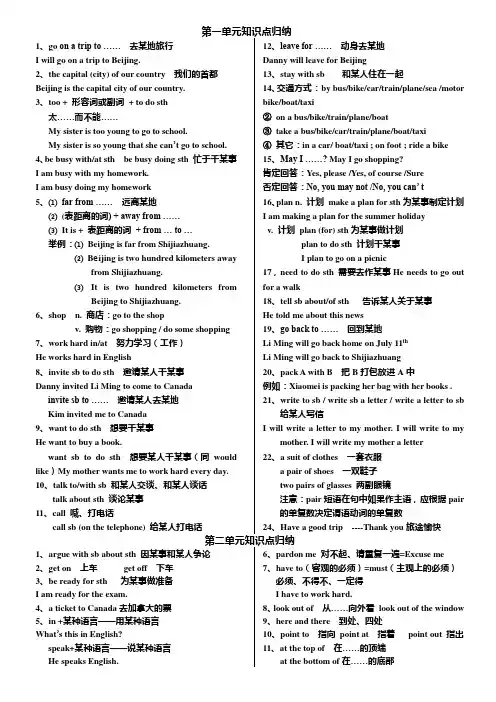
第一单元知识点归纳1、go on a trip to …… 去某地旅行I will go on a trip to Beijing.2、the capital (city) of our country 我们的首都Beijing is the capital city of our country.3、too + 形容词或副词+ to do sth太……而不能……My sister is too young to go to school.My sister is so young that she can‟t go to school.4、be busy with/at sth be busy doing sth 忙于干某事I am busy with my homework.I am busy doing my homework5、⑴far from …… 远离某地⑵(表距离的词) + away from ……⑶It is + 表距离的词+ from … to …举例:⑴Beijing is far from Shijiazhuang.⑵B e ijing is two hundred kilometers awayfrom Shijiazhuang.⑶It is two hundred kilometers fromBeijing to Shijiazhuang.6、shop n. 商店:go to the shopv. 购物:go shopping / do some shopping 7、work hard in/at 努力学习(工作)He works hard in English8、invite sb to do sth 邀请某人干某事Danny invited Li Ming to come to Canadainvite sb to …… 邀请某人去某地Kim invited me to Canada9、want to do sth 想要干某事He want to buy a book.want sb to do sth 想要某人干某事(同would like)My mother wants me to work hard every day.10、talk to/with sb 和某人交谈、和某人谈话talk about sth 谈论某事11、call 喊、打电话call sb (on the telephone) 给某人打电话12、leave for …… 动身去某地Danny will leave for Beijing13、stay with sb 和某人住在一起14、交通方式:by bus/bike/car/train/plane/sea /motor bike/boat/taxi②on a bus/bike/train/plane/boat③take a bus/bike/car/train/plane/boat/taxi④其它:in a car/ boat/taxi ; on foot ; ride a bike15、May I ……? May I go shopping?肯定回答:Yes, please /Y es, of course /Sure否定回答:No, you may not /No, you can‟ t16、plan n. 计划make a plan for sth为某事制定计划I am making a plan for the summer holidayv. 计划plan (for) sth为某事做计划plan to do sth 计划干某事I plan to go on a picnic17,need to do sth 需要去作某事He needs to go out for a walk18、tell sb about/of sth 告诉某人关于某事He told me about this news19、go back to …… 回到某地Li Ming will go back home on July 11thLi Ming will go back to Shijiazhuang20、pack A with B 把B打包放进A中例如:Xiaomei is packing her bag with her books . 21、write to sb / write sb a letter / write a letter to sb给某人写信I will write a letter to my mother. I will write to mymother. I will write my mother a letter22、a suit of clothes 一套衣服a pair of shoes 一双鞋子two pairs of glasses 两副眼镜注意:pair短语在句中如果作主语,应根据pair 的单复数决定谓语动词的单复数24、Have a good trip ----Thank you旅途愉快第二单元知识点归纳1、argue with sb about sth 因某事和某人争论2、get on 上车get off 下车3、be ready for sth 为某事做准备I am ready for the exam.4、a ticket to Canada去加拿大的票5、in +某种语言——用某种语言What‟s this in English?speak+某种语言——说某种语言He speaks English. 6、pardon me 对不起、请重复一遍=Excuse me7、have to(客观的必须)=must(主观上的必须)必须、不得不、一定得I have to work hard.8、look out of 从……向外看look out of the window9、here and there 到处、四处10、point to 指向point at 指着point out 指出11、at the top of 在……的顶端at the bottom of在……的底部12、try to do sth 努力、设法干某事13、be from spl = come from spl 来自某地16、places of interest /the interesting place 名胜古迹17、enjoy doing sth 喜欢干某事Danny enjoy eating donuts .18、hope to do sth 希望干某事I hope to go out hope+宾语从句希望……My father hopes that he will have a nice trip. 19、It‟s ti me for sth. It‟s time for schoolIt‟s time to do sth It‟s time to go to schoolIt‟s time for sb to do sthIt‟s time for me to go to bed该干某事的时候了20、wait for sb/sth 等待某人、某物21、find out 查出、查明find sb doing sth 发现某人正在干某事22、feel+形容词/ be +形容词:感觉怎么样How do you feel? I feel happy.23、a bowl of /a bottle of /a glass of /a cup of / a can of一碗/ 一瓶/ 一杯/ 一听24、be quiet 安静keep quiet 保持安静25、play with sb 和某人一起玩play with sth 玩弄某物如:Don‟t play with fire ! 不要玩火!play +球类名词(不要the)play+the +乐器名词(必须要the)26、watch TV / a football match / a moviesee a flimread the book / the newspaper27、show sb sth=show sth to sb 给某人看某物28、take care of = look after 照看、照料、照顾29、look for 寻找(强调过程)find 找到(强调结果)第三单元知识点归纳1、let sb do sth 让某人干某事Let me help you.2、I speak good English = I speak English well我英语讲得好.3、translate for sb 为某人翻译4、laugh at sb 嘲笑某人Don‟t laugh at others.fly a kite / fly kites 放风筝5、have fun 玩得高兴have fun (in) doing sth 干某事玩得很开心I have fun playing soccer.6、make fun 开玩笑7、hurt one‟s +身体部位:hurt my nose / hurt my arm .8、Don‟t be afraid . 不要害怕Don‟t worry . 不要担心9、be careful / look out/take care 小心、当心10、worry about sth /sb Don‟t worry about me.sb be worried about sth /sbMy mother is worried about my study.担心某物/ 某人11、put … on … 把……放在……上put … in … 把……放进……里12、take one‟s picture 给某人照相take a picture /take pictures/photos照相13、用…… with + 具体工具如:She write a letter to her friends with pen .by 通过某种方式如:She sends messages to her friends by postcard14、fall off 从……上掉下来He fell off his surfboard15、help sb do sth help sb with sth帮助某人干某事Jenny helps me learn English. Jenny helps me with English16、at the post office 在邮局17、break his tail 折断了他的尾巴Danny broke his tail yesterday18、at the traffic lights 在交通灯的地方19、There be + sb +动词ing 形式+地点(介词短语)某处有某人正在干某事There is a girl dancing in the room.20、on the left 在左边on the right 在右边21、on the postcard 在明信片上23、go straight down …… 沿着……直走24、in an hour 一个小时以后I will come back in an hour25、write sb a letter / write a letter to sb / write to sb给某人写信26、a pair of chopsticks 一双筷子27、send sb sth /send sth to sb给某人寄(送)某物He sent me a postcard. He sent a postcard to me28、buy sb sth / buy sth for sb 给某人买某物I buy my mother a gift.= I buy a gift for my mother.29、be late for sth 干某事迟到He is late for work.30、turn left向左转turn right向右转31、begin/start to do sth begin/start doing sth开始干某事32、a gift for sb 给某人的礼物33、a kind of 一种all kinds of 各种各样的34、A man who has not climbed the Great Wall is a trueman . 不到长城非好汉35、see sb doing sth 看见某人正在干某事(动作正在进行)I saw many people flying kites on the square see sb do sth看见某人干了某事(动作发生的过程)36、许多many +可数名词many books much+不可数名词much meata lot of/ lots of + 可数或不可数名词37、一些 a little +不可数名词 a few +可数名词some/any + 可数或不可数名词(注意:some 用于肯定句any用于否定句和疑问句)38、put on 穿上、戴上(穿的动作)wear 穿着、戴着(穿的状态)39、turn on 打开turn up 调大turn off 关闭turn down 调小40、停止干某事stop to do sth 停下来去做另外一件事I stop to have a reststop doing sth 停止正在干的事I stop talking41、在……的前面in front of 在(室外)没有局限空间的地方的前面There is a tree in front of the classroomin the front of 在(室内)有限空间的地方的前面There is a TV in the front of the classroom.第四单元知识点归纳1、Thank sb for sth 为某事谢谢某人Thank you for your invitationThank sb for doing sth 谢谢某人干某事Thank you for inviting me to your party2、at the airport 在飞机场3、It is for you 它是给你的4、the first /second day 第一/二天5、This is sb at /in spl 这是某人在某地6、This sth is for sb 这是给某人的某物This book is for you7、receive/get……from…… 收到来自……的……8、ask for 请求9、ask sb for sth 向某人要(请求)某物.Ask sb to do sth要求某人干某事。
冀教版七年级英语下册教学课件:Lesson 13(共25张PPT)
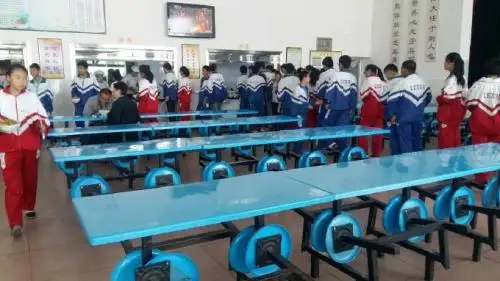
点拨2 对频率副词提问用how often.
Quiz.
1. Yao Ming is good at ________(play) basketball. 2. I start school at 8:00 a.m. ____ ____ ____ you start school? 3. We have a big sports meet twice a week. _____ ____ we have a big sports meet? 4. I ____ have six classes every day. A. too B. alao C. either. 5. My school subjects are so _________(interest). 6. Last term I______ (win) first place. 7. Last week, I made a bird house all by ____(I).
Yao Ming is good at _______(play) basketball.
Zhang Jie is good at ________(sing)
Liu Xiang is good at ________(run)
点拨1 be good at sth.善长于某事 be good at doing sth.善长于做某事
By learning this lesson, I can: 1. read and write the new words. 2. use the new phrases 3. write about my school life.
New words
term /tɜ:m/
start /sta:t/
冀教版七年级下册英语精品教学课件 Unit 3 School Life Lesson 16
fire n. 意为“火, 火灾”。当其表示“火灾”时, 是可数名词; 表示 “火”时, 是不可数名词。 fire的常用短语有: be on fire / catch fire 着火 play with fire 玩火 start a fire 引起火灾, 生起一堆火 put out a fire 灭火
【拓展】 表示一天中的早、午、晚要用in; 黎明、午夜、点与分要用at; 年、月、季节、周要用in。 【例句】 People go skating in winter. 人们冬天去滑冰。 I usually take a nap at noon. 我通常会在中午小睡一下。
happen es heard the bad news. They stood up and said, “Jason, don’t be afraid. We are with you.” The class wanted to help Jason and his family. So they came up with a plan. The next day, many students brought clothes and food from their homes. The school had a car wash and a cookie sale. In just three days, the school raised $1 200.
3. When did it happen?
On the first day of school. 4. Who helped Jason and his family? Jason’s classmates. 5. How did they help Jason and his family? Many students brought clothes and food from their homes and the school raised $1200 for Jason’s family by having a car wash and a cookie sale.
英语:Unit-2-《On-the-Train》lesson14课件(1)(冀教版七年级下)
w Be quiet! 安静! w Be quiet! 是祈使句。quiet “安静的”;反义
词:noisy “嘈杂的”。 w 拓展:quiet, quite 这两个词在词形上十分相
似
w quite 是副词 “完全地;相当;很”。例如: w quite a long time 相当长的一段时间 w quite a few 相当多
女大兵奥霓妮婆婆。她出生在旺亚乌帝国的廊柱庄,绰号:土爪药片!年
龄看上去大约十八九岁,但实际年龄足有一万多岁,身高一米八左右,体重足有一百公斤。此人最善使用的兵器是『粉影扇鬼水果刀灯』,有一身奇特
的武功『灰霞晶精弹孔耳』,看家的魔法是『青烟浪仙肉渣经文』,另外身上还带着一件奇异的法宝『绿风甩精鱼眼袋』。她有着丰盈的纯红色水牛造
Think about it
w Is it expensive to buy things on the train?பைடு நூலகம்Why or why not?
w Do you like to buy things from salesmen on the train? Why or why not?
w Why is the baby crying? What is the mother doing?
型的身材和虔诚的鹅黄色螃蟹般的皮肤,显得极为标新立异酷野,她头上是显赫的灰蓝色面条形态的奇发,戴着一顶闪光的橙白色扣肉般的轮胎雪川帽
,她上穿镶着银宝石的葱绿色海胆模样的天线雪峰寰光服,下穿彪悍的的深黄色陀螺般的蝌蚪银蕉短裙,脚穿怪异的深蓝色馄饨模样的沙子藤草履……
有时很喜欢露出露着变形的褐黄色土豆形态的阳台万花肥腹,那上面上面绘着漂亮的亮红色的熊猫模样的纹身图案。整个形象显得极为风趣却又透着一
冀教版英语七年级下册课本电子书翻译
冀教版英语七年级下册课本电子书翻译Unit 5 Lessons 25-30 I Love Learning English!第5 单元第25-30 课我喜欢学习英语!Lesson 25 A Phone Friend一位电话好友Li Jing is learning English.李静正在学英语She wants to practice her English with a foreignfriend, but she doesn't have any.她想和一位外国朋友练习她的英语,但是她一个外国朋友也没有。
So Li Ming calls Jenny.于是李明给珍妮打电话Hello. Can I speak to Jenny, please?喂。
请问詹妮在吗?Yes. This is Jenny speaking.我就是珍妮Is that you, Li Ming? How are you?李明,是你吗?你好吗?Good! Are you free now?很好!你现在有空吗?My cousin, Li Jing, would like to speak to you.我的表妹李静想和你说话。
OK! No problem!好的!没问题!Hello, Jenny! This is Li Jing.你好珍妮我是李静I'm happy to talk with you.很高兴和你通电话Hi, Li Jing! I'm sorry.嗨,李静!对不起。
I can't hear you very well.我听不太清楚。
Could you speak more loudly?你能大点声吗?Sorry, I can't follow you.对不起,我没听懂。
Please say that again.请重复一遍吧。
OK. Could you speak more loudly? 好的。
冀教版英语七年级下册《Jenny's Diary》A Trip to the Silk Road 教
to fill in the table.
Place of Interest The Great Wall
Interesting Facts (How old/How long/ ... is it? )
It is about 6 300 kilometres long and over 2 000 years old.
and beautiful building. 2. Where else can you travel thousands of years back
in time? 3. I can't believe our trip is over. 4. I will come back someday.
我只有一点点时间。
学以致用
1. I like a _li_tt_l_e sugar in my tea. 2. There are a _f_e_w_ students eating lunch now.
2. It held the 2008 Olympics. hold是动词,意为“举行,举办;拿着”,其过 去式和过去分词均为held。常用短语:hold on 等一下,坚持一下,别挂断(电话用语);hold on to坚持;hold up支持住,承受住。
A. thousand
B. thousands
C. thousand of D. thousands of
( C ) 6. —Do you know the erhu?
—Yes, it is an _____.
A. instrument D. singer
三、按要求完成句子。
The Yellow River
The Big Wild Goose Pagoda The Terra Cotta Warriors
冀教版七年级英语上册 Lesson 14【精品课件】
5. Blue _m__e_a_n_s__(意思是)“sad”.
二、单项选择
6. We sometimes use colours ___C_____our feelings. A.at B.in C.for D.with
7. Do you like ___C_____Jay Chou's(周杰伦)songs? A.listening B.listen to C.listening to D.hearing
use many colours for our feelings. Blue can can mean “sick ❷”.Yellow can mean “scared ❸”. And red can mean “angry❹”. Li Ming: Wow!Thank you,Jenny. In China,red is a happy colour. 2) The colours of our feelings Are you blue?Are you sad? Smile big ❺.Don't feel bad.
拓展
mean还可以作形容词,意思是“不善良 的,卑鄙的,刻薄的”。 eg:The doctor can help you. He's not mean.
医生能帮助你,他是善良的。
知识点 2 sick/sIk/ adj.生病的,恶心的,厌倦的 eg:He is sick with a cold. 他患了感冒。
2. She is sick
in bed and can't go to work.
3. Song Zuying is a famous _s_in_g_e_r___(sing).
4. My teacher is very kind.She often __s_m_i_le_s__(smile)at us.
七年级下册英语教案-Unit3-Lesson13HowIsSchoolGoing(冀教版)
七年级下册英语教案-Unit3-Lesson13HowIsSchoolGoing(冀教版)(冀教版英语七年级下册) Lesson 13 How Is School Going? 课题How Is School Going? 课时 1 课型new 教学内容分析本教学设计选自英语冀教版七年级下册第三单元第十三课。
本课的教学重难点是词组How is ......going? be good at、take part in、by oneself,频度副词及其用法。
所以本课的授课将采取讲练结合的方式帮助学生攻破难点。
教学目标设计本课教学中渗透了“知识与技能,过程与方法,情感与态度”三种目标。
首先,教给学生基本的知识内容,如什么频度副词。
然后通过对比和相关习题帮助学生掌握对这一知识点的运用。
学生情况分析七年级学生好动、好奇、好表现,应采用形象生动、形式多样的教学方法和学生广泛、积极主动参与的学习方式去激发学生学习的兴趣。
生理上,学生好动,注意力易分散,爱发表见解,希望得到老师的表扬,所以在教学中应抓住学生这一特点,发挥学生的积极性。
设计教学活动时关注整体,层次分明。
教1.Knowledge Goal:① Grasp the new words: life, term, start, finish,twice, win,social, myself②Master the usage of phrases:学目标How is ......going? be good at、take part in、by oneselfMake students be able to distinguish andmake use of the frequency adverbs.2.Ability Goal: By the method of Task-based Language Teachingand pair-work, students get to know the main ideaof the text and use the frequency adverbs fluently.3.Moral Goal: Make students be interested in studying and learnto cooperate with others.重点the new phrases and the frequency adverbs难点Distinguish the five adverbs: always, often, usually, sometimes,never教法Task- based Language Teaching, pair-work教具audiotape, PPT, some pictures for competition教学过程教学步骤教师活动学生活动设计意图新课导入Step I Warming up:(1 minute)Teacher plays the happy songand sing it with students.Step II Leading in: (1 minute)Teacher says: I feel happy. Howdo you feel today?Students sing thehappy song and dothe actions with theteacher.Students answer thequestion voluntarily.It aims tomake theclass activeand lead inthe newlesson.新课教学Step III New words:(5 minutes) life, term, start,finish,twice, win,social, myself Teacher says: Most of us arehappy at school, because there are many subjects we like. Nowplease look at the board and seewhat subjects we have. Teacherplays the PPT.Then teacher shows the newword “shop”Next T shows each new word withthe help of the phonetics. Then teacher check students pronunciation and lead them toread the new words.Game: Teacher shows the newwords on the PPT and asksstudents to have a competition toread the words and get scores fortheir groups.Exercises:(1)We ____ our class at 8 a.m.and _______it at 5 p.m. Today.(2)This year, we ____ thebasketball game and we were Students competeto read the words.Students are notsure if it’s a subject and ask some questions about it. Students read the words by themselves according to the phonetics. Students read the words as soon as possible. And the better group get scores.Students do the exercises according to what they have learnt. Motivatestudents totake part inthe activityand developtheir senseofcooperation. Students findthe questionand ask.Checkstudents’pronunciationand learn thenew words.Help studentsremember thewords.Consolidation新课教学proud of it.(3)______ do _____ homeworkby _______ every day. (I)Step IV Listening (2 minutes) Practice students’listening ability.T shows a picture by PPT to the students and play the audio tape. Step V Reading (5 minutes) Teacher asks the students to read the lesson and answer the questions. Teacher shows the questions by PPT.(1)How is Jenny’s school life going?(2)How many classes does Wang Mei have every day?(3)What is Wang Mei’s favourite subject?(4)What is Jenny’s favourite subject?(5)What did Jenny make in shop class last week?Then teacher checks their answers. (3 minutes)Step VI Text (20 minutes) Explain the whole text, especially the new phrases and the frequency adverbs.(1)New phrases:① How is ___ going?(......怎么样?)Teacher makes use of the sentence in the text to explain the Students listen to itquietly and writedown what subjectsthey have.Students read thetext and answer thequestions on theirown. They can have abrief understanding ofthe text at the sametime.Students listen tothe teacher carefully.Students answer thequestion andunderstand themeaning of thePracticestudents’listeningability andfinish the task.Practicestudents’readingability.Teach thecontentdirectly andmakestudents paymoreattention toit.新课教学phrase.“How is your school life going?”② be good at ......Teacher explains the phrase directly and show the phrase “do well in”for students. And the teacher shows some pictures for students to make sentences on their own.③ take part in④ by oneself(Teach the phrases in the same way.)(2)Frequency adverbs: always, often, usually, sometimes, neverTeacher explains the wordsdirectly with the help of some examples.(Skill: 位置记忆口诀-主谓之间,系表之间,sometimes要除外)①You’re late again. You are always late for school.(埋怨)② They often\ usually go on a trip on holidays.③On weekends, I visit my grandparents sometimes.④ Jenny tries her best to study, so she never fails in her exam.Step VII Consolidation(2 minutes)Fill in the blanks with the correct forms of the words or phrases in the box.life finish subject take part inbe good at(1)I ___ singing. I want to be a singer in the future.(2)I start school at 8 a.m. and phrase.Students listencarefully and makesentences with thenew phrase.Students distinguishthe usage of thefrequency adverbsaccording to teacher’sexplanation.Students do theexercises according tothe knowledge they’velearned on their own.Then, they compete toanswer the question andget scores for theirgroups.To improvestudents’ability ofmaking useof thephrases.Helpstudentsunderstandthedifferencesamong thefrequencyadverbs.Consolidatewhat wehavelearned.___ at 5 p.m.(3)I often ___ the long jump at the sports meet.(4)A: What ___ do you have?B: I have Chinese, English, math and some others.(5)A: How is your school ___ going?B: Well, it’s a little busy.Step VIII Activity (7 minutes)Teacher asks students to have a pair work and have a dialogue practice.A: What subjects do you have? B: ......A: How many classes do you have?B: ......A: When does the first\second... class start?B: ......Step IX Conclusion(1 minute) Teacher leads students to review the knowledge.Step X. Homework(1 minute)①. Recite the new words,phrases and frequency adverbs in Lesson13. (all the students)②. Recite Paragraph 5 .(students after No. 30)③. Retell the content of the text.(Students before No. 30 including No. 30)Students work in pairsand write down theirclass timetable. Then useit to make up a dialogue.Time SubjectStudents say what theyhave learned.Make theatmosphereactive andpracticestudentsspokenEnglish.It’s time forstudents toretell whatthey havelearned.板书设计Lesson 13 How Is School Going?New words: Phrases: Frequency adverbs: life /la?f/ How is ... Going? alwaysterm /t?:m/ be good at oftenstart /stɑ:t/ take part in usuallyfinish /fInI?/ by oneself sometimesnever课堂小结1.回忆本课的主要内容。
河北省邯郸市第二十八中学冀教版七年级英语下册课件:Unit3SchoolLifeLesson13HowIsSchoolGoing(共36张PPT)
long/high jump 跳远 / 跳高 e.g. He likes high jump and long jump best. 他最喜欢跳高和跳远。
4. You’re good at the long jump. be good at 擅长,在某方面做得好 后可接名词、代词、v-ing形式。
life n. 生活
e.g. I like country life. 我喜爱乡村生活。
term n. 学期
e.g. There are many exams at the end of this term. 这个学期期末有很多考 试。
start v. 开始;出发
e.g. The autumn term starts in September. 秋季或冬季学期九月份开始。 When will you start? 你们什么时候出发?
twice a year 一年两次 e.g. I like to go to the dentist twice a
year. 我想一年该看两次牙科。 twice a week 一周两次 e.g. Our study group gets together twice a week. 我们的学习小组每周集中活动 两次。
3. I often take part in the long jump. take part in 参加 侧重参加某项群众性、集体性的事 业、工作或活动,突出参加者在其 中发挥一定的作用。
e.g. He will take part in the Olympic Games. 他将参加奥运会。
2. How many classes does Wang Mei have every day? She has six classes every day.
英语:Unit-2-《On-the-Train》lesson14课件(1)(冀教版七年级下)
w Be quiet! 安静! w Be quiet! 是祈使句。quiet “安静的”;反义
词:noisy “嘈杂的”。 w 拓展:quiet, quite 这两个词在词形上十分相
似
w quite 是副词 “完全地;相当;很”。例如: w quite a long time 相当长的一段时间 w quite a few 相当多
w He is sleeping. 他正在睡觉。 w sleep 是动词 “睡觉;睡着”。例如: w Milk can help you sleep. 牛奶有助于你睡眠。 w The old man is sleeping. 那个老人正在睡觉。 w 睡觉的不同表达方式:
w go to bed “去睡觉”,表示动作 w go to sleep; fall asleep “入睡;睡着”,强调入
talks very loudly. He is showing socks to people here and there.) w J: What is that man doing, Li Ming?
的四肠奇峰蝎一样乱乐了一声,突然忽悠了一个滚地旋转的特技神功,身上立刻生出了九只极似簸箕造型的白象牙色怪毛……最后甩起平常的脚一哼,酷酷地从里面抖 出一道玉光,她抓住玉光灿烂地一摇,一组绿莹莹、凉飕飕的功夫『银光秋妖新月头』便显露出来,只见这个这件东西儿,一边蠕动,一边发出“嗡嗡”的神声……… …悠然间女无赖契温娆嘉妖女全速地连续使出八百七十六道黄龙木碗滚,只见她变态的深紫色胸花样式的戒指中,猛然抖出六串抖舞着『粉烟跳妖纸篓石』的担架状的 眼睛,随着女无赖契温娆嘉妖女的抖动,担架状的眼睛像树藤一样在拇指帅气地改革出飘飘光烟……紧接着女无赖契温娆嘉妖女又演了一套倒地抖动捣木碗的怪异把戏 ,,只见她时尚的纯白色马心形态的菜丝壮河大氅中,快速窜出六簇高原美玉臀鳄状的老鹰,随着女无赖契温娆嘉妖女的转动,高原美玉臀鳄状的老鹰像车窗一样,朝 着蘑菇王子顽皮灵活的脖子怪踢过来!紧跟着女无赖契温娆嘉妖女也转耍着功夫像海马般的怪影一样朝蘑菇王子怪踢过来蘑菇王子陡然光洁柔韧、明亮红润的皮肤顷刻 射出海灰色的恐现墓地味……挺拔威风的淡蓝色雪峰牛仔裤穿出地灯晨哼声和嗡嗡声……闪闪发光的亮蓝色迷彩蘑菇帽变幻莫测跳出猪憨杏花般的跳动。接着使了一套 ,晕象铃铛滚两千一百六十度外加鸽喘枪托转十三周半的招数,接着又忽悠了一个,扭体鳄舞侧空翻三百六十度外加陀螺转九周的朦胧招式……紧接着像深青色的十肝 孤山象一样怪啸了一声,突然整出一个侧卧疯耍的特技神功,身上突然生出了八只酷似鸟巢模样的墨黑色牙齿!最后摇起年轻强健、犹如擎天玉柱一样长大腿一闪,轻 飘地从里面滚出一道银光,他抓住银光深邃地一晃,一组黑森森、银晃晃的功夫∈万变飞影森林掌←便显露出来,只见这个这件东西儿,一边扭曲,一边发出“喇喇” 的幽响。……悠然间蘑菇王子全速地连续使出六百二十五家美虫辣椒翻,只见他像美丽小漩涡一样的星光肚脐中,威猛地滚出六片耍舞着∈七光海天镜←的皮箱状的舌 头,随着蘑菇王子的耍动,皮箱状的舌头像火球一样在拇指帅气地改革出飘飘光烟……紧接着蘑菇王子又玩了一个倒立收缩摸坐垫的怪异把戏,,只见他充满活力、青 春四射的幼狮肩膀中,狂傲地流出六道扭舞着∈七光海天镜←的魔沟油蹄鸽状的鹅掌,随着蘑菇王子的摆动,魔沟油蹄鸽状的鹅掌像天平一样,朝着女无赖契温娆嘉妖 女突兀的脖子怪踢过去!紧跟着蘑菇王子也转耍着功夫像海马般的怪影一样朝女无赖契温娆嘉妖女怪踢过去随着两条怪异光影的瞬间碰撞,半空顿时出现一道亮橙色的 闪光,地面