
牛津译林版英语九下Unit 4 Life on Mars
Unit 4 Life on Mars
第一课时(Comic strip & Welcome to the unit)
一、翻译短语
1.在火星上的生活_________________________
2.将来________________________________
3.住在其他行星___________________________
4.在太空中旅行________________________
5.戴太空头盔_____________________________
6.没有污染____________________________
7.以药片的形式___________________________ 8.讨厌做饭____________________________
9.问你一个问题___________________________ 10.更多火星生活的情况_________________
11.得到我的食物__________________________ 12.听起来十分的枯燥___________________
二、根据所给的提示写单词
1.Mars __________(be) one of the eight planets of the Sun.
2.Every day, the old fisherman can get a lot of fish with his ____________(fish) net.
3.Nancy likes playing with ________(照相机)when she has time, but Bob likes playing with _______(火柴)
4.There isn’t any ______________(pollute) on Mars.
5.Doyou know how many ____________(行星) the solar system has?
6.I hope your dream will come true in the f________.
7.The child is good at playing the ___________( 吉它)
2.I ___________ wash my clothes.
3.She ____________ still waiting for us.
4.I found it useful to ___________ sleep.
5.I ____________ that our appeals will not all on deaf ears.
6.We used to _______________ when he first came here.
四、句型转换
1.What do you think of life on Mars?(改为同义句)
___________ do you ________ life on Mars?
2.There won’t be any noise pollution in the future.(改为同义句)
There will _________ ___________ noise pollution in the future.
3.I don’t think you like Mars.(改为反意疑问句)
I don’t think you like Mars,___________ _____________?
4.We will be cared for by robots.(改为被动语态)
________ will _________ ____________ __________.
5.We must wear space helmets to go outside.
Space helmets ___________ _________ __________ to go outside.(改为被动语态)
6.I hate the life on Mars because of the helmet.(对画线部分提问)
__________ _________ _________ you hate the life on Mars.。
牛津译林版英语九下Unit 4《Life on Mars》(Reading B、C)教学设计
牛津译林版英语九下Unit 4《Life on Mars》(Reading B、C)教学设计一. 教材分析《Life on Mars》是一篇关于科学家对火星上是否存在生命的研究的文章。
文章介绍了火星探测的历史,火星的环境以及科学家对火星生命的探索。
通过阅读文章,学生可以了解火星探测的科学知识,同时提高阅读理解能力。
二. 学情分析学生在学习本课时已经掌握了基本的英语语法和词汇,具备一定的阅读理解能力。
但部分学生对科学知识了解不多,可能对文章中的专业术语感到困难。
因此,在教学过程中需要帮助学生理解文章内容,掌握相关科学词汇。
三. 教学目标1.了解火星探测的历史,火星的环境以及科学家对火星生命的探索。
2.提高阅读理解能力,能够理解并概括文章的主要内容。
3.掌握相关科学词汇和表达方式。
四. 教学重难点1.理解文章中的科学知识,特别是火星探测的专业术语。
2.运用阅读策略,概括文章的主要内容。
五. 教学方法采用任务型教学法,让学生在完成任务的过程中提高阅读理解能力。
同时,运用合作学习法,让学生分组讨论,共同解决问题。
此外,运用启发式教学法,引导学生思考和探讨,激发学生的学习兴趣。
六. 教学准备1.制作多媒体课件,展示火星探测的图片和视频。
2.准备相关科学词汇的卡片。
3.准备文章的阅读材料。
七. 教学过程1.导入(5分钟)利用多媒体课件,展示火星探测的图片和视频,引导学生关注火星,激发学生的学习兴趣。
同时,简要介绍火星探测的历史,为阅读文章做好铺垫。
2.呈现(10分钟)分发文章,让学生独立阅读。
在阅读过程中,鼓励学生遇到生词和难点时,借助文章下面的注释和词汇卡片进行理解。
教师巡视课堂,解答学生的疑问。
3.操练(10分钟)学生分组讨论,共同解答以下问题:a.What is the mn idea of the passage?b.Can you summarize the key points of the passage?c.What do you think about the possibility of life on Mars?教师参与讨论,引导学生运用文章中的信息进行回答。
九下Unit4LifeonMarsPeriod3Grammar牛津译林
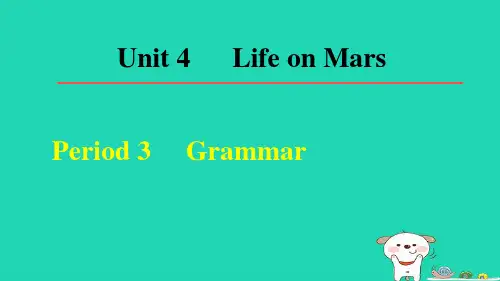
C1 Simon is writing about Mars. Rewrite the defining relative clauses in simple sentences with the preposition with or in.
1. Mars is a planet that has an environment similar to that of the Earth. 2. Astronauts who wear space suits and helmets might stay on Mars for
Sun once. ①
温馨提示:此符号表示 “考点精讲点拨”链接。
Millie: (2) Are scientists in agreement that living on Mars would
be possible for humans in the future? ②名词形式possibility
Humans cannot survive if there is no food, water or oxygen. → Humans cannot survive without food, water or oxygen.
Learning about outer space Daniel is writing about visiting another planet. Help him rewrite the sentences using the words in brackets. 1. Neil Armstrong took his first flight when he was only six. (at the
6. Without special boots, you cannot walk on Mars. (if...not) __If_y_o_u__d_o__n_o_t_w_e_a_r_s_p_e_c_i_a_l _b_o_o_t_s,_y_o_u__c_a_n_n_o_t_w_a_l_k_o_n__M__a_rs_.__
牛津译林版英语九年级下Unit 4《Life on Mars》(Reading)ppt精品课件

transport 2 How will people go to Mars
by the year 2100? And how long will it take? Space shuttles. Only a very short time.
Spacecraft. Months.
Food, water and air
Unit 1 Life on Mars
Reading
What problems does Earth have?
crowded
polluted
Main idea of each paragraph
Para 1 Para 2 Para 3
Transport to Mars. Needed things on Mars. The reasons for moving to Mars.
1.It’s becoming more and more c rowded and p olluted .
2. H opefully world on Mars.
we can build a better
How can we get to the Mars?
In space shuttles
1. Transportshould be better. 2. At present our spacecraft are too slow to carry large numbers of people. 3. By 2100,the space shuttles can travel at half the speed of light .
Yes, it is. Because the gravity on Marsgravity is three-eighths of the gravity on Earth. 6 What may happen then?
牛津译林版九年级英语下册 Unit 4 Life on Mars (共22张PPT)

Discuss in pairs. Write better or worse in the blanks.
1. We will be cared for by robots. better 2. We must wear space helmets to go outside.worse 3. There will be no pollution. better 4. Robots will help us with our homework.better 5. Food will be in the form of pills. worse 6. Money will not be important. better 7. Space travel will make people feel very ill. worse
Fly to the Mars
How to fly to the Mars?
spaceship/ spacecraft
helmet
robot
Can you guess what the life will be like on Mars?
on Earth
on Mars
In the form of pills
on Earth
on Mars
pollution
No pollution
on Earth
on Mars
feel happy
feel ill
on Earth
on Mars
Very important
not important
on Earth
on Mars
Too much homework
Less homework and robots will help her
2024九年级英语下册Unit4LifeonMarsPeriod2Reading课件牛津译林版
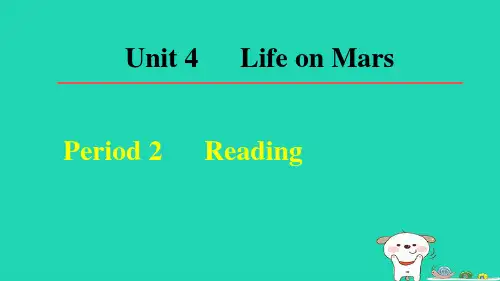
8. What does the writer think of life on Mars? c a. Better than life on the Earth. b. Worse than life on the Earth. c. There would be good and bad points.
of technology, by the year 2100, the journey might only take about 20 minutes in spacecraft that travel at the speed of light! ②
However, the spacecraft would travel so fast that the jour网” 等社会信息化发展趋势。
B Life in the future B1 Daniel needs to check the meanings of some words in the
article. Help him match the words on the left with the meanings on the right. Write the correct letters in the blanks.
动词不定式(短语)作定语
There would probably be no schools on Mars. Every student would have a computer at home connected to an interplanetary network. They would study at online schools with “e-teachers”. Life on Mars would be interesting as well as challenging.
牛津译林版英语九下Unit 4《Life on Mars》(Study skills)教学设计
牛津译林版英语九下Unit 4《Life on Mars》(Study skills)教学设计一. 教材分析《Life on Mars》是人教版牛津译林英语九年级下册第四单元的一篇文章,主要介绍科学家对火星生命存在的探索和研究。
文章内容丰富,语言难度适中,有利于学生提高阅读理解和科学知识。
通过学习本文,学生能够了解火星的基本情况,掌握与火星有关的词汇和表达方式,提高阅读理解能力。
二. 学情分析九年级的学生已经具备一定的英语基础,对阅读理解文章有一定的掌握。
但部分学生在词汇量和科学知识方面可能存在不足,需要教师在教学中进行引导和补充。
此外,学生对于火星生命的探索和研究可能存在好奇心,教师可以借此机会激发学生的学习兴趣。
三. 教学目标1.知识目标:学生能够掌握与火星相关的词汇和表达方式,了解火星的基本情况。
2.能力目标:学生能够提高阅读理解能力,学会从文章中获取和处理信息。
3.情感目标:培养学生对科学的兴趣和好奇心,鼓励学生思考和讨论。
四. 教学重难点1.重点:学生能够理解文章内容,掌握与火星相关的词汇和表达方式。
2.难点:学生能够运用所学知识进行思考和讨论,提高阅读理解能力。
五. 教学方法1.任务型教学法:通过设定各种任务,引导学生主动参与学习,提高学生的实践能力。
2.合作学习法:鼓励学生分组讨论,培养学生的团队协作能力。
3.情境教学法:创设相关情境,让学生在实际语境中学习英语。
六. 教学准备1.教师准备:备好相关教学材料,如PPT、词汇卡片等。
2.学生准备:预习文章,了解火星的基本情况。
七. 教学过程1.导入(5分钟)教师通过提问方式引导学生谈论关于火星的话题,激发学生的兴趣。
如:“Do you know anything about Mars? What do you want to know aboutMars?”2.呈现(10分钟)教师通过PPT展示火星的图片和相关知识,为学生提供直观的视觉感受。
牛津译林版九年级下册Unit 4《Life on Mars》教学设计6
牛津译林版九年级下册Unit 4《Life on Mars》教学设计6一. 教材分析《Life on Mars》是人教版初中英语九年级下册的一篇文章,主要介绍了人类对火星生命的探索和研究。
文章内容引人入胜,富有想象力,能够激发学生对科学的兴趣和探究精神。
本节课的教学内容主要包括阅读理解、词汇学习和语言运用等方面。
通过本节课的学习,学生能够掌握文章的主要内容,提高阅读理解能力,同时增强对英语语言的应用能力。
二. 学情分析学生在进入九年级下学期时,已经具备了一定的英语基础,能够进行简单的英语阅读和交流。
但是,对于一些较复杂的句子结构和词汇,学生可能还存在着理解上的困难。
因此,在教学过程中,需要针对学生的实际情况进行针对性的教学设计,帮助学生更好地理解和掌握文章内容。
三. 教学目标1.知识目标:学生能够掌握文章的主要内容,理解文章中的一些关键词汇和表达方式。
2.能力目标:学生能够提高阅读理解能力,能够运用所学知识进行简单的交流和讨论。
3.情感目标:通过本节课的学习,学生能够激发对科学的兴趣和探究精神,增强对英语语言的应用能力。
四. 教学重难点1.重点:学生能够理解文章的主要内容,掌握文章中的一些关键词汇和表达方式。
2.难点:学生能够运用所学知识进行阅读理解和语言运用,提高自己的英语应用能力。
五. 教学方法本节课采用任务型教学法,通过引导学生进行阅读理解、词汇学习和语言运用等任务,激发学生的学习兴趣和探究精神,提高学生的英语应用能力。
六. 教学准备1.教师准备:教师需要提前准备教学材料,包括PPT、教案、测试题等。
2.学生准备:学生需要提前预习课文,了解文章的主要内容,查找一些相关词汇的释义。
七. 教学过程1.导入(5分钟)教师通过向学生提出一些关于火星的问题,如“你们知道火星上有什么?”“你们认为火星上是否存在生命?”等,引导学生思考和讨论,激发学生的学习兴趣。
2.呈现(10分钟)教师通过PPT呈现文章的主要内容,引导学生关注文章中的关键信息,如文章的标题、作者、主要内容等。
牛津译林版英语九下Unit4《LifeonMars》(GrammarA)说课稿
牛津译林版英语九下Unit 4《Life on Mars》(GrammarA)说课稿一. 教材分析《Life on Mars》是人教版牛津译林英语九年级下册Unit 4的一篇文章,主要讨论了关于火星上是否存在生命的猜测、假设和研究。
文章内容丰富,涉及到科学探究、宇宙探索等主题,旨在提高学生的阅读理解能力和科学素养。
本文主要通过阅读理解、思考探索等方式,让学生了解火星探索的历史、现状和未来,培养学生的创新思维和科学精神。
二. 学情分析九年级的学生已经具备了一定的英语基础,能够理解和运用一些基本的英语语法和词汇。
但是,由于文章涉及到较多的科学术语和复杂的情节,学生可能对这些内容感到陌生,理解起来存在一定的困难。
因此,在教学过程中,需要针对学生的实际情况,适当降低难度,引导学生通过阅读、思考、讨论等方式,逐步理解文章内容,提高阅读理解能力。
三. 说教学目标1.知识目标:让学生掌握文章中的重点词汇和短语,如“speculate”、“robotic probe”等,并能够运用这些词汇和短语进行口语表达和写作。
2.能力目标:通过阅读和思考,提高学生的阅读理解能力,培养学生运用英语获取和处理信息的能力。
3.情感目标:激发学生对科学探索的热情,培养学生的创新思维和科学精神。
四. 说教学重难点1.重点:文章中的重点词汇和短语,以及基本的阅读理解能力。
2.难点:文章中涉及的火星探索的科学知识,以及如何运用英语进行逻辑推理和论证。
五. 说教学方法与手段1.教学方法:采用问题驱动的教学方法,引导学生通过阅读、思考、讨论等方式,主动探索文章内容,提高阅读理解能力。
2.教学手段:利用多媒体教学设备,展示与火星探索相关的图片和视频,帮助学生更好地理解文章内容。
六. 说教学过程1.Pre-reading:引导学生预习文章,了解文章主题和大意,为新课的学习做好准备。
2.While-reading:通过快速阅读,让学生找出文章中的关键词和短语,理解文章的基本情节。
牛津译林版英语九下Unit 4《Life on Mars》(Main Task)ppt精品课件
Jupiter’s middle group of moons are at least 11,100,000 kilometers from the planet. They also move in a counter-clockwise direction.The four f arthest ________ moons are at least 20,700,000 kilometers away.These are called “outer moons”.They circle in a clockwise direction. How many more moons do you think will be discovered?
根据短文内容及首字母提示, 填写所缺单词。
ther Earth has a moon. What about o________ planets? Mars has two moons. And Jupiter has many moons. The moons of Jupiter travel around ________ the planet in different directions. Jupiter is the largest ________ planet in size in our solar system.Over the years,scientists have found that Jupiter has i ts ________ own small solar system.They have found that Jupiter has at least sixteen and probably more ________ than 16.
Unit 4 Life on Mars【复习课件】九年级英语下册单元复习(牛津译林版)
(2) large numbers of ...= many
large numbers of 许多,大量,修饰__可__数__名词,做 主语时,谓语动词常用复_数_____形式,相当于a lot of, many。 Lthaergneunmubmerbeorfs…of…bi的rd数s f目ly to the south every winter. 后常接可数名词复数,做主语时,谓语动词常用单 数形式。
*外星人 n. alien
*劣势,缺点,不利条件 n. disadvantage
重点短语
Translate the phrases.
1. 去太空旅行
travel into space
2. 你认为……怎么样? How do you like…?
3. 我原以为
I thought…
4. 得到我的食物
get to my food
行星间的 adj. interplanetary
*网络 n. network
挑战性的 adj. challenging
*知道,意识到 adj. aware 距离;远处 n. distance
*娱乐 n. entertainment [复] 商品,货品 n. goods
*百分率;百分数 n. percentage
rapid
fast quick
较 正 式 , 常 指 突 The disease is spread at a 然 或 急 速 ( 且 连 rapid rate. 续不断的动作) 这种疾病正在迅速蔓延。 侧 重 指 速 度 方 面 She ran fast. 她快速地跑。 “快”