
人教版高中英语必修二UNIT 4《History and traditions》Section C
人教版高中英语必修二Unit4HistoryandTraditions知识点总结归纳完整版(带答案)
人教版高中英语必修二Unit4HistoryandTraditions知识点总结归纳完整版单选题1、Friendship, ______ on mutual respect and ______ feelings and activities, tends to last long.A.based; sharedB.basing; sharedC.based; sharingD.basing; sharing答案:C考查非谓语动词。
句意:友谊建立在相互尊重、分享感情和活动的基础上,往往会持续久远。
分析句子结构可知,该句谓语动词是 tends to ,base与逻辑主语Friendship之间是被动关系,故要用过去分词形式based作定语修饰Friendship;固定短语base on意为“基于;使建立在……基础上”,其中介词on后应接动名词sharing。
故选C项。
2、Only a(n) ________ of people are interested in that political issue. A.flockB.amountC.handfulD.bagful答案:C考查固定短语。
句意:只有少数人对那个政治问题感兴趣。
A. flock(鸟或羊等动物)群,一大群人;B. amount数量;C. handful一把;少数,少量;D. bagful满口袋。
a handful of 少量的,一小部分。
根据空前的“only”可知只有少数的人对政治感兴趣。
故选C。
3、With the Olympic flame ________, the Beijing 2022 Winter Olympics came to an end on February 20th.A.to extinguishB.extinguishesC.extinguishedD.extinguishing答案:C考查非谓语动词的用法。
Unit 4 History and Traditions高中英语人教版(2019)必修第二册
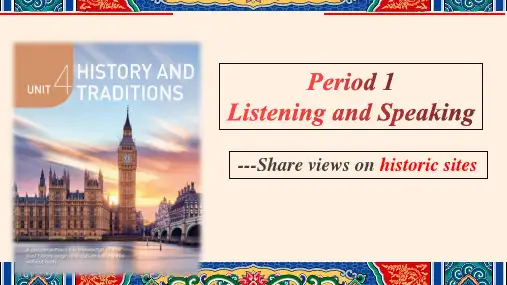
Located (locate )to the east of the Temple of Confucius, this was the historical home of the descendants of Confucius where they managed sites and ceremonies in Qufu. Kong Family Mansion Today it is a museum.
other building in the city can be taller than it.
WX::AOWnha,iittd,hyaioot’usmmreesipasnecwat.hnTehreeatxS’sphaarkleietstslpesebiaoritenlwikawesmfhryoicmhoh?mWmethoeawtana–ncSsotirnsactofiodmredn-ecuetp–honCi-noAngvfoudnc.iiufsfaenrdent frSohamkestpheaere,m5._e_a_tw_n_oi_no_fg_t_h_oe_gf_r_eta_ht_ee_st_im_n_i_nd_di_sv_in_id_h_ius_t_aor_ly_w_! oI rredalsly. wSaontmtoeviisdit itohemUKs– I’m
3. He lived _o_ve_r__20_0_0__ye_a_r_s__ago.
Xiao Kong
1. Confucius has _o_v_e_r_3__m_i_ll_io_n__descendants. 2. He was a great _ed_u_c_a_t_o_r and had many ideas about_e_d_u_c_a_ti_o_n____. 3. He was _on_e__o_f _th_e__gr_e_a_t_es_t_m__in_d_s__in history.
Unit 4 History And Traditions高中英语人教版(2019)必修第二册

5 Role Play
B: Welcome to our school! A: Thank you! I’m so happy to be here. Oh, what’s that over there? It looks like a statue of an ancient man. Who is he? …… A: Thank you for your explanations. I am looking forward to studying with you guys under Confucius’ guidance! B: Let me show you our classroom.
3 Listening for the second time
Decide whether these statements are true, false, or not mentioned.
① Confucius said that learning without understanding leads to
一个不了解自己历史、起源、和文化的民族,就如同一颗无根之树。
1 Lead-in
How can we learn more about history and traditions?
1. Read books 2. Watch documentaries 3. Visit websites 4. Read travel journals 5. Visit historical sites 6. Attend cultural festivals
recorded in the family tree.
T F NM
④ Dacheng Hall is the tallest building in Qufu.
人教版高中英语必修第二册精品课件Unit 4 HISTORY AND TRADITIONS 写作指导
(二)精彩句型 1.They attract visitors from every corner of the world. 它们吸引了来自全世界的游客。 2.A trip along the Yellow River will enable you to know more about the people living on its banks. 一次黄河之行将使你更多地了解生活在黄河两岸的人民。 3.The ancient temple covers an area of ten mu,with a history of over 100 years. 这座古庙占地十亩,有一百多年的历史。 4.It is most famous for the beautiful West Lake,which has a long history with a love story. 它最著名的是美丽的西湖,它有着悠久的爱情故事。
人教版(2019)必修第二册Unit 4 History and Traditions List教案

2019新人教高中英语必修二Unit 4 Listening and Speaking公开课教案Analysis of the materials:Theme Group: History,Society and CultureThis unit focuses on history and traditions covering the long history and cultural traditions of China,Britain,Russia,Ireland,Brazil,Greece,Egypt and other countries.It's of great significance for students to understand the English language,the historical and cultural connotation of the world's important civilization and the way of thinking contained in these history and traditions.In this unit,you will read about history and traditions of the UK;and listen to people talk about historic places and share your own experiences;and write about a place by describing different senses;and learnmore about different tea cultures,etc.The Target Teaching Text Analysis(目标文本分析)(What)Theme:With the section purpose of sharing views on historic sites under the guidance of the unit theme history and traditions,the listening script is a dialogue between a Chinese student and a British tourist on their way to Confucius Temple.It'll help Ss learn about Confucius in Qufu and Shakespeare in the UK as well as their profound influence on Chinese and British history and traditions respectively,which need all human's protection and inheritance(保护和传承)and lay a good foundation for the following Reading and Thinking section.(How)Feature:Evidently,it is a conversation with Shakespeare and Confucius mentioned together and some idioms as well as historic sites at home and abroad presented, aiming to make Ss learn more about Confucius and be open with colorful cultures and traditions.(Why)Purpose:It's mainly meant to help Ss understand it is human beings,history and traditions that make historic sites truly alive and meaningful, andreflect on the profound influence of Confucius and his thoughts on Chinese history and traditions,after which Ss will share some views on two questions,enhancing their international perspective,strengthening national identity and cultural confidence and learning to present China stories well(增强国际视野,坚定民族认同与文化自信,讲好中国故事).Analysis of the students:Students involved are from Pearl Class 2,Senior 1,most of whom are active, energetic and quick-minded with relatively creative thinking,and have mastered some good learning methods.In a way,they are generally hard-working and eager to improve their overall English abilities.Luckily, they know about Confucius and Shakespeare,and are very familiar with Confucius's thoughts as well as some basic information about Shakespeare. (Wonder)H owever,they complain that they have much trouble in listening and speaking,forgetting what they've heard quickly.And they have a strong desire to have more to say rather than 1 or 2 words. (To learn)Thus,listening strategies with three steps will be presented ahead of time.Then Ss may find it relatively relaxing to share views on historic sites to practice listening and speaking,the purpose of which is to strengthen their national identity and cultural confidence.Teaching aims:1.Enable students to get familiar with the vocabulary of“Confucius,Temple ofConfucius,Confucius' descendants,Confucius 'educational thoughts”.2.Guide students to understand some English idioms and their related cultural allusions.3.Help students to talk about Confucius 'ideas on education and introduce the historyand importance of a historic site.Teaching key and difficult points:1.To help students to get familiar with the vocabulary of“Confucius,Temple ofConfucius,Confucius' descendants,Confucius' educational thoughts".2.To enable students to understand English idioms and the related cultural allusions.3.To lead students to talk about Confucius' educational thoughts.Teaching procedures:Step I Lead-inLook at the Opening Page and have a discussion.1.How do you understand the quote“A people without the knowledge of their past history,origin and culture is like a tree without roots"by Marcus Garvey?2.Why is it important to protect historic buildings and cultural traditions?Suggested answers:1.In this quote,Garvey is emphasizing the importance of knowledge about the history of yourcountry and people.He uses“people”in the countable form to refer to all the persons who live in a particular place or belong to a particular country,race,or other groups.In Garvey's case,race is especially important.A tree is a good metaphor for a group of people.For example,we talk about“family trees”,which detail our relatives across time.A tree without roots would easily fall down and die.The roots also feed the tree.The roots of a tree cannot usually be seen,but they often spread deep and wide.In this way,a people's history also has deep roots that spread far and wide.If people do not know about their history,they will not learn from the past and will not be able to develop and progress well into the future. 2.It is important to protect historic buildings and cultural traditions because they are a recordof our shared history and tell us a lot about who we are as a country and people.Step ⅡListeningActivity 1 Warming upLook at some photos ofQufu.What can you say about these places?Suggested answers:Activity 11.Temple of Confucius:The most famous and largest temple honoring the great sage.It is also aUNESCO World Heritage Site.It covers 16,000 square meters and has 460 rooms.The main part consists of nine courtyards with several gates.Dacheng Hall stands at the centre and isthe principal place for offering sacrifices to Confucius.2.Kong Family Mansion:Located to the east of the Temple of Confucius,this was the historicalhome of the descendants of Confucius from where they managed sites and ceremonies in Qufu.Today it is a museum.3.Cemetery of Confucius:This is where Confucius and his descendants are buried.There are morethan 10,000 of them,buried here over 2,000 years.The cemetery has had many renovations and extensions in its history.Activity 2 PredictionPredict what the listening text is about by looking at Activity 2 on page 38.Suggested answer:The listening text is probably about the introduction of a great educator—Confucius.Activity 3 First listeningListen to a conversation between a British tourist and a Chinese student in Qufu,and then write down what they say about Confucius.(红色为学生作答)Activity 4 Second listening1.Listen again and decide whether these statements are true(T),false(F),or not mentioned(NM).(1)Confucius said that learning without understanding leads to confusion.( )(2)Xiao Kong is doing a research project on Confucius philosophy.( )(3)As one of Confucius' descendants,Xiao Kong's name is recorded in the family tree.((4)Dacheng Hall is the tallest building in Qufu.( )2.Answer the question:Why do you think William said his hometown was similar to Qufu?A.There are famous halls in his hometown.B.There are no tall buildings in his hometown.C.Both places have a famous person who was born there.D.His hometown doesn't allow other buildings to be more noticeable than the historic buildings. Suggested answers:1.(1)F(2)F(3)NM(4)T 2.DActivity 5 Third listeningWrite down the English idioms that are used in the conversation.Explaintheir meanings and think about some Chinese equivalents.(红色为学生作答部分)SteplIISpeakingActivity 1 Draw a mind map to sort out the information about Confucius in this class and listActivity 2 Think about a historic site that you have visited,work in groups and give anintroduction to its historyand importance.and statues.They were constructed over many dynasties and are an important record of tradition and belief in China during that time.StepIV Homework1.Must:Explorative assignment(探究性作业):Output a n essay with requirements below.(30′)假如你是来自21世纪的李华,有幸穿越时空遇见孔子,你想对他说些什么?要点如下:(1)孔子及其弟子的言行和思想汇聚成《论语》,在全世界广为传播,并举例说明;(2)结合日常学习生活阐述孔子的“温故而知新”对你的影响;Key words:The Analects of Confucius《论语》;Review the old and learn the new 温故而知新注意:可适当增加细节,恰当描述你对孔子想说的话。
人教英语2019新教材必修二Unit 4 课文翻译
16世纪时,邻国威尔士并入英格兰王国。随后,苏 格兰在18世 也 加入 进 来 , 从 而 诞 生 了 大不列颠王国 。19世纪 时 ,爱尔兰王国加入, 组 成 了大不列颠及 爱尔兰联合王国。
Finally, in the 20th century, the southern part of Ireland broke away from the UK, which resulted in the full name we have today: the United Kingdom of Great Britain and Northern Ireland. Most people just use the shortened name: “the United Kingdom” or “the UK”. People from the UK are called “British”, which means the UK is also often referred to as Britain or Great Britain.
联合王国、大不列颠、不列颠、英格兰——很多人对 这些不同名字的含义感到困惑。如果有区别的话,那 么区别 何 在 ?稍微了解一下英国历史 就 可 以 帮 助你解 开这个谜题。
In the 16th century, the nearby country of Wales was joined to the Kingdom of England. Later, in the 18th century, the country Scotland was joined to create the Kingdom of Great Britain. In the 19th century, the Kingdom of Ireland was added to create the United Kingdom of Great Britain and Ireland.
Unit4HistoryandTraditions单词讲解课件高中英语人教版
27.ocean n. 大海;海洋 ●oceanic a. 海洋的;巨大的;广阔的
Atlantic Ocean 大西洋 Pacific Ocean 太平洋 Indian Ocean 印度洋 Arctic Ocean 北冰洋
28.breath in 吸气;吸入
●achievable
a. 可实现的,可达到的
make an achievement(in doing sth.) (在做某事方面)取得成就
a great/remarkable achievement 一项了不起的成就
one’s achievement in... 某人在...方面的成就
a sense of achievement 成就感
3.puzzle n. 谜;智力游戏;疑问 vt. 迷惑;使困惑
puzzled a. 困惑的,迷惑不解的 puzzling a. 令人迷惑的 puzzlement n.迷惑,困惑
puzzle about\over 冥思苦想;苦苦思索 be a puzzle to sb 一件让某人困惑的事 be in a puzzle 不知如何是好 ,感到困惑 be puzzled about 对…迷惑不解
a. 慷慨的;大方的;丰富的
●generously ad. 慷慨大方地
●generousity n. 慷慨;大方
be generous to sb
对某人慷慨
be generous in doing sth 乐于做某事
be generous with sth
在某方面大方
It is generous of sb. to do sth. 某人做某事很慷慨
人教版(2019)必修第二册Unit 4 History and Tradit课文讲解课件(共30页
people: 1) [pl.] 人,人们 2) [C] 民族,种族 the 56 peoples of China
Big Ben (大本钟)
Houses of Parliament (国会大厦)
Buckingham Palace(白金汉宫)
Tower Bridge(塔桥)
Activity 3
when? 1st century 5th century 8th century
11th century
16th century
What happened?
What changed?
Romans arrived
towns and roads
language and way Anglo-Saxons came houses were built
联合王国的人被称为“英国人”,这意味着联合 王国也经常被称为英国或大不列颠。
Para.3
The four countries that belong to the United Kingdom work together in some areas.
last country was Ireland, but later the southern half didn't want
to be __jo_i_n_e_d__to________ the United Kingdom.
A: I remember now! The southern part _b_r_o_k_e__a_w_a_y___ from
Wales was joined to Kingdom of England
When?
What happened?
Unit 4 History And Traditions 词汇 课件-高中英语人教版必修第二册
aspect (方面) 原本是一个天文学术语,表示“星体的相对位置”。它 由“a- (to) + spect (to look 看) ”构成,字面意思就是“(星体相互) 观 看对方”。后来衍生出“看待事物的方式”“事物呈现出来的外观”。
She felt she had considered the problem from every aspect. 她认为她已经从各个角度考虑了这个问题。
来自词根techno- (art, skill 技术) 同根词:technology
《变形金刚》(Transformers)是历史上最成功的商业动画之一,最初 改编自日本TAKARA TOMY公司的戴亚克隆和微星系列。它在玩具市 场和音像市场上取得的成功是空前巨大的,以至于80年代一度风靡全球, 在亚欧美等多个国家都兴起了一股“变形”热,让“transformers”成 为全世界家喻户晓的名词。前后进行了真人电影化以及游戏化。
Each play has a theme or central idea which the playwriter hopes to get across through dialogue and action.
每个剧目都有一个主题或中心思想,剧作家希望通过对话和行 为让人们理解这些主题或思想。
正式用语 (对应 woman) 拓展male (对应man)
说出下列句子中画线词的释义。 1. Water can transform a desert into a garden. 使改变 (desert → garden)
2. The book has been translated into thirty languages since it came on the
高中英语人教版 必修第二册Unit4 History And Traditions词汇讲解
Unit 4 History And Traditions1.Confucius n. 孔子2.mansion n.公馆;宅地3.cemetery n.墓地;公墓4.philosophy n. 哲学5.descendant n. 后裔;后代;子孙➢offspring n. 子孙,后代〔辨析〕指人或动植物的后代,常为幽默用法。
〔例证〕Her offspring are diligent and intelligent. 她的孩子们既勤奋又聪明。
➢descendant n. 后代,后裔〔辨析〕指有血缘关系的后代,只用于人。
〔例证〕They are the descendants of Confucius. 他们是孔子的后裔。
6.individual adj. 单独的;个别的n. 个人7.heel n.足跟;(脚、袜子、鞋等的)后跟8.Achilles’ heel (喻)(希腊神话)阿克琉斯的脚跟,致命的弱点9.kingdom n. 王国;领域10.chief adj. 最重要的;最高级别的n. (公司或机构的)首领;酋长11.puzzle n. 谜;智力游戏;疑问vt. 迷惑;使困惑同义词辨析Puzzle、baffle、bewilder、confuse【导航词义:困惑】➢puzzle v. 使困惑,使迷惑〔辨析〕指无法理解某事而感到有些困扰。
〔例证〕What puzzles him is why that movie is so popular.令他不解的是,为什么那部电影如此受欢迎。
➢baffle v. 使困惑,难倒〔辨析〕指完全不能理解或解释问题、行为等。
〔例证〕The cloze test baffled many students in her class.完形填空测验难倒了她班上的很多学生。
➢bewilder v. 使困惑,使迷茫〔辨析〕多指不知所措、无法清楚地思考,通常用被动语态。
〔例证〕She was bewildered by his remarks. 他的话把她给弄糊涂了。