
冀教版小学英语四年级下册知识点汇总
Unit 1 Hello Again!(Lesson 1-5 为新授课Lesson 6 为故事课)Lesson 1: How Are You?New Words / Phrases:pupil Mr. Wood Steven his herNew Sentence Pattern:Welcome back to school!My name is Jenny. = You can call me Jenny.向别人介绍自己:(有三种方法)I am Jenny. = My name is Jenny. = You can call me Jenny.向别人介绍第三方:1.(单数)Jenny, this is Steven. He is a new pupil.2.(复数)Steven, these are my friends. His name is Danny. Her name is Kim.Lesson 2: Is This Your Pencil?New Words / Phrases:pen pencil ruler crayon rubber book notebook bag desk pencil case New Sentence Pattern:Whose pencil is this? It’s Jenny’s pencil.疑问词:what What’s this? It’s a pencil.where Where is the cat? It’s under the desk.how How do you go to school? By bus.how many How many books do you have? Three.how much How much is the sweater? Thirty yuan.who Who is he? He is my friend Li Ming.whose Whose pencil is this? It’s Jenny’s pencil.Lesson 3: Where Are They?New Words / Phrases:blackboard desk chair schoolbag方位介词:between … and …beside on in underNew Sentence Pattern:英语句型中的主谓一致:Danny is between the desk and the chair.The crayons are under the desk.Lesson 4: How Many Books Are There?New Words / Phrases:game put on put … on …from … to …numbers 1-100:one two three four five six seven eight nine teneleven twelve thirteen fourteen fifteen sixteen seventeen eighteen nineteentwenty thirty forty fifty sixty seventy eighty ninety one hundred New Sentence Pattern:How many books are there? There are eight books.Lesson 5: Where Is Danny?New Words / Phrases:in front of behind in the classroom on the playgroundNew Sentence Pattern:Where is Danny? He’s in the classroom. He’s in front of Steven. He’s reading a book. Where is Jenny? She’s on the playground. She’s behind Danny. They are playing a game.Letters and Sounds:ea m ea t r ea d br ea d sw ea ter s ea thr ea d oo z oo sch oo l b oo k l oo k m oo n w oo dUnit 2 Days and Months(Lesson 7-11 为新授课Lesson 12 为故事课)Lesson 7: Months of the YearNew Words / Phrases:January February March April May June July August September October November DecemberNew Sentence Pattern:What’s your favourite month? December.Whose birthday is in July? My birthday is in July.Lesson 8: First, Second, ThirdNew Words / Phrases:first second third fourth fifth sixthseventh eighth ninth tenth eleventh twelfthNew Sentence Pattern:This is a race. Li Ming is the first. The girl is the second. The boy in red shorts is the third.January is the first month.Lesson 9: When Is It?New Words / Phrases:New Year’s Day January the firstthe Spring Festival in January or February International Workers’ Day May the firstChildren’s Day June the firstTeachers’ Day September the tenthNational Day October the firstNew Sentence Pattern:When is the New Year’s Day? January the first is the New Year’s Day.Lesson 10: Rain and SunNew Words / Phrases:sun cloud rain wind snowNew Sentence Pattern:I like rain and snow. What about you?Lesson 11: How’s the Weather Today?New Words / Phrases:cold snowy sunny cloudy windy rainyNew Sentence Pattern:How is the weather today? It’s windy. It’s cool.How is the weather in July? It’s hot and sunny.What day is it? It’s Tuesday.地名的表示方法:Kunming Lanzhou Xi’an Changchun BeijingLetters and Sounds:ir f ir st th ir d ur n ur se Th ur sday er teach er driv er or w or k w or d Try to read: d ir ty f ur danc er w or ldUnit 3 All About Me(Lesson 13-17 为新授课Lesson 18 为故事课)Lesson 13: How Old Are You?New Sentence Pattern:Steven: How old are you, Danny?Danny: I’m nineteen years old.Steven: When is your birthday?Danny: My birthday is December 17.Lesson 14: Are You Short or Tall?New Sentence Pattern:Let’s get to work, class.Mr. Wood: How tall are you?Kim: I don’t know.Mr. Wood: You’re 1.3 metres tall.Li Lei: How tall am I?Mr. Wood: You’re 1.4 metres tall.Lesson 15: Where Do You Live?New Sentence Pattern:A: Where do you live, Steven?B: I live in a house beside the park.A: What’s your address?B: My address is 135 Ninth Street.Lesson 16: How Do You Go to School?New Sentence Pattern:A: How do you go to school, Kim?B: I live near the school. So I go to school on foot.A: Jenny, how do you go to school?B: I go to school by bus. I live far from the school.A: How do you go to school, Steven?B: By car. My dad drives me.A: Do you walk to school, Danny?B: No, I ride my bike!Lesson 17: What Do You Like to Do?New Sentence Pattern:A: What do you like to do?B: I like to fly kites with my friends.Jenny likes to fly kites, but Steven likes to play ping-pong.Letters and Sounds:ou h ou se cl ou dy m ou se ow c ow br ow n fl ow er ar M ar ch f ar st ar ass cl ass gr ass gl assUnit 4 My Favourites(Lesson 19-23 为新授课Lesson 24 为故事课)Lesson 19: My Favourite ColoursNew Sentence Pattern:A: My favourite colour is brown. What’s your favourite colour?B: Blue is my favourite colour.I like blue. My favourite colour is blue.We like blue. Our favourite colour is blue.They like blue. Their favourite colour is blue.Lesson 20: My Favourite ClothesNew Sentence Pattern:A: I like skirts!B: Me, too!We like skirts. Our favourite clothes are skirts.They like shorts. Their favourite clothes are shorts.Lesson 21: My Favourite FoodNew Sentence Pattern:A: What’s your favourite food for lunch?B: I like hamburgers. Hamburgers are my favourite.Lesson 22: My Favourite SubjectNew Words / Phrases:subject Chinese English science math PE art musicNew Sentence Pattern:What subject is it? It’s English.What’s your favourite subject? My favourite subject is English. I also like PE.Lesson 23: My Favourite School WorkNew Words / Phrases:interesting draw pictures write stories play games sing songsNew Sentence Pattern:A: What’s your favourite school work?B: I like to draw pictures. That’s my favourite school work. It’s interesting! Letters and Sounds:or sh or t f or ty c or nour y our f our p oural w al k t al k ch al k。
冀教版四年级英语下册知识点归纳

冀教版四年级英语下册知识点第一单元:一、对应词my ?your I ?you our?your this ? that here ?thereyes?no come?go teacher?student boy?girl his?her二、知识点1、表示在几楼上,要用介词on,如on the first floor.在一楼。
The first表示第一的,序数词在使用时前面一定要加the,表示事物的排列顺序。
2、介绍离自己近的事物时用this is ….,介绍离自己比较远的事物时用that is…如:This is my computer. 这是我的计算机。
That is your computer.那是你的计算机。
3、how many…?多少?用来询问物品的数量有多少,后面只能跟名词的复数形式。
如How many books do you have?你有多少本书?4、当表示有一个时,名词的前面可以用a或者an.元音前用an , 辅音前用a.如 an apple一个苹果an orange一个橙子a pear 一个梨 a dog一只狗5、当用Is this…? Is that…?提问时,一般用肯定回答是:Yes, it is .否定是: No , it isn’t.第二单元:1、同义词:supper ===dinner 晚饭2、say (第三人称单数)??says3、同义句:What time is it? ===What’s the time?现在几点了?4、Let’s…后面直接跟动词的原形。
如:Let’s go! 让我们走吧!Let’s clean the classroom.让我们打扫教室吧!5、It’s time for …后面跟名词。
如:It’s time for dinner. 该吃晚饭了。
It’s time for English class.该上英语课了。
It’s time to…后面跟动词。
冀教版小学英语四年级下册知识点汇总(K12教育文档)

冀教版小学英语四年级下册知识点汇总(word版可编辑修改)编辑整理:尊敬的读者朋友们:这里是精品文档编辑中心,本文档内容是由我和我的同事精心编辑整理后发布的,发布之前我们对文中内容进行仔细校对,但是难免会有疏漏的地方,但是任然希望(冀教版小学英语四年级下册知识点汇总(word版可编辑修改))的内容能够给您的工作和学习带来便利。
同时也真诚的希望收到您的建议和反馈,这将是我们进步的源泉,前进的动力。
本文可编辑可修改,如果觉得对您有帮助请收藏以便随时查阅,最后祝您生活愉快业绩进步,以下为冀教版小学英语四年级下册知识点汇总(word版可编辑修改)的全部内容。
Unit 1 Hello Again!(Lesson 1-5 为新授课 Lesson 6 为故事课)Lesson 1: How Are You?New Words / Phrases:pupil Mr。
Wood Steven his herNew Sentence Pattern:Welcome back to school!My name is Jenny。
= You can call me Jenny.向别人介绍自己:(有三种方法)I am Jenny。
= My name is Jenny. = You can call me Jenny。
向别人介绍第三方:1.(单数)Jenny, this is Steven. He is a new pupil.2。
(复数)Steven, these are my friends。
His name is Danny。
Her name is Kim。
Lesson 2: Is This Your Pencil?New Words / Phrases:pen pencil ruler crayon rubber book notebook bag desk pencil caseNew Sentence Pattern:Whose pencil is this? It’s Jenny’s pencil.疑问词:what What’s this? It's a pencil。
冀教版英语四年级下册全册单元知识梳理
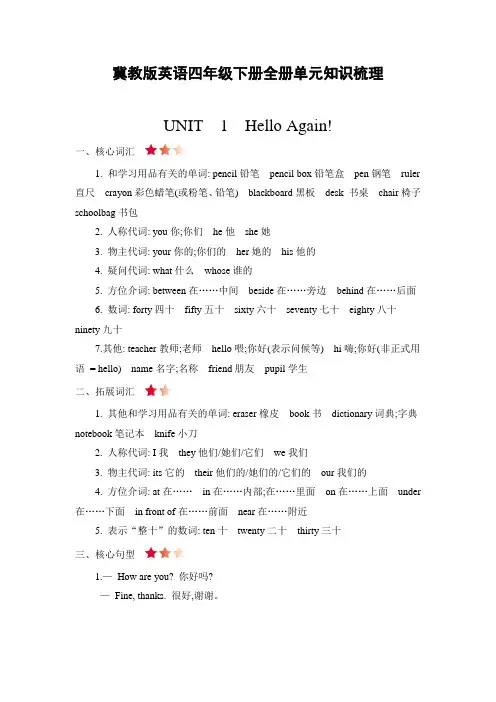
冀教版英语四年级下册全册单元知识梳理UNIT 1Hello Again!一、核心词汇1. 和学习用品有关的单词: pencil铅笔pencil box铅笔盒pen钢笔ruler 直尺crayon彩色蜡笔(或粉笔、铅笔)blackboard黑板desk 书桌chair椅子schoolbag书包2. 人称代词: you你;你们he他she她3. 物主代词: your你的;你们的her她的his他的4. 疑问代词: what什么whose谁的5. 方位介词: between在……中间beside在……旁边behind在……后面6. 数词: forty四十fifty五十sixty六十seventy七十eighty八十ninety九十7.其他: teacher教师;老师hello喂;你好(表示问候等)hi嗨;你好(非正式用语= hello)name名字;名称friend朋友pupil学生二、拓展词汇1. 其他和学习用品有关的单词: eraser橡皮book书dictionary词典;字典notebook笔记本knife小刀2. 人称代词: I我they他们/她们/它们we我们3. 物主代词: its它的their他们的/她们的/它们的our我们的4. 方位介词: at在……in在……内部;在……里面on在……上面under 在……下面in front of在……前面near在……附近5. 表示“整十”的数词: ten十twenty二十thirty三十三、核心句型1.—How are you? 你好吗?—Fine, thanks. 很好,谢谢。
解读:此句是向别人问好及其回答的句型。
句中的be动词根据主语的变化而变化。
如果主语是第三人称单数的时候, are要改为is。
对此句的回答应该是“OK. (很好。
)”“Fine, thank you.(很好,谢谢。
)”等。
举一反三: —How are your parents?你父母好吗?—Fine, thanks. 很好,谢谢。
冀教版英语四年级下册知识点重点总结【word】

四年级下册第一单元重点归纳我要掌握的读音/i:/— ea : meat ; read/u:/— oo : zoo ; school我要掌握的单词你,你们you你的,你们的your嗨hi朋友friend他he他的his铅笔pencil什么what直尺ruler谁的whose书桌desk书包schoolbag在…旁边beside四十forty六十sixty八十eighty我要掌握的短语一个新学生 a new pupil / student在书桌上on the desk在书桌下面under the desk在操场上on the playground看书read a book我要掌握的句型1.介绍离自己较近的单个人或事物This is +人/物.这是……This is Peter.这是彼特。
This is a pencil box.这是一个铅笔盒。
/e/— ea : bread ; sweater/u/— oo : book ; look教师,老师teacher喂,你好hello名字name学生pupil / student她she她的her铅笔盒pencil box钢笔pen彩色蜡笔crayon黑板blackboard椅子chair在…中间between在…后面behind五十fifty七十seventy九十ninety在…和…中间between…and...在书包里in the schoolbag 在…前面in front of 把…放…上put…on…玩游戏play a game2.确认单个物品是否属于对方的句型及答语Is this your +单个物品 +其他?这是你的……吗?Yes,it is./No,it isn't.是的,它是。
/不,它不是。
Is this your book,Amy?这是你的书吗,埃米?Yes,it is.是的,它是。
Is this your pen?这是你的钢笔吗?No,it isn't.是的,它是。
冀教版四年级英语下册Unit 4 My Favourites 知识点汇总清单

UNIT My Favourites一、核心词汇1. 与颜色相关的词: colour颜色;涂色brown 棕色;棕色的blue蓝色;蓝色的2. 形容词性物主代词: our 我们的their他们的;她们的;它们的3. 与学科相关的单词: subject 学科;科目Chinese 汉语;语文English 英语science科学math数学PE体育art美术;艺术music 音乐4. 连词: and 和;与but但是5. 表示喜欢某物程度的单词: favourite 最喜爱的;特别喜欢的人(或事物)6.其他名词: clothes衣服二、拓展词汇1. 表示三餐的名词: breakfast 早餐lunch午餐dinner 晚餐2. 表示身体各部位的名词: finger 手指head 头nose 鼻子3. 表示食物的名词: dumpling 饺子hamburger 汉堡包hot dog 热狗4. 动词: draw 画画love 爱,喜欢sing 唱歌5. 形容词: great 很棒的hungry 饿的interesting有意思的6.副词: also 也always 总是;一直sure 确信o’clock ……点钟7. 名词: people 人们picture 图片song 歌曲8. 人称代词的宾格: them 他们;她们;它们三、核心句型1. —What’s your favourite colour?你最喜爱什么颜色?—My favourite colour is red. 我最喜爱的颜色是红色。
解读:此句型是what引导的特殊疑问句,用来询问最喜爱的颜色的句型。
be 动词根据句子中主语的变化而变化,另外句子中的your可以替换为其他的形容词性物主代词或者名词所有格。
举一反三:—What’s your favourite colour?你最喜爱的颜色是什么?—It’s red.是红色。
—What is Jim’s favourite colour? 吉姆最喜爱的颜色是什么?—His favourite colour is blue. 他最喜爱的颜色是蓝色。
2023年冀教版小学英语四年级下册知识点汇总
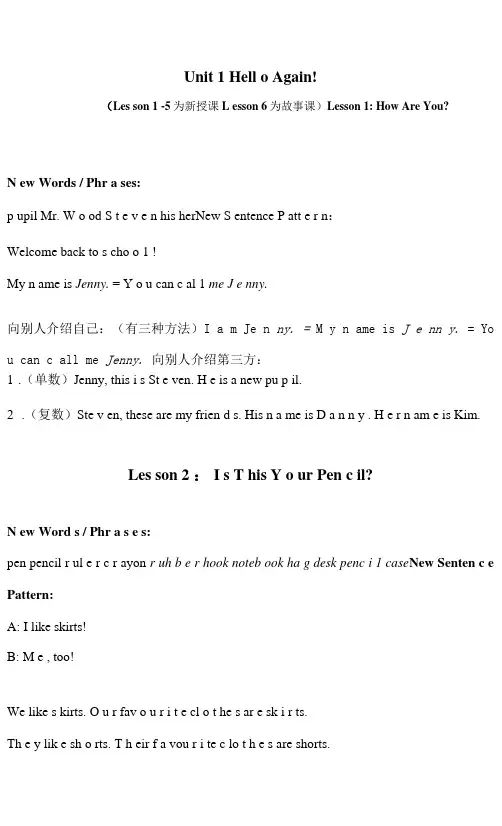
Unit 1 Hell o Again!(Les son 1 -5为新授课L esson 6为故事课)Lesson 1: How Are You?N ew Words / Phr a ses:p upil Mr. W o od S t e v e n his herNew S entence P att e r n:Welcome back to s cho o 1 !My n ame is Jenny. = Y o u can c al 1 me J e nny.向别人介绍自己:(有三种方法)I a m Je n ny. = M y n ame is J e nn y. = You can c all me Jenny. 向别人介绍第三方:1.(单数)Jenny, this i s St e ven. H e is a new pu p il.2.(复数)Ste v en, these are my frien d s. His n a me is D a n n y . H e r n am e is Kim.Les son 2 : I s T his Y o ur Pen c il?N ew Word s / Phr a s e s:pen pencil r ul e r c r ayon r uh b e r hook noteb ook ha g desk penc i 1 case New Senten c e Pattern:A: I like skirts!B: M e , too!We like s kirts. O u r fav o u r i t e cl o t he s ar e sk i r ts.Th e y lik e sh o rts. T h eir f a vou r i te c lo t h e s are shorts.L e sson 21: My F avourite FoodNew Sente n c e P a t tern:A: What's y o u r fav o u rit e f ood for I u nc h ?B: I like hambu r g ers. H a mb u r g e r s ar e my f avourite.Lesso n 22: M y F avou rite Subjec tNew Words /Ph ras e s:s ub j e c t Chines e E n g 1 i sh s c i ence math PE a rt musicN e vv S e n t e n c e Pattern: What s ub j ect is i t ? It's English.What9 s you r favou r ite s u bject? My f a v o uri t e subject is E nglish. I a Iso 1 i ke PE.L ess o n 2 3 : M y Fav o urit e Scho o 1 W o rkNew Word s /Phrases: i nteresting d raw pic t ure s write s t o ries pl a y game s s i ng son gsNew Se n ten c e Patt e r n:A:Wh a t9 s yo u r fav o u rite s c h ool work?B: I 1 i ke to draw pi c t u res. That's my f avo u ri t e schoo 1 work. It9s in t ere s ti n g!L ett e rs an d Sounds:or short f。
冀教版四年级下册英语语法知识点
一、名词1.名词是表示人、事物或抽象概念的名称,分为可数名词和不可数名词。
2.可数名词有单数和复数形式,单数名词后常有冠词(a/an)或表示数量的词修饰。
复数名词一般是在单数名词后加-s或-es。
有些名词复数形式有变化。
3.不可数名词表示无法分为单个单位的事物,它们没有复数形式。
不可数名词常用于表示物质、材料、状态等。
二、代词1.代词用来代替名词,可以使语言连贯。
2.人称代词有主格形式和宾格形式。
主格形式可以做主语,宾格形式可以做宾语或介词后的宾语。
3.物主代词用来表示所属关系,有形容词性物主代词和名词性物主代词。
形容词性物主代词放在名词前修饰名词,名词性物主代词可以作主语、宾语、表语等。
4.指示代词用来指示特指的人或事物,包括this, that, these, those等。
5.不定代词表示不确定的人或事物,包括some, any, no, every,all等。
三、动词1.动词表示人或物的动作、状态或存在,常用于句子的谓语部分。
2.动词有时态、语态和词形变化。
时态包括一般现在时、一般过去时、一般将来时等。
3.情态动词用来表示说话人的情绪、意愿和推测等,包括can, could, may, might, will, would, shall, should等。
4.动词还有进行时和完成时的形式,用来表示动作的进展或完成。
5.不定式是动词的一种特殊形式,作为动词的名词、形容词或副词的宾语或补语等。
四、形容词和副词1.形容词用来描述名词的特征或状态,通常放在名词前面。
2.副词用来修饰动词、形容词或其他副词,常位于动词之前,形容词之后。
五、冠词和介词1.冠词用来修饰名词,分为不定冠词a/an和定冠词the。
2.介词用来表示位置、方向、时间、原因、方式等。
常见的介词有on, in, at, under, over, by, with等。
六、连词1.连词用来连接句子或词语,使句子或文段结构整齐,通顺。
2.常见的连词有and, but, or, because, when, if等。
(完整版)冀教版英语四年级下册知识点大全
(完整版)冀教版英语四年级下册知识点大全Unit 1 Hello Again!Lesson 1: How Are You?New Words (新单词)Pupil 学生his (男)他的her(女)她的New Sentence Pattern(新句型)Welcome back to school! 欢迎回到学校My name is Jenny. = You can call me Jenny. 我叫Jenny .向别人介绍自己:(有三种方法)I am Jenny. = My name is Jenny. = You can call me Jenny.我叫Jenny .向别人介绍第三方:1.(单数)Jenny, this is Steven. He is a new pupil.Jenny ,这是Steven,他是一名学生.2.(复数)Steven, these are my friends. His name is Danny. Her name is Kim.Steven, 这些都是我的朋友,他的名字叫Danny,她的的名字叫Kim.Lesson 2: Is This Your Pencil?New Words / Phrases(新单词)pen 钢笔pencil 铅笔ruler 尺子crayon蜡笔rubber 橡皮book 书notebook教科书bag包desk 桌子pencil case文具盒New Sentence Pattern(新句型)提问:Whose pencil is this? 这是谁的铅笔?回答:It’s Jenny’s pencil.它是Jenny的铅笔。
疑问词:What什么What’s this? 这是什么。
回答: It’s a pencil. 这是一只铅笔Where哪里Where is the cat? 猫在哪?回答: It’s under the desk.它在桌子底下How怎么How do you go to school? 你怎么去学校?回答: By bus. 坐公共汽车How many数量How many books do you have? 你有多少本书?回答: Three.三本(数量)How much 多钱How much is the sweater? 这件羊毛衫多钱?回答: Thirty yuan. 30元Who谁Who is he? 他是谁?回答: He is my friend Li Ming. 是我的朋友,李明。
英语知识点思维导图(冀教版四年级下册)--建议用A0纸打印
Where do/does + 主语 + live ?--主语 + live/lives + 介词 + 地点 + 其他W here do you live?W here does your grandpa live?What's one's address?--One's address is + 具体位置.--具体位置.W hat is your address?M y address is 35 Xinhua Street.英认某地是否在另一地点附近Is that near + 地点?--Yes./No.e too.I like playing football.M e too.t oo 还有“过于、太“的意思T he coat is too big for me.How do you go (to) + 地点?--I go (to) + 地点 + 出行方式.How do you go to the park?--I go to the park on foot.How do you go to there?--I go there by subway.g o 后面跟t rain s hip b ike p lane s ubway b us ake a car a bus t he subway t he rain ide a bike a horse f oot D o you + 动词原形 + 其他?D o you go to school by bus?Y es,I do.喜欢做某事H e likes to eat bananas.喜欢做某事,常表示爱好W e like playing chess.喜欢某人或某物I like this map.hat do/does sb. like to do?-Sb. like/likes to 动词原形(+ 其W hat do you like to do?I like to fly kites.hat's your favourite colour?-My favourite colour is ...-... is my favourite colour./i:/ 长元音s ea teacher /e/ 短元音h eavy ready 千位t housand短语i n front of i n the front of 区别在于包含关系on in behind above beside under near b etween 区分beside 与near 区分between 与among b e (助)动词a m is are 一般动词put do play read fly drink listen clean sit wash swim write ride come l ive t eacher name pupil friend crayon blackboard desk chair metre 组合词s choolbag birthday 短语名词p encil box p encil case 月星颜c olour食f oods ubject意思“和,与”,表示并列或承接在三个及以上的单词或短语时,一般在最后两个之间加andM r. 某先生M rs. 某女士M iss 某小姐。
202X年冀教版小学英语四年级下册知识点汇总
千里之行,始于足下。
202X年冀教版小学英语四年级下册知识点汇总
以下是202X年冀教版小学英语四年级下册的知识点汇总:
1. 词汇:学习并掌握下列词汇,其中包括动物、食物、家庭成员、学校用品、交通工具、颜色等等。
2. 语法:
- 复习一般现在时态,包括be动词和动词的第三人称单数形式变化规则。
- 复习一般过去时,包括一般过去时的肯定、否定和疑问句的构成方式。
- 学习现在进行时,掌握现在进行时的构成方式和用法。
- 学习比较级和最高级形式的构成和用法。
- 学习there be句型的用法和一般疑问句和否定句的构成方式。
3. 句型:
- 复习和掌握陈述句、一般疑问句和否定句的基本句型结构。
- 学习和掌握疑问代词和指示代词的用法。
4. 对话:
- 学习并模仿简单的对话,包括问候、介绍人物、询问姓名、问路、购物和预定等情景对话。
5. 阅读理解:
- 练习阅读理解技巧,理解短文中的主要信息和细节,并回答问题。
6. 书写:
- 练习正常大小的大小写字母的书写,并能正确地写出单词和简单句子。
第1页/共2页
锲而不舍,金石可镂。
以上是202X年冀教版小学英语四年级下册的知识点汇总,希望对你有帮助。
如有其他问题,请随时提问。