
初中英语教师业务素质考试试题体例
建议参考以下体例命题
教师中考英语试题体例
一、 (时间90分钟;满分100分) 听力测试。根据要求回答问题。(10分)
这是中考听力的第一题,本题的考查点与《英语课程标准》中语言知识的哪一部分相关?平
日的教学中,我们应该注意什么?
这是中考听力的第五题,本题主要考查了语言技能中听力的哪方面能力?如何把教材中的听
力部分与该题对接?
二、完形填空。根据要求回答问题。(15分)
As we all know, Charles Dickens is considered to be a great English writer. He's very
famous not only in Britain, but also in many in the world. He was born in 1812 and
he lived in London. He wrote lots of books, and he also liked
Maybe it's interesting to hear that and books were so good. He gave public readings
of his stories that were very popular. His stories first appeared in a magazine, in
parts. part. He wrote a lot, and most of them are popular. There are films was a
wonderful it, but he used his experiences in ended.
31. A. cities B. countries C. towns D. villages
32. A. reading B. writing C. acting D. playing
33. A. what B. how C. when D. why
34. A. the next B. next C. next to D. next time
35. A. too B. as well C. as well as D. also
36. A. book B. story C. play D. film
37. A. hated B. enjoyed C. wanted D. shamed
38. A. as B. while C. until
D. since
初中英语教师资格考试学科知识与教学能力试卷与参考答案(2024年)
2024年教师资格考试初中英语学科知识与教学能力复习试卷与参考答案一、单项选择题(本大题有30小题,每小题2分,共60分)1、Which of the following sentences correctly uses the present perfect continuous tense?A)They have been working on the project all day.B)They have worked on the project all day.C)They work on the project all day.D)They had been working on the project all day.Answer: A) They have been working on the project all day.Explanation: The present perfect continuous tense is used to express an action that started in the past, continues into the present, and may continue beyond. It’s formed with “have/has + been + verb-ing.” Option A is the correct usage because it shows an ongoing action that has been happening all day.2、Choose the correct form of the verb that agrees with the subject in the following sentence:Every boy and girl in the class_____(be) required to submit their homework on time.A)areB)isC)wereD)beAnswer: B) isExplanation: When the subject consists of two nouns connected by “and,” but they refer to a single entity or if the nouns are singular and denote a single concept, such as a pair of twins acting as one, the verb should be singular. Here, “every boy and girl” is treated as a collective unit performing a single action, hence “is” is used instead of “are.”3、What is the main purpose of the following sentence in a初中英语classroom?A. To introduce new vocabulary.B. To explain a grammatical rule.C. To provide a reading passage.D. To elicit a student’s opinion.Answer: DExplanation: The sentence “What do you think about the book we just read?” is designed to elicit a student’s opinion, making it a good example of a question that aims to engage students in critical thinking and discussion.4、In a lesson on the present perfect tense, which of the following activities would be most a ppropriate for practicing the structure “have/has + past participle”?A. Role-playing a conversation.B. Completing a gap-fill exercise with past tense verbs.C. Listening to a story and identifying past events.D. Discussing past experiences with a partner.Answer: DExplanation: Discussing past experiences with a partner allows students to practice forming sentences in the present perfect tense, as they would naturally use this structure to describe actions that started in the past and are still ongoing or have a present result. This activity is thus ideal for reinforcing the use of “have/has + past participle” in a conversational context.5、Which of the following is NOT a principle of Communicative Language Teaching (CLT)?A. Focus on fluency over accuracyB. Emphasis on communication breakdown as a learning opportunityC. Grammar as the primary focus of every lessonD. Integration of language skills in activitiesAnswer: C. Grammar as the primary focus of every lessonExplanation: Communicative Language Teaching emphasizes the development of communicative competence over grammatical accuracy alone. While grammar is an essential component of language learning, CLT advocates for a more balanced approach that integrates all skills and views communication breakdowns as opportunities to learn rather than solely focusing on grammatical rules.6、In the context of vocabulary teaching, which method encourages students to discover the meaning of new words through contextual clues?A. Direct instructionB. Deductive methodC. Incidental learningD. Rote memorizationAnswer: C. Incidental learningExplanation: Incidental learning occurs when students encounter new vocabulary naturally within the context of reading or listening activities, encouraging them to infer the meanings of new words based on the surrounding text or conversation. This method is often considered more effective than direct instruction or rote memorization because it promotes deeper understanding and retention by engaging students actively in the discovery process. The deductive method is not typically used for vocabulary acquisition but rather for teaching grammar structures.7、The following sentence is correctly punctuated:A. I can’t decide whether to go to the party or not, so I’m going to ask my friend, John.B. I can’t decide whether to go to the party or not; so, I’m going to ask my friend, John.C. I can’t decide whether to go to the party or not, so I’m going to ask my friend, John.D. I can’t decide whether to go to the party or not, so I’m going to ask my friend, John.Explanation: The comma after “not” in the first clause is correctly placed, as it is used to separate two independent clauses joined by a comma and a coordinating conjunction. The second clause is complete and does not require additional punctuation. The other options either omit the comma or incorrectly place it.8、Which of the following sentences is a fragment?A. The students were eager to learn.B. The teacher explained the concept clearly.C. Walking through the park, the children laughed and played.D. She was nervous, and the butterflies in her stomach were fluttering.Answer: CExplanation: A fragment is an incomplete sentence that lacks either a subject or a verb. In option C, the phrase “Walking through the park” lacks a main verb, making it a fragment. The other options are complete sentences with a clear subject and verb.9、Which of the following is NOT a characteristic of communicative language teaching (CLT)?A. Focus on language accuracy over fluencyB. Emphasis on the use of language in real-life situationsC. Student-centered activities that encourage interactionD. Integration of language skills in meaningful contextsExplanation: Communicative Language Teaching (CLT) emphasizes fluency and the ability to communicate effectively in real-life situations rather than focusing solely on accuracy. While accuracy is important, CLT prioritizes the ability to convey meaning in context.10、Choose the most appropriate way for a teacher to introduce new vocabulary to students:A. Provide definitions onlyB. Use the words in sentences and discuss their usage in contextC. Ask students to memorize the words and their translationsD. Show pictures without any further explanationAnswer: BExplanation: Introducing new vocabulary through sentences and discussing their usage in context helps students understand how words function within language and aids in retention. This method also encourages active engagement with the material, making it more memorable and applicable.11.The teacher is preparing a lesson plan for a middle school English class. Which of the following is an appropriate objective for this lesson?A. To introduce the students to new vocabulary related to sports.B. To teach the students how to use the passive voice correctly.C. To enable the students to understand and produce simple sentences in past tense.D. To h elp the students to compare and contrast two countries’ cultures.Answer: C. To enable the students to understand and produce simple sentences in past tense.Explanation: The question asks for an appropriate objective for a middle school English class, which implies that the objective should focus on language proficiency. Option C focuses on both understanding and producing language in the past tense, which is a relevant objective for a middle school English class.12.In a lesson about the solar system, the teacher wants to engage the students in a discussion about the relative sizes of the planets. Which of the following activities would be the most effective for this purpose?A. A reading passage about the solar system with multiple-choice questions.B. A group activity where students build their own model of the solar system using different-sized balls.C. A video presentation on the solar system with interactive quizzes.D. A worksheet with detailed diagrams of the planets and their sizes.Answer: B. A group activity where students build their own model of the solar system using different-sized balls.Explanation: Engaging students in a hands-on activity can be more effective for learning complex concepts like the relative sizes of the planets. Option B encourages active participation and collaboration, which can enhance understanding and retention of the information. The other options focus more on passive learning or individual assessment, which may not be as effective forpromoting discussion and understanding.13、Which of the following is NOT a common method for teaching vocabulary in an English as a Foreign Language (EFL) classroom?A. The Keyword MethodB. The Semantic Mapping TechniqueC. The Grammar-Translation MethodD. The Total Physical Response (TPR)Answer: C. The Grammar-Translation MethodExplanation: While the Grammar-Translation Method focuses on reading and writing, and understanding grammatical rules, it is not commonly used specifically for teaching vocabulary. In contrast, the Keyword Method uses a familiar word that sounds similar to the new word to aid memory, the Semantic Mapping Technique helps students to see the connections between words by creating a visual map, and the Total Physical Response (TPR) involves physical movement to help learn and remember new words.14、In the context of formative assessment, which of the following would be the most effective way to provide feedback to a student who has just given a short oral presentation in English?A. Giving a grade without commentsB. Providing a written summary of all the mistakes madeC. Offering specific praise and constructive suggestions immediately after the presentationD. Waiting until the end of the term to discuss the performanceAnswer: C. Offering specific praise and constructive suggestions immediately after the presentationExplanation: Formative assessment is aimed at providing ongoing feedback that can be used by instructors and students during the instructional process. Immediate feedback, with specific praise and constructive suggestions, is beneficial because it allows the student to understand what they did well and what could be improved while the experience is still fresh. This approach supports learning and motivation. A grade without comments does not provide actionable information, a list of all the mistakes may be discouraging, and waiting until the end of the term is too late for the student to make use of the feedback.15.What is the most appropriate way to introduce a new topic in a初中English class?A)By asking students to repeat the new vocabulary.B)By showing a related video clip.C)By conducting a group discussion on the topic.D)By reading the text aloud to the class.Answer: BExplanation: Showing a related video clip is often an engaging and effective way to introduce a new topic in a初中 English class. It can help students visualize the content and make connections with the topic before diving into the text.16.Which of the foll owing techniques is most suitable for assessing students’ comprehension of a short story in a初中 English class?A)Multiple-choice questions.B)Writing a summary of the story.C)Performing a role-play based on the story.D)Discussing the story with a partner.Answer: BExplanation: Writing a summary is a good way to assess students’ comprehension because it requires them to process and recall information from the story. It also helps students practice their writing skills and organize their thoughts.17.The following sentence is an example of a(n)_______structure.A. SimpleB. CompoundC. ComplexD. Compound-ComplexAnswer: C. ComplexExplanation: The sentence “Although he studied hard, he still failed the exam, which was a great disappointment to his parents.” contains a main clause (“he still failed the exam”) and two dependent clauses (“Although he studied hard” and “which was a great disappointment to his parents”), making it a complex sentence.18.In the following dialogue, which sentence is an example of a questiontag?A. “I think he will come, won’t he?”B. “She’s a good teacher, isn’t she?”C. “He has finished his homework, hasn’t he?”D. “We will have the meeting tomorrow, won’t we?”Answer: C. “He has finished his homework, hasn’t he?”Explanation: A question tag is a short question at the end of a statement. It is used to ask for confirmation or to make sure that the information is correct. In this case, “hasn’t he?” is the question tag that corresponds to the statement “He has finished his homework.”19.Which of the following sentence structures is commonly used to conveya direct command in English?A)The teacher asked the students to sit down.B)The students were told by the teacher to sit down.C)The teacher commanded the students to sit down.D)The students needed to sit down, the teacher said.Answer: CExplanation: The structure “commanded + object + to-infinitive” is a typical way to convey a direct command. In this case, “The teacher commanded the students to sit down” is the correct structure for a direct command.20.In the context of teaching a new vocabulary word, which activity would be most effective for students to understand and remember the word “benefit” as a noun?A)Listening to a story that uses the word “benefit” in different contexts.B)Having students write sentences using the word “benefit” in a workbook.C)Watching a video that demonstrates the word “benefit” in various situations.D)Practicing a role-play where students discuss the “benefits” of different activities.Answer: DExplanation: Role-playing is an interactive and engaging activity that allows students to use the new vocabulary word in a real-life context. By discussing the “benefits” of different activities, students can better understand and remember the meaning of the word “benefit” as a noun.21、The teacher should use the following method to engage students in a reading activity. Which one is the most appropriate?A. Direct instructionB. Inquiry-based learningC. Traditional repetitionD. Passive listeningAnswer: BExplanation: Inquiry-based learning is an effective method to engage students in a reading activity. It encourages students to ask questions, explore information, and develop critical thinking skills. Direct instruction, traditional repetition, and passive listening do not promote active student involvement and critical thinking.22、In the context of teaching grammar, which of the following statements about using authentic materials is true?A. Authentic materials are too difficult for intermediate-level students.B. Authentic materials should not be used due to potential grammatical errors.C. Authentic materials can provide real-life contexts that help students understand and practice grammar.D. Authentic materials should only be used in advanced classes.Answer: CExplanation: Authentic materials can provide real-life contexts that help students understand and practice grammar. They expose students to the natural use of language and can make grammar lessons more meaningful and relatable. Using authentic materials is beneficial for all levels of students, not limited to advanced classes. Intermediate-level students can benefit from authentic materials with proper support and modifications.23.The teacher’s role in a language classroom is primarily focused on:A. Ensuring the students are quiet and follow instructionsB. Providing a wealth of information about the languageC. Facilitating student interaction and communicationD. Correcting every error the students makeAnswer: CExplanation: The primary role of a teacher in a language classroom is to facilitate student interaction and communication. This encourages students to practice and develop their language skills through real-life interactions,rather than focusing solely on providing information or correcting errors.24.Which of the following is NOT an effective strategy for promoting vocabulary learning in a secondary English class?A. Encouraging students to use dictionariesB. Teaching new vocabulary in isolationC. Creating word banks with related wordsD. Incorporating vocabulary into thematic unitsAnswer: BExplanation: Teaching new vocabulary in isolation is not an effective strategy for promoting vocabulary learning. It’s more bene ficial for students to learn new vocabulary in the context of thematic units or real-life situations, where they can see how the words are used in different contexts. Encouraging students to use dictionaries, creating word banks, and incorporating vocabulary into thematic units are all effective strategies for enhancing vocabulary learning.25.Which of the following sentence structures is most suitable for teachinga new concept to students in a middle school English class?A. Simple present tenseB. Present perfect tenseC. Conditional sentenceD. Future perfect tenseAnswer: A. Simple present tenseExplanation: The simple present tense is often used for teaching newconcepts and facts, as it is straightforward and easy for students to understand and practice. It is also the most common tense used in English instruction for new vocabulary and grammar concepts.26.In a lesson on describing people, which of the following activities would be most effective in helping students practice their descriptive language skills?A. Role-playing a dialogue about a person’s appearanceB. Completing a multiple-choice quiz about adjectivesC. Writing a short story about a character they have createdD. Listening to a recorded story and identifying descriptive wordsAnswer: C. Writing a short story about a character they have created Explanation: Writing a short story about a character provides students with an opportunity to practice using descriptive language in a creative and meaningful way. It encourages them to think about how adjectives and descriptive phrases can be used effectively in a narrative context. This activity also allows students to practice their imagination and creative writing skills.27.The teacher plans to use a storybook in the English class to teach a new topic. Which of the following activities is most appropriate for helping students engage with the story and improve their comprehension?A)Role-playing the characters in the story.B)Watching a movie adaptation of the story.C)Having a quiz about the characters and events in the story.D)Reading the story silently and then summarizing it.Answer: A) Role-playing the characters in the story.Explanation: Role-playing allows students to actively engage with the text, practice speaking skills, and better understand the characters’ perspectives. This method encourages interaction and can enhance comprehension and retention of the material.28.In a lesson on the past tense, the teacher wants to ensure that students understand the difference between “go” and “went.” Which of the following methods is the most effective for teaching this distinction?A)Providing a list of example sentences with the correct forms of “go” and “went.”B)Using a diagram to show the past tense form of irregular verbs.C)Comparing and contrasting the past tense forms with the present tense forms.D)Playing a game where students have to identify the correct past tense form based ongiven sentences.Answer: C) Comparing and contrasting the past tense forms with the present tense forms.Explanation: By comparing and contrasting the past and present tense forms, students can more easily recognize the pattern and understand the difference between the two. This method helps reinforce the rules of verb conjugation and improves students’ overall grammar knowledge.29.In a primary school English classroom, the teacher is planning a reading lesson. Which of the following activities would be most suitable for students to practice their comprehension skills?A. Role-playing the storyB. Answering multiple-choice questions about the storyC. Drawing a picture of the storyD. Discussing the moral of the storyAnswer: BExplanation: Answering multiple-choice questions is an effective way for students to demonstrate their comprehension of the text. It requires them to recall specific details and understand the main ideas of the story. Role-playing, drawing, and discussing the moral are also valuable activities, but they may not directly assess comprehension as effectively as multiple-choice questions.30.Which of the following vocabulary teaching strategies is most appropriate for teaching a new vocabulary word to middle school students who have a strong foundation in English?A. Using a visual aid to illustrate the wordB. Providing a list of synonyms and antonymsC. Creating a word wall with the new vocabularyD. Engaging students in a game to practice using the wordAnswer: BExplanation: Providing a list of synonyms and antonyms is a valuable strategy for teaching vocabulary to students with a strong foundation in English. It helps them understand the nuances of word meanings and expand their vocabulary. Using a visual aid can be helpful, but it may not be sufficient for students who already have a good grasp of the language. Creating a word wall and engaging in a gameare also beneficial, but they may not be as effective for teaching new vocabulary as providing synonyms and antonyms.二、简答题(20分)Question: How can teachers effectively utilize technology in their English language teaching to enhance students’ language skills and engagement in the classroom?Answer:1.Integrating Technology for Language Skills Development:•Listening and Speaking: Use audio and video resources such as podcasts, videos, and online platforms like YouTube to expose students to authentic English. Tools like language learning apps and virtual role-playing games can also be used for interactive speaking activities.•Reading and Writing: Incorporate digital texts, e-books, and online forums to develop reading and writing skills. Students can create digital presentations or blogs, and use grammar and spell-checking tools toimprove their written work.•Grammar and Vocabulary: Interactive grammar websites andvocabulary-building apps can make learning these aspects more engaging and interactive.2.Interactive Learning and Engagement:•Flipped Classroom: Use video lessons and online resources as homework, allowing class time for interactive discussions, practice, andapplication.•Interactive Whiteboards: Utilize interactive whiteboards for group activities, games, and real-time feedback, fostering student engagement and collaboration.3.Student-Centered Approach:•Personalized Learning: Use technology to cater to different learning styles and abilities. Adaptive learning software can provideindividualized instruction based on students’ performance.•Student-Created Content: Encourage students to create their own content, such as videos, podcasts, or blogs, to enhance their language production skills.4.Assessment and Feedback:•Formative Assessment: Utilize online quizzes, self-assessment tools, and discussion forums to provide ongoing feedback and track stude nts’ progress.•Feedback Through Technology: Use digital tools for immediate feedback on students’ work, such as online grading systems, which can be more efficient than traditional paper-based methods.5.Teacher Training and Support:•Professional Development: Teachers should receive training on how to effectively integrate technology into their teaching. This can include workshops, webinars, and online courses.•Ongoing Support: Schools should provide technical support and resourcesto ensure that teachers have the necessary tools and training to integrate technology effectively.Explanation:Incorporating technology into English language teaching can greatly enhance students’ language skills and engagement. By utilizing a variety of digital resources and tools, teachers can cater to different learning styles, provide personalized instruction, and create an interactive and engaging learning environment. Additionally, technology allows for ongoing assessment and feedback, enabling teachers to monitor students’ progress and adjust their teaching strategies as needed. Continuous professional development and support for teachers are crucial in ensuring successful integration of technology in the classroom.三、教学情境分析题(30分)Question: Teaching Scenario AnalysisScenario:You are a teacher in a rural junior high school in China. The class you are teaching consists of 25 students, with a mix of English language proficiency levels. The topic for today’s lesson is “Describe Your Hometown.” The students have already learned basic vocabulary and sentence structures related to this topic. However, many of them struggle with expressing their ideas in English.Task:1.Analyze the given scenario and identify the main challenges you might face in teaching this topic.2.Propose a lesson plan that addresses these challenges and ensures that all students can participate and improve their English language skills.Answer:1.Main Challenges:•Vocabulary Limitations: Many students may have a limited vocabulary to describe their hometown, which can hinder their ability to express their ideas effectively.•Language Proficiency Levels: There may be a significant gap in the English language proficiency levels of the students, making it difficult to cater to all their needs.•Shyness and Lack of Confidence: Students may feel shy or lack confidence in speaking in English, especially in front of their peers.•Lack of Interest: Some students may not find the topic engaging, leading to disinterest in participating in the lesson.2.Lesson Plan:Objective:To help students describe their hometown using appropriate vocabulary and sentence structures, while promoting their confidence and interest in English language learning.Materials:•Whiteboard and markers•Vocabulary cards•Pictures of different hometowns• A worksheet with questions about the students’ hometowns• A video clip showcasing different aspects of rural China Procedure:1.Warm-up:•Begin the lesson with a brief discussion about what students already know about their hometowns. Encourage them to share their thoughts in pairs.2.Vocabulary Building:•Display pictures of different hometowns on the whiteboard and introduce relevant vocabulary (e.g., river, mountain, temple, market) using the vocabulary cards.•Have students practice using the new vocabulary in sentences.3.Modeling:•Demonstrate how to describe a hometown using a sample paragraph. Pay attention to the structure of the sentences and the use of appropriate vocabulary.•Encourage students to ask questions and clarify any doubts.4.Group Activity:•Divide the class into small groups and give each group a worksheet with questions about their hometowns. Students should work together to answer the questions and describe their hometowns using the new vocabulary. •Monitor the groups to ensure that all students are participating and that the activity is progressing smoothly.5.Presentation:•Invite each group to present their findings to the class. Encourage them to use the new vocabulary and sentence structures they have learned.•Provide positive feedback and constructive criticism to help students improve their language skills.6.Video Clip:•Show a video clip showcasing different aspects of rural China. Ask students to discuss what they have seen and relate it to their ownexperiences.•Use this opportunity to reinforce the vocabulary and sentence structures they have learned.7.Wrap-up:•Summarize the lesson and review the key vocabulary and sentence structures.•Encourage students to continue practicing describing their hometowns at home.Explanation:This lesson plan addresses the challenges mentioned earlier by incorporating various strategies to cater to different student needs. By using pictures, videos, and group activities, the lesson promotes engagement and encourages students to participate actively. The focus on vocabulary building and sentence structure helps students improve their language skills, while the opportunity to present in front of their peers boosts their confidence.。
初中英语中小学教师专业素质考试题
初中英语中小学教师专业素质考试题一、选择题1. 下列单词中,哪个单词的读音与其他三个不同?A. appleB. catC. ballD. map2. What ________ your mother do?A. doB. doesC. isD. are3. -- ________ is your birthday? -- It's October 10th.A. What timeB. What dayC. What colorD. What season4. He ________ the piano every day.A. playB. playsC. is playingD. played5. My sister is two years ________ than me.A. oldB. youngC. olderD. younger6. -- How often ________ you go to the library? -- Twice a week.A. doB. doesC. shouldD. can7. The kites ________ in the sky now.A. flyB. fliesC. are flyingD. flew8. We ________ English next year.A. will studyB. studiedC. are studyingD. study9. The book ________ on the desk yesterday, but it isn't there today.A. isB. wasC. areD. were10. -- What ________ you do last night? -- I watched a movie.A. doB. doesC. didD. will二、完形填空A mother camel and her baby camel were carrying their things across the desert. The baby camel was 11 ________. It 12 "Mom, my back is so 13________. Can you slow down a little bit?"The mother smiled and said, "My dear baby, I am 14 slow. We should walk 15 faster to 16 across the desert before it gets too hot."The baby camel struggled(挣扎) 17 tired and slow, but he said 18 and louder, "Mom, I can't go on. My feet 19 so heavy." The mother helped him carry his things to the top of a 20 for a rest. When they reached the top, they saw a beautiful view of the desert."It's beautiful!" said the baby camel. "I'm glad you brought me up here, Mom." Then he cheered up(高兴起来) and continued the journey.Sometimes we all need to 21 down and rest. However, we should 22 up again and continue our journey no matter how 23 our problems and difficulties are. When we 24 persisting(坚持) and working hard, we will be 25 of the wonderful view after overcoming the difficulties.11. A. tired B. thirsty C. excited D. hungry12. A. shouted B. whispered C. sang D. said13. A. cold B. hot C. comfortable D. painful14. A. going B. going too C. going too fast D. going too slow15. A. a little bit B. a little C. a little time D. a little fast16. A. arrive B. reach C. return D. get17. A. feel B. feeling C. to feel D. felt18. A. stronger B. weaker C. happy D. sad19. A. looks B. feel C. sound D. taste20. A. tree B. hill C. stone D. house21. A. stay B. look C. buy D. slow22. A. get B. speed C. hurry D. think23. A. big B. small C. long D. little24. A. keep on B. give up C. work D. stop25. A. afraid B. happy C. shy D. excited三、阅读理解ADear parents and students,I am happy to announce that our annual school picnic will be held on May 25th. This is an important event in our school calendar, and we encourage all students to attend.We will be visiting Green Valley Park, which is known for its beautiful scenery and fresh air. There will be games, sports activities, and a nature treasure hunt for the students. In addition, we have invited a local band to perform during the picnic. We are confident that everyone will have a wonderful time.Please note that students are required to wear their school uniforms during the picnic. Parents are welcome to join us and can bring their own picnic food or purchase food from the stalls that will be set up at the park.We kindly ask that you complete and return the permission slip by May 10th if your child will be attending the picnic. The slip includes important information regarding transportation and emergency contact details.If you have any questions or concerns, please feel free to contact the school office. We look forward to an enjoyable day at Green Valley Park.Sincerely,Mr. JohnsonPrincipal26. What is the purpose of the letter?A. To inform parents and students about the annual school picnic.B. To invite parents to attend a band performance at the school.C. To announce a change in the school calendar.D. To ask parents for permission to visit Green Valley Park.27. When will the school picnic take place?A. May 10thB. May 25thC. May 26thD. May 27th28. What can students do during the picnic?A. Attend classes and take exams.B. Visit a local band's performance.C. Participate in games and sports activities.D. Have a picnic at the school.29. What are parents allowed to do during the picnic?A. Bring their own food.B. Buy food from the school canteen.C. Make arrangements for transportation.D. Enroll their child in the local band.30. What should parents do if they have any questions or concerns?A. Contact the principal directly.B. Visit Green Valley Park in person.C. Complete a permission slip by May 10th.D. Bring their child's uniform to the school.。
初中英语教师资格考试试卷模板
初中英语教师资格考试试卷模板篇 1Oh my goodness! Let me tell you about the template of the junior high school English teacher qualification examination paper. Firstly, the paper usually includes several important sections. For example, the listening part takes up a certain proportion to test the candidates' ability to understand spoken English. The reading section is quite significant as well, accounting for a considerable part. It examines the comprehension skills and vocabulary knowledge of the test-takers. The writing section is where candidates can showcase their language expression and organization skills.The examination paper focuses on grammar in a comprehensive way. It checks not only the basic grammar rules but also the application of them in various contexts. Vocabulary is another key aspect. Candidates need to have a wide range of vocabulary to handle different questions. The difficulty level of the questions varies from easy to challenging. This is to ensure that only those with solid language foundation and good teaching potential can pass the exam. Isn't it exciting and challenging?篇 2Oh my goodness! Let me tell you about the principles and basis of the junior high school English teacher qualification examination papers. The primary goal of these papers is to evaluate candidates' comprehensive abilities and knowledge in the field of English teaching. They are designed based on the curriculum standards and teaching syllabuses. For instance, the knowledge coverage range of the papers is determined by referring to the key points and requirements in these standards and syllabuses. This ensures that candidates have a comprehensive understanding ofgrammar, vocabulary, reading, writing, and listening skills. Moreover, these papers aim to assess candidates' educational and teaching capabilities. How well can they design teaching plans? Can they handle various teaching situations effectively? Can they inspire students' interest in learning English? All these aspects are carefully examined through the questions and tasks in the papers. Isn't it fascinating and challenging? So, dear candidates, do your best to show your talents and skills in this important examination!篇 3Oh dear friends! Let's take a deep dive into the scoring criteria and key points for awarding marks in the junior high school English teacher qualification examination papers. The writing section, for instance, is of great significance. For language expression, clear and accurate words, proper grammar and rich vocabulary are highly valued! How about the completeness of the content? A comprehensive coverage of the topic with relevant details is essential. And the logical coherence? A smooth and rational flow of ideas makes a huge difference! In the multiple-choice questions, accuracy in understanding grammar rules and vocabulary usage is crucial. Do you get it? In the reading comprehension part, the ability to grasp the main idea and extract key information accurately is what matters most. Isn't it amazing? So, dear friends, knowing these scoring details can surely help us better prepare for the exam and achieve excellent results. Let's go for it with full enthusiasm!篇 4The process of designing the test paper for the Junior High School English Teacher Qualification Examination is a meticulous and rigorous one. Firstly, the selection of proposition personnel is of paramount importance. They must be experts in the field of English teaching, with rich experience and profound knowledge. Then, during the proposition process, a variety of factors are taken into consideration.How to assess the language skills of candidates comprehensively? How to reflect the latest teaching requirements and educational concepts? These are all issues that need to be addressed carefully.After the proposition is completed, a strict review and proofreading process follows. Specialized teams are responsible for checking the accuracy, clarity, and fairness of the questions. They ensure that there are no ambiguous or misleading contents. Moreover, they also check whether the difficulty level and distribution of questions are reasonable. How important is this step? It's like the final polishing of a precious gem, making the test paper perfect and reliable!In conclusion, through these elaborate procedures and strict measures, the test paper for the Junior High School English Teacher Qualification Examination can guarantee its scientificity and impartiality, providing a fair and effective assessment platform for candidates.篇 5In recent years, the trend of the junior high school English teacher qualification examination papers has been constantly evolving. The education reform and the new requirements of English teaching have pushed for innovations in these papers. For instance, there is a greater emphasis on practical language usage and communication skills. Instead of merely testing grammar and vocabulary knowledge, questions now require candidates to apply language in real-life scenarios. This could be in the form of role-playing or problem-solving tasks. Also, with the integration of technology in education, there might be multimedia-based questions that assess candidates' ability to handle digital teaching resources. Isn't this a great step forward? But how can we go further? Shouldn't we incorporate more cultural elements to enhance candidates' cross-cultural awareness? Or perhaps introduce more project-based assessments to test their teamwork and leadership skills? The possibilities are endless, but the goal remains clear -to select outstanding teachers who can meet the diverse needs ofmodern English education. How exciting and challenging this journey is!。
教师资格考试初中英语学科知识与教学能力试卷与参考答案
教师资格考试初中英语学科知识与教学能力复习试卷与参考答案一、单项选择题(本大题有30小题,每小题2分,共60分)1.题目:初中英语教学中,以下哪项是关于词汇教学的正确方法?A. 要求学生死记硬背单词表B. 通过语境和实例教授词汇C. 要求学生独立翻译课文以巩固词汇D. 仅通过语法规则教授词汇答案:B. 通过语境和实例教授词汇解析:在初中英语教学中,词汇教学应当结合语境和实例进行,帮助学生理解并记忆词汇的用法。
死记硬背单词表并不利于长期记忆和词汇的实际应用。
独立翻译课文无法直接体现学生对词汇的实际掌握情况。
仅通过语法规则教授词汇是片面的,缺乏实际应用场景的训练。
因此,正确答案是B。
2.题目:在英语教学中,如何有效地提高学生的口语能力?A. 鼓励学生观看英语电影以提高听力水平B. 组织英语角活动,鼓励学生参与交流C. 仅通过教科书中的对话练习进行口语训练D. 要求学生背诵大量英语文章以提高语感答案:B. 组织英语角活动,鼓励学生参与交流解析:提高口语能力需要实际的语言交流和互动。
观看英语电影可以提高听力水平,但不一定直接提高口语能力。
仅通过教科书中的对话练习是单向的学习方式,缺乏真实的交流环境。
背诵大量英语文章有助于语感的提高,但口语能力的提升还需要实际的语言运用和交流。
组织英语角活动能够提供一个真实的交流环境,鼓励学生参与交流是提高口语能力的有效方法。
因此,正确答案是B。
3.The main purpose of the primary English language education curriculum is to enablestudents to:A. Develop basic reading and writing skills.B. Enhance their ability to understand and use a foreign language.C. Improve their listening and speaking abilities.D. All of the above.Answer: D. All of the above.Explanation: The primary English language education curriculum aims to develop students’ basic reading and writing skills, enhance their understanding and use of a foreign language, and improve their listening and speaking abilities. These goals are interrelated and collectively contribute to the development of students’ overall language proficiency.4.In the context of teaching English as a second language, the term “languageacquisition” refers to:A. The process of learning a new language.B. The process of understanding a new culture.C. The process of learning about the world.D. The process of learning about oneself.Answer: A. The process of learning a new language.Explanation: Language acquisition refers specifically to the process by which individuals learn and develop their abilities to use a new language. This process involves various cognitive, social, and emotional factors that work together to enable learners to produce and understand language in a new linguistic and cultural context. While understanding a new culture, learning about the world, and learning about oneself can all be important aspects of language learning, they are not synonymous with language acquisition.5.Which of the following is the main purpose of the teaching plan in a middle schoolEnglish class?A. To evaluate students’ language skillsB. To assess students’ understanding of the subject matterC. To plan and organize classroom activitiesD. To determine students’ readiness for the next grade levelAnswer: C. To plan and organize classroom activitiesExplanation: The teaching plan in a middle school English class serves as a roadmap for teachers to organize and structure their lessons effectively. It includes specific objectives, activities, and assessments to ensure that students are learning the content and skills appropriate for their grade level.6.What is the most important criterion for a teacher to consider when designing alesson about the topic “Cultural Differences”?A. The level of difficulty of the vocabularyB. The cultural relevance to students’ backgroundsC. The teacher’s personal interestsD. The availability of multimedia resourcesAnswer: B. The cultural relevance to students’ backgroundsExplanation: When designing a lesson about cultural differences, it is crucial for teachers to consider the cultural background of their students. This helps to ensure that the material is relevant and meaningful to students, fostering an appreciation and understanding of different cultures.7、关于初中英语课程中的语法教学,以下哪种观点是正确的?• A. 语法教学应当放在教学首位,学生必须熟练掌握。
初中英语老师专业能力测试题与参考答案

初中英语老师专业能力测试题与答案初中英语老师专业能力测试题二、选择填空(本题共15分,每小题1分)将代表最佳答案的字母在答题卡上相应的位置涂黑。
26. –We’ll travel to different places in this summer vacation. Enjoy your trip!- ______.A. Me, tooB. Yes, I’d love toC. The same to youD. Very well, thank you27. To m’s a taxi driver, _____he really wants to be a singer.A. orB. andC. soD. but28. – Do you know if Jack will drive to New York this weekend?- Jack? Never! He ______driving so far.A. has hatedB. will hateC. hatedD. hates29. - A. nice shirt! A present?- Yes, it is. My aunt ______it to me for my last birthday.A. was sendingB. had sentC. will sendD. sent30. – Is Mr. Smith in the office?- No, He______to the library.A. goesB. had goneC. has goneD. would go31. – Excuse me, can I park my car here?- Yes, you can park on ______side of the street.A. anotherB. bothC. eitherD. neither32. - Oh you sound just like an Englishman.- ______, I still have trouble expressing myself.A. Yes, you’re rightB. Well, not quite like thatC. I don’t mindD. You’re welcome33. –We’d better invite Tom and Kate to the party tonight.- Yes, ______? I’ll give them a call right now.A. whyB. why notC. what forD. how34. Although he failed this time, he didn’t give up and ______studying hard.A. stoppedB. continuedC. succeededD. finished35. - Why are you so ______, Helen?- I thought I had lost my purse, but I didn’t. I found it in my study!A. angryB. happyC. sadD. nervous36. - Is there any ______for two chairs in the office?- Yes, I think so.A. groundB. floorC. spaceD. area37. - How was the performance last night?- It was so good. Though it ______nearly four hours, few people left early.A. coveredB. reachedC. lastedD. played38. I was late for school because my a larm clock didn’t ______this morning.A. go onB. go offC. go awayD. go up39. -______you leave so soon?-Yes. I have to catch my plane.A. CanB. WouldC. ShouldD. Must40. – What did that lady ask you just now?- She asked me______.A. who was I waiting forB. whether could I help herC. how she could get to the bus stopD. what has happened三、完形填空(本题共15分,每小题1分)阅读下面短文,掌握其大意,然后从41 – 55各题所给的四个选项中,选出一个最佳答案。
教师业务考试试题英语
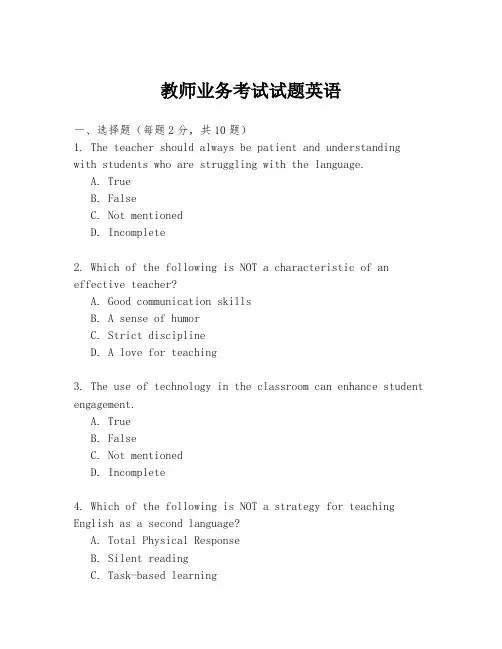
教师业务考试试题英语一、选择题(每题2分,共10题)1. The teacher should always be patient and understanding with students who are struggling with the language.A. TrueB. FalseC. Not mentionedD. Incomplete2. Which of the following is NOT a characteristic of an effective teacher?A. Good communication skillsB. A sense of humorC. Strict disciplineD. A love for teaching3. The use of technology in the classroom can enhance student engagement.A. TrueB. FalseC. Not mentionedD. Incomplete4. Which of the following is NOT a strategy for teaching English as a second language?A. Total Physical ResponseB. Silent readingC. Task-based learningD. Grammar-translation method5. In the communicative approach to language teaching, the focus is on:A. Grammar rulesB. Vocabulary buildingC. Communication skillsD. Cultural understanding6. The teacher should adapt their teaching methods to meet the needs of individual students.A. TrueB. FalseC. Not mentionedD. Incomplete7. Which of the following is NOT a benefit of cooperative learning?A. Improved social skillsB. Increased motivationC. Reduced workload for the teacherD. Enhanced critical thinking8. The teacher should provide feedback to students in a timely manner.A. TrueB. FalseC. Not mentionedD. Incomplete9. Which of the following is NOT a component of lessonplanning?A. ObjectivesB. MaterialsC. AssessmentD. Personal preferences10. In the context of teaching English, cultural awareness is important because:A. It helps students understand the language betterB. It promotes tolerance and respect for diversityC. It is required by the curriculumD. Both A and B二、填空题(每题1分,共5题)1. The process of teaching and learning is often referred to as the __________.2. A __________ lesson plan includes all the necessary components for a successful lesson.3. Teachers should encourage __________ among students to foster a positive learning environment.4. The __________ approach to teaching emphasizes the importance of practical use of the language.5. Teachers should be aware of their students' __________ needs and adjust their teaching strategies accordingly.三、简答题(每题5分,共2题)1. Describe the role of assessment in the teaching and learning process.2. Explain why it is important for teachers to be culturally sensitive when teaching English as a second language.结束语:This concludes the Teacher's Professional Examination in English. Good luck with your teaching endeavors.。
教师资格考试初中英语学科知识与教学能力试题及答案指导(2024年)
2024年教师资格考试初中英语学科知识与教学能力模拟试题及答案指导一、单项选择题(本大题有30小题,每小题2分,共60分)1、The sentence “The cat is sleeping on the mat” is an example of which of the following sentence types?A. CommandB. InterrogativeC. ImperativeD. Declarative答案:D解析:This sentence is a declarative sentence because it makes a statement or provides information. It is not a command (A), interrogative (B), or imperative (C) sentence as it does not issue a command, ask a question, or give an order.2、Which of the following phrases is an example of a present continuous tense in English?A. She has eatenB. She eatsC. She is eatingD. She had eaten答案:C解析:The phrase “She is eating” is in the present continuous tense, which describes an action that is currently happening. Options A and D are in the present perfect tense, which indicates an action with a present result or an action that started in the past and continues to the present. Option B is in the simple present tense, which is used for actions that are habitual, general truths, or repeated actions.3、The main purpose of the Reading and Writing section in the junior high English curriculum is to ______.A)Improve students’ listening skillsB)Enhance students’ speaking abilitiesC)Foster students’ reading and writing skillsD)Develop students’ translation skillsAnswer: C) Foster students’ reading and writing skills4、In the context of teaching English as a second language, which of the following techniques is most effective for teaching idiomatic expressions to 初中生?A)Translating the idioms into their native languageB)Providing a list of idioms for memorizationC)Using context and real-life examples to explain the meaningsD)Focusing solely on grammatical structures related to idiomsAnswer: C) Using context and real-life examples to explain the meanings解析:3、阅读和写作部分在初中英语课程中的主要目的是培养学生的阅读和写作能力。
英语教师专业素养考试试题
一.单项选择题。
( )1.学生在学校各项权利中最主要.最基本的一项权利是A.受教育权 B.生命健康权 C.性的不可侵犯权 D.人身自由权( )2.教师未经学生同意按考分高低排列名次,张榜公布,或让学生分发试卷即侵犯学生的A.隐私权 B.名誉权 C.受教育权 D.人身自由权( )3.关于“师爱”,下列正确说法是A.出于私情之爱 B.对少数优秀学生的关爱C.严慈相济,既有母爱的纯真.慈祥,又有父爱的严格.庄重D.师爱不具有育人的作用( )4.在对待学生的不同态度中,下列哪种类型普遍受学生欢迎A.对立型 B.民主性 C.放任型 D.权威型( )5.教师在合法权益受到侵害时,依照法律的规定,向法定主管机关申述理由,请求处理的制度,称为A.教师行政复议 B.教师申诉制度 C.教师行政诉讼 D.教师调解制度( )6."关注个体差异"就是根据学生实际存在的爱好.兴趣和差异A.完全由学生自己决定如何学习 B.将学生分按优.中.差分班教学C.使每个学生的特长都得到发挥 D.大力培养单科独进的尖子生( )7.You ca n’t pass the exam _____ you study hard.A.if B.because C.unless D.so( )8.—What happened to you this morning?—The teacher asked me for my _____ when I was late again.A.meaning B.idea C.excuse D.answer( )9.—Would you help me put away these things?—_________.A.Yes, quite right B.Never mind C.You’re welcome D.With pleasure ( )10.—Why don’t you do it yourself?—Sorry, I don’t think I’m ______ to.I need someone’s help.A.possible B.ready C.afraid D.able( )11.—Can you tell me_______?—He has just moved to another city.A.where does he live B.does he live whereC.where he lives D.he lives where( )12.—How much did you _______ on that woolen T-shirt ?—I _______ 80 yuan for it.A.cost, spend B.spend, paid C.pay, cost D.take, cost ( )13.The _______ he is , the _______ he feels.A.busily, happily B.busy, happyC.busier, happier D.more busy, more happy( )14.Why does this woman decided _____ these places?A.not go B.doesn’t go C.not going D.not to go( )15.Excuse me, could you _____ me your new dictionary?A.borrow B.keep C.lend D.take( )16.The box is ________ heavy ________ I can’t lift it.A.too, to B.so, that C.very, that D.too, that( )17.He gave up ______two years ago.That’s to say, he is a non-smoker now.A.smoke B.smoking C.to smoke D.smoked( )18.—What about having a cup of tea?—__________.A.I want it B.Help yourself C.Good idea D.Me, too ( )19.Have you decided _______ with me ?A.who will you go B.who will go C.who went D.who did you go ( )20.—____ is this dictionary?—10 yuan.A.How much B.How C.Whose Which( )21.Jack____ the other runners.He couldn’t catch up with the others.A.fall down B.fell behind ell over D.felt sorry( )22.How often does Li Lei ____ his parents?A.hear from B.hear of C.hear that D.listen to( )23.—Excuse me, where is the nearest post office?—Sorry, I_______.A.don’t tell you B.have no idea C.don’t go there D.can’t thi nk so ( )24.Now ______very good.We’re all living a happy life.A.time is B.time are C.times is D.times are( )25.Long long ago, there______ a temple at the top of the hill.A.used to have B.used to be C.would be D.were( )26.The Olym pic_______, “Swifter, Higher, Stronger.” ________that every athlete should try to run faster, jump higher, and throw further.A.competition; meaning B.motto; meansC.motto; which means D.spirit; mean( )27.________wild animals are in danger around the world.A.A large number B.A good many C.A great deal of D.A plenty of ( )28.I can’t go _____ because I have to go home at once.A.else anywhere B.anywhere else C.else nowhere D.somewhere else ( )29.Tom has made many friends since he________ to China.A.came B.comes C.has come D.will come( )30.Do you need ________ to read on the train?A.special anything B.any special thingC.anything specially D.anything special二、判断题。
教师资格考试初中英语学科知识与教学能力试题及答案指导
教师资格考试初中英语学科知识与教学能力模拟试题及答案指导一、单项选择题(本大题有30小题,每小题2分,共60分)1.()The main purpose of the primary English curriculum is to develop students’ability to use English in everyday life and to prepare them for further study or work in English-speaking countries.A. To improve students’ speaking skills onlyB. To enable students to understand and use English grammar and vocabularyC. To develop students’ reading and writing skills onlyD. To prepare students for further study or work in English-speaking countries答案:D解析:The primary English curriculum aims to equip students with a range of language skills, including speaking, listening, reading, and writing, as well as cultural knowledge. However, its primary goal is often to prepare students for future studies or employment in English-speaking contexts, which is why option D is the most accurate choice.2.()Which of the following is NOT one of the core skills tested in the primary Englishproficiency test?A. ListeningB. SpeakingC. ReadingD. Writing答案:D解析:The primary English proficiency test typically includes tests of listening, speaking, reading, and writing skills. While writing is an important skill, it is not usually the sole focus of such tests. Therefore, option D is not one of the core skills tested in the primary English proficiency test.3、关于初中英语课程的教学方法,以下哪项描述是不准确的?A. 教学方法应该侧重于传统讲授,以确保学生掌握所有知识点。