
人教版高一英语必修2 Unit 2 The Olympic Games全单元教案
Unit 2 The Olympic GamesPeriod 1 Pre-class task: about vocabulary of item in the Olympic GamesStep 1 Word Game: Part 1: Each group get 4 words to guess. one points for each. Part 2: The quickest to match the word correctly can get 2 points for his/ her group, but if the answer is wrong,1 points will be lost.shot put击剑discus throw 摔跤javelin throw 悬挂式滑翔Marathon 冰球Canoeing 举重ice hockey 马拉松Weightlifting 划独木舟Wrestling 铁饼fencing 推铅球hang-gliding 标枪Part 3: The quickest to guess the word correctly can get 2 points for his/ her group, but if the answer is wrong,1 points will be lost.Rings, high bar , side hors(鞍马)e, vaulting horse(跳马), double bar , free exercisesStep 2 Warming upTalk about when ,where, and anything you know about the Olympics according to the pictures given.1. get Ss to talk about picturesTeacher can give one example2. let 2 Ss share their understanding of the pictures and act it out for the classStep 3. Speaking Activity 1 ( Warming up p17)Page 49 Now turn to page 49 and look at exx.1&21.Read through the words and fill in the form2.Work in pairs and make a simple dialogue using the information in the form by asking:•Do you know which sports are usually part of the Winter Olympics?•Which sports are played between team?•In which sports are Chinese athletes the best?3.Pairs to act it outStep 4 Speaking Activity 2Teacher help the Ss to talk about their hobbies(about sports) by teaching them some expression.1. show some useful express2.explain them if necessary.3.give some words of sports for Ss to talk with their partner.4.act it outStep 6 Homework1.Find out the fact in Warming up to the number gi ven to you (it’ll be checked tomorrow)2.Finish Exx.1-4 on p11-123.《课程探究》Exx 1&24.Go over the new words.Period 2Step 1 Number gameHave the Ss to open the book on page 9, try to match the number to the events. The one who get the closest answer will get 1 point of the group1.show the number to the Ss2.have the Ss write down the answers by filling with the number in the table776 B. C. The ancient Olympic Games start in Greece.393 A. D. The ancient Olympic Games stop1896 The modern Olympic Games start in Greece.311&13 The numbers of competitors & countries took part in 18961932 China first joined in the Games.1984 China first got gold medal by Xuhaifeng.10.000&119 The numbers of competitors & countries joined in Sydney Olympic2004 China got the 2th place in Athens.2008 China will host the 29th Summer Olympics in Beijing.3. check and give points to the group.Step 2 Pre-readingShowing the Motto of the Beijing 2008 Olympic Games Bid (北京奥运申报口号) to the whole class.1.raise a question: “Do you know more about the Olympics history?”2.get the Ss to read about an interview to get more.3. get the Ss to make sure the relationship between Pausanias and LiliStep 3 Reading comprehensionRead the Olympic Games1.Make sure the information they have to get:The 29th Olympics The old OlympicsThe Olympic GamesThe 27th Olympics The modern Olympics1st time: Read the text quickly and find out the answers to the following Qs:1). The old Olympics: when / where / who/what to get2). The modern Olympics: how often / how many sets / who3). The 27th Olympics: when / where to live/ for the spirit of…4). The 29th Olympic: when / where/ what to get2nd time: Read the text carefully and answer the question on page 11,have the Ss:. 1.Read the passage again and find out the answers to the questions in Ex 22.Discuss the answers with your partner3.Tell the whole class the answersStep 4 Summing up1 individual work, take out a piece of paper to sum up the text2.pair work: “Close the books, talk about the Olympics with what you have learnt & your own knowledge.”3.act it outStep 5 Homework1.《英语周报》知识点练习和短文改错2.Finish Ex.1 of a table on p113.P50 Ex.2, P51 reading task4.Go over notes on page 78-79.Period 3 & 4Step 1 Homework checking & motivating1.check the homework2. talk the motto of modern Olympic Games: Swifter/faster, higher, strongerStep 2 Language points1. Ss give the phrases and expressions according to the Chinese T gives2. Ss raise Qs on some difficult points they found while reading the textReading text:1.Take part in/join in 参加2.The spirit of ……精神、宗旨、灵魂ed to 过去常常4.Find out 查明,找出5.Every four years 每四年,每隔三年6.All over the world (遍及)全世界7. A set of 一套,一组pete with/against 和……竞争pete for…为……而竞争10.be admitted to 获准做某事11.be admitted as 作为…被接受12.reach the standard 达到……水平、标准13.play an important role/part in 在……方面扮演重要角色(起重要作用)14.as well as 和……一样15.think you for your time 感谢您(能抽空……)e from the same root 同根17.Have (no) chance of doing sth. 有(没)做……的机会18.Go with 伴随,与……搭配19.relate…to…把……与关联起来20.relate with 和……有关21.Run against…和……赛跑22.Hear of 听说23.Make sure 确定24.Take turns 轮流25.One after another 一个接一个take part in参加take part in, join, join in, attend的区别take part in 指参加某种活动,如体育、比赛、游戏、讨论、战斗等,并积极地起着作用。
人教版高中英语必修二 Unit2 the Olympic Games 单元知识点总结
Book2 Unit 2 The Olympic Games一、重点词汇总结1.ancient adj.古代的in ancient times 在古代;古老的;年代久远的We were deeply attracted by the ancient buildings.pete vi. 竞争,对抗,compete with 与……竞争,compete for 竞争以获得……compete with/against sb. for sth. 为得到某物与某人竞争,compete in (a game, a match) 参加;在……方面竞争,be in competition with sb.和某人竞争competition n.比赛;竞争,competitor n.比赛者;竞争者,competitive adj.竞争的;有竞争力的He believed that nobody could compete with him.More than 1000 competitors took part in the competition to compete for the first prize.Wang Junxia has competed in two Olympics.3. take part in 参加Did you take part in the fighting?4.medal 奖牌/章 a gold/silver/bronze medal 金/银/铜牌It’s certain that he will win a silver medal for racing.5.stand for 是……的意思,代表(不用于进行时);容忍,忍受(用于否定句中);支持,主张P.O. stands for Post Office.I’m not standing for it any longer.I hated the organization and all it stood for.6.volunteer:n. 义务工作者,志愿者;v. 自愿做;义务做;无偿做,搭配:volunteer to do sth 自愿做某事Are there any volunteers for the event?Jill volunteered to organize this meeting.7.regular:adj. 规则的;有规律的;定时的,on a regular basis 定期的;adj. 通常的;平常的;n. 常客,老主顾There is a regular bus service to the airport.I can’t see my regular doctor today.He is one of my regulars.8.basis n.原因,缘由;基准;准则;方式,on a regular basis 例行的,有规律的;基础;要素;基点She was chosen for the job on the basis of her qualifications and ideas.The basis of a good marriage is trust.9.admit (admitted, admitted):允许(人或物)进入,admit sb to/into 允许某人进入;容纳;承认,供认,admit (to) sth/doing sth 承认某事/做过某事,admit th at … 承认,admit sb/sth to be adj./n 承认……是……The servant opened the door and admitted me into the house.Only one hundred boys are admitted to the school every year.The theatre admits only 200 persons.I admit my mistake.He admitted having done wrong.You must admit the task to be difficult.Do you admit to your fault?10.as well 也,又,还Air is necessary for people; it is necessary for plants as well.11.host :vt. 做东,主办;n. 主人,东道主He is willing to host the visitors.He acted as host to his father’s friend s.12.responsibility:n.责任,负责,responsibility for (doing) sth/ to do sth (做)……责任;对……负责,take responsibility for (doing) sth 对……负责任take on the responsibility 承担责任; (n.) 职责;义务;任务responsibility to sb 对某人负责,responsibility to do sth 做某事的责任,a sense of responsibility 责任感,responsible adj. 有责任的,有义务的;可信赖的They have responsibility for ensuring that the rules are enforced.She feels a strong sense of responsibility to help these countries.13.replace vt.代替,取代,replace sth/sb 取代某物/某人,replace sth/sb with/by 以……代替某物/某人;替换;replace sb/sth = take the place of sb/sth = take sb’s /sth’s place 取代,替代Can anything replace a mother’s love?If he can’t manage he’ll have to be replaced.14.charge vt. 收费,要价,charge sb/sth for sth 因……而向某人收费, charge sb sth for sth 因……而向某人收……费;vt. 指控,控告;起诉;指责;charge sb with sth 指控某人某事;charge sb with doing sth 指控某人做了事; n. 要价,收费,charge for sth ……的收费,free of charge 免费;n. 主管,掌管,责任take charge of 负责,掌管,in charge of 主管,掌管, in the charge of 被掌管What did they charge for the repairs?He was charged with murder.Delivery is free of charge.He took charge of the farm after his father’s death.15.fine vt. 罚款,处某人以罚金,fine sb for sth 因……而罚某人的款;n. 罚金,罚款;adj. 可接受的,满意的He was fined for speeding.She has already paid over ﹩2000 in fine.I’ll leave this here, ok? Fine.16.advertise vt. 为……做广告;登广告,advertise sth 登广告宣传某物,advertise for sb/sth 为征求……登广告; advertisement = ad 广告; advertising n. 广告,广告业They advertise their new product on TV.The company is advertising for typists in the newspapers.17.bargain v. 讨价还价,商讨条件,bargain with sb over/about/for sth 就某物与某人讨价还价;n.便宜货;n. 协议;交易:make a bargain with sb about sth 与某人就某事/物达成协议He was bargaining with the shop owner over the price.The car was a bargain at that price.18. one after another 一个接一个地;依次地Strange things happened one after another.19. deserve v. (不用于进行时态)值得,应得,应受You deserve a rest after all that hard work.What have I done to deserve this?注意:deserve后接doing或动名词的主动形式表示被动意义,等于接不定式的被动语态。
高一英语 2 Unit2 the Olympic Games全单元
照对市爱民阳光实验学校高一英语必修2 Unit2 the Olympic Games全单元Teaching plan of unit 2The Olympic GamesTeaching aims:TopicAncient and modern Olympic Games; physical educationUseful words and expressions:honest ancient compete competitor medal host Greece Greek magical interview athlete admit set (n.) slave stadium gymnasium replace prize silver physical root relate sail poster advertise foolish promise golden take part in a set of as well as one after anotherFunctional items:Talking about interests and hobbiesWhat are your hobbies?What do you like doing in your free time?How do you become good at them?What is enjoyable about this hobby?What have you learned from this hobby?Agreement and disagreementI think that….I don’t think that ….I agree…I don’t agree…I’m sure that ….I’m not sure whether…Do you think that…?There is no doubt that….StructuresThe future passive voiceWhen and where will the next Olympic Games be held?The 2021 Olympics will be held in China.Teaching proceduresPeriod 1 (Reading)Step 1. Warming upShow the Ss the video of the opening ceremony of the 28th Olympic Games held in Athens on August 14th, 2004.Ss say something about the Olympic Games.Ss finish the chart on page 9.Step 2. Pre-readingLet the Ss discuss the three questions in pre-reading.Collect answers from the Ss.Step 3. While-readingFirst listen to the tape, paying attention to pronunciation and intonation, and try to get the general idea of the passage.(It tells us the differences and the similarities about the ancient and modern Olympics.)2. Ss read the passage and answer the following questions:1). What upsets Pausanias about the modern Winter Olympic Games?2). What amazes Pausanias about the modern summer Olympic Games?3). Why does Pausanias think Athens, Greece and Beijing, China should feel proud?4). Why does Pausanias think people may be competing for money in the modern Olympic Games?5). What makes Pausanias happy about the modern Olympic Games?3. Ss read the whole passage and fill in the table on page 11.Step 4. After-readingSs discuss what they have learned.Suggested answer:Through the comparison between the ancient and modern Olympic Games, we have learned the differences and the similarities between them. Know we can have a deep understanding of the games. From the passage, we can also know that the Olympic Games are developing and improving. It’s our duty to make the Olympic games better and healthier. We know that the principal in 2021 Beijing Olympic Games is Green Olympic Games. It shows that people are paying more and more attention to our environment. In the coming Olympic Games, what will you do?2. Ss discuss: what will you do for the coming 2021 Beijing Olympic Games?HomeworkRecite the key sentences in the text.Retell the text.Period 2. (Language learning and grammar)Step 1. RevisionSs try to retell the text, using their own words.Step 2. Language pointshost (v.)are to be heldadmit (v.) admitted admittedbe admitted to be admitted asas well asmarry sb. be/get married to sb.make sure thatStep 3 Discovering useful words and expressionsSs read the text and finish exercise 1 and 2 on page 11 and 12.Ss read the passage on page 12, part 3 and try to complete it with appropriate words.Ss do exercises 4 and 5 on page 12.Step 4. Grammar: The future passive voiceShow the Ss the following sentences, then change them into passive voice.1). I do my homework.2). I have finished my homework.3). I am doing my homework.4). I will do my homework.The basic form of the passive voice: be + P.P.Ss read the sample on page 13 first and make one poster by themselves using the passive voice.Ss finish the rules for the Olympic Games on page 13.Step 5. PracticeSs do Wb using structures: exercise 2 on page 50.HomeworkReview what they have learnt about the future passive voice.Finish Wb exercises 1 and 2 on page 49.Finish using structures, exercise 1 on page 49.Period 3. Extensive ReadingStep 1. RevisionCheck Ss’ homework.Step 2. Reading (P14)Ss listen to the tape to get the general idea.The main idea:The story is about a princess who races to marry the man that can run faster than her. In order to win the race, a man asks for help from the Goddess of Love.Ss read and finish True of False questions.Check the answers.Step 3. Reading (page 51)This reading material includes three different topic about the ancient Olympic Games. Now read the first part and tell the main idea of it.The main idea:It describes the opening ceremony of the ancient Olympic Games.Ss read the second part and the third part and get the main ideas Main idea for the second part:It tells us the training life of a successful athlete and the records that he got for winning the match.Main idea for the third part:A woman was discovered in the Olympic Games. She aroused some argument. A law was passed that women were not allowed to take part in the Games.3. Ss read again and fill the form on page 52.HomeworkFind the sentences which use the future passive voice from the passage.Period 4. ListeningStep 1. revisionCheck the homeworkI will only be marries to a man who can run faster than me.If he can’t run as fast as me, he will be killed.No one will be pardoned.Why will they let themselves be killed?Throw an apple in front of Atlanta when she is running past and she will be relaxed.Step 2. Listening (page 15)Ss are asked to read fast the sentences in part 2 to get the general idea to choose the best answer.Listen to the tape again to number the events.Listen to the tape again and pause at key sentences. Then check the answer.Step 3. Listening task (page 51)Ss read the sentences in part 1 quickly.Play the tape three times and check the answer.Step 4. Listening (page 48)Teacher can say something about marathon.Ss listen to the tape and answer the questions on page 48.HomeworkFinish part 2 on page51.Read the listening material after class.Period 5. SpeakingStep 1. RevisionCheck the homeworkStep 2. Speaking (page 15)Get the Ss carry out a survey of the interests in the class and write down the names of the Ss who have the same interests.The Ss who have the same interests sit together and work in groups of four to talk about their interest.Ask some groups to act their dialogue out.Step 3. Talking (page 48)Now turn to page 48. Look at the requirements first to know what you should do. Do you agree with this idea? Give your opinions using the following expressions.I think that…I don’t think that…I agree…I don’t agree…I’m sure that….I’m not sure whether…..There is no doubt that ….Do you think that…?Step 4. speaking (page 52)Divide the class into groups of three. Ss discuss their training plan.Ss write their training plans in the form on page 53.Period 6. WritingStep 1. Pre-writingSs read the requirements on page 16.Step 2. Writing (page 16)Ss write down what they have to do to study a hobby and tell the others the good things and the bad things.Suggested writing:Swimming is my favorite sport. I like it because it can bring me much fun. The process of learning swimming is very interesting. You can try different ways of swimming, such as breaststroke and backstroke. You can swim at any time of the year if you like. In hokt summer, if you jump into the river or the sea to have a s wim, you’ll feel cool and comfortable. Even in cold winter, you can swim if you are brave enough. If you are a beginner, you must be careful. You’d better not swim alone and bring life buoy with you in case of danger. If you want to be a good swimmer, you must have a lot of practice and have great determination.Step 3. Writing task (page 53)1. Suppose you are a coach, and you are coaching a student to prepare for a coming competition. He has practiced for some days. You need to write a report to tell him what he needs to practice to improve further. Now talk about the form and discuss them with your team members.2. Now write a report with suitable expressions according to what you have discussed just now.3. Choose one to read his/her report in class,HomeworkFinish the project on page 53.Period sevenTeachers can use this period freely.Suggestion: Teachers can use this period to let Ss sum up what they have learned and explain what Ss couldn’t understand very well in this unit. Teachers can also add more practice in this period to consolidate what the Ss have learned. Finally, ask the Ss to finish checking yourself. It is very important to improve their learning.。
高中英语人教版必修2《unit 2 The Olympic Games》课件 (2)
What He does his best and people say appreciates any help given
to him.
His situation
What he did
What it showed
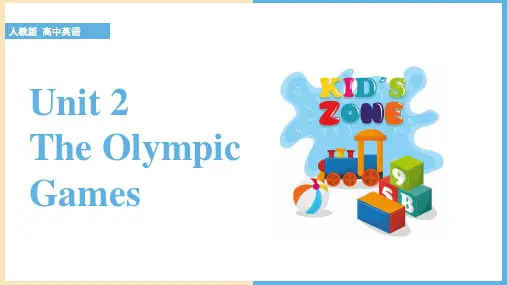
Read the stories and fill in the chart below.
What happened
What he did
Bjornar Hakensmoen A Canadian’s skiing pole broke during a race.
He gave her another pole even though his Norwegian team were competing against her team.
What people thought
Kip Keino He was very ill and in great pain. He still took part in the race.
True courage and perseverance. They praised him by putting him on the front cover of a sports magazine.
Try to find more stories about the Olympic Games on the Internet.
人教版 高中英语
THANKS
人教版 高中英语
Unit பைடு நூலகம் The Olympic Games
Three Inspiring Stories about the Olympic Games
高中英语人教版必修2《Unit 2 The Olympic Games》课件
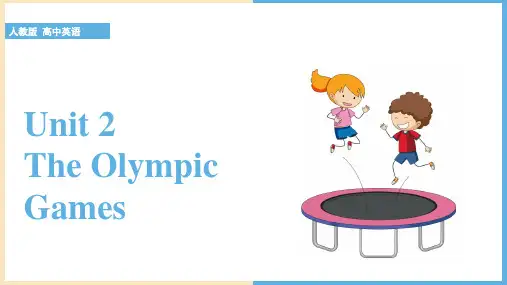
Phidippides
The Greeks were very worried and didn’t know what to do. They sent Phidippides to Sparta to ask for help for the battle …
Listen and write down in one sentence how the hero of the story sent his message miles away.
_____ I start the Olympic Games when the fire in the stadium is lit. _____ I am happy when new countries get
Olympic medals. _____ I travel through many countries
人教版 高中英语
Unit 2 The Olympic Games
Before listening to the story look at the pictures below. Write underneath each picture what is happening. In what ways can messages be sent to people far away?
_____ I am proud to be a bridge between the ancient and modern Olympic Games.
_____ The greatest honour is for the last athlete to carry me into the stadium.
carried by many runners. _____ The XXX lights me.
高中英语 unit2 The Olympic Games课件 新人教版必修2
was interests surprises amazes pleases
Pausanias? Pausanias? Pausanias? Pausanias? Pausanias?
h
13
Find some key words of the “Reading” to catch the main idea.
Summer
Running
Olympics
Where are the Summer nothing Olympics held?
Different
Ancient Modern
no exists
Only held in Modern
Olympics
Running mainly
many more events
h
15
h
16
Hosting the Olympic Games is another competition more fierce. Why do so many countries compete in hosting?
h
17
Discuss:
What will you do for the 2008 Olympics?
Sets(kinds) Only Summer Both Summer and Olympics Games Winter Olympic Games
Host city Athens in Greece
many cities in the world
Athletes only men
anybody reachingthe standard
h
21
h
22
人教版高中英语 必修二 Unit2 《The Olympic Games ---Reading》
776 BC, Greece Running,jumping,wrestling
1896, Greece 1984, Carl Lewis…
393AD—1896, stopped
2000, Sydney
Motto: …
In 2008, the 29th Olympic Games, in Beijing, good effects
to live in, a s_ta_d_i_u_m___ for competitions, a large swimming pool, a g_y_m_n_a_s_i_u_m__ as well as seats for those who watch the games. It’s a great ohn_o_r__ to host the Olympic Games. The Olive wreath has been re_p_l_a_c_e_d__ by medals. But it’s still about being able to ruanstef_r_____, juigmhperh______ and thurortwhefr_______.
2. Why does he think Athens and Beijing should feel proud? Because Li Yan has explained that it is a great honour to host the Olympic Games.
3. Why does he think people may be competing for money in the modern Olympic Games? He think that so many things have changed in the Olympic Games that he fears that the spirit of the Olympics may have changed too.
人教必修2Unit2TheOlympicGames
P
MIDDLE SCHOOL ENGLISH
Revision Lesson Audition practice
TEACHING
Read the text and find something about the numbers here:
Details
Model : 4 years A. 776BC
Details
Read the text and find something about the numbers here: Model : 4 years A: 776BC Answer
In the 1896 games there B.393AD were 311 competitors from C.1896 just 13 countries. D.1896,311,13 E. 2000,10,000,200,27th F.300 G.1984,4 H.28,3 J.2008,29th
B.393AD C.1896 D. 1896,311,13 E. 2000,10,000,200,27th F.300 G.1984,4 H.28,3 J.2008,29th
R L A
P
MIDDLE SCHOOL ENGLISH
Revision Lesson Audition practice
TEACHING
3.( F) Carl Lewis won three gold medals in the 1984 Olympic Games.
4.( F) The Olympic Games were held in Los Angeles. 29th 5.( F) The 28th Olympic Games will be held in Beijing. 6.( F) The Winter Olympic Games are held every three years.
人教版高中英语必修2《Unit2TheOlympicGames》全单元全英文教学设计附教学资源单词表
Unit 2 The Olympic GamesPart One: Teachi ng Desig n (第一部分:教学设计)Period 1: A lesson plan for reading |(AN INTERVIEW)AimsTo talk about the history of the Olympics gamesTo read an in terview about the Olympic GamesProceduresI. Warming upWarming up by sharingMorni ng, everyo ne! Today we are goi ng to learn about THE OLYMPIC GAMES. But first, I ' like to know howmuch you know about the Olympics to be held in Beijing. Anything about it is ok. Oh, Li Lei, do you want a try? … Right. You know so much about the Olympics. Toady, we 'llearn more about it in ancient Greece. b5E2RGbCAPWarming up by describingNow, boys and girls. I ' show you a video show of the 28 th Olympic Games. Please tell me what it is about and describe it to the class. Ok, Wang Lin, please describe it. Won derful. That' Liu Xia ng. The hurdle king! p1EanqFDPwWarming up by discuss ingHi, class. You know our country is trying her best to prepare for the 2008 Olympic Games. Every one is expecting and excited about it. Let' discuss what we can do for it. And imagine what we will do at the 2008 Olympics. DXDiTa9E3dII. Pre-reading1. Asking and answeringNow, please read the three questions before the Reading. Let ' do it in turn. Let ' begin from the first row here …ok, you did a good job. Let ' summarize your answers.RTCrpUDGiTPlease look at the three pictures in the reading. Please talk about them. Imagine whatever you can. 5PCzVD7HxA For reference: The first picture is the status of a great Greek. His name is Pausanias. He was a famous traveler and writer in the second century AD. His Guide to Greece is an extremely comprehensive guidebook for tourists, concentrating on buildings, tombs and status and including a lot of information on the mythological, religious and historical background to the monuments described. It is so in formative that it may be called the foun dati on of classical archaeology and this ancient Baedeker is still used as a guide to classical Greece. Can you remember a famous ancient Chinese traveler and writer? He also wrote a book. Yes, his name is Xu Shake. His works is The Notes of Xu Shake's travels.The sec ond picture is the ope ning ceremony of the Olympic Games. Maybe this is the prin ciple stadium. It ' large and can hold thousands of audienee.The third picture is a Chin ese athlete n amed Yang Yang. She won a gold medal for China in the2002 win ter Olympic Games. She is a famous skati ng player.3. Talking and SharingWe know there are many differences and similarities about the ancient and modern Olympics. Do you know anything about them? You can simply guess. Yes, Lucy, try … jLBHrnAILgIII. Reading1. Reading aloud to the recording and finding the general idea xHAQX74J0XNow please listen and read aloud to the recording of the text AN INTERVIEW. Pay attention to the pronunciation and inton ati on as well as the pauses with in each sentence. Then try to get the gen eral idea of the passage. Have you got the main idea? LDAYtRyKfEYes, it tells us the differe nces and the similarities betwee n the ancient and moder n Olympics. Zzz6ZB2Ltk2. Reading and actingNow let ' play the parts of the Greek writer Pausanias and the Chinese girl Li Li. Now boys, you are Pausanias; girls, you are Li Li. Please pay attention to the bold words. dvzfvkwMH3. Reading and findingNow read the text aga in. The boys shall try to finish the task: What was the ancient Olympics like? The girls shalltry to fin ish the task: What is the modern Olympics like? rqyn14ZNXi4. Reading and collecting informationOk, now let ' read it silently. First let ' talk about the same points between the ancient and modern Olympics. Who can an swer? Any volun teers? EmxvxOtOcoThen let ' come to the differences.5. Reading and underlining 找教案 SixE2yXPq5Next you are to read and underline all the useful expressions or collocations in the no tebook after class as homework. 6ewMyirQFLIV Closing downClos ing dow n by doing exerciseTo end the less on you are to do the comprehe nding exercises 1 & 2. kavU42VRUsClos ing dow n by discuss ingYou know our government has tried its best to compete for hosting the 29th Olympic Games. It has cost a lot of mo ney. Do you thi nk it is worthwhile? Why? y 6v3ALoS89Clos ing by imagi ningImagine what we will do and what we can do for the 29 th Olympic Games now. M2ub6vSTnPClos ing dow n by n arrati ngWe can see the text is written in a conversational style. And there are two speakers. One is Pausanias, a Greek writer 2000 years ago, the other is Li Li, a Chinese girl. Now let ' change it into a narrative style. In other words, let ' describe the ancient andpassage. Copy them to yourmoder n Olympic Games in our own words. Who would like to have a try? OYujCfmUCwClos ing dow n by summariz ingAs we have finished the passage we'll sum up what we have learned. First let 's see the writing skills. It is written in a conversational style. It 's in a very interesting way. It adopts a dialogue between Pausanias who lived 2000 years ago and a Chinese gird in modern world. Through their dialogue, the differences and similarities between the ancient and modern Olympic Games are made known to the readers. Just because it is in a conversational style, there are quite a few oral spoken English and elliptical phrases. eUts8ZQVRdThrough the comparis on betwee n the an cie nt and moder n Olympic Games, we have lear ned the differe nces and the similarities between them. Now we can have a deep understanding of the Games. From the passage, we can have a deep understanding of the Games. From the passage, we can also get to know that the Olympic Games are develop ing and improvi ng. It 's our duty to make the Olympic Games better and healthier. We know that one of the sloga ns for 2008 Beiji ng Olympic Games is Gree n Olympic Games. It shows that people are pay ing more and more attention to our environment. sQsAEJkW5T Period 2: A lesson plan for Learning about Language GMsIasNXkA(The Future Passive Voice)Aims:To lear n about future passive voiceTo discover useful words and expressi onsTo lear n the methods of words formati onProceduresI. Warming upWarming up by dictat ingThere are several importa nt sentences in this un it. Let' dictate them. If you can 'learn them by heart after ClaSS.TIrRGchYzg①When and where will the next Olympic Games be held? 7EqZcWLZNX②I live in what you call Ancient Greece ” and / used to write about the Olympic Games more than2000 years ago.izq7IGf02E③All countries can take part if they reach the standard to be admitted to the games. zvpgeqj1hk④The n ext Olympic Games will be held in my hometow n. NrpoJac3v1⑤It is just as much a competition among countries to host the Olympics as to win an Olympicmedal.1nowfTG4KIWarming up by discovering useful words and expressions fjnFLDa5ZoTurn to page 11 and do exercises 1,2, 3 and 5 first. Check your answers against your classmates '.tfnNhnE6e5II. Learning about word formation1. Do exercise 4 and discover the rules.Turn to page 12 and find out the rules of word formation. HbmVN777sLBy adding -ing to a verb, we can change the verb into a noun. V7i4jRB8HsThat means we can change doing some sport" into the name of the sport" .83icPA59W9By addi ng -er to a verb, we can cha nge the verb into a noun. That means we can cha nge doing some sport "into the person who does the sporf'.mZkkikzaaP2. Means of word-formati on in gen eralAffixati on, conversion, and compositi on (or compo unding) are the chief means of word-formati on in En glish.Besides these, there are also other mi nor ways of word-formatio n in cludi ng clippi ng, acronymy, ble nding etc.AVktR43bpwIII. Learning about Present Future Passive VoiceTurn to page 13 and do exercise 3. And tell the class the formation of present future passive voice. ORjBnOwcEdW Closing down by summarizing找教案 2MiJTy0dTTI. Present future passive voice (take ask" for example) giiSpiue7A2.The passive Voice of phrasal verbGen erally speak ing, only tran sitive verbs can form the passive voice, for on ly tran sitive verbs can be followed by objects. But many intran sitive verbs together with some prepositi ons and adverbs can be used as tran sitive verbs.So they can also be followed by the objects. Therefore they can also be used in passive voice. uEh0U1YfmhBut note that all the phrasal verbs are used as a whole. When using them in passive voice, we cannot drop out the prepositi ons and adverbs. For examples: IAg9qLsgBXAt last they put out the fire. * At last the fire was put out. WwghWvVhPEThey will put up a notice on the wall. ------ ► A notice will be put up on the wall. asfpsfpi4kHave you sent for a doctor? —► Has the doctor bee n sent for?ooe y YZTjj1I have never heard of such a thing before. k Such a thing has never been heard of before.BkeGuInkxIWe must take good care of the children here. —The children must be taken good care of here. PgdO0sRlMoHis classmates laughed at him for the foolish mistake. *■ He was laughed at for the foolish mistake by his classmates 3cdXwckm15 Period 3: A lesson plan for using languageAims:To read about the an cie nt Olympic GamesTo liste n and talk about hobbiesTo write about hobbiesProcedures1. Warming upWarming up by introducingHi! Class. You know Greece is the world-k nown country with an ancient civilizati on .It has a long history with so much marvelous culture. The Greeks had won derful stories about the Gods and Godd nesses who were part of their religi on. They believed that these god or goddesses would help huma ns if they felt sorry for them or if the huma ns were good people. However, the Gods did not always help. They behaved like people who were un predictable and capricious. To try to get the support of the Gods people had to pray to them and offer them prese nt. I n this story the Goddess Hera, the wife of the chief God, Zeus was sorry forHippomenes and agreed to help him. h8c52WOn g M Warming up by sharingNow, boys and girls. Is there anybody who can tell us some Greek mythology. You know they are so famous in huma n history. Or can you speak out some n ames of Greek Gods and Goddesses.v4bd y Gious Prometeus 普罗米修斯 a son of the former chief God Sphinx 斯芬克斯------a being with a human face but a lion bodyPan dora 潘多拉--- a beautiful girl with every ill and evil thought and deedZeus 宙斯 --- the chief God who governed the worldHera 天后---- the wife of Zeus who governed the loven . Guided reading1. Reading and judgingRead the text THE STORY OF ATLANTA, and complete the True or False guestions after the text on page14.J0bm4qMpJ92. Reading and answeringRead the text again, and answer the following questions. xvauA9grYPA. What was Atlanta ' problem?B. What were Atlanta ' rules?C. What was Hippomenes ' amazement?D. What made Hippome nes cha nge his mind?E. Whom did Hippome nes turn to for help?F. Can you guess what was the ending?your Next you are to read and un derl ine all the useful expressi ons or collocatio ns in the passage. Copy them tonotebook after class as homework. bR9C6TJscwFor listening turn to page 15 and be ready to do exercises 1. pN9LBDdtrdFirst read the questions carefully and imagine what is the listening about. DJ8T7nHuGTWhen doing exercise 2, you must make clear what is wrong with the sentence. And tell the class which is correct, which is wrongand which is only half true. QF81D7bvUA5. ActingNext we are going to put the text A STORY OF ATLANTA on stage. You know there are four charactors in the story. Who would like to be them? 4B7a9QFw9hWho will be Alanta ' father, the old king?Who will be the Goddess of Love? 找教案 ix6iFA8xoXOk. Li Li, you are the Greek prin cess. Zhang Qiang, you are the brave young man Hippome nes. Lucy, you are theGoddess of Love. Zhou Gang, you are the prin cess ' father. The rest of class, please prepare it in groups of four. Then act your play before class. wt6qbkCyDEA text play of THE STORY OF ATIANTATime: one morning in spri ngPlace: at the palacePeople: the old kin g(K), the prin cess (A), the young man (H), the Goddess of love (L).Now, class. Let ' carry out a survey of the interests in the class and write down the names of the classmates who have the same interests. You can carry out the task like this. Kp5zH46zRkWhich do you like, sport, music or collect ion?Which of the sports do you like best?What is your favorite sport?Are you in terested in table tennis?After the survey, the ones who have the same in terests sit together and please work in groups of four to talk about their in terest. Y^HdOAA61Why do you like this sport / music / collect ion?When do you begi n to like it?What ' enjoyable about the hobby?What have you lear ned from the hobby?III.Guided writing1. Writing an imagined dialogueGroups 1 and 2 are going to write an imag ined dialogue betwee n the prin cess and Hippome nes. You may begi n like this : Oh, my dear princess, I want to marry you …chAPJxABH2. Writing a descriptionTurn to page 16 and follow the direct ion to write a descripti on of your favorite hobby. qd3YfhxCzoHere is an example:Swimming is my favorite sport. I like it because it can bring me much fun. The process of learningGo to the library to read or get on li ne to search in order to find more in formati on on the Olympic Games and the ancient Greek mythology. Take no tes of your finding and report to your groupmates next Mon day morning. 找教案 E836L11DO5Part Two: Teaching ResourcesSection 1: The writing style of the reading AN INTERVIEW S42ehLvE3MSection 2: Background information on the Olympic Games 501nNvZFisI. Events of the Moden Olympic GamesArchery, Baseball, Badm inton, Basketball, Beach, Volleyball, Boxing, Cano e/Kayak, Cycli ng, Diving, Equestria n,Fencing, Field Hockey, Gymnastics, Handball, Judo, Modern Pentathlon, Rowing, Sailing, Shooting, Soccer,Softball, Swimming, Synchronized Swimming, Table Tennis, Tennis, Tae kwon do, Track & Field, Triathlon,Volleyball, Water Polo, Weightlifti ng, Wrestli ng jW1viftGw9II. Olympic TraditionsThe Olympic AnthemThe Olympic an them was writte n by the Greek n ati onal poet Costis Palamas and composed by Greek musicia nSplros Samaras. It was first sung at the 1896 Games. The IOC adopted it as the official Olympic an them to crow n olympic ceremonies at the 1958 IOC Session in Tokyo. xSODOYWHLPThe Olympic MottoThe Olympic motto swifter, higher, stronger "comes from three Latin words "citus, altius, fortius ”which actually mean""aster, higher, braver ". The French educator, Baron Rerre de Coubertin, who revived the ancient OlympicGames and in 1896 led the first modern 01ympic Games in Athens, borrowed the phrase from a Dominican priest Henri Dinon. Mr.Dinon introduced these words while presenting athletic prizes at a college in 1891.But how did these words become the mottoof the Olympic Games? It was Michel Breal who introduced this phrase at the closing dinner of the congress for the reestablishment of the modern Olympic Games on June 23,ter, the International Olympic Committee formally adopted this phrase as the official motto of the Games. LOZMkIqI0wThe Olympic CreedThe Olympic creed was also introduced at the 1896 Games. As stated by Pierre de Coubertin, the creed is as follows: ” The most important thing in the Olympic Games is not to win but to take part, just as the most important thing in life is not the triumph but the struggle. The essential thing is not to have conquered but to have fought well. ” ZKZUQsUJedThe Olympic FlagIt was Pierre de Coubertin who conceived the idea of the Olympic flag with five coloured interlocking rings on a white backround. The rings represent the union of the five continents and the meeting of the athletes from all around the world at the Olympic Games.Today, almost a century after the flag 's creation, the six colours, those of the rings (blue, yellow, black, green, red) and that of the white background which stands for peace, still maintain their symbolism and can be found in flags across the world. The Olympic flag was first used during the Antwerp Games in 1920. dGY2mcoKtT The Olympic Oath“ In the name of all the competitors, I promise that we shall take part in these Olympic Games, respecting and abiding by the rules which govern them, in the true spirit of sportsmanship, for the glory of sport and the honour of our teams.”At the opening Ceremony of each Games, one athlete from the host country takes Olympic oath on behalf of all competing athletes. This particular gesture of sports-manship was introduced at the 1920 Games in Antwerp, Belgium. A coach or team official takes a similar oath at each Opening Ceremony. rCYbSWRLIAThe Olympic FlameThe Olympic flame is one of the most visible symbols of the modern Games. Its tradition has survived from theGames of ancient Greece, where a sacred flame, ignited by the sun, burned continually on the altar of the goddessHera.FyXjoFlMWhThe modern Olympic flame was first lit in 1928 at the Amsterdam Olympic Games, where it burned throughout the competitions. It has become a major symbol for solidarity among nations and embodies the Olympic spirit en compass ing the ideals of purity, the en deavour for perfect ion, the struggle for victory, frien dship and peace.TuWrUpPObxThe Torch RelayDuring the 1896 Games in Athe ns, young in spired sportsme n had orga ni sed the first torch relays. However, thetradition of the Olympic torch officially began at the Berlin Games in 1936. As in ancient times, the torch is lit bythe sun in Ancient Olympia, the n passed from runner to runner in a relay to the host city, where it is used to lightthe Olympic Stadium ' s flame duri ng the Games ' Opening Ceremony. The flame the n bur ns un til it is ext in guished at the Closing Ceremony. 7qWAq9jPqESection 3: Words and expressions from unit 2 THE OLYMPIC GAMES iiviWTNQFkhonestadj. 1. not disposed to cheat or defraud; not deceptive or fraudulent: honest lawyers 2. marked by truth: givehonest answers 3. without pretensions: worked at an honest trade 4. without dissimulation; frank: my honestopinion 5. habitually speaking the truth: an honest man 6. worthy of being depended on: an honest working staff7. free from guile: His answer was simple and honest yhUQsDgRT1ancientadj. 1. very old: an ancient mariner 2. in or of times long ago: ancient Rome and Greece 3. having existed since avery early time: ancient history/customs MduZYnKsacompetev. to try to win sth. in competiti on with some one else: Joh n competed for a place at their school, but did n 'get it.compete for someth ing; en gage in a con test; measure on eself aga inst others09T7t6eTnomedaln. an award for wi nning a champi on ship or commemorat ing some other eve nt e5TfZQIUB5hostn. a man who receives guests: He acted as host to his father's friends. China is the host country for 2008 OlympicGames. v. be the host of or for: We hosted 4 couples last ni ght. S1S OV A CVQMmagicaladj. possess ing or using or characteristic of or appropriate to super natural powers: a magical spell GXRw1kFW5sinterviewn. 1. the questi oning of a pers on (or a con versati on in which in formati on is elicited); ofte n con ducted byjourn alists: My in terviews with tee n-agers revealed a weake ning of religious bon ds. 2. a conference (usually with some one importa nt) v. 1. con duct an in terview in televisio n, n ewspaper, and radio report ing 2. discuss formally with (somebody) for the purpose of an evaluati on: We in terviewed the job can didates. 3. go for an in terview in the hope of being hired: The job can didate in terviewed everywhere. 找教案http://www.zhaojiaoa n. com UTREx49Xj9 athleten. a pers on trained to compete in sportsadmitv. 1. allow participati on in or the right to be part of; permit to exercise the rights, functions, and resp on sibilities of: admit some one to the professi on 2. allow to en ter; gra nt entry to: We cannot admit non-members into our club. 3. serve as a means ofentrance: This ticket will admit one adult to the show. 4. give access or entrance to: The French doors admit onto the yard. 5. afford possibilitye: This problem admits of no solution. 6. declare to be true or admit the existenee or reality or truth of: He admitted his errors. 7. admit into a group or community: WW ll have to vote on whether or not to admit a new member. 8. have room for; hold without crowding: The theater admits 300 people.8PQN3NDYyPreplacev. 1. put someth ing back where it bel on gs: Replace the book on the shelf after you have fini shed read ing it. 2.substitute a pers on or thing for (ano ther that is broke n or in efficie nt or lost or no Ion ger work ing or yield ing what is expected): He replaced the old razor blade. 3. put in the place of ano ther; switch seem in gly equivale nt items: The con artist replaced the origi nal with a fake Rembra ndt. 4. take the place or move in to the positi on of: Smith replaced Miller as CEO after Miller left. mLPVzx7ZNwrelatev. 1. have or establish a relati on ship to: She relates well to her peers. 2. be in a relati on ship with: How are these two observati ons related? 3. give an acco unt of: The wit ness related the even ts. 4. have to do with or be releva nt to5. make a logical or causal connection: I cannot relate these events at all. AHP35hB02dsailn. 1. a large piece of fabric (as canvas) by means of which wind is used to propel a sailing vessel 2. an ocean trip taken for pleasure v. 1. traverse or travel by ship on (a body of water): We sailed the Atlantic 2. travel in a boat propelled by wind: I love saili ng, especially on the ope n sea. 3. travel by boat on a boat propelled by wind or by other means: The QE2 will sail to Southampton tomorrow. 4. move with sweeping, effortless, gliding motions: Shreds of paper sailed through the air. 找教案 NDOcB141gT advertise v. 1. call attention to: Please don' advertise the fact that he has AIDS. 2. make publicity for; try to sell (a product) 1zOk7L y2vApromisen. 1. grounds for feeli ng hopeful about the future: There is little or no promise that he will recover. 2. a verbal commitme nt by one pers on to ano ther agree ing to do (or not to do) someth ing in the future v. 1. give grounds for expectations: The results promised fame and glory. 2. make a promise or commitment 3. promise to undertake or give: I promise you my best effort. 4. make a predict ion about; tell in adva nee fuNsDv23Kh。
最新人教版高一英语必修二unit2全套课件
主干回顾 ·夯基础
核心探究 ·破疑难
考点对练 ·全突破
[即学即练] (1)You must a_d__m_i_t_ the task ___t_o_b__e_____ difficult.你 必须承认这项任务是艰巨的。 (2)He a_d__m_i_tt_e_d__s_t_e_a_l_in_g_ the bicycle. 他承认偷了自行 车。
The child deserved to be rewarded/punished.
rewarding/punishing. 这孩子该奖/罚。 You deserve it. 这是你应得的。
即学即用 (1)不劳者就该挨饿。
Those who do not work _d_e_s_e_r_v_e_t_o__ starve. (2)他做了这样的事,应该受到惩罚。
5.bargain vi.讨价还价;讲条件;n.便宜货 (1)bargain with sb. about/over/for sth. 和某人就某事讨价还价
She bargained with the fishmonger over the price. 她与鱼贩讲价钱。 (2)make a bargain with sb.和某人达成协议、约定 He has made a bargain with his father. (3)a good (bad) bargain买得(不)合算 (4) strike a bargain with sb. 与某人成交 (5) It's a bargin. 这可是便宜货。 (6) a bargain price (=a low price) 廉价
高一英语人教新课标必修二unit2 the olympic games 单元重点知识讲义
负责任 9. replace v 取代;替换;代替 同义词组 take the palace of; take
sb’s/sth’s place 取代 10.similarity n 相似性;相像点 similar adj 相似的 similarly adv 相
三 重点句型
1. I lived in what you call “Ancient Greece” and I used to write about the Olympic Games a long time ago.(used to do sth 曾经做 某事) 我生活在你们所说的“古希腊“,我曾经写过很久以前奥林匹克运 动会的情况。 There’s as much as competition among countries to host the
似地 11.charge v 收费、控诉 n 费用,主管
charge sb some money for sth 因为某人、某事 收某人的钱 charge sb with sth 用什么控诉某人 12.physical adj 物理的,身体的 Physics 物理 Physicist n 物理学家 physician 物理学家 13.advertise v 做广告;登广告 advertisement n 广告 advertiser n 刊登广告者 14.bargain v 讨价还价 n 便宜货 bargain with sb 和某人达成协 议。。。。 15.hopeless adj 没有希望的;绝望的 hope n/v 希望 hopeful adj 充 满希望的 16.foolish adj 愚蠢的,傻的 fool 愚弄 17.admit v 承认 admit doing sth 承认做某事 be admitted to/into … 被。。。。。。接收;被准许进入 18. deserve v 值得,应受 deserve doing sth =deserve to be done sth