
2019-2020年六年级英语下册 6B Module3 Unit3教案 沪教牛津版
2019-2020年六年级英语下册 6B Module3 Unit3教案沪教牛津版
一、单元分析(Unit Analysis)
(一)单元地位(Unit Position)
1.本单元内容围绕牛津教材中出现的一些人物如:Kitty,Alice, Danny等人日常生活展开,介
绍了他们每天在上学放学路上之所见。
此外,还有一个语言背景,就是他们与家庭成员之间关于“时间”话题的语言沟通。
2.本单元内容与学生的实际生活联系紧密,有很强的实用性。
教师可引导学生挖掘自己生活中的
语言素材进一步运用发挥。
3.本单元中第一次出现句型It takes sb. sometime to do sth.。
在教学过程中,应创设不同情
景让学生通过反复的操练模仿来熟悉这个句型。
4.本单元出现的When时间状语从句并非新授内容,教学时应该注重让学生在理解的基础上进行灵
活运用。
(二)单元目标(Unit Target)
1.词汇学习:掌握用介词短语表示地点的方式。
2.语言功能:
1)学会调查了解周围同学的上学、放学情况。
2)学会用固定句型询问时间的信息。
3)学会用时间状语从句表示两个动作之间的时间关系。
3.语法结构:
1)掌握固定的介词词组表示地点。
2)掌握用副词或状语表示程度。
3)用含有“多长时间”词语的问句来问时间长短。
4)用名词或名词短语表示时间。
5)用连词表示两个动作之间的时间关系。
4.情感教育:
培养学生关心生活关心家人的意识,增进学生与周围熟识的人的交流。
(三)单元重点(Unit Focus)
1.关键词汇:near, not too far away, quite far away, how long. 2.语言功能:
1)询问时间。
--How long does it take … ?
--It takes sb. sometime to do sth.
2)时间状语从句: Sb. see(s) … when …
3.语法要点:
1)掌握用副词quite表示程度。
2)掌握用介词near等表示地点。
3)掌握用副词表示地点。
二、教学设计(Teaching Designs)
附送:
2019-2020年六年级英语下册 6B Unit 6 活动单教案苏教牛津版
班级姓名学号
【学习目标】
1.掌握be going to的用法。
2.了解动词在一般将来时的句子中的形式,be going to中的be动词会随着主语而变化。
3.能用正确的语音、语调朗读课文,并正确理解课文含义。
【活动方案】
活动一:复习句型,巩固be going to的用法。
1.小组会话
What are you/they going to do? I’m /We’re/They’re going to….
What is he/she/it going to do? He’s/She’s/It’s going to….
2.Play a game.
活动二:听录音,初步理解导入部分的内容。
听导入部分录音,回答问题。
(1)What day is it today?
(2)What’s the weather like today?
(3)What are David and Gao Shan talking about?
活动三:运用多种阅读方式,理解对话部分的内容。
1.听读课文,判断下列句子的正误,正确的写“T”,错误的写“F”。
( )⑴ David is going to see the Beijing opera with Gao Shan.
( )⑵ David is going to meet Gao Shan at six in front of the Garden Theatre.
( )⑶ There is a concert in the school tomorrow.
( )⑷ David is going to play the piano at the concert.
( )⑸ Nancy is going to play the violin at the concert.
2.选择你喜欢的人物,分角色朗读课文,填表。
3.请在小组内分角色再读课文,如果你还有不能理解的短语或句子,请先画出来,然后在小组内请教同学,如果还不能解决,请举手问老师。
【课堂反馈】
1.请朗读下列短语或句子,然后将其译成汉语。
(1)Hello.Is that Gao Shan? (2)warm and sunny
(3)have school
(4)call Gao Shan
(5)talk about their plans (6)see a Beijing opera (7)Would you like to join us?(8)in front of
(9)by the way
(10)tomorrow afternoon (11)at the concert
(12)of course
2. 比一比,哪组课文读得最好。
3.完成下列句子。
(1)They going to (take) photos this morning.
(2 ) Su Hai going (cook) nice food for me soon .
(3 ) you going to (play)football next Sunday?
(4 ) What she to (do ) tomorrow evening?.
(5)I to New York next year.
【Homework】
1.听磁带,模仿录音中的语音语调,熟读课文。
2.抄写句子和短语2+1遍。
小学教育资料
好好学习,天天向上!
第7 页共7 页。
【沪教牛津版(三起)】六年级下册英语教案Unit3Our-school-in-the-future
【沪教牛津版(三起)】六年级下册英语教案Unit3Our-school-in-the-futureU3 Our school in the future教学内容与目标教学内容功能描述●描述对将来的愿景。
语言知识核心句型和日常用语● What changes would you like to see in our school?● Studengts will have a picnic every month.词汇Carry,mountain,even, space, a piece of, have a picnic,better and better语音m, n, ng,n(k),n(g)语言技能听●听懂谈论关于未来学校变化的对话。
说●用一般将来时说说未来学校可能会有怎么样的变化。
读●读懂郭老师和孩子们之间关于未来学校变化的对话。
●读懂关于未来学校的短文。
写●能结合语境写出正确的句子,并简单描述未来学校的变化。
教学目标●能在语境中正确运用本单元的核心词汇,复习已学相关核心词汇。
●对未来充满美好的期待。
●能用一般将来时对未来学校进行描述。
●根据字母m, n, ng,n(k),n(g) 的发音规律,能拼读简单的单词。
教学重点:●词汇:Carry,mountain,even, space, a piece of, have a picnic,better and better ●句型:What changes would you like to see in our school?Studengts will have a picnic every month.●根据字母m, n, ng,n(k),n(g) 的发音规律,能拼读简单的单词。
教学难点:● will be 和 will do 的用法区别。
M1 Changes and differencesU3 Our school in the futurePeriod1教学目标[知识目标]1.通过Look and learn 复习动词词组2.通过Listen and say的学习,学习词汇和词组,复习使用一般将来时,谈论对未来学校的憧憬。
沪教版六年级英语下册Unit 3 Our school in the future教案与反思
Module 1 Changes and differences原创不容易,为有更多动力,请【关注、关注、关注】,谢谢!师者,所以传道,授业,解惑也。
韩愈Unit 3 Our school in the future◆教材分析The undergraduate through the Do a survey task, further consolidate the use of the general.◆教学目标【知识目标】Review the verb phrases through Look and learn.【能力目标】Through the writing task of Think and write, it helps students to consolidate the ability to use the written expression in general future. 【情感目标】It is the students who learn to look forward to their future life.◆教学重难点【教学重点】Vocabulary: mountain, even, spaceSentence pattern review:In the future, schools will be different. 【教学难点】The writing and application of sentences in the future.◆课前准备Tape recorder, Multimedia◆教学过程Step 1. Think and sayMy school in the pastIn the past, our school was...There was/were...There wasn’t/weren’t...Students...My school nowNow, my school is...There is/are...What did Ms Guo ask the children to do? Step 2. Thin and answerWhat’s a time box?What would you like to put into a time box? Step 3.Look and learnThe simple future tensewillbe going towill not/won’tbe not going toThe simple future tensetomorrownext Monday/week/...in the futurein the futurthis evening/Sunday/...will / won’tbe going to/be not going toWhere would you go for a picnic?What would you take with you for a picnic? Who do you want to have a picnic with? What do you ned to grow a plant?soila shovelStep 4. Read and writen sunny days, I like to have a picnic with my family. We always brings a lot of food and go to the same park. But in the future, I hink picncs will be different. First, you will get information on the computer. You will know the best place to have a picnic. When you get to the place, you can choose the food online an the restaurant will send you the food. Wouldn’t that be interesting?Step 5. Read aloudStudents will have a picnic every month.Students will study online at home.Students will grow a lot of plants in the garden.Students will not carry any books.All their books will be on a small computer.I will be the head teacher.Step 6. Think and sayStudents will...Students will not...I will be...Step 7. Guess and say[来源:学+科+网]Schools of the future.Step 8. Think and sayWhere will schools be?They will be under the sea, on high mountains and even in space.How do you find books now?[来源:学科网ZXXK]How will you find books in the future?Robots will help us find books in the library.Step 9. Discuss and shareWhat else can robots do?Step 10. Read aloudRobots will help us find books in the library.They will also do other things in schools.Step 11. Read and completeWe use _____ in our lessons now.In the future, we will use _________ in all our lessons.Step 12. Think and sayWhat will you do with computers in the future?What will teachers be like in the future?They will be...Step 13. Class debateRules:1. Choose Group A or Group B.A: Computers will replace teachers in schools.B: Computers will not replace teachers in schools.2. Present your ideas one by one.[来源:学.科.网Z.X.X.K]3. Each one can present for 1 minute.Step 14. Think and write[来源:Z§xx§]In the future, schools will be different.Step 15. Read and thinkLast week,I flew a kite in the park.I fly a kite in the park every weekend.Next week,I will fly a kite in the park.Step 16. Look and sayLastEveryNestStep 17. HomeworkComplete the letter and read it aloud.【素材积累】1、人生只有创造才能前进;只有适应才能生存。
(六年级英语教案)牛津小学英语6b全册Unit3教案
牛津小学英语6b全册Unit3教案六年级英语教案牛津小学英语6b unit 3单元教学内容简析:本单元主要话题是围绕问路来展开一各项语言话题的。
重点学习问路中经常涉及的相关用语。
本单元a部分通过创设情景,展开一段有关问路的情景对话。
b部分主要主要学习表示场所的词组和问路相关的动词词组。
c部分和d部分是本单元的句型结构部分,重点学习句型及其答句。
can you tell me the way ...?go along ...,turn ...at ...crossing .the ...is on your ...how can i get to ...?等句式。
要求学生能够四会掌握这些句型。
e部分为read and number。
复习句型和一般过去时。
f部分为游戏活动部分,要求学生在听听、看看、做做、玩玩中进行。
g部分为语音部分,让学生了解字母组合or在单词中的读音。
h部分是一首歌曲,要求学生能演唱。
单元教学要求:1. 能听得懂、会说、会读和会拼写stops, turn left /right , post office ,get on /off, along,street。
2. 掌握会话中出现的三会单词和词city, crossing, away, suddenly, shout, thief ,shoppingcenter , .middle school , out of , train station ,history museum .3. 能听得懂、会说、会读和会写四会句型:can you tell me the wayto ...,please?4. 能听得懂、会说、会读日常交际用语go along this street, and then turn right at the thirdcrossing . how far is it from here ?it's about a kilometer away .you can take bus no. 5.how many stops are there? how can i get to the shopping center?5. 了解字母组合ou在单词中的读音。
上海新世纪版英语六年级下册6BUnit3Lesson1U3L1同步讲义教案

学员编号:年级:小六课时数:学员姓名:辅导科目:英语学科教师:授课类型T U3L1(新世纪6下)基础知识梳理星级★★★教学目标1、使学生能够基本掌握本单元中的基础词汇及重要句型;2、使学生熟练运用本节课所学的知识。
(建议2-5分钟)批注:由提问学生:图片中的两个卡通人物在干什么,引出本节课的主题---打电话。
然后也可以先和学生模拟着用英语打一通电话,并且先不指出学生在打电话的过程中所犯的错误,通过课文的学习之后再让孩子回到这里,自己发现错误(建议20-25分钟)T同步-U3L1基础知识梳理1一、词汇Words1. suppose vt. & vi. 假设;认为【e.g.】I suppose not. 我不认为不是那样的。
I suppose you are right. 我想你是对的。
Let’s suppose (that) the news is true. 让我们假定这消息是真的。
【习惯用语】be supposed to do 被期望或要求做Suppose that 假定批注:让学生联想之前已经学过的think这个词的用语,与suppose相似2. message n. 消息;口信;情报;电报【常用搭配】take a message for sb 捎个口信,转告e.g. I’m sorry, she’s out right now. Can I take a message for you? 对不起,他现在不在,要不要我帮你留话?leave a message (for sb.) 留个话e.g. May I leave a message 我可以留个口信吗?give sb. a message 给某人带口信e.g. Please give Julia a message to say that we shall be late. 请给茱莉亚带个信儿,告诉她我们晚点到。
批注:message 很容易和information和news相混淆,注意message所表示的是口头或书面的某人给某人的“信息”,如果是口头形式,可以解释为“口信”,并且message可数,而information和news不可数。
六年级英语下册 6B Module3 Unit3课件 沪教牛津版
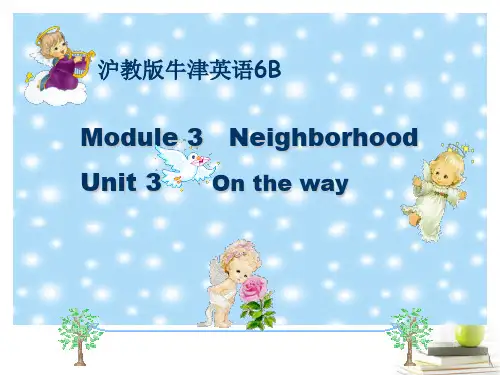
S2: I live
not too far away from/ quite far away from/
school.
far away from
S1: How do you go to school?
S2: I go to school by _____/on foot.
I go to school by _____/on foot, then …
Find out and write:
Байду номын сангаас
Today, My family spent three hours and twenty minutes on travelling.
Time my family spent on travelling on ______ (date)
Mum
10 minutes (to the market)
Peter lives far away from school. It takes him almost an hour to get to school.
About you:
S1: Do you live near or far away from school?
near/ quite near
Danny lives not too far away from school. It takes him about half an hour to get to school.
Kally lives quite far away from school. It takes her more than 40 minutes to get to school.
30 minutes (back home)
沪教版三年级起点小学六年级英语下册教案Unit 3 Our school in the future_教案3
Period3
教学目标
1.知识目标:
(1)词汇学习:mountain,even, space
(2)句型:In the future,schools will be different.
(3)语音复习:m, n, ng,n(k),n(g)
2.能力目标:
S1:There will not be many cars in the street in the future.
2.请学生说说他们希望未来成为怎样的人。
T:What would you like to be in the future?
S1:I'll be tall andbeautiful.I'll be a superstar.
T:What will our city be like in forty years'time? Look at these pictures.
S1:We will live in space.
3.让学生默读Look and read的课文,通过提问帮助学生理解课文,整理信息,让学生找出课文主题句。
4.出示Learn the sounds的录音,请学生跟录音朗读单词。请学生完成Listen and circle的练习,然后核对答案。
5.拓展:
/m/man map Tim jam
/n/nut natural can moon
/ŋ/king tank sing
III. Post-task activities
请学生充分发挥想象,说说未来的学校会是怎样的,把它写下来,学生分组交流。
板书设计
Unit3 Our school in the future
2019-2020年牛津英语上海版六年级下册6BModule1Unit3TheDragonBoatFestival4课时教案附反思
2019-2020年牛津英语上海版六年级下册6BModule1Unit3TheDragonBoatFestival4课时教案附反思2019-2020年牛津英语上海版六年级下册6BModule1Unit3TheDragonBoatFestival4课时教案附反思(一)知识与技能1熟练掌握连词but 的用法。
2掌握介词with, without 的用法.3运用一般过去时描述过去发生的事情。
(二)过程与方法1用“Wh-”问句引出有关端午节的话题.e.g. When is the Dragon Boat Festival?What do people eat?Why do we celebrate the festival?2使用情态动词would操练句型Would you like…?Yes, please./ No, thanks.3使用一般现在时表达自己的好恶e.g. don’t like/hate/love4 Using modals to indicate preferencese.g. I would rather have…(三)情感、态度与价值观1学习一系列与中国传统节日:端午节,有关的信息,了解本国的风土人情,拓宽知识面,1)了解端午节的来历。
2)了解中国人如何庆祝端午节。
2唤醒学生保护中国传统节日的强烈责任感。
Period 1Language focus:Using adjectives to describe objectse.g. a salty rice dumping/a sweet rice dumplingUsing prepositions to indicate timee.g …in summer. It’s on the fifth day of the fifth lunar month…Asking ‘Wh-‘questions to find out various kinds of specific information about a persone.g. What do people eat /What do people do to celebrate this festivalUsing connectives to link contrasting idease.g. Kitty loves the sweet rice dumplings, but she hates the salty ones.Using the simple present tense to express preferencese.g. loves/hates/likesUsing prepositional phrases to describe objectse.g. salty ones with meat and green beans/sweet ones without red beansPre-task preparation1Ask students what they like to do and eat to celebrate the Dragon Boat Festival. Encourage students to talk about this festival.2Review and introduce new vocabulary items in Look and learn.3Play the recording: Look and learn and Look and read. Students listen and follow in their books. 4Play the recording again. Students listen and repeat.While-task procedure1Students pair up to talk about the rice dumplings they like. Have them complete the survey form in Circle and write by circling and writing down what they have discussed with their partners. They are required to use the target language in their report, like this: I love…, but I hate …/My classmate loves…, but …/We both love…, but…2Ask individuals to read their reports to the class.3Collect all reports and bind them into a book for circulation in class.4Conduct a simple survey to find out the most popular kind of rice dumpling among students by counting how many students like a particular kind of rice dumpling. Ask some students why they like or dislike a particular kind of rice dumpling.ConsolidationGrammar Practice Book 7A pages 9 and 10Period 2Language focus:Asking ‘wh-‘questions to find out the reasone.g. Why do we celebrate the Dragon Boat FestivalUsing the simple past tense to talk about past activities and statese.g. Qu-yuan was born around two thousand years ago in China.Using the simple present tense to talk about present statese.g. Nowadays, people eat rice dumplings and have Dragon Boat races to …Pre-task preparationLanguage learning activity(This section aims at providing students with opportunities to practise the language/vocabulary needed or become familiar with the background for the task that follows.)1 Give students some time to read the story silently. Then ask students: Was Qu-yuan sad Why Encourage volunteers to answer the questions.2 Play the recording: Look and read. Students listen and follow in their books.3 Play the recording again. Students listen and repeat. Ask students to pay attention to the pronunciation and intonation of the words4 Remind students of the use of the past tense in the story .Go over the verbs in the past tense withstudents. Invite the more able students to speak out and spell, if possible, the corresponding verbs in their present tense form.5 Remind students to pay attention to the use of different tenses when talking about the past and the present in the story.6 Distribute a copy of photocopiable page 8 to each student. Students read the text on page 11 of the Student’s Book again individually. Have them complete the list and write down the answers to the questions.7 To check the answers with students, invite some students to write the list on the board. Then invite the more able students to answer the questions orally.ConsolidationGrammar Practice Book 7A pages 12Period 3Language focus:Using modals to make an offere.g. Would you like a piece of rice dumplingUsing formulaic expressions to accept offerse.g. Yes, please. I really like rice dumplings.Using formulaic expressions to decline offerse.g. No, thanks. I don’t like rice dumplings very much.Using modals to indicate preferencese.g. I’d rather have a piece of pizza.Pre-task preparationLanguage learning activity(This section aims at providing students with opportunities to practise the language/vocabulary needed or become familiar with the background for the task that follows.)1 Review the names of the food and drink items that students have learned previously, e.g. pizza, pancake, cookies, hamburger, lemonade, 7-UP, coffee, etc. Introduce new food items, e.g. Chinese pudding, Christmas pudding with the help of pictures or photos.2 Play the recording: Look and say. Students listen and follow in their books.3 Students work in groups of three and use the modeled conversation in About you to do the role-play. Have some groups come out and act the conversation.ConsolidationGrammar Practice Book 7A Page 13Period 4Language focus:Using formulaic expressions to begin and end a lettere.g. Dear _____/Yours,Using the simple present tense to express interestse.g. don’t like/hate/loveUsing prepositions to describe objectse.g. I hate the sweet ones with/without…Using modals to indicate preferencese.g. I would rather have…Pre-task preparationReview the format of a letter with students. Tell students that a letter should include the date, receiver’s name and address, greeting, body, complimentary close and writer’s signature. Remind students that there are different letter formats and that it is acceptable to indent the paragraphs.While-task procedure1 Have students look at Think and write on Page 13 of the Student’s Book. Students are required to complete the letter to a pen-friend, telling him/her about the Dragon Boat Festival. Remind them they also have to read pages 10 and 12 of the Student’s Book again in order to find all the relevant information.2 When the students have completed their letters, invite a few more able student to read their letters aloud.ConsolidationGrammar Practice Book 7A page 15NOTES: (单元教后记)本单元通过学习一系列与中国传统节日:端午节,有关的信息,了解本国的风土人情,拓宽知识面,唤醒学生保护中国传统节日的强烈责任感。
Module+3+Uniteaking+课件2023-2024学年牛津上海版(试用本)六年级英语下册
Homework
• Copy the new words and phrases. Then read them aloud after the recording and memorize them.
• Read the text aloud on page 66, Student’s Book 6B after the recording until you can read it very fluently.
Listen and write
Listen to the dialogue again. Complete the table.
How to save water
DOs
DON'TS
Brush our teeth with the tap off.
Don't wash the fruits under a running tap.
✘
vegetables running tap
✔︎
dripping tap
✘
water
shower bath
teeth running tap
Listen and repeat
Read the text aloud after the recording. Save water! Don't waste it!
• Finish the exercise on page 56, ool, we can save water by turning off a dripping tap. We can also save water by watering the garden with grey water. We can save water by not playing water games.
最新沪教版小学英语六年级下册Unit 3《Our school in the future》教
Unit 3《Our school in the future》第一课时教案教材分析本节内容选自沪版英语教材六年级(下),本单元主要内容围绕“Our school in the futrue”展开,通过本单元的学习,让学生大胆发挥想象,对我们今后的生活环境,生活方式进行猜测,提倡环保的生活意识。
首先,从视听入手,让学生整体感知课文内容。
然后指导学生阅读,通过问答的形式加强学生的口语练习。
于都后阶段是真实运用语篇的重要环节。
通过同学间的对话表演来训练他们的口语表达能力。
通过对后面的小故事使学生将所学的语言得到有效延伸。
根据课程标准对本节课的要求,针对小学生的心理特点和认知水平,结合教材,本着面向全体学生,基于学全面发展的原则,确定本节课的教学目标。
1.掌握本课时的一些日常活动用语:carry, online, head teacher, PS, mountain,even, space, dinosaur, a piece of, have a picnic, better and better等2.能读懂描述未来的短文,掌握整体理解的技能,理解文章的主旨。
教学重点:能读懂描述未来的短文,掌握整体理解的技能,理解文章的主旨。
学生分析本单元学习如何废物利用,孩子们需要提前预习,学习里面的新短语,新单词。
从学生年龄特点和认知特点,以及对英语学习的情感表现来看,本单元的教学对象是小学六年级的学生,他们学习英语的热情虽然没有低年级学生那么高、兴趣也没那么浓,但他们喜新好奇,求知欲强,富有想象力,并且具有较高的表现欲,且经过几年的英语学习,他们已有一定的词汇和语言基础。
而且他们也有比较强的竞争意识,尤其是我所教的班级,更是喜欢小组竞赛和个人竞赛以及各种表演,更喜欢通过活动游戏等形式学习新知。
教学目标Knowledge objectives知识与技能1.掌握本课时的一些日常活动用语:carry, online, head teacher, PS,mountain, even, space, dinosaur, a piece of, have a picnic, better and better 等2.能读懂描述未来的短文,掌握整体理解的技能,理解文章的主旨。
小学六年级英语教案 牛津小学英语6B Unit 3 第三课时9篇
小学六年级英语教案牛津小学英语6BUnit 3 第三课时9篇牛津小学英语6B Unit 3 第三课时 1教学内容:c. work in pairs d. listen and write教学目的:1.能熟练掌握句型“who’s taller than david? whose schoolbag is heavier, yours or mine?”并能灵活进行替换练习。
2.能听懂所听内容,提取有用信息,并用完成填空的方式重构信息。
3.在激发学生兴趣的基础上提高学生的听力。
教学重点:1.根据提供的单词灵活替换句型。
2.根据所听内容完成信息重构。
教学难点:根据所听内容完成信息重构。
教具准备:录音机、磁带、图片等。
教学过程:step 1 warm up1.greetings2. sing a song: i wish i was taller3. free talk.围绕本单元的b部分单词及句型“who’s…than….? whose…than…? as…as…”等句型结合学生实际与生进行闲谈。
step 2 revision1. listen and repeat.(a部分内容)2. look and read.①出示b部分图片指学生读。
②小组竞赛方式,复习形容词及其比较级的读法。
3.look and write.根据出示的单词,写出它们的比较级。
如:old-older4. look and say①出示图片,引导生用“who’s…than…? whose…is…”进行对话.如:who’s taller than david? gao shan is. whose schoolbag is heavier, yours or mine? yours is, i think.②出示单词,引导生替换。
old, young, long, tall, short, fat…step 3 presentation1. look and say出示图片,指导讨论图片内容。