
英语人教版八年级下册新目标英语八年级下Unit6单元教案
Celia
1c. PAIRWORK
A: How long has Alison been skating? B: She’s been skating for five hours.
A: How long did Sam skate?
B: He skated for four hours.
2a&2b. Listen to the interview. Check the questions you hear. Match the questions with the answers.
Yao Min
started playing basketball 17years
1989 has been playing
plays
1980
2006
He started playing basketball in 1989. He has been playing basketball since 1989. He has been playing basketball for 17 years.
Questions
1. How long did you skate today? √ 2. How long have you been skating today? 3. Was this your first skating √ marathon? 4. Do you skate every day? √ 5. When did you get your first pair of skate? 6. How long have you been skating? √
Answers
a. No, I skated a marathon last year. b. Yes, I do. c. For six hours.
d. Since I was seven
years old.
3a. Read the passage.
I’m talking to you from the Hilltop School Skating Marathon. Here, students are skating to raise money for charity. For every hour they skate, each student raises ten yuan for charity. The skating marathon has been going for five hours now, and several skaters are still skating. Alison was the first one to start, and has been skating for the whole five hours. Next is Sam, and he has been skating for four hours. Lu Ning has been skating for four hours too, and Li Chen just started an hour ago. 整个的
姚明 1980:be born 1989~now: basketball player
When did Yao Ming start playing basketball? He started playing basketball in 1989. How long has Yao Ming been playing basketball? He has been playing basketball since 1989. He has been playing basketball for 17 years.
3b. It’s now 2 pm. Write the Students’ names from 3a on the time line.
9am Alison 10am Sam Lu Ning 11am 12am 1pm Li Chen 2pm
4. Groupwork
A: Ye Lan, what sport do you play?
3. For every hour they skate, each student
raises ten yuan for charity each 着重于个别的“每个”; every 着重于全体, 意为“所有的”。如: She knows each student of the class. 她认识这个班上的每一个学生. She knows every student of the class. 她认识这个班上的所有学生.
He has been acting for 45 years.
Miss Li 1975: be born 2001~2006: teach Chinese
When did Miss Li start teaching? She started teaching in 2001. How long has Miss Li been teaching Chinese? She has been teaching Chinese for 6 years.
Complete the table.
Name
Alison Sam Lu Ning
Has been skating for
5 hours 4 hours 4 hours 1 hour
Li Chen
Explanation
1. talk to sb =speak to sb 找某人谈话 e.g. I will talk to him about the matter. 2. raise money for 为……筹集资金 raise 除了表示我们以前学过的“抚养”、“升起”的 意思以外, 这一课里我们还学习到它表示“筹(款)” “募捐”, 它还可以表示“招(兵)”。如: raise a loan 借款 raise a regiment 招募一团兵 Students are skating to (in order to) raise money for charity. 不定式短语作目的状语。
for和表示一段时间的词组连用。
They have been working for two hours.
他们已工作两小时了。 since 和表示过去某一时刻的词或词组连用。 They have been running since six o’clock. 从6点起他们一直在跑。 I have been waiting for you since I came here. 自到这儿以来我一直在等你。 since后可跟句子, 句子时态多用一般过去时。
4. The skating marathon has been going for five
hours now.
分词作表语相当于一个形容词, 表示主语的特征
或性质, 不可与主语交换位置。如:
His hobby is growing flowers. Tom’s job is tiring. 动名词作表语是对主语的内容进一步解释、说明, 相当于一个名词, 可与主语交换位置。如: Growing flowers is my hobby.
It is a popular Korean music group. There are five boys in this group. They have been singing for 4 years.
1a. Discuss these questions.
1. How long did you sleep last night?
成龙(Jackie Chan)
1954:be born 1961~now: act
When did Jackie start acting? He started acting in 1961. How long has Jackie Chan been acting?
He has been acting since 1961.
Who is she?
She is a diver (跳水运动员). She was born in Hebei in 1981. She has been diving since 1988. She won the gold medal at the 2004 Olympics.
Who are they?
Name Li Lei Sport
swimming
When started 10 years old
How long
three and a half years
Report: Li Lei likes swimming. He started swimming when he was 10 years old. He has been swimming for three and a half years.
B: Tennis.
A: When did you start?
B: When I was eleven.
A: So how long have you been playing? B: Three and a half years.
Interview your classmates. Ask them what sports they play and fill in the chart.
2. When did you start
class today?
3. How long have you
been in class today?
1b. Listen. Fill in the chart below.
How long? Alison Sam Victor I’ve been skating for five hours. I skated for four hours. I’ve been skating for five hours. I skated for two hours.
人教版八年级英语下册第六单元集体备课教案设计
人教版八年级英语下册第六单元集体备课教案设计全文共3篇示例,供读者参考篇1Class: Grade 8Subject: EnglishUnit: Unit 6Topic: Collective Lesson Plan DesignAim:1. To introduce and practice new vocabulary related to travel and transportation.2. To improve students’ listening and speaking skills through various activities.3. To enhance students’ ability to ask for and give directions.Objectives:1. Students will be able to understand and use vocabulary related to travel and transportation.2. Students will be able to listen and respond to questions regarding directions.3. Students will be able to ask for and give directions using appropriate language.Materials:- Textbook- Worksheets- Flashcards- Maps- Audio clipsProcedure:1. Warm-Up (10 minutes)- Begin the lesson by showing pictures of different modes of transportation and asking students to name them.- Play a quick game of charades where students act out different modes of transportation for others to guess.- Introduce the topic of the lesson: travel and transportation.2. Vocabulary Presentation (15 minutes)- Present new vocabulary related to travel and transportation through flashcards and visuals.- Practice pronunciation and spelling of the new words with students.- Engage students in a discussion about their favorite mode of transportation and why they prefer it.3. Listening Comprehension (20 minutes)- Play an audio clip of a conversation between two people asking for and giving directions.- Have students listen carefully and answer comprehension questions related to the dialogue.- Pair students up and have them practice similar dialogues, taking turns asking for and giving directions.4. Speaking Practice (25 minutes)- Divide the class into groups of 3-4 students.- Provide each group with a map and a set of directions to a specific location.- Have one student in each group be the “tour guide” and give directions to the rest of the group.- Encourage students to use the vocabulary and phrases they have learned to ask for and give directions accurately.5. Written Exercise (15 minutes)- Distribute worksheets with exercises related to asking for and giving directions.- Allow students time to complete the worksheets individually.- Review the answers as a class and provide feedback on any errors.6. Role-Play Activity (15 minutes)- Assign different scenarios to each pair of students, such as asking for directions to a tourist attraction or navigating a city using public transportation.- Have students role-play the scenarios in front of the class, focusing on using appropriate language and gestures.7. Review and Homework (5 minutes)- Review the key points of the lesson and summarize the vocabulary and phrases learned.- Assign homework, such as writing a short dialogue asking for and giving directions, to reinforce the material covered in class.By incorporating a variety of activities that cater to different learning styles, this lesson plan aims to engage students in the topic of travel and transportation while improving their listening, speaking, and writing skills. Through collaborative work and role-playing exercises, students will have the opportunity to practice using the new vocabulary and language structures in a meaningful context.篇2Unit 6: Travelling around China1. Teaching goals:- Enable students to talk about different tourist attractions in China- Improve students' listening, speaking, reading and writing skills- Enhance students' cultural awareness of China2. Teaching materials:- Textbook: People's Education Press Grade 8 English Volume II- Audio files- Flashcards of tourist attractions in China3. Teaching procedures:Step 1: Warm-up (10 minutes)- Show pictures of famous Chinese tourist attractions and ask students if they know the names and locations of these places- Play a video clip showing the beauty of China's landscapes- Discuss with students what factors attract tourists to visit these placesStep 2: Presentation (15 minutes)- Introduce vocabulary related to travelling such as tourist attractions, sightseeing, accommodation, transportation, etc.- Show flashcards of famous tourist attractions in China and ask students to guess the names of these places- Play audio files of the correct pronunciations and meanings of the wordsStep 3: Practice (20 minutes)- Divide students into pairs or small groups and ask them to discuss their favorite tourist attractions in China- Encourage students to use the vocabulary they have learned in their conversations- Monitor students' discussions and provide feedback on their use of languageStep 4: Listening (15 minutes)- Play audio files of a dialogue between two tourists discussing their travel plans in China- Ask students to listen carefully and fill in the missing information on a worksheet- Check answers as a class and discuss the dialogue's contentStep 5: Reading (20 minutes)- Distribute a passage about a Chinese tourist attraction to each student- Ask students to read the passage and underline key information about the attraction- Have students share their findings with the class and discuss the unique features of each placeStep 6: Writing (20 minutes)- Ask students to write a short paragraph describing their dream vacation in China- Encourage students to use the vocabulary and structures they have learned in their descriptions- Peer review each other's paragraphs and provide constructive feedbackStep 7: Review and wrap-up (10 minutes)- Review the vocabulary and key points covered in the lesson- Encourage students to ask any questions they may have about the material- Summarize the lesson and connect it to the overall theme of travelling in China4. Homework assignment:- Ask students to research and write a short essay about a tourist attraction in China that they would like to visit- Encourage students to include details about the attraction's history, significance, and their personal reasons for wanting to visit5. Assessment:- Evaluate students' understanding of the lesson through quizzes, class participation, and homework assignments- Provide feedback on students' language use, vocabulary acquisition, and critical thinking skillsBy following this lesson plan, students will not only improve their English language proficiency but also gain a deeper appreciation for the diverse cultural heritage and natural beauty of China.Traveling around China with English will enhance students' interest in learning English and make them more motivated and active in the process of learning English.篇3Unit 6: Could you please clean your room?Lesson 1: A new broom sweeps cleanObjectives:1. Students will be able to understand and use the target language "Could you please clean your room?"2. Students will be able to identify different household chores and items.3. Students will be able to effectively communicate their preferences for household chores.Warm-up:- Begin the lesson by showing pictures of different household chores and items (e.g. sweeping the floor, doing the laundry, washing dishes, vacuuming, etc.). Ask students to identify the actions and items being shown.Presentation:- Introduce the target language "Could you please clean your room?" by writing it on the board and asking students to repeat after you.- Explain the meaning of the sentence and emphasize the use of "could you please" as a polite way to make a request.Practice:1. Pair students up and have them practice asking each other to do household chores using the target language.2. Use flashcards with pictures of different household chores and items to reinforce vocabulary.Production:- Divide the class into small groups and have each group create a dialogue where one student asks another to do a household chore using the target language. Encourage students to be creative and use the vocabulary they have learned.Wrap-up:- Have students present their dialogues to the class and provide feedback on pronunciation and usage of the target language.- Reinforce the importance of being polite when making requests.Homework:- Ask students to write a short paragraph describing their favorite and least favorite household chores, using the target language.。
人教新目标英语八年级下册讲义—Unit 6 An old man tried to move ……
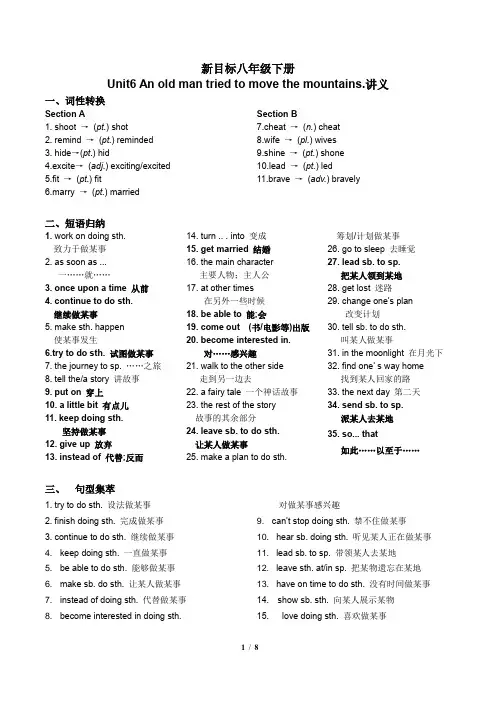
新目标八年级下册Unit6 An old man tried to move the mountains.讲义一、词性转换Section A1. shoot →(pt.) shot2. remind →(pt.) reminded3. hide→(pt.) hid4.excite→(adj.) exciting/excited5.fit →(pt.) fit6.marry →(pt.) married Section B7.cheat →(n.) cheat8.wife →(pl.) wives9.shine →(pt.) shone10.lead →(pt.) led11.brave →(adv.) bravely二、短语归纳1. work on doing sth.致力于做某事2. as soon as ...一……就……3. once upon a time 从前4. continue to do sth.继续做某事5. make sth. happen使某事发生6.try to do sth. 试图做某事7. the journey to sp. ……之旅8. tell the/a story 讲故事9. put on 穿上10. a little bit 有点儿11. keep doing sth.坚持做某事12. give up 放弃13. instead of 代替;反而14. turn .. . into 变成15. get married 结婚16. the main character主要人物;主人公17. at other times在另外一些时候18. be able to 能;会19. come out (书/电影等)出版20. become interested in.对……感兴趣21. walk to the other side走到另一边去22. a fairy tale 一个神话故事23. the rest of the story故事的其余部分24. leave sb. to do sth.让某人做某事25. make a plan to do sth.筹划/计划做某事26. go to sleep 去睡觉27. lead sb. to sp.把某人领到某地28. get lost 迷路29. change one’s plan改变计划30. tell sb. to do sth.叫某人做某事31. in the moonlight 在月光下32. find one’ s way home找到某人回家的路33. the next day 第二天34. send sb. to sp.派某人去某地35. so... that如此……以至于……三、句型集萃1. try to do sth. 设法做某事2. finish doing sth. 完成做某事3. continue to do sth. 继续做某事4. keep doing sth. 一直做某事5. be able to do sth. 能够做某事6. make sb. do sth. 让某人做某事7. instead of doing sth. 代替做某事8. become interested in doing sth.对做某事感兴趣9. can’t stop doing sth. 禁不住做某事10. hear sb. doing sth. 听见某人正在做某事11. lead sb. to sp. 带领某人去某地12. leave sth. at/in sp. 把某物遗忘在某地13. have on time to do sth. 没有时间做某事14. show sb. sth. 向某人展示某物15. love doing sth. 喜欢做某事四、重点句子1. A man told yu Gong that he could never do it. 一个人告诉愚公他绝不可能把山移走。
人教版新目标八年级英语下册全册电子版教案
人教版新目标(新)八年级下册电子教案Unit 1What's the matter?第一课时Section A (1a-2d)1.重点单词:matter,back,sore,throat,stomachache,foot,neck,stomach,fever,lie,rest,cough,Xray,toothache,headache2.重点短语:have a sore throat,have a stomachache,have a cold,lie down,take one's temperature,have a fever,go to a doctor3.重点句式:—What's the matter?—She talked too much yesterday and didn't drink enough water.She has a very sore throat now.You should drink some hot tea with honey.It doesn't sound like you have a fever.You need to take breaks away from the computer.I think I sat in the same way for too long without moving.If your head and neck still hurt tomorrow,then go to a doctor.1.重点短语和句型2.询问对方身体状况的句型及答语询问对方身体状况的句型及答语一、预习课本P1-2新单词并背诵,完成下面的汉译英。
1.问题____________ 2.背部____________3.疼痛的____________ 4.嗓子____________5.胃痛____________ 6.脚____________7.脖子____________ 8.胃____________9.发烧____________ 10.平躺____________11.休息____________ 12.咳嗽____________13.X光____________ 14.牙疼____________15.头疼____________二、认真预习1a-2d找出下列短语和句型。
人教新目标八年级英语下册第6单元教案教学设计
(三)情感态度与价值观
1.情感目标:激发学生对英语学习的兴趣,增强学生的自信心和自主学习意识;培养学生合作、分享、互助的良好品质。
(三)学生小组讨论
1.教学活动:将学生分成若干小组,针对教师提出的问题或情境,进行小组讨论和角色扮演。
2.教学方法:引导学生运用所学知识,进行互动交流,提高学生的合作能力和口语表达能力。
3.教学目标:培养学生团队合作精神,提高学生实际运用英语的能力。
(四)课堂练习
1.教学内容:设计多种形式的练习题,包括听力、口语、阅读和写作,让学生在练习中巩固所学知识。
3.精讲多练,提高效果:在讲解语法知识点时,教师要精讲精练,用简洁明了的语言解释难点,避免冗长的解释。同时,加大学生的课堂练习力度,让学生在练习中掌握知识,提高运用能力。
4.互动交流,提升能力:鼓励学生在课堂上积极互动,开展各种形式的口语练习,如小组讨论、角色扮演、辩论等。同时,加强写作训练,让学生在写作中运用所学知识,提高书面表达能力。
五、作业布置
为了巩固本节课所学知识,提高学生的语言运用能力,特布置以下作业:
1.书面作业:
(1)完成教材第6单元课后练习题,包括填空、选择、改错等,重点加强对现在完成时态和一般过去时态的运用练习。
(2)根据课堂所学,运用频率副词和本单元所学的词汇、短语,写一篇关于自己过去经历的小短文,如:描述一次购物、踢足球、探望祖父母的经历等。
2.口语作业:
(1)与同学进行对话练习,运用所学语法知识,谈论彼此的过去经历,提高口语表达能力。
Unit6 Grammar Focus-4c课件人教版新目标英语八年级下册
3. The mice knew that __u_n_le_s_s_ they helped her make a dress, she would not be able to go to the party.
能将自己变成人。 He can’t _t_u_r_n_ himself __in_t_o_ a person _u_n_l_e_s_s he can __h_id__e his __ta_i_l__.
unless是连词,意为“除非;如果不”, 引导条件状语从句,含有否定意义,相 当于if ... not 。 注意:unless引导条件状语从句时,如果 主句是一般将来时,从句用一般现在时 表将来。如:
The old man told his family that they should all helped him to move the mountains.
Yu Gong said they could put them into the sea because it’s big enough to hold everything.
主语 + 谓语 + so + adj. /adv. + that从句
The boy ran so fast that I couldn’t catch him. He was so angry that he couldn’t say a word.
注意:so 与 that也可连起来写,即: … so that … (以便/为了……),引导目的状语从句
新目标英语八年级下册Unit6课件全 共64页

Li Chen
4 GROUPWORK Make a survey, interview your classmates. Ask them what sports they play .
Name
Sport When started How long
Li Ying basketball 10 years old 5 years
since后可跟句子,句子时态多用一般过去时
I have been waiting for you since I came here.
自到这儿以来我一直在等你。
Yao Ming’s sports life
was born
started playing basketball plays 17 years
用for和since填空
1.They have been learning Chinese _s_in_c_e_ 2. they came to China. 3.2. I haven’t seen her f_o_r___ a long time. 4.3. He has been living heresi_n_c_e__ 2019. 5.4. She has been doing her homeworkfor
Ten yuan.
3. How long has the skating marathon been going?
For five hours.
4. Who was the first to start?
Alison was the first to start.
5. How long has he been skating?
8. When did he start?
新目标八年级英语下册Unit 6教学设计
新目标八年级英语下册 Unit 6 教学设计一、教学目标1.能够听懂关于不同国家的风俗和传统的简单对话。
2.能够通过阅读短文来了解不同国家的风俗和传统。
3.能够用英语描述自己国家的风俗和传统。
4.能够参加小组讨论,表达自己对不同国家文化的观点。
5.能够根据提示写一篇关于自己国家传统的短文。
二、教学重难点1.教学重点:通过听、说、读、写等多种方式了解不同国家的风俗和传统,并表达自己的观点和描述。
2.教学难点:能够运用所学语言知识、句型和词汇描述和讨论不同国家的文化差异。
三、教学准备1.教材:新目标八年级英语下册 Unit 6。
2.多媒体设备。
3.小组讨论的话题和题目。
四、教学过程Step 1 导入新课1.引入新课前,询问学生是否了解过不同国家的风俗和传统。
2.引出本课的主题:不同国家的风俗和传统。
Step 2 预习导学1.让学生观看一段描述中国传统节日的视频,并提问:–What festival is it about?–How do Chinese people celebrate it?2.学生讨论问题并给出答案。
3.教师搜集学生的回答,写在黑板上。
4.提醒学生观察和回答问题时要用英语。
Step 3 新课呈现1.展示一个包含不同国家风俗和传统的幻灯片,并向学生描述每个国家的特点。
2.通过问答的方式与学生互动,引导他们了解不同国家的文化差异。
Step 4 听力训练1.放一段录音,让学生听对话,选择正确的答案。
2.听完录音后,学生与同桌讨论并给出答案。
3.教师与学生核对答案,并给予反馈。
Step 5 阅读训练1.学生阅读一篇关于日本传统节日的短文。
2.学生独立回答与短文相关的问题,并将答案写在答题卡上。
3.教师检查学生的答案,并给予反馈。
Step 6 口语训练1.学生分组进行小组讨论,针对不同国家的风俗和传统进行讨论。
2.教师设定话题并提供问题指导学生讨论,鼓励学生表达个人的观点和看法。
Step 7 写作训练1.学生根据提示写一篇关于自己所在国家传统的短文。
新目标英语八年级下册Unit-6-Section-A-(3a-3c)公开课
The Monkey King has excited the children of China for many years. And as soon as the TV program came out more than 30 years ago. Western children became interested in reading this story because the clever Monkey King keeps fighting to help the weak and never gives up.
Do you want to be the Monkey King? Why or why not?
• Be brave,
• Keep fighting to help the weak and never give up!
Level A:1、Finish off the exercises in the workbook.
magic stick
wonderful make the stick help the weak big or small
so …. that hide it in his ear
….
fight bad turn himself into people unless….
as soon as
children all over the world
C. Western children are also becoming interested in the story of the Monkey King .
Scanning 细读
(Para.1)
1、What happened in November 1979?
人教新目标版八年级英语下册unit6SectionA(1a2d)教学设计
5.口语表达:设计角色扮演、小组讨论等活动,鼓励学生运用所学时态表达个人经历和感受,提高口语表达能力。
6.写作实践:让学生根据课堂所学,撰写一篇关于自己或他人梦想的小短文,运用一般过去时和现在完成时,巩固所学知识。
2.过程与方法方面:重点在于培养学生的听力策略,如预测、关键词识别等,以提高学生在实际语境中的听力理解能力。难点在于如何引导学生有效地运用阅读策略,如扫读和精读,以快速获取文章主旨和细节信息。
3.情感态度与价值观方面:重点在于激发学生对梦想的追求,并培养学生面对困难时的积极态度。难点在于如何通过教学活动,让学生内化这些价值观,并将其转化为实际行动。
2.学生能够理解并运用一般过去时和现在完成时描述过去发生的事情,以及过去的事情对现在造成的影响。
3.学生能够通过听力训练,提高获取关键信息的能力,如:理解人物的经历、梦想和成就等。
4.学生能够在阅读过程中,运用阅读策略(如:预测、扫读、精读等)获取文章大意,提高阅读理解能力。
(二)过程与方法
1.通过小组合作、讨论、分享等形式,培养学生合作学习的能力和口语表达能力。
4.学生互相批改作文,分享优秀作品,教师给予点评和指导。
(五)总结归纳(500字)
1.教师引导学生回顾本节课所学内容,总结一般过去时和现在完成时的用法。
2.学生分享学习心得,讨论如何将所学知识应用到实际生活中。
3.教师强调梦想的重要性,鼓励学生为实现梦想而努力奋斗,面对困难时保持积极态度。
4.教师布置课后作业,要求学生运用所学知识,撰写一篇关于梦想的短文,巩固课堂所学。
八年级英语下册Unit6Anoldmantriedtomovethemountains教案新版人教新目标版
Unit 6 An old man tried to moved the mountains.Section A 1 (1a-2d)一、教学目标:1. 语言知识目标:1) 能掌握以下单词:remind, bit, silly, instead of能掌握以下句型:① How does the story begin?② What happened next?③ What do you think of the story of Yu Gong?④ What could Yu G ong do instead of moving the mountains?2) 能够用英语询问故事的开始、发展及后续等。
能够对故事中的人物或情节发表一些简单的看法或观点。
2. 情感态度价值观目标:学习愚公,要学习他“主动挖山”的精神。
在我们生活工作中存在着很多的“山”。
在这些山的面前我们应该采取怎样的态度对待它?是通过“搬家”来避开它或找领导请求帮助;还是像愚公一样明知困难却迎难而上,凭借自己的力量勇敢的克服困难。
愚公不畏艰险,不怕困难,勇敢面对的精神,正是值得我们所学习的。
二、教学重难点1. 教学重点:1) 掌握本课时中出现的生词:remind, bit, silly, instead of;2) 学会询问故事发展的基本句型:How does the story begin?What happened next?3) 学会表达故事中的人物或情节,并发表一些简单的看法或观点。
What do you think of / about the story of Yu Gong?I think it’s a little bit silly.I still don’t agree with you.2. 教学难点:学会表达故事中的人物或情节,并发表一些简单的看法或观点。
三、教学过程1. 播放动画片《寓公移山》的视频,导入本单元主题。