
2014八年级上册英语Units1-5单元知识点归纳
大多数形容词和副词有三个等级: 1)原级(不作比较),修饰词 very,so,too,pretty,really; 2)比较级,表示“较……”或“更……”的意思(两 者之间进行比较), 标志词than,A or B,of the two, 修饰词much,a lot,a little; 3)最高级,表示“最……”的意思(三者或三者以 上作比较),形容词最高级前面一般要加定冠词 the,后面可带in(of)短语来什么比较的范围。
help with housework帮助做家务 be free有空 on weekends在周末 how often多久一次 hardly ever几乎从不 swing dance摇摆舞 once a week每周一次 twice a month每月两次 every day每天 go to the movies去看电影 use the Internet用互联网 play tennis打网球 stay up late熬夜;睡得很晚 at least至少 have dance and piano lessons上舞蹈课和钢琴课 go to bed early早点睡觉play sports进行体育活动 be good for对……有好处 go camping去野营 not…at all一点儿也不…… in one’s free time在 某人的业余时间 the most popular最受欢迎的
5、…数量 + 比较级 than … My father is three years older than my mother. 6、比较级+ and + 比较级, “越来越…” Now it is hotter and hotter. 现在越来越热 7、The + 比较级…,the + 比较级… “越…,就越…” The more , the better. 越多越好。 The more you eat, the fatter you will become. 你吃得越多,你就越容易变胖 注: Tom is the tallest boy in his class. =Tom is taller than any other boy in his class. =Tom is taller than the other boys in his class.
the next day第二天 drink tea喝茶 find out找出;查明 go on继续 take photos照相 something important重要的事 up and down上上下下 come up出来 buy sth. for sb. / buy sb. sth.为某人买某物 taste + adj. 尝起来…… look+adj. 看起来…… nothing…but+动词原形 除了…之外什么都没有 seem+(to be)+ adj. 看起来…… arrive in+大地点 / arrive at+小地点 到达某地 decide to do sth.决定去做某事 try doing sth.尝试做某事 try to do sth.尽力去做某事
such as比如;诸如 old habits die hard积习难改 go to the dentist去看牙医 morn than多于;超过 less than少于 help sb. with sth.帮助某人做某事 How about…? ......怎么样?/ ……好不好? want sb. to do sth.想让某人做某事 How many+可数名词复数+一般疑问句? …有多少…? 主语+find+that从句. ……发现…… spend time with sb.和某人一起度过时光 It’s+ adj.+ to do sth. 做某事的……的。 ask sb. about sth.向某人询问某事 by doing sth. 通过做某事 What’s your favorite……?你最喜爱的……是什么? the best way to do sth.做某事的最好方式
一、规则变化:
1、一般直接在词尾加er; est tall—taller--tallest light—lighter--lightest 2、以字母e结尾的直接加r; stnice—nicer—nicest fine—finer—finest 3、以辅音字母加y结尾的形容词,要变y为i再加er; est heavy—heavier—heaviest busy—busier--busiest 4、以重读闭音节结尾且末尾只有一个辅音字母的形容词,要双写 末尾的辅音字母再加er; est thin—thinner--thinnest hot—hotter—hottest big—bigger—biggest (注:双写必须同时符合以下条件a.以辅音字母+元音字母+辅音 字母 结尾;b.中间的元音字母发单元音;c. 重读闭音。一般满足前 两个条件多为双写的词) 5、多音节形容词或部分双音节形容词变比较级在前面加more,最 高级在前加most beautiful—more beautiful—most beautiful important—more important—most beautiful
注:older 一般指年龄大小; My father is older than my mother. elder指长幼关系(一般修饰名词作定语); My elder brother is a driver. farther指距离更远; further指抽像的. I want to study English further. further reading
be good at擅长…… be good with善于与…相处 have fun doing sth.享受做某事的乐趣 be good at doing sth擅长做某事 make sb. do sth.让某人做某事 want to do sth.想要做某事 as+adj./adv.的原级+as 与……一样…… It’s+ adj.+for sb. to do sth. 对某人来说,做某 事……的。
take…seriously认真对待 give sb. sth.给某人某物 come true(梦想、希望)实现;达到 Can I ask you some…?我能问你一些……吗 How do you like…?你认为……怎么样? Thanks for doing sth.因做某事而感谢。 What do you think of…?你认为……怎么样? much+ adj./adv.的比较级 ……得多 watch sb. do sth.观看某人做某事 play a role in doing sth.发挥做某事是作用/在做 某事方面扮演重要的角色 one of&、两者之间的比较,句中有明显的标志词than Tom is taller than John 2、Which/Who is + 比较级, A or B ? Which is easier, maths or English? 3、能修饰比较级的副词及短:much(…的多)、 a lot(…的 多)、even(更…)、still(更…)、a bit(…一点儿) This city is much more beautiful than that one Today is even hotter than yesterday. 4、… is the +比较级 + of the two. Tom is the taller of the two boys. 汤姆是这两个男孩中 最高
one of……之一 look like看起来像 around the world全世界 a symbol of……的象征 let sb. do sth.让某人做某事 plan to do sth.计划/打算做某事 hope to do sth.希望做某事 happen to do sth.碰巧做某事 expect to do sth.盼望做某事 How about doing…?做……怎么样? be ready to do sth.乐于做某事 try one’s best to do sth.尽力做某事
think of认为 learn from从…获得;向…学习 find out查明;弄清楚 talk show谈话节目 game show游戏节目 soap opera肥皂剧 go on发生 watch a movie看电影 a pair of一双;一对 one day有一天 try one’s best尽某人最大努力 such as例如 as famous as与…一样有名 dress up打扮;梳理 have a discussion about就……讨论 take sb.’s place代替;替换 do a good job干得好 something enjoyable令人愉快的东西 interesting information有趣的资料
forget doing sth.忘记做过某事 forget to do sth.忘记做某事 enjoy doing sth.喜欢做某事 want to do sth.想去做某事 start doing sth.开始做某事 stop doing sth. 停止做某事 dislike doing sth. 不喜欢做某事 keep doing sth.继续做某事 Why not do. sth.?为什么不做……呢? so+adj.+that+从句 如此……以至于…… tell sb. (not) to do sth. 告诉某人(不要)做某事
Unit1 Where did you go on vacation?
go on vacation去度假 stay at home待在家里 go to the mountains去爬山 quite a few相当多 go to the beach去海滩 go out出去 visit museums 参观博物馆 of course当然 go to summer camp去参观夏令营 study for为……而学习 taste good尝起来很好吃 most of the time大部分时间 go shopping去购物 have a good time玩得高兴 in the past在过去 feel like给…的感觉\感受到 walk around四处走走 because of因为 one bowl of… 一碗……
Units 1---5 复习( 课件)-2024-2025学年人教版英语八年级
Review the words of unit 1
任务一:我指你说
anyone
everyone someone bird
umbrella
anywhere of course diary
bicycle wet
wonderful myself enjoyable building because of
戏院;剧场 (n.) 使人舒服的;舒适的 (adj.) 座位;坐处(如椅子等) (n.) 银幕;屏幕 (n.) (在空间、时间上)接近 (adj.) 票;入场券 (n.)
worst 最差(的);最坏(的);最糟(的) (adj.& adv.) cheaply 便宜地;低廉地 (adv.)
song 歌;歌曲 (n.) choose 选择;挑选 (v.) carefully 细致地;小心地;谨慎地 (adv.) reporter 记者 (n.)
few
yourself activity trader
below
quite a few hen
decide
wonder enough
most
pig
try
difference hungry
something seem
paragliding top
as
noting
bored feel like wait
hill
review the grammar 一、一般过去时
一.概念:表示过去发生的动作,常与过去状语连用。 for example:yesterday, the day before yesterday,last week,three days ago,just now
八上英语unit1-unit5知识点总结

八年级上册英语语法、短语和知识点总结Unit 1 Where did you go on vacation?本单元的话题:谈论假期活动内容,复习一般过去时。
本单元的语法:1.复习一般过去时;2.学习不定代词和不定副词的用法。
1.本单元出现的动词不规则过去式有:is\am--was是 are -- were是 go--went去 buy—bought买 take --took拿走do\does—did feed—fed喂 see—saw 看见 eat—ate吃 have\has—had 有,吃feel—felt感觉 ride—rode骑 get—got到达,得到 can—could 能,会forget—forgot忘记 drink—drank喝 find—found找到2.不定代词和不定副词的用法:some bodyany oneevery thingno where(疑问副词)不定代词和不定副词(1)左边的some、any、every、no与右边的body、one、thing构成不定代词,some、any、every、no与右边的疑问副词where构成不定副词;(2)一般情况下以some开头的不定代词和不定副词用于肯定句,以any开头的不定代词和不定副词用于否定句、疑问句;以no开头的不定代词和不定副词表示否定含义(no one为两个单词);(3)不定代词或不定副词和形容词连用时,形容词放在后面。
He has something important to do.他有重要的事情要做。
(肯定句用something,形容词important放后)Did you buy anything special? (一般疑问句用anything,形容词special放后)Did you go anywhere interesting last month?上个月你去令人感兴趣的地方了吗?(一般疑问句用不定副词anywhere,形容词interesting放后)(4)不定代词和不定副词做主语时,后面的动词用单数形式。
八年级英语上册1-5
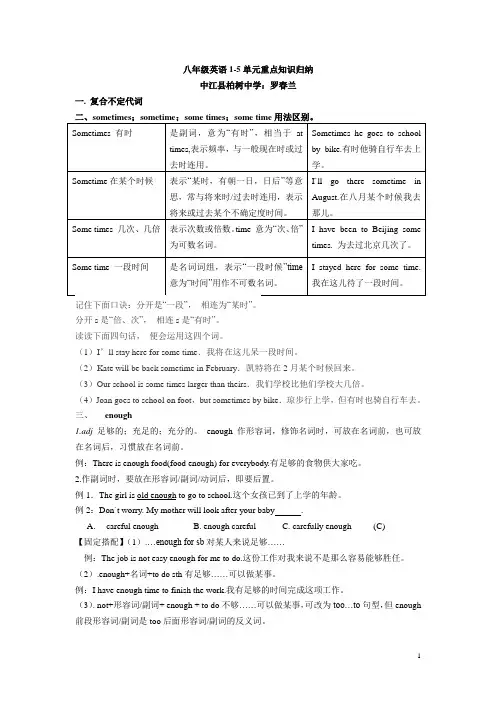
八年级英语1-5单元重点知识归纳中江县柏树中学:罗春兰一.复合不定代词三、enough1.adj足够的;充足的;充分的。
enough作形容词,修饰名词时,可放在名词前,也可放在名词后,习惯放在名词前。
例:There is enough food(food enough) for everybody.有足够的食物供大家吃。
2.作副词时,要放在形容词/副词/动词后,即要后置。
例1.The girl is old enough to go to school.这个女孩已到了上学的年龄。
例2:Don`t worry. My mother will look after your baby .A.careful enoughB. enough carefulC. carefully enough (C)【固定搭配】(1).…enough for sb对某人来说足够……例:The job is not easy enough for me to do.这份工作对我来说不是那么容易能够胜任。
(2).enough+名词+to do sth有足够……可以做某事。
例:I have enough time to finish the work.我有足够的时间完成这项工作。
(3). not+形容词/副词+ enough + to do不够……可以做某事,可改为too…to句型,但enough 前段形容词/副词是too后面形容词/副词的反义词。
例:The book isn`t easy enough for me to read.=The book is too difficult for me to read. 这本书太难了,为看不懂。
四、hard; hardly1.hard既可作形容词又可作副词。
Hard作形容词时,意为“困难的,硬度,勤奋的,严厉的,苛刻的”;作副词时,意为“努力的,猛烈的,剧烈的”。
例:This ground is too hard to dig.这块地太硬,挖不动。
2014版新目标英语八年级英语上册_Units1-10单元知识点期末复习总结打印_(新版)
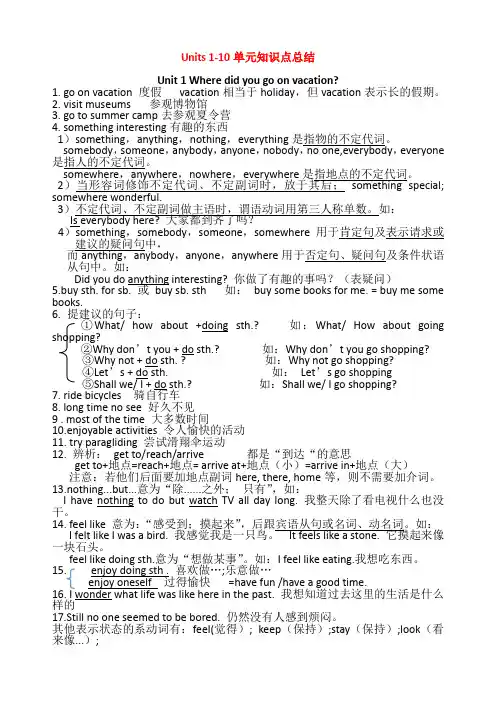
Units 1-10单元知识点总结Unit 1 Where did you go on vacation?1. go on vacation 度假vacation相当于holiday,但vacation表示长的假期。
2. visit museums 参观博物馆3. go to summer camp去参观夏令营4. something interesting有趣的东西1)something,anything,nothing,everything是指物的不定代词。
somebody,someone,anybody,anyone,nobody,no one,everybody,everyone 是指人的不定代词。
somewhere,anywhere,nowhere,everywhere是指地点的不定代词。
2)当形容词修饰不定代词、不定副词时,放于其后;something special; somewhere wonderful.3)不定代词、不定副词做主语时,谓语动词用第三人称单数。
如:Is everybody here? 大家都到齐了吗?4)something,somebody,someone,somewhere用于肯定句及表示请求或建议的疑问句中,而anything,anybody,anyone,anywhere用于否定句、疑问句及条件状语从句中。
如:Did you do anything interesting? 你做了有趣的事吗?(表疑问)5.buy sth. for sb. 或buy sb. sth 如:buy some books for me. = buy me some books.6.提建议的句子:①What/ how about +doing sth.? 如:What/ How about going shopping?②Why don’t you + do sth.? 如:Why don’t you go shopping?③Why not + do sth. ? 如:Why not go shopping?④Let’s + do sth. 如:Let’s go shopping⑤Shall we/ I + do sth.? 如:Shall we/ I go shopping?7. ride bicycles 骑自行车8. long time no see 好久不见9 . most of the time 大多数时间10.enjoyable activities 令人愉快的活动11. try paragliding 尝试滑翔伞运动12. 辨析:get to/reach/arrive 都是“到达“的意思get to+地点=reach+地点= arrive at+地点(小)=arrive in+地点(大)注意:若他们后面要加地点副词here, there, home等,则不需要加介词。
unit1-5八年级上册英语知识点总结

9/25/2014
• • • • • • • • •
Section B 1.activity → (pl.) activities 2.decide → (n.) decision 3.try → (pt.) tried 4.bike → (同义词) bicycle 5.build → (n.) building 6.difference → (adj.) different 7.like → (反义词) dislike 8.below → (反义词) above
9/25/2014
Self Check
1.go to the countryside 去乡下 2.in the shopping center 在购物中心 3.have a fun time 玩得高兴;过得愉快 4.after three hours 三个小时以后 5.keep going 一直走 6.twenty minutes later 20分钟后
9/25/2014
(2)修饰不定代词something, anyone等的词要 放在不定代词的后面。 例如: Did you meet anyone interesting? 你遇见有趣的人了吗?
【注意】这些不定代词作主语时看作单数, 谓语动词用单数形式。 例如: Everyone was on vacation. 所有的人都在度假。
Did he buy you a book? Please get some bread for me.
9/25/2014
· 练一练 3·
11.My brother bought me a new bike yesterday.(同义句转换) My brother ________ a new bike ________ me yesterday. 12.Did Tom buy a big house for his parents? (同义句转换) Did Tom ________ ________ ________ a big house? 13.Please get me some tea. (同义句转换) Please ________ some tea ________ me. 14.I bought a gift a for my daughter.(改为否定句) I ________ ________ a gift for my daughter. 15.—When ________ you ________ the bike? —Last month. A.have,bought B.had, bought C.do, buy D.did, buy
八年级上册英语123单元知识点

八年级上册英语123单元知识点Unit 1 Where did you go on vacation?一、重点单词。
1. anyone.- 用法:不定代词,意为“任何人”,常用于疑问句和否定句中。
例如:Did you meet anyone interesting on your vacation?(你在假期中遇到有趣的人了吗?)2. anywhere?- 用法:副词,意为“在任何地方;到任何地方”,常用于疑问句和否定句中。
例如:I can't find my keys anywhere.(我到处都找不到我的钥匙。
)3. wonderful.- 词性:形容词,意为“精彩的;绝妙的”。
例如:We had a wonderful time at the party.(我们在聚会上玩得很开心。
)4. few.- 用法:形容词,意为“不多;很少”,修饰可数名词复数,表示否定意义。
例如:There are few students in the classroom.(教室里几乎没有学生。
)- 对比:a few表示“一些;几个”,表示肯定意义。
例如:There are a few apples on the table.(桌子上有几个苹果。
)5. most.- 用法:- 形容词,意为“最多的;大多数的”。
例如:Most students like English.(大多数学生喜欢英语。
)- 副词,意为“最;非常”。
例如:This is the most beautiful flower in the garden.(这是花园里最漂亮的花。
)二、重点短语。
1. go on vacation.- 含义:去度假。
例如:They went on vacation last month.(他们上个月去度假了。
)2. stay at home.- 含义:待在家里。
例如:I stayed at home and watched TV yesterday.(我昨天待在家里看电视了。
Units1-5单元重要知识点汇总暑假预习2023-2024学年人教版八年级英语上册
8年级上册1---5单元重要知识点汇总Unit 1 Where did you go on vacation?1.一般过去时的特殊疑问句及其回答教材原文—Where did you go on vacation?你去哪里度假了?—I went to the mountains.我去山里了。
问句是一般过去时的特殊疑问句,其结构为:特殊疑问词+did+主语+动词原形+其他?其中did是助动词,其后的动词要用原形。
如:—What did you do yesterday afternoon?你昨天下午干什么了?—I played tennis with my friend.我和我的朋友一起打网球了。
2.anywhere的用法教材原文Oh, did you go anywhere interesting?哦,你去什么有趣的地方了吗? anywhere:副词,意为“任何地方;无论何处”,常用于否定句、疑问句和条件状语从句中与修饰语连用时,修饰语要置于anywhere之后somewhere:意为“某个地方”,常用于肯定句,与修饰语连用时,修饰语要置于somewhere之后everywhere:表示“到处;处处”,常用于肯定句nowhere:表示“不在任何地方;任何地方都不”,相当于not anywhereI cannot find it anywhere.我在什么地方都没找到它。
Are you going anywhere tonight?今晚你要去什么地方吗?If you go anywhere, take me with you.你要是去什么地方,带我和你一起去。
I remember seeing him somewhere.我记得在哪儿见过他。
You can go anywhere interesting if you want.如果你想,你可以去任何有趣的地方。
3.How is/was...?句型的用法教材原文How was your vacation?你的假期怎么样?How is/was...?意为“……怎么样?”,是一个表达问候的句型。
【配套K12】人教版八年级英语上册 unit1--5 知识点
人教版八年级英语上册 unit1--5 知识点人教版八年级上册英语知识点Unit1 Where did you go on vacation 1. go on vacation 去度假at home 待在家里to the mountains 去爬山 4. go to the beach 5. visit museums 6. go to summer camp a few for out of the time 11. taste good a good time 13. of course like shopping the past 17. walk around 18. because of 19. one bowl of…去海滩参观博物馆去参加夏令营相当多为……而学习出去大部分时间尝起来很好吃玩得高兴当然给……的感觉;感受到去购物在过去四处走走因为一碗……20. the next day 第二天 21. drink tea 喝茶22. find out 找出;查明 23. go on 继续 photos 照相 25. something important 重要的事26. up and down 上上下下27. xxe up 出来 28. buy sth. for sb. / buy sb. sth. 为某人买某物29. taste + adj.尝起来……30. look+adj. 看起来………but+动词原形除了……之外什么都没有 ++ adj. 看起来…… 33. arrive in+大地点 / arrive at+小地点到达某地 to do sth. 决定去做某事 35. try doing sth. 尝试做某事 / 36. try to do sth. 尽力去做某事37. forget doing sth. 忘记做过某事/ 38. forget to do sth. 忘记做某事 39. enjoy doing sth. 喜欢做某事 40. want to do sth. 想去做某事41. start doing sth. 开始做某事 42. stop doing sth. 停止做某事 43. dislike doing sth. 不喜欢做某事 44. keep doing sth. 继续做某事 45. Why not do. sth.为什么不做……呢?46. so+adj.+that+从句如此……以至于…… 47. tell sb. (not) to do sth. 告诉某人做某事Unit2 How often do you exercise1 help with housework帮助做家务2 on weekends 在周末3 how often 多久一次4 hardly ever 几乎从不5 once a week 每周一次6 twice a month 每月两次7 every day 每天8 be free 有空9 go to the movies 去看电影 10 use the Internet 用互联网 11 swing dance 摇摆舞 12 play tennis 打网球13 stay up late 熬夜;睡得很晚14 at least 至少15 have dance and piano lessons 上舞蹈课和钢琴课 16 go to bed early 早点睡觉 17 play sports 进行体育活动 18 be good for 对……有好处 19 go camping 去野营20 not…at all 一点儿也不…… 21 in one’s free time 在某人的业余时间22 the most popular 最受欢迎的 23 such as 比如;诸如24 old habits die hard 积习难改25 go to the dentist 去看牙医26 morn than 多于;超过27 less than 少于28 help sb. with sth. 帮助某人做某事29 How about…......怎么样?/ ……好不好? 30 want sb. to do sth. 想让某人做某事31 How many+可数名词复数+一般疑问句?……有多少…… 32 主语+find+that从句. ……发现……33 spend time with sb. 和某人一起度过时光 34 It’s+ adj.+ to do sth. 做某事的……的。
人教版八年级英语上册Unit1-5知识点总结
Unit1 Where did you go on vacation?短语归纳1.go on vacation去度假2.stay at home待在家里3.go to the mountains去爬山4.go to the beach去海滩5.visit museums 参观博物馆6.go to summer camp去参加夏令营7.quite a few相当多8.study for tests为测验而学习9.go out出去10.most of the time大部分时间11.have a good time doing=have fun doing =enjoy oneself玩得高兴12.of course=sure =certainly当然13.feel like给……的感觉;感受到14.go shopping去购物15.in the past在过去16.walk around四处走走17.because of+名词短语:因为 because+句子18. a/one bowl of… 一碗……19. the next day第二天20.drink tea喝茶21.find out找出;查明22.go on继续23.take photos照相24.something important重要的事25.up and down上上下下e up出来 come out 出版发行27.go out with anyone 跟别人出去28.say about 发表对…看法29.rain hard 雨下得大30.too much+不可数名词太多too many+可数名词复数太多much too+形容词太用法:1.buy sth. for sb. / buy sb. sth.为某人买某物2.taste / look/sound/smell good. 尝起来/看起来/听起来/闻起来不错3.nothing…but+动词原形除了……之外什么都没有4.seem+(to be)+ adj. 看起来……5.arrive in+大地点 / arrive at+小地点 /get to +地点/reach +地点到达某地6.decide to do sth.决定去做某事7.try doing sth.尝试做某事 / try to do sth.尽力去做某事8.forget doing sth.忘记做过某事/ forget to do sth.忘记做某事9.enjoy doing sth.喜欢做某事10. want to do sth.想去做某事11.start doing sth.开始做某事12.stop doing sth. 停止做某事13.dislike doing sth. 不喜欢做某事14.keep doing sth.继续做某事 keep on doing sth 不停做某事15.Why not do. sth.=why don’t you do sth为什么不做……呢?16.so+adj.+that+从句如此……以至于……17.tell sb. (not) to do sth. 告诉某人(不要)做某事18.enough +名词,形容词+enough19.not really .真的没有。
八年级上册英语各章知识点
八年级上册英语各章知识点八年级上册英语共分为八章,分别为Unit 1 My name’s Gina、Unit 2 How do you spend your day、Unit 3 I’m more outgoing thanmy sister、Unit 4 Where’s my backpack、Unit 5 Do you want to watch a game show、Unit 6 I’m going to study computer science、Unit 7 What’s the highest mountain in the world、Unit 8 Have youread Treasure Island?在Unit 1中,我们学习了介绍自己和他人的基本语言表达方式,例如问候语、自我介绍以及问他人职业等。
同时,这个单元也涉及了一些简单的句子构成和词汇记忆,如名词、动词、形容词等。
在Unit 2中,我们学习了日常生活中的时间表达方式和活动。
包括但不限于时间点、时间段、天气、体育活动、音乐、电视和动漫等。
同时,学习了一些疑问词和句型,如何询问他人的生活日程和活动安排。
在Unit 3中,我们学习了比较级和最高级的用法,以及提升自我表达的内容。
在写作方面,学习了如何写自我介绍和描述身体特征、性格特点等内容的表达方式。
在Unit 4中,我们学习了空间定位和方向指引,涉及到日常生活的方位词,如在、上、下、前、后、左、右等。
同时学习了询问物品位置和给出方向指引的句型。
在Unit 5中,我们学习了电视节目和相关的语言表达方式,如看电视的频率、频道、电视节目大纲等。
同时学习了询问他人观看电视节目喜好和推荐节目的方式。
在Unit 6中,我们学习了关于职业、未来规划和学科相关的语言表达方式。
同时学习了一些时间状语和将来时态的表达方式,以及一些偏重于学术方面的术语。
在Unit 7中,我们学习了地理方面的知识,如世界地图、城市分布、山脉、河流、湖泊等。