
北师大版小学英语四下说课稿2
Lesson 4模版
尊敬的各位评委老师,大家好,我是…号考生。
今天,我说课的题目是北师大版小学英语四年级下册Unit7 At the restaurant Lesson4 Have a Try。
下面我将从4个方面阐述我的教学设计:统全局,说教材;悟课标,说教法;重学情,说学法;求创新,说教学流程。
一、统全局说教材。
首先我们来进行教材分析
本课的话题是食物。
要求学生围绕食物单词,在一定的情景下正确运用What do you like?I like ……. 询问和回答对食物的喜好。
通过活动培养学生的英语交流能力。
本课既承接三年级蔬菜、水果的话题,又为下一课时的学习奠定基础,起到承前启后的作用。
:
、French fries
询问别人或说明自己对食物的喜好,能跟随录音跟唱歌谣,能仿照范例,书写句子。
ⅱ过程与方法目标:能在听说玩演的活动中采用自主、合作、探究的学习方式巩固所学知识。
ⅲ情感态度和价值观目标:通过学习,渗透不挑食的习惯的养成教育。
激发英语学习兴趣。
通过教学目标,我们不难发现:
本节课的重点在于引导学生掌握what do you like?I like……句型;并运用在日常交际中;
难点在于询问别人对食物的喜好.
二、悟课标说教法。
新课标指出英语教学应创造性的设计贴近学生实际的教学活动。
本节课我将遵循激导探放的原则,关注学生的个性发展,主要采用任务型教学法,结合歌曲导入法、游戏教学法、情景表演法等来突破重难点,完成学习任务。
三、重学情说学法。
学生是学习的主人,我所面对的四年级学生,他们活泼好动,但是有意注意不够集中,因此让学生通过唱一唱、猜一猜、说一说、演一演的方式来激发兴趣;运用模仿跟读法、游戏互动法将教为主导、学为主体真正落到实处。
四、求创新说教学流程。
本节课将通过情景导入----新知呈现----游戏操练----巩固运用---总结评价,这五大环节完成教学任务。
环节一,歌曲绘画导情境
①歌曲热身T:Hello,boys and girls,let’s sing a song learned in L2.
《I like chicken》
②简笔画导入T: “B and G, look, what’s this?” Good!it’s ice cream.
T: Do you like it? We are going to learned U7 L4
此环节以歌曲热身,以简笔画导入,配合动作,师生互动,拉近距离,营造一种课伊始、趣亦生的氛围。
环节二,温故学习呈新知
Part 1、1 Review
1.Retell the story
根据关键词,在故事插图的帮助下引导学生一起复述故事,为后续的表演做铺垫。
2.words practice
设置学生点餐情景,T:here is the menu,what do you like?
通过问学生喜好的食物巩固食物单词:bread, hamburger, fried rice, French fries等。
注意锻炼学生拼读能力:根据单词音、义、形来的不同,渗透自然拼读法。
同时还要注意拼写能力
T: B and G, How to spell dumplings? Fingers up, follow me!
2. Sentence drill
A:I like fruit,what do you like?
B:I like bread.
A:Do you like chicken?
B:No, I don’t. (通过沙场大点兵的游戏鼓励学生询问别人喜欢的食物)
我觉得单词教学要注重语境,做到词不离句。
在这段教学中,让学生在理解小对话的基础上,将新授单词替换原有对话,采用pair work、group work等形式一问一答不断操练
Part 3 Trace and Write
1、learn to say
2、trace and write
3、read and check
环节三,趣味闯关多运用
设置2个闯关活动
第一关:sharp eyes 火眼金睛我能行
利用多媒体课件快闪功能,让学生找出消失的单词。
第二关:I do you guess 我来比划你来猜
教师做动作,学生猜相应的单词。
本环节以游戏激趣,重视学生体验参与。
让学生在学中玩,玩中学。
环节四,情境表演常操练PPT呈现麦当劳背景
T:I’m a waitress of M,here’s the menu. What do you like?
T: now who want to be the waiter/waitress? Let’s make a dialogue.
请几组学生展示表演,鼓励学生在生活情境中灵活运用,达到学以致用的目的。
环节五,欢乐歌谣巧总结
Let’s chant.
T:look at this pic on pageX, what can you see? What is the chant about?
本环节以chant的形式来复习总结,将学生的学习热情推向了又一个高潮。
布置作业,余音绕梁:制作一个英文菜单
课已经结束了,但思考还在延伸。
在整个教学过程中,我始终站在一个引导者、组织者、合作者、促进者的位置上,帮助鼓励学生,注重全体参与和个别展示相结合。
为学生营造了良好的英语氛围。
我的说课到处结束,thank you so much!。
北师大版小学四年级英语下册《Uncle Jack’s farm》说课稿
北师大版小学四年级英语下册《Uncle Jack’s farm》说课稿一、教材分析1. 教材背景《Uncle Jack’s farm》是北师大版小学四年级英语下册的教材。
本册教材主要围绕一个农场中发生的故事展开,通过生动有趣的内容,培养学生的英语听、说、读、写的能力,同时增加对农场生活的了解。
2. 教材结构本册教材共分为8个单元,每个单元都有一个故事情节,并围绕此情节安排了听、说、读、写等活动。
通过逐渐增加的难度,帮助学生巩固和提高英语能力。
3. 教材特点•以情境教学为核心,生动有趣的情节激发学生学习英语的兴趣•强调听、说、读、写的综合训练,注重口语交际能力的发展•增加对农场生活、动植物等内容的了解,拓展学生的知识面二、教学目标1. 知识与能力目标•能够理解和运用本单元的重点词汇和句型•能够准确朗读教材内容,表达自己的意思•能够听懂并正确回答与故事情节相关的问题•能够正确书写和拼读单词和短语2. 情感与态度目标•培养学生的学习兴趣,提高对英语学习的自信心•培养学生合作学习的意识,提高团队合作能力•培养学生对农场生活和动植物的兴趣,增加对自然界的关注三、教学重点和难点1. 教学重点•掌握本单元的重点词汇,如farm, animals, vegetables等•训练学生的听力理解能力,能够听懂并回答与故事情节相关的问题•提高学生的口语表达能力,运用所学内容进行简单的对话2. 教学难点•学生对于新学词汇的掌握和运用能力•学生在听力理解和口语表达方面的听说能力提高四、教学准备•教材:《Uncle Jack’s farm》教材本•多媒体设备:投影仪、音响等五、教学过程1. 导入新课•向学生展示教材上本单元的故事情节,引起学生的兴趣2. 新课讲解2.1 重点词汇讲解•通过幻灯片或黑板等方式展示本单元的重点词汇,逐一讲解和示范发音2.2 故事情节讲解•具体讲解故事情节,注重对关键词汇、短语和句型的讲解和演示3. 听力训练3.1 听音选图•播放教材录音,要求学生根据听到的内容选择正确的图片3.2 听音回答问题•播放教材录音,要求学生听懂内容并回答相关问题4. 口语练习4.1 对话练习•学生分成小组,根据教材中的对话内容进行练习,鼓励学生运用所学句型进行对话4.2 角色扮演•学生按照教材中的角色扮演情节,通过对话展示所学内容5. 书写训练•引导学生书写教材中的关键词汇和句子,通过操练提高书写能力6. 小结与反馈•对本课的重点内容进行小结,并针对学生的表现给予相应的反馈和鼓励六、板书设计重点词汇:- farm- animals- vegetables句型:- What's on the farm?- There are...- What does Uncle Jack do?- He...七、教学反思通过本课的教学实施,学生在听、说、读、写各个方面都得到了一定的提高。
北师大版小学四年级英语下册说课稿
北师大版小学四年级英语下册说课稿一、教材分析教材特点- 本教材是北师大版小学四年级英语下册,共计10个单元,内容丰富有趣。
- 教材注重培养学生的英语交流能力,注重听、说、读、写等多种能力的培养。
- 教材内容结合生活实际,具有很强的实用性,能够激发学生研究英语的兴趣。
本节课的位置和重要性- 本节课是第五单元的第一课,介绍了今天的日期,以及如何用英语表达星期几。
- 掌握这一知识点对于学生来说是非常重要的,能够帮助他们更好地了解世界的运行规律,同时能够提高他们的语言表达能力。
二、教学目标知识目标- 能够听、说、读、写并理解今天的日期和星期几的表达方式。
- 能够用英语回答有关日期和星期几的问题。
能力目标- 能够与他人进行简单的日期和星期几的交流。
情感目标- 培养学生对英语研究的兴趣和积极参与的态度。
三、教学重难点教学重点- 掌握今天的日期和星期几的表达方式。
- 运用所学知识进行简单的交流。
教学难点- 听懂他人关于日期和星期几的问句,并能够用英语回答。
四、教学准备- 教材课件和教学素材- 指示卡片和图片- 课堂游戏道具五、教学过程1. 导入新课- 通过展示卡片和图片,引导学生回忆上一单元所学内容,并温数字和星期的表达方式。
2. 新课讲解- 向学生介绍今天的日期,并教授如何用英语表达今天是星期几。
- 利用教材课件进行语音、语调的示范,并引导学生跟读和模仿。
3. 听力训练- 播放听力材料,要求学生听懂句子中关于日期和星期几的信息,并完成相应的练。
4. 口语练- 通过小组合作的形式,让学生分角色进行对话练,互相问答有关日期和星期几的问题。
5. 游戏活动- 利用课堂游戏道具,设计一些互动游戏,让学生在愉快的氛围中巩固所学内容。
6. 巩固训练- 布置相关练作业,要求学生用英语描述明天的日期,并写出星期几。
六、板书设计Today is [日期]. It's [星期几].七、课堂总结- 通过本节课的研究,学生掌握了表达日期和星期几的基本方式,并能够进行简单的交流。
北师大版四年级下册英语教案
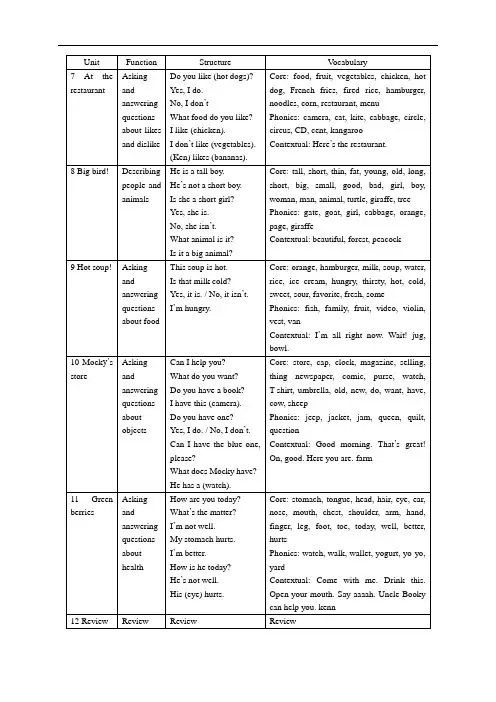
Unit Function Structure Vocabulary7 At the restaurant Askingandansweringquestionsabout likesand dislikeDo you like (hot dogs)?Yes, I do.No, I don’tWhat food do you like?I like (chicken).I don’t like (vegetables).(Ken) likes (bananas).Core: food, fruit, vegetables, chicken, hotdog, French fries, fired rice, hamburger,noodles, corn, restaurant, menuPhonics: camera, cat, kite, cabbage, circle,circus, CD, cent, kangarooContextual: Here’s the restaurant.8 Big bird! Describingpeople andanimals He is a tall boy.He’s not a short boy.Is she a short girl?Yes, she is.No, she isn’t.What animal is it?Is it a big animal?Core: tall, short, thin, fat, young, old, long,short, big, small, good, bad, girl, boy,woman, man, animal, turtle, giraffe, treePhonics: gate, goat, girl, cabbage, orange,page, giraffeContextual: beautiful, forest, peacock9 Hot soup! Askingandansweringquestionsabout food This soup is hot.Is that milk cold?Yes, it is. / No, it isn’t.I’m hungry.Core: orange, hamburger, milk, soup, water,rice, ice cream, hungry, thirsty, hot, cold,sweet, sour, favorite, fresh, somePhonics: fish, family, fruit, video, violin,vest, vanContextual: I’m all right now. Wait! jug,bowl.10 Mock y’s store AskingandansweringquestionsaboutobjectsCan I help you?What do you want?Do you have a book?I have this (camera).Do you have one?Yes, I do. / No, I don’t.Can I have the blue one,please?What does Mocky have?He has a (watch).Core: store, cap, clock, magazine, selling,thing newspaper, comic, purse, watch,T-shirt, umbrella, old, new, do, want, have,cow, sheepPhonics: jeep, jacket, jam, queen, quilt,questionContextual: Good morning. That’s great!On, good. Here you are. farm11 Green berries AskingandansweringquestionsabouthealthHow are you today?What’s the matter?I’m not well.My stomach hurts.I’m better.How is he today?He’s not well.His (eye) hurts.Core: stomach, tongue, head, hair, eye, ear,nose, mouth, chest, shoulder, arm, hand,finger, leg, foot, toe, today, well, better,hurtsPhonics: watch, walk, wallet, yogurt, yo-yo,yardContextual: Come with me. Drink this.Open your mouth. Say aaaah. Uncle Bookycan help you. kenn12 Review Review Review ReviewUnit 7 At the restaurantLesson 1教学内容:1、Structures (New)What food do you like?I like (chicken).Do you like (fruit)?Yes, I do. / No, I don’t.2、VocabularyCore: a restaurant, a menu, food, fruit, vegetables, chicken, a hot dog,French fries, a hamburger, fried rice, noodles, a cornContextual: Here’s the restaurant.教学目标:掌握询问对方喜欢什么食品的句型。
新教材北师大版 三起 四年级英语下册全册英文教学设计 第二学期全套教案

Preparation
Prepare student cards.
You will also need:
flashcards for this Unit.
1.Set the scene
Ask the children if they have a favorite restaurant. Then ask them what dish they usually order. Try to elicit the words for chicken and vegetables in Chinese. Write the words on the board.
Repeat the procedure for vegetables.
Now explain themeaning of the word food. Write the word on the board. Read the word aloud and have the children repeat it after you.
Picture 6:“Does Mocky look happy?”
Pictures 7/8: “Do you think Mocky likes the food on the menu?”
Picture 9: “What is happening now?”
4.Story
Student Book pages 2 and 3
5.Set homework
Encourage the children to tell the story to theirfamilies.
Lesson 2
Preparation
北师大版四年级英语下册Unit9HotsoupLesson2教案

Lesson 2教学内容:Structures:It’s some hot soup.What’ s this?Is this (an orange)?Is this (soup) (hot)?Vocabulary:Core: soup, hamburger, water, milk, rice, an ice cream, an orange, a lemon, hungry, thirsty, hot, cold, sweet, sour, big, small, some, fresh教学目标:学习一些食物的单词。
教学重点:正确区分、使用食物单词。
教学难点:正确使用Is this (soup) (hot)?教具准备:本单元的卡片教学过程:1.复习(1)用本单元的教学卡片复习第一课学过的句型结构和词汇。
(2)拿起hamburger的教学卡片,问:“What’s this?”引导回答:“It’s a hamburger.”再问:“Is this a hamburger?”引导学生回答:“Yes, it is.”指着教学卡片问:“Is this an orange?”引导回答:“No, it isn’t.”(3)重复这一步骤,用其他的教学卡片练习。
(4)拿起soup的教学卡片,问:“Is this soup hot?”引导回答:“Yes, it is.”再问:“Is this soup cold?”引导回答:“No, it isn’t.”(5)用同样的方法练习ice cream, rice, hamburger, milk, water.2.学单词(1)让学生看第28页上端的图。
放录音,让学生指相应的图。
(2)再放一遍录音,把这一页给学生展示。
每放一个单词暂停,让学生跟读。
(3)放第三遍录音,不停顿,让学生跟着录音重复。
(4)不放录音,指第一幅图,引导学生说出名称。
用同样的方法完成其余的图片。
3.听一听(1)让学生看第28页下端的两行图。
北师大版四年级英语下册教案.docx

北师大版四年级英语下册教案元教学目:技能目1、能指、出食物名称;2、能、明食物的喜好;3、能理解故事内容;4、能朗故事。
知目1、音能区音字母 k 和 c 在中的音。
2、:能指、出noodles, fried rice, vegetables, chicken, hamburger, French fries, fruit, bread, dumplings, hot dog等食物名称。
情景:能在境中理解并排restaurant, hungry, menu, love等。
3、句型能在境中运用“What do you like? I like ⋯.Do you like ⋯ ? Yes, I do./No,I don ’t. ” 或明食物的喜好。
情感、策略、文化意目能通食物的学. 培养健康食、合理食的意和 . 并能通比初步了解中西方食的差异。
元内容分析本元是食物 . 属于《准( 2011 年版)》中“ 食”的目。
三年教材中的“ Fruits ”和“ Vegetables ”等元都属于 . 而且明个人喜好的句型“ I like beans. ”以及noodles 等相关在前面的学中也已渗透。
教可以合些相关内容 . 引学生学新言。
在境中学和使用“ What do you like? I like/I don ’t like ⋯.Do you like ⋯? Yes, I do./No, I don ’t. ” 和回答食物的喜好是本元主要言学内容。
以上主要句型都是在Mocky 和 Ken 一家人到餐就餐 . 相互喜什么食物的程中自然呈。
Mocky想知道 Ken 和 Ann 喜什么食物 . 于是引出了“ What do you like? I like⋯. ”句型。
后来 .Ken 和 Ann 意到 Mocky不菜 . 在帮助 Mocky 点菜 . 引出“ Do you like noodles? Yes, I do./ No,I don’ t. ”等一般疑句及回答。
2020年北师大版四年级英语下册全册教案 第二学期全套教学设计 (2)
Unit 7 At the Restaurant个人增减单元教学目标:技能目标1、能指认、说出食物名称;2、能询问、说明对食物的喜好;3、能理解故事内容;4、能朗读故事。
知识目标1、语音能区别辅音字母k和c在单词中的发音。
2、词汇话题词汇:能指认、说出noodles, fried rice, vegetables,chicken, hamburger, French fries, fruit, bread,dumplings, hot dog等食物名称。
情景词汇:能在语境中理解并排认restaurant, hungry,menu, love等词汇。
3、句型能在语境中运用“What do you like? I like….Do youlike…? Yes, I do./No, I don’t.”询问或说明对食物的喜好。
情感、策略、文化意识目标能通过对食物话题的学习,培养健康饮食、合理饮食的意识和习惯,并能通过比较初步了解中西方饮食的差异。
单元内容分析本单元话题是食物,属于《标准(2011年版)》中“饮食”的话题项目。
三年级教材中的“Fruits”和“Vegetables”等单元都属于该话题,而且说明个人喜好的句型“I likebeans.”以及noodles等相关词汇在前面的学习中也已渗透。
教师可以结合这些相关内容,引导学生学习新语言。
在语境中学习和使用“What do you like? I like/I don’tlike….Do you like…? Yes, I do./No, I don’t.”询问和回答对食物的喜好是本单元主要语言学习内容。
以上主要句型都是在Mocky和Ken一家人到餐馆就餐,相互询问喜欢什么食个人增减物的过程中自然呈现。
Mocky想知道Ken和Ann喜欢什么食物,于是引出了“What do you like? I like…,”句型。
后来,Ken和Ann意识到Mocky不认识菜单,在帮助Mocky点菜时,引出“Do you like noodles? Yes, I do./ No, I don’t.”等一般疑问句及回答。
北师大版四年级英语下册全册教案
北师大版五年级英语下册全册教案教学过程第〔 1 〕课时Text教学过程第〔 2 〕课时Words to learn,Uncle Booky’s Blackboard教学过程第〔 3 〕课时Listen to this,Let’s sing!(Play the game),Talk together,Listen and Match教学过程第〔4 〕课时Reading Comprehension教学过程第〔 5 〕课时Touch, Ask and Answer,Writing Exercises,Let’s chant!教学过程第〔 6 〕课时Ask and find out,Sounds and Letters教学过程第〔7 〕课时Uncle Booky’s Storytime教学过程第〔8〕课时Self-assessment Reflection教学过程第〔9〕课时单元检测Unit 8单元教材分析〔五年级第二学期先锋英语〕课时备课教学过程第〔 1 〕课时Text教学过程第〔 2 〕课时Words to learn,Uncle Booky’s Blackboard教学过程第〔 3 〕课时Listen to this,Let’s sing!(Play the game),Talk together,Listen and Match教学过程第〔4 〕课时Reading Comprehension教学过程第〔 5 〕课时Touch, Ask and Answer,Writing Exercises,Let’s chant!教学过程第〔 6 〕课时Ask and find out,Sounds and Letters教学过程第〔7 〕课时Uncle Booky’s Storytime教学过程第〔8〕课时Self-assessment Reflection教学过程第〔9〕课时单元检测Unit 9单元教材分析〔五年级第二学期先锋英语〕课时备课教学过程第〔 1 〕课时Text教学过程第〔 2 〕课时Words to learn,Uncle Booky’s Blackboard教学过程第〔 3 〕课时Listen to this,Let’s sing!(Play the game),Talk together,Listen and Match教学过程第〔4 〕课时Reading Comprehension教学过程第〔 5 〕课时Touch, Ask and Answer,Writing Exercises,Let’s chant!教学过程第〔 6 〕课时Ask and find out,Sounds and Letters教学过程第〔7 〕课时Uncle Booky’s Storytime教学过程第〔8〕课时Self-assessment Reflection教学过程第〔9〕课时单元检测教学过程第〔 1 〕课时Text。
北师大版小学四年级下册英语教案
Unit Function Structure Vocabulary7 At the restauran t Askingandansweringquestions aboutlikes anddislikeDo you like (’tWhat food do youlike?I like (chicken).I don’t like(vegetables).(Ken) likes(bananas).Core: food, fruit, vegetables,chicken, , restaurant, menuPhonics: camera, cat, kite, cabbage,circle, circus, CD, cent, kangarooContextual: Here’s the restaurant.8 Big bird! DescribingpeopleandanimalsHe is a tall boy.He’s not a short boy.Is she a short girl?Yes, she is.No, she isn’t.What animal is it?Is it a big animal?Core: tall, short, thin, fat, young,old, long, short, big, small, good,bad, girl, boy, woman, man, animal,turtle, giraffe, treePhonics: gate, goat, girl, cabbage,orange, page, giraffeContextual: beautiful, forest,peacock9 Hot soup! Askingandansweringquestions aboutfoodThis soup is ’t.I’m hungry.Core: orange, , vest, vanContextual: I’m all right now. Wait!jug, bowl.Unit 7 At the restaurant Lesson 1 教学内容: 1、 Structures (New)What food do you like? I like (chicken).10 Mock y’s storeAsking and answerin g questions about objectsCan I ’t. Can I have the blue one, please?What does Mocky have?He has a (watch). Core: store, cap, clock, magazine,selling, thing newspaper, comic, purse, watch, T-shirt, umbrella, old,new, do, want, , quilt, question Contextual: Good morning. That ’s great! On, good. Here you are. farm11 Green berriesAsking and answerin g questions about healthHow are you today? What ’s the matter? I ’m not well. My stomach better. How is he today?He ’s not well. His (eye) hurts. Core: stomach, tongue, your mouth. Say aaaah. Uncle Booky can12 Review ReviewReviewReviewDo you like (fruit)?Yes, I do. No, I don’t.2、VocabularyCore: a restaurant, a menu, food, fruit, vegetables, chicken, aContextual: Here’s the restaurant.教学目标:掌握询问对方喜欢什么食品的句型。
北师大版小学四年级英语下册教学设计全册
Write the question What food do you like? on the board. Read the question aloud to the children, pointing to each word as you do so. Explain its meaning and have the children repeat the question after you.
Repeat the procedure for vegetables.
Now explain the meaning of the word food. Write the word on the board. Read the word aloud and have the children repeat it after you.
Point to the word for chicken and say, “The English word for this food is chicken.” Write the English word next to the word you have already written. Model the word for the children and have them repeat it after you.
Picture 1: “Who can you see in the pictures?”
“Where are they going?”
Picture 2: “What are they reading?”
Pictures 3/4/5: “What do you think Mocky, Ken, and Annare talking about?”