
2019年同等学力申硕英语考试大纲
2016年同等学力英语考试大纲完整版解析(第六版)
同等学力人员申请硕士学位英语水平全国统一考试大纲(第六版)在2012年颁布,2013年启用。
与原有大纲相比,新大纲取消了分设试卷一、试卷二及试卷二得分的有关要求。
一、指导思想
为了客观地测试以同等学力申请硕士学位人员(以下简称同等学力人员)的英语水平,保证学位授予的质量,根据国务院学位委员会办公室关于修订《同等学力人员申请硕士学位英语水平全国统一考试大纲》的要求以及相关会议的精神,在总结近几年来同等学力人员英语水平统一考试经验的基础上,结合同等学力人员学习英语的特点,开展了第五次修订工作并形成新的考试大纲(第六版)。
本考试大纲要求通过教学使学生具有较好的用英语获取信息的能力和一定的用英语传递信息的能力。
这就要求考生具有较强的阅读理解能力,一定的口语交际能力和语篇信息处理能力,同时也必须具有一定的英译汉能力和写作能力。
本考试旨在测试考生是否达到大纲所规定的各项要求和具有大纲所规定的各项语言运用能力。
二.评价目标
本考试重点考查考生的英语口语交际、阅读、语篇完形处理、英译汉和写作等技能(由于技术上的原因,本考试暂时取消听力测试,口语交际技能的测试采用书面形式进行。
考生听力能力的测试由各院校在考生学习期间进行)。
考生应在词汇知识、语法知识、口语交际能力、阅读理解能力、语篇完形处理能力、英译汉能力和写作能力等方面分别达到以下要求:(一)词汇
掌握约6000个英语词汇和约700个常用词组(见附录一和附录二)。
对6000个词汇中的2800个左右的积极词汇(词汇表中用黑体标出的词)要求熟练掌握,即能在口语交际和写作中准确地运用;其余词汇则要求能在阅读、语篇完形处理和英译汉等过程中识别和理解。
(二)语法
掌握英语的基本语法知识、常用句型和结构,能正确理解包含这些知识、句型和结构的句子和语篇。
(三)口语交际
能用英语进行日常口语交流。
对于生活、学习和工作中的常见英语交流,能理解交流情景、
说话人的意图和会话的含义,并能运用相应的知识和判断进行恰当的交流。
能正确理解英语口语中常见的习惯用法。
(四)阅读
能综合运用英语语言知识和阅读技能读懂一般性题材的文章、广告等应用性文本和博客及跟帖等互动形式的阅读材料。
要求能抓住大意,读懂细节,能理解上下文的逻辑关系,并能领会和分辨作者或话语参与各方的主要意图和态度及其异同等。
(五)语篇完形处理
在理解阅读材料的基础上能综合运用词汇、语法、搭配、语段、篇章逻辑等方面的知识和上下文等对语篇各层次的信息进行正确判断和完形处理。
(六)英译汉
能在不借助词典的情况下,把一般性题材的文章及科普文章中的段落从英语译成汉语,能准确表达原文的意思,语句通顺,用词基本正确,无重大语言错误。
(七)写作
具有用书面英语表达思想和见解的基本能力。
所写文章应切合主题,能正确表达思想,意义连贯,无重大语言错误。
三、题型、题量、分值及参考答题时间
本考试所制定的试卷共有七个部分,包括口语交际、词汇、阅读理解、完形填空、短文完成、英译汉和写作。
卷面满分为100分,考试时间共计150分钟。
第一部分口语交际
本部分共设10题,每题1分,考试时间为15分钟。
本部分包括A、B两节,A节为完成对话,B节为完成访谈或问答等。
在每段对话、访谈或问答等口语转写材料中设置3~4个空白,并在材料前给出同等数量的出自材料本身的备选答案。
要求考生从备选答案中为每个空白选出一个最佳答案,使转写材料完整。
第二部分词汇
本部分共设10题,每题1分,考试时间为10分钟。
本部分设选择替换和选择填空两种题型,每次考试只采用其中一种。
选择替换要求考生根据句意对句中带下画线的一个词或词组进行替换选择,即从所给的4个备选答案中选出一个最佳替换词或词组。
选择填空要求考生根据句意对句中的一个空白进行填空选择,即从所给的4个备选答案中选出最佳答案并填入空白处,使句子完整。
第三部分阅读理解
本部分共设25题,每题1分,考试时间为45分钟。
本部分包括A、B两节,A节为段落阅读,B节的阅读形式可以是博客与跟帖或相关短文阅读、短文主题快读、广告浏览等。
A节要求考生在对阅读材料理解的基础上从所给的4个备选答案中选出一个最佳答案。
B节除了四选一以外,还可以在几份阅读材料的相应位置设置若干个空白,同时在它们前面提供同等数量的备选答案,要求考生根据考题指令从备选答案中为每个空白选出一个最佳答案。
第四部分完形填空
本部分共设10题,每题1分,考试时间为10分钟。
本部分在一篇难度适中的短文中设置10个空白,每个空白给出4个备选答案,要求考生从所给备选答案中选出一个最佳答案,使短文完整。
第五部分短文完成
本部分共设20题,每题1分,考试时间为20分钟。
本部分共有3篇短文,每篇短文自身有3~4个空白。
同时,每篇短文前面又设有3~4个带有1个空白的语言段。
这些语言段前设有方框,其中为每个语言段的空白提供了相应的备选答案。
短文和语言段共设置20个空白。
本部分要求考生在理解短文和语言段的基础上完成两项任务:一是从语言段前面的方框中所设的备选答案中选出一个最佳答案分别填入各个语言段的空白处,使相应的语言段完整;二是从短文前的3~4个语言段选项中选出一个最佳答案分别填入短文的相应空白处。
两项任务完成后应该使短文完整。
第六部分英译汉
本部分要求考生把一段100词左右的英语短文翻译成汉语,共10分,考试时间为20分钟。
要求译文意思准确,文字通顺。
第七部分写作
本部分要求考生在规定时间内,按照话题和提纲的要求用英语写出一篇不少于150词的短文,共15分,考试时间为30分钟。
本部分的考试形式还可以是看图作文、描述图表或根据一篇所给的文章写出内容提要或读后感等。
四、题型、题量、记分及参考答题时间一览表
同等学力申请硕士学位人员英语水平考试的题型、题量、记分及参考答题时间如下:。
2019 年同等学力人员申请硕士学位英语答案及解析
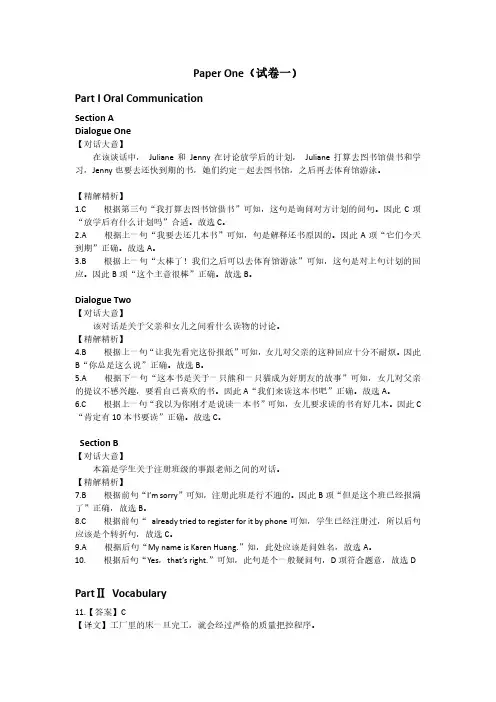
Paper One(试卷一)Part I Oral CommunicationSection ADialogue One【对话大意】在该谈话中, Juliane和 Jenny在讨论放学后的计划, Juliane打算去图书馆借书和学习,Jenny也要去还快到期的书,她们约定一起去图书馆,之后再去体育馆游泳。
【精解精析】1.C 根据第三句“我打算去图书馆借书”可知,这句是询问对方计划的问句。
因此C项“放学后有什么计划吗”合适。
故选C。
2.A 根据上一句“我要去还几本书”可知,句是解释还书原因的。
因此A项“它们今天到期”正确。
故选A。
3.B 根据上一句“太棒了!我们之后可以去体育馆游泳”可知,这句是对上句计划的回应。
因此B项“这个主意很棒”正确。
故选B。
Dialogue Two【对话大意】该对话是关于父亲和女儿之间看什么读物的讨论。
【精解精析】4.B 根据上一句“让我先看完这份报纸”可知,女儿对父亲的这种回应十分不耐烦。
因此B“你总是这么说”正确。
故选B。
5.A 根据下一句“这本书是关于一只熊和一只猫成为好朋友的故事”可知,女儿对父亲的提议不感兴趣,要看自己喜欢的书。
因此A“我们来读这本书吧”正确。
故选A。
6.C 根据上一句“我以为你刚才是说读一本书”可知,女儿要求读的书有好几本。
因此C “肯定有10本书要读”正确。
故选C。
Section B【对话大意】本篇是学生关于注册班级的事跟老师之间的对话。
【精解精析】7.B 根据前句“I’m sorry”可知,注册此班是行不通的。
因此B项“但是这个班已经报满了”正确,故选B。
8.C 根据前句“ already tried to register for it by phone可知,学生已经注册过,所以后句应该是个转折句,故选C。
9.A 根据后句“My name is Karen Huang.”知,此处应该是问姓名,故选A。
10. 根据后句“Yes,that’s right.”可知,此句是个一般疑问句,D项符合题意,故选DPartⅡ Vocabulary11.【答案】C【译文】工厂里的床一旦完工,就会经过严格的质量把控程序。
【精品】19《英语》考试大纲.doc
19《英语》考试大纲一、指导思想为了客观地评价我校专升本学生的英语水平,保证专升本学生的生源质量,根据教育部有关精神,结合我校大学英语教学的实际情况,在参照《上饶师范学院大学英语教学大纲》的基础上,制定本考试大纲。
二、考试目标本考试采用水平测试的方法,利用科学、公平、规范的方式考查学生的英语基础和基本的应用英语语言的能力其中包括正确运用英语语法和词汇的能力、阅读英文文章的能力和一定的英文写作能力和翻译能力,为使学生能以英语为工具、获取专业所需信息,并为进一步提高知识水平和综合能力打下扎实的基础。
三、适用对象专升本学生四、考试内容与要求:考试内容分为客观测试和主观测试两大分部。
以基础知识为主要内容,体现在语法与词汇、阅读理解、翻译和写作等五个方面,难度趋于水平考试 3--4级左右。
考试方法为闭卷笔试。
(一)词汇应掌握3500个左右的英语单词,正确熟练使用由这些单词构成的常用搭配,并具备用构词法知识识别生词的能力。
(二)语法知识掌握主谓一致关系、表语从句、宾语从句、定语从句和状语从句等句型、直接引语和间接引语的用法、动词不定式和分词的用法、各种时态、主动语态、被动语态等基本的语法知识,并注重在语篇层面上运用语法知识理解全文的能力。
(三)阅读能力考生应该能够综合运用英语语言知和阅读技能理解书面英语,能以每分钟60词的速度阅读各种题型(包括社会生活、人物传记、科普、史地、政治、经济等)和体(包括议论文、记叙文、说明文、应用文等)的文字材料。
阅读材料的生词量不超过3%。
应试学生应能够:1.掌握所读材料的主旨和大意;2.了解用以阐述主旨的事实和有关细节;3.根据上下文判断某些生词或短语的意义;4.理解单词的意义和上下之间的逻辑关系;5.根据所读的材料进行一定的判断、推理;6.领会作者的观点和态度。
(四)写作能力能在30分钟内写出长度为120个单词的短文,内容切题,语句连贯,条理清楚,语言基本正确,语言通顺恰当。
同等学力申硕英语大纲
同等学力申硕英语大纲I. 前言同等学力申硕英语考试是为了评估学位申请者在英语语言能力方面的水平而设立的。
本大纲旨在为考生提供关于考试内容、考试形式、考试要求等方面的详细信息。
考生应仔细阅读本大纲,并按照其中的指导准备和参加考试。
II. 考试内容同等学力申硕英语考试主要包括以下几个方面的内容:1. 听力理解(Listening Comprehension)此部分考察考生对于英语口语和听力的理解能力。
考生将会听到一系列录音,包括对话、采访、讲座等,然后回答相关的问题。
2. 阅读理解(Reading Comprehension)此部分考察考生对于英语文章的阅读理解能力。
考生将面临一些来自不同领域的英语文章,然后回答相关的问题。
3. 翻译(Translation)此部分考察考生的翻译能力。
考生将需要将一段中文文字翻译成英文,或将一段英文文字翻译成中文。
4. 写作(Writing)此部分考察考生的英语写作能力。
考生将需要根据题目要求完成一篇短文或一篇论述性的文章。
III. 考试形式同等学力申硕英语考试采用机器阅卷的方式进行评分。
考试过程中,考生需在规定的时间内完成各个部分的任务。
1. 听力理解考试将会通过播放录音的方式进行。
考生需要仔细听录音,并选择正确的答案。
每个问题后会有适当的停顿时间供考生作答。
2. 阅读理解考生需要在规定时间内阅读文本,并回答与文本相关的问题。
考生需要全面理解文本内容,并准确理解问题的意思。
3. 翻译考生将会在试卷上看到需要翻译的句子或段落,然后将其翻译成指定语言。
翻译要求准确、流畅,并保持原文的意思。
4. 写作考生将需要根据题目要求,完成一篇指定主题的英语短文或论述性文章。
写作要求清晰、准确,并具备良好的结构和组织能力。
IV. 考试要求同等学力申硕英语考试要求考生在以下方面达到一定标准:1. 词汇考生需具备一定的词汇量,能够理解和运用日常生活和学术领域的常用词汇。
2. 语法考生需掌握基本的英语语法规则,能够正确理解和运用不同的语法结构。
同等学力申硕英语水平全国统考大纲

同等学力申硕英语水平全国统考大纲National Postgraduate English Level Examination Syllabus for Candidates with Equivalent Academic CredentialsIntroductionThe National Postgraduate English Level Examination (NPELE) is an important assessment for candidates with equivalent academic credentials who wish to pursue higher education in English-medium programs in China. The NPELE aims to evaluate candidates' English language abilities in reading, writing, listening, and speaking, and ensure that they possess the necessary language skills to succeed in their academic endeavors. The following syllabus outlines the key components of the NPELE and provides guidance for candidates preparing to take the examination.Reading ComprehensionThe reading comprehension section of the NPELE assesses candidates' ability to understand and analyze written texts in English. Candidates will be required to read a series of passages on a variety of topics and answer questions based on the information presented in the texts. The passages may include academic articles, essays, reports, and other forms of writtencommunication. Candidates should be able to identify main ideas, supporting details, and infer meaning from context. They should also demonstrate an understanding of vocabulary, sentence structure, and rhetorical strategies.WritingIn the writing section of the NPELE, candidates will be asked to compose essays or short responses on assigned topics. Candidates should be able to express their ideas clearly and coherently, develop arguments logically, and support their claims with relevant evidence. They should also demonstrate a command of grammar, punctuation, and spelling. Candidates may be asked to write in a variety of genres, such as argumentative essays, opinion pieces, summaries, and reports.Listening ComprehensionThe listening comprehension section of the NPELE evaluates candidates' ability to understand spoken English in academic contexts. Candidates will listen to a series of audio clips, such as lectures, interviews, and conversations, and answer questions based on the information presented. Candidates should be able to comprehend main ideas, supporting details, and infer meaning from tone of voice, intonation, and context. Theyshould also demonstrate an understanding of vocabulary, pronunciation, and discourse markers.SpeakingThe speaking section of the NPELE assesses candidates' ability to communicate effectively in spoken English. Candidates will engage in a variety of tasks, such as giving presentations, participating in discussions, and responding to prompts. Candidates should be able to articulate their ideas clearly and confidently, engage in meaningful dialogue, and adapt their language to different contexts and audiences. They should also demonstrate fluency, pronunciation, and intonation.Preparation StrategiesTo prepare for the NPELE, candidates should familiarize themselves with the format and content of the examination, practice relevant language skills, and develop effective study habits. Candidates may use a variety of resources, such as textbooks, online materials, language courses, and practice exams. They should also engage in regular reading, writing, listening, and speaking activities to enhance their language proficiency. Additionally, candidates may benefit from seeking guidance from teachers, tutors, or language partners to receive feedback on their performance and improve their skills.ConclusionThe NPELE plays a crucial role in evaluating candidates' English language proficiency and ensuring that they are adequately prepared for their academic studies. By following the guidelines outlined in this syllabus and engaging in systematic preparation, candidates with equivalent academic credentials can enhance their language abilities and achieve success in the examination. It is essential for candidates to approach the NPELE with confidence, determination, and dedication in order to fulfill their academic aspirations and pursue their future goals.。
同等学力申硕统考英语 第五章 短文完成
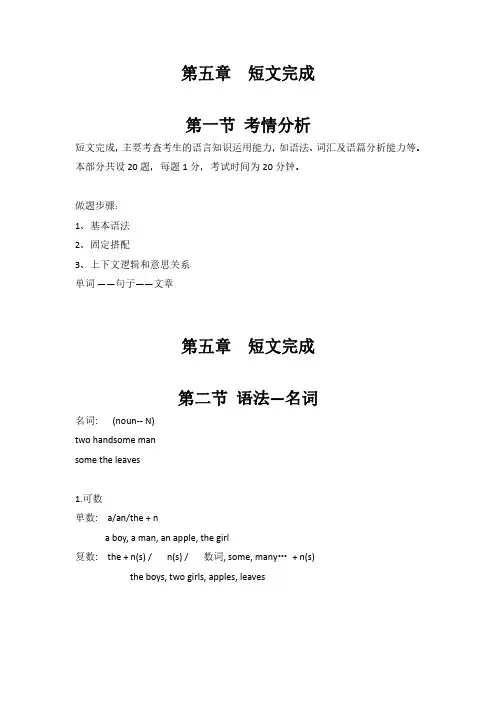
第五章短文完成第一节考情分析短文完成,主要考查考生的语言知识运用能力,如语法、词汇及语篇分析能力等。
本部分共设20题,每题1分,考试时间为20分钟。
做题步骤:1、基本语法2、固定搭配3、上下文逻辑和意思关系单词——句子——文章第五章短文完成第二节语法—名词名词:(noun--N)two handsome mansome the leaves1.可数单数:a/an/the+na boy,a man,an apple,the girl复数:the+n(s)/n(s)/数词,some,many…+n(s)the boys,two girls,apples,leaves1.直接加S:apples,books,brothers2.s/x/sh/ch为结尾加es:glasses,boxes,matches3.辅音加y为结尾变ies:cities,enemies4.f/fe—ves:wives,knives(特殊roofs,proofs,chiefs)5.以o为结尾es或s:negroes,heroes,tomatoes,potatoesradios,zoos,pianos,photos6.特殊foot-feet,goose-geese,tooth-teeth,child-children,man-men, woman-women,sheep-sheep,deer-deer,mouse-micedatum-data,medium-media,bacterium-bacteria,curriculum-curricula,criterion-criteria,phenomenon-phenomena,analysis-analyses,basis-bases,crisis-crises,diagnosis-diagnoses.名词:不可数物质或者抽象名词some/a little/much/a piece of/the(特指)+with much reverence and ceremony毕恭毕敬、彬彬有礼plenty of timetwo glasses of winea sheet of paperan item of clothinga piece of advice/some advice2019年There are plenty of other reasons the eSports community is growing.电子竞技社区的发展还有很多其他原因。
2023年同等学力申硕考试大纲
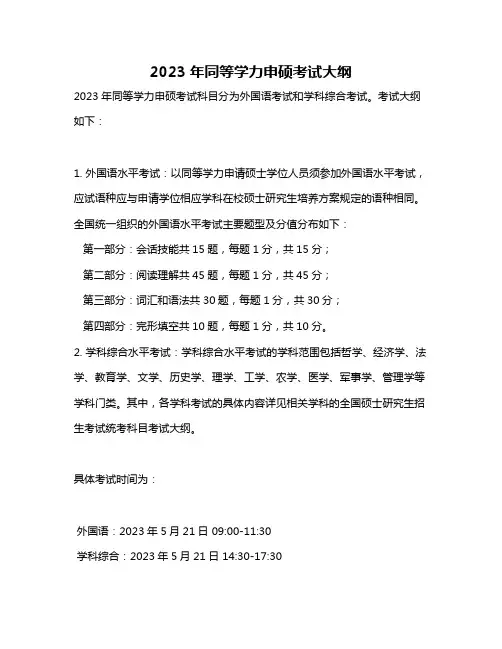
2023年同等学力申硕考试大纲
2023年同等学力申硕考试科目分为外国语考试和学科综合考试。
考试大纲如下:
1. 外国语水平考试:以同等学力申请硕士学位人员须参加外国语水平考试,应试语种应与申请学位相应学科在校硕士研究生培养方案规定的语种相同。
全国统一组织的外国语水平考试主要题型及分值分布如下:
第一部分:会话技能共15题,每题1分,共15分;
第二部分:阅读理解共45题,每题1分,共45分;
第三部分:词汇和语法共30题,每题1分,共30分;
第四部分:完形填空共10题,每题1分,共10分。
2. 学科综合水平考试:学科综合水平考试的学科范围包括哲学、经济学、法学、教育学、文学、历史学、理学、工学、农学、医学、军事学、管理学等学科门类。
其中,各学科考试的具体内容详见相关学科的全国硕士研究生招生考试统考科目考试大纲。
具体考试时间为:
外国语:2023年5月21日 09:00-11:30
学科综合:2023年5月21日 14:30-17:30
请注意,以上考试大纲仅供参考,具体内容请以官方发布的信息为准。
同等学力人员申请硕士学位英语水平全国统一考试历年真题及模拟试
本书是专门为提高考生参加同等学力人员申请硕士学位英语水平全国统一考试成绩而编写的复习资料。其内 容包括2013~2019年真题和3套模拟试卷及详解。历年真题从文章导读、答案详解、全文翻译、审题构思、范文 点评等多角度予以分析,为考生分析了解题技巧,指明了解题思路。模拟试题根据最新考试题型,在参考众多相 关考试用书、国内外权威杂志以及优秀论文等大量素材的基础上精心设计而成,具有很强的针对性和实用性。
同等学力人员申请硕士学位英 语水平全国统一考试历年真题
及模拟试
读书笔记模板
01 思维导图
03 目录分析 05 读书笔记
目录
02 内容摘要 04 作者介绍 06 精彩摘录
思维导图
本书关键字分析思维导图
统一
考试
优秀论文
英语水平
技巧
杂志
真题
考试
真题
考生 试题
历年
全国
学力
全国
人员
硕士学位
考试
模拟
内容摘要
精彩摘录
这是《同等学力人员申请硕士学位英语水平全国统一考试历年真题及模拟试题详解(2013~2019)》的读书 笔记模板,可以替换为自己的精彩内容摘录。
谢观看
目录分析
第二节大纲变化说 明
第一节大纲要求
第三节试题分析及 应试技巧
2013年同等学力人 员申请硕士学位英语 水平全国统一考试试
题及详解
2014年同等学力人 员申请硕士学位英语 水平全国统一考试试
题及详解
2015年同等学力人 员申请硕士学位英语 水平全国统一考试试 题及详解
2016年同等学力人 员申请硕士学位英语 水平全国统一考试试 题及详解
同等学力人员申请 硕士学位英语水平 全国统一考试模拟 试题及详解(三)
2019英语二考试大纲
全国硕士研究生入学统一考试英语(二)考试大纲(非英语专业)(2019年版)I. 考试性质英语(二)考试主要是为高等院校和科研院所招收专业学位硕士研究生而设置的具有选拔性质的全国统一入学考试科目。
其目的是科学、公平、有效地测试考生对英语语言的运用能力,评价的标准是高等学校非英语专业本科毕业生所能达到的及格或及格以上水平,以保证被录精品文档,你值得期待取者具有一定的英语水平,并有利于各高等学校和科研院所在专业上择优选拔。
II .考查内容考生应掌握下列语言知识和技能:(一)语言知识1. 语法知识考生应能熟练地运用基本的语法知识,其中包括:(1)名词、代词的数和格的构成及其用法;(2)动词时态、语态的构成及其用法;(3)形容词与副词的比较级和最高级的构成及其用法;(4)常用连接词的词义及其用法;(5)非谓语动词(不定式、动名词、分词)的构成及其用法;(6)虚拟语气的构成及其用法;(7)各类从句(定语从句、主语从句、表语从句等)及强调句型的结构及其用法;(8)倒装句、插入语的结构及其用法。
2. 词汇考生应能较熟练地掌握5500个左右常用英语词汇以及相关常用词组(详见附录相关部分)。
考生应能根据具体语境、句子结构或上下文理解一些非常用词的词义。
(二)语言技能1. 阅读考生应能读懂不同题材和体裁的文字材料。
题材包括经济、管理、社会、文化、科普等,体裁包括说明文、议论文和记叙文等。
根据阅读材料,考生应能:(1)理解主旨要义;(2)理解文中的具体信息;(3)理解语篇的结构和上下文的逻辑关系;(4)根据上下文推断重要生词或词组的含义;(5)进行一定的判断和推理;(6)理解作者的意图、观点或态度。
2. 写作考生应能根据所给的提纲、情景或要求完成相应的短文写作。
短文应中心思想明确、切中题意、结构清晰、条理清楚、用词恰当、无明显语言错误。
III. 考试形式、考试内容与试卷结构(一)考试形式考试形式为笔试。
考试时间为180分钟。
同等学力申硕英语水平全国统考大纲
同等学力申硕英语水平全国统考大纲全文共3篇示例,供读者参考篇1National Unified Examination for Master's Degree in EnglishI. PurposeThe National Unified Examination for Master's Degree in English is designed to assess candidates' English language proficiency at an advanced level. It is intended for applicants who hold a bachelor's degree or equivalent and are seeking admission to English-taught master's programs in universities across China.II. Examination Format1. Listening Comprehension: This section tests candidates' ability to understand spoken English in various contexts, such as academic lectures, presentations, and conversations. It consists of multiple-choice questions and is timed.2. Reading Comprehension: This section assesses candidates' reading and comprehension skills by presenting them with passages on a range of topics, including literature,social sciences, and natural sciences. Questions may be multiple-choice, true/false, or short answer.3. Writing: The writing section requires candidates to produce coherent and well-structured essays on given topics. Candidates are expected to demonstrate proficiency in grammar, vocabulary, and organization. Essays may be argumentative, descriptive, or expository.4. Translation: This section tests candidates' ability to translate passages from Chinese to English and vice versa. Candidates are expected to accurately convey the meaning and style of the original text.5. Speaking: The speaking section assesses candidates' ability to express themselves fluently and coherently in English. Candidates may be asked to discuss a given topic, give a presentation, or participate in a role-play scenario.III. Examination Guidelines1. Preparation: Candidates should familiarize themselves with the exam format and practice using sample questions. They should also work on improving their English language skills through reading, listening, and speaking practice.2. Time Management: Candidates should allocate their time wisely during the exam to ensure that they complete each section within the allotted time. They should also allow time for checking their work for errors.3. Use of Resources: Candidates are not allowed to use dictionaries or other reference materials during the exam. They must rely on their own knowledge and skills to complete the tasks.4. Scoring: Each section of the exam is scored separately, and candidates will receive a total score based on their performance across all sections. Scores are used by universities to evaluate applicants for admission to their master's programs.IV. ConclusionThe National Unified Examination for Master's Degree in English is a crucial step for candidates seeking to pursue graduate studies in English-taught programs in China. By demonstrating their English language proficiency through this exam, candidates can enhance their chances of admission to top universities and pursue their academic and career goals. Candidates are encouraged to prepare diligently for the exam and strive to achieve their best performance on test day.篇2National Postgraduate English Level Examination Syllabus for Candidates with Equivalent Education BackgroundIntroduction:The National Postgraduate English Level Examination is a key component of the admission process for postgraduate programs in China. Candidates with equivalent education background are those who do not hold a bachelor's degree in English but wish to pursue postgraduate studies inEnglish-speaking countries or English-taught programs. This document outlines the syllabus for the English section of the examination, which aims to assess candidates' language proficiency and readiness for graduate-level studies.Language Skills:The examination covers four key language skills: listening, reading, writing, and speaking. Each skill is essential for academic success and is evaluated through a variety of test formats.1. Listening:Candidates will be tested on their ability to understand spoken English in various academic contexts. This includeslectures, presentations, and discussions. Candidates will need to demonstrate their ability to follow complex arguments, identify main ideas, and take notes effectively.2. Reading:Candidates will be tested on their reading comprehension skills, including their ability to understand and analyze academic texts. The texts may cover a wide range of topics, including science, social science, humanities, and literature. Candidates will need to demonstrate their ability to identify main ideas, supporting details, and inferences.3. Writing:Candidates will be required to write essays on academic topics. This may include analyzing arguments, synthesizing information from multiple sources, and presentingwell-organized and coherent arguments. Candidates will need to demonstrate their ability to use appropriate academic vocabulary, grammar, and sentence structures.4. Speaking:Candidates will be tested on their ability to speak fluently and coherently on academic topics. This may include giving presentations, participating in discussions, and answeringquestions. Candidates will need to demonstrate their ability to express ideas clearly, support arguments with evidence, and engage in academic discourse.Syllabus:The examination syllabus is designed to assess candidates' language proficiency at the B2-C1 level of the Common European Framework of Reference for Languages (CEFR). The syllabus includes the following key components:1. Grammar:Candidates will be tested on their knowledge of English grammar, including verb tenses, sentence structures, and word forms. Candidates will need to demonstrate their ability to use grammar accurately in both written and spoken English.2. Vocabulary:Candidates will be tested on their knowledge of academic vocabulary, including words and phrases commonly used in academic writing and speaking. Candidates will need to demonstrate their ability to use vocabulary appropriately and effectively in different contexts.3. Reading Comprehension:Candidates will be tested on their ability to understand and analyze academic texts. This may include multiple-choice questions, short-answer questions, and summary writing tasks. Candidates will need to demonstrate their ability to identify main ideas, supporting details, and inferences.4. Writing:Candidates will be required to write essays on academic topics. This may include argumentative essays, compare and contrast essays, and critical analysis essays. Candidates will need to demonstrate their ability to organize ideas coherently, use appropriate vocabulary and grammar, and provide evidence to support arguments.5. Listening Comprehension:Candidates will be tested on their ability to understand spoken English in academic contexts. This may include listening to lectures, presentations, and discussions. Candidates will need to demonstrate their ability to follow complex arguments, take notes effectively, and answer comprehension questions.6. Speaking:Candidates will be tested on their ability to speak fluently and coherently on academic topics. This may include givingpresentations, participating in group discussions, and responding to questions. Candidates will need to demonstrate their ability to express ideas clearly, support arguments with evidence, and engage in academic discourse.Conclusion:The National Postgraduate English Level Examination Syllabus for Candidates with Equivalent Education Background is designed to assess candidates' language proficiency and readiness for graduate-level studies. By following the syllabus and preparing effectively, candidates can improve their English language skills and increase their chances of success in the examination. Good luck to all candidates preparing for the examination!篇3National Unified Examination for Postgraduate Admission of Master Degree Applicants with Equivalent Academic Background(英文全国同等学力申硕英语水平全国统考大纲)I. Test Introduction:The National Unified Examination for Postgraduate Admission of Master Degree Applicants with Equivalent Academic Background is conducted to assess the Englishproficiency of candidates who have the equivalent academic background for applying for a master's degree in China. The exam aims to evaluate the candidates' reading, writing, listening, and speaking abilities in English.II. Test Format:1. Listening Comprehension:This section consists of multiple-choice questions based on recorded material. Candidates will be required to listen to a series of dialogues, monologues, and conversations and answer questions related to the content.2. Reading Comprehension:Candidates will be required to read a set of passages and answer questions based on the information provided in the passages. The questions may include multiple-choice questions, true/false statements, and matching exercises.3. Writing:In this section, candidates will be required to write an essay on a given topic. The essay should demonstrate the candidates' ability to organize their ideas logically and coherently.4. Speaking:Candidates will be required to participate in a face-to-face interview with an examiner. The examiner will ask the candidates questions related to their personal experiences, opinions, and goals.III. Test Scoring:The National Unified Examination for Postgraduate Admission of Master Degree Applicants with Equivalent Academic Background uses a standardized scoring system to evaluate the candidates' performance in each section of the exam. The total score is calculated based on the candidates' performance in all sections of the exam.IV. Test Preparation:Candidates can prepare for the exam by practicing listening, reading, writing, and speaking exercises. They can also take sample tests to familiarize themselves with the exam format and improve their English proficiency.V. Test Administration:The National Unified Examination for Postgraduate Admission of Master Degree Applicants with Equivalent Academic Background is administered annually by the Ministryof Education of China. Candidates can register for the exam online and choose a test center near their location.VI. Conclusion:The National Unified Examination for Postgraduate Admission of Master Degree Applicants with Equivalent Academic Background is an important assessment tool for evaluating the English proficiency of candidates with equivalent academic background. Candidates who pass the exam will have a better chance of being admitted to a master's program in China. It is essential for candidates to prepare thoroughly for the exam to achieve a satisfactory score.。
2019英语二考试大纲
全国硕士研究生入学统一考试英语(二)考试大纲(非英语专业)(2019 年版)I. 考试性质英语(二)考试主要是为高等院校和科研院所招收专业学位硕士研究生而设置的具有选拔性质的全国统一入学考试科目。
其目的是科学、公平、有效地测试考生对英语语言的运用能力,评价的标准是高等学校非英语专业本科毕业生所能达到的及格或及格以上水平,以保证被录取者具有一定的英语水平,并有利于各高等学校和科研院所在专业上择优选拔。
II . 考查内容考生应掌握下列语言知识和技能:(一)语言知识1. 语法知识考生应能熟练地运用基本的语法知识,其中包括:(1) 名词、代词的数和格的构成及其用法;(2) 动词时态、语态的构成及其用法;(3) 形容词与副词的比较级和最高级的构成及其用法;(4) 常用连接词的词义及其用法;(5) 非谓语动词(不定式、动名词、分词)的构成及其用法;(6) 虚拟语气的构成及其用法;(7) 各类从句(定语从句、主语从句、表语从句等)及强调句型的结构及其用法;(8) 倒装句、插入语的结构及其用法。
2. 词汇考生应能较熟练地掌握5500 个左右常用英语词汇以及相关常用词组(详见附录相关部分)。
考生应能根据具体语境、句子结构或上下文理解一些非常用词的词义。
(二)语言技能1. 阅读考生应能读懂不同题材和体裁的文字材料。
题材包括经济、管理、社会、文化、科普等,体裁包括说明文、议论文和记叙文等。
根据阅读材料,考生应能:(1) 理解主旨要义;(2) 理解文中的具体信息;(3) 理解语篇的结构和上下文的逻辑关系;(4) 根据上下文推断重要生词或词组的含义;(5) 进行一定的判断和推理;(6) 理解作者的意图、观点或态度。
2. 写作考生应能根据所给的提纲、情景或要求完成相应的短文写作。
短文应中心思想明确、切中题意、结构清晰、条理清楚、用词恰当、无明显语言错误。
III. 考试形式、考试内容与试卷结构(一)考试形式考试形式为笔试。
考试时间为180 分钟。