
译林英语九年级上册第二单元unit 2重要知识点归纳
9A Unit 2 重要知识点归纳1.Which one do you want to wear, Eddie?one, it 和that都是代词,用来代替上文中提到的物,但是具体区别如下:one:泛指上文提到的那类人或物中的一个,即同类但不是同一个物,复数形式为ones;例: I lost my pen, so I bought a new one.it:指代上文中提到过的那个人或物,即同类且为用一个物,复数形式为they 或them;例:This is a cat, and I don’t like it.that:特指上文提到的可数名词单数或不可数名词,常用在比较的句子中,复数形式为those。
例:The weather in Beijing is different from that in Shanghai.2.try on ”试穿“;on是副词,当宾语是名词时可以放try 和on 之间也可以放on的后面,当宾语是代词时只能放中间。
例:What a beautiful coat! Can I try it on? 多么漂亮的衣服!我可以试穿一下吗?3.There is nothing wrong with... = There isn’t anything wrong with... = Nothing is wrong with...意思是“...没问题”例:There is nothing wrong with your computer. 你的电脑没有任何问题。
该句型的肯定句式为:There is something wrong with...= Something is wrong with...例:There is something wrong with my computer.该句型的一般疑问句式为:Is there anything wrong with...? = Is anything wrong with...?注意:something 用于肯定句,anything用于否定句或一般疑问句,即肯定句的something变否定句时要变成anything。
4.sure 的用法And I’m not sure if blue looks good on you. 我不确定你穿蓝色是否好看。
(P20)①sure 形容词,“确信,肯定”之意,后面可以跟of短语(be sure of)、动词不定式(be sure to do sth.)或从句(be sure that)。
区别:be sure of和be sure to do sth的主语是人, 是主语感到“有把握;确信”be sure to do的主语可以是人,也可以是物, 表示说话人推测“肯定,一定;必然会,势必”。
例:I am sure of the time of the meeting. 我对开会的时间很确定。
He is sure to come here on time. 他一定能按时到这里。
I am sure that my mother will buy me a new pen.我确信我妈妈会给我买一支新钢笔。
② make sure “确保,设法保证”,后面常跟动词不定式(make sure to do sth)、of短语(make sure of)或从句(make sure that)例:Please make sure that the door is locked.请确保门确实是锁好了.③ sure 还可用作副词,意为“当然”,表示同意,相当于certainly或者of course.例:-May I keep this book? 我可以保留这本书吗?- Sure./ Certainly./Of course. 当然可以。
5.If 的用法①连词,“是否”,引导宾语从句。
例:I don’t know if he can finish the work.我不知道他能否完成工作。
②连词,“如果”,引导条件状语从句。
例:If you see my father, give him this note. 你要是见到我父亲,把这张便条给他。
注意:主将从现用于if引导的条件状语从句中,不适用于if引导的宾语从句。
6....look(s) good on sb. ...穿在某人身上好看= sb. Look(s) good in + 颜色/衣服例: Red looks good on you.= You look good in red.你穿红色很好看。
7.one day 和some day的区别o ne day “某天,一天”,既可以表示将来的某一天,也可以表示过去的某一天。
some day “某天”,指将来的某一天。
8.look out of 向…外面看(后面加宾语) look out 向外看(后面不加宾语);当心;小心(=be careful)look after 照顾 look for 寻找 look through浏览,仔细查看look about/around环顾四周 look over检查 look sb. up and down上下打量某人look down向下看 look up向上看;查阅,查找 look at…看…look forward to sth./doing sth.期待 look down on/upon sb.看不起某人9.Some people believe that colours can influence our moods.一些人相信颜色能够影响我们的心情。
(P22)①influence 用作及物动词,意思是“影响,起作用”。
后面可以跟名词或代词做宾语,还可以跟动词不定式做宾语补足语(influence sb to do sth 影响某人做某事)。
例:I was influenced to accept the job by my father.受我父亲的影响,我接受了那份工作。
The weather influences the crops.天气影响农作物。
② influence还可以作名词,“影响,作用”,常见搭配:have an influence on sb/sth 对...有影响。
例:His best friend has a good influence on him. 他最好的朋友对他有好的影响。
10.You may wonder whether it is true.你可能想知道这是不是真的。
(P22)wonder这里作及物动词,“想知道”,相当于want to know;具体用法如下:①后面接if/whether引导的宾语从句,表示有礼貌地询问。
例:She wondered if/whether you would be free the next day.她想知道你第二天是否有时间。
②后接who, what, when, how 等疑问词引导的宾语从句。
例:I wonder who cleaned up the room just now.我想知道谁刚才打扫了房间。
③后接“疑问词+to do”构成的短语。
例:I wonder what to do next. 我想知道下一步做什么。
wonder还可以作名词,可数,“奇迹,奇观”.例: The Great Wall is a man-made wonder.长城是一处人造奇观。
11.Whether用作连词,“是否”。
可以引导宾语从句、主语从句和表语从句,后面还可以跟动词不定式,常用于whether...or not结构。
if和whether区别:①在动词不定式之前只能用whether例:I can’t decide whether to stay. 我不能决定是否留下。
②在whether …… or not 的固定搭配中,只能用whether例:I want to know whether it’s good news or not. 我想知道是否是好消息。
③在介词后,只能用whether。
例:It depends on whether he is ready.这件事要看他是否有准备。
I am not interested in whether you’ll come or not.你来不来我不感兴趣。
④引导主语从句、表语从句、同位语从句时,只能用whether,不用if。
例: Whether the news is true remains a question.这个消息是否真实仍然是个问题(主语从句) The question is whether they can take our advice.问题是他们是否能接受我们的意见(表语从句)The question whether he’ll come is unknown.他是否来的问题还不知道(同位语从句)12.energetic 形容词,意为“有活力的”energy 名词,意为“能量;精力;活力”例:He is energetic.= He is full of energy.他精力充沛。
13.sleepy 形容词,意为“困倦的,瞌睡的”,可充当定语或表语。
Please wake up the sleepy boy. 请叫醒那个打瞌睡的男孩。
(做定语)I am too sleepy to watch the end of the show.我太困倦了,不能把演出看完。
(做表语)注意:区别sleepy、asleep、sleepsleepy: 形容词,“瞌睡的,困倦的”,可以充当表语或定语,常用于固定短语feel sleepy“感觉困倦”;asleep: 形容词,“睡着”,只做表语,不做定语,常用于固定短语fall asleep“入睡”;sleep:①动词,“睡;睡觉”,强调睡觉这一动作;②名词,“睡眠”,固定短语: get to sleep 开始入睡; go to sleep去睡觉;睡着例:She lay down on the sofa and soon fell asleep.他躺在沙发上很快就睡着了。
Can you give me something to help me get to sleep?你能给我一些帮助我入睡的东西吗?14.relaxed,是relax的过去分词形式,可以用作形容词,意为“放松的,自在的,随意的”;be relaxed about sth 对某事随意/宽松/不严格。
例:We’re pretty relaxed about time.我们在时间上很随意。
注意:relax、relaxing、relaxed的区别①relax,动词,“(使)放松”,可以做不及物动词也可以做及物动词,做及物动词时,后面可以接名词或代词作宾语;例:I want to relax after work . 下班后我想放松下。
牛津译林版九年级英语上册Unit2重点短语梳理及答案
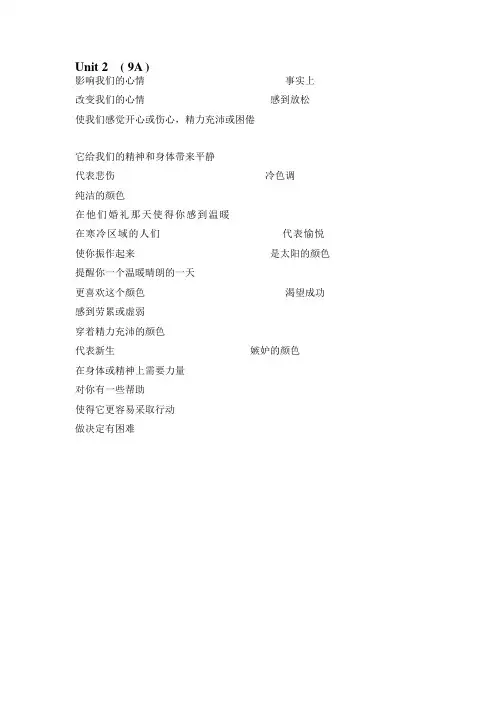
影响我们的心情_______________________ 事实上__________________改变我们的心情________________________ 感到放松__________________使我们感觉开心或伤心,精力充沛或困倦_________________________________________________________________它给我们的精神和身体带来平静______________________________________代表悲伤____________________________ 冷色调_______________________ 纯洁的颜色______________________在他们婚礼那天使得你感到温暖______________________________________ 在寒冷区域的人们______________________ 代表愉悦__________________ 使你振作起来_______________________ 是太阳的颜色_________________ 提醒你一个温暖晴朗的一天______________________________________更喜欢这个颜色_________________________ 渴望成功_________________ 感到劳累或虚弱_____________________________穿着精力充沛的颜色___________________________代表新生_________________________ 嫉妒的颜色______________________ 在身体或精神上需要力量________________________________________对你有一些帮助___________________________________________使得它更容易采取行动________________________________________________ 做决定有困难_______________________________________________________影响我们的心情influence our moods 事实上in fact改变我们的心情change our moods 感到放松feel relaxed使我们感觉开心或伤心,精力充沛或困倦make us feel happy or sad, energetic or sleepy它给我们的精神和身体带来平静it brings peace to our mind and body代表悲伤represent sadness 冷色调calm colour纯洁的颜色the colour of purity 在他们婚礼那天on their wedding day 使得你感到温暖make you feel warm 在寒冷区域的人们people in cold areas 代表愉悦represent joy 使你振作起来cheer you up是太阳的颜色the colour of the sun提醒你一个温暖晴朗的一天remind you of a warm sunny day更喜欢这个颜色prefer this colour 渴望成功hope for success 感到劳累或虚弱feel tired or weak穿着精力充沛的颜色wear energetic colour 代表新生represent new life 嫉妒的颜色the colour of envy在身体或精神上需要力量require strength in either body or mind对你有一些帮助be of some help to you使得它更容易采取行动make it easier to take action做决定有困难have difficulty making a decision。
Unit 2 Reading 牛津译林版英语九年级上册讲义 (含答案)

9AU2Reading【知识梳理1】Some people believe that colours can influence our moods.(P22)一些人认为颜色能影响我们的情绪。
1.influence,及物动词,意为“影响”。
We became the best of friends and he influenced me deeply.我们成了最好的朋友,而他深深地影响了我。
[拓展]influence,名词,意为“影响”。
固定搭配have an influence on...意为“对...有影响”What you read has an influence on your thinking. 你读的东西对你的思想有影响。
固定搭配under the influence of ... 意为“在...的影响下”In his youth he fell under the influence of Beethoven. 他年轻时受到贝多芬的影响。
[辨析]influence vs effectinfluence一般指间接影响,其范围较广,涉及行为、思想、感情,多指影响无形的事物。
affect仅指影响感情,指影响具体的事物,常指不良影响。
[经典例题](1)Chinese people__________by Mao Zedong’s__________.A.is influenced, thoughts B.are influenced, thoughtC.influenced , thoughts.D.are influenced, thoughts(2)Parents' behavior always has an important influence ________ their children.A.on B.over C.as D.with(3)Chinese Poetry Competition has ________ influence on people. More people like poetry. A.a B.an C.the D./答案:DAB2.mood,可数名词,意为“心情;情绪”。
译林版英语九年级上册unit2知识点
译林版英语九年级上册unit2知识点Unit 2 Knowledge Points in Yilin English Grade 9IntroductionIn the ninth grade of Yilin English, Unit 2 covers a wide range of knowledge points that are crucial for students to understand and master. These knowledge points not only enhance the students' comprehension and application of English grammar rules but also develop their reading and writing skills. This article aims to provide a comprehensive overview of the key topics covered in Unit 2.Verb tensesUnderstanding verb tenses is essential in mastering English grammar. Unit 2 focuses on several verb tenses, including simple past, present perfect, and future continuous. The simple past tense is used to talk about finished actions in the past, while the present perfect tense indicates actions that started in the past and continue into the present. The future continuous tense expresses actions that will happen in the future and are expected to be ongoing.For example, "She watched a movie last night." (simple past)"He has lived in this city for ten years." (present perfect)"I will be studying English at this time tomorrow." (future continuous)Modal verbsModal verbs play a significant role in expressing various attitudes, abilities, and possibilities in English. In Unit 2, students learn about modal verbs such as can, could, may, might, must, and should. These verbs are used to convey ideas like permission, ability, necessity, obligation, and advice.For instance, "You must finish your homework before watching TV.""She should practice playing the piano more often."Clauses and complex sentencesAnother important aspect covered in Unit 2 is the use of clauses and the construction of complex sentences. A clause is a group of wordsthat contains a subject and a verb. Clauses can be independent (can stand alone as a sentence) or dependent (cannot stand alone as a sentence). By using different types of clauses, students can create more sophisticated and varied sentence structures.For example, an independent clause: "She went to the park."A dependent clause: "When she finished her work."Combining the two: "She went to the park when she finished her work."Passive voiceThe topic of passive voice is introduced in Unit 2 to help students understand how to emphasize the object of a sentence instead of the subject. It is created by using the verb "to be" plus the past participle of the main verb. Passive voice is commonly used when the focus is on the recipient of an action rather than the doer.For example, "The book was written by Mark Twain."Vocabulary and reading comprehensionUnit 2 also focuses on improving students' vocabulary and reading comprehension skills. Students are exposed to a variety of texts and encouraged to widen their vocabulary range by learning new words and phrases in context. Additionally, they practice reading comprehension through answering questions and completing tasks based on the given texts.ConclusionUnit 2 of Yilin English Grade 9 covers crucial knowledge points that strengthen students' understanding and proficiency in English. By mastering verb tenses, modal verbs, clauses, passive voice, and expanding their vocabulary, students can enhance their language skills in reading, writing, and speaking. These knowledge points serve as building blocks for further language development and lay a solid foundation for their language journey.。
译林版九年级上册英语unit2知识点

译林版九年级上册英语unit2知识点Unit 2: The Olympic GamesIntroduction:The Olympic Games is a global sporting event that captivates the attention of millions of people around the world. It represents the pursuit of excellence, sportsmanship, and unity among nations. In this unit, we will explore various aspects of the Olympic Games, including its history, sports, traditions, and the impact it has on society.1. Ancient Olympics:The origins of the Olympic Games date back to ancient Greece, where they were held in honor of the Greek god Zeus. These early Olympics served as a platform for athletic competitions among city-states, fostering a sense of friendly rivalry and camaraderie within the Greek society. The games included sports such as running, discus throw, and chariot races.2. Modern Olympics:The modern Olympic Games, as we know them today, were revived in 1896 by Pierre de Coubertin. The inaugural event took place in Athens, Greece, with participants from 14 nations. Since then, theOlympic Games have grown in size and popularity, with thousands of athletes from over 200 countries competing in various sports.3. Olympic Sports:The Olympic Games offer a diverse range of sports that cater to different interests and abilities. From athletics and swimming to archery and wrestling, these sports showcase the strength, skill, and agility of athletes from around the world. Each sport has its own set of rules and regulations, ensuring fair competition and impartial judgment.4. Olympic Symbols:The Olympic Games are recognized by several iconic symbols, each with its own significance. The Olympic flag, consisting of five interlocking rings, represents the unity of the five continents. The Olympic flame, lit during the opening ceremony and extinguished during the closing ceremony, symbolizes the enduring spirit of the games. The Olympic motto, "Faster, Higher, Stronger," encapsulates the strive for excellence and personal improvement.5. Olympic Tradition:The Olympic Games are steeped in tradition, which adds to the unique atmosphere and excitement surrounding the event. The openingceremony, marked by the parade of nations, lighting of the Olympic cauldron, and various cultural performances, sets the stage for the games to begin. The closing ceremony, on the other hand, is a time to celebrate the achievements of the athletes and bid farewell to the host city.6. Impact of the Olympic Games:The Olympic Games go beyond just a sporting event; they have a profound impact on society, economy, and culture. Hosting the Olympics provides a platform for countries to showcase their infrastructure, hospitality, and organizational abilities on a global stage. It also stimulates tourism, boosts the local economy, and promotes international cooperation and understanding.7. Controversies and Challenges:Despite the positive aspects, the Olympic Games have faced their fair share of controversies and challenges. Issues such as doping, corruption, and high costs associated with hosting the games have been raised in recent years. However, steps have been taken to address these concerns and uphold the integrity of the Olympics.Conclusion:The Olympic Games embody the spirit of competition, unity, and achievement. From their ancient roots in Greece to the global phenomenon they have become today, the Olympics continue to inspire individuals, nations, and communities worldwide. It is a testament to the power of sports in bringing people together and promoting peace and understanding among diverse cultures.。
牛津译林版九年级英语上册Unit2知识汇总
精品基础教育教学资料,仅供参考,需要可下载使用!01 Unit2单词indigo 靛蓝,靛青violet 紫罗兰色rainbow 彩虹mood 心情;情绪influence 影响whether 是否characteristic 特征;品质calm 平静的,沉着的relaxed 放松的;白在的.peace 安宁;和平;和睦sadness 悲哀,忧伤purity 纯浩wedding 婚礼,结婚庆典prefer 宁愿选择,更喜欢create 造成,引起;创造,创建feeling 感受cheerup 使振作起来remind 提醒;使想起.wisdom 智慧as 因为envy 妒忌;羡慕greenwith envy 妒忌的,眼红的require 需要,要求.strength 力量heat 热difficulty 困难;费力havedifficulty (in) doing sth 做某事费劲decision 决定relationship 关系certainly 必定地,无疑地everyday 每天的;日常的personal 个人的;私人的suit 适合celebration 庆祝;庆祝活动ancient 古代的,古老的therapy 疗法;治疗discover 发现,发觉teens [复]十几岁promise 承诺,允诺or 否则work 奏效,产生预期的效果practice 从事,执业stressed 紧张的,有压力的suggest 建议wouldrather (=’d rather)宁愿,更倉欢trust 信任calm 平静,镇静warmth 温暧,暧和;热情handbag 女用皮包,手提包match 相配,般配balance 使…平衡02 Unit2知识梳理【重点短语】1.There is nothing/something wrong with sth.某物没问题 /有问题,出故障2.after a rain shower一阵阵雨之后3.sth look good on sb某物穿在某人身上好看4.change our moods改变我们的情绪5.the relationship between colours and moods 颜色和情绪之间的关系6.make sb feel energetic让某人感到精力充沛7.feel sleepy感到昏昏欲睡8.feel relaxed感到放松的9.bring peace to our mind and body把和平带给我们的身心10.represent sadness代表悲伤11.the colour of purity 纯洁的颜色12.prefer to do更喜欢做某事13.cheer sb up使某人振作14.prefer A to B与 B 比较更喜欢 A15.prefer doing A to doing B比起做 B 事情更喜欢做 A 事情16.create a warm and comfortable feeling产生一种温暖舒服的感觉17.remind sb of sth=think of sth使某人想起某事18.the colour of wisdom 智慧的颜色19.hope for success渴望成功20.make it +形容词+ to do sth使得做某事怎么怎么样21.require strength in either body or mind在身体或心理上需要力量22.have difficulty doing sth 做某事有困难23.make a decision作出一个决定24.ask sb for help向某人寻求帮助25.too tired to move太累了而不能动26.get into trouble陷入困境27.our everyday lives 我们的日常生活28.light colours 浅色29.depend on sth取决于...30.personal taste个人的品味31.suit sb合某人的身32.instead of doing代替做某事 ,而不是做某事33.be used for celebrations被用来庆祝34.the colours of rulers统治者的颜色35.in ancient Europe在古代欧洲36.feel confident enough 感到足够的自信37.feel stressed感到有压力38.remind sb to do sth提醒某人去做某事39.suggest sb to do sth = advise sb to do sth建议某人去做某事40.give sb a suggestion = give sb some advice 给某人建议41.give sb free sth给某人免费的某物42.would rather do sth更喜欢做某事 =prefer to do sth43.be dressed in被穿上44.make oneself look more powerful使某人自己看上去更有力量45.feel a little bit stressed 感到有点压力46.a good match一个很好的搭配47.be of some help= be helpful有帮助的48.promise to do 许诺做某事【重点句型】1.--Is (there) anything wrong with your bike?--No, there is nothing wrong with it.--你的自行车出问题了吗?--没有,没有任何问题2.Do you know how many Easter Egg there are in Ready Player One?你知道《头号玩家》(Ready Player One)里有多少彩蛋(Easter Egg)?3.I\'m not sure if indigo is girls favorite colour.我不确定靛青色是否是女孩子们最喜欢的颜色4. Purple looks good on you. You look good in purple.你穿紫色很好看(两种方式)5. Do you know how many colours there are in a rainbow?你知道彩虹多少颜色吗6.When I hope for success. I prefer yellow to blue.当我希望成功时,比起蓝色,我更喜欢黄色7.The old photo reminded me of the good old days.这张旧照片使我想起了美好的往日8.Can you tell me what colours can do?你能告诉我颜色能起什么作用吗9. I wrote that song to cheer myself up我写那首歌是给我自己打气的10.Some restaurants prefer to use warm colours to create a warm and comfortable feeling.一些餐厅喜欢用暖色来创造温暖和舒适的感觉11.Enjoying natural beauty can bring peace to our mind and body.欣赏大自然的美景能给我们身心带来安宁12.I\'m not sure if/whether weather can influence our moods.我不确定天气是否能影响我们的心情13.I\'m afraid we have to make a decision as soon as possible.恐怕我们得尽快做出决定了14.Some people prefer blue because it’s the color of calm.有人偏爱蓝色,因为它是安宁之色15.Tan Dun\'s music may be of some help for you when you feel impatient.当你急躁不安时谭盾的音乐可能对你有帮助16.Does the advice make it easier for you 10 lake action?这些建议能使你更容易采取行动吗17. The student from theUSAhas no difficulty (in) communicating with us.那位来自美国的学生和我们交流起来没有困难18.I prefer mopping to washing dishes.比起待洗碗,我更喜欢拖地19.I\'m not sure if I should stay at home instead of going shopping.我不确定我是否该呆在家而不是去购物20. We wonder if he will offer us some advice.我们想知道他是否会给我们提供一些建议21. His decision depends on his parents\' help and support.他的决定取决于父母的帮助和支持22. Ali Pay has influenced our daily /everyday life in many ways.支付宝Ali pay在许多方面影响了我们的日常生活23. Do you know (that) yellow was the colour of the rulers in ancientChina?你知道黄色在中国古代是统治者的颜色吗24. Doctors often suggest eating more vegetables and fruits to keep healthy.医生们经常建议多吃蔬菜和水果来保持健康25. The boy promised no! to be late for school any more.这个男孩允诺不再上学迟到了26. I wore orange to cheer myself up but it didn\'t work.我穿橙色来使自己振作,但是没有奏效27. If this rip can change your moods. you can get all your money back.如果这次旅行不能改变你的情绪,可以全额退款28. Andy would rather wait for one more/ another hour than knock at /on the door.Andy宁愿再等一个小时也不愿意敲门29. The hot weather makes me feel a little bit/a little/a bit stressed.炎热的天气是我感到有一点压抑30. I think a white shirt and a pair of jeans are A good match.我觉得白衬衫和牛仔裤是很相宜的搭配31. He would rather be punished than say sorry to us.他宁愿受罚也不愿向我们道歉32. Do you think the powerful red can balance the calm white?你认为有力的红色能平衡宁静的白色吗33. The color white can help me calm down and that\'s why I like white.白色能帮助我平静下来,那就是我喜欢白色的原因34. Do people with dark skin look good in red?黑皮肤的人穿红色好看吗35. He had difficulty (in) explaining to me why he was late again.他难于向我解释为什么他又迟到了36 The wonderful programs can always cheer me up when I am sad.这些精彩的节目在我悲伤的时候总能让我振作起来37. He didn\'t realize his mistake until I reminded him (of it).直到我提醒他,他才意识到自己的错误38. I wonder i/whether he is willing to take part in my birthday party.我想知道他是否愿意来参加我的生日聚会【重点语法】that引导的宾语从句宾语从句是指一个句子充当宾语,在主句与从句之间有一个引导词。
九年级上册英语Unit 2 Colours Welcome知识讲解-译林版(含答案)

Unit 2 ColoursComic strip & Welcome to the unit1.But there 's nothing wrong with pink, you know. And I'm not sure if blue looks good on you.Do you know how many colours there are in a rainbow?【1】there is something(nothing)wrong with sb/sh:某人(或某物) (没)有问题。
注意此结构还可以说成Something (Nothing) is wrong with sb sth【2】it的含义和用法:是否;此处引导一个宾语从句【3】回顾学习介词on和in表示“穿衣服时的不同用法,如:She looks beautiful in the coat. (在衣服“里面”)= The coat looks beautiful on her (衣服在人“上面”)【4】注意第四处划线部分的句型结构:其为宾语从句,请注意使用的是陈述句语序,即there are,而不是are there练习:(1) There must be something wrong with my computer。
(同义句转换)_________ _________ _________ _________ _________ my computer.(2) My computer must be broken.(同义句转换)_________ _________ _________ _________ _________ with my computer. (3) The 14-year-old boy looks nice _________ black and the violet sweater looks good _________ the 16-year-old girl.A. with: onB. in: onC. on: in D in; with(4) Kitty looks _________ in red while green clothes are nice _________ Helen.A. good; onB. well; in C good; at D. well; for(5)--Which coat is better _________ me. the blue one or the black one?A.WearB. put onC. inD. on答案:1. Something must be wrong with 2. There must be something wrong 3.B 4.A 5.D词汇练习:A.根据汉语意思写出单词1.There are over 100 teachers ________ (从事,执业) in our school.2.Some people were ill because they were ________ (影响)by the bad weather.3.He's ________ (允诺)that he will not give up his English.4.The ________ (悲伤)on his face showed that he failed in the exam.5.All the students are ________ (要求)to get to school on time.6.I’m too ________ (困) to go on doing my homework.7.He looked ________ (放松) and confident before the match . He was sure towin .8.The old man lives in a ________ (宁静的) village by himself .9.Students want to get a _________ (平衡) between their homework and theirhobbies .10.Red _______ ( 代表) power and it is also the colour of heat and strongfeelings .11.This photo ________ (提醒,使想起) me of my childhood.B. 根据句意,用括号内所给单词的适当形式填空。
译林版九年级上册英语u2知识点
译林版九年级上册英语u2知识点I. IntroductionIn the second unit of the 9th grade English textbook published by YiLin Press, various essential concepts and topics are covered. This unit focuses on expanding the students' vocabulary and developing their language skills. In this article, we will explore some of the key points covered in Unit 2 of the 9th-grade English curriculum.II. Vocabulary ExpansionOne of the primary objectives of Unit 2 is to broaden students' vocabulary. The unit introduces a wide range of new words and phrases related to a variety of contexts. These include words related to health, emotions, daily routines, and leisure activities. Students will learn how to properly use these words and incorporate them into their spoken and written English.III. Grammar and Language TipsUnit 2 also provides students with a deeper understanding of grammar rules and language usage. The unit touches upon verb tenses, direct and indirect speech, and adverbial phrases. Through interactive exercises and examples provided in the textbook, students can practiceand master these grammatical concepts, thus improving their overall language proficiency.IV. Reading ComprehensionAnother crucial aspect of Unit 2 is developing students' reading comprehension skills. The unit includes various reading materials, such as newspaper articles, short stories, and dialogues, which cover different topics like health issues, friendship, and personal experiences. By reading these texts, students will not only expand their vocabulary but also enhance their reading comprehension and critical thinking abilities.V. Speaking and Listening ActivitiesUnit 2 also focuses on developing students' speaking and listening skills. The textbook provides opportunities for students to engage in pair and group discussions, role-plays, and presentations. Through these activities, students can practice expressing their opinions, presenting arguments, and actively listening to others. This helps them build confidence in using English as a communicative tool.VI. Writing SkillsUnit 2 also includes writing tasks to help students improve their writing skills. The unit introduces different writing formats, such as personal letters, diary entries, and magazine articles. Students are encouraged to express their thoughts, ideas, and personal experiences through writing, while also applying the grammar and vocabulary concepts they have learned.VII. Cultural InsightsIn addition to language learning, Unit 2 also offers cultural insights. Students learn about different cultures, traditions, and customs by exploring texts and dialogues that provide a glimpse into the lives of people from various countries. These cultural insights help students broaden their horizons and develop a better understanding and appreciation of different cultural backgrounds.VIII. ConclusionUnit 2 of the 9th grade English textbook published by YiLin Press provides students with a comprehensive language learning experience. Through vocabulary expansion, grammar practice, reading comprehension activities, speaking and listening exercises, writing tasks, and cultural insights, students can enhance their overall language proficiency and develop a deeper understanding of the English language. Each component of the unit is designed to engage studentsand create a well-rounded learning environment. By mastering the knowledge points covered in this unit, students will be better equipped to communicate effectively in English.。
译林九年级英语上册U2知识点
译林九年级英语上册U2知识点Unit 2: Language Points in Yilin Ninth Grade English TextbookIn the second unit of the Yilin Ninth Grade English textbook, students are introduced to various language points that will enhance their English language skills. This unit covers a range of topics such as giving directions, expressing preferences, and discussing daily routines. In this article, we will delve into some of the key language points in this unit and explore their significance in language learning.One of the important aspects covered in Unit 2 is giving directions. Understanding how to ask for and give directions is crucial when navigating a new place or city. The unit provides students with vocabulary related to this topic, such as "turn left," "go straight ahead," and "cross the road." By practicing these phrases, students will gain confidence in communicating effectively in real-life situations. They will be able to understand and give directions, improving their overall comprehension and speaking skills.Another essential language point in this unit revolves around expressing preferences. The ability to express personal preferences is valuable in daily life, as it allows individuals to communicate their likes and dislikes. Students learn how to use phrases like "I prefer," "Ilike," and "I don't like" to express their preferences for different foods, activities, and hobbies. This knowledge helps students interact with others more effectively and express their opinions confidently, ultimately enhancing their interpersonal skills.Additionally, Unit 2 covers the topic of discussing daily routines. Through learning phrases like "get up," "have breakfast," and "go to bed," students can effectively describe their daily activities and routines. This is particularly important as it enables learners to communicate their schedules, express time-related concepts, and understand others' daily routines. Developing an understanding of daily routines enhances students' ability to engage in meaningful conversations and facilitates their language understanding in various contexts.Furthermore, Unit 2 delves into the importance of prepositions in English. Prepositions are words that show the relationship of one word to another word or phrase. They are vital for constructing grammatically correct sentences. This unit focuses on prepositions of place, such as "on," "in," and "under," as well as prepositions of time, such as "at," "in," and "on." Understanding and properly using prepositions helps students master sentence construction, strengthen their writing skills, and communicate accurately.While exploring these language points, it is crucial for students to engage in various activities and exercises to reinforce their understanding. The Yilin Ninth Grade English textbook provides a range of reading, listening, speaking, and writing activities related to these language points, allowing students to practice and consolidate their knowledge. Students should actively participate, ask questions, and seek additional resources to further enhance their language proficiency.In conclusion, Unit 2 of the Yilin Ninth Grade English textbook introduces students to vital language points necessary for effective communication in English. By understanding and practicing these language points, students can enhance their ability to give directions, express preferences, discuss daily routines, and use prepositions correctly. These language points not only strengthen students' language skills but also enable them to communicate confidently and fluently in real-life situations.。
牛津译林版九年级英语上册unit2语法知识点归纳
牛津译林版九年级英语上册unit2语法知识点归纳1. I’d rather wear blue than pink. 我宁愿穿蓝色也不愿穿粉红色。
(Would rather+动词原形+than +动词原形,宁可……也不……, 与其……不如……) Liu Hulan would rather die than give up. 刘胡兰宁死也不屈服。
I would rather not tell you about it. (would rather not do sth. 宁愿不做某事)2. There is nothing wrong with pink. 粉红色没什么不好。
(there is something / nothing wrong with…… 有/ 没有毛病)3. Blue looks good on you. (蓝色穿在你身上很好看。
)(衣服+look nice + on + 人,指衣服好看,衣服穿在人身上用on)(人+ look nice + in +衣服, 指人好看,人在衣服里面用in)4. This report explains what colours can do(宾语从句,用陈述句的语序) and thecharacteristics they represent.(定语从句,修饰characteristics)5. Wear ing blue clothes or sleep ing in a blue room is good for the mind and body.(对身心有好处,有益于身心健康)6. Blue can create the feeling of harmony. (创造协调感)7. Blue can also represent sadness. (代表悲伤,象征伤心)8. White is the colour of purity. = White represents purity. 白色象征纯洁。
Unit2知识点梳理课件牛津译林版英语九年级上册
3.everyday adj.每天的,日常的 daily 每日的,日常的 我们的日常生活our everyday lives every day 每天
4.personal adj.个人的,私人的 名词 personality 个性,性格 可数
16
5.suit vt.适合 形容词 suitable
9A Unit 2 知识点梳理
1
Welcome to the unit
2
1.indigo n.靛蓝,靛青 2. violet n.紫罗兰色 3. rainbow n.彩虹 【补充】 1.sth looks good on sb =sb looks good in sth 2.There is nothing wrong with sth
他学英语语法挺费劲。He has great difficulty learning English grammar. 23.decision n.决定
动词decide 决定(做某事)make a decision(to do sth) = decide to do sth = make up one’s mind to do sth.
8
prefer to do B rather than do A 比起做A更宁愿做B would rather do B than do A 比起做A更宁愿做B 12.create vt.造成,引起,创造,创建
形容词creative 名词 creation 13.feeling n.感觉,感受 可数feelings
14.cheer up 使振作起来 使某人振作起来cheer sb up 形容词 cheerful 令人愉快的
9
15.remind vt.提醒,使想起 提醒某人做某事 remind sb to do sth 使某人想起... remind sb of sb/sth