
初中英语_英语教学设计学情分析教材分析课后反思
Unit 1 When is your birthday?教学设计【复习目标】1、掌握序数词的构成及日期的表达方法2、熟练运用“When---?”开头关于日期的问答3、通过本单元话题的学习,学会关爱身边的人、关注身边的事【复习过程】一、课前预习:依据本单元的内容绘制复习知识网络二、课内复习:自主复习1、回顾本单元的单词,是否还有不熟悉的。
2、开始回忆a.请默写出1到12月的单词________________________________________________________________________ __________________________________________________________________________b.翻译第一第二第三第四第五第六第七第八第九第十第十一第十二第十三第二十排球赛艺术节学校郊游生日聚会音乐节三、复习重点【短语】how old多大school trip郊游basketball game篮球赛school day学校上课日【句型】When is your / his / her birthday? It’s…When is your birthday? My birthday is November 11.When is Sarab’s birthday? Sarab’s birthday is January 21.How old are you? I’m 14.【语法】1.when引导的特殊疑问句2.序数词四、难点讲评1.___When is your birthday,Vera?___维拉,你什么时候出生的?___My bithday is October tenth..我的生日是10月10日。
释:1)此句中when是疑问副词,意为“什么时候”,构成特殊疑问句。
疑问代词有:who、what、whose、which等。
疑问副词有:when、where、how、why等。
2)___My bithday is October tenth.= ___My bithday is on October tenth.2.when与what time释:when可以对“年、月、日及时刻”提问。
回答常用in、on、at构成的介词短语。
具体日期前用on;年、月前用in;在时刻前用at。
例如:When do you go to school?你什么时候上学?I go to school at seven.我七点上学。
When were you born?你什么时候出生?I was born on April 2,1966.我出生于1966年4月2日。
What time 常用来询问“钟点”而不询问“年、月、日”。
例如:What time does he usually get up? 他通常几点起床?He usually gets up at 6:00. 他通常6点起床3.How old are you ?你多大了?释:1)此句是就年龄进行提问的特殊疑问句,其句型结构为:How old+be+主语?表示“……几岁/多大了”,句中how old意为“多大年龄/几岁”,在回答这个句型时,常用“主语+be+数词+years/months old”来表示,也可以直接说出年龄。
例如:—How old is your father? —你爸爸多大了?—He is sixty. —他六十岁了。
2)How old are you? 的同义句有:What’s your age? / May I know your age?3)At the age of 是用来表示年龄一种说法。
What age are you? 你几岁 ? ( 你多大年龄 ? ) 在英语中表达年龄时常说:She‘s eight. 也可以说:She is eight years of age . 还可以说:She is eight years old. 但不可说:She is eight age.4)“年龄”表示法还有:(1)“at the age of + 基数词”或“at +基数词”。
基数词后不再加 years old , 此短语常作状语。
如: At the age of eight ,he went to an island with his parents .(2)“of + 基数词”。
此结构常作后置定语,数词后不能接 years old。
如:At that time , he was just a boy , of sixteen . 当时,他只是一个十六岁的男孩。
(3)“基数词-year-old”。
此结构常用前置定语。
如:When he was an eight-year-old boy , he began to make a living .当他是一个八岁的男孩时,就开始谋生了。
(4)“be in one’s + teens / twenties / thirties……nineties”表示“在某人十几岁/二十几岁/三十几岁……九十几岁时”。
如: He was in is fifties .6. 基数词变序数词的规律:英语中,用来表示事物的数目的词是基数词,用来表示事物顺序的词是序数词。
那么基数词变序数的口诀是什么呢?记住:“基变序有规律,结尾字母是th”,“一、二、三特殊记,结尾字母t,d,d”,“八去t,九去e,f要把ve替”,“ty将y变成i,th前面有个e”,“几十几,也好记,只变个位就可以”。
注意:在基数词改为序数词时,多数都在基数词尾加th,但one,two,three所对应的序数词依次为first,second和third(即“结尾字母t,d,d”)。
eight在加th时要去掉末尾字母t(eigh t→eighth,即“八去t”);nine在加th时要去掉字母e(nine→ninth,即“九去e”);以ve结尾在加th时,应先把ve用f换掉,然后再加th。
(如:five→fifth,twelve→twelfth,即f 要把ve替);以ty结尾的基数词在变成序数词,应先将y变i,th前面还要加上字母e(如:twenty→twentieth,thirty→thirtieth,……ninety→ninetieth等,即ty把y变成i,th前面还有一个e);类似twenty-four,twenty-six这样“几十几”的基数词在改为序数词时,只需变个位就可以了。
如:twenty-four→twenty-fourth,twenty-six→twenty-sixth等。
五、典型例解( )1.Tom and Ann stood in front of the mirror and looked at ________.A. herB. himC. themD. themselves分析:D 本题考查反身代词的运用。
依据题意:汤姆和安站在镜子前,看着他们自己。
需要用反身代词,故用D。
()2.September 10th is ___________.A. Women’s DayB. Children’s DayC. Mid-autumn DayD. Teachers’ Day分析:D。
本题考查节日名称。
本题属于社会常识。
()3.Have you learned ____ lesson?A. twelveB. twelvethC. the twelfthD. the twelve分析:C。
本题考查序数词的用法。
题意为:你们学第十二课了吗?以ve结尾在加th时,应先把ve用f换掉,然后再加th。
( )4.—Who’s the girl in red?—Sorry, I don’t know ____.—____ is a new student.A. she; SheB. her; SheC. her; HerD. she; Her分析:B 前者在动词后面做宾语应用宾格her, 后者在句子中做主语应用主格she。
( )5.—Where does he live?—He ____ in Shanghai.A. livesB. liveC. is liveD. to live分析:A 从第一句可以判定下句用一般现在时, 答句主语为第三人称单数, 故选A。
( )6.Li Lei often ____ Lin Tao ____ his English.A. help; toB. helps; withC. helps; toD. help; with分析:B help sb. with sth. 意为“帮助某人做某事”,与help sb. (to) do sth. 同义。
题干中often暗示用一般现在时, 主语为第三人称单数, 故选B。
( )7.He doesn’t like apples ____.A. veryB. muchC. at allD. little分析:C not ... at all 表示“一点也不”,故选C。
( )8.I like the little cat a lot but she likes it ____.A. a lotB. a littleC. lotD. much分析:B like ... a lot 表示“很喜欢…”,后面的but有转折的意思,a little意为“一点点(表示程度)”。
句意为“我很喜欢那只小猫,但她只是有点(喜欢它)”,故选B。
( )9.Sally often helps me study English. And I help her study Chinese. We help _____.A. each otherB. othersC. the otherD. other分析:A 根据句意“Sally帮我学英语,我帮她学汉语”可知我们互相帮助。
each other意为“互相”,因此选A。
( )10.He ____ to visit China.A. wantB. to wantC. don’t wantD. wants分析:D 主语he是第三人称单数, 其否定形式为doesn’t want,故选wants。
六、板书设计Unit 1 When is your birthday?When is your / his / her birthday? It’s…When is your birthday? My birthday is November 11.When is Sarab’s birthday? Sarab’s birthday is January 21.How old are you? I’m 14.对于本单元的这个话题学生应该是比较感兴趣的,但由于我们彼此之间比较生疏(我面对的学生不是我自己所教的),所以课堂气氛不够活跃,但整节课下来,让我觉得他们之间有着很明显的差距。
初中英语_Sad but beautiful教学设计学情分析教材分析课后反思

(一)教学策略与过程1.教学设计思路本课的研究方向为阅读教学。
设计思路:首先通过音乐欣赏引入话题并运用已给词汇谈论二泉映月; 然后通过选择合适的标题、找关键信息、根据短文回答问题、句子填空等训练学生skimming, scanning, detailed reading, guessing等阅读策略与技巧;接着通过观看video唤起对二泉音乐中凄美的认识;最后欣赏自己喜欢的音乐或电影。
通过阅读前、阅读中环节中由浅入深、从简到难的阅读任务进行大量的语言输入,为读后拓展活动中的语言输出做铺垫,帮助学生搭建语言输出的脚手架。
读后活动中,主题为“为什么二泉映月会凄美“小组讨论环节切合本课阅读主题、贴近生活,能激发学生谈论的兴趣,有效地促使学生在交际中运用目标语,很好地帮助学生学以致用。
2.教学过程(步骤、目的、教师活动、学生活动、媒介运用)Step 1. Warming upGreeting and daily talk.The purpose of this step: To warm Ss up.Step 2. Leading inShow some pictures and talk about the teacher.The purpose of this step: To lead in the new topic and get the Ss to beinterested in this lesson.Step 3. Pre-readingTwo students play a piece of music. Encourage the Ss to talk about the music by using these words.The purpose of this step: To get Ss to know something about erquan yingyue. Step 4. While-reading1. Task 1: Tell the Ss to skim the passage and answer the questions.2. Task 2: Tell the Ss to scan the passage and find out the main idea of eachparagraph .3. Help the Ss to analyse the style and structure of the passage.4. Task 3: Tell the Ss to read the passage carefully and answer the questions. Andthen ask some individuals to choose one golden egg and answer the question.(Encourage the Ss to compete in telling the answers to Tasks 1, 2 &3)The purpose of this step: To develop the Ss’ reading ability in getting the main idea and detailed information of a passage.Step 5. Post-reading1. Task 4: Encourage the Ss to retell the passage.2. Task 5: Tell the Ss to fill in the blanks with the correct forms of the words.The purpose of this step: To develop their ability in using the key languagepoints.Step 6. Extension1. Play a 2-minute video clip about erquan yingyue.2. Task 6: Encourage the Ss to discuss in groups and make a report about whyerquan yingyue is sad but beautiful.The purpose of this step: To teach the Ss a moral lesson .Step 7. Summing upReview the words and expressions.The purpose of this step: To develop the Ss’ ability in summing up knowledge.Homework assignmentItem 1. Read and translate the passage.The purpose of this step: To consolidate what was learnt.(二)教学对象分析1.学生已有知识和经验九年级的学生具有一定的英语基础和表达能力,学习的意识和目的性进一步增强。
初中英语_Whatdoeshelooklike教学设计学情分析教材分析课后反思
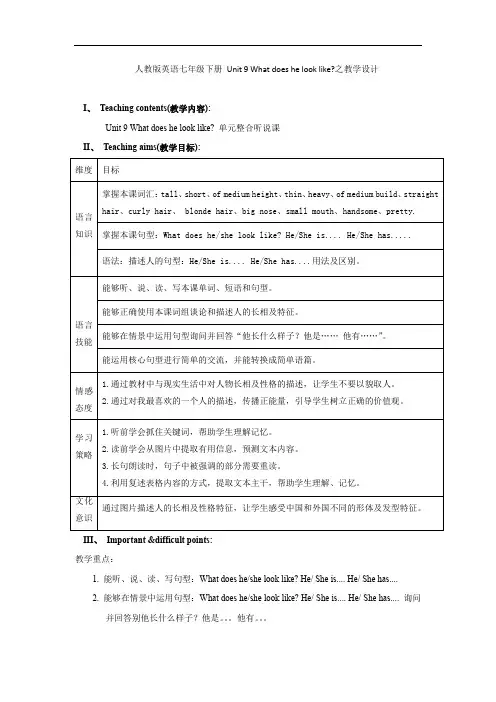
人教版英语七年级下册Unit 9 What does he look like?之教学设计I、Teaching contents(教学内容):Unit 9 What does he look like? 单元整合听说课II、Teaching aims(教学目标):III、Important &difficult points:教学重点:1. 能听、说、读、写句型:What does he/she look like? He/ She is.... He/ She has....2. 能够在情景中运用句型:What does he/she look like? He/ She is.... He/ She has.... 询问并回答别他长什么样子?他是。
他有。
教学难点:能运用单词和核心句型在进行交流,并能转换成简单语篇进行介绍。
IV、Teaching aids1. 教师准备:多媒体课件、板书卡片、教学卡片2. 学生准备:课本V、Teaching procedures(教学步骤)Watch a short video.Let SS watch a short video. 学生看自己班级学生的小视频。
I、Warming up:1. ChantLet SS chant and say together. 学生看着PPT并跟着老师进行chant.T: Do you like this video? Good. Look at this? Can you say?Let’s go!(chant 两遍。
)T: Great. You are really good chanters.2. BrainstormLet SS look at the PPT and say words aloud.T: Show your English! Now, I will give you another challenge.Say the words as quickly as possible.Let’s find the most beautiful student in our class.【设计意图】开课之初,通过让学生观看自己班级的微视频,微视频里有自己班级的学生以及对学生的描述,能让学生对今天要学习的内容产生亲切感。
初中英语教学设计与反思
初中英语教学设计与反思初中英语教学设计与反思(精选6篇)在日常生活中,教学是我们的工作之一、反思自己,必须要让自己抽身出来看事件或者场景,看一段历程当中的自己。
怎样写反思才更能起到其作用呢?以下是本店铺为大家收集的初中英语教学设计与反思,希望对大家有所帮助。
初中英语教学设计与反思 1一、教材分析本课是本单元的中心课文,主要以“邀请”这个话题为主线,电话交际为辅线来展开教学活动,讨论距离(befarfrom)请求许可(MayI Yes,youmay.No,youmaynot.)表明意图(Iwantto?)中展开教学活动。
二、学情分析学生已学习了打电话用语和MayI?句型,为学习本课做好了铺垫。
三、教学目标1.帮助学生掌握并灵活运用本课的重点词汇、短语、句型2.帮助学生掌握语言技能知识,熟练使用电话用语和邀请的日常交际用语,正确表达与本课有关的Distance、Permission、Intentions 内容。
3.让学生感受勇敢地开口与同学交流合作的快乐。
四、教学重点难点1.1.词汇:want,come,hello,with,who,when,do,leave,for,arrive2.2.短语:leaveforarrivein/attalkto/with3.3.句型:(1).wantsomebodytodosomething(2).invitesomebodytosomewhere(3).Thanksfor?五、教学方法创设情境、小组演练、仿编对话六、教学媒体MultimediaRecorderandTape七、教学过程Step1RevisionandLead-in1.帮助学生创设情境编演一个小对话,让他们四人一组模仿编演:A:MayIplaypingpongnow?B:No,youmaynot.A:MayIdomyhomeworknow?B:Yes,youmay.2.告诉学生李明想请Jenny和Danny一起去北京,该如何对父母说,让学生试编一个小对话,由此导入新课。
初中英语_ Unit 4 Sad but beautiful.教学设计学情分析教材分析课后反思
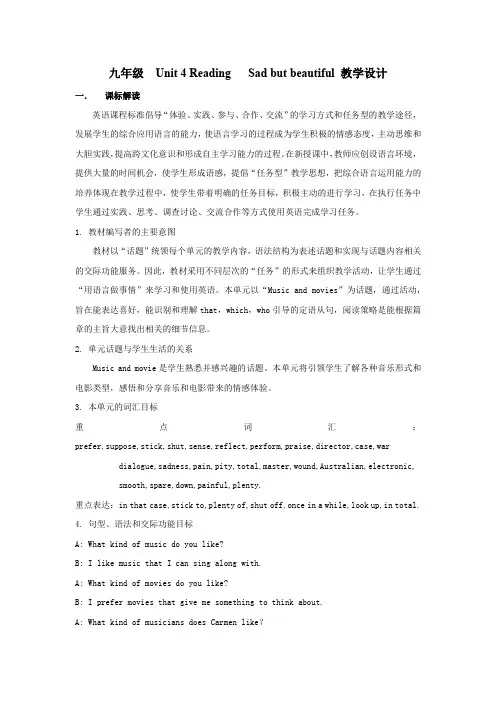
九年级Unit 4 Reading Sad but beautiful 教学设计一.课标解读英语课程标准倡导“体验、实践、参与、合作、交流”的学习方式和任务型的教学途径,发展学生的综合应用语言的能力,使语言学习的过程成为学生积极的情感态度,主动思维和大胆实践,提高跨文化意识和形成自主学习能力的过程。
在新授课中,教师应创设语言环境,提供大量的时间机会,使学生形成语感,提倡“任务型”教学思想,把综合语言运用能力的培养体现在教学过程中,使学生带着明确的任务目标,积极主动的进行学习,在执行任务中学生通过实践、思考、调查讨论、交流合作等方式使用英语完成学习任务。
1. 教材编写者的主要意图教材以“话题”统领每个单元的教学内容,语法结构为表述话题和实现与话题内容相关的交际功能服务。
因此,教材采用不同层次的“任务”的形式来组织教学活动,让学生通过“用语言做事情”来学习和使用英语。
本单元以“Music and movies”为话题,通过活动,旨在能表达喜好,能识别和理解that,which,who引导的定语从句,阅读策略是能根据篇章的主旨大意找出相关的细节信息。
2. 单元话题与学生生活的关系Music and movie是学生熟悉并感兴趣的话题。
本单元将引领学生了解各种音乐形式和电影类型,感悟和分享音乐和电影带来的情感体验。
3. 本单元的词汇目标重点词汇:prefer,suppose,stick,shut,sense,reflect,perform,praise,director,case,wardialogue,sadness,pain,pity,total,master,wound,Australian,electronic, smooth,spare,down,painful,plenty.重点表达:in that case,stick to,plenty of,shut off,once in a while,look up,in total.4. 句型、语法和交际功能目标A: What kind of music do you like?B: I like music that I can sing along with.A: What kind of movies do you like?B: I prefer movies that give me something to think about.A: What kind of musicians does Carmen like?B: She likes musicians who play different kinds of music.5. 本单元教学的基本设想1)采用“任务链”式活动设计,小步推进,螺旋上升。
初中英语_Unit1教学设计学情分析教材分析课后反思
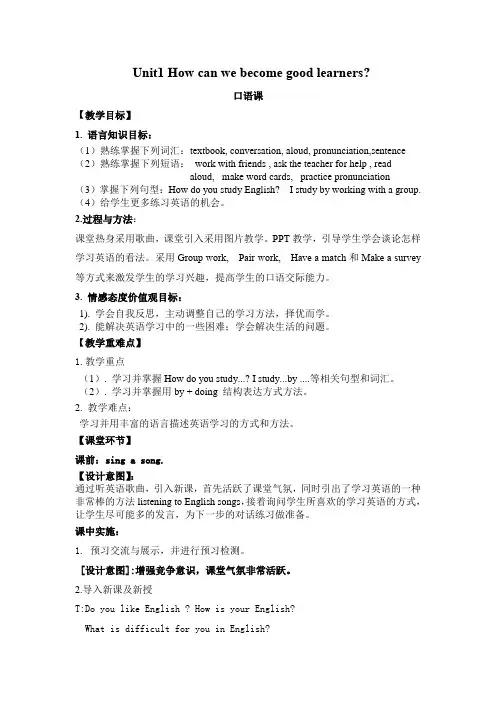
Unit1 How can we become good learners?口语课【教学目标】1. 语言知识目标:(1)熟练掌握下列词汇:textbook, conversation, aloud, pronunciation,sentence (2)熟练掌握下列短语:work with friends , ask the teacher for help , readaloud, make word cards, practice pronunciation(3)掌握下列句型:How do you study English? I study by working with a group. (4)给学生更多练习英语的机会。
2.过程与方法:课堂热身采用歌曲,课堂引入采用图片教学。
PPT教学,引导学生学会谈论怎样学习英语的看法。
采用Group work, Pair work, Have a match和Make a survey 等方式来激发学生的学习兴趣,提高学生的口语交际能力。
3. 情感态度价值观目标:1). 学会自我反思,主动调整自己的学习方法,择优而学。
2). 能解决英语学习中的一些困难;学会解决生活的问题。
【教学重难点】1.教学重点(1). 学习并掌握How do you study...? I study...by ....等相关句型和词汇。
(2). 学习并掌握用by + doing 结构表达方式方法。
2. 教学难点:学习并用丰富的语言描述英语学习的方式和方法。
【课堂环节】课前:sing a song.【设计意图】:通过听英语歌曲,引入新课,首先活跃了课堂气氛,同时引出了学习英语的一种非常棒的方法listening to English songs,接着询问学生所喜欢的学习英语的方式,让学生尽可能多的发言,为下一步的对话练习做准备。
课中实施:1.预习交流与展示,并进行预习检测。
[设计意图]:增强竞争意识,课堂气氛非常活跃。
初中英语教学设计与反思5篇(优秀版)
《初中英语教学设计与反思》初中英语教学设计与反思(一):初中英语教学设计与反思现代的英语教学要求学生听说读写全面发展,而英语知识散碎性又意味着记忆的不断重复性,那么把学生抓在手中让他们跟着学,有兴趣学就变得十分重要。
这就要求英语教学设计日臻精致、完美,行之有效和富于独创性,以极大地刺激学生的学习情绪,满足他们的学习欲求,构成师生之间和谐愉悦的课堂氛围。
下方是我对我们人教版初中英语八年级上Unit7第一课时教学设计,对如何将《英语新课程标准》的理念融入课堂教学作如下探讨。
Unit 7How do you make a banana milk shake?一、教学目标:1、重点词汇:peel, cut up, put into, pour, turn on。
2、重点句式:How do you make ?First , than ,next , finally。
3、语法知识:how much + 不可数名词how many + 可数名词二、潜力目标:学生学会熟练制作奶昔,并且能够用英语解说制作的步骤。
三、教具:多媒体搅拌器几个塑料杯六个香蕉两杯牛奶一大杯做好的香蕉奶昔教学过程一、导入课堂,先微笑询问全班同学:What drink do you like?待学生纷纷表达自我喜好时,举着备好的奶昔边说:Here is some banana milk shake。
Would you like some?学生抢着回答yes时,把准备好的奶昔分给他们(部分学生自带有杯子)品尝。
之后问:Do you know how to make this milk shake?(有学生回答no),并宣布:此刻我们来制作这种香蕉奶昔。
二、教学make a banana milk shake1、播放图片,让学生观看并说出制作奶昔所需工具和物品(必要教师时帮忙补充)。
顺势学习搅拌器(biender)这个单词。
2、播放制作香蕉奶昔全过程,结合学习关键词汇:peel, cut up, put into,pour, turn on。
初中英语_初二英语上册教学设计学情分析教材分析课后反思
教学设计_Unit 7 Will people have robots? Section B (2a-2e)_英语_初中_【教学内容】Unit 7 Will people have robots? Section B (2a-2e)【课型】新授课【教学目标】(一)知识与能力1. New words:human servants human snake shape building over and over again2. Target languages: how to talk about the future and make predictions. (Will + verb)(1)Students can obtain information by reading(2)Students can improve their reading skills (scanning for the main idea, careful reading for detailed information and further understanding)(二)情感态度与价值观1. Develop students’ imagination to make predictions about our future.2. Encourage students to get ready for a better future.(三)过程与方法1.Tasked-based language teaching method2. Students-focused teaching method3. Competitive method【教学重难点】(一)教学重点1. How to lead students to improve their reading skills smoothly.2. How to get students to use “ will” to make predictions about robots.(二)教学难点1. How to stimulate students’ imagination.2. How to get students to use “will” to make predictions about robots.3. How to make students to understand the reading text deeply.【设计思路】Step 1 Warm-upRound 1 Guessing gameShow some pictures of different robots and ask students to describe the appearances and their capabilities. Ask students to guess what the robots can do.Students’ activities:Describe the robots’ appearances and their capabilities.Guess what the robots can do.【设计目的】用竞赛的形式更能吸引学生的兴趣,同时又达到为阅读做好铺垫。
初中英语_Qomolangma教学设计学情分析教材分析课后反思
《Qomolangma—the most dangerous mountain in the WOrld?》教学设i∣∙一、教学目标知识目标:掌握单词achievement∖thick∖include∖condition∖succeecl∖achieve∖force∖nature z短语take in∖in the face of∖θven though,句型give UP doing sth,序数词+不左式等能力目标:1•快速阅读短文,找出主旨句。
2.仔细阅读各段,提取关键信息tl情感目标:学习登山者勇于而对挑战,不放弃的精神,做生活中的攀登者,努力解决日常生活中的困难。
二、教学重点1.句型:OneOf+ the+最高级+可数划词复数2.根据文章写出介绍登山者JUnkOTabei的短文三、教学难点1.形容词最髙级2.人名、地久、数字、年代的念法四、教学方法任务型教学五、教具准备PPT课件六、教学过程SteP 1: GreetingT: TOday I am your new teacher, and you are my new StUdents. SO this ClaSS is a ChalIenge for us. (板书ChaIIenge)DO you Want to ChaIIenge yourself? Let's ChaIlenge OUrSelVeS together!SteP 2: Warming UP(1) T: FirSt Of all, Iet me introduce myself.(出示幻灯片)T:HaVe you ever been to Mingji?(出示图片)One Of the most POPUIar PlaCeS in Mingji is the Ming Lake・(板书the most POPUlar)It is in the SOUtheaStern Part Of Mingji・(板书SOUtheaStern∖southwestern)BeaUtifUl SightS include the StatUe Of Meng MU Ci Zi and WOOden bridges.(板书include)The musical fountain is the most famous』板书the most famous)The highest Water COIUmn Can reach 18.43 meters.(练Ar数字的读法)(2) T: I have introduced myself. NOW I Want to know SOmething about you.In OUr class, WhO is the tallest? WhO HaS the IOngeSt hair? WhO Can run fastest? WhO Can Sing the most beautifully?I know that you WiIl have an importa nt exam in two mon ths ・ YOU are PrePari ng for it now. I have SOme questions abOUt geography ・ Can you help me?(岀示 PPT )In the WOrld the biggest desert is ........... The deepest Sea is ............ T he IOngest river is ........... T he highest mountain is.........SteP 3: FaSt reading —read and match Par.l a.Spirit (精神)of ClimberS Par.2 b.Achievements (成就)Of ClimberSPar.3 c. Facts and dan gers___________ ClOUdS_____________ SnOW in ClUde___________ Weather COnditiOnSJ _________________ StOrmSPar.2 __________________ ____________________________WhO WhenThe first PeOPIe to reach the top__________________ ______________________________ The first Chinese to do SO__________________ ______________________________ The first WOman to SUCCeed____________________ ____________________________SteP 5: Time to relax Par.l Part Of ChinametersDiffiCUItieS in the ______________(1) PIay a game: LiSten and POint the directions(2) WatCh a ShOrt VideOSteP 6: T:FrOm the video, We know that it is Very dangerous to Climb QOmOIangma・ SOme PeOPIe even IOSt their IiVeS・ BUt Why do SO many ClimberS risk their lives? Read Par.3 and find OUt the reas on.(1)OnG Of the main reasOnS is that _______________________________(2)The SPirit Of these Climbers ShOWS that _____________________________________ ・SteP 7: SUmmarySteP 8: PairWOrkAiSa reporter; B is JUnkO Tabei, PraCtiCe the dialogue・SteP 9: Make a report about JUnkO Tabei.JUnkO Tabei WaS born in __________ ・ She WaS the first WOman to ____________ ・ EVen though it is ____ to CIimb QOmOlangma, many PeOPle Want to _____________ ・ I think JUnkO Tabei is Very_________ .We ShOUId Iearn from her. We ShOUld never _____________ ・SteP 10: HOmeWOrkSteP 11:情感提升:Climb your OWn CiOmOIangmaMaybe I am not good at English・Maybe I WOrry about the COming exam・Maybe I argued With my best friend・Maybe my ParentS are too StriCt With meI won't give UP trying to achieve my dream・I Want to ChalIenge myself.Be a Climber Of Iife・KeeP moving・I WiIl reach the top Of my QOmOlangma!(附带板书)difficulty八年级卜册Wnit7 SeCtiOn A Reading))学情分析八年级学生在上学期学习过有关形容词、副词比较级和最髙级的相关知识,同时对有关喜马拉雅山的地理知识比较熟悉,这些都有助于学生理解本课内容。
初中英语_九年级全一册教学设计学情分析教材分析课后反思
初中英语人教版九年级全一册Unit 2 I think that mooncakes are delicious!教学设计【课型】复习课【学习目标】1.知识目标:Can master the words, expressions and important passages of Unit14.2.能力目标:Can share past memories and experiences freely.Can look ahead to the future.3.情感目标:Learn to be thankful to the people around us.【重点与难点】重点:掌握Unit 2中的重点单词、短语和句子。
难点:能力目标。
【知识链接】Step1、Leading--inEnjoy an English song named “I remember ...”Step2、解读目标Step3、Review:Task1. To be the best reciter.(背诵者)Phrases1. be going to 将要,打算2. in + 时间在……后3. give sb. sth. 给某人某物,把某物给某人4. plan to do st 计划做某事5. refuse to do sth. 拒绝做某事6. one of + 名词复数…之一7. It is + 名词 + 动词不定式做某事是…..8. What …..think of…..? ….认为……怎么样….9. make sb. do sth. 使 / 让某人做某事10. used to be 过去是…….11. warm sb. to do sth. 告诫某人做某事12. tell sb. to do sth. 告诉某人做某事13. decide to do sth. 决定做某事14. promise to do sth 承诺/ 答应做某事Sentences1. What a great day!多么美好的一天!2. How pretty the dragon boats were! 龙舟真漂亮啊!3. Bill wonders whether they‘ll have zongzi next year. 比尔想知道明年他们是否将再吃粽子。
初中英语_Unit2教学设计学情分析教材分析课后反思
Unit 2 I'll help to clean up the city parks.Section A 3a-3c教学设计一、教学目标:1. 语言知识目标:1) 学习掌握下列词汇:several, feeling, satisfaction, joy, owner, journey2)阅读短文,能按要求找到相应的信息。
3)通过阅读提高学生们的阅读能力。
4) 了解世界各地的学生们都进行哪些志愿活动。
2. 情感态度价值观目标:使学生在谈论如何为别人提供帮助的对话中能意识到尽己所能,帮助他人,乐于奉献是一种良好的品德,培养学生为他人着想,热爱公益事业,乐于助人的优良品质。
二、教学重难点:1. 教学重点:1) 掌握本部分出现的生词和词组,达到熟练运用的目标。
2) 阅读短文,获得相关的信息。
通过阅读练习,来提高阅读能力。
2. 教学难点:1) 阅读短文,获得相关的信息的能力。
2) 理解并运用所学的词汇及表达方式。
三、教学过程Step1: Free talk(1) Do you want to be a volunteer?(2) What can you do as a volunteer?Step 2: Prediction(1) Where is the boy in the first picture? What’s he doing?(2) Where are the girls in the second picture? What are they doing?(3) Do they work for money?Step 3: SkimmingRead the passage quickly and fill in the blanks. Students Who Volunteer:Mario works in:…an animal hospitalLoves: animalsMary works in: an after-school reading programLoves: readingStep 4:ScanningTask1: Read Para.2 and answer.What does Mario volunteer to do?He volunteers at an animal hospital to care for animals. Task2: Read Para.2 and fill in the chart.Task3: Read Para.3 and answerWhat does Mary volunteer to do?She works at an after-school reading program to help kids to readTask4: Read Para.3 and fill in the chart.Task5: Looking & Thinking观察表格中蓝色字体的动词短语及相应的横线上所填的单词,可以看出,to后均用的动词的______形式,这种_________________即为动词不定式的基本形式。