
外研版初中英语知识点汇总
初一外研版英语笔记
初一外研版英语笔记一、词汇部分。
1. 重点单词。
- 名词。
- country:国家。
例如:China is a big country.(中国是一个大国。
)- capital:首都。
如:Beijing is the capital of China.(北京是中国的首都。
)- language:语言。
English is an international language.(英语是一门国际语言。
)- 形容词。
- big:大的。
反义词是small。
例如:This city is very big.(这个城市很大。
)- famous:著名的。
We can visit some famous places.(我们可以参观一些著名的地方。
)- 动词。
- be from:来自。
I am from Shanghai.(我来自上海。
)- speak:说(某种语言)。
He can speak English and French.(他会说英语和法语。
)2. 单词变形。
- country(复数)countries。
例如:There are many countries in the world.(世界上有许多国家。
)- big(比较级)bigger,(最高级)biggest。
My house is bigger than yours.(我的房子比你的大。
)3. 词汇记忆技巧。
- 联想记忆法:比如记忆“capital”,可以联想到各国的首都,像法国的首都巴黎(Paris)是一个充满艺术气息的首都。
- 制作单词卡片:一面写单词,一面写释义和例句,随时复习。
二、语法部分。
1. 一般现在时。
- 用法。
- 表示经常或习惯性的动作或状态。
例如:I get up at six every day.(我每天六点起床。
)- 表示客观事实或真理。
The earth goes around the sun.(地球绕着太阳转。
)- 句子结构。
外研版初中英语知识点归纳
Module 1 重点词组1. “欢迎回到某地”welcome back to +地点名词如:欢迎回到学校welcome back to school热烈欢迎某人:give sb a warm welcome不用谢:You are welcome2. 首先:first of all (放句首)3.失物招领:lost and found失物招领箱:lost and found box在失物招领箱中:in the lost and found box4. 某人有某物:have(got)/has(got)= have/has某处有某物:there be(is/are)There be 的be动词的单复数根据“就近原则”变化(be动词与离它最近的主语在数上保持一致如:(1)桌子上有一支钢笔和一些书There is a pen and some books on the desk. (这里要用is,因为靠近它的名词a pen,是单数)(2)桌子上有一些书和一支钢笔There are some books and a pen on the desk,.(这里用are,因为靠近它的名词是some books,是复数) 5.谁的:?这是Lucy6. 在这儿/如果主语是名词要用全部倒装(谓语动词放在主语之前),如果主语是代词用部分倒装如:这儿有一封信。
Here is a letter.(letter是名词,要全部倒装,letter要放在谓语动词is后)它在这儿。
Here it is.(it是代词,要部分倒装,it放is前面)7.照顾:take care of = look after小心(照顾、做、处理):be careful with+名词小心做某事:be careful to do sth如:小心鸡蛋:Be careful with the eggs.小心地把鸡蛋拿到厨房:Be careful to take the eggs to the kitchen.8.从现在开始:from now on9.男士钱包:wallet 女士钱包:purse10.与。
初中英语知识点总结外研社

初中英语知识点总结外研社一、词汇与短语1. 基础词汇- 常见名词:家庭成员、学校科目、日常用品、颜色、数字、食物等。
- 动词:一般现在时、一般过去时、现在进行时的动词变化。
- 形容词和副词:描述人、物、地点的特征及其比较级和最高级形式。
- 代词:人称代词、物主代词、反身代词、指示代词、疑问代词等。
2. 短语搭配- 动词短语:look at, listen to, help with, play with等。
- 介词短语:in the morning, on the table, at school等。
- 常用表达:问候、感谢、道歉、请求、提供帮助等。
二、语法1. 时态- 一般现在时:表示经常发生的动作或状态。
- 现在进行时:表示正在进行的动作。
- 一般过去时:表示过去某一确定时间发生的动作或状态。
- 一般将来时:表示将来某一时间会发生的动作或状态。
2. 句型结构- 陈述句:表达事实或陈述性的句子。
- 疑问句:提出问题的句子,包括一般疑问句和特殊疑问句。
- 否定句:表达否定意义的句子。
- 祈使句:表示命令、请求或建议的句子。
3. 语态- 被动语态:表示句子的主语是动作的承受者。
4. 非谓语动词- 动名词:作为名词使用,可以作主语、宾语等。
- 分词:现在分词和过去分词,用作形容词或副词。
5. 从句- 宾语从句:作为句子宾语的从句。
- 定语从句:修饰名词或代词的从句,通常由关系代词引导。
- 状语从句:表示时间、原因、条件、结果等的从句。
三、阅读理解1. 阅读技巧- 快速阅读:通过略读抓住文章大意。
- 精读:仔细阅读,理解文章细节和深层含义。
- 寻找主题句:通常位于段落的开头,概括段落主要内容。
2. 阅读题型- 事实细节题:根据文章内容选择或判断正确的信息。
- 主旨大意题:确定文章或段落的中心思想。
- 推理判断题:根据文章内容进行逻辑推理,得出结论。
四、写作技巧1. 文章结构- 引言:介绍背景信息,引出文章主题。
外研社版九年级英语知识点
外研社版九年级英语知识点一、动词时态动词时态主要分为以下几种:一般现在时、一般过去时、一般将来时、现在进行时、过去进行时、将来进行时、现在完成时、过去完成时、将来完成时。
1. 一般现在时(Simple Present Tense)表示经常性或习惯性的动作,或者客观真理等。
句子结构为:主语 + V原 + 其他成分。
如:- I go to school every day.- Water boils at 100 degrees Celsius.2. 一般过去时(Simple Past Tense)表示过去发生的动作或状态,并且已经结束。
句子结构为:主语 + V过去式 + 其他成分。
如:- She visited her grandparents last weekend.- They played basketball yesterday.3. 一般将来时(Simple Future Tense)表示将来要发生的动作或状态。
句子结构为:主语 + will + V 原 + 其他成分。
如:- I will buy a new car next year.- They will have a party on Friday.4. 现在进行时(Present Continuous Tense)表示现在正在进行的动作,常与时间状语连用。
句子结构为:主语 + am/is/are + V-ing + 其他成分。
如:- She is reading a book now.- They are playing soccer in the park.5. 过去进行时(Past Continuous Tense)表示过去某一时刻正在进行的动作。
句子结构为:主语 + was/were + V-ing + 其他成分。
如:- He was studying when I called him.- They were watching a movie at that time.6. 将来进行时(Future Continuous Tense)表示将来某一时刻正在进行的动作。
外研版初中英语知识点汇总
外研版初中英语知识点汇总一、时态和语态1.一般现在时:表示经常性的动作、习惯、真理、客观事实等。
2.一般过去时:表示过去的动作或状态。
3.一般将来时:表示将来发生的动作或状态。
4.现在进行时:表示现在正在进行的动作。
5.过去进行时:表示过去一些时间正在进行的动作。
6.现在完成时:表示动作已经完成,对现在的影响。
7.过去完成时:表示过去一些时间或动作之前的完成动作。
8.将来完成时:表示将来一些时间还没有完成的动作。
9. 被动语态:由“be”动词及过去分词构成,表示被动的动作或状态。
二、名词1.可数名词和不可数名词。
2.单数和复数形式。
3. 可数名词的限定词:a / an, some, any等。
4. 不可数名词的限定词:some, any, much, many, a lot of等。
5. 物主代词:my, your, his, her, its, our, their。
6. 不定代词:somebody, anybody, everybody, nobody, something, anything, everything, nothing等。
7.句子成分中的名词:主语、宾语、表语、定语等。
三、代词1. 主格和宾格代词:I, you, he, she, it, we, they。
2. 形容词性物主代词:my, your, his, her, its, our, their。
3. 名词性物主代词:mine, yours, his, hers, its, ours, theirs。
4. 反身代词:myself, yourself, himself, herself, itself, ourselves, yourselves, themselves。
5. 不定代词:somebody, anybody, everybody, nobody, someone, anyone, everyone, no one等。
外研版初中英语各册知识点外研版
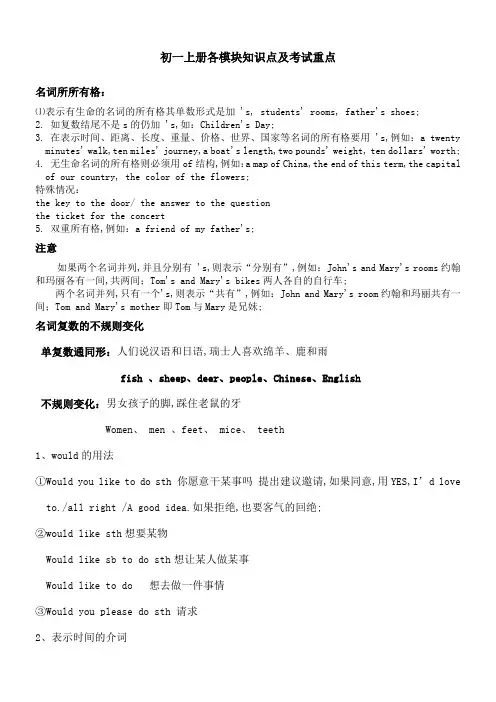
初一上册各模块知识点及考试重点名词所所有格:⑴表示有生命的名词的所有格其单数形式是加 's, students' rooms, father's shoes;2. 如复数结尾不是s的仍加 's,如:Children's Day;3. 在表示时间、距离、长度、重量、价格、世界、国家等名词的所有格要用 's,例如:a twenty minutes' walk,ten miles' journey,a boat's length,two pounds' weight, ten dollars' worth;4. 无生命名词的所有格则必须用of结构,例如:a map of China,the end of this term,the capital of our country, the color of the flowers;特殊情况:the key to the door/ the answer to the questionthe ticket for the concert5. 双重所有格,例如:a friend of my father's;注意如果两个名词并列,并且分别有 's,则表示“分别有”,例如:John's and Mary's rooms约翰和玛丽各有一间,共两间;Tom's and Mary's bikes两人各自的自行车;两个名词并列,只有一个's,则表示“共有”,例如:John and Mary's room约翰和玛丽共有一间;Tom and Mary's mother即Tom与Mary是兄妹;名词复数的不规则变化单复数通同形:人们说汉语和日语,瑞士人喜欢绵羊、鹿和雨fish 、sheep、deer、people、Chinese、English不规则变化:男女孩子的脚,踩住老鼠的牙Women、 men 、feet、 mice、 teeth1、would的用法①Would you like to do sth 你愿意干某事吗提出建议邀请,如果同意,用YES,I’d love to./all right /A good idea.如果拒绝,也要客气的回绝;②would like sth想要某物Would like sb to do sth想让某人做某事Would like to do 想去做一件事情③Would you please do sth 请求2、表示时间的介词At 后接时间点,周末at the weekendIn 用在年、月、季节或上午、下午、晚上等名词前On 后一般跟具体的某一天或某一天的上午、下午或晚上3、look、see、watch、readLook集中注意力看,强调看的动作,如跟宾语,要用atSee 强调看的结果,看见,看到Watch 强调专注地看,有欣赏的意味,常用语看电视,看球赛Read 阅读,看书1、would的用法①Would you like to do sth 你愿意干某事吗提出建议邀请,如果同意,用YES,I’d loveto./all right /A good idea.如果拒绝,也要客气的回绝;②would like sth想要某物Would like sb to do sth想让某人做某事Would like to do 想去做一件事情③Would you please do sth 请求2、表示时间的介词At 后接时间点,周末at the weekendIn 用在年、月、季节或上午、下午、晚上等名词前On 后一般跟具体的某一天或某一天的上午、下午或晚上初一下册重点知识2、形容词和副词形容词比较级用法:1.最明显的提示词是than,其结构为“A…+比较级+than+B”;2.有表示程度的副词a little,a bit,a few,a lot,much,even,still,far,rather,any等修饰时,用形容词比较级;3.表示两者之间进行选择“哪一个更…”时,句型“Which/Who is+形容词比较级,A or B ”4、表示“越来越……”,即“比较级+and+比较级”,多音节词和部分双音节词时用“moreand more+形容词原级”;5、表示“越……就越……”时,用“the+比较级,the+比较级”结构;形容词最高级用法:1.表示三者或三者以上的人或物进行比较时,用最高级形式;最高级前必须加定冠词the,句末常跟一个in/of短语来表示范围;2.表示在三者或三者以上的人或物进行选择时,用“Which/Who is+the+最高级,A,B or C ”3、表示“最……的……之一”时,用“one of the+形容词最高级”结构,4、形容词最高级前面可以加序数词,表示“第几最……一、词汇1、enjoyenjoy sth/doing 喜欢某物/做某件事情enjoy oneself= have a good time玩的愉快派生词:enjoyable,令人愉快的 enjoyment, 乐趣2、dress,put on, wear,be indress后常跟人作宾语,给…穿衣服,get dressed或dress oneself put on意为穿上,强调穿的动作,宾语通常是衣服、鞋帽wear穿着,戴着,强调穿的状态,宾语可以是衣帽也可以是饰品be in也表状态,后面要加颜色,表示穿着什么颜色的衣服3、 bring, take, carry 和get的用法;bring意思为“拿来”、“带来”;指将某物或某人从别处“带来”;Bring me the book, please.take意思是“拿走”,“带走”It looks like rain. Take a raincoat with you.carry 是“带着、搬运、携带”的意思, 不表明来去的方向;Do you always carry a handbagGet 是去某处将某物拿回来;Please go to my office to get some chalk.4、strict adj. be strict with sb.对某人要求严格be strict in sb 对某事要求严格5、spend人+spend+时间/金钱+ on sth/ in doing sth6、get ready forget ready for sth 为…做准备强调动作get ready to do sth 准备去做…强调动作be ready for sth 准备好… 强调状态be ready to do sth 准备好去做…强调状态get sth ready 把sth 准备好7、look forward to doing8、be good/bad atdo well/badly in9、hope 与wish的区别:希望去做… hope to do sth/wish to do sth希望sb去做… wish sb to do …hope与wish后都可以接that从句.二、金牌句型1、It is more difficult for old people to learn English.It is +adj.+for sb+to do sth.2、It is the best way to get to school.3、What’s the population of Shanghai在询问有多少人口用“What’s the population of…”/ “How large i s the population of…”表示“有多少人口”用“…have/has a population of…”形容人口的多少用large和small,而不用many,much和few,little4、有关how的疑问句短语How long… 多长时间或物体长度How soon… 过多久,用于将来时间How often… 频率How far… 多远,指距离5、What be sb like 询问某人什么样,可以是外貌或性格等;What do/does sb look like 询问相貌;初二上册考试重点一、语法1、时态的考察,对于各种时态主要看时间标志词,尤其是:just now/just/now; ago/before; five years ago/since five years ago/for five years, 时态的考察以现在完成时为重点,注意非延续性动词在现在完成加时间的情况下需要变为延续性状态的词;have been to /have been in/ have gone to2、反义疑问句祈使句Let引导的祈使句有两种情况:1Let's go home, shall we/ shan't we2Let us/me..., will you或won't you;Let me have a try, will you/won't you3动词原形开头的祈使句都用will you 或won’t you当陈述部分含I think believe, suppose...that... 结构时,其反意疑问句须与从句的主、谓语保持一致,注意主句的主语必须是第一人称;例如:I don't think he will come, will he若是非第一人称,则与主句的主语相一致He thinks that she will come, doesn’t he当陈述部分为从句时,若主句主语为 I ,反意部分的主语为从句主语;若不为 I ,反义部分的主语为主句主语;①I know your father is a worker, isn't he①she knows your father is a worker, doesn’t she当陈述部分含有以下这些含有否定意义的词时:few, little, seldom,hardly, never, not, no, no one, nobody, nothing, none, neither等,其反意疑问句需用肯定结构;例如: He is never late for school, is he陈述部分是there be句型时,其反意疑问句中要用there;There was a hospital here, wasn't there陈述部分的主语是everything, nothing, anything或something 时,反意疑问句的主语应用代词it;Something is wrong with my radio, isn't it 我的收音机出毛病了,是吧陈述部分的主语是 everybody, everyone, anybody, anyone, somebody, someone, nobody, no one, none, neither 时, 其反意疑问句的主语需用复数代词they;例如:Everyone is here, aren't they 大家都到了,是吗3、to do 不定式1. 不定式作主语时,常用it作形式主语,而将作主语的不定式放在句子后部;It is exciting to surf the Internet.It's ... of sb. to do sth.与It's... for sb. to do sth.形容词形容人的时候用of,形容事情的时候用forIt's very kind / nice of you to help me;It's hard for the Chinese students to learn Russian. 中国学生学俄语是很难的;2.动词不定式在句中作宾语,如带有宾语补足语时,要先用it作形式宾语,而将该不定式后置;注意:一些动词之后可以接to和doing作宾语时,如stop,forget,remember, try,need 等I don't think it right to do it in that way.我觉得以那种方式去做是不恰当的;I find it hard to get along with him.我发现与他相处不是件容易的事;4.作补语有些动词后跟不带to 的不定式作宾语补足语;①感官动词②使役动词③help sb. do…或help sb. to do当此类句子改为被动语态时,要补上to.He is often heard to sing this song.The workers were made to work 12 hours a day.在 think, find, consider, discover等动词后常用to be +adj.结构作宾补,有时to be 可省略;We all think/ consider/ find/ discover him to be kind and honest.动词不定式的省略1不定式在使役动词 let, have, make和感官动词 see, watch, notice , observe, hear, smell, feel, find 等后作宾补时,省略to;help 可带to,也可不带to →help sb to do sth;2 Why not 后面接不带to 的不定式;常用来表建议;Why not have a break3but和except:but/except前的部分出现实义动词do时,其后面出现的动词不定式可以不带to;比较:He wants to believe anything but to take the medicine.Last night I did nothing but to watch TV.He does everything except to work.4 由and, or或than连接的两个不定式,第二个不定式的to 可以省去;例如:He wants to move to France and marry the girl.5通常在discover, imagine, suppose, think, understand等词后,可以省去to be:He is supposed to be an honest man.4、情态动词must是重点1表示义务;意为“必须”主观意志;否定形式是needn’t,2表示揣测;意为“想必、准是、一定”等,只用于肯定句;否定形式是can’t3musn’t本身表示“禁止”,“不允许”,“不能”二、重点词汇、句型1、※What/how about doing …※Why not/wh y don’t you do…..※It is +adj.+for sb to do sth 此句型到第九模块会重点讲解2、※other 系列词3、※4、※ no one 和none5、bring, take, carry 和get的用法;bring意思为“拿来”、“带来”;指将某物或某人从别处“带来”;Bring me the book, please.take意思是“拿走”,“带走”,把某物或某人从这里“带来”或“拿到”某处之意;It looks like rain. Take a raincoat with you.carry 是“带着、搬运、携带”的意思,指随身携带,有背着、扛着、抱着、提着的含义,不表明来去的方向;Do you always carry a handbagGet 是去某处将某物拿回来;Please go to my office to get some chalk.6、through/across/overthrough 穿越,指从空间内穿越 through the dooracross,横越穿过,从表面走过,或从一边到另一边,across the roadover翻越,跨越7、provide /offerprovide sth for sb / provide sb with sthoffer sth to sb / offer sb sth主动提供8、happen / take placehappen指事件偶然发生,还可以表示“碰巧”之意,不用于被动语态sth happen to sbsb happen to do sth.It happens that+句子take place多指按计划或者安排而发生,不用于被动语态9、compare…with…比较compare…to…. 比喻10、depend on sb 依赖depend on sth 依…而定初二下册重点知识一、重点词汇1、makemake +宾语+动词原形 He made us stay with him.make +宾语+ 形容词 He tried to make his mother happymake +宾语+名词- He made me his friend.make +宾语+介词短语 He asked us to make ourselves at home.make +宾语+过去分词 What made him so frightened2、seemSeem+形容词 English seems a little difficult.Seem to do He doesn’t seem to have any friends.=It seems that he doesn’t have any friends.It seems as if they were in a dream.3、suggestsuggest+名词、代词suggest doing建议做某事suggest sb do 建议某人做某事4、refuse to do sth拒绝做某事5、beat 打败,后接运动员、球队、对手win 接比赛、战争,奖项6、avoid doing sth避免做某事7、dependdepend on sb 依赖depend on sth 依…而定8、on one’s own独自of one’s own 某人自己的9、have problem with …在哪一方面有麻烦have problem/trouble/difficulty indoing,其中trouble/difficulty是不可数名词,前面用no/much/some/little any修饰10、come up出现,发生1发芽,In March, lots of plants begin to come up.2太阳升起3发生,出现I'll let him know if anything comes up.4被提及A number of questions came up at the meeting.11、in order to、to+动词原形、so as to,so…that.so that,in order thatin order to、to+动词原形、so as to引导目的状语从句,有时为了表示强调,也可把in order to,to do放在句首,否定形式是in order not to,so as not to12、as well as并且,还,可与not only…but also互换,但是as well as强调前面的内容,not only…but also强调后面的内容1连接两个并列成分He as well as his friends likes going shopping.2as well as还可以表示“和…一样好”,well是副词,用于修饰实义动词;3as well 可单独做副词,表示“也”,位于句末;13、such adj. 如此,这样so +adj.+a/an+单数名词such+a/an+adj.+单数名词such +adj.+复数名词、不可数名词,当adj.是many/much/few/little时用so14、倒装句So + be/助动词/情态动词+主语“某人或某物也一样”I will go there tomorrow. So will she.So +主语+be/助动词/情态动词“的确如此”"It was very cold yesterday.""昨天很冷;""So it was.""的确如此;"对于上述两种情况,当前一句是否定句时, so须改用neither或nor;15、besides,but,except和except forbesides:除了......还包括He has another car besides this.but与excep t同义,但but多用在every,any,no等和由这些词构成的复合词except:除了;例句:Except you, there is no one can help me. 除了你没人能帮我except for:在一类中除去另一类,Smith is a good man, except fo r his bad temper二、语法知识1、宾语从句宾语从句的语序宾语从句的语序应为陈述句的语序;例如:I hear that physics isn’t easy.I think that you will like this school soon.Can you tell me how I can get to zooPlease tell me when we’ll have the meeting.宾语从句的时态如果主句的时态是一般现在时,宾语从句该用什麽时态就用什麽时态;I don’t think that you are right.Please tell us where he is.Can you tell me how I can get to the railway station如果主句的时态是一般过去时,宾语从句只能用相应的过去时态一般过去时, 过去进行时, 过去将来时,过去完成时;例如:He asked what time it was.He told me that he was preparing for the sports meet.He asked if you had written to Peter.知识拓展:宾从的主语与主句的主语或宾语相同时,可把从句替换为“疑问词 + to d o”①.I haven’t decided where I will go =I haven’t decided where to go②.He asked me what I bought = He asked me what to buy.2、状语从句★时间状语从句1由 when,as soon as ,before 等引导的时间状语从句用一般现在时表示将来时间;2带有till或until引导的时间状语从句的主从复合句里,如果主句用肯定式,其含义是“一直到……时”,谓语动词只能用延续性动词;如果主句用否定式,其含义是“直到……才……”, “在……以前不……”, 谓语动词可用瞬间动词;例如:The young man read till the light went out.We won’t start until Bob comes.★条件状语从句1条件状语从句遵循“主将从现”原则,一般现在时表示将来时间;2“祈使句 + and or+ 陈述句” 在意思上相当于一个带有条件状语从句的复合句;Hurry up, or you’ll be late. =If you don’t hurry up, you’ll be late.★结果状语从句结果状语从句由so…that, such…that, so that此知识点牵扯到重点词汇中的 so +adj.+a/an+单数名词such+a/an+adj.+单数名词such +adj.+复数名词、不可数名词,当adj.是many/much/few/little时用so3、to do 和doing做宾语常考的动词后加-ing.1. Enjoy doing sth 喜欢做某事2. Like doing sth 喜欢做某事3. Have fun doing sth 玩得开心4. Practice doing sth 练习做某事5. Spend doing sth 花费时间做某事主语是人6. Keep doing sth 保持一直做某事7. How about doing sth 做某事怎么样表建议8. What about doing sth 做某事怎么样表建议9. Have a difficulty doing sth 做某事有困难10. Have a good time doing sth 玩得开心11. Feel like doing sth 想要做某事12. Can’t help doing sth禁不住做某事13. start doing sth 开始做某事14. go on doing sth 继续做某事15. mind doing sth 介意做某事16. finish doing sth 完成做某事17. be busy doing sth 忙于做某事18. see/hear sb doing 看到/听到某人正在做某事19. remember doing sth 记住曾做过某事20. forget doing sth 忘记曾做过某事21. try doing sth 做某事试试看有何效果22. mean doing sth 意味着做某事23. can't help doing sth 禁不住做某事24. stop doing sth. 停止正在做的事初三上册考试重点知识一、语法知识1、时态被动语态的特殊用法:1、不及物动词带介词和介词宾语,在变为被动语态时,仍然要带上介词,如The teacher is listened to carefully by the students in class.The new students are looked after in the school.The things are take good care of .2、当动词带有符合宾语时,并且宾补是省去“to”的动词不定式时,在被动语态中应加上“to”,一感,二听,三让,四看They make us do all the work. We are made to do all the work.We often hear her sing English songs. She is often heard to sing English songs.I see him walk to school. He is seen to walk to school.3、当动词带双宾语时,将其中一个宾语提前作被动语态的主语,另一个不动; 如果是将指物或指事的宾语提前,则指人的宾语前应加上 to、for如:I am given some nice presents.They give me some presentsSome nice presents are given to me.The children are often told some stories byhimHe often tells the children some stories.Some stories are often told to the children by him.动词后加to:give,show,send,bring,lend,promise等;动词后加for: pay,buy,sing,make,get等3、定语从句修饰人只用who的情况:a. 先行词是one , ones , anyone , those 时;b. there be句型中修饰名词时;c. 先行词后有一个较长的定语;1Anyone who hasn’t handed in his home- work should stay after school.2There is a girl who wants to see you at the school gate.3Did you see the man in the park yesterday afternoon who wore a red shirt 修饰人或物只用that的情况:1 先行词是all, few, little, nothing, everything, anything 等不定代词时; All that he said is true.2 先行词被only, no, any, all,等词修饰时;He is the only foreigner that has been to that place.3 先行词是序数词或被序数词修饰的词;例如:He was the second person that told me the secret.4 先行词是形容词最高级或被形容词最高级修饰的词;This is the best book that I have read this year.5 先行词既包括人又包括物时;例如:修饰物只用which的情况:a. 先行词在定语从句中作介词的宾语时b. 先行词为that时1This is the house in which Lu Xun once lived . 这就是鲁迅以前住过的房子;2What’s that which you are holding in your arms 你抱着的那个是什么定语从句可简化为短语1.定语从句为被动语态时可简化为过去分词短语;定语从句为现在进行时可简化为现在分词短语;2.定语从句的谓语be后是介词短语,可简化为介词短语作定语;3.定语从句的谓语动词含情态动词,可简化为不定式;eg.1I bought a book that was written by Lu Xun.= I bought a book written by Lu Xun.2Tell the children who are playing there not to do that.= Tell the children playing there not to do that.3The book that is on the table is mine.= The book on the table is mine.4 We have nothing that we should fear.= We have nothing to fear.4、冠词和数词1、a/an用在序数词之前表示“再一次,又一次’2、the用在姓氏复数之前,表示“某某一家人”,“某某夫妇”;例如:the Browns, the Whites等;3.表示一个具体数字时,hundred, thousand, million一律不用复数;在表示一个不确定数字时则用复数;例如:There are three thousand students in our school.After the war, thousands of people became homeless.3 表示“……十”的数词的复数形式可用来表示人的岁数或年代,例如:He is in his early thirties.He died still in his forties.This took place in 1930s.5、主谓一致1. 语法一致的原则2并列主语如果指的是同一人,同一事物或同一概念,谓语动词用单数;例如:His teacher and friend is a beautiful girl.The poet and writer has come.3由and连接的并列单数主语之前如果分别由each, every修饰时,其谓语动词要用单数形式;例如: In our country every boy and every girl has the right to receiveeducation.4主语是单数时,尽管后面跟有 but ,except, besides, with ,as well as等短语,谓语动词仍用单数;例如:The teacher with his students is going to visit the museum.5 一些只有复数形式的名词,如people, police, cattle, clothes等作主语时,谓语动词要用复数;The police are looking for lost boy.7有两部分构成的物体的名词,如glasses, shoes, trousers, chopsticks, scissors 等作主语时,谓语动词用复数;例如:Where are my shoes I can’t find them.Your trousers are dirty. You’d b etter change them.如果这类名词前用了a pair of等,则往往用作单数,谓语动词的单复数形式往往取决于pair的单复数形式;例如: My new pair of socks is on the bed.2. 意义一致的原则1表时间、距离、价格、度量衡等的名词作主语时,谓语动词通常用单数;例如:Twenty years is not a long time.Ten dollars is too dear.2有些集合名词,如family, team等作主语时,如作为一个整体看待,谓语动词用单数;如指其中每个成员,则用复数;例如:My family is big one.My family are watching TV.5“分数或百分数/the rest+of+名词”构成的词组作主语时,其谓语动词要以of后面的名词而定;名词是复数,谓语动词用复数:名词是单数,谓语动词用单数;例如:It is said that 35 per cent of the doctors are women.Three –fourths of the surface of the earth is sea.8凡是以“定冠词+形容词或分词”作主语,往往根据意义一致的原则决定谓语动词的单复数形式;如果这种主语指的是一类人,谓语动词用复数;如果指的是一个人或抽象概念,谓语动词用单数形式;例如:The sick have been cured and the lost have been found.The dead is a famous person.3. 邻近一致的原则1由连词or, either……or,neither……nor, not only…but also,等连接的并列主语,如果一个是单数,一个是复数,则谓语动词按就近一致原则,与最靠近它的主语一致;例如:Either you or I am right.Neither the children nor the teacher knows anything about it.2在“There be” 句型中,谓语动词和靠近的主语一致;There are two apples and one egg in it.4以here开头的句子,其谓语动词和靠近的主语一致;Here is a letter and some books for you.词汇1、do some reviews about表示“对......做评论”;do an interview with表示“采访......”.2、too……to 太……而不能He is too young to go to schoolso…that 如此…以至于,…enough to…,注意同义句转换3、as far as 就…而言,据…as long as 只要:I don't mind as long as it doesn't rain.as soon as一…就…I'll write you as soon as I get there.as well as和…一样He grows flowers as well as vegetables.4、please两个意思,一个是请,一个是取悦,Mark treid to please Jen.pleased,感到愉悦的,高兴的pleasure,名词,相当于fun,can you open the door for me My pleasure.pleasant,是形容词,舒服的,宜人的such a pleasant day5、allow/encourage/advise sb to dosb be allowed/encouraged/advised6、prefer to do…rather than do…prefer doing A to doing Bwould rather do …than do…would rather do…than do….do A instead of doing B7、above all,after all,first of all,in allabove all,尤其是,最重要的是,强调内容的重要性after all 毕竟,终究first of all 首先,表示顺序上的首先in all 总共8、instead of /insteadinstead of 是介词短语,常位于句中,而instead是副词,可置于句中,常用逗号与句子主干分开,也可直接置于句末,通常用于上文已经说明的被代替的对象;He is too busy, let me go instead.9、in order to、to+动词原形、so as to,so…that.so that,in order thatin order to、to+动词原形、so as to引导目的状语从句,有时为了表示强调,也可把in order to,to do放在句首,否定形式是in order not to,so as not to10、some time 一段时间sometime 某个时候sometimes 有时候some times 几次11、be used to do 被用来做某事be used to dong 习惯于used to do 曾经12、no one 和none13、so +adj.+a/an+单数名词such+a/an+adj.+单数名词such +adj.+复数名词、不可数名词,当adj.是many/much/few/little时用so14、be supposed to do被期望或要求; 应该suppose that假定15、progress,不可数名词make progress16、倒装句So + be/助动词/情态动词+主语“某人或某物也一样”I will go there tomorrow. So will she.So +主语+be/助动词/情态动词“的确如此”"It was very cold yesterday.""昨天很冷;""So it was.""的确如此;"对于上述两种情况,当前一句是否定句时, so须改用neither或nor;初三下册知识重点一、词汇1、debate v.&n.辩论1debate about sth.争论某事2debate with sb.与某人争论2、neither 和none1neither“两者都不”,是both的反义词,neither,neither of作主语时,谓语动词用单数形式,Neither of the two boys is right.N either…nor…既不…也不…,主谓一致遵循就近原则2none 三者或三者以上都不,none和none of做主语时,谓语动词单复数皆可;3、prevent防止,预防主要考点:prevent ;;;from sth/doing sth 阻止…做…=keep /stop …..from…..4、absent缺席的,不在场的反义词:present短语:be absent from缺席5、supposebe supposed to do被期望或要求; 应该suppose that假定6、lead a…life过着…的生活7、关于off的词组Set off 出发put off 推迟give off发出〔光、热、气味等〕Get off 下车turn off 关闭hurry off匆忙离开... Fall off 跌落go off 爆炸8、fit 合适,合身9、success 名词,成功 The meeting is a great success.successful 形容词,成功的 The meeting is successful.succeed 动词,成功 He succeeded in teaching.10、suggestion 可数名词 some suggestionsadvice 不可数名词 some advice 、 a piece of advicesuggest sb do sth advise sb to do sth11、do damage to 对…造成损害do harm/good to 对…有害no good doing做某事没好处no good to sb 对某人无益12、make effort to do sth努力去做某事13、miss1想念 I will miss you.2错过 He missed the train.3不见了 Who is missing14、a large amount of 大量的,修饰可数名词复数形式;只修饰名词复数:many / several/ a few / few/ alarge number of 只修饰不可数名词:much/ a little/ a great deal of即可修饰不可数名词又可修饰名词复数的:a lot of/plenty of15、have effect on对;;;造成影响make differences to 对…造成影响16、give in 屈服give up 放弃17、in other words换句话说in a word 总而言之have words with sb 和某人吵架18、help oneself to 慢慢享用19、not…any more不再数量上不再=no more 但是在句子中的位置不同not …any longer时间上不再= no longer20、be named after;;;以;;;命名21、above all,after all,first of all,in allabove all,尤其是,最重要的是,强调内容的重要性after all 毕竟,终究 at fist 开始,起先,带有转折之意first of all 首先,表示顺序上的首先 in all 总共22、achieve完成,达到,收获achieve a high levelachieve great progress23、no matter…无论… 引导让步状语从句之后加疑问词24、in place of代替与instead ofinstead of代替……,而不是……用在名词,代词或介词短语前We will go by bus instead of on foot.我们坐车去,而不是步行;in place of与instead of意思相同;书面语,代替某人可说in sb's placeWe use gas in place of coal in cooking.我们用煤气代替煤作饭Our monitor is away. I am action in place of him.我们班长不在,我代替他的职务.take the place of 取代,代替做谓语,用在名词,代词前Tractors have taken the place of horses in many places.在许多地方拖拉机代替了马25、be essential fo r …对…极其重要26、What’s more 并且,进一步说27、from the bottom of one’s heart 由衷地…28、owe to 归功于owe sth to sth 把…归功于…owe sth to sb 欠某人某物29、pay back 偿还30、apply for 申请二、语法知识感叹句:感叹句是表示喜、怒、哀、乐以及惊异等感情的句子;句末用感叹号“”,读时用降调,感叹句往往由what或how引导,what修饰名词,how修饰形容词,副词或动词;1. what引导的感叹句:1what + a/an +形容词+单数可数名词+陈述句主语+谓语What a beautiful city it isWhat an interesting story she told2what+形容词+复数可数名词/不可数名词+陈述句主语+谓语What expensive watches they areWhat terrible weather it is2.How引导的感叹句:1How+形容词/副词+陈述句主语+谓语How cold it isHow hard he works2How+陈述句主语+谓语How he loves his sonHow I miss you3How+形容词+a/an+单数可数名词+陈述句主语+谓语How tall a tree it is4上述两种感叹句可以互相转换;例如:What a clever boy he is→How clever the boy isWhat a cold day it is→How cold it is。
外研版英语九年级上册知识点总结(精华版)
九年级英语上册知识点总结Module1 Wonders of the world一、重点短语1.wonders of the world世界奇观2.natural wonders自然奇观3.join in = take part in参加;加入(活动)4.agree with sb.同意某人的看法5. agree to do sth.同意做某事6.in one’s opinion依某人看来;按某人的意见7.more than = over多于,超过8. millions of数百万的;数以百万计的9.produce electricity供电10.would like to do sth. = want to do sth.想做某事11.get out of...从....出来12.become grey变成灰色13.look across眺望, 向对面看14.look down to俯视;向下看15.go down下去;下沉;坠落16.look over从(某物上面)看过去:仔细检查17. go through穿过,经历,经受,浏览18.at the bottom of在.....的底部19.on both sides在两边20.in height高度;在高度上21. do an interview with sb.采访某人22.draw a picture of画一副......的图画23.fall away突然向下倾斜24.wait for等候25.dozens of许多26.be famous for以.......而闻名二、固定结构1. sb./sth agrees with sth.某人/某物适应(食物、气候)/符合某物,I don't think the food here agrees with me. 我觉得这里的食物不对我的胃口His explanation agrees with the facts of the situation.他的解释与实情相符。
外研初中英语知识点总结版
外研初中英语知识点总结版外研初中英语是一门重要的课程,涵盖了各种语法、词汇、听力、口语、阅读和写作技能。
在这篇文章中,我们将总结外研初中英语的各个知识点,帮助学生更好地掌握这门课程。
一、语法知识点1. 时态外研初中英语中常用的时态包括一般现在时、一般过去时、一般将来时、现在进行时、过去进行时、过去将来时等。
学生需要掌握每种时态的构成和用法。
2. 语态英语中的语态包括主动语态和被动语态,学生需要了解两种语态的构成和转换规则。
3. 语气英语中的语气包括陈述句、疑问句、祈使句和感叹句,学生需要掌握各种语气句子的构成和用法。
4. 名词学生需要掌握名词的单数和复数形式、名词所有格的构成,以及可数名词和不可数名词的区分。
5. 代词代词包括人称代词、物主代词、指示代词、疑问代词和不定代词,学生需要掌握各种代词的用法和形式。
6. 动词学生需要掌握动词的不同形式,包括动词的原形、过去式、过去分词和现在分词,以及动词的时态和语态变化。
7. 形容词和副词学生需要掌握形容词和副词的比较级和最高级形式,以及它们在句子中的使用。
8. 连词学生需要掌握各种连词的用法和功能,包括并列连词、从属连词和关联副词。
9. 介词学生需要掌握各种介词的用法和搭配,以及介词短语在句子中的定位和连接作用。
二、词汇知识点1. 常用词汇外研初中英语中包括了大量的常用词汇,学生需要掌握各种日常生活和学习中常用的单词和短语。
2. 扩展词汇外研初中英语还包括了一些拓展词汇,学生需要了解各种学科、社会和文化领域的专业术语和常用词汇。
3. 词根词缀学生需要了解一些常用的词根和词缀,以便通过词根词缀分析和推断词义。
三、听力知识点1. 听力题型外研初中英语的听力部分包括各种题型,如听对话选图片、听对话选择最佳答案、听短文选择最佳答案等,学生需要熟悉各种题型的要求和解题技巧。
2. 听力技巧学生需要通过不断的练习,培养自己的听力技巧,包括提高听力理解能力、提高听力速度、提高听力答题效率等。
外研版初中英语各册知识点(外研版)
外研版初中英语各册知识点(外研版)初一上册各模块知识点及考试重点名词所所有格:⑴表示有生命的名词的所有格其单数形式是加's, students' rooms, father'sshoes 。
(2). 如复数结尾不是 s 的仍加's,如: Children's Day 。
(3). 在表示时间、距离、长度、重量、价格、世界、国家等名词的所有格要用's,例如:a twenty minutes' walk ,ten miles' journey ,a boat's length ,two pounds'weight, ten dollars' worth 。
(4). 无生命名词的所有格则必须用of 结构,例如:a map of China ,the end of thisterm , the capital of our country, the color of the flowers。
特殊情况:the key to the door/ the answer to the questionthe ticket for the concert(5). 双重所有格,例如: a friend of my father's 。
【注意】如果两个名词并列,并且分别有's,则表示“分别有”,例如:John's and Mary's rooms (约翰和玛丽各有一间,共两间);Tom's and Mary's bikes(两人各自的自行车)。
两个名词并列,只有一个's,则表示“共有”,例如:John and Mary's room (约翰和玛丽共有一间);Tom and Mary's mother (即 Tom 与 Mary 是兄妹)。
名词复数的不规则变化单复数通同形:人们说汉语和日语,瑞士人喜欢绵羊、鹿和雨fish、sheep、deer、people、Chinese、English不规则变化:男女孩子的脚,踩住老鼠的牙Women 、 men、feet、mice、teeth1、 would 的用法①Would you like to do sth?你愿意干某事吗?提出建议邀请,如果同意,用YES ,I’d love to./all right /A good idea.如果拒绝,也要客气的回绝。
七年级上册外研版英语课堂笔记
七年级上册外研版英语课堂笔记一、Module 1 My classmates。
1. 重点单词。
- nice:adj. 美好的;令人愉快的。
例如:She is a nice girl.(她是一个好女孩。
)- to:prep. 到;向。
例如:Welcome to Beijing.(欢迎来到北京。
)- meet:v. 遇见;结识。
例如:Nice to meet you.(很高兴见到你。
)- classmate:n. 同学。
例如:He is my classmate.(他是我的同学。
)- his:pron. 他的。
例如:His name is Tom.(他的名字是汤姆。
)- her:pron. 她的。
例如:Her book is very interesting.(她的书非常有趣。
)2. 重点短语。
- be from:来自。
例如:I am from China.(我来自中国。
)- Nice to meet you:很高兴见到你。
这是初次见面时常用的打招呼用语,回答通常是“Nice to meet you too”。
3. 重点句型。
- What's your name? 你叫什么名字?这是询问他人名字的常用句型,回答可以是“My name is...”或者“I'm...”。
- I'm from... 我来自……,用来介绍自己的籍贯。
例如:I'm from Shanghai.(我来自上海。
)二、Module 2 My family。
- family:n. 家;家庭。
例如:This is my family.(这是我的家庭。
)- father:n. 父亲;爸爸。
例如:My father is a teacher.(我的爸爸是一名教师。
)- mother:n. 母亲;妈妈。
例如:My mother likes cooking.(我的妈妈喜欢做饭。
)- sister:n. 姐妹。
例如:My sister is a student.(我的姐姐是一名学生。