
[全]人教版初中英语七年级下全册知识点归纳总结
人教版初中英语七年级下全册知识点归纳总结
Unit 1 Can you play the guitar?
1.情态动词(can,can't, must,mustn't) 助动词(do,does,don't,doesn't),let后面接的动词用原型
2. play+ the/a/an/one's+ 乐器 play the guitar 弹吉他 play his guitar弹他的吉他 pay +球类/棋类/游戏类 play chess 下国际象棋 play computer games玩电脑游戏 play with sb./sth.和某人玩/ 玩某物 改错题: 1)Can you play the chess? 把the 去掉 2)Tom always plays the computer games on weekends. 把the 去掉 3)Lucy can play violin very well. 在play 与 violin之间加the
3.join 参加社团、组织、团体 join the +社团、组织、团体 be in 成为…成员
4.4个说的区别: 1)say+内容 say it in English用英语说它 2)speak+语言 speak English说英语 speak a little English说一点英语 3)talk 谈论 talk about sth 谈论某事 talk with sb 与某人交谈 talk to sb跟某人说 4)tell 告诉,讲述 tell sb(not)to do sth告诉某人(不要)做某事 tell stories讲故事
5. want(sb)to do sth想(让某人)做某事 help sb. (to) do sth. 帮助某人做某事 help sb. with (doing)sth.在某方面帮助某人 like to do sth. 或者 like doing sth. 喜欢做某事 need to do sth.需要做某事 help oneself to 随便享用 with sb’s help= with the help of sb在某人的帮助下
6.4个也的区别: 1)too 肯定句末 (前面加逗号) 2)either否定句末(前面加逗号) 3)also 1.放在行为动词之前; 2. be /助动词/情态动词之后 4)as well 口语中(前面不加逗号)
7. be good at+ V-ing=do well in+ V-ing擅长于 be good for 对…有益 (be bad for对…有害) be good to 对…友好 (good 可用friendly,nice,kind替换) be good with和…相处好 8.特殊疑问句的构成:疑问词+一般疑问句 9.How/ what about+V-ing …怎么样?(表建议) 10.感官动词(look, sound, taste, smell, feel)+adj/ like 改错题: It tastes well. 把well 改为good. 11.选择疑问句:回答不能直接用Yes或者No,要从中选择一个回答 Can you play the guitar or the violin? I can play the guitar.不能用yes或者no来回答 12.students wanted for school show(wanted表示招募,含有被动意义) 13.把某物展示给某人看show sth to sb=show sb sth 给某人展示某物 把某物给予某人 give sth to sb=give sb sth给予某人某物 买某物给某人 buy sth for sb.=buy sb sth给某人买某物 14.be busy doing sth/ be busy with sth忙着做某事 15.be free= have time有时间,有空 16.have friends= make friends交朋友 17.call sb at +电话号码 拨打…号码找某人 18.on the weekend= on weekends在周末 19.English-speaking students 说英语的学生(带有连词符,有形容词性质) 20.do kung fu表演功夫
Unit 2 What time do you go to school? 1.问时间用what time几点?询问时刻,钟点when什么时候,几点…… what time is it?=What is the time?几点了? at+钟点 at 7 o’clock at noon/ at night(during/ in the day) on+ 具体某天、星期、特指的一天 on April 1st on Sunday on schoolmornings/nights in +年、月、上午、下午、晚上 in 2020 2.时间读法: 顺读法 at eight five 在8:05分 eight thirty 8:30 eight fifteen 8:15 逆读法: 分钟≤30用past five past eight(8:05) half past eight(8:30) 分钟>30用to a quarter to ten(9:45) 整点用 …o’clock 7 o’clock(7:00) 3.3个穿的区别: 1)wear 表状态,接服装、手套、眼镜、香水等 2)put on 表动作,接服装 3)dress 表动作,接sb/ oneself 给某人穿衣服 get dressed穿衣 4.from…to…从.…到… between…and…在…和…之间 either…or… 要么…要么 5.(be/ arrive) late for (school/class/work) 6.频度副词(1.放在行为动词前2.放在be /助动词/情态动词后) always总是 usually通常 often经常 sometimes有时 never决不 7.一段时间前面要用介词for for half an hour持续半个小时 wait for hours for the bus等公车等了数小时 8.eat/ have+食物+ for+ breakfast/ lunch/ dinner/ supper eat/have+ breakfast/ lunch/ dinner/ supper eat/have+ a/an+形容词 +breakfast/ lunch/ dinner/ supper 吃一个有营养的早餐 have a good/great breakfast 8.either…or连接两个主语时,遵循就近原则 (1) Either Tony or his sisters wash the dishes. 此句与wash接近的主语是sisters,复数形式,用原型 (2) Either Tony's sisters or Tony washes the dishes. 此句与wash接近的主语是Tony,单数形式,所以动词用三单形式,以sh结尾的动词,加es. 9.a lot of=lots of "许多,大量" 后面接可数名词的复数,或者不可数名词 some 一些,后面接可数名词的复数,或者不可数名词 many许多、大量,修饰可数名词复数 too many太多,修饰可数名词复数 much许多、大量,修饰不可数名词 too much太多,修饰不可数名词 much too“实在太”修饰形容词或副词 10.It is +adj+for sb +to do sth (adj修饰to do sth)做某事对于某人来说……
It is important for me to learn English.学英语对于我来说很重要。 11. It takes sb. +时间+ to do sth. 做某事花费某人…时间 It takes me five minutes to walk to school.走路去学校大约花费我5分钟时间。
Unit 3 How do you get to school? 1.疑问词 ①how 如何(方式),询问交通方式 How do you go home? I walk/ride my bike. ②how long 多长(时间)答语常用“(For/ about +)时间段” ③how far多远(距离)答语常用“(It’s +)数词 +miles/ meters/kilometers/ride/walk...
例题: 1.__ does it take you to get from your home to school? 从你家到学校大约花费多长时间?
---It's about twenty minutes.大约20分钟 A. How long B. How far C. How D. What time 此处选A. 2. ___ is it from your home to school? It's about twenty minutes' bus ride.大约20分钟的公车旅程.
A. How long B. How far C. How D. What time 此处选B. ④how often多久一次(频率)答语常用“Always/ often/ every day/…”或 “次数+时间”等表频率的状语
⑤how many多少个(询问可数名词的数量多少) ⑥how much多少(询问不可数名词数量的多少,比如牛奶、面包等);还可询问价格,多少钱
⑦how old 多少岁 (询问年龄)
(完整版)人教版初中英语七年级下册Unit1SectionB教材全解

人教版初中英语七年级下册Unit1SectionB教材全解Unit 1 Can you play the guitar?Unit 1 Section B教材全解1.Hello,I’m Peter.I like to play basketball.I can speak English and I can also play soccer.你好!我是彼特。
我喜欢打篮球。
我会说英语,也会踢足球。
【重点注释】①I like to play basketball.我喜欢打篮球。
like doing sth.和like to do sth.都表示“喜欢做某事”,但动名词所表示的动作,在意义上比较一般和抽象,时间观念不强,不指某一次动作;动词不定式则常指某个具体的一次性的动作。
例如:She likes swimming.她喜欢游泳(经常性的爱好)。
She likes to swim this afternoon.她今天下午想游泳(特指某一次的动作)。
另外,在搭配(使用方法)上,还有一点区别:(1)“like to do sth.”一般与“would”搭配,构成would like (would like 后面只能跟动词不定式,即woule like to do sth.),表示“意愿”。
例如:I would like to swim with you .我愿意和你去游泳。
Would you like to skate? 你愿意去滑冰吗?Would you like to have some bananas?你想吃些香蕉吗?(2)“like doing sth.”表示“爱好”。
例如:I like watching TV.我喜欢看电视。
Do you like singing ?你喜欢唱歌吗?②I can speak English and I can also play soccer.我会说英语,也会踢足球。
Unit8-9单词知识点讲义人教版英语七年级下册
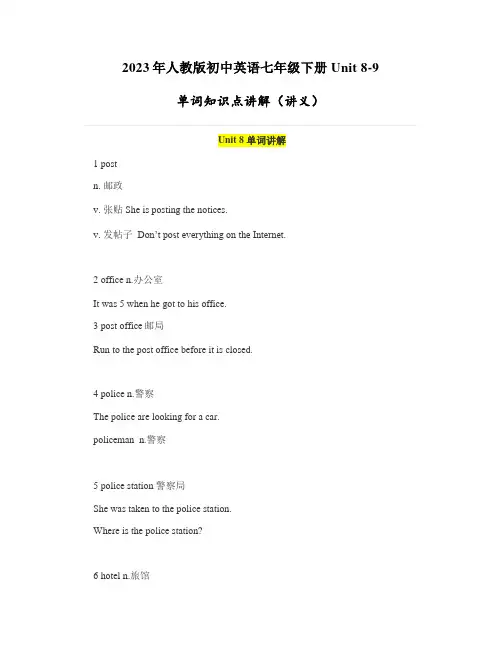
2023年人教版初中英语七年级下册Unit 8-9单词知识点讲解(讲义)Unit 8 单词讲解1 postn. 邮政v. 张贴 She is posting the notices.v. 发帖子Don’t post everything on the Internet.2 office n.办公室It was 5 when he got to his office.3 post office邮局Run to the post office before it is closed.4 police n.警察The police are looking for a car.policeman n.警察5 police station 警察局She was taken to the police station.Where is the police station?6 hotel n.旅馆Did you book a hotel room?7 restaurant n.餐馆We had dinner in a restaurant.The restaurant isn’t far from here.8 bank n.银行Where is the nearest bank?n.岸At the bank of the river, she is doing some washing.9 hospital n.医院He works in a hospital.He spent 2 weeks in hospital.10 street n.大街He lived at 221B Baker Street.11 payv.支付;付费pay (sb.) (for sth.)I’ll pay for the meal.pay 200 yuan a week for the roompay sb. sth.She didn’t pay me the money she owes me. n. 工资;薪水Her job is hard work, but the pay is good. pay the bill 买单12 pay phone 付费电话13 nearadj.附近的His house is very near.In the near future, we’ll be apart.adv. Visitors come from near and far. prep./adv.在..附近Do you live near here?My birthday is near summer vacation.14 acrossadv.从一边到另一边;横过;宽The river is too wide. I can’t swim across. prep.He walked across the field. 他走过田野。
初中英语人教版七年级下册全册重点句子翻译汇总(分单元编排)

七年级英语下册重点句子翻译汇总Unit 1 Can you play the guitar?1.孩子们正在学习读和写。
The children is learning to read and write.2.Alice会讲英语故事吗?Can Alice tell English stories ?3.我哥哥不会弹吉他也不会下象棋。
My brother can’t play the guitar or chess.4.学校在周末关闭。
The school is closed at the weekend.8.为了让我们的国家更强大,我们必须努力学习。
For make our country more stronger, we must study hard.6.-你姐姐会做什么?-她会打网球。
What can your sister do ? She can play tennis.7.-你想加入什么俱乐部?-我想加入国际象棋俱乐部。
- What club do you want to join?-I want to join the chess club.8.你会做什么运动?What sports can you play ?9.你擅长讲故事。
You are good at telling stories.10.我喜欢打篮球。
I like to play basketball.12.简会打篮球,但她不会打排球。
Jane can play basketball, but she can’t play volleyball.13.我们想要能参加学校演出的学生。
We want students who can take part in the school play.14.你会唱歌还是会跳舞?Can you sing or dance?15.请放学以后和张先生谈。
Please talk with Mr. Zhang after school.16.来给我们演示一下!Come and show us !17.我会说英语,也会踢足球。
人教版七年级下册英语Unit 9知识点归纳总结与练习(含答案))

Unit 9 What does he look like?一、词汇集锦curly _______ straight _______ tall ________ medium __________ height __________ (be) of medium height __________ thin _______ heavy _______ build ________ (be) of medium build _________ a little _________ cinema _________glasses __________ later _________ handsome ________ actor _______ actress ________ person ________ nose _________ blonde__________ mouth_______ round ________face ________ eye _________ singer _______ artist _______ crime ________criminal ________ put _________ each ________way _______ describe ________ differently________ another _________ end _______in the end ______real _____jeans ________二、短语归纳1. look like 看起来像2. short/long/curly/straight hair 短/长/卷/直发2. medium height 中等身高3. medium build 中等身材4. be a little late 有点儿晚5. wear glasses 戴眼镜6. See you later then. 那么回头见。
人教版初中英语七年级下册Unit12SectionA教材全解
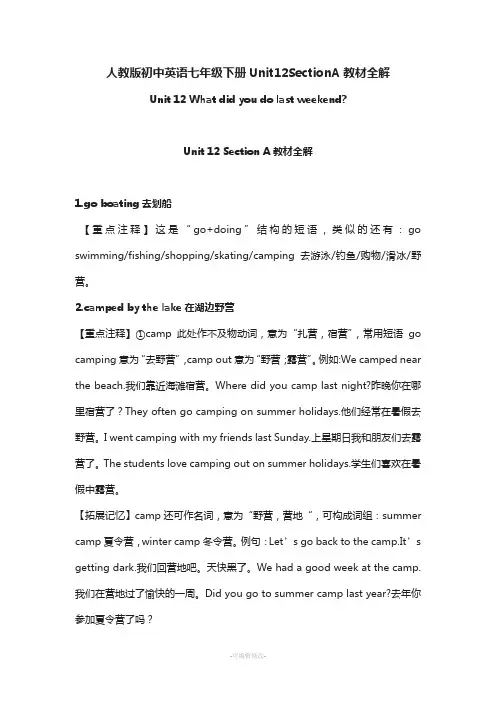
人教版初中英语七年级下册Unit12SectionA教材全解Unit 12 What did you do last weekend?Unit 12 Section A教材全解1.go boating去划船【重点注释】这是“go+doing”结构的短语,类似的还有:go swimming/fishing/shopping/skating/camping去游泳/钓鱼/购物/滑冰/野营。
2.camped by the lake在湖边野营【重点注释】①camp此处作不及物动词,意为“扎营,宿营”,常用短语go camping意为“去野营”,camp out意为“野营;露营”。
例如:We camped near the beach.我们靠近海滩宿营。
Where did you camp last night?昨晚你在哪里宿营了?They often go camping on summer holidays.他们经常在暑假去野营。
I went camping with my friends last Sunday.上星期日我和朋友们去露营了。
The students love camping out on summer holidays.学生们喜欢在暑假中露营。
【拓展记忆】camp还可作名词,意为“野营,营地“,可构成词组:summer camp夏令营,winter camp冬令营。
例句:Let’s go back to the camp.It’s getting dark.我们回营地吧。
天快黑了。
We had a good week at the camp.我们在营地过了愉快的一周。
Did you go to summer camp last year?去年你参加夏令营了吗?②by the lake在湖边,by此处是介词,意为“在……旁边”、“在……近旁”、“在……手边”,此时要注意它与介词near有所不同,即by表示的距离更“近”。
人教版新标准初中英语知识点精析七年级下册UNIT2
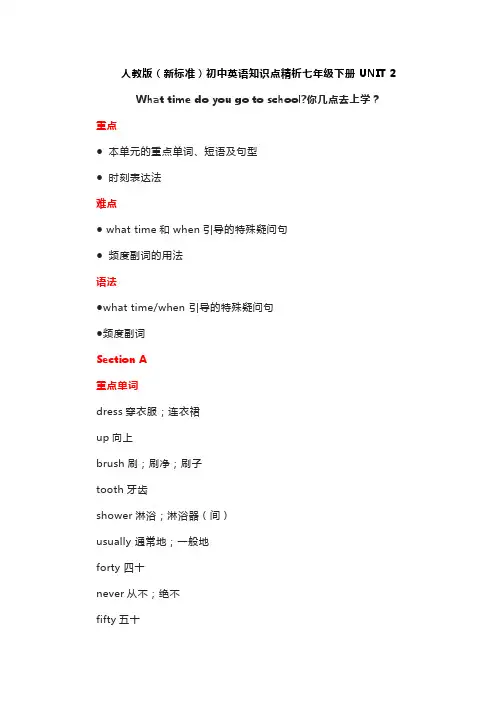
人教版(新标准)初中英语知识点精析七年级下册 UNIT 2 What time do you go to school?你几点去上学?重点●本单元的重点单词、短语及句型●时刻表达法难点● what time和when引导的特殊疑问句●频度副词的用法语法●what time/when 引导的特殊疑问句●频度副词Section A重点单词dress穿衣服;连衣裙up向上brush刷;刷净;刷子tooth牙齿shower淋浴;淋浴器(间)usually 通常地;一般地forty 四十never从不;绝不fifty五十early早(的)job工作;职业work工作o'clock(表示整点)……点钟station电(视)台;车站night晚上;夜晚funny 奇怪的;滑稽好笑的exercise锻炼;练习best最好的;最好地;最group组;群重点短语get up起床;站起go to school去上学get dressed 穿上衣服brush teeth 刷牙eat breakfast 吃早饭take a shower 洗淋浴radio station 广播电台at night 在晚上go to work 去上班be late for 迟到on weekends (在)周末1.-What time do you usually get up,Rick?里克,你通常几点起床?-I usually get up at six thirty.我通常6:30起床。
2.I never get up so early.我从不那么早起床。
3.That's funny time for breakfast!那个时间吃早饭真有意思呀!4. After that, I usually exercise at about ten twenty.在那之后,我通常在10:20左右锻炼。
Section B重点单词half一半;半数past晚于;过(时间);过去的quarter一刻钟;四分之一homework家庭作业clean打扫;弄干净;干净的run跑;奔walk行走;步行quickly 很快地either或者;也(用在否定词组后)lot大量;许多sometimes有时taste有……的味道;品尝;味道;滋味life生活;生命do(one’s) homework做作业go to bed 上床睡觉take a walk 散步;走一走play sports 做运动get home 到家either...or... 要么......要么......;或者......或者......lots of 大量;许多from...to...从......到......重点句型1.When do students usually eat dinner?学生们通常什么时候吃晚饭?2. In the evening, I either watch TV or play computer games.在晚上,我要么看电视,要么玩电脑游戏。
(完整版)人教版初中英语七年级下册Unit7SectionA教材全解
(完整版)⼈教版初中英语七年级下册Unit7SectionA教材全解⼈教版初中英语七年级下册Unit7SectionA教材全解Unit 7 It’s raining!.Unit 7 Section A教材全解1.raining下⾬【重点注释】rain在这⾥是动词,意为“下⾬”,raining是动词rain的现在分词(v.ing形式)。
例如:It often rains in summer.夏天经常下⾬。
It is raining outside.外⾯正在下⾬。
【拓展记忆】1)rain还可作名词,是不可数名词,意为“⾬;⾬⽔”。
例如:There is a lot of rain here in summer.这⼉夏天⾬⽔很多。
We have too much rain this summer.今年夏天⾬⽔太多了。
2)在表⽰“下⾬”时,可以⽤rain的不同形式来表达。
例如:⊙北京在下⾬——There is rain in Beijing.(rain作名词,表⽰“⾬”)=It is rainy in Beijing.(rain的形容词形式rainy表⽰“下⾬的”)=It is raining in Beijing.(rain的现在分词形式raining表⽰“下⾬”) ⊙明天将要下⾬——It will _____ tomorrow.It will be _____ tomorrow.There will be ____tomorrow.(第⼀空“rain”,will之后加动词原形;第⼆空“rainy”,be是系动词,之后加形容词;第三空“rain”,这⾥rain是名词,不可数名词,意为“有⾬”) 3)⽤heavy (heavily=hard)/light表⽰⾬的⼤/⼩。
例如:∵∵∵There will be a heavy rain tomorrow.明天会下⼤⾬。
It is raining heavily / hard here now。
人教版初中英语知识点归纳总结(分册复习合集)
人教版英语分册复习知识点七年级上Unit 1-Unit 2重点句型1. —My name’s Jenny. —I’m Gina. Nice to meet you.2. —What’s your/his/her name? —My/His/Her name is … .3. What’s your/his/her family/first name?4. —What’s your telephone number? —It’s 218-9176.5. What’s his/ her telephone number?6. —What’s this/that in English? —It’s a ruler.7. —Is this/that your pencil? —Yes, it is./No, it isn’t.8. How do you spell pencil?/Spell pencil./Can you spell pencil?9. Is that your computer game in the lost and found case?10. Call Alan at 495-3539.重点语法be在一般现在时中的基本用法:I用am, you用are,is跟着他她它。
He ,she ,it用is,we, you they都用are。
单数名词用is,复数名词都用are。
be的几种形式:is, am, are —being —was, were —been主谓一致:主谓一致的15种常考情况:1.表示时间,重量,数目,价格,长度,数学运算等的词或短语作主语时,尽管他们是复数形式,但如果把这些复数形式的词或短语看作是一个整体,谓语动词用单数形式。
Two months is quite a long time. Twenty dollars is enough.2.动词不定式,动名词,从句或不可数名词作主语时,谓语动词用单数。
人教版初中英语七年级下册UNIT5知识点精析
人教版初中英语七年级下册UNIT5知识点精析七年级下册UNIT5Why do you like pandas?你为什么喜欢熊猫?重点●提建议的句型●forget的用法难点●why 引导的特殊疑问句●形容词的用法语法●why引导的特殊疑问句;形容词的用法公众号Section A重点单词panda熊猫zoo 动物园tiger 老虎elephant大象lion狮子giraffe 长颈鹿animal动物cute 可爱的;机灵的lazy懒散的;懒惰的smart 聪明的beautiful美丽的;美好的kind种类Australia 澳大利亚south南方的;南,南方Africa 非洲pet 宠物cat猫leg 腿sleep 睡觉重点短语kind of 稍微;有点儿South Africa 南非black and white 黑白相间重点句型1.Let's see the pandas first.咱们先看熊猫吧。
2.They're my favorite animals.它们是我最喜欢的动物。
3.Where are they from?它们来自哪里?4.She sleeps all day...她整天睡觉......Section B重点单词friendly友好的shy 羞怯的;腼腆的save救;救助flag旗;旗帜place地点;位置forget忘记;遗忘water 水danger危险cut砍;切down(坐、躺、倒)下;向下;沿着tree树kill杀死;弄死over超过,多于;在……上方重点短语get lost 迷路be in(great) danger 处于(极大)危险之中lose one's home失去某人的家园cut down 砍倒(be)made of 由……制成的重点句型1.The elephant is one of Thailand's symbols.大象是泰国的象征之一。
人教版七年级下册英语(全册)重点短语语法归纳练习册
人教版七年级下册英语(全册)重点短语语
法归纳练习册
简介
本练册是人教版七年级下册英语教材的重点短语语法归纳练册。
旨在帮助学生巩固和复教材中涉及的重点短语和语法知识。
本文档
将对练册的内容进行简单概述。
内容总结
练册的内容主要包括以下几个方面的内容:
1. 重点短语
练册中包含了教材中出现的一些重点短语的练题,通过练帮助
学生掌握这些重点短语的用法和搭配。
2. 语法练
练册中还设置了一些语法练题,涵盖了教材中的语法知识点。
通过这些题目的练,学生能够加深对语法知识的理解和掌握。
3. 归纳总结
练册最后提供了一份归纳总结,对教材中出现的重点短语和语法知识进行了简洁明了的总结,帮助学生进行复回顾。
使用建议
1. 学生可以按照部分顺序进行练,有针对性地温故知新。
2. 建议学生在完成每部分的练后,对答案进行自我检查,并及时纠正错误。
3. 可以借助教师的辅导或同伴讨论,在练过程中共同提高。
结语
通过本练册的研究,相信学生可以全面、系统地巩固和复人教版七年级下册英语教材中的重点短语和语法知识,提高英语研究的能力和水平。
以上是对《人教版七年级下册英语(全册)重点短语语法归纳练习册》的简单概述。
希望对您有所帮助!。