
人教版七年级下册英语各单元知识点归纳
人教版七年级下册英语各单元知识点归纳 Unit 1 Can you play the guitar? ◆短语归纳 1. play chess 下国际象棋 2. play the guitar 弹吉他 3. speak English 说英语 4. English club 英语俱乐部 5. talk to 跟…说 6. play the violin 拉小提琴 7. play the piano 弹钢琴 8. play the drums 敲鼓 9. make friends 结交朋友 10. do kung fu 练 (中国) 功夫 11. tell stories 讲故事 12. play games 做游戏 13. on the weekend/on weekends 在周末 ◆用法集萃
Unit 2 What time do you go to school? ◆短语归纳 1. what time 几点 2. go to school 去上学 3. get up 起床 4. take a shower 洗淋浴 5. brush teeth 刷牙 6. get to 到达
7. do homework 做家庭作业 8. go to work 去上班 9. go home 回家 10. eat breakfast 吃早饭 11. get dressed 穿上衣服 12. get home 到家 13. either…or… 要么…要么… 14. go to bed 上床睡觉 15. in the morning/ afternoon/ evening 在上午/下午/晚上 16. take a walk 散步 17. lots of=a lot of 许多,大量 18. radio station 广播电台 19. at night 在晚上 20. be late for=arrive late for 迟到 ◆用法集萃
1. play +棋类/球类 下……棋,打……球 2. play the +西洋乐器 弹/拉……乐器 3. be good at doing sth.= do well in doing sth. 擅长做某事 4. be good with sb. 和某人相处地好 5. need sb. to do sth. 需要某人做某事 6. can + 动词原形 能/会做某事 7. a little + 不可数名词 一点儿…… 8. join the …club 加入…俱乐部 9. like to do sth. =love to do sth. 喜欢/喜爱做某事
1. at + 具体时间点 在几点(几分) 2. eat breakfast/ lunch/dinner 吃早饭/午饭/晚饭 3. thirty\half past +基数词 ……点半 4. fifteen\a quarter to +基数词 差一刻到……点 5. take a/an +名词 从事……活动 6. from …to … 从……到…… 7. need to do sth 需要做某事 Unit 3 How do you get to school? ◆短语归纳 1. get to school 到达学校 2. take the subway 乘地铁 3. ride a bike 骑自行车 4. how far 多远 5. from home to school 从家到学校 6. every day 每天 7. take the bus 乘公共汽车 8. by bike 骑自行车 9. bus stop 公共汽车站 10. think of 认为 11. between … and … 在…和…之间 12. one 11-year-old boy 一个11岁的男孩 13. play with … 和…玩 14. come true 实现 15. have to 不得不 ◆用法集萃
Unit 4 Don’t eat in class. ◆短语归纳 1. on time 准时,按时 2. listen to … 听…… 3. in class 在课上 4. be late for 做……迟到 5. have to 不得不 6. be quiet 安静 7. go out 外出 8. do the dishes 清洗餐具 9. make breakfast 做早饭 10. make (one’s) bed 铺床 11. be noisy 吵闹 12. keep one’s hair short 留短发 13. play with sb. 和某人一起玩 14. play the piano 弹钢琴 15. have fun 玩得高兴 16. make rules 制订规则 ◆用法集萃
1. take… to …= go to … by… 乘…去… 2. How do / does (sb)get to …? …是怎样到…的? 3. How far is it from … to …? 从…到…有多远? 4. It takes sb. some time to do sth. 做某事花费某人多长时间。 5. How long does it take to do sth.? …花费多长时间? 6. It is + adj. + to do sth. 做某事是…. 7. Thanks for + n. / Ving 感谢你(做)某事。
1. Don’t + 动词原形+其他, 不要做某事。 2. help sb. (to) do sth. 帮助某人做某事 3. too many + 可数名词复数 太多的…… 4. practice doing sth. 练习做某事 5. be strict with sb. 对某人要求严格 6. be strict in sth. 对某事要要求严格 7. leave sth sp. 把某物忘在某地 8. keep + 宾语+形容词 使……保持某种状态 9. learn to do sth. 学会做某事 10. have to do sth. 不得不做某事 Unit 5 Why do you like pandas? ◆短语归纳 1. kind of 有几分,有点儿 2. be from / come from 来自于 3. South Africa 南非 4. all day 整天 5. for a long time 很长时间 6. get lost 迷路 7. places with food and water 有食物和水的地方 8. cut down 砍倒 9. in (great) danger 处于(极大)危险之中 10. twelve years old 十二岁 11. things made of ivory 由象牙制成的东西 ◆用法集萃
Unit 6 I’m watching TV. ◆短语归纳 1. watch TV 看电视 2. read a newspaper 看报纸 3. talk on the phone 通过电话交谈 4. listen to music 听音乐 5. use the computer 使用电脑 6. make soup做汤 7. wash the dishes 洗餐具 8. kind of 有点儿 ◆用法集萃
Unit 7 It’s raining! ◆短语归纳 1. not bad 不错 2. at the park 在公园 3. take a message for … 为……捎个口信 4. have a good time / have a great time / have fun / enjoy oneself 过得很愉快 5. call sb. back 给某人回电话 6. no problem 没问题 7. right now 现在 8. talk on the phone 通过电话交谈 9. some of ………当中的一些 10. by the pool 在游泳池边 11. drink orange juice 喝橙汁 12. study hard 努力学习 13. on a vacation 在度假 14. in the mountains 在山里
1. —Why…? 为什么……? —Because… 因为…… 2. let sb. do sth. 让某人做某事 3. want to do sth. 想要做某事 4. one of + 名词复数 ……之一 5. forget to do sth. 忘记要做某事 6. forget doing sth. 忘记做过某事 7. help sb. (to) do sth. 帮助某人做某事 8. be friendly to sb. 对某人友好
1. —What + be+ 主语+ doing? ……正在做什么? —主语+ be + doing sth. ……正在做某事。 2. I’d love / like to do sth. 我愿意做某事。 3. any other + 可数名词单数 其他任何一个…… 4. wish to do sth. 希望做某事 15. call sb. 给某人打电话 16. write to sb. 给某人写信 17. right for… 适合…… 18. 给……拍一张照片 ◆用法集萃
Unit 8 Is there a post office near here? ◆短语归纳 1. post office 邮局 2. police station 警察局 3. pay phone 付费电话 4. Bridge Street 桥街 5. Center street 中心大街 6. Long Street 长街 7. near here 附近 8. across from 在……对面 9. next to 挨着,靠近 10. between… and… 在……和……之间 11. in front of 在……前面 12. excuse me 劳驾 13. far from 离……远 14. go along… 沿着……走 15. turn right / left 向右 / 左转 16. on the(或one’s) right / left 在(某人的)右边 / 左边 17. in my neighborhood 在我的街区 18. look like 看起来像 19. in life 一生中 20. be free 免费(有空) ◆用法集萃
(完整版)人教版七年级下册英语第一单元各单元知识点归纳.doc

人教版七年级下册英语第一单元各单元知识点归纳Unit 1 Can you play the guitar?◆短1. play the guitar 吉他2. play chess 下国象棋3. play the violin 拉小提琴4. English club 英俱部5. talk to 跟⋯6. speak English 英7. play the piano 琴8. play the drums 敲鼓9. make friends 交朋友10. do kung fu (中国 ) 功夫11. tell stories 故事12. play games 做游13.on weekends 在周末◆用法集萃1. play the + 西洋器/拉⋯⋯器2. play + 棋 /球下⋯⋯棋,打⋯⋯球3.be good at doing sth.= do well in doing sth. 擅做某事4.be good with sb. 和某人相地好5.need sb. to do sth. 需要某人做某事6.can + 原形能/会做某事7.a little + 不可数名一点儿⋯⋯8.join the⋯club加入⋯ 俱部9. like to do sth. =love to do sth.喜/喜做某事◆ 写作Dear Sir,I want to join your organization ( ) to help kids with sports, music and English. My name is Mike. I am 15 years old. I ’m a student in No. 1 Middle school. I can play the guitar well. I can sing many songs. I can swim and speak English well, too. I think I can be good with the kids. I also do well in telling stories.I hope to get your letter soon.。
人教版七年级英语下册各知识点归纳总结
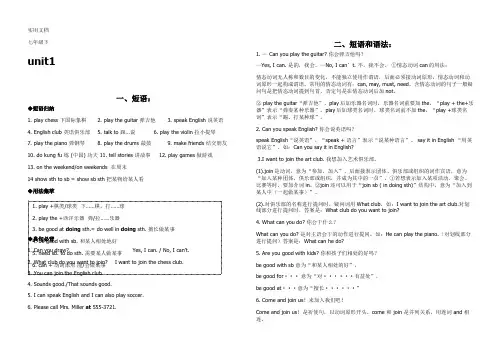
七年级下unit1一、短语:◆短语归纳1. play chess 下国际象棋2. play the guitar 弹吉他3. speak English 说英语4. English club 英语俱乐部5. talk to 跟…说6. play the violin 拉小提琴7. play the piano 弹钢琴8. play the drums 敲鼓9. make friends 结交朋友10. do kung fu 练 (中国) 功夫 11. tell stories 讲故事 12. play games 做游戏13. on the weekend/on weekends 在周末14 show sth to sb = show sb sth 把某物给某人看◆用法集萃◆典句必背1. Can you draw? Yes, I can. / No, I can’t.2. What club do you want to join? I want to join the chess club.3. You can join the English club.4. Sounds good./That sounds good.5. I can speak English and I can also play soccer.6. Please call Mrs. Miller at 555-3721.二、短语和语法:1. — Can you play the guitar? 你会弹吉他吗?—Yes, I can. 是的,我会。
—No, I can’t. 不,我不会。
①情态动词can的用法:情态动词无人称和数目的变化,不能独立使用作谓语,后面必须接动词原形,情态动词和动词原形一起构成谓语。
常用的情态动词有:can, may, must, need。
含情态动词的句子一般疑问句是把情态动词提到句首,否定句是在情态动词后加not。
人教版七年级下册英语期末复习:Unit 7-Unit 12 各单元语法知识点复习提纲(全面!)
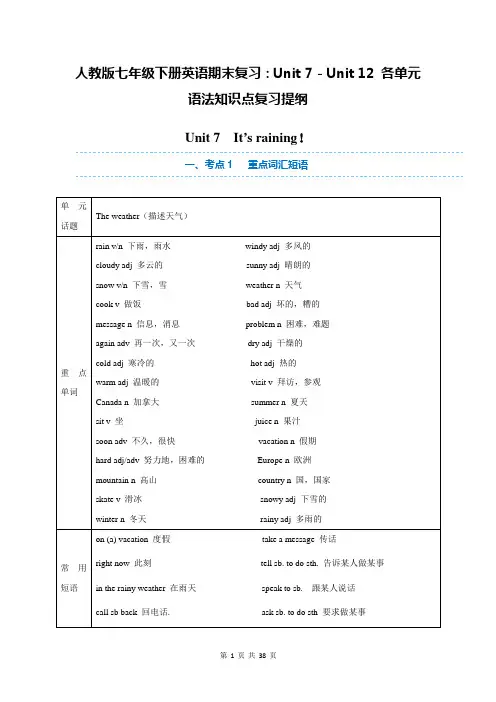
人教版七年级下册英语期末复习:Unit 7-Unit 12 各单元语法知识点复习提纲Unit 7 It’s raining!一、考点1 重点词汇短语1 messagemessage为可数名词,意为“消息,信息”,take a message for sb.“为某人捎个口信”。
拓展:give sb. a message 捎信给某人,leave a message 留口信,get the message 明白对方的意思。
Can I take a message for him?当某人发现要找的人不在或接电话的人发现打电话者要找的人不在时,常用此语2 could 情态动词意为“能,可以“,表示请求许可,在语气上比can委婉客气,但这种句式的肯定回答用can。
Could you just tell him to call me back?3 call及物动词,意为“打电话给”。
call sb. (up) “打电话给某人”,call sb. at +电话号码,意为“拨打……找某人”。
拓展:call 是一个多义词,call sb 可表示“叫醒某人,呼唤某人”;give sb. a call 给某人打电话。
4 back副词“回来,回原处,向后”;call sb. back给某人回个电话。
【即学即练】I’ll _____you _____.我将给你回电话。
5 visit此处用作及物动词,意为“拜访,探望”,后接表示人的名词或代词。
visit还可意为“参观,游览”,后接表示地点的名词。
拓展:visit还可用作可数名词,意为“访问,参观,拜访。
be on a visit to ... “正在访问/参观……”。
visitor参观者,游览者,游客。
I’m having a great time visiting my aunt in Canada._____ my grandparents every year at Christmas.我每年圣诞节都去探望我的祖父母。
人教版英语七年级下册单元Unit6知识点+测试卷+思维导图

⼈教版英语七年级下册单元Unit6知识点+测试卷+思维导图Unit 6 I’m watching TV.1.重点词汇:newspaper, movie, tea, house, pool, supermarket, living room, race, wash, drink, study, miss, wish, young, delicious2.短语归纳:1.watch TV 看电视2. read a newspaper 看报纸3. talk on the phone 通过电话交谈4. listen to music 听⾳乐5. use the computer 使⽤电脑6. make soup做汤7. wash the dishes 洗餐具8. kind of 有点⼉3. 必背典句:1. —Why are you doing? 你在做什么?—I’m watching TV. 我在看电视。
2. —What’s she doing? 她在做什么?—She’s washing her clothes. 她在洗她的⾐服。
3. —What are they doing? 他们在做什么?—They’re listening to a CD. 他们在听⼀张CD 唱⽚。
4. —Are you doing your homework? 你在做你的家庭作业吗?—Yes, I am. / No, I’m not. I’m cleaning my room.是的,我在做。
/ 不,我没有。
我在打扫我的房间。
5. Zhu Hui misses his family and wishes to have his mom’s delicious zongzi.朱辉思念他的家⼈并希望吃上他妈妈的可⼝粽⼦。
4.语法知识:现在进⾏时1.定义:表⽰现在或现阶段正在进⾏的动作。
常与now, these days等时间状语连⽤,句⾸有Look ! / Listen !等提⽰语。
人教版七年级英语下册 Unit9 What does he look like单元知识点总结
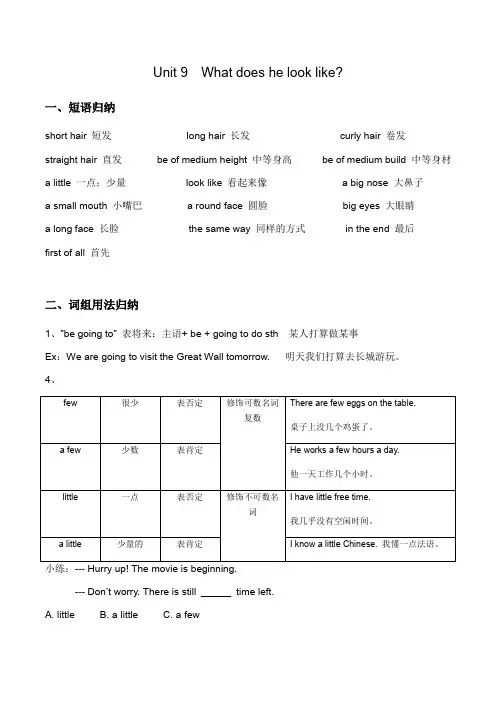
Unit 9 What does he look like?一、短语归纳short hair 短发long hair 长发curly hair 卷发straight hair 直发be of medium height 中等身高be of medium build 中等身材a little 一点;少量look like 看起来像 a big nose 大鼻子a small mouth 小嘴巴 a round face 圆脸big eyes 大眼睛a long face 长脸the same way 同样的方式in the end 最后first of all 首先二、词组用法归纳1、”be going to” 表将来:主语+ be + going to do sth 某人打算做某事Ex:We are going to visit the Great Wall tomorrow. 明天我们打算去长城游玩。
4、小练:--- Hurry up! The movie is beginning.--- Don’t worry. There is still time left.A. littleB. a littleC. a few5、each:做形容词时,修饰可数名词单数,意为“每个;各自”Ex:Each school has its own library. 每一所学校都有它自己的图书馆。
三、语法归纳(一)询问及描述外貌:1、询问外貌:What do/ does sb look like? 某人长什么样?2、描述人的外貌的句型如下:(1)表示某人的个头或身材:主语+ be of +形容词+ height/ build.Ex:Our math teacher is of medium build. 我们的数学老师是中等身材。
(2)表示某人的高矮胖瘦:主语+be +形容词.Ex:She is short and thin. 她很瘦小。
期末复习人教版英语七年级下册单元重点知识点语法汇总
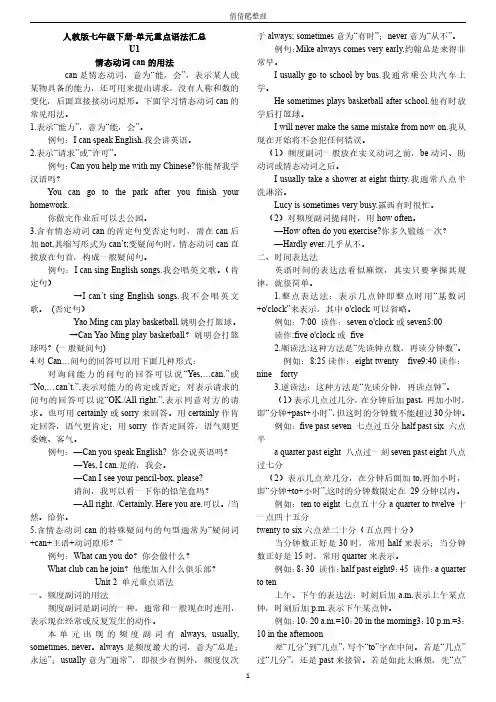
人教版七年级下册-单元重点语法汇总U1情态动词can的用法can是情态动词,意为“能,会”,表示某人或某物具备的能力,还可用来提出请求,没有人称和数的变化,后面直接接动词原形。
下面学习情态动词can的常见用法。
1.表示“能力”,意为“能,会”。
例句:I can speak English.我会讲英语。
2.表示“请求”或“许可”。
例句:Can you help me with my Chinese?你能帮我学汉语吗?You can go to the park after you finish your homework.你做完作业后可以去公园。
3.含有情态动词can的肯定句变否定句时,需在can后加not,其缩写形式为can’t;变疑问句时,情态动词can直接放在句首,构成一般疑问句。
例句:I can sing English songs.我会唱英文歌。
(肯定句)→I can’t sing English songs.我不会唱英文歌。
(否定句)Yao Ming can play basketball.姚明会打篮球。
→Can Yao Ming play basketball?姚明会打篮球吗?(一般疑问句)4.对Can…问句的回答可以用下面几种形式:对询问能力的问句的回答可以说“Yes,…can.”或“No,…can’t.”,表示对能力的肯定或否定;对表示请求的问句的回答可以说“OK./All right.”,表示同意对方的请求。
也可用certainly或sorry来回答。
用certainly作肯定回答,语气更肯定;用sorry作否定回答,语气则更委婉、客气。
例句:—Can you speak English?你会说英语吗?—Yes,I can.是的,我会。
—Can I see your pencil-box,please?请问,我可以看一下你的铅笔盒吗?—All right./Certainly.Here you are.可以。
人教版英语七年级下册单元Unit 5 知识点+测试卷+思维导图
Unit 5 Why do you like pandas?1.重点词汇:tiger, elephant, koala, panda, lion, giraffe, smart, cute, lazy, friendly, beautiful, shy, South Africa, Australia2. 短语归纳:1.kind of 有几分,有点儿2. be from / come from 来自于3. South Africa 南非4. all day 整天5. for a long time 很长时间6. get lost 迷路7. places with food and water 有食物和水的地方8. cut down 砍倒9. in (great) danger 处于(极大)危险之中10. twelve years old 十二岁11. things made of ivory 由象牙制成的东西3. 必背典句:1. Elephants can walk for a long time and never get lost. 大象能走很长时间并且从不迷路。
2. They can also remember places with food and water. 它们也能记住有食物和水的地方。
3. But elephants are in great danger. 但是,大象处于极大危险之中。
4. People cut down many trees so elephants are losing their homes.人们砍倒了许多树,因此,大象渐渐失去它们的家园。
5. Today there are only about 3,000 elephants (over 100,000 before)现在仅有大约3000头大象(之前超过10万头大象)。
6.Isn’t she beautiful? 她难道不美丽吗?4.语法知识:(1)形容词的作用和用法形容词是指用来修饰、说明名词或不定代词,表示人或物的性质、特征和状态。
人教版七年级英语下册1-12单元重点短语词组、句型及各单元短语
Unit 1 Can you play the guitar?1.play chess 下国际象棋 play the guitar 弹吉他2.speak English 说英语 English club 英语俱乐部3.talk to 跟…说 play the violin 拉小提琴4.play the piano 弹钢琴 play the drums 敲鼓5.make friends 结交朋友6.do kung fu 会(中国)功夫7.tell stories 讲故事 play games 做游戏8.on the weekends (在)周末用法集萃play +棋类/球类下……棋,打……球1.play the +西洋乐器弹/拉……乐器2.be good at doing sth.= do well in doing sth. 擅长做某事3.be good with sb. 善于与某人相处4.need sb. to do sth. 需要某人做某事5.can + 动词原形能/会做某事6.a little + 不可数名词一点儿……7.join the …club 加入…俱乐部8..like to do sth. =love to do sth. 喜欢/喜爱做某事like ding sth.喜欢做某事典句必背Can you draw? Yes, I can. / No, I can’t.1.What club do you want to join?2.I want to join the chess club.3.You can join the English club. Sounds good.4.I can speak English and I can also play soccer.5.Please call Mrs. Miller at 555-3721.重点句子点拨:1、Can you play the guitar?你会弹吉他吗?点拨1:can是情态动词,它的意思是能、会,表示某人具有做某事的能力,情态动词后必须用动词原形,情态动词can没有人称和数的变化。
英语学习:人教版七年级下册各单元思维导图
英语学习:人教版七年级下册各单元思维导图Unit 1: My School Life- Vocabulary:- Classroom objects- School subjects- Grammar:- Simple present tense- Plural forms of nouns- Speaking:- Talking about school facilities- Describing school subjects and preferences- Listening:- Understanding class schedules- Following instructions in the classroomUnit 2: Hobbies- Vocabulary:- Leisure activities- Sports and games- Grammar:- Present continuous tense- Adverbs of frequency- Speaking:- Talking about hobbies and interests- Discussing preferences and dislikes- Listening:- Understanding conversations about hobbies- Following instructions for games and activitiesUnit 3: At Home- Vocabulary:- Rooms and furniture- Daily routines- Grammar:- Present simple tense- Prepositions of place- Speaking:- Describing rooms and houses- Talking about daily routines- Listening:- Understanding conversations about household chores - Following instructions for recipes and tasksUnit 4: Food and Drink- Vocabulary:- Types of food and drinks- Quantifiers- Grammar:- Countable and uncountable nouns- How much/How many- Speaking:- Talking about food preferences- Ordering food at a restaurant- Listening:- Understanding conversations about meals and recipes - Following instructions for cooking and servingUnit 5: Family and Friends- Vocabulary:- Family members- Personal pronouns- Grammar:- Possessive adjectives- Wh-questions- Speaking:- Introducing family members- Describing relationships- Listening:- Understanding conversations about family activities- Following instructions for interviews and introductionsUnit 6: At the Zoo- Vocabulary:- Animals and their characteristics- Adjectives to describe animals- Grammar:- There is/are- Speaking:- Talking about animals and their habitats- Listening:- Understanding conversations about zoo visits - Following directions for finding animalsUnit 7: The Weather- Vocabulary:- Weather conditions- Seasons and months- Grammar:- Present continuous for future arrangements - Adjectives to describe weather- Speaking:- Talking about weather in different seasons - Making plans based on weather forecasts- Listening:- Understanding weather reports- Following instructions for outdoor activitiesUnit 8: Holidays- Vocabulary:- Festivals and celebrations- Holiday activities- Grammar:- Past simple tense- Time expressions- Speaking:- Talking about past holidays and celebrations- Describing holiday traditions- Listening:- Understanding conversations about holiday experiences - Following instructions for crafts and gamesUnit 9: Around Town- Vocabulary:- Places in a city- Directions and locations- Grammar:- Imperatives- Giving and following directions- Speaking:- Asking for and giving directions- Describing places in a city- Listening:- Understanding conversations about city attractions - Following directions to different locationsUnit 10: Health and Fitness- Vocabulary:- Body parts and health issues- Sports and exercises- Grammar:- Present continuous for future arrangements- Imperatives for instructions- Speaking:- Talking about health and fitness routines- Giving advice on healthy habits- Listening:- Understanding conversations about health problems - Following instructions for exercises and workouts。
人教版英语七年级下册各单元重要语法内容
一、动词的一般现在时人教版英语七年级下册的重要语法内容之一为动词的一般现在时。
在学习动词的一般现在时时,学生需要掌握动词的三单特殊变化规则,即在第三人称单数时,动词需要在词尾加上-s或-es。
学生还需要学习动词的否定形式和疑问形式的构成方法,以及常见的一般现在时的时间状语如often, usually, always等的用法。
二、名词的单数和复数形式另一个重要的语法内容是名词的单数和复数形式。
学生需要了解名词单数和复数形式的规则,掌握常见的名词复数变化规则,如在词尾加上-s, -es, -ies等。
学生还要熟练掌握一些不规则名词的复数形式,如man-men, woman-women等。
三、形容词的比较级和最高级形容词的比较级和最高级也是七年级下册的重要语法内容之一。
学生需要学习形容词比较级的构成方法以及常见的比较级形式,如比较级+than, more+形容词等。
学生还需要了解形容词最高级的构成方法以及常见的最高级形式,如the+形容词最高级, most+形容词等。
四、介词的基本用法介词是英语中一个重要的语法内容,学生需要掌握介词的基本用法,包括介词表示地点、时间、方向、原因等的用法,以及介词与动词、名词、形容词的搭配。
学生还需要学习一些常用介词的用法,如in, on, under, behind, between等。
五、情态动词情态动词是七年级下册的另一个重要语法内容。
学生需要了解情态动词can, could, may, might, must, shall, should, will, would等的用法和意义,并能正确运用这些情态动词进行句子的构成。
学生还需要学习情态动词的否定形式和疑问形式的构成方法。
六、并列连词和从属连词七年级下册还包括并列连词和从属连词的学习。
学生需要了解并掌握一些常见的并列连词如and, but, or等的用法,以及从属连词如because, when, if, although等的用法。