
秋季学期外研版初中七年级英语上册教案全册
秋季学期外研版初中七年级英语上册教案全册Module1Myclamate(共5课时)Unit1Nicetomeetyou(2课时)Ⅰ.Teachinggoal(教学目标)1.能够听懂、读懂关于自我介绍的对话。
2.能够运用所学动词be的基本句型进行简单的自我介绍。
Ⅱ.Teachingdifficultie(教学重难点)重点:掌握本单元的基本词汇和句型,正确运用be动词的各种形式造句。
难点:能够用英语进行自我介绍。
Ⅲ.Teachingaid:(教学辅助)PPT课件第1课时(Activity1—3)ⅣTeachingcontent(教学内容)Ⅴ.Teachingprocedure:(教学过程)Step1.Warming-up播放英文歌曲或视频“Dayoftheweek”来活跃课堂气氛,同时为接下来的教学内容作好准备。
当学生能熟练地唱出这首歌时,英语教学就变得容易多了。
Step2Liteningandreading1.Litenandread.(Activity1)①教师播放录音,让学生整体感知对话内容。
②教师再次播放录音,学生跟—1—读、模仿。
③学生两人一组练习对话。
④教师让不同的小组展示对话,关注学生的发音。
2.Litenandrepeat.Nowpoint,akandanwer.(Activity2)①教师放录音,学生听录音。
②教师再次播放录音,学生跟读、模仿。
③学生两人一组根据日历练习对话。
④教师让部分小组展示对话。
环节说明:本活动以日历的形式让学生学习表示星期一至星期日的7个词汇,然后指着日历上的具体日期来询问星期几,进而练习相关句型“Whatdayiittoday”教师向学生说明在西方国家Sundayithefirtdayoftheweek,让学生了解这种文化差异。
Step3Practice1.Readandmatch.Nowlitenandcheck.(Activity3)①学生个体活动,完成匹配。
②教师播放录音,学生核对答案。
核对答案后,教师还可以让学生继续跟读1-2遍,为后面的活动打好基础。
环节说明:本活动考査学生阅读理解的能力,需要学生了解问句中表示星期几的单词和“tomorrow”之后完成匹配。
2.Workinpair.Akandanwer.(Activity4)①教师讲明活动要求。
②学生两人一组练习对话。
③学生展示对话,教师给出评价。
3.Litenandwrite.(Activity5)①教师播放录音,学生听写。
如果学生听一遍录音完成活动有困难,教师可以播放两遍。
②如果学生拼写有困难,教师可以板书这些单词,然后带领学生总结这些单词的拼写规律及如何按照拼读规则来记这些单词。
4.Write.Nowlitenandcheck.(Activity6)教师可以让学生听录音,然后模仿。
—2—5.Workinpair.Akandanwer.(Activity7)环节说明:本活动是通过真实的语境,练习本单元所学的重点内容。
学生通过谈论星期几引出自己最喜欢的日子,语境真实,学生会感觉到有交流的必要。
小结训练Whatdayiyourfavouriteday2.请把它写在书上。
Pleaewriteitinyourbook.Step5Practice.作业课件(略)Step6.Summary.Sumuptheunitbriefly.Step7.Homework:完成《学案》中相关练习。
ⅥBlankboarddeigning.(板书设计略)Ⅶ.Teachingreflection.(教学反思)本节课活动的目的在于掌握本单元的重点词汇和询问星期几的句型。
学生基本完成任务。
但学生对单词的拼写有困难,布置课外记忆任务。
—3—第2课时(Activity4—7)ⅣTeachingcontent(教学内容)Ⅴ.Teachingprocedure:(教学过程)Step1.Warming-up环节说明:此活动的目的是巩固所学语言点,提高学生的语言表达能力。
也为后面的活动做铺垫。
Step2完成教材Activitie4,5的任务1.Workinpair.Chooethecorrectanwer.(Activity4)建议:本活动可以分成两个步骤来进行。
第一步:回答问题。
教师可以采用学生个体活动的形式,让学生再读一遍对话,然后选出正确的答案。
第二步:问答练习。
教师可以采用以下操作方案开展活动。
方案1:链条式活动,A同学提问,B同学回答,B同学提问,C同学回答……(Anwer:1.Ye,hei.2.Ye,hei.3.No,hein\\'t.4.No,hein\\'t.5.Ye, Iam.)方案2:如果学生水平较高,可以让学生按照一般现在时的一般疑问句的句—4—式结构,组织新的问题进行提问并回答。
如:“IDamingfromWuhan”这样能够更好地激发学生参与的热情。
环节说明:本活动主要是通过问答的形式进一步检査学生对对话内容的理解,同时学习“be动词”的一般现在时的一般疑问句。
教师领读单词并询问学生有没有不认识的单词,然后学生个体活动完成短文,教师带领全班核对答案。
(Anwer:1.tudent2.Grade3.America4.England5.Chinee)环节说明:本活动要求学生运用对话中出现的重点词汇完成小短文,一方面考査学生对对话中的重点词语和信息的掌握,另一方面也考査学生对短文的理解能力。
小结训练(C)1.SamiEnglih._______?A.What'yournameB.HowoldareyouC.Whataboutyou(A)2.MLii_______.A.ChineeB.EnglandC.America(B)3.—AreyoufromChina—_______.A.Ye,I'mB.No,I'mnotC.Ye,I'mnotStep3Pronunciationandpeaking1.Litenandrepeat.(Activity6)学生朗读,教师纠正不正确发音,最后听录音跟读。
学生回顾学过的单词,每个读音后补充两个例词。
2.Workinpair.Akandanwer.(Activity7)方案1:教师可以邀请一名学生和自己一起为其他同学做示范。
然后让学—5—生两人一组互相对话。
SheiinClaSi某GradeSeven.Step5Practice.作业课件(略)Step6.Summary.Sumuptheunitbriefly.Step7.Homework:完成《学案》中相关练习。
ⅥBlankboarddeigning.(板书设计略)Ⅶ.Teachingreflection.(教学反思)本节课活动旨在使学生掌握本单元的语音、词汇及表达。
学习“be动词”的一般现在时的一般疑问句。
训练学生口头表达能力。
学生在一般疑问句的使用上有待巩固。
Unit2I’mWangLinglingandI’m13yearold.(2课时)—6—Ⅰ.Teachinggoal(教学目标)1.能够正确使用and和but,掌握中西方在姓名拼写方面的差异。
2.能够运用所学动词be的基本句型进行简单的自我介绍。
Ⅱ.Teachingdifficultie(教学重难点)重点:掌握本单元的基本词汇和句型。
难点:正确运用连词and和but,熟练运用be动词的各种形式造句。
Ⅲ.Teachingaid:(教学辅助)PPT课件第3课时(Activity1—2)ⅣTeachingcontent(教学内容)Ⅴ.Teachingprocedure:(教学过程)Step1.Warming-upT:AreyoufromShanghai,LinglingS1:Ye,Iam.T:IShanghaiabigcity(用动作让学生理解)S1:Ye.T:WhataboutJimS2:I'mfromBeijing.T:It'thecapitalofChina.(用图片帮助学生理解)—7—环节说明:此活动的目的是复习“be动词”的用法,同时激起学生的学习兴趣。
输入一些本单元的重点词汇。
为后面的学习作铺垫。
Step2完成教材Activity1的任务Puttheentenceinthecorrectorder.Nowworkinpair.Akandanwer.①教师提问,学生回答,复习上一节课所学内容。
②学生个体活动,把这5句话排序,形成一个小对话。
③同桌之间相互核对答案。
④全班核对答案。
(Anwer:a—3;b—1;c—5;d—2;e—4)⑤学生开展两人小组对话。
⑥几个小组到教室前面进行对话展示。
Step3ReadingReadthepaageandcheck(√)thetrueentence.Nowcorrectthefaleente nce.(Activity2)建议:本题分为两个步骤来进行。
第一步判断正误,第二步改错。
第一步:判断正误①学生个体阅读。
②判断正误。
(Anwer:1.某2.某3.√4.某5.某6.某)③放录音,让学生自己核对答案。
教师检査答案时可以采用下列方式:反馈方式a:由一名学生宣读答案,然后鼓励其他学生发表不同意见。
反馈方式b:在学生阅读过程中,教师如果发现学生的答案出入比较大,可以将学生组成两人小组后再提问。
第二步:改错本活动要在上一个活动的基础上进行。
如果学生的水平较高,则可以在判断正误的同时改正错误。
(Anwer:1.DavidiDaming'Englihname.2.Lingling'EnglihnameiLucy. 4.WangHuiifromShanghai.5.Tonyi13yearold.6.TonyifromCambridge,ama llcityinEngland.)环节说明:本部分活动的目的是训练学生在阅读中获取具体信息的能力。
—8—小结训练1.GuangzhouithecapitalofGuangdong.2.Everyone(每人)iintheclaroom.3.Tonyimygoodfriend,buthein'tinChina.Step4Otheractivitie(问题探究)1.我们班上的每一个人都来自中国。
EveryoneinourclaifromChina.2.南京是江苏的省会吗?INanjingthecapitalofJiangu3.大明不在七(6)班。
Damingin'tinCla6Grade7.4.我十二岁,但是她不是。
I'mtwelveyearold,buthein't.5.他的英文名字叫Tom.HiEnglihnameiTom.Step5Practice.作业课件(略)Step6.Summary.Sumuptheunitbriefly.Step7.Homework:完成《学案》中相关练习。
外研版七年级英语上册教案全集
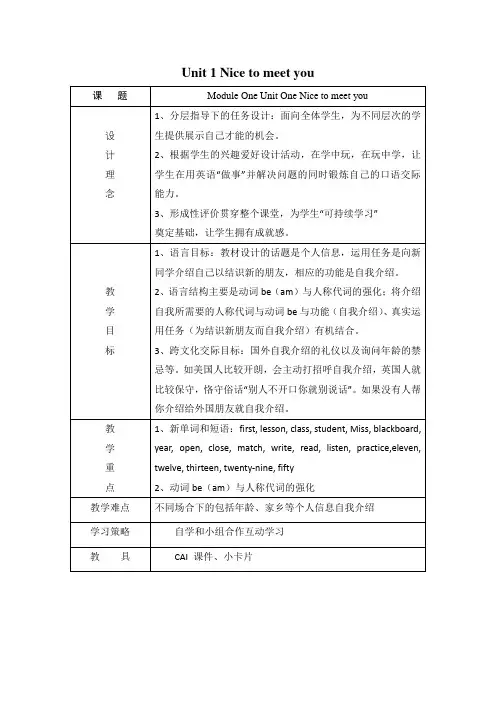
Unit 1 Nice to meet you教学流程图: 教学步骤 l (1课时)一、第一教学环节:情景创设、布置任务、激趣导入二、第二教学环节:师生互动、培养能力、给予成就感三、第三教学环节:评价总结、激发竞争、巩固提高附:评价表(小组成员之间进行评价,以星号为标记,五个星为最高,但是必须小组全票才能通过生效)Unit 2 I’m from China and I’m ChineseTeaching aimKnowledge: *useful expressions in introducing and greeting*nominal genitive pronoun & determinative genitive pronounAbilities: To be able to introduce oneself and others and greet peopleMoral education:To build up students’ confidence and interest in English- learning Key points: Introducing othersThis is Betty. This is my friend, Tony.Difficult points: 1) Asking for and receiving personal information.What’s your nameCan you introduce yourself please, BettyI’m from America. I’m 13 yea rs old.2) To master the names \ languages\ of some countriesTeaching methods: Group work, displayTeaching aids: Computer recorderTeaching procedures:Step 1 Teacher’s self-introduction (Lead-in)Name, Country, language, Age otherKey Sentence Structures:My name is ##.My first name is ##.My telephone number is ##.I’m from ##. I ‘m ##.My age is a secret.I am from Beijing. I come from Beijing. I am a native in Beijing.I come from China. I was born in China and brought up in China. I speak Chinese. In my spare time, I enjoy ###.My E-mail Address is ##.Step 2 Foreign teacher’s introduction (The same)This is our foreign teacher. (Name, Country, language, Age other) Students’ Activity: Listen and get some informationStep 3. The stud ents’ IntroductionNameAgeTeacherYearClassPhone numberE-mail addressCountryLanguageOtherListen and prepare the introduction.Introduce themselves according to the form.Pair work; Introduce themselves.Step 4. Part 2 on the book.Please listen to the tape so that we can know more about Daming, Lingling and Wang Hui. Please don’t open your books. Look at the blackboard.Listen and Answer.:1)Where is Daming from2)Where is Lingling from3)Where is Wang Hui from4)How old are theyName Country Language Age OtherBettyTonyLinglingWork in pairs to practise the dialogue.Students’activity: Listen to the tape; Practise their listening; Improve their abilities of get informationStep 5. Learning the dialogue.Practise the listening skill & Role playStudents’ activity: According to the form, they work in groups to practise the dialogue.Step6. Show a map of the world to practise the names \ languages of the countries Listen and think so many foreign countries’ names.Step7. Read aloudThe students read aloud to practise oral English.Write some sentences about the pictures.Step9. Learning the language item.1)My name’s … /I’m from…/He’s fourteen years old.2)The names of the countries.The students learn the language points.Homework: Introduce one of your pen-friends.Unit 3 Language in use学习目标:1.学习be动词的简单用法。
外研版七年级英语上册教案完整版

2)练习询问姓名和相互间的问候。
What’s your name
I’m…
How are you I’m fine, thank you.
3)练习向别人介绍某人This is…
1)Work in pairs part7
教学目标
学习向别人介绍某人的用语
教学重点
This is my…She/He is…
教学难点
Be的变化运用
教具
多媒体、录音机
课时
1
教学课程
.
T: This is my friend…
S: Hello,…This is my father…
T: Nice to meet you.
S: Nice to meet you, too.
S: Hello, Ms…
T: Sit down please.
S: Thank you.
3.Drills
(1)练习打招呼问好。
(2)练习感谢他人。
(3)练习告别语Goodbye。
4.Practise
1)Work in pairs part7 and part8
2) Complete the sentences.
It’s a/an…book,bag,chair,desk…
教学难点
This/that的变化运用;a/an的运用
教具
多媒体、录音机
课时
1
教学课程
.
T: What’s this in English?
S: It’s a book.
T: How do you spell it?
外研版初中英语七年级上册(WY)教案 Module 1 Unit 2

Book1 Module1My classmates一、教学内容:Unit2 I ‘m Wang Lingling and I’m thirteen years old二、课型:Reading and writing三、教学目标:1、能够正确使用下列单词和词组:but, everyone, capital, last name,first name,big,small.2、能够读懂别人的自我介绍的短文。
3、能够对别人进行自我介绍和能介绍别人。
4、在跟不同地区的人交流时,学会尊重不同地域不同的表达习惯,理解他人。
四、教学重难点:1、掌握本课新词和词组2、掌握中外不同的姓名表达习惯:first name, last name3、能够进行简单的自我介绍五、教学准备:课堂整体运用任务型教学模式, 创设真实语境,通过个人呈现,同伴互动,小组活动等师生、生生的交流,充分体现了学生在学习过程中的主体地位,教师只是课堂的引导者,组织者和合作者.本课指导学生通过阅读获取信息,培养学生阅读技能。
在教学过程中,采用多媒体手段辅助教学,利用各种图片和习题任务贯穿整个教学过程。
因此,本节课需准备:PPT课件、课堂练习表格、奖品六、教学过程:words study.1、Lead the students to learn t he new w ords in groups.2、Show the sentences about the new words in this unit and some pictures.3、Choose the little teacher to teach the new words and the teacher correct the mistakes.4、Check the exercise in Activity 1.groups.2、Fill in the blanks.Check the answers with the whole class.3、Little teacher toteach the newwords.The other s toread after the little teacher.4、Competitive in the whole class..estions.②Let the students read Paragraph 1 in groups of six and find out difficulties.③Solve difficulties.T: Let’s continue learning Paragraph 2.(2) Paragraph 2:①Present someread Paragraph 2 and the students listen carefully to point out important Solve lasttalking.knowstudentsblanks③One team studentsread Paragraph 2 and the other students pointout difficultiespoints.④Tosay thedifficulties and solve together.(3)Read the Paragraph3.① Fill in the blanksafter reading paragraph3readingstudents to check the answersfirst andAsk a group of sixread paragraph 3. Let thestudentsandout My name is ______ _______I’mfrom__________.It’s a _____city in England. Tony is my ______name and Smith is my ________name.I’m thirteen______old.It’s nice to_____ you all.②The students check the answers in groups first and then competive.③ A group of six students to read paragraph 3. The other1.Retell.①Let the students fillin the blanks accordingto the pict ure .②Call back the answersfrom two students thenread the short passagein the whole class .2.Speaking①Ask and answer about the people in the pictures.②Ask some students to come to the blackboard and introduce七、板书设计:Module 1 Unit 2 I ‘m Wang Lingling and I’m thirteen yearsoldWhat’s your name? My name is…Where are you from? I’m from…Nice to meet you, … Nice to meet you, too.达标训练题(100分)一、阅读文章,从中找出重要信息填写下面的表格。
新外研版初中七年级上册英语全册教案修正版
Module 1 My teacher and my friends.Unit 1 Good morning, Miss Zhou.Ⅰ. Analysis of the text:This is the first English lesson. Students should know how to greet with the teacher and other students.Ⅱ. Arrangement of teaching in this moduleThree periods for this module, one period for one unit.Ⅲ.Teaching focus:1. Master language of daily greetings.Key vocabulary and phrases: hello, class, my, name, is, Miss, good, morning, good morning, afternoon, good afternoon, goodbye2. Be skilled in oral expression of greetings.Ⅳ.Teaching aims:1. Function: Greetings in students’ daily life.2. Listening: Students can understand others’ greetings by listening.3. Speaking: Students can introduce themselves and greet with others.4. Reading: Students can understand the similar dialogue of greetings.5. Writing: Students can write greeting words in their daily life. Ⅴ.Character building:Motivate students’ interest in learning English. Make friends with all students.Ⅵ.Teaching Procedures:Part I: Lead in:Step 1: Greeting with the students.Step 2: Introduce myself and ask students to introduce themselves to the class.Step 3: Sing a song: Good morning.Part II: Vocabulary study:Step 1: Play the recording and have them point out the words and phrases. Step 2: Play the recording again and have them read after the tape. Step 3: Have the students match the phrases and pictures in PPT.Part Ⅲ: Dialogue study:Step 1: Practise the dialogue with the whole class and have them make corresponding reacts.Step 2: Have students to practise the previous dialogue with their partner.Step 3: Listen and read.—Hello, class. My name’s Miss Zhou.—Good morning, Miss Zhou—Good afternoon, class.—Good afternoon, Miss Zhou.—Goodbye, class.—Goodbye, Miss Zhou.Listen again and repeat.Step 4: Match1. Hello, my name’s Daming. a) Goodbye, Tom.2. Good morning, Lingling, b) Hello, my name is Lingling.3. Good afternoon, Carla. c) Good morning, Carla.4. Goodbye, Mike, d) Good afternoon, MikeStep 5: Listen and checkKeys: 1. b 2. c 3. d 4.aStep 6: Work in pairs. SayA: Hello, my name’s ….B: Good morning, …A: Good afternoon, …B: …A: Goodbye, …B: …Part Ⅳ: Letters study:Step 1: Sing A B C Song.Step 2: Listen letters in Activity 5 and read after the tape.Step 2: Listen letters in Activity 6 and have them number the letters in Activity4.Step 3: Have some of them to write down letters on the blackboard and check in the class.Step 4: Listen again and write.Step 5: Work in pairs and check your answers.Unit 2 Good morning, I’m Chen Zhong.Ⅰ.Analysis of the text:In this text students will learn how to introduce themselves to others, and make relative greetings.Ⅱ.Arrangement of teaching in this moduleThree periods for this module, one period for one unit.Ⅲ.Teaching focus:1. Master language of self-introduction and greetings in the situation of first meeting.Key vocabulary and phrases: Mr., I, what, your, please, sorry, can (can’t), you, spell, it, yes, thank, how, fine, thanks, Mrs. too2. Be skilled in oral expression of self-introduction and greetings in the situation of first meeting.Ⅳ. Teachi ng aims:1. Function: Self-introduction and greetings in the situation of first meeting.2. Listening: Students can understand others’ introduction and greetings by listening.3. Speaking: Students can introduce themselves and greet with others.4. Reading: Students can understand the similar dialogue ofself-introduction and greetings.5. Writing: Students can write their self-introduction.Ⅴ. Teaching Procedures:Part I: Lead in:Step 1: Review the greeting phrases in the previous period by having the whole class play the dialogue in real situation.Step 2: Ask students to introduce themselves to the class.Step 3: Enjoy Fl ash: What’s your name?Part II: Vocabulary study:Step 1: Play the recording and have them point out the words and phrases in Activity 1.Step 2: Play the recording again and have them read after the tape. Step 3: Have the students match the sentences in Activity 3 and check their answer with their partner.Keys: 1. c 2. a 3. bStep 4: Listen the dialogue in Activity 4 and check their answers. Step 5: Write the sentences in Activity 5.Part Ⅲ: Dialogue study:Step 1: Listen sentences in Activity 6 and have them number the sentences in Activity 6.Step 2: Teacher practise a dialogue with single student as follows: — Good afternoon. How are you?—I’m fine, thanks. How are you?—I’m fine too, thanks. What’s your name?—I’m Tom. What’s your name?—I’m Sarah.Step3: Work in pairs and practise the dialogue. Have some of them to perform their dialogue for the whole class.Unit 3 This is my friends.Ⅰ.Analysis of the text:In this text students will learn how to introduce their friends and family members to others.Ⅱ.Arrangement of teaching in this moduleThree periods for this module, one period for one unit.Ⅲ.Teaching focus:1. Master language of introducing friends and family to others.Key vocabulary and phrases: this, she, teacher, friend, her, his, nice, to, meet, time, go, now, bye, see, tomorrow2. Be skilled in oral expression of introducing someone to others. Ⅳ.Teaching aims:1. Function: Introduction of friends and family members.2. Listening: Students can understand others’ introduction of someone.3. Speaking: Students can introduce their friends and family members to others.4. Reading: Students can understand the similar dialogue of introducing others.5. Writing: Students can write the introduction of their friends and their family members.Ⅴ.Teaching Procedures:Part I: Lead in:Step 1: Review the greeting phrases in the previous period by having the whole class play the dialogue in real situation.Step 2: Ask students to introduce themselves to the class.Step3: Enjoy a song: Make new friends.Part II: Vocabulary study:Step 1: Play the recording and have them point out the words and phrases in Activity 1.Step 2: Play the recording again and have them read after the tape. Step 3: Have the students match the sentences in Activity 3 and check their answer with their partner.Step 4: Listen the dialogue in Activity 3 and check their answers. Step 5: Write the sentences in Activity 3.Part Ⅲ: Dialogue study:Step 1: Listen sentences in Activity 4 and have them number the sentences in Activity 4.Step 2: Match1. This is my friend. a) His name’s Tony.2. She is my friend. b) Goodbye.3. Hello. c) Nice to meet you.4 . It’s time to go now. d) Her name’s Betty.Step 3: Listen and check.Keys: 1.a 2. d 3. c 4. bStep 4: Listen and numbera) Goodbye. See you tomorrow.b) Hello, Daming. This is my friend, Amy.c) It’s time to go now. Goodbye.d). Hello, Amy, nice to meet you.e) Hello, Daming, nice to meet you too.Keys: b d e c aStep 5: Listen again and say.Step6: Work in groups. Say.This is my friend. … name’s … Hello…, nice to meet you.Step 7: Work in group of 4 and fill the blanks in Activity 7, then have some groups of them to perform the dialogue for the whole class.1. This is my friend. ________ name’s Tony.2. This is my ________. Her ___________ Betty.3. Nice to _________ you.4. It’s time to go now.___________.5. Goodbye. See you __________.Step 7: Now listen and check.Keys: 1.His 2. friend, name’s 3.meet 4. Goodbye 5.tomorrow Module 2 My English lessonUnit 1 Open your book.Ⅰ.Analysis of the text:In this text students will learn how to recognize objects in the class. Ⅱ.Arrangement of teaching in this moduleThree periods for this module, one period for one unit.Ⅲ.Teaching focus:1. Master language of asking the name of specific objects in the class, and master the words of objects in the class.Key vocabulary and phrases: sit, down, sit down, open, book, listen, draw, put, up, hand, stand, stand up, close What’s this in English?, What’s this?, It’s…, instruction pronoun thi s.2. Be skilled in oral expression of asking the name of specific objects in the class and give corresponding answers.Ⅳ.Teaching aims:1. Function: recognition of objects in the class.2. Listening: Students can understand others’ questions of asking thenames of specific objects, and give corresponding answers.3. Speaking: Students can ask and answer objects’ names.4. Reading: Students can understand the similar dialogue of asking and answeringobjects’ names.5. Writing: Students can write the names of objects in the class. Ⅴ.Teaching Procedures:Part I: Lead in:Step 1: Review the greeting phrases in the previous period by having the whole class play the dialogue in real situation.Step 2: Ask some students to introduce their partners to the class. Step3. Enjoy a song: Hello and how are you?Part II: Vocabulary study:Step 1: Show some pictures of objects in the class by PPT, give students the names of the objects.Step2: Play the recording and have them point out the words and phrases in Activity 1.Step3: Listen and read.Good morning, class.Good morning, Miss Zhou.Please sit down.Step 4: Play the recording and have them point out the words and phrases in Activity 2.Sit down.Open your bookListen.Draw.Put up your hand.Stand up.Close your book.Step 5: Play the recording again and have them read after the tape. Step 6: Listen again and do.Step 7: Enjoy a song: Nice to meet you!Part Ⅲ: Dialogue study:Step 1: Teacher ask the whole class the objects in the PPT’s names. Step 2: Match the expressions in Activity 3.1. Put up a) your book2. Open b) …down3. Stand c)… up4. Sit d)…your hand.Step3: Call back the answers from the whole class.Keys: 1. d 2. a 3. c 4. bStep4: Write the letters in Activity 5.Step5: Listen and check.Step 6: Work in pairs, one student point one object in the PPT, the other answer the question.Step 7: Work in pairs and fill the blanks in Activity 6. Have some of them to perform the dialogue for the whole class.Stand up.Yes.Open your book.Yes.Step 8: Work in pairs. Say and do.Unit 2 What’s your number?Ⅰ.Analysis of the text:In this text students will learn how to express English number.Ⅱ.Arrangement of teaching in this moduleThree periods for this module, one period for one unit.Ⅲ.Teaching focus:1. Master language of asking the name of body and master the names of body.Key vocabulary and phrases: student, new, here, in, one, two, three, four, five, six, seven, eight, nine, ten, telephone, number2. Be skilled in oral expression of asking the name of spec ific part’s name of body.Ⅳ. Teaching aims:1. Function: recognition of parts of body.2. Listening: Students can understand others’ questions of asking the names of specific parts of body, and give corresponding answers.3. Speaking: Students can ask and answer parts of body’s nam es.4. Reading: Students can understand the similar dialogue of asking and answering parts of body’s names.5. Writing: Students can write the names of parts of body.Ⅴ. Teaching Procedures:Part I: Lead in:Step 1: Review the objects’ n ames in the classroom.Step 2: Point one object and ask students to give its name.Part II: Vocabulary study:Step 1: Learn English number from one to five.Step 2: Enjoy a song: Three blind mice.Step 3: Learn English number from six to ten.Step 4: Enjoy a song: Ten little Indians.Part Ⅲ: Listening practice.Step 1: Look at the pictures in Activity 1.Step 2: Listen and read.—Hello. Are you a new student here?—Yes, I am.— What class are you in?—I’m in Class 3. Mr. Chen’s class.Step 3: Listen and repeat.one two three four fivesix seven eight nine tenStep 4: Listen and chant.One, two, three, four, five.Once I caught a fish alive.Six, seven, eight, nine, ten,Step 5: Then I let it go again.Part Ⅳ: Dialogue study:Step 1: Ask the students to read the conversation silently.Step 2: Play the recording and ask the students to listen and read the conversation.Step 3: Read the conversation.Step 4: Act it out.Part Ⅴ: Do exercises:Step 1: Listen and point the number in Activity 5.a. 816 275 b .975 146 c. 359 412 d. 384 926keys: d b a cStep 2: Call back the answer from the whole class and check the answer. Step 3: Listen and write the number in Activity 6.What’s your number?1 Sam: ________2 Lisa: _________3 Kate: _________4 Mike : _________Keys: 1. 975146 2. 816275 3. 384926 4. 359412Step 4: Call back the answer from the whole class and check the answer. Step 5: Now listen again and check.Step 6: Listen and write.1 one2 ______3 ______4 ______5 ______6 ______7 ______8______9. ______10_______Step 7: Call back the answer from the whole class and check the answer.Mike one five one, eight nine three, fourStep 9: Call back the answer from the whole class and check the answer. Part Ⅵ Work in pairs.Ask and answer.What’s your number?It’s 179 456.What’s your number?It’s 942 381.Unit 3 I’m twelve.Ⅰ. Analysis of the text:In this text students will learn numbers.Ⅱ. Arrangement of teaching in this moduleThree periods for this module, one period for one unit.Ⅲ. Teaching focus:1. Master language of asking number, and master the numbers.Key vocabulary and phrases: old, eleven, twelve, thirteen, fourteen, fifteen, sixteen, eighteen, nineteen, twenty, boy, girl, desk, chair, bag2. Be skilled in oral expression of asking and answering numbers. Ⅳ. Teaching aims:1. Function: recognition of numbers.2. Listening: Students can understand others’ questions of asking numbers, and give corresponding answers.3. Speaking: Students can ask and answer numbers.4. Reading: Students can understand the similar dialogue of asking and answering numbers.5. Writing: Students can write numbers.Ⅴ. Teaching Procedures:Part I: Lead in:Step 1: Review the objects’ names in the classroom.Step 2: Point one object and ask students to give its name.Step 3: Review the English number.Part II: Vocabulary study:Step 1: Show some pictures.Step 2: Ask and answer.Step 3: Learn the new words.Part Ⅲ: Listening practice.Step 1: Look at the pictures in Activity 1.Step 2: Listen and read.—What’s your name, please?—I’m Daming.—How old are you?—I’m twelve.Step 3: Read the conversation.Step 4: Act it out.Part Ⅳ: Do exercises:Step 1: Listen and repeat the number in Activity 2.11 12 13 14 15eleven twelve thirteen fourteen fifteen16 17 18 19 20sixteen seventeen eighteen nineteen twentyStep 2: Match the number in Activity 3.seventeen twelve nineteen fifteen sixteen thirteen twenty eleven fourteen eighteen11 12 13 14 16 17 18 19 20Step 3: Call back the answer from the whole class and check the answer. Step 4: Listen and point.1. 11+ 4 = 152. 12+6 = 183. 14+6= 204. 17+2= 19Step 5: Listen and write.1. 11+________= _______2. _______+4 = _______3. _______+2= ________4. 3+ ________ = _______5. _______+1= _______6. 2+ _______= ________Keys: 1. 11+6=17 2. 15+4=19 3. 18+2=20 4. 3+13=16 5. 16+1=17 6. 2+12=14Step 6: Call back the answer from the whole class and check the answer. Step 7: Listen and write.1 eleven2 ______3 ______4 ______ 5_______6_______7 ______ 8 ______ 9 ______ 10_______Step 8: Call back the answer from the whole class and check the answer. Step 9: Listen and match12 13 14 15 16 17 18 19 20boys girls desks chairs books bagsKeys: 12 17 20 19 16 14Step 10: Call back the answer from the whole class and check the answer. Part Ⅴ Work in pairs.Module 3 My English bookUnit 1 What’s this in English?Ⅰ. Analysis of the text:In this text students will learn how to recognize objects in the class. Ⅱ. Arrangement of teaching in this moduleThree periods for this module, one period for one unit.Ⅲ. Teaching focus:1. Master language of asking the things in the class, and master the English expressions of them.Key vocabulary and phrases: English, a/an, write, on, the, blackboard, OK, pen, no, pencil, do, bird, cat, dog, flower, map.2. Be skilled in oral expression of asking and answering the things in the class.Ⅳ. Teaching aims:1. Function: To recognize objects in the class.2. Listening: Students can understand others’ questions of asking objects in the class., and give corresponding answers.3. Speaking: Students can ask and answer objects in the class..4. Reading: Students can understand the similar dialogue of asking and answering objects in the class..5. Writing: Students can write objects in the class.Ⅴ. Teaching Procedures:Step 1 Lead in:1. Review English expression of numbers.2. Show some numbers by PPT, have students give the number of things.3. Review the objects’ names in the classroom.4. Point one object and ask students to give its name.Step 2 Vocabulary study:1. Show some pictures by PPT.2. Ask and answer: What’s this in English?3. Enjoy Flash.4. Learn the new words.5. Read the new words.Step 3 Listen and read.1. Ask the students to read the conversation silently.2. Play the recording and ask the students to listen and read the conversation.3. Read the conversation.4. Act it out.Step 4 Listen and point.1. Ask the students to look at the pictures in Activity2.2. Ask and answer like this:—What’s this in English?—It’s a dog. (1. a bird 2 .a book 3. a cat 4. a dog 5. a flower 6. a pen 7. a pencil3. Work in pairs.Step 5 Listening practice.1. Play the recording of Activity 3 and listen and write.2. Play the recording of Activity 5 and listen and write.1) What’s ____________________?2) ______________ cat.3) How _______________ spell “cat”?4) _____________________4. Listen again and check.5. Call back the answer from the whole class and check the answer. Keys:1. this in English2. It’s a3. do you4. C-A-T, cat.Step 6 Work in pairs.1. Ask and answer like this.A: What’s this in English?B: A pen?A: No.B: A pencil?A: Yes, a pencil.B: How do you spell “ pencil ”?A: P-E-N-C-I-L, pencil.2. Work in pairs.Unit 2 Can you help me, please?Ⅰ.Analysis of the text:In this text students will learn how to spell the words.Ⅱ.Arrangement of teaching in this moduleThree periods for this module, one period for one unit.Ⅲ.Teaching focus:1. Master language of asking positions of things, and master the English expressions of positions.Key vocabulary and phrases: help, me, classroom, know, say, that, again, welcome, you’re welcome.2. Be skilled in oral expression of asking and answering the position of things.Ⅳ.Teaching aims:1. Function: recognition of positions.2. L istening: Students can understand others’ questions of spelling, and give corresponding answers.3. Speaking: Students can ask and answer “how to spell”.4. Reading: Students can understand the similar dialogue of asking and answering spelling.5. Writing: Students can write spelling of the words.Ⅴ. Teaching Procedures:Step 1 Lead in:1. Review the text of Unit 1.2. Show some pictures, ask the students to look at the pictures, then talk something about the pictures.3. Introduce the new words.Step 2 Vocabulary study:1. Show some pictures by PPT.2. Ask and answer:What’s this in English?How can you spell it?3. Learn the new words.4. Read the new words.Step 3 Listen and read.1. Ask the students to read the conversation silently.2. Play the recording and ask the students to listen and read the conversation.3. Read the conversation.Daming : Can you help me, please, Lingling?Lingling: Yes, of course.Daming : How do you spell “ classroom ” ?Lingling: I’m sorry. I don’t know.Miss Zhou: It’s C-L-A-S-S-R-O-O-M.Daming: Cab you say that again, please?Miss Zhou : Yes. It’s C-L-A-S-S-R-O-O-M.Daming: Thank you.Miss Zhou : You’re welcome.4. Act it out.Step 4 Listen and point.1. Ask the students to look at the pictures in Activity2.2. Ask and answer like this:—What’s this in English?—It’s a monkey. …3. Work in pairs.Step 5 Listening practice.1. Play the recording of Activity 3 and Listen and say.2. Read and match.1. Can you help me , please ? a ) You’ re welcome.2. How do you spell “ desk ”? b) Yes, D-E-S-K.3. Can you say that again, please? c) It’s D-E-S-K.4. Thank you. d) Yes. Of course.3. Listen again and check.4. Call back the answer from the whole class and check the answer. Keys: 1.d 2..c 3. b 4.a5. Listen again and say.6. Listen and point.Step 6 Work in pairs.1. Ask and answer like this.A: Can you help me, please?B: Yes, of course.A: What’s this in English?B: It’s a…A: How do you spell it?B: …A: Thank you.B: You’re welcome.2. Work in pairs.Step 7 Write.1. Ask the students to read through the sentences in Activity 6. A: ________ you help me, please?B: Yes. ____________.A: How do __________ spell “ __________” ?B: It’s D-E-S-K.A: ___________ say that again, please?B: Yes, _____________.A: _________ you.B: You’re __________.2. Listen and check.Keys:1. Can2. of course3. you, desk 5. Can you 6. D-E-S-K 7. Thank 8. welcome3. Read together.Unit 3 What colour is it?Ⅰ. Analysis of the text:In this text students will learn colours of things.Ⅱ. Arrangement of teaching in this moduleThree periods for this module, one period for one unit.Ⅲ. Teaching focus:1. Master language of asking colour of things, and master the English expressions of colours.Key vocabulary and phrases: of, course, want, cocour, black, white, blue, green, yellow, red, brown, orange, and What colour is/are …?2. Be skilled in oral expression of asking and answering the colours of things.Ⅳ. Tea ching aims:1. Function: Recognition of colours.2. Listening: Students can understand others’ questions of asking colours, and give corresponding answers.3. Speaking: Students can ask and answer colours.4. Reading: Students can understand the similar dialogue of asking and answering colours.5. Writing: Students can write colours.Ⅴ. Teaching Procedures:Step 1 Lead in:1. Review the text of Unit 1 and 2 .2. Show some pictures, ask the students to look at the pictures, then talk something about the pictures.3. Introduce the new words.Step 2 Vocabulary study:1. Show some pictures by PPT.2. Ask and answer:What’s this in English?What colour is it?3. Learn the new words.4. Read the new words.Step 3 Listen and point.1. Ask the students to look at the pictures in Activity 1.2. Play the recording and ask the students to listen and point.3. Listen and repeat.4. Work in pairs.—What colour is it ?—It’s black, B-L-A-C-K, black.Step 4 Look, read and match.1. Ask the students to look at the pictures in Activity2.2. Look through the sentence.3. Play the recording and ask the students to listen and point.4. Match the sentences.1 ) What colour is the pen? a) It’s red2 ) What colour is the cat? b) It’s yellow.3) What colour is the pencil? c) It’s white.4 ) What colour is the flower? d) It’s red, green and orange.5 ) What colour is the dog? e) It’s blue.6 ) What colour is the bird? f) It’s brown.5. Call back the answer from the whole class and check the answer.6. Listen again and say.Step 5 Work in pairs.1. Ask and answer like this.A: What colour is the …?B: It’s…2. Work in pairs.Step 6 Write.1. Ask the students to read the words in Activity 6.2. Complete the table in Activity 6.3. Call back the answer from the whole class and check the answer. Keys:1. bag book desk pen pencil2. bird cat dog flower3. black blue brown green orange red white yellow4. Ask the students to read through the conversations in Activity 7 silently.5. Fill in the blank.1. —What colour is the dog?—It’s ________2.—What ________ is the flower?—It’s _______3. —__________ is the bird?—It’s red, green and _______.4.—What _______________?—It’s yellow.5. — ________________ the pen?—It’s __________6.—____________ the cat?—It’s _______.7. Listen and check.Module 4 My everyday life.Unit 1 What day is it today?Ⅰ. Analysis of the text:In this text students will learn how to ask and answer “What day is it today?” , “What’s the weather like today?” , “What’s your favourite sports?”.Ⅱ. Arrangement of teaching in this moduleThree periods for this module, one period for one unit.Ⅲ. Teaching focus:1. Students will comprehend and produce the sentence structures.2. Students will learn about activities and the weather .and some sentences about them.3. Students will successfully request information about activities and the weather .and can talk about their activities the like.4. Key vocabulary and phrases:day, today, Monday, Tuesday, Wednesday, Thursday, Friday, Saturday, Sunday, yesterday, birthday, favourite, spring, summer, autumn, winter, warm, hot, cool, cold, weather, like, basketball, football, swimming, table tennis, sport, let, us, let’s=let us, play, after, school, idea 5. Key structures:1) What’s your favourite sport?2) Do you like watching television?3) Can you speak English?4) What’s the weather li ke in summer?6. Be skilled in oral expression of asking and answering everyday life. Ⅳ. Teaching aims:1. Listening: To understand the listening parts in the text about activities and the weather.2. Speaking: To master the sentence structures and practice.3. Reading: To know something about activities and the weather.4. Writing: Write a composition about “ My favourite sport”Ⅴ. Teaching Procedures:Step 1 Lead in:Step 1 Lead in:1. Review English expression of colours.2. Show some pictures by P PT, ask and answer “What colour is it?”.3. Ask and answer. What day is it today?4. Learn new words: Sunday, Monday, Tuesday, Wednesday, Thursday, Thursday, Friday, SaturdayStep 2 Vocabulary study:1. Show some pictures by PPT.2. Ask and answer: What day is it today?3. Learn the new words.4. Read the new words.Step 3 Listen and read.1. Play the recording and ask the students to listen.2. Ask the students to read the conversation silently.3. Play the recording and ask the students to listen and read the conversation.4. Read the conversation together.5. Act it out.Step 4 Work in pairs.Monday—Good morning, class. What day is it today?—It’s Monday.—Yes, it’s Monday. Write it in your book.—M-O-N-D-A-Y, Monday.—What day is it tomorrow?—Tuesday.—Yes, tomorrow is Tuesday.Step 5 Listen and repeat.1. Ask the students to look through the table in Activity2.2. Play the recording and ask the students to listen.3. Listen and repeat.4. Now point, ask and answer.What day is it? It’s …5. Work in pairs.Step 6 Read and match.1. Ask the students to look through the sentences in Activity 3.2. Match the sentences.1 Today is Wednesday. What day is it tomorrow? a) Sunday.2 Today is Friday. What day is it tomorrow? b) Tuesday.3 Today is Monday. What day is it tomorrow? c) Thursday.4 Today is Saturday. What day is it tomorrow? d) Saturday.5. Call back the answer from the whole class and check the answer.。
外研版初中英语七年级上册(WY)教案 Module 9 Unit 1
Module 9 People and places一、教学内容:Unit 1 We’re enjoying the school trip a lot.二、课型:Listening and speaking三、教学目标:1、能掌握本单元的词汇及短语:call, lie, lie in the sun, take photos,wait, walk, a few, enjoy, go back2、能掌握现在进行时态be (am /is /are) +doing的用法和结构。
3、能听懂含有现在进行时态的简短对话.4、能转述正在做或发生的事情;能根据图片、视频、真实行为等描述正在发生的事情。
四、教学重难点:掌握现在进行时态句子的肯定,疑问与否定形式,并能用现在进行时态叙述正在发生的事情。
五、教学准备:本课指导学生通过听力获取信息,培养学生听力技能。
教师在教学时尽量用游戏,图片或flash动画的多种媒体来引起学生的学习兴趣,引导学生在交际中动态生成,学生有话可说,乐于合作分享。
这样就有利于他们更好的运用课本知识,达到提高综合运用语言能力的目的。
同时培养学生的合作精神,发展其思维和想象等能力。
在教学过程中,采用多媒体手段辅助教学,利用各种图片和习题任务贯穿整个教学过程。
因此,本节课需准备:PPT课件、挂图、录音机、课堂练习表格、奖品。
六、预习要求:1、根据音标自学本课新单词;2、查找相关资料,找出你认为本课较重要的语言点和短语。
Lead in1.Free talk:(1).Show some pictures and ask Ss like these: What is he/ she doing now?Where are they ? What are they doing now?(2).Show more pictures and let Ss talk about them, try to use the sentences with “be doing .”Task1:Check the newwords.1. Show some pictures and thing s to get the students to say out the new words and phrases.anize the students to read the new words together.3.Ask the Ss to describe 1.Look at the pictures and things to say out the new words and phrases.2. Read the new words and phrases together.3. To describe the picture and try toTask2:listening1.Play the tape, ask thestudents to listen andnumber the pictures.(Activity 2)2.Ask the students toListen to the conversation carefullyand match the people 1-5with the actions a-g.T: “Now, we are goingto listen to a dialoguebetween Betty and hermum. Betty is in Chinaand her mum is at home inAmerica. Let’s listenand match.”1.Betty a. eat an iceg. buy presentsstudents to check their answers. students the the work to read the conversation. 3. Have a competition: in the the anize students to come to the blackboard some language points that they found. 2.Help the students to difficult 3.Check theanswers.1.Read the conversation with the video.2. Read the conversation ingroups.3. Read the dialogue in groups and choose the best group.1. Students come tothe blackboard to show out somelanguage points,the other students listen to them carefully and note .2.Solve the difficult points.with the teacher ’s help.thethecomplete the table.(Activity 3)the students to underlinecorrect3. Ask the students towhattheusing3. 1.Students complete the table.(Activity 3)2.Students underline the correct words. (Activity 4)3.Students work in pairs .Say what people are doing in the conversation, using the form in Activity 3.Task 6:Do some speaking 1.Work in pairs. Ask students to talk about the photos wh ich they brought and say what people are doing in the photos at the moment . A: This is a photo of my familyI’m sitting on thegrass andreading. My father /mother /brother /sisteris …... We are having a good time. B: In this photo, we are enjoy ing the schooltrip. Li Ming is …Tony is …2. Have some students to come to the blackboard to talk about the ir photos.3.Play a guessing game. Have some Ss to do the actions in front of the class. The other Ss guess what is he doing.4.Ask students to do someExercises and then check. game. Some Ss do the actions in front of the class. The other Ss guess what is he doing.4.Do the exercises , then check.达标训练题一、单项选择()1.At the moment,everyone dumplings.A. are eatingB. eatingC. is eatingD. eat()2.Listen! She in the classroom.A. is singingB. singC. to singD. is sing()3.Americans like the sun.A. lie inB. lying inC. to lie unde rD. lying on ()4.My father enjoys piano.A. to playB. playingC. play theD. playing the()5.This is not easy work.A. aB. /C. oneD. an二、用所给动词的适当形式填空。
外研版七年级英语上册教案全册
最新外研版七年级英语上册教案全册Module 1 My classmatesUnit 1 Nice to meet you .学习目标:1、学会的单词:单词表从Chinese 到China . (90页) 短语: be from = come from2、重点句型:My name is .... I’m …. You’re …. Are you …?3、能用be动词一般现在时形式并正确运用于自我介绍中。
课堂准备:1、试读本单元的单词,不会读的在单词下打―△‖.2、试读第2页Activity2单词,不会读的在单词下打―△‖.3、试读第3页Activity3的对话, 不会读的在单词下打―△‖, 同时试着完成第三页的5个句子的判断. 自学交流:1、be动词有哪三种不同形式?、、。
2、用be动词的正确形式填空:① My name Miss Li.②I Chinese.③He my friend.④We students.⑤What your name?⑥Where you from?合作探究:1、Chinese 是名词时,翻译为: ___________ ; 是形容词时翻译为: ___________2、be from 的同义词组为: ___________He is from China .(改为同义句) He ___________ China .3、what about 的同义词为: ___________4、Is Daming from Beijing ? 肯定回答: _________ 否定回答: _________巩固提高:Work in pairs. Ask and answer.(Activity5)A: What’s your name? B: My name is…A: Are you English?B: No,I’m …A:How old ar e you? B:I’m … years old .I’m in Class …A: Nice to meet you,…B: Nice to meet you ,too.拓展延伸:单项选择:( )1. -Nice to meet you. - .A. Good morningB. You are welcomC. Nice to meet you, tooD. Goodbye( )2.H e from Beijing, I from Shanghai.A. is,isB. am, amC. is, amD. is, comes( )3. - Are you from Ch ina ? – Yes ,A. I’mB. I’m notC. I’ amD. I am( )4. – is Mary from? -She is from .A. Whe n, AmericanB. Where, AmericaC. What, England( )5. My sister is .A. twelve year oldB. twelve years oldC. twelve-years oldD. twelve-year-old( )6.-What about ______ a rest ?- OK. Let’s go out and have a walk .A. to takeB. takesC. taking本课小结:我学会了:1、我能背本课的单词、短语和句子(听写)2、am、is are的用法(口诀)*老师,我想对您说:Unit 2 I’m Wang Lingling and I’m thirteen years old .学习目标:1、学会单词:从everyone 到all. (90页) 短语:be from = come from2、三个问句的灵活运用:What’s his/ her name? How old is he/ she? Where is he/ she from?3、能用be动词一般现在时形式并正确运用于自我介绍中; 人称代词和物主代词课堂准备:1、试读本单元的单词,不会读的在单词下打―△‖.2、试读第4页Activity1的句子,把句子按正确顺序排列.3、试读第4页Activity2的三段短文, 不会读的在单词下打―△‖,试着完成6个句子的判断.4、单项选择1)- are you? -I’m thirteen years old.A .WhatB . How C. How old2) Mike is from and he is .A. Chinese, ChinaB. America, AmericanC. English, England自学交流:1、Introduce yourself to the class.(自我介绍): My name is… I’m a… I’m…years old. I’m from…2、Work in pairs. Ask and answer.(互相问答)A: What’s your name? B: My name is…A: Where are you from? B: I’m from… I’m…A: How old are you? B: I’m …years old.合作探究:1.不定代词everyone 意为:2.the capital of China意为: capital 还可以翻译为:3.探讨一下first name 和last name巩固提高:1. 互相问答: What’s his/ her name? How old is he/ she? Where is he/ she from?2. Writing(写):①Activity 5②Activity 6拓展延伸:一. 用be动词的适当形式填空:1.My mother ______ a teacher.2.Your sister ______ ten years old.3.His students ______ all in the classroom.4.You and I _____ good friends.5.Lucy ______ an English girl.She ______ in Class Two this year.6.You _______ our Chinese teacher this term.二. 用and衔接句子来介绍自己:My name’s … and I’m …本课小结:1、我背得了本课的单词、短语和句子2、我学会用and 衔接句子来介绍自己:My name’s … and I’m …*老师,我想对您说:Unit 3 Language in use学习目标:1、记住本模块全部单词(90页)2、重要句子:①I’m your teacher .②She’s my friend . ③He’s from Shanghai . ④My name is Li Daming . ⑤Her English name is Lucy .⑥His English name is Henry. ⑦Are you from America ? No, I’m not .3、能够正确使用be ,明了一般现在时态中be的用法;人称代词和物主代词与be 的运用.课堂准备:读熟单词并能记住本模块所有单词及重要句子自学交流:互相作自我介绍: I’m . This is .He’s my friend . I’m years old. He’s years old. We’reand we’re inClass .合作探究:1、1)先再复习一下系动词be (is, am, are) 动词的用法。
七年级英语上册全册教案(新外研版).doc
七年级英语上册全册教案(新外研版)注意:this is 不能缩写,而 that is 可以缩写成that’s。
打电话时,介绍自己用this, 询问对方用that。
如:This is Lucy speaking.Is that Lucy speaking?2. Good to see you. 很高兴见到你!此句为熟人之间见面常用的问候语,还可以说:Nice to see you. / Glad to see you. /Pleased to see you.It’s nice to see you all.很高兴见到你们所有人!句中all为代词,意思“每个,全体”;作主语时,be动词用are。
如:All the students are here today.所有的学生都到齐了。
3. I’m Wang Lingling and I’m thirteen years old.我叫王玲玲,我今年十三岁了。
介绍自己名字的时候可以用“I’m”、“I am”或“My name is ...”,此句还可以说:My name is Wang Lingling.另外,这里的“...years old”,表示.......几岁,这里的数字可以省略,直接说成:I am thirteen.对它提问用:How old...? 如:How old is Lingling?She is thirteen years old.4. Tony is my first name and Smith is my lastname. 托尼是我的名,史密斯是我的姓。
family name 姓 = last name 教名与中国习惯不同,大多数英语姓名有三个名字:教名,中间名和姓。
他们的姓放在最后。
(中间名一般很少用)如果你要称呼别人为……先生,夫人,小姐时,只能在family name也就是last name 前加上Mr, Mrs, Miss,如上面的这个名字,你只能称他为Mr. Green,而不能称他为Mr. James。
外研版英语七年级上册教案全册精编版
外研版英语七年级上册教案全册公司内部编号:(GOOD-TMMT-MMUT-UUPTY-UUYY-DTTI-U n i t1N i c e t o m e e t y o u教学流程图: 教学步骤 l (1课时)一、第一教学环节:情景创设、布置任务、激趣导入二、第二教学环节:师生互动、培养能力、给予成就感三、第三教学环节:评价总结、激发竞争、巩固提高附:评价表(小组成员之间进行评价,以星号为标记,五个星为最高,但是必须小组全票才能通过生效)Unit 2 I’m from China and I’m ChineseTeaching aimKnowledge: *useful expressions in introducing and greeting*nominal genitive pronoun & determinative genitive pronoun Abilities: To be able to introduce oneself and others and greet peopleMoral education:To build up students’ confidence and interest in English- learningKey points: Introducing othersThis is Betty. This is my friend, Tony.Difficult points: 1) Asking for and receiving personal information.What’s your nameCan you introduce yourself please, BettyI’m from America. I’m 13 years old.2) To master the names \ languages\ of some countries Teaching methods: Group work, displayTeaching aids: Computer recorderTeaching procedures:Step 1 Teacher’s self-introduction (Lead-in)Name, Country, language, Age otherKey Sentence Structures:My name is 。
外研版七年级英语上册教案全集
规定的八分钟时间内,以小组为单位, 符合自己实际的句子,反复操练。
看谁结交的朋友最多, 她将获得一份丰 2. 学生拿到卡片之后,以小组为单位
厚的奖品。
全班自由交流,首先要拿着自己的创
3. 同时填写这份表格:
意姓名卡片进行 “自我介绍 ”,然后询问
Num Nam 他/ 她的名片基本内容 对方的姓名等相关信息之后,填写表
五
Drill and practice: 操练阶段
Nice to meet you 步
完成 Task One: 制作 Name
交
际
Presentation :
教
学
Drill and practice: 操练阶段
法
完成 Task Two: 看谁的朋友最
教学流程图:
完成 Task Three: “心有灵犀”交 朋友
作出阅读的动作;如果只说 read,那么
学生便不要动。几轮下来,看看到底那
些同学能坚持到最后,成为 “心有灵犀 ”
的好朋友。互相交换名片,留做纪念。
三、第三教学环节:评价总结、激发竞争、巩固提高
教师活动
学生活动
1. 布置作业
初中生评价能力发展中的一个突出特
2. 评价手册
点就是十分重视同龄人对自己的评价
通过一到两组的简笔画的形式进行 动脑筋,猜测这是什么,并积极举手
自我介绍。如:
发言,获得老师的奖品。并有可能获
得本组的加分(学生课前分好组,每
节课要进行竞赛,看看哪一组上课最
认真)
2.认真观看动画或课件,仔细听老师 的 介 绍 : My name is …I am a…
I ’ m … years old. I am from,跟随…老师 学习有关自我介绍的词。 教师首先画出一个圆圈,让学生用
外研版七年级上册英语教案(新版)
外研版七年级上册英语教案(新版) Title: Unit 2: My SchoolObjectives:1. Students will be able to identify and describe school subjects.2. Students will practice using simple present tense to talk about their school life.3. Students will improve listening and speaking skills through group activities.Materials:1. Textbook2. Flashcards of school subjects3. Audio recording of a conversation about school4. Whiteboard and markersProcedure:Begin the lesson by showing flashcards of different school subjects. Ask students to name each subject and write them on the board. Engage students by asking which subjects they like and why. This encourages participation and helps them practice vocabulary related to school.Play the audio recording of a conversation between two students discussing their favorite subjects and daily school routines. Ask students to listen carefully and note key information. After the listening activity, conduct a short discussion about what they heard, prompting students to share their opinions.Divide the class into small groups and assign each group a specific school subject. Each group will create a short dialogue using the simple present tense to describe what they typically do in that subject. Allow groups time to prepare and practice their dialogues.After preparation time, have each group present their dialogue to the class. Encourage peer feedback and provide positive reinforcement for creativity and use of language. Conclude the lesson by summarizing the key points discussed and highlighting the importance of each school subject in their education.Assessment:Evaluate students based on their participation in discussions, group activities, and presentations. Provide feedback on their use of vocabulary and grammar.。