
英语语法讲义-作文讲解
2. 对立观点式模式
• 09年学位英语作文:
• 1、有些父母给孩子选工作 • 2、有些孩子认为应该自己选工作 • 3、你的看法
2. 对立观点式模式
• There is no consensus of opinions among society about 中心词 choosing job. Some people are in favor of the idea that 观点① parents should help their kids to choose job . not only do they point out the fact that 理由① parents have experience ,but also argue that 理由② have ability to choose job for their kids.
•
1. 问题解决式模式
• C解决问题
• Therefore, I would like to take following step to ⑥ 回应观点 . (for one thing) on one hand , ⑦措施一 .
(for other thing) on the other hand,
话题,这种现象尤其对那些涉及到其切身利 益的人所描述, 我认为任何事情都比不上学
位What I believe is based on the following reasons. To begin with, ③ 原 因一degree is a symbol of knowledge, which can entitle you to engage in the professional work. what’s more (even more), ④原因二it is connected with wealth ,
• 关于父母给孩子选工作在社会上并没有达成统一 的观点, 一些人支持父母应该为他们的孩子选工 作这样一种观念, 他们不仅指出这样一种理由父 母有经验, 而且还争辩另一种理由父母有能力为 他们的孩子选工作.
2. 对立观点式模式
• However, other people take an opposite side. They firmly believe that观点②children should find jobs by themselves. An example can give the details of this argument:举例子 80% children found jobs by themselves in China according to the sociologists’ survey. There is some truth in both argument.
disadvantages. My viewpoint are based on the following reasons:理由① .In
addition to the above-mentioned
effects, it might bring about
as
well as
.
• 对我而言, 我同意前者/后者, 我认为…的 观点利大于弊.我的观点基于如下理由:…. 除上述所列理由,它或许会给带来…和….
• 因此, 我要采取以下步骤/措施去获取学位, 首先/一方面,为了考取学位我要尽我最大 的努力学习英语,
1. 问题解决式模式
• (for other thing) on the other hand, ⑧ 措施二I will write good essays about my major as much as possible during my study in university . I believe where there is hope there is brightness
• ④原因二
the most important
• factor is that (last but more
• importantly), ⑤原因三
as is
• shown in the theme given above.
• 我认为基于以下原因.首先…, 其次…,诸如 以上给出的主题所示,最重要的因素是…
作文讲解
CONPOSITION
CONPOSITION
1. 问题解决式模式 2. 对立观点式模式 3. 经典句子 4. 参考作文
1.问题解决式模式
• A提出问题---B分析问题---C解决问题
1. 问题解决式模式
• A提出问题
• Today, ①中心词 has become a matter of great concern of the general public in our society, which is especially described among people involving it. And I (we, people) believe that ②观 点.
• 当今….已变成目前社会上人们普遍关注的 话题,这种现象尤其被描述对那些涉及到切 身利益的人, 我认为…
1. 问题解决式模式
• B分析问题
• What I believe is based on (基于) the
• following reasons. To begin with, ③
• 原因一 ,what’s more (even more),
• 其次/另一方面我在大学期间要尽我所能写 好本专业的论文, 我相信哪里有光明哪里 就有希望.
•2. 对立观点式模式
• A.有人认为X是好事, 赞成X, 为什么? • B.有人认为X是坏事, 反对X, 为什么? • C.我的看法。
2. 对立观点式模式
• There is no consensus of opinions
2. 对立观点式模式
• However, other people take an
opposite side. They firmly believe that
观点②
.An example can give the
details of this argument: 举例子
There is some truth in both argument.
• 尽管如此, 一些人还是持相反的观点, 他们坚定 地认为孩子们应该自己找工作.可以举个具体的例 子:来说明这种理由.根据社会学家的调查在中国 80%的孩子都是自己找工作.两种争论都有其道理.
2. 对立观点式模式
• As for me, I agree to the latter idea, which I think the advantages of 观点③ choose job by oneself overweigh the disadvantages. My viewpoint are based on the following reasons:理由① It can not only exercise ability, but also make more friends. In addition to the above-mentioned effects, it might bring about knowledge as well as wealth.
• 对我而言, 我同意后者, 我认为自己找工作的观点 利大于弊.我的观点基于如下理由:它不仅能锻炼能 力,而且还可广交朋友. 除上述所列理由,它或许 会给带来知识和财富.
•
•3. 经典句子
•
可以取代第一段的一些经典句子
可以取代第一段的一些经典句子
• 1、Currently, 中心词 has been the order of the day. This does demonstrate the theory —— nothing is more valuable than that. Some people hold the idea that 中心思想 .
• 根据社会学家的调查,那些拥有学位的70%的人 • 得到了90%的财富.诸如以上给出的主题所示,最 • 重要的因素是学位受到了人们的关注并为之奋斗.
1. 问题解决式模式
• Therefore, I would like to take following step to ⑥ 回应观点obtain degree . (for one thing) on one hand , ⑦ 措施一I will try my best to study English for the test for degree .
• 尽管如此, 一些人还是持相反的观点, 他们 坚定地认为…, 可以举个详细例子来说明这 个理由.…, 两种理由都有其道理.
2. 对立观点式模式
• As for me, I agree to the
former/latter idea, which I think the advantages of 观点③ overweigh the
• 目前, 已经是我们这个时代的主题。这 • 阐释了一个理论---没有什么东西 • 比起它更有价值,非常清楚____,
可以取代第一段的一些经典句子
• 2、Why ? you may wonder, should 中 心词 be our subject which nearly all people focus on nowadays. Because it is worthy of exploring , and some people hold an opinion that 中心思想
among society about 中心
词
.Some people are in favor
of the idea that 观点① . not
人教版英语八年级上册知识点、语法和作文总结
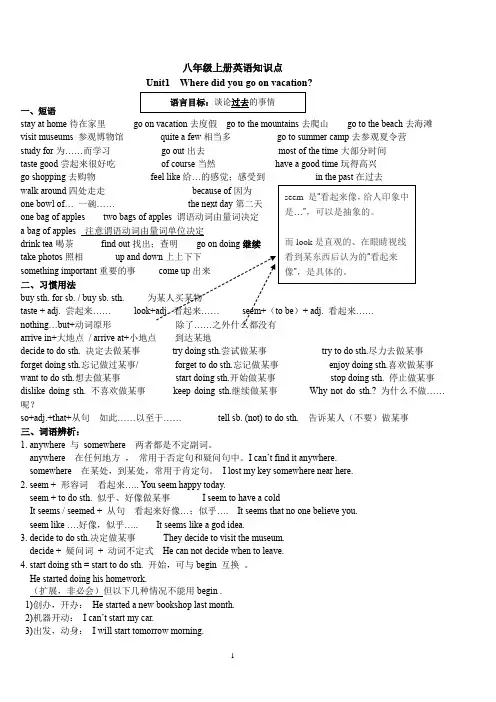
八年级上册英语知识点Unit1 Where did you go on vacation?一、短语stay at home 待在家里 go on vacation 去度假 go to the mountains 去爬山 go to the beach 去海滩 visit museums 参观博物馆 quite a few 相当多 go to summer camp 去参观夏令营study for 为……而学习 go out 出去 most of the time 大部分时间taste good 尝起来很好吃 of course 当然 have a good time 玩得高兴go shopping 去购物 feel like 给…的感觉;感受到 in the past 在过去walk aroundone bowl of… a bag of apples drink tea 喝茶 take photos 二、习惯用法 taste + adj. nothing…but+arrive in+大地点 / arrive at+小地点到达某地decide to do sth. 决定去做某事 try doing sth.尝试做某事 try to do sth.尽力去做某事forget doing sth.忘记做过某事/ forget to do sth.忘记做某事 enjoy doing sth.喜欢做某事want to do sth.想去做某事 start doing sth.开始做某事 stop doing sth. 停止做某事dislike doing sth. 不喜欢做某事 keep doing sth.继续做某事 Why not do sth.? 为什么不做……呢?so+adj.+that+从句如此……以至于…… tell sb. (not) to do sth. 告诉某人(不要)做某事三、词语辨析:1. anywhere 与 somewhere 两者都是不定副词。
英语语法认识作文
英语语法认识作文Title: Understanding English Grammar: A Comprehensive Exploration。
Introduction:English grammar plays a crucial role in effective communication, enabling individuals to convey their thoughts and ideas accurately. In this essay, we will delve into various aspects of English grammar, exploring its significance and providing insights into its intricacies.1. The Basics of English Grammar:English grammar encompasses various elements, including parts of speech, sentence structure, punctuation, and syntax. Understanding these fundamentals is essential for constructing coherent and meaningful sentences.1.1 Parts of Speech:English language consists of eight primary parts of speech: nouns, pronouns, verbs, adjectives, adverbs, prepositions, conjunctions, and interjections. Each serves a distinct purpose in conveying meaning within a sentence.1.2 Sentence Structure:Sentences in English typically follow a subject-verb-object (SVO) structure, where the subject performs the action indicated by the verb on the object. However, variations such as subject-verb (SV) or subject-object-verb (SOV) are also observed in different contexts.1.3 Punctuation:Punctuation marks such as periods, commas, semicolons, colons, and apostrophes aid in clarifying the meaning and structure of sentences. They help organize ideas, indicate pauses, and separate clauses within a sentence.1.4 Syntax:Syntax refers to the arrangement of words and phrases to create well-formed sentences in a language. It governs how words combine to form phrases, clauses, and sentences, thereby influencing the overall meaning and clarity of communication.2. Common Grammar Pitfalls:Despite its rules and conventions, English grammar presents challenges for learners due to its complexity and numerous exceptions. Some common pitfalls include subject-verb agreement errors, misplaced modifiers, and confusion between similar-sounding words (homophones).2.1 Subject-Verb Agreement:Ensuring that the subject and verb in a sentence agree in number (singular or plural) is vital for grammatical accuracy. Failure to maintain agreement can lead to confusion and ambiguity in meaning.2.2 Misplaced Modifiers:Modifiers, such as adjectives and adverbs, should be placed close to the words they modify to avoid ambiguity or unintended meanings. Misplacing modifiers can result in sentences that are awkward or difficult to understand.2.3 Homophones:Homophones are words that sound alike but havedifferent meanings and spellings (e.g., "there," "their," and "they're"). Confusing these words can lead to errors in written communication, affecting clarity and precision.3. Strategies for Improving Grammar Skills:Enhancing proficiency in English grammar requires a combination of practice, study, and exposure to the language in various contexts. Employing the following strategies can aid in improving grammar skills:3.1 Reading:Reading extensively exposes learners to different grammatical structures, styles, and vocabulary usage. It helps develop an intuitive understanding of grammar rules and conventions through exposure to authentic written texts.3.2 Writing:Regular writing practice allows individuals to apply grammar rules in context and receive feedback on their usage. Engaging in activities such as journaling, essay writing, and creative writing fosters fluency and accuracyin expression.3.3 Seeking Feedback:Seeking feedback from peers, teachers, or language professionals can provide valuable insights into areas for improvement. Constructive criticism helps identifyrecurring errors and enables targeted practice to address specific grammar issues.3.4 Utilizing Resources:Various resources, such as grammar textbooks, online courses, and language-learning apps, offer comprehensive explanations, exercises, and quizzes to reinforce grammar concepts. Utilizing these resources effectively can supplement formal instruction and self-study efforts.Conclusion:In conclusion, mastering English grammar is essentialfor effective communication and language proficiency. By understanding its fundamentals, identifying common pitfalls, and employing strategies for improvement, learners can enhance their grammar skills and express themselves with clarity and precision in written and spoken communication. Continued practice and exposure to the language are key to achieving proficiency and confidence in using English grammar effectively.Total Word Count: [Word count]。
独立主格语法考点总结讲义-高三英语复习作文专题

2024年高三英语高考三轮复习【作文专题】独立主格语法考点总结(讲义)独立主格(Abosolute Phrase)是一个短语,在句中作状语。
在使用独立主格结构之前,需要先明确主句部分和状语部分。
若状语部分的逻辑主语和主句的主语不一致时(即状语部分有自己独立的主语),则使用独立主格结构。
独立主格结构由两部分组成:前一部分是名词或代词,后一部分是非谓语动词(动名词,不定式,现在分词,过去分词)或形容词,副词,名词或介词短语。
with/without复合结构,同样也是在句中作状语,且状语部分的逻辑主语和主句的主语不一致时,考虑使用。
因此with/without复合结构作状语时属于独立主格结构的其中一种。
两者的联系与区别想进一步探究的同学可以去观察总结,这里不作赘述。
这里主要讲独立主格最为常见的形式:名词/代词+分词(现在分词/过去分词);名词/代词+不定式;名词/代词+形容词;名词/代词+介词短语。
独立主格常见结构(一)名词/主格代词+现在分词现在分词构成的独立主格结构表示状语部分的逻辑主语(名词/代词)主动进行的动作或状态。
(1).女孩盯着他,他不知所措。
(With) the girl staring at him,he was at a loss.你还有其它表示方式吗?【讲解】把“他不知所措”当作主句,那么“女孩盯着他”作伴随状语。
由于状语部分有自己独立的主语“女孩”,和主句的主语不一致,所以使用独立主格结构。
又因为“女孩”和“盯”之间表示主动,所以使用现在分词。
在作状语时,with复合结构也属于独立主格结构的一种,两者可以互换。
但在口语表达中,一般不使用独立主格结构。
(2).伤心并且害怕,他坐着一动不动,啥也没说,泪水不由自主地留下脸颊。
Heartbroken and frustrated, he sat still and said noting, (with) tears rolling down his cheeks beyond control.你还有其它表示方式吗?【讲解】“他坐着一动不动并且啥也没说”是主句,那么“伤心并且害怕(伴随状语1)”和“泪水不由自主地留下脸颊(伴随状语2)”是两个状语。
关于英语语法的英语作文

关于英语语法的英语作文英语语法,在我们的英语写作中一直贯彻始终,虽然我们不一定会注意到。
下面是店铺给大家整理了英语语法英语写作范文,供大家参阅!英语语法的英语作文篇1Grammar is that part of language that enables us to build sentences and communicate ideas and thoughts to others.The key components of English Language Grammar include Parts of Speech,Grammar Usage,and Grammar Mechanics.Parts of Speech include nouns,verbs,and modifiers such as adjectives,articles,and adverbs.The study of Grammar Usage encompasses correct verb tense usage,compound and complex sentence structure,and other usage issues.Grammar mechanics cover such issues as spelling rules,punctuation,and capitalization.If it's been a long time since you reviewed your grammar basics,it may be time to brush up on your grammar ing grammatically correct sentence structure is important if you want to appear professional and impress the people you deal with.Even if you have a solid understanding of grammatical concepts,there are always finer points to learn.Although knowing formal grammar is not as important in speaking as it is in writing,the more sophisticated sentences you are able to use,the better you can communicate.And communication is the key to success.英语语法的英语作文篇2Languagu itself is one of the great inventions in human history,as great as the discovery of fire,the use of electricity,the invention of computer,etc.Thanks to language,we can talk,argue and sing ,and then acivilized,wonderful world birthed .However,i would prefer to see a beatiful sentence as a kind of art ,like the flaming sun rising in the morning ;the pure world covered by snow in winter ,quiet and peaceful ; a curvaceous girl ,fascinatingly.Language is made up by sentences ,words and some special symbols make up a sentence . But if we put some words and some symbols together randomly ,that will not a sentence .So there must be some rules to organize these words ,that is grammar.A sentence or a article can not show its fascination without grammar .Grammar plays a role of the pillar in a sentence like the trunk of a tree.So we must realize the importance of learning English grammar lacking which any language is ephemeral and doomed .But many students do not pay enough attention to grammar ,because they think grammar is useless and difficult ,they insist that the purpose of learning a foreign language is just to talk and chat and they don't want to be a writer ,so it is not necessary to spend lots of precious time on mastering a boring and nonsense thing .Maybe they are right in some ways .However ,i hold a different opinion .I learn English not only just to talk or chat with people ,but also appreciate it ,i like enjoying beautifull and perfect things .Actually,that is two quite different attitudes :"If you start a job ,just do it perfectly !" someone say ," we can't do everything well ,because our energy ,our power is limited ,so the most important things must come first !" the others disagree .Both are ok ,it is nonsense to argue who is right or who is wrong .In a word ,if you want to touch the quintesence of English ,you must learn grammar well ;if you have the courage tosay to yourself / my heart will go on / just to try your best to learn grammer well ,it is not a bad thing to you at least .英语语法代词的用法代词是代替名词的一种词类。
关于英语语法难学的英语作文
关于英语语法难学的英语作文英文回答:The English language is known for its complexity, especially when it comes to grammar. There are numerous rules and exceptions, making it a challenging subject for many learners. Let's explore some of the specific reasons why English grammar can be difficult:Subject-Verb Agreement: English verbs must agree with their subjects in number (singular or plural) and person (first, second, or third). For example, "I run" is correct, but "They run" is not. This rule can be especially tricky with irregular verbs, which have different forms for different subjects.Verb Tenses: English has a wide range of verb tenses, each with its own specific rules for usage. Learners must understand the differences between present, past, future, perfect, and progressive tenses. Misusing verb tenses canlead to confusion or misunderstanding.Modal Verbs: Modal verbs (like "can," "may," "must") express possibility, permission, or obligation. They have their own unique grammatical rules, and their use can vary depending on the situation.Conditionals: English conditionals use "if" clauses to express the relationship between events or actions. There are several types of conditionals, each with its own set of rules. Understanding conditionals is crucial for expressing complex ideas.Subjunctive Mood: The subjunctive mood is used to express hypothetical or uncertain events. It has its own unique verb forms, which can be confusing for learners.Pronoun Case: English pronouns have different forms depending on their grammatical function (subject, object, etc.). Using the incorrect pronoun case can make a sentence grammatically incorrect.Articles and Prepositions: Articles ("a," "an," "the") and prepositions ("in," "on," "at") play a crucial role in English grammar. Their usage can be difficult to master, as they often depend on the context.Punctuation: English punctuation rules are essentialfor conveying meaning and fluency. Incorrect punctuationcan make a sentence hard to read or even change its meaning.中文回答:英语语法难学的原因:主谓一致,英语动词必须与主语在数和人称上保持一致。
高三英语一轮语法复习之非谓语动词写作指导讲义

非谓语动词写作指导第一局部:非谓语动词在剧中所做成分一、非谓语动词作状语George returned after the war, only to be told that his wife had left him.乔治战后归来,却被告知他的妻子已经离他而去。
One evening Harry phoned me, asking me to come to his flat as soon as possible.一天晚上哈里给我打,要求我尽快去他家。
Seriously injured, he had to be taken to hospital immediately.因为受伤较重,他得被立即送往医院。
二、非谓语动词作宾语She pretended not to see me when I passed by.当我经过时,她假装没看见我。
I still remember being taken to the Famen Temple and what I saw there.我仍记得别人带我去过法门寺,并记得在那里所看到的一切。
三、非谓语动词作宾补I looked up and noticed a snake winding its way up the tree to catch its breakfast.我抬头看,注意到一条蛇正沿树蜿蜒而上,捕捉它的早餐。
I was surprised to find my hometown changed so much.发现我的家乡变化如此之大我感到很惊奇。
I saw him go upstairs.我看到他上楼了。
四、非谓语动词作定语Laura was away in Paris fbr over a week. When she got home, there was a pile of mail waitingfor her.劳拉去巴黎待了一周多的时间。
关于英语语法令我头疼的英语作文并举例
关于英语语法令我头疼的英语作文并举例全文共3篇示例,供读者参考篇1English grammar can be a tricky and confusing subject for many learners. With its countless rules, exceptions, and nuances, mastering English grammar can often feel like a daunting task. As a non-native speaker myself, I have had my fair share of struggles with English grammar. In this essay, I will discuss some of the most common grammar issues that have caused me headaches, along with examples to illustrate them.One of the biggest challenges I face in English grammar is the proper use of articles. The use of "a," "an," and "the" can be confusing, especially for languages that do not have articles like Chinese. For example, knowing when to use "a" versus "an" can be tricky. "A" is used before words that begin with a consonant sound, while "an" is used before words that begin with a vowel sound. For instance, "a car" and "an apple." However, the rule can be complicated when dealing with words that have silent letters, such as "an hour" and "a university."Another common area of confusion for me is verb tenses. English has twelve tenses, making it challenging to know when to use each one correctly. For example, knowing when to use the present perfect tense versus the past simple tense can be tricky. "I have eaten" (present perfect) is used when the action is completed but the specific time is not mentioned, while "I ate" (past simple) is used when the action is completed at a specific time in the past. It can be confusing to remember which tense to use, especially in more complex sentences.Subject-verb agreement is another grammar issue that often causes me trouble. Making sure that the subject and verb in a sentence agree in number can be challenging, especially when dealing with singular and plural subjects. For example, knowing whether to use "is" or "are" with a singular or plural subject can be confusing. "The book is on the table" (singular subject) versus "The books are on the table" (plural subject) can trip me up, even though it seems straightforward.Punctuation is another area where I struggle with English grammar. Knowing when to use commas, semicolons, and colons can be confusing, as different punctuation marks serve different purposes. For example, knowing when to use a comma to separate items in a list can be challenging. "I bought apples,oranges, and bananas" versus "I bought apples, oranges and bananas" (both are correct depending on the style guide). Incorrect punctuation can change the meaning of a sentence and make it hard to understand.In conclusion, English grammar is a complex and challenging subject for many learners, myself included. The rules and exceptions can be difficult to grasp, and the nuances of the language can be confusing. However, with practice and perseverance, one can improve their grammar skills and become more proficient in English. By understanding common grammar issues and practicing with examples, learners can overcome their struggles and improve their language proficiency. It may be a headache at times, but mastering English grammar is a rewarding and worthwhile endeavor.篇2English grammar can be a real headache for many learners, and I am no exception. The rules, exceptions, and nuances of English grammar can be confusing and overwhelming at times. In this essay, I will delve into some of the aspects of English grammar that make my head spin, using examples to illustrate my points.First and foremost, one of the most challenging aspects of English grammar for me is the correct usage of articles –“a”, “an”, and “the”. Knowing when to use each of these articles can be tricky, especially for non-native speakers. For example, I often struggle with sentences like “I saw a cat on the roof” vs. “I saw the cat on the roof”. Understanding the subtle differences in meaning and context between these two sentences can be perplexing.Another aspect of English grammar that confounds me is the proper use of prepositions. Prepositions are small words that can have a big impact on the meaning of a sentence. For instance, the difference between “I am at home” and “I am in home” may seem subtle, but it can drastically alter the interpretation of the sentence. Learning the correct prepositions to use in different contexts is a constant challenge for me.Additionally, verb tenses in English grammar can be a source of frustration for many learners, myself included. The various tenses – past, present, future, etc. – can be difficult to master, especially when irregular verbs are thrown into the mix. For example, the difference between “I ate dinner” and “I have eaten dinner” can be confusing for those learning English as a second language.Furthermore, the rules of subject-verb agreement in English can be confounding at times. Understanding when a verb should agree with a singular or plural subject can be perplexing. For example, knowing whether to say “The team is playing well” or “The team are playing well” can be a real head-scratcher.In conclusion, English grammar is a complex and intricate system that can be challenging to navigate for many learners. The rules, exceptions, and nuances of English grammar can make one’s head spin. From articles to prepositions to verb tenses and subject-verb agreement, there are many aspects of English grammar that can leave one feeling perplexed. However, with practice, patience, and perseverance, I believe that anyone can improve their understanding of English grammar. As the saying goes, practice makes perfect – and that certainly applies to mastering English grammar.篇3English grammar has always been a challenging aspect of the English language for many students. The rules and structures can be confusing and difficult to remember, leading to frustration and headaches for learners. In this essay, I will discuss some of the common grammar issues that have caused me headaches and provide examples to illustrate them.One of the most common grammar headaches for many learners is the usage of articles - a, an, and the. Knowing when to use these articles can be tricky, especially for non-native speakers. For example, many students struggle with when to use "a" or "an" before a word. The general rule is to use "a" before words that start with a consonant sound and "an" before words that start with a vowel sound. However, there are exceptions to this rule, which can lead to confusion. For instance, while "a university" follows the rule, "an hour" does not. Therefore, understanding these exceptions is essential in mastering the usage of articles.Another grammar headache for me is the correct usage of prepositions. Prepositions are words that show the relationship between nouns or pronouns and other words in a sentence. However, using the wrong preposition can completely change the meaning of a sentence. For instance, the prepositions "at," "in," and "on" are frequently misused. "At" is used for specific locations or points, "in" is used for enclosed spaces, and "on" is used for surfaces. Understanding these distinctions is crucial for using prepositions correctly in sentences.Subject-verb agreement is another challenging aspect of English grammar that has caused me headaches. Ensuring thatthe subject and verb in a sentence agree in number can be confusing, especially with compound subjects or phrases. For example, in a sentence like "The dog and the cat is playing in the yard," the verb "is" should be replaced with "are" to agree with the plural subject "dog and cat." Failure to match the subject and verb correctly can result in grammatically incorrect sentences.Punctuation rules are also a common source of headaches for many learners. Knowing when to use commas, semicolons, colons, and apostrophes can be daunting. For example, many students struggle with using commas to separate items in a list or to set off nonessential elements in a sentence. In addition, understanding the correct usage of apostrophes to show possession or contraction is essential for writing clear and grammatically correct sentences.In conclusion, English grammar can be a challenging aspect of the language for many learners. Issues such as article usage, prepositions, subject-verb agreement, and punctuation can cause headaches and confusion. By understanding these grammar rules and practicing them regularly, students can improve their language skills and communicate more effectively in English. Despite the difficulties, mastering English grammar is achievable with dedication and practice.。
初中英语作文含语法解析《我最爱的学科-科学》
My Favorite Subject - ScienceScience is my favorite subject in school. There are many reasons why I like it so much.First, it's full of interesting experiments. We get to do hands-on activities like mixing chemicals and observing how things work. It's exciting to see the results and understand the scientific principles behind them.Second, science helps us understand the world around us. We learn about nature, the universe, and how everything is connected. It makes me feel amazed by the complexity and beauty of our surroundings.In class, our teacher explains difficult concepts clearly. She also encourages us to ask questions and think critically. This way, we can really dig deep into the subject.I always look forward to science classes. It not only broadens my knowledge but also sparks my curiosity about the unknown.语法重点解析1. 一般现在时描述喜好及课堂情况:文章在阐述对科学课的喜爱以及课堂上的相关情况时,主要使用了一般现在时。
文章英语语法讲解
文章英语语法讲解
以下是关于“文章英语语法讲解”的总结:
一、文章的基本结构
1. 文章开头
- 开场白:引入主题,吸引读者注意。
- 阐述主题:明确文章要讨论的话题。
2. 文章主体
- 分段论述:将文章分为若干段落,每个段落阐述一个观点或论据。
- 转折词:使用转折词来连接句子和段落,使文章逻辑清晰。
- 因果关系:阐述事物之间的因果关系,增强说服力。
3. 文章结尾
- 总结:对全文进行总结,强调文章主题。
- 结束语:对读者发出呼吁或提出建议。
二、常见的英语语法错误
1. 主谓不一致:主语和谓语动词在人称和数上不一致,导致句子结构混乱。
2. 动词时态错误:混淆不同时态,导致句子意思表达不清。
3. 名词单复数错误:忽略名词单复数的变化,导致句子意思表达不清。
4. 冠词使用不当:混淆定冠词和不定冠词,导致句子意义不明。
5. 介词使用不当:混淆不同介词的用法,导致句子意义不明。
6. 形容词和副词混用:误用形容词和副词,导致句子意义不明。
7. 语序错误:忽略英语语序规则,导致句子意义不明。
三、如何避免语法错误
1. 多读多写:通过大量阅读和写作练习,提高英语语感,减少语法错误。
2. 学习语法规则:系统学习英语语法规则,掌握常用表达方式。
3. 检查和修改:写完文章后,仔细检查和修改语法错误,确保句子结构正确。
4. 寻求帮助:请教英语老师或母语为英语的朋友,及时纠正语法错误。
初中英语作文含语法解析《我最喜欢的运动-篮球》
My Favorite Sport - BasketballBasketball is my favorite sport. I fell in love with it when I was in primary school.There are several reasons why I like it so much. First, it's a great way to exercise. Running, jumping, and shooting the ball all help to keep my body fit and strong. Second, it's a team sport. I enjoy playing with my teammates, passing the ball to each other, and working together to score goals. We learn to communicate and cooperate with each other, which is really important.I often play basketball in the school playground after class. Sometimes, I also watch basketball games on TV. The exciting matches always make me cheer and shout.In conclusion, basketball has brought me a lot of fun and has become an important part of my life.语法重点解析1. 一般现在时描述喜好及日常活动:文章在阐述自己对篮球的喜爱以及日常打篮球、看篮球比赛等活动时,主要使用了一般现在时。