
【最新】人教精通版英语六年级下册Unit 1《I went to Sanya for my holidays》 lesson1~Lesson 3课件
am/ is are
was were
每天,早餐我吃鸡蛋和牛奶。 I h_a_v_e_ eggs and milk for breakfast every morning.
昨天,早餐我吃面条。 I _h_a_d_ noodles for breakfast yesterday morning.
prefer — preferred
4.以辅音字母加y 结尾的词,先 改 y为 i,再加ed
study — studied
5.不规则变化.(见不规则动词表P102)
规则动词过去式-ed的发音
1.在以清辅音结尾的规则动词后,
-ed读作/ t / worked
/w3:k/t/
2.在以浊辅音或原音结尾的规则动词后,
don’t/ doesn’t
didn’t
do/ does
did
谓语构成
1.动词 be
was , were
2.动词 have, has had
3.助动词do, does did
4.行为动词用过去式
一般过去时以动词的过去式来表示,
没有人称和数的变化.(was,were除外)
I went to school yesterday.
我去年11岁. I _w_a_s_ 11 years old last year.
他现在在北京。 He __is__ in Beijing now. 他昨天在上海。 He _w_a_s_ in Shanghai yesterday.
他们今天在中国。 They _a_r_e_ in China today.
为什么 使用,用 单词,词 乘飞机 在晚上 在家 许多
一般过去时态
什么是一般过去时?
动词的一般过去时态表示过去发生的 动作、情况或存在的状态。
行为动词(即实义动词)的过去式没有人称 和数的变化。
所有时态都是通过
动词
变化来表现的
Please look at the sentences
我今年12岁. I _a_m_ 12 years old this year.
他每天都吃水果。
He __h_as__ fruit every day.
昨天他吃了3个苹果。
He _h_a_d__ 3 apples yesterday.
have/ has
had
I get up at 6:30 every morning. I _g_ot_ up at 9:00 last Sunday.
They went to school yesterday.
一般过去时的谓语构成:由动词 的过去式构成(参看书本)
规则变化
1.一般加ed work — worked 2.以e结尾加d change — changed
3.末尾只有一个辅音字母的重读闭 音节词,先双写这个辅音字母,再 加ed . stop — stopped
-ed读作/d /
lived /lIv d//
play ed /pleI d//
3.在以/t/或/d/结尾的规则动词后,
-ed读作/Id /
visit ed /’vIzIt I/d/
finished /t/ enjoyed /d/ shouted /Id/ moved /d/
helped /t/ wanted /Id/ called /d/ needed /Id/
bought
sang heard made found broke
thought
fell wrote was/were
Exercises
1.I __C__ the number down on a
piece of paper a moment ago.
A. write
B. writed
C. wrote
4.What time _d_i_d_ you _g_e_t_ (get) to school this morning?
5.Jim _d_id_ (do) a lot yesterday. He _w_e_n_t (go) shopping and _c_o_o_ke_d_ (cook) supper.
动词原形、第三人称单数 动词过去式
They don’t watch TV in the evening. They _di_d_n_’t_w__at_c_h TV last night.
She doesn’t play basketball after school.
She _d_id_n_’t__pl_a_y_ basketball after school yesterday.
I _to_l_d_ (tell) them the news yesterday. I _d_id_n_’t__t_el_l _ them the news.
行为动词一般过去时的疑问式
一般过去时的一般疑问式在句 首加助动词did
Did+主语+动词原形……?
They f_i_ni_s_he_d_(finish) their work at four. 一般疑问句: _D_i_d_ they _f_in_i_sh_ their work at four? Yes, they _d_id___. No, they _d_i_d_n_’t.
Comrade Lei Feng did good deeds in his life. 雷锋同志做了一生的好事。
4. 表示过去所发生的一系列的动作,而 这一系列的动作是从现在的角度来考虑 的,不是从动作相互之间的关系这一角度 来考虑的。
Miss Liu got up at seven o’clock this morning, dressed, had breakfast, and went to work.
行为动词一般过去时的疑问式
一般过去时的特殊疑问式
疑问词+did+主语+动词原形……?
They finished their work at four.
A
B
对划线部分提问 A:What did they do at four?
B:When did they finish their work?
注意
1.__D_i_d you __re_m__em__b_er(remember) to buy the oranges?
2.Who _i_n_ve_n_t_e_d_ (invent) the computer.
3.We _w_e_n_t_ (go) to the cinema last night. The film _w_a_s__ (be) very good.
Unit 1
I went to Sanya for my holidays
lesson1~Lesson 3
sun moon star learn blackboard say subject lesson but
yesterday
太阳 月亮 星星 学习,学到 黑板 说 学科 课 但是
昨天
why use word by plane at night at home a lot of
6. He usually _g_e_ts_ (get) up at 6 in the morning. Look! He _is__ge_t_t_ing (get) up now. But yesterday he _g_o_t_ (get) up very late, so he _w_e_n_t (go) to school late. He _w_as_ (be) late for school.
just now in the old days in those days in 1980 the other day at that time once upon a time
行为动词一般过去时的否定式
一般过去时的否定式是在动词原形 前加助动词did not (didn’t).
主语+didn’t+动词原形
morning
yesterday afternoon
evening
the day before yesterday
4.与one 连用: morning
one
evening day
Monday afternoon
5.与that 连用:
that
morning winter day year
6.其他时间状语:
-No, he did not (didn’t).
写出下列动词的过去式
1. look
2. live
3. stop 4. go
looked lived stopped
went
11. go 12. have 13. do 14.get
went
had did got
5. hope hoped 15. come came
用法
1.在过去某一时间内发生的动作:
He got home at ten o’clock last night. 2.表示过去经常或反复发生的动作, 常与often,always等表示频度的 间状语连用:
I often got up very early at that time.
3.表示已故人所做的事情。
1.Lucy did her homework at home. (改否定句) Lucy d_i_d_n’t_d_o__ her homework at home.
2.He found some meat in the fridge. (变一般疑问句) D__id_ he _f_in_d _a_n_y_ meat in the fro 连用:
六年级下册英语课件Unit1 I went to Sanya for my holidays.|人教精通版
Look and say What did you do during your holidays? I enjoyed the moon and stars.
enjoy the moon and stars
六年级下册英语课件-Unit1 I went to Sanya for my holidays.(Lesson6)|人教精通版( 2014秋 ) (共24张PPT)
六年级下册英语课件-Unit1 I went to Sanya for my holidays.(Lesson6)|人教精通版( 2014秋 ) (共24张PPT)
>>Presentation
Look and say What is he interested in? He is interested in writing English.
do tasks
六年级下册英语课件-Unit1 I went to Sanya for my holidays.(Lesson6)|人教精通版( 2014秋 ) (共24张PPT)
六年级下册英语课件-Unit1 I went to Sanya for my holidays.(Lesson6)|人教精通版( 2014秋 ) (共24张PPT)
>>Presentation
Look and say What are they interested in? They’re interested in talking in English.
talk in English
六年级下册英语课件-Unit1 I went to Sanya for my holidays.(Lesson6)|人教精通版( 2014秋 ) (共24张PPT)
人教精通版英语六年级下册unit 1《i went to sanya for my holidays》单元教学目标
Unit1 单元教学目标1. 能够借助图片和所学的单词和句型,在适当的情景中运用简单的过时态的句子表达自己和他人在过去某个时间做的事情。
2. 能够在一定情境中,用英文就有关假日活动和学习收获等话题和朋友进行简单交流,如:What did you do for your holidays? How did you learn English? 等。
3. 能够在相关语境中,正确听、说、认读下列三会短语与句子:go to the beach, enjoy sunbathing, enjoy the moon and stars, stay at home, have a party, enjoy Spring Festival, listen to English, speak English, read English, write English, talk in English, play in English, do tasks, have an English party, act in drama, learn from each other,以及We have learned a lot of English words. We learned from each other. 等句子。
4. 能够在真实的语境中正确听、说、读、写出下列四会单词和短语:by plane, sun, moon, star, at night, at home, learn, a lot of, word,blackboard, say, subject, lesson, but, yesterday, why, use; 以及What did you do for your holiday? I went to Sanya, We are very interested in English. How did you learn English? We learned English by doing things. 等句子。
人教精通版六年级英语下册 《I went to Sanya for my holidays》

IwenttoSanyaformyholiday s.
核心词汇
sun moon star blackboard subject word lesson yesterday 昨天 学习 太阳 月亮
核心词汇
say use but why byplane atnight athome alotof
Exercise
选择合适的句子,补全对话。 John:Youlooksad. Whathappened? Kate:Ihavetrouble(困难)inlearningEnglish. Icouldn’tremembertheEnglishwords.1.__________ John:IlearnedEnglishwordsbyusingthem.2._________ Kate:Thenhowabouttalking? Icouldn’ttalkwithothers. John:3.__________ Kate:Bytheway, didyoudotasksinEnglish? John:Yes. 4.__________ Kate:Thankyou. IwilltrymybesttolearnEnglish. John:5.__________IhopeyoucanimproveyourEnglish.
Exercise
用所给词的适当形式填空。 1. WelearnedEnglishby__________(write) Englishdairieseveryday. 2.—Didyou__________(have) apartylastmonth? —No, I__________(have) thepartylastweek. 3. Wehavelearnednearly400__________(word). 4. Englishandmatharemyfavourite__________(subject). 5. Didyouenjoy__________(ride) ahorselastweekend?
人教精通版六年级下册英语Unit1 I went to Sanya for my holidays.(Lesson1)课件
I went on a trip with my parents this Spring Festival. We drove there.
Beijing is the capital of China. It’s in the north of China. We ate Beijing Roast Duck and the delicious noodles. And we visited many interesting places, such as the Summer Palace, Beihai Park.
Talk about travel:
Where did you go ...? When did you go ...? Who did you go with? How did you go ...? What did you do there? How is ...? ... ?
Travel Diary>Beijing and Hangzhou
3 What did Kate do there? She __e_n_jo_y_e_d_ _su_n_b_a_t_h_i_n_g_ during the day, and she e_n_j_o_y_e_d_ the m__o_o_n_ and stars at night.
QUESTIONS
Happy Holiday>Beijing
That was a wonderful trip, right?
That was a wonderful trip, right?
See you !
Talk about travel:
Where did you go ...? When did you go ...? Who did you go with? How did you go ...? What did you do there? How is ...? ... ?
最新人教精通版英语六年级下册Unit1IwenttoSanyaformyholidays
stayed at home went to Sanya by plane
Homework
1. 听录音,熟读本课课文。
2. 试着用今天所学内容与同伴交流 假期生活的内容。
What did they do during the holidays? They stayed at home.
What did Gao Wei and Kate do during the holidays?
went to Sanya by plane
stayed in a hotel by the sea
精通英语六年级下册
Unit One I went to Sanya for my holidays.
Lesson One
What did she do during the holidays?
She stayed at home.
And she enjoyed Spring Festival with frieed sunbathing during the day.
I enjoyed the moon and stars at night.
What did my friends do during the holidays?
They had a big party.
What did Gao Wei and Kate do during the holidays?
B:I went there…
A:Did you have a …? B:Yes, I had a …. She went to Beijing.
精通版六年级英语下册 Unit 1 I went Sanya for my holidays Les
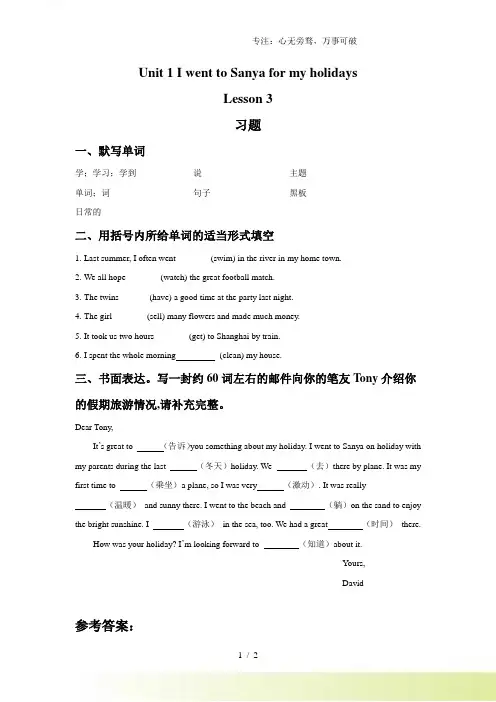
Unit 1 I went to Sanya for my holidaysLesson 3习题一、默写单词学;学习;学到_______ 说_____________ 主题______________单词;词_____________ 句子___________ 黑板_________________日常的____________二、用括号内所给单词的适当形式填空st summer, I often went _______ (swim) in the river in my home town.2.We all hope _______ (watch) the great football match.3.The twins ______ (have) a good time at the party last night.4.The girl _______ (sell) many flowers and made much money.5.It took us two hours _______ (get) to Shanghai by train.6.I spent the whole morning (clean) my house.三、书面表达。
写一封约60词左右的邮件向你的笔友Tony介绍你的假期旅游情况,请补充完整。
Dear Tony,It’s great to (告诉)you something about my holiday. I went to Sanya on holiday with my parents during the last (冬天)holiday. We (去)there by plane. It was my first time to (乘坐)a plane, so I was very (激动). It was really (温暖)and sunny there. I went to the beach and (躺)on the sand to enjoy the bright sunshine. I (游泳)in the sea, too. We had a great (时间)there.How was your holiday? I’m looking forward to (知道)about it.Yours,David参考答案:一、默写单词learn say topicword sentence blackboarddaily二、用括号内所给单词的适当形式填空1. swimming2. to watch3. had4. sold5. to get6.cleaning三、书面表达。
人教精通版六年级下册英语说课稿:Unit1 I went to Sanya for my holid
人教精通版六年级下册英语说课稿:Unit1 I went to Sanya formy holidays Lesson 6一、教学目标1.学习新词汇和短语:film, adventure, theater, actor等;2.学会表达自己的旅游经历,能够使用一般过去时句型描述自己的旅游过程;3.提高听力水平,通过听力练习来培养学生的语感和语音准确性。
二、教学重点1.短语和词汇的掌握;2.一般过去时句型的正确使用。
三、教学难点1.过去式的不规则变化;2.难以表述的语音部分。
四、教学内容与过程1.Warming-up给学生展示几张图片,让学生简单描述图片中的场景,引导学生回顾过去学过的表达旅游经历的句型。
2.Pre-task带着学生一起读一篇关于电影的短文,介绍了发生在全球各地不同电影节的一些趣闻,并学习新词汇和短语。
3.While-task让学生听一段录音,教材中的Lesson 6,图片中描述的是小男孩去电影院看电影的情景,教师可以讲解电影院和电影票等相关的短语和单词,并带着学生一起回答问题。
4.Post-task让学生以Lesson 6里小男孩的经历为基础,回想自己的一个旅游经历,用一般过去时句型描述,并让学生互相交流,加深对一般过去时句型的掌握。
5.Extensive reading让学生拓展阅读,鼓励学生去阅读更多关于电影和电影节的内容,以提高学习兴趣和语感,同时可以在阅读中掌握更多单词和短语。
五、教学总结通过学习Lesson 6,学生既学习了词汇和短语,又掌握了一般过去时对于表述自己旅游经历等内容非常有用。
在教学过程中,教师需要多采用听力和交流的方式来培养学生的口语表达能力和听力水平。
同时,让学生在课外拓展阅读可以增加学习兴趣,反复练习也是帮助学生巩固所学知识的方法之一。
六年级下册英语教案 Unit 1 I went to Sanya for my holidays 第
六年级下册英语教案 Unit 1 I went to Sanya for my holidays第一课时人教精通版一、教学目标1.能听、说、读、写 holiday、beach、swim、play、visit、大海、沙滩等词汇;2.能听懂、会说句型 I went to Sanya for my holidays;3.能用日常口语问答和描述自己或他人的度假经历;4.能了解祖国的热门旅游城市——三亚。
二、教学重点1.听、说日常口语;2.学习使用句型 I went to Sanya for my holidays;3.了解重点词汇 holiday、beach、swim、play、visit 等的用法。
三、教学难点1.能用英文描述日常生活中的事件;2.能流利地口语交流。
四、教学准备1.教学PPT;2.音频设备。
五、教学过程1. Warming-up1.Greet the students;2.Ask some students to share their recent holidays and what they did.2. Presentation1.Introduce the target vocabulary through pictures and explanations;2.Play an audio clip for students to listen and repeat;3.Explain the grammar points and play another audio clip of I went to Sanya for my holidays.3. Practice1.In pairs, ask students to talk about their recent holidays using the target vocabulary and sentence structures;2.Select a few pairs to share their stories with the class.4. Production1.Ask students to write a short paragraph about their recent holidays and share with the class orally;2.Provide feedback and correction.5. Summary and Homework1.Summarize the key points of the lesson and clarify any doubts that students may have;2.Assign homework: write a short composition about your dream holiday.六、教学评估1.Evaluate students’ performance during pair work and class presentation;2.Mark students’ homework based on accuracy and appropriateness.七、板书设计Vocabulary Sentence structuresholiday I went to… for my holidaysbeachswimplayvisit八、教学延伸1.Explore famous tourist attractions in Sanya and other places in China;2.Watch a travel documentary or movie in English and discuss it in class.。
人教精通版英语六年级下册unit 1 i went to sanya for my holidays lesson4~lesson6课件
read English
talk in English
speak English
write English
play in English
Language points
• 1.be interested in +Ving 对· · · 感兴趣
• eg.I am interested in playing computer games.
• 大家早上好!我是李燕。让我告诉你们我们 怎样学习英语的 • 三年前我们开始学习英语。我们的英语老师 用很多种方法教我们,因此我们对英语课非 常感兴趣。
• We often sang, danced, chanted and played games. Our teacher usually let us do things by ourselves. We did interesting tasks. • 我们经常唱歌,跳舞,说唱和玩游戏。 我们的老师通常让我们自己做事情。我 们做有趣的任务。
• Sometimes we did role play. We used words and sentences to tell stories. We often worked in pairs and in groups. In groups we always helped each other and learned from each other. We all did a good job! • 有时我们进行角色扮演。我们用单词和 句子讲故事。我们经常两人合作和小组 合作。在小组里,我们总是互相帮助, 互相学习。我们做得都很好!
learn 学习 学到 word 单词,词 a lot of 许多,很多 blackboard 黑板
小学英语六年级下册(人教精通版)Unit1 I went to Sanya for my holidays.(Lesson1)课件
Talk about travel:
Where did you go ...? When did you go ...? Who did you go with? How did you go ...? What did you do there? How is ...? ... ?
Travel Diary>Beijing and Hangzhou
My holiday
I went on a trip with my parents this Spring Festival. We drove there.
Beijing is the capital of China. It’s in the north of China. We ate Beijing Roast Duck and the delicious noodles. And we visited many interesting places, such as the Summer Palace, Beihai Park.
We had a visit to Hangzhou for 2 days. Hangzhou is one of the most beautiful cities in China. It’s in Zhejiang Province, in the east of China. We went to the West Lake and we saw many beautiful lotus and lovely fish in the water.
CHANT
get, got, got up late. do, did, did the dishes. go, went, went shopping. have, had, had great fun. stay, stayed, stayed at home. enjoy, enjoyed, enjoyed the holidays!