
译林版牛津英语8A unit3 grammar
Most short + er adverbs
hard high harder higher
+ est
hardest highest
Adverb Comparative Long more + adverbs quickly more quickly carefully more carefully
more than Amy. Millie has _____flowers _____
Amy has _____flowers _____Millie. than fewer
Comparing their CDs
Kitty has ______________ more CDs than Daniel.
Let’s compare our things with
‘more/fewer/less than…’
Comparing their food
Pet Club
Helping Hands Club
Comparing their pens
Kitty has the most pens of the three.
_____ (fast) than all my other faster classmates. She swims the _________ fastest (fast) in my class.
4. Millie writes quickly ______ (quickly). She writes ____________ more quickly (quickly) than the other students in my class. Millie writes the ______________ most quickly (quickly) of us
________________ any other student in my class.
Greener China Club
Last Name week Millie 72
Comparing trees, points and time
Kitty 68 Daniel 65
Points
Time (hours)
72
2
points
68
1
points
points
65
1.5
Try to finish the sentences.
Comparing two things many (修饰可数名词)
much (修饰不可数名词) more…than (比……多) few (修饰可数名词) fewer less
more
most
fewest least
little (修饰不可数名词) few…than less…than (比……少)
Unit 2 School life Grammar (A&B)
Comparing two animals
Comparing activities
wonderful exciting interesting useful …
…
(more activities)
Comparing their flowers
1. Millie planted__________________ trees than _____________. 2. Daniel _____________ trees of the three. 3. Kitty scored ________ points _________. 4. __________ the fewest points of the three. 5. Daniel spent __________ time than Millie. 6. Kitty ______________________time of all.
翻译下列句子。 1. Sandy喝的水比Simon少。 Sandy drinks less water than Simon. 2. Daniel学的科目比John多。 Daniel studies more subjects than John. 3. Millie的中国朋友比Daniel多。 Millie has more Chinese friends than Daniel.
改错。
least 1. Mr. Smith eats the fewest beef. the fewest 2. Tom has least sheep of them. 3. Mary has the more bread than her
classmate.
less 4. The students in China have little free time than those in the UK. fewer 5. Cindy has less friends in his new school than in his old school.
all.
1. come first/second /third first, second, third 作副词用 2. She draws better than any other student in my class. any 指任何一个, 名词student用单数 = She draws better than the other students in my class.
4. 李雷是我们班跳的最远的。 Li Lei jumps the __________ farthest in my class. =Li Lei jumps faster _____ than the other students in my class. ________________ =Li Lei jumps _____ faster than
Helping Hands Club
Who has the … of all?
Greener China Club
LastName week
Millie
Kitty
Daniel
72
Points Time (hours) 72 2
points
68
68 1
65
65
points
points
1.5
Try to finish the sentences.
Daniel has _____________ fewer CDs than Kitty.
Comparing their juice
Sandy
Simon
Sandy _________________________Simon. has more orange juice than
less orange juice ____Sandy. Simon has ____ than
Look at the table below and complete the sentences.
Subjects Clubs Free time each day Nancy 6 3 4 hours John 8 2 3 hours Daniel 12 4 1 hour
1. John studies _____ more subjects than Nancy,
Superlative most + most quickly most carefully
Adverb
Comparative Superlative replace the word
Irregular replace the adverbs word
well badly far
better best worse worst further/father furthest/farthest
Sandy came second in the race. She
ran faster than Millie.
Amy came first in the race. She ran
the fastest.
We form comparative and superlative adverbs like this:
Complete the sentences with the
correct forms of the words in brackets. 1. Sandy draws _____ well (well). She draws _____ better (well) than any other student in my class. She draws ____ best (well) of us all.
Comparative and superlative adverbs We can form comparative and superlative adverbs in the same way we form comparative and superlative adjectives.
Millie came third in the race. She ran fast.
2. David jumps ____ high (high). He jumps _______ higher (high) than any other of my classmates. He jumps the _________ highest (high) in my class.
3. Amy swims ____ fast (fast). She swims
but he studies ______ fewer subjects than me. I
最新牛津译林初中八年级英语上册 Unit 3 A day out Grammar教案
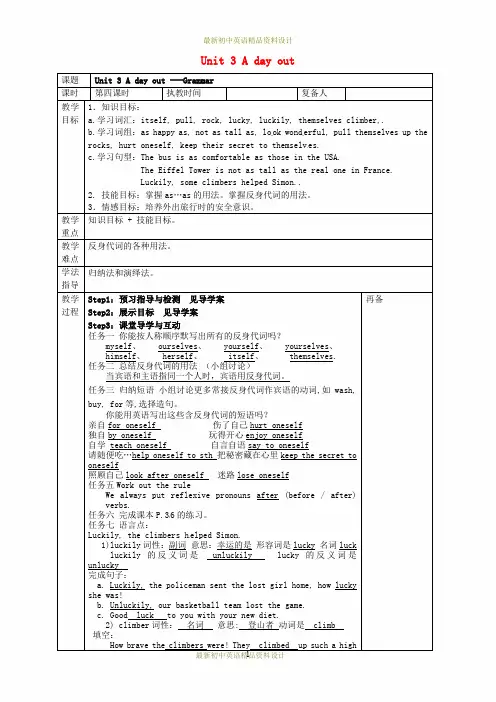
Unit 3 A day out课题Unit 3 A day out ---Grammar课时第四课时执教时间复备人教学目标1.知识目标:a.学习词汇:itself, pull, rock, lucky, luckily, themselves climber,.b.学习词组:as happy as, not as tall as, lo ok wond erful, pull themselves up the rocks, hurt oneself, keep their secret to themselv es.c.学习句型:The bus is as comfortable as those in the USA.The Eiffel Tower is not as tall as the real one in France.Luckily, some climbers helped Simon..2. 技能目标:掌握as…as的用法。
掌握反身代词的用法。
3.情感目标:培养外出旅行时的安全意识。
教学重点知识目标 + 技能目标。
教学难点反身代词的各种用法。
学法指导归纳法和演绎法。
教学过程Step1:预习指导与检测见导学案Step2:展示目标见导学案Step3:课堂导学与互动任务一你能按人称顺序默写出所有的反身代词吗?myself、 ourselves、 yourself、 yourselves、himself、 herself、 itself、 themselves.任务二总结反身代词的用法(小组讨论)当宾语和主语指同一个人时,宾语用反身代词。
任务三归纳短语小组讨论更多常接反身代词作宾语的动词,如wash, buy, for等,选择造句。
你能用英语写出这些含反身代词的短语吗?亲自for oneself 伤了自己hurt oneself独自by oneself 玩得开心enjoy oneself自学 teach oneself 自言自语say to oneself请随便吃…help oneself to sth 把秘密藏在心里keep the secret to oneself照顾自己look after oneself 迷路lose oneself任务五Work out the ruleWe always put reflexive pronouns after (before / after)verbs.任务六完成课本P.36的练习。
英语牛津译林八上Unit3教案(全单元)
英语牛津译林八上Unit 3:教案(全单元)8A Unit 3全部教案Warm-up activities1 Review some keywords and phrases such as ‘exercise’,’climb’,’keep fit’ and‘enjoy’. Ask students to look at the pictures and read the conversation between Eddie and Hobo.2 Try to elicit from students the funny aspects of the comic strip. Allow students to express their feelings.Ask two more able students to role-play the conversation in front of the class.*********************************************Presentation1 Divide the class into groups of three. Set strict time limit of 1-2 minutes. Each student in a group reads one of the postcards in Part A. Ask students to underline the names of places mentioned in the postcard and add the names of the city and the country.2 Encourage each student to take turns to explain the postcard to the other studentsin the group. Then students match the pictures to the text on the postcards on their own. Check answers in class.3 Ask students to do Part B on their own, and then check answers with their partners. Check answers in class. Elicit sentences from students such as The Opera House isin Sydney, Australia.Language pointsExercise, climb the hill, need to do, keep fit, come on, enjoy ourselves, take sb. to swh. , what happened there, the famous Harbour Bridge, the Opera House, the River Seine, the White House,Homework1 Learn the language points by heart.2 一课三练P.253 Preview the Reading Part.****************************************************Revision1 Review key vocabulary according to the general ability of the class. Presentation (Reading A)1 Show the pictures of the World Park in Beijing. Elicit the names of the places or building.2 Explain to students the context of the letter. Ask Who’s writing the letter? Who’s Linda? Who’s she writing to?3 Read the letter to the class while students follow in their books. Try to read with expression.4 Divide the class into groups of three and allocate one part to each group. Ask them to find adj., verbs or phrases in the letter, which describe how Linda felt that day. They can either underline the words they do not know or write them on a piece of paper. Then go through the words students have underlined.5 Ask students in each group to go through the three sections in Linda’s letter and discuss the different feelings expressed in it.3 Ask students to write a schedule of the day out indicating places and movements only. Ask them to list the key words.6 Check students’ understanding. Ask comprehension questions.**********************************************Presentation (Reading B)1 Ask students to read the conversation on their own.2 Ask students to replace the underlined phrase with the correct words. Encourage less able students to find the words in the letter on page 36&37.3 Ask students to compare answers in pairs. Then ask two students to read out the conversation in class to check the correct answers.4 Ask students to write the list of new words and definitions in their vocabulary record books.5 Divide the class into pairs and ask them to read the conversation.**********************************************Presentation (Reading C)1 Do Part C as a class competition.2 Ask students to close their books . Then read the sentences at random one at a time. Write them on the Bb only one at a time. Make it clear that students raise their hands when they are ready to answer.3 Ask students to correct the false sentences. Allow less able students to open their books and find the correct information.4 Talk to students about a home page to focus their attention on Part C2. Then ask them to sequence the pictures on Daniel’s home page on their own.5 Check answers as a whole class activity.6 Ask students if there are any disagreements. Encourage them to explain why they have selected a certain sequence in order to identify reasons for mistakes. Language points (Part A)Invite sb. to do, at the beginning, get on a coach, be boring, on the highway, feel sick, most of the trip, arrive at, be made of metal, in front of, places of interest, from all over the world, the real ones in Egypt, an amazing day, join in, teach himself, a home page, for everyone to look atLanguage points (Part B)Travel from one place to another, movement of cars, the main road, come up from your stomach, the tall metal building, the old stone buildingLanguage points (Part C)It takes sb. time to doHomework1 Learn the language points by heart.2 一课三练P.26-273 Preview the Vocabulary Part.****************************************************** Presentation (Vocabulary)1 Part A is a recognition task asking students to identify the English names of popular places of interest in Beijing. Bring in photos of these places.2 Explain the context of the tasks. Ask students to study the pictures and words.2 Ask students to check answers with a partner. Then check the correct answers with the whole class by asking individual students to read out the sentences.3 Part B is a problem-solving task and students need to use their existing knowledge of Beijing to do it. Bring in a map of Beijing.4 Revise means of transport by asking students how they go to school or work.5 Ask students to do the task in pairs. Then ask students in a pair to compare their answers with another pair. Then ask students to take turns to read the sentences aloud to check the correct answers.Language pointsThe Monument to the People’s heroes, the red maple leaves, walk slowly around the big lake, feel the beauty of…, the names of the transport, more than an hour. Homework1 Learn the language points by heart.2 一课三练P.283 Preview the Grammar Part.************************************************Presentation (Grammar Part A)1 Elicit from students the context illustrated in the picture.Focus students’ attention on the trip and how the Class 1, Grade 8 students felt at the time. E.g., How was the trip? (boring, too long) Then ask them to form sentences with the keywords and write them on the Bb. E.g., The trip was boring. It was too long. Ask them to join the two ideas in one sentence.2 Ask students to list other similar ideas about the journey using ‘and’.3 Ask students to combine the two contrasting ideas--- of a boring trip on the coach and a wonderful day. Ask them when we use ‘and’ and ‘but’ to elicit the rulers.4 Ask students to combine the two options.5 Elicit a few sentences from students’ own experiences, focus on the sentences with the same subjects and verbs.6 This is a deductive learning activity. Encourage students to work it out as a problem-solving task following a set sequence of deduction. Students should be able to work out the correct joining word and also which words to delete by applying rules on Page 41.7 Elicit feedback from the class. Ask students to read out their new sentences. The others listen carefully and express agreeme nt or disagreement. If there’s any disagreement, encourage students to explain their reasons to help them focus on the different details of the rule.********************************************Presentation (Grammar Part B)1 Read the sample sentences. As k students to identify the verb and the ‘to’-infinitive in each sentences.2 Elicit other verbs that are usually used with ‘to’-infinitive. Give them the extra examples listed on page 43.3 Ask students to complete ‘Work out the rule!’ at the bottom of the page. For less able students, tell them to go through the example sentences and the explanations again.4 Ask students to complete the conversation in pairs. They should make sense of the sentences before they select a verb. Remind less able students that they need to use ‘to’-infinitives in the conversation.6 Ask students to read the conversation in pairs. Ask a pair of more able students to read out the conversation to the class.**************************************************Presentation (Grammar Part C)1 Write down some sentences containing reflexive pronouns. You can use the following examples:* I fell over and hurt myself.* My baby sister can feed herself.* My cat cleans itself every day.* We found ourselves in the centre of the city.2 Underline the reflexive pronouns in the sentences. Explain the use of reflexive pronouns. Tell them we use them when the subject and the object are the same person or thing.3 Explain the difference between reflexive and personal pronouns by giving some examples.4 Go through the table. Make sure students are able to distinguish between the singular and plural forms.5 Write some more verbs, e.g., ‘teach’, ‘give’, ‘buy…for’,’ look after’,etc.6 Ask students to complete ‘Work out the rule!’ at the bottom of the page.7 Explain the context and tell students that they need to find out Linda and Simon’s secret. Ask students to read the cartoon story first without working out the correct reflexive pronouns. Check the understanding of the vocabulary.8 Then ask students to go through the story again and work out the correct reflexive pronoun for each blank.9 Ask more able students to read out the speech bubbles in sequence. The rest of the class should listen carefully and check their answers.Language pointsDecide to do, prepare to do, see the sunset, take some photos of it,climb the rocks, hide-and-seek, pull himself up, luckily, do not tell anybody about this, keep their secret to themselvesHomework1 Learn the language points by heart.2 一课三练P.29-303 Preview the Integrated skills Part.************************************************Presentation (Integrated skills A)1 Talk to students about different school events. Elicit from students names of such events, e.g., a sports day, a funny day, a school fair, etc.2 Set the context of organizing sports, music, drama or any other events involving competition.3 Briefly review language required for a schedule using your students’ own experience. Use information based on the school. Write some details on the Bb.4 Read the poster in pairs. Ask some questions to find out the main points, e.g. , What’s it about? Who is it about? What will happen? Where will it happen? When?4 Ask students to look at Kitty’s notes and complete as much of the schedule as possible on their own. Encourage them to find the answers in the poster and underline them.5 Play the recording for Part A2 and ask students to complete the rest of the notes on their own.Play the recording again so that Ss are able to check, confirm or change their initial responses.6 Ask more able student to read the completed notes to the whole class to check answers .7 Present Part 3 as a quiz reading the sentences one by one. Ask more able student to rewrite the false statements with the correct details.Presentation (Integrated skills B)1 Ask students to practice the conversation in pairs and then change roles.2 Close the books and listen to me while I read the conversation. Ask students to repeat the sentences as they hear them.3 Encourage Ss to memorize the sentences. Ask them to pretend they are talking on the phone.4 Ask Ss to work in pairs and use the conversation as a model to make suggestions about visiting a place, express their opinions and make arrangements.Language pointsTh e final of…, take place, cheer for our team, with your support, we will win,half-time, presentation of cup and medals, per person, cost of the trip, over an hour, Shall we go to the Great Wall?, I’m afraid…, Why don’t we…?, play hide-and-seekHomework1 Learn the language points by heart.2 一课三练P.313 Preview the Study skills, Main task & Checkout Part.****************************************************** Presentation (Study skills)1 Make Ss aware of the difference between facts and opinions. Ask more able students what is a fact and what is opinion.2 Ask students to read the leaflet about the World Park.3 When they are comparing their answers, ask them to underline the words which express opinions and personal feelings.Language points (Study skills)467,000 square metres in areaPresentation (Main task)1 Introduce the topic of planning a day out. Ask Ss to bring in brochures of local places which they would like to visit.2 Elicit from Ss the need for accuracy in terms of times, dates, transport, places and types of activities.3 Remind students the context of this section. Go through the plan in Part A and point out the information which Kitty and Daniel want to include in the invitation letter.4 Tell Ss that the model plan prepares them for writing an invitation letter with their own information and details.5 Ask students to go through kitty and Daniel’s letter quickly and complete it on their own.6 Direct Ss’ attention to the different parts of the letter. Ask students to cover the prompts on the left. Ask them to match them with the corresponding parts in kitty and Daniel’s letter.7 Ask students to write a rough draft using the plans they have prepared in Part B. Language points (Main task)Is coming to visit you, all the way to…,************************************************Presentation (Checkout)1 Revise the use of joining words, reflexive pronouns and verbs +to infinitives.2 Ask students to read through the conversation and complete the sentences.3 Check the correct answers with the whole class and tell them to write their scores in the paw.4 Ask Ss to look at the pictures in Part B and explain the context. Ss then write the names of the places on their own.Language points (Checkout)Planned to go, pack my bag instead, play badly, shuttle bus, go climbing on rocks Homework1 Learn the language points by heart.2 一课三练P.32-343 Preview the Unit 4.。
译林版(2024)Unit 3 第3课时 Grammar同步课件2024-2025学年七年级英语上册
Learn the grammar to improve the accuracy of making a sentence.
How to find the difference between the similar knowledge points.
Revision
teach
音 / tiːtʃ / 义 vt.& vi.教(课程),讲授 形 -er,teacher 例 This is Mr Wu. He teaches English.
音 / tiːm / 义 n.队;组
team
例 I often play football with my friends in the school football team.
great
grass
big
hall
behind
who
pen
happy
people
board
about
club
放在中间,要和后面的元音拼
teacher
winter
visit
dining
study
field
class great hall
cookie sugar behind
back big who
pen board
shows.
Lead-in
Words
Grammar Summary
人称代词金字塔
I
I am the
King.
You
He/She/It
We/You/They
人称代词金字塔
You are Monkey King.
You
You are ... Monkey King as well!
Unit 3 第3课时 Grammar-八年级英语下册(牛津译林版)

in brackets.
I __w__a_s___ (be) in Hainan last month. Some of our classmates __h_a_s_n_’_t_b_e_e_n___ (not be) to Hainan yet.
I _h_a_v_e__li_v_e_d__ (live) in Sunshine Town since I was born. Daniel ___li_v_e_d___ (live) in Nanjing in 2007.
I
(2)
_h_a_v_e_s_e_e_n_
never
so
many
wonderful pictures before.
C
Complete their conversation with the correct forms of the words
in brackets.
be buy read return see show
I ___w_r_o_t_e___ (write) an email to my friend yesterday. Daniel _h_a_s_a_l_r_e_a_d_y_w__r_it_t_en__ (write/already) two emails.
B
Help them complete the sentences with the correct forms of the words
C
Complete their conversation with the correct forms of the words
in brackets.
Millie: (5) __D_i_d_y_o_u__l_ik_e__(you/like) it?
译林牛津版英语8AUnit3教材分析及全单元教案

译林牛津8AUnit3教材分析一、教材分析本单元的主要话题是度假旅游。
开篇通过Eddie和Hobo这两个卡通人物妙趣横生的对话,引出“爬山”这一旅游方式,为后面的主题讨论埋下伏笔;随后介绍了国外一些著名的旅游景点,引出了本单元的主要话题。
阅读部分向学生介绍了私人信件的书写方式,信中非正式的语言描写了Linda去北京世界公园旅游的一次经历,并表达了旅游之后的感受。
词汇部分介绍了北京的名胜以及在那里可以进行的活动,还介绍了到北京名胜的交通方式。
语法部分包括三个内容,通过故事的发展呈现出来,A部分通过讨论学生去的游览地方,介绍了and, but和or的用法;B部分在关于去南山郊游的对话中介绍了带to的不定式的用法;C部分是一个漫画故事,讲述了去南山游览的过程中发生的一件事,在此语境中学习反身代词的用法。
综合技能部分展示了一份学校某一次活动的海报,海报后还设置了一个时间表,提供了时间和对应的活动安排,学生可以来检查他们从阅读文章和听力材料中获取的信息是否正确,还可以运用表示提建议和作安排的语言来组织一次活动。
学习技能部分介绍了事实与观点的区别,要让学生了解说服他人要会运用语言来表达自己的观点,在广告、新闻、信件以及报告中常把事实和观点结合起来。
中心任务部分主要围绕制定旅游计划展开,让学生根据相关信息制定旅游计划。
检测部分主要检查学生对所学语法内容的理解和运用情况。
二、总体目标通过讨论度假旅游及相关的故事,即学习and, but和or这些连词的用法及不定式和反身代词的用法,又了解国内外一些著名旅游景点,特别是北京的名胜古迹,培养学生热爱自然、热爱祖国的情怀。
同时,通过词汇的学习、综合技能的训练、学习技能的了解和任务的完成,使学生在各个方面的能力得以提高。
三、教学重点难点A: 重点1、学习制定和交流自己的假期旅游计划、2、学会使用and, but和or理解句子;3、正确使用不定式;4、掌握反身代词的用法。
B: 难点1、动词不定式的用法;2、写信邀请朋友外出旅游。
(牛津译林版)八年级上册教案:unit3Grammar

电子备课教案模板教学内容8A,Unit3 Grammar 主备人授课人集体备课成员教学目标1. To grasp the usage of “as…as”2.To learn to use reflexive pronouns教学重点To grasp the usage of “as…as” and reflexive pronouns 教学难点To learn to use reflexive pronouns突破难点主要策略Group work, pair work课前准备PowerPoint, pictures, etc.集体研讨课文内容主备初稿集体讨论意见个性化内容Step1 Lead in1.Showing you some picturesI would like to show you some pictures.T: Are they happy?S: Yes. They enjoyed themselves.T: Where can we see the photos?S: On Daniel’s ho me page.2. Get the students to talk about thepictures above. Then elicit the sentences‘They enjoyed themselves.’Get the student to feel the differencesbetween the following sentences:He taught himself. (‘He’ and‘Himself’ is the same person.)He tau ght him. (‘He’ is one person.‘Him’ is another. )In this way, we can help the students tounderstand that we use reflexive pronounswhen the subject and the object are the sameperson.STEP 2 Spellings of reflexive pronounsSingularPlural TheFirstPersonmyself ourselvesThe Second PersonyourselfyourselvesThe Third Person himselfthemselvesherselfitselfGet the students to complete the exercises on Page 36. Check the answers in pairs and then check the answers together.Get the students to read and act out the dialogue.STEP 3 Other ways to use reflexive pronounsFor stronger class, it is good for the teacher to do some summary here.作表语Mary is notquite herselftoday.玛丽今天身体不好.That brave boyin the story wasmyself.故事里那个勇敢的男孩就是我本人.作宾语He cuthimself.他割伤了自己.Be careful, oryou will hurtyourself.小心, 否则你会伤着自己.She has tolook afterherself.她不得不自己照顾自己.I looked atmyself in themirror.我照镜子.作同位语Kate herselfcooked the mealyesterday.昨天凯特自己烧了饭.They will come here themselves.他们将亲自到这儿来.You may go and ask the teacher himself.你可以去问老师本人.I myself did the work.我亲自做的这件事.习惯用法Helpyourself! Helpyourselves你随便吃!你们随便吃!STEP 4 Doing some additional exercises1. Don’t tell me the answer. I’ll work out the problem myself.2. She is too young to look after herself.3. Help yourself/yourselves to some meat, please.4. Lei Feng was always ready to help others, he never thought of himself.5. It’s a new knife. Be careful not to cut yourself.6. It’s easy, so you should learn how to teach yourself/yourselves.7. I didn’t do it for them. They did it themselves.8. The workers just made the metal tower all by themselves.9. We need your help because we can’t finish the work on time ourselves.10. Can you work out the physics problems yourself/yourselves?STEP 5 HomeworkMake summaries about the grammar items in your own ways.Finish off the exercises in the Handbook小四号宋体,单倍行距,首行缩进2字符。
牛津译林版八年级英语上册Unit 3 Grammar 示范课教学设计
学习理解之感知与注意
效果评价
观察学生对问题的回答反馈,了解学生对视频内容的感知情况。
环节设计意图:引起学生兴趣,激活已知,引出主题,为本节课的语法知识学习做铺垫。
环节二:创设情景,学习as… as…,not as/so… as的用法。(10 mins)
引导学生通过自主探究的方式,总结、归纳as…as…,not as/so…as…的含义和用法。
11.Students fill in the blanks.
12.Studentsobserve and work out the rule.
活动层次
学习理解之感知与注意、获取与梳理、概括与整合
效果评价
通过学生作答的情况,了解学生对反身代词的认识、理解情况。
环节设计意图:引导学生在语境中识别并理解反身代词的含义和用法。
Unit 3A dayout
Period 4 Grammar
一、教学内容分析
本节课是本单元的语法课。主要内容包括同级比较as...as/ not as…as/ not so…as用法以及反身代词的构成及其用法。
二、学情分析
对于八年级的学生来说,他们已经在之前的学习中,了解了形容词和副词的比较级以及最高级,但对原级比较as…as和反身代词的用法缺乏整体认知。
2. Previewintegrated skills.
8.Studentsread andcompletethe sentences.
9.Students read and complete the passage.
活动层次
应用实践之内化与运用
效果评价
观察学生的作答情况,了解学生对所学语法知识的理解以及运用情况。
环节设计意图:巩固所学新知的同时,为后续活动提供情境。
牛津译林版英语八年级上册8AUnit3短语归纳及默写纸
8AUnit3词组讲义Welcome to the unit1.爬山climb a hill2.需要锻炼并保持健康need to exercise and keep healthy / fit做早操do morning exercises 做更多运动do more exercise3.玩得高兴enjoy oneself = have a good time= have fun4.打算做某事be going to do sth5.这座山不及真的那么高This hill isn’t as high as a real one.(one替代同类)6.在桥下/沿河乘船旅行take a boat trip under the bridge/ along the river7.经过歌剧院go past the Opera House8.小心,当心take care=look out=be careful9.照顾take care of = look after10.好好地照顾你的母亲take good care of your mother= look after your mother well11.山的顶部the top of the hill12.美国的总统the President of the USA13. 一个带有大花园和许多树的漂亮的建筑物a beautiful building with a big garden and many trees14. 坐在河边咖啡馆里sit in a coffee shop by the river15. 由…制成(看得出原材料)be made of由….制成(看不出原材料) be made from16,桥有多宽/长/重?How wide/long/heavy is the bridge?17.它有90英尺宽It's 90 feet wide. 一座90英尺宽的桥a 90-foot-wide bridge16. 重超过50吨weigh over 50 tons17.桥有多重?Ho w much does the bridge weigh? =What's the weight of the bridge?= How heavy is the bridge? Reading18. 邀请某人做某事invite sb to do sth19. 邀请我参加学校组织的世界公园之旅invite me to join the school trip to the World Park20. 参加运动会join in=take part in the sports meeting21. 加入游泳俱乐部/入党join the Swimming Club/ the party22.太阳在晴朗的蓝天中照耀The sun was shining in a clear blue sky.(shine-shone)23.路上交通繁忙There was a lot of/ much/ heavy traffic on the way.24.有点无聊 a little/ a bit boring25.到达公园(3种) arrive at the park= get to the park=reach the park26.上/下车get on/ off the bus/it get out of the car/ get into the car27.我们所有人都迫不及待地下车.We couldn’t wait to get off the bus.28.迫不及待地做某事/迫不及待要某物can’t wait to do sth./can't wait for sth29.一百多个世界各地景点的模型models of more than a hundred places of interest all over the world30.对...感兴趣show/have interest in (doing) sth31.变得兴奋become excited32.金门大桥的模型看起来就像家乡的那座一样棒。
Unit 3 Grammar 课件 2022-2023学年牛津译林版八年级英语下册
weDeok ythoeureli.ke
Millie: (5)__________ (you/like) it?
Simon: Oh yes. I (6h)a_d____ (have) a great time therev.isIit(e7)______ (visit) many placdes of inaterest and
Nanjing?
Simon: Yes. I (2)h__a_v_e__b__e_e_n__ (be) there
three times.
Millie: When (3d)i_d__y_o__u__g_o(you/go) there
last?
spe
Simon: Last summer. I n(4t)______(spend) a
3. I __w__a__s (be) in Hainan last month. Some of our classmahtaevse_n__n_o__t_______ (not be) to Hainan ybeet.en
4. I _h__a_v_e_____ (live) in Sunshine Town sinlicveedI was born. Daniel l_i_v_e__ (live) in Nanjing in 2007. d
1. 我上周看过这部电影。
I s_a__w__ this movie last week.
2. 我已经看过这部电影很多次。
I h__a_v_e__s_e_e_n_ this movie many times.
Simon is showing Millie some pictures. Complete his sentences with the correct forms of the words in brackets.
牛津译林版英语八上Unit 3《A day out》(Grammar)说课稿
牛津译林版英语八上Unit 3《A day out》(Grammar)说课稿一. 教材分析《牛津译林版英语八上Unit 3 A day out》是一篇关于旅游的阅读文章。
通过描述作者在一个周末的游玩经历,让学生在阅读中了解不同的旅游地点和活动,同时学习一般过去时的用法。
本节课主要通过阅读理解,语法讲解和口语练习来提高学生的英语水平。
二. 学情分析八年级的学生已经掌握了基本的英语语法知识,对于一般过去时有一定的了解。
他们在阅读理解方面已经有了一定的基础,能够理解并运用一些基本的阅读策略。
但是,他们在口语表达和写作方面还需要进一步提高。
三. 说教学目标1.知识目标:学生能够理解并运用一般过去时;学生能够理解并运用与旅游相关的词汇和短语。
2.能力目标:学生能够通过阅读理解文章,获取信息;学生能够用英语描述自己的旅游经历。
3.情感目标:学生能够激发对旅游的兴趣,提高对英语学习的热情。
四. 说教学重难点1.教学重点:学生能够理解并运用一般过去时;学生能够理解并运用与旅游相关的词汇和短语。
2.教学难点:学生能够用英语描述自己的旅游经历;学生能够运用阅读策略,理解文章内容。
五. 说教学方法与手段在本节课中,我将采用任务型教学法和交际法进行教学。
通过设计各种任务,让学生在实践中学习和运用英语。
同时,我将使用多媒体教学手段,如PPT和视频,来辅助教学,提高学生的学习兴趣。
六. 说教学过程1.导入:通过提问学生是否喜欢旅游,引出本节课的主题。
然后展示一段旅游视频,激发学生的兴趣。
2.阅读理解:学生阅读文章,回答相关问题。
教师引导学生运用阅读策略,理解文章内容。
3.语法讲解:教师讲解一般过去时的用法,让学生通过例句理解并掌握。
4.口语练习:学生分组讨论,用英语描述自己的旅游经历。
教师给予反馈和指导。
5.写作练习:学生根据文章内容和自己的旅游经历,写一篇旅游日记。
教师批改并给予反馈。
6.总结:学生总结本节课所学内容,教师进行点评。